St. John of the Cross is the Spanish mystic who wrote Dark Night of the Soul in the 16th Century.
I take it to mean that St. John was thinking about that time between the Super Bowl and Opening Day of baseball season.
I do not follow professional basketball. I might give one or two March Madness games a look, but I prefer college women’s basketball, because college women still adhere to quaint customs like “passes” and “assists.”
So baseball means a lot to me. When I was growing up in the Upper Arroyo Grande Valley, I wanted to be—sorry, my beloved Gigantes fans, and I hope still my friends—Maury Wills, the Dodger shortstop and base-stealer extraordinaire, when I grew up. My childhood heroes were Koufax and Lincoln.
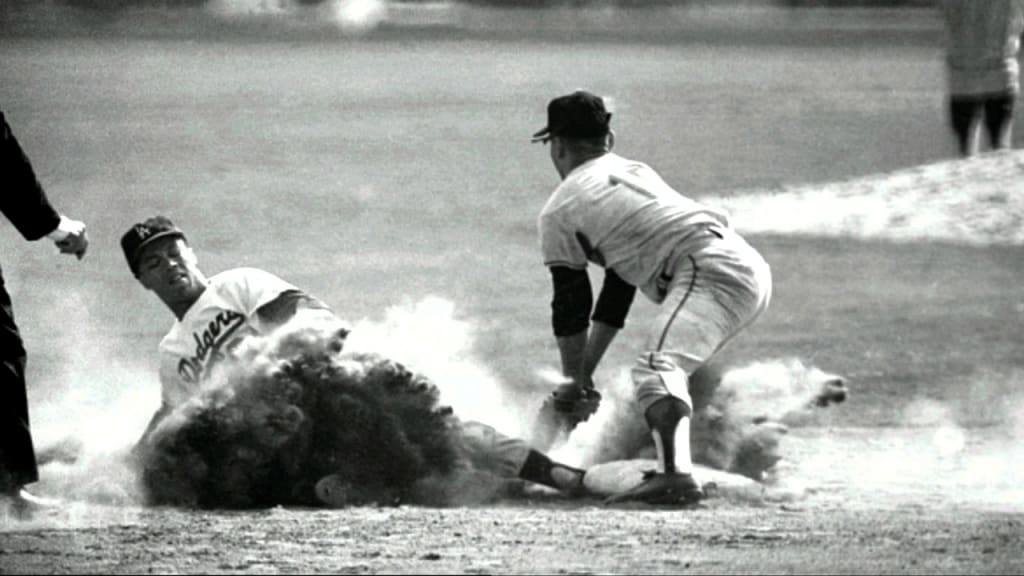
When Sandy retired—his pitching arm had atrophied from years of damage and was markedly shorter than his right arm—we were on a family weekend in Solvang where, years later, I would marry Elizabeth, at Mission Santa Ines—and when I saw the headline inside a newspaper-dispensing basket, it was a punch to the gut. It was almost, but not quite, November 1963.
I have all the stories about Sandy that other Dodger fans have, about how wild he was, how he found his delivery, how he refused to pitch in the Series on a high holy day (my mother, Roman Catholic, a faith that has not been kind to Jews, fell in love with him from that moment), how he finished the ninth in the perfect game with my Dad and I listening and not breathing much, to a radio set atop the kitchen stove.
Nearly as important as his athletic prowess was his grace as a speaker, a teacher, a man, a mensch.
He later moved to Templeton, in my home county, San Luis Obispo. It was nice to know that he was that close to me. If it’s possible to love a man you’ve never met, and it is, then we loved this man.

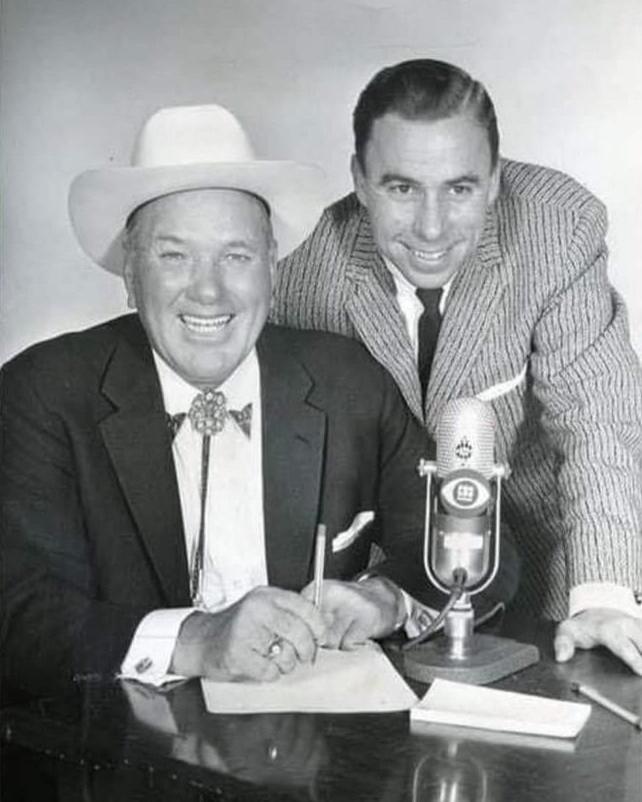
When I was very little, Dad and I used to watch baseball on television together. And his idol Dizzy Dean broadcast the CBS Game of the Week, brought to you by Falstaff Beer, with Pee Wee Reese. Dean incensed English teachers across our great nation by inventing verb conjugations like “He slud into third!” When the game turned into a blowout, he’d sing “The Wabash Cannonball.”
Once, in high school, when something or someone had broken my heart, Dad intuited how troubled I was and stayed home from work at Madonna Construction so we could watch a World Series game together. My Dad was not an easy Dad. He had a volcanic temper and inherited the curse that visited both sides of our family–alcoholism–but baseball was our common ground, the place where we could meet and tell each other, without uttering a word, how much we loved each other.
Vin Scully did the talking for us.
My Dad grew up on the Ozark Plateau during the Great Depression, when shoes were required for school and church, and his baseball idols were the St. Louis Cardinals, the “Gashouse Gang” (the Dean brothers, and some colorful names: Pepper Martin, Spud Davis and Ripper Collins). They were all working-class boys from the South or Southwest. All they did was win five National League pennants and three World Series between 1926 and 1934.
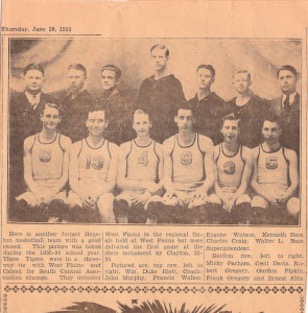
Dad was a tobacco farmer’s son who did like basketball. He’s #4 in the old newspaper clipping, when his team, from tiny Houston, Missouri, was the runner-up in the state championship, losing to a big St. Louis high school. “Uncle Bob passed off to nephew Frank,” the radio announcer said during the game. Dad’s teammate, thanks to the longevity and evident potency of my grandfather—his natural force was unabated, as Exodus says of Moses— was also his nephew. In fact, Frank might’ve been older than Dad.
But I think baseball was Dad’s favorite. “Uncle Bob” was a marvelous athlete: graceful and powerful–I saw him drive the green on a 326-yard hole at Black Lake with a three-wood that was older than Arnold Palmer–and it was his prowess as a second baseman that brought him to Taft Junior College, where he met my Mom. He was also, we discovered to our shock one day at Frank Mello’s ranch in the Edna Valley, an expert horseman. When the Quarter horse Belle threw my big sister, Bob’s little girl, Dad was furious. I am not condoning his behavior, but he vaulted into the saddle and rode Belle into a lather until she nearly sank to her knees.
I learned later that Dad had pretty much grown up on horseback on the Ozark Plateau, where horses were once revered. (The incredible film Winter’s Bone, with a very young Jennifer Lawrence, depicts a far more terrifying place today.) The same’s true of County Wicklow, where my Mom’s ancestors came from.
Dad’s Grandfather Taylor once hit him—hard— in the small of the back with his quirt.
Sit up! he growled. You’re hurtin’ the horse!
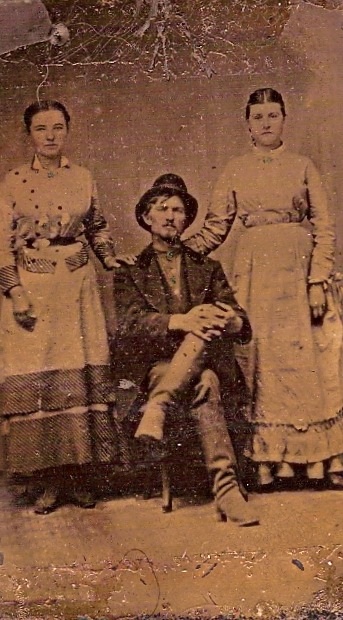
That’s Taylor, in the center, formidable looking in high boots, on a tintype, probably taken in 1880, that was found in a root cellar and returned to my family in the 1970s. His sister-in-law, Mildred, is to the left. His wife, Sallie, the lovely woman to the right, is my great-grandmother. She died relatively young of influenza. Sometimes on their horseback rides, my Dad, a little stunned, would hear Taylor, this tough old cob, begin to cry and softly call out Sallie’s name. My sister is named Sally. I have always loved that name.
Oh, and Belle? She never threw Roberta again.
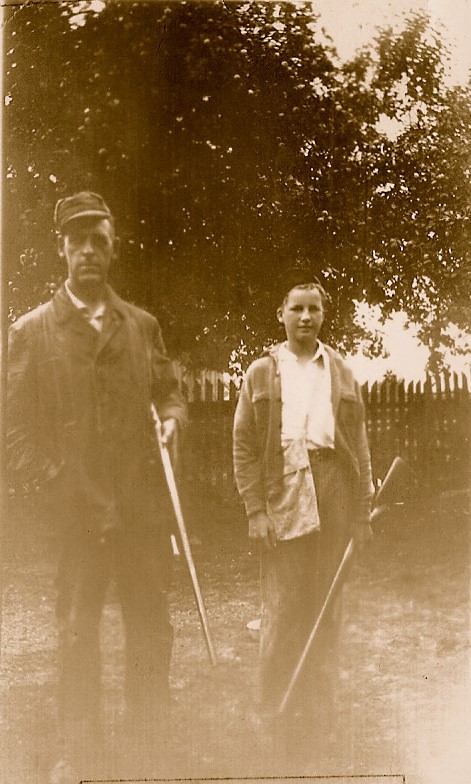
And here’s Dad, twenty-six years before, with his neighbor Barbi Dixon. Dad’s about twelve– with a Winchester Model 12 shotgun, heavy for a twenty-gauge and long-barreled, in a photo taken when the Great Crash was a current event. I do not like hunting. but my Dad—like my father-in-law, Gail, the San Francisco 49er, a teenager in Depression-era Puyallup, Washington— hunted to help feed his family.
When I went hunting with Dad, I discovered that he had mastered shotguns. When he was in his late forties, with me lugging around the long Model 12, made longer by a choke, and field pheasants and chukkars laughing at me, Dad had acquired a beautifully engraved twenty-eight gauge Spanish over-and-under. He had learned, because I was his son, to raise, traverse and fire it so rapidly that I was never sure whether it was his shot or mine that had brought the pheasant down.
Fifty-five years later, I am sure.
The first baseball game we saw together, along with Russ, the man who owned the liquor store that shared the same building as the Fair Oaks Theater (he called me “Sheriff,” because I seldom went anywhere, in 1958, without my Mattel Fanner Fifty pistols in their holsters), was at the Los Angeles Coliseum.
It was the Dodgers against—wouldn’t you know it?—Dad’s team, the St. Louis Cardinals.
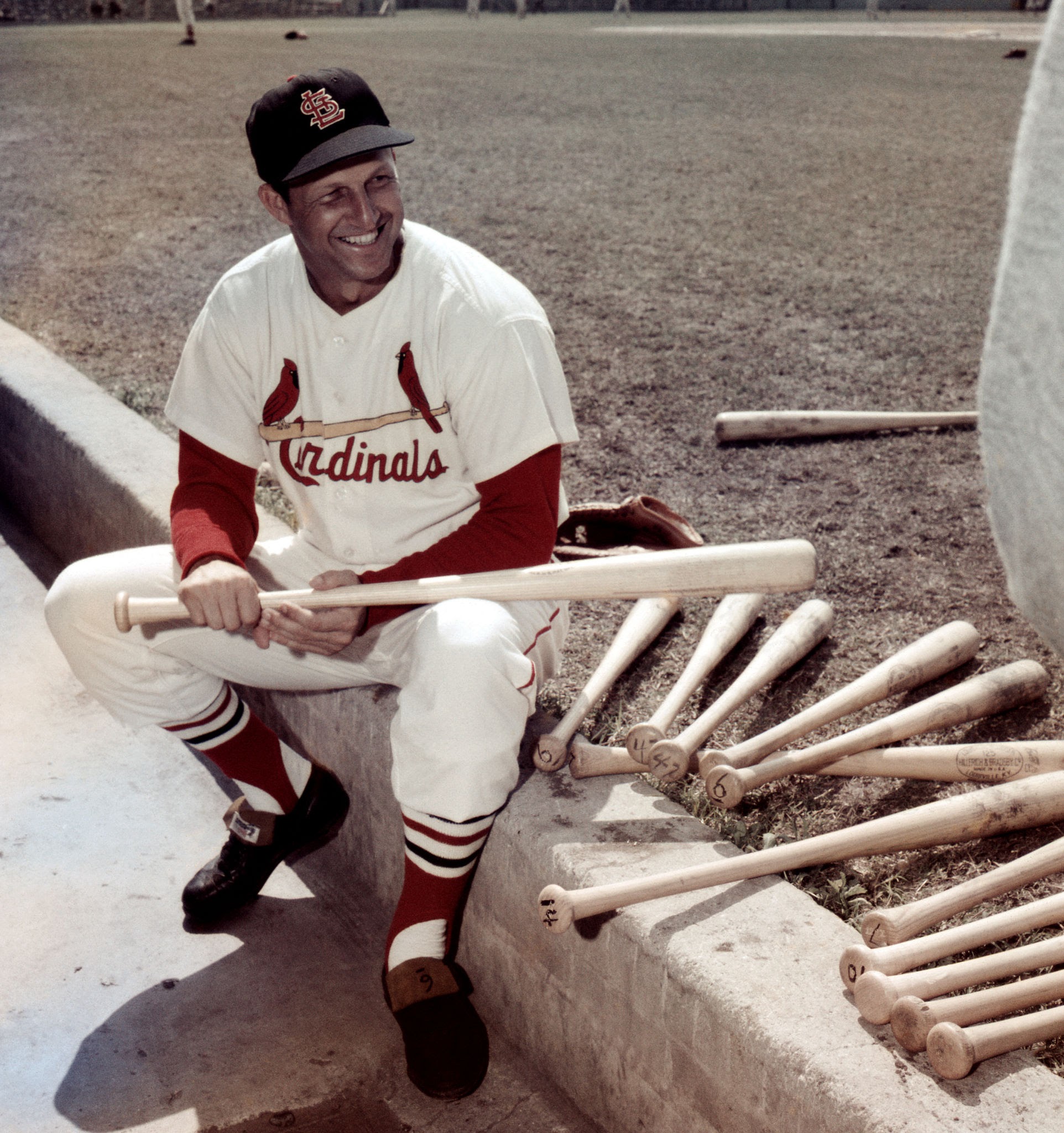
Now that I am seventy-one I realized that, when I was six years old, I saw Stan Musial (below). I wish I remembered that. All I remember is a big frozen lemonade in a conical container, sold by a stadium barker, and falling asleep, my head in Dad’s lap, on the long car trip home.
Now, in the off-seasons, I watch, obsessively, Ken Burns’s Baseball on the MLB Network. I loved showing my AGHS U.S. History kids the segment “Shadow Ball,” about Satchel Paige and Josh Gibson, the Negro Leagues greats. Paige–“with which pitch would you like me to strike you out?” he’d coo down to the opposing batter—started a game for the Kansas City Athletics in 1965, when he was fifty-nine years old. Josh Gibson hit nearly 800 home runs against pitching that was pretty much superior to anything in the 1930s all-white Major Leagues had to offer.
Burns’s series is also where I discovered the team of my father’s childhood, the Gashouse Gang.
A decade later, roughly contemporary to Joe DiMaggio and Ted Williams, Stan Musial became a Cardinal. When I saw him, he’d already taught former Cardinal and brand-new Dodger Wally Moon how to hit “Moon Shots,” towering fly balls over the absurdly high left-field screen at the Coliseum, a prophylactic measure intended to prevent home runs in a stadium that was designed for the 1932 Olympics and, later, Trojan football.
There are, I’ve discovered, four subjects that lend themselves to telling the most impossibly beautiful and moving stories, and they are war, horses, dogs and baseball.
In Burns’s Homeric series, I discovered a Stan Musial fan in the Southern writer Willie Morris, who wrote, among many things, the wonderful book My Dog Skip. The movie version requires at least one box of Kleenex, which ties it, in my mind, with Old Yeller and Warhorse.
This is Morris, on the campus of the University of Mississippi campus at Oxford, a place perhaps haunted by another Southern writer and dog-lover, William Faulkner. (I once read a wonderful novel about Faulkner and the German general Erwin Rommel, a Civil War buff–-this is true-–and a devoted fan of “Stonewall” Jackson. The writer and the future Afrika Korps commander, then a military attache on duty in the United States, got gloriously drunk together and decided to do a midnight tour of the nearby Shiloh battlefield. They somehow survived. In 1862, many Americans didn’t.)

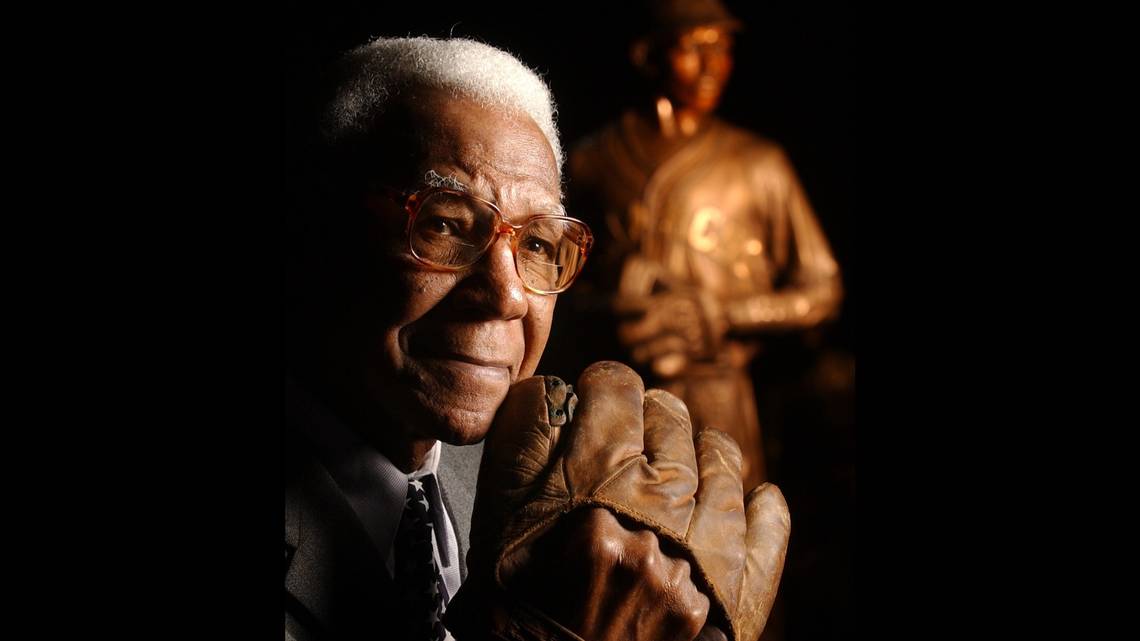
One of the elements that made Burns’s documentary so powerful was the careful choice of commentators. Buck O’Neil, the Negro Leagues player-manager, became my surrogate grandfather. In one of the most shivery moments in the series, O’Neil remembered that he and Satchel, during their playing days, visited a big, barnlike building in—was it Atlanta?—that had been an antebellum slave market. After a long, long silence, Paige turned to O’Neil and said: “I feel like I been here before.”
Another was Willie Morris, from Yazoo, Mississippi, a Cardinals fan. Through some accident in the ether, he discovered a spot at the edge of a family cornfield where he could pick up Cardinals broadcasts on a what I assume was a crystal set. He’d lie down there, with his dog beside him, keeping him warm, and enjoy baseball the way it’s meant to be enjoyed, on the radio, where his writer’s imagination could make Stan Musial–powerful and graceful, like my Dad, but in measures far beyond his–into the hero that Musial was meant to be. I am sure that, somehow in God’s intentions, Sandy Koufax was meant to my hero, too.
 A Work in Progress