
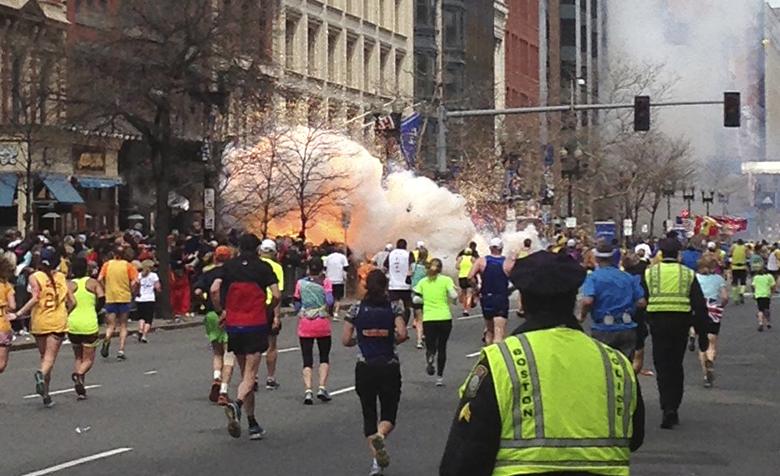
The Boston Marathon was today. It was the tenth anniversary of the bombing. What I remember is that children were killed and some runners lost their legs. But I remember, too, Boston policemen and policewomen running toward the explosion, and the volunteers who came out of the crowd to shepherd victims to ambulances.
The marathon is run every year, with the Covid exceptions, to mark another date in our history that qualifies for the Dickens allusion. The towns of Lexington and Concord are nearby, and on April 19, 1775, 800 British soldiers and marines marched on Lexington to seize a cache of arms reportedly stored there for the use of the American militia, the Minutemen.
The march, made at night, must have been terrifying for the British soldiers, unsophisticated young men for whom military service was the way out from stinking slums and cholera, or, if they were Irish, the way out from starvation.They did not know that Paul Revere and William Dawes were out there, riding ahead of them, to sound the alarm at their approach.
But all along the road, in the dark, they could hear dogs baying and church bells ringing.
When they reached Lexington, they might’ve found the response to the alarms laughable. A motley and very small crew of militia awaited them. What followed was David v. Goliath. Round One to Goliath.
But that was Lexington. These are twin battles—Lexington and Concord—and on the way back to Boston from Concord, the Minutemen ambushed the British and began to winnow them down. Three hundred of the 800 young men come here from an ocean away were casualties— killed, wounded or missing.
I am not a student of the American Revolution. I can tell you the names of several Civil War generals’ horses and I can describe, pretty accurately, the fate of Torpedo Squadron 8 at the Battle of Midway in 1942.
But in 1988, television reminded me of Lexington and Concord in the form of April Morning, a made-for-television film based on the novel by Howard Fast.
It sticks in my mind because James Lee Barrett wrote the script and his son, David, was one of our students at Mission Prep. The film sticks, too, because of its talented cast: Tommy Lee Jones, Robert Urich (if you’re keeping score at home, Jones would have to hang Urich in Lonesome Dove) and Meredith Salenger, the teenaged protagonist in a remarkable Disney movie about the Great Depression, The Journey of Natty Gann.
While April Morning isn’t, in my mind, in the same league as Natty Gann, the other reason it sticks in my mind is this scene, when the British arrive in Lexington. It’s terrifying—the drums contribute–and it reminds us that figures from the 18th century were not faintly comical bewigged men, nor were they submissive women. (I give you Abigail Adams or the appropriately-named Ruth, Salenger’s character, in April Morning as examples. )
Policewomen ran toward the bomb in 2013.
One more point: Confederate volunteers in April 1861 and rioters in January 2021 seemed to believe that they were carrying on the tradition of the Minutemen.
These groups were misinformed and manipulated; demagoguery is a tragic American political tradition.
And the grievances the Minutemen had were not “YOU WILL NOT REPLACE US,” a chant illuminated by the hardware-store Tiki Torches at Charlottesville six years ago. Their grievances, in 1775, make up two-thirds of the next year’s Declaration of Independence.
The thought would’ve been inchoate, but the militia on Lexington Green knew, somehow, that they were there to build a nation, not tear it apart.
 A Work in Progress