
Someone is trying to tell me something and, for once, it’s not the typical condemnatory voice that I’ve lived with for seventy-one years. Today it was affirming. It began to creep up on me when I drove to do some grocery shopping at drove past a Muslim family at Elm Street Park. They had a blanket spread out in the shade and they were eating—men, women with their hair covered, little kids. When I drove back home, the blanket was folded and all of them were standing in a circle and holding hands and, I think, singing. To paraphrase a song by Sting: Muslims love their children, too.
It then dawned on me: Ramadan is over. That didn’t hit me until I got home and remembering my beloved student Leila, a devout Muslim, I got little tears in my eyes. Leila had tears in her eyes when, as part of a school assembly that honored retiring teachers, she presented me with a bouquet of roses. She is compassionate, considerate, respectful and she has a first-rate mind—an engineer’s mind, but one driven by a deeply humanitarian heart.
That was the second international moment. The first came when I saw this version of the !Xhosa wedding song on a South African variant of The Voice. The young woman, named Siki Jo-An, is twenty-five and she’s from Elizabethtown.
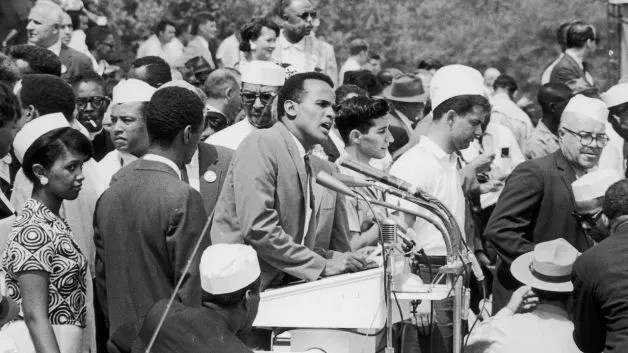
I first heard this song, performed by Miriam Makeba, whose clicks are profound, when I was a little boy on Huasna Road and Mom had both double albums of Harry Belafonte’s concerts at Carnegie Hall. Our cabinet stereo, big as a coffin, also served for the Stones albums I smuggled out of my brother’s bedroom and for my copy of the White Album, which, yes, I did play backward. Paul was dead.
But no albums were played so much as Belafonte’s. I realize now that the man was a fundamental part of my education, along with the braceros who worked the fields just beyond our pasture fence and the food–sopa, sushi, lumpias–that were part of what made growing up in Arroyo Grande so formative for me.
Belafonte’s songs ranged from “Hava Nagela” to “John Henry” to “Sylvie” to “La Bamba.” Since he was Jamaican, perhaps his most famous song endures because of the film Beetlejuice. It’s a marvelous moment.
Maybe it’s because of the braceros, but maybe my favorite song from those albums was his take on “La Bamba.” You can hear Belafonte dancing on the album, but it would be many, many year later, thanks to this video, that I got to see him dance. And, yes, is Spanish is beautiful.
So here’s a Mexican song performed by a Jamaican. Belafonte gave me the education I needed to marvel, sixty years later, at a Muslim family celebrating together, happy together, on the shaded lawn in the Elm Street Park in the town that is my home—and theirs.
Oh, and dinner? Pesto pasta. As American as my collateral ancestor, the president’s aunt, Mildred Washington.
Here are “Mas Que Nada,” from Brazil, by Jazz singer Carol Albert–she gets the song, as do her musicians (the trumpeter is incredible) and backup singers–and “Guantanemara,” from Cuba, by the wonderful Playing for Change people.
And I don’t want to end with even that song. An old American favorite was another South African song written in 1939. It became a Tokens hit in 1961 America. Ladysmith Black Mambazo, “discovered” by Paul Simon in the 1980s, performed the song here, circa 1990, with an a cappella group from London’s East End, the Mint Juleps.
Maestro?
 A Work in Progress