
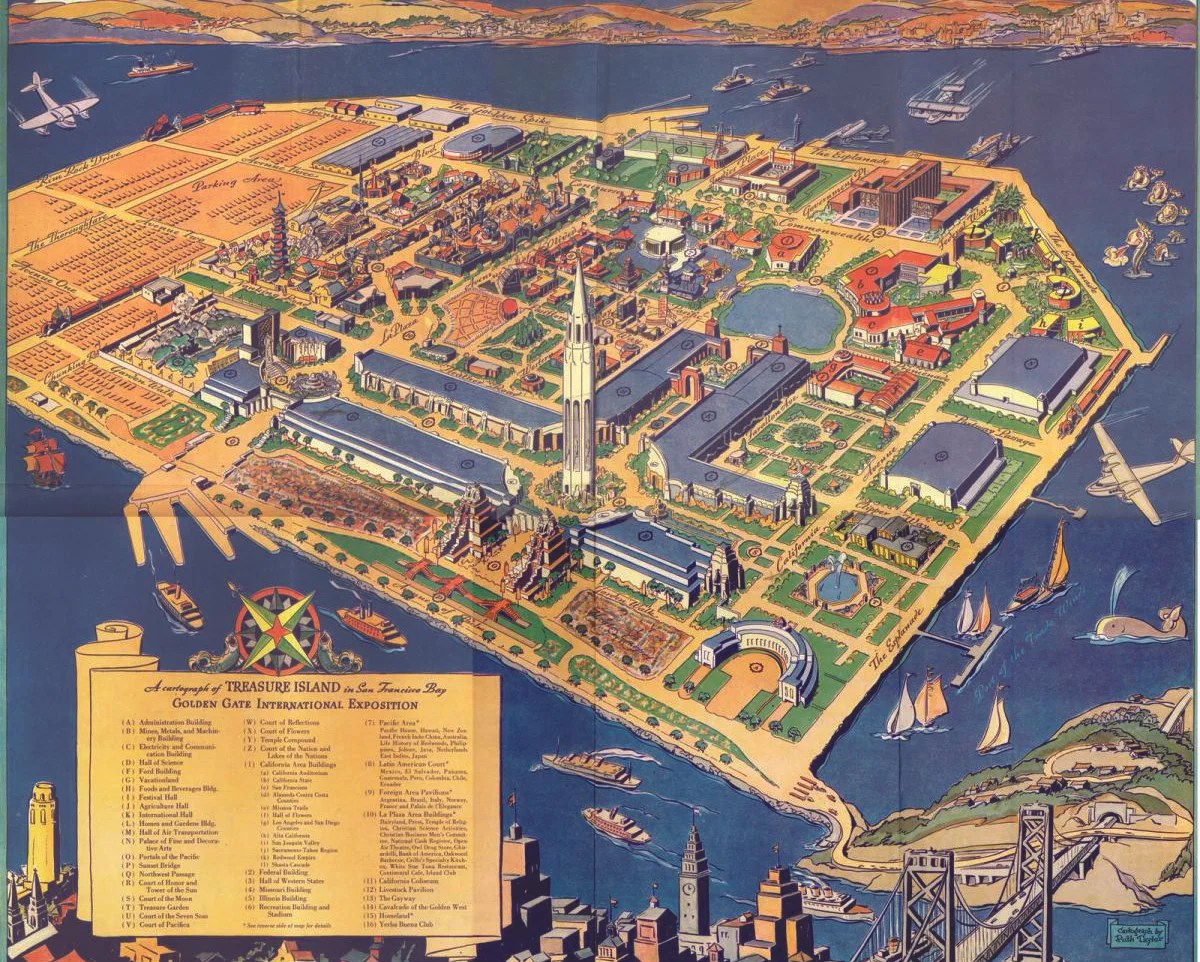
In 1939, San Francisco’s Treasure Island was the site for the Golden Gate Exposition, a showcase dedicated to a world beginning to emerge from the Great Depression. The Exposition was a masterpiece of Art Deco design and, with California comfortably distant from Europe, tinges of optimism must’ve remained awhile; I imagine the fall of France ended all that.
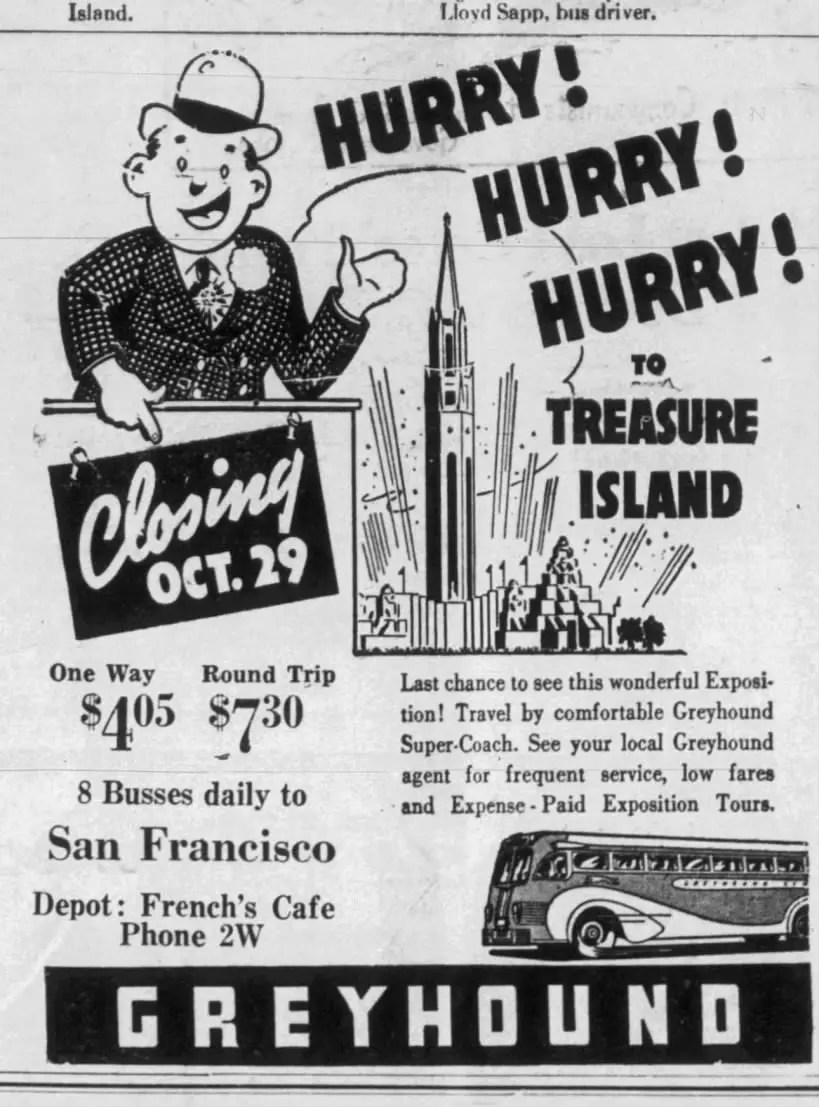
The Exposition even won periodic mention in the little Arroyo Grande Herald-Recorder, including this October 1939 display ad. I think the Greyhound station was in the Olohan Building, whose basement is now home to Klondike Pizza. A Klondike pizza is also good for transient moments of optimism, if I may be allowed to editorialize.
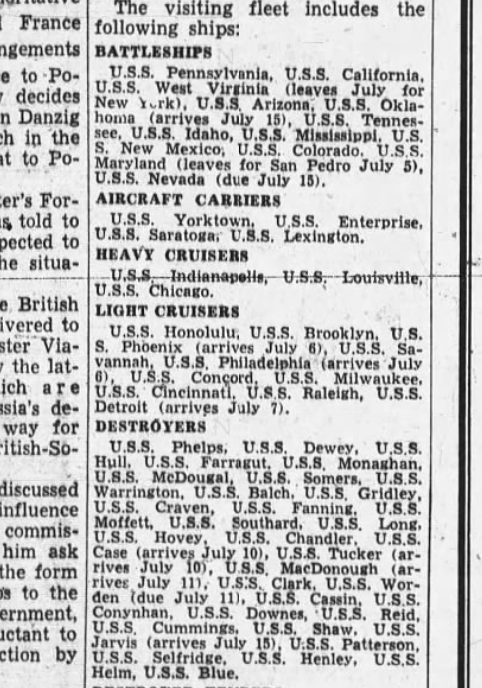
What had to be a highlight of the Exposition came in June and July 1939, when most of the Pacific Fleet, just off maneuvers, sailed into San Francisco Bay for a visit. Many years ago, my wife and my sons and I spent a delightful visit to our favorite city during Fleet Week, when we saw the Blue Angels, sailors from twenty nations, and, on a Muni Bus, a bearded lady (who was very nice) and a man who could do 360s with his dentures. I preferred the visits to the submarine Pompanito and the Liberty Ship Jeremiah O’Brien, but I’m built that way, I guess.
Here’s an article from an Oakland newspaper—with little seeming regard for what we’d call “national security” today— about the ships, and their 40,000 men, headed for the Exposition:
And here, also from British Pathe, is a remarkable video as the fleet arrives, led by battleships, then a light cruiser and finally the preciuus carriers. And then, best of all, happy sailors coming ashore for liberty.
The scale of these ships is hard to imagine, even though they’re relatively small when compared to modern aircraft carriers. A Pennsylvania-class battleship, like the one in the video below, displaced 32,000 tons, was 600 feet long and carried a complement of about 60 officers, 70 Marines and 1,000 enlisted men. These ships were small cities. And small cities need the mail delivered, even in mid-Caribbean. This film is from the early 1930s:
And the battleship in the newsreel—you had to know this was coming—was, of course, USS Arizona, lost with 1100 crew, including two sailors who were raised in Arroyo Grande, on December 7, 1941.
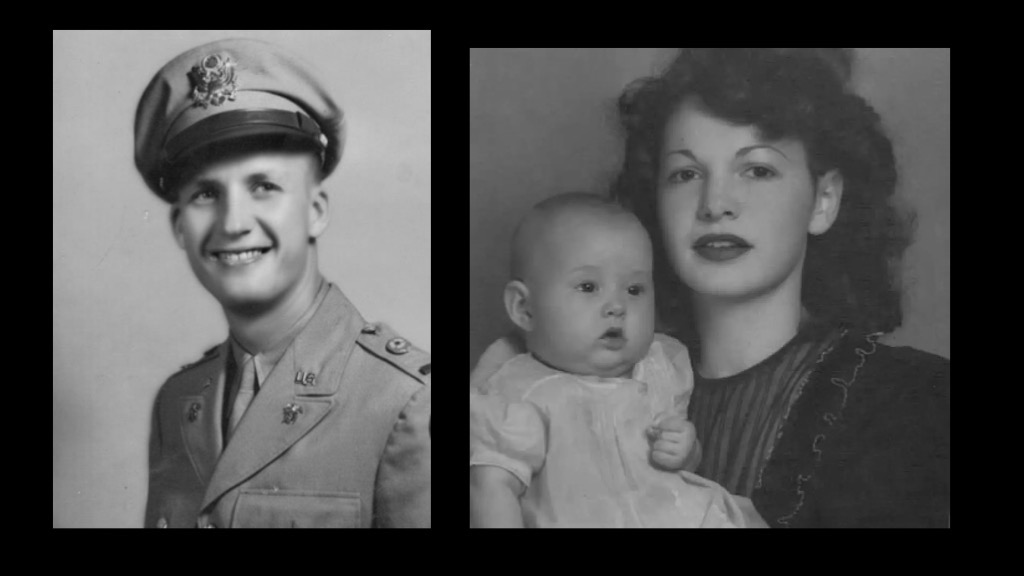
Maybe it’s just me, but I am a devoted fan of American film, and as a cultural barometer, 1939 was a sign of renewed confidence in the same way the Exposition was. My parents began dating that year, when their movie dates might’ve included The Wizard of Oz, Stagecoach, Goodbye Mr. Chips, Ninotchka, Destry Rides Again and Gone With the Wind.
And that brief moment of renewed self-confidence, of hope, is what makes the images of these ships and their young men so poignant to me. These are the fates of some of the ships cited in the Oakland newspaper article above:

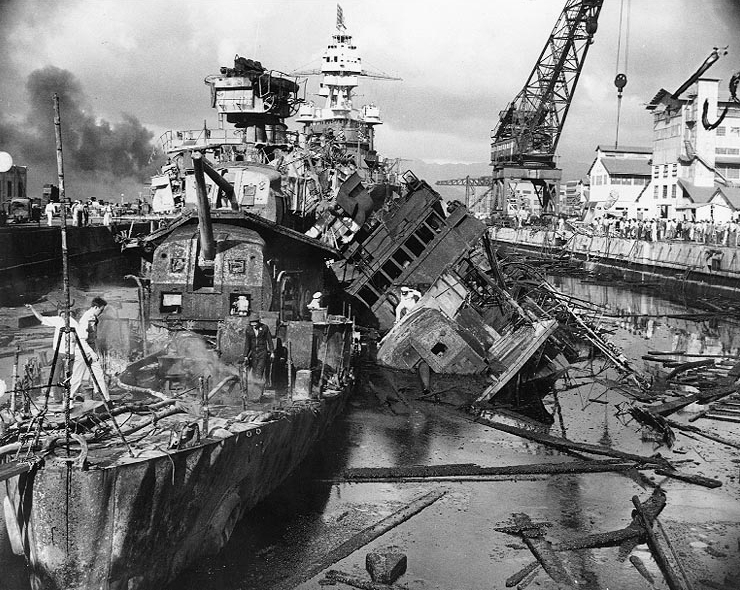
As devastating as the photograph above is, both destroyers were salvaged, rebuilt and returned to duty, as were the damaged battleships. One of them, Nevada, which made a heroic run under attack for the Pearl Harbor exit channel, was, on June 6, 1944, hurling 14-inch shells at the Germans defending the Normandy invasion beaches. Nevada, in fact, was granted the honor of firing the opening salvo that day.
One of my favorite lessons in U.S. History was devoted to the construction of the Oakland Bay Bridge, truly, to steal a term, an engineering marvel. It, and its sister bridge, are emblematic of the way we responded to the Great Depression.
We responded to the shattering of our confidence at Pearl Harbor with new ships and old ships pulled to the surface from Pearl Harbor mud and made new again. Vast fleets of warplanes, tanks, trucks, artillery and small arms, Spam and K-ration Lucky Strikes, a labor force that went to war— a third them women and many of them killed in factory accidents—and over 400,000 young men killed in combat, all of these made up our response.
These things happened because of a generation that, before the war, was dismissed by intellectuals as pleasure-seeking, selfish and shallow. This was my parents’ generation. My parents were hard-working, generous and deeply read. I became a history teacher because of the values they instilled in me.
Learning about the Exposition, in what remains—after a fair amount of European travel (Dublin, London, Edinburgh, Paris, Nice, Amsterdam, Munich, Salzburg, Florence, Venice, Rome) with twenty to forty of my closest teenaged friends, my students—the city I love the most. The Exposition reminded me of my mother and father and their generation. If this was a twilight time in our history, followed by four years of wartime dark, we were still here in the morning.
 A Work in Progress