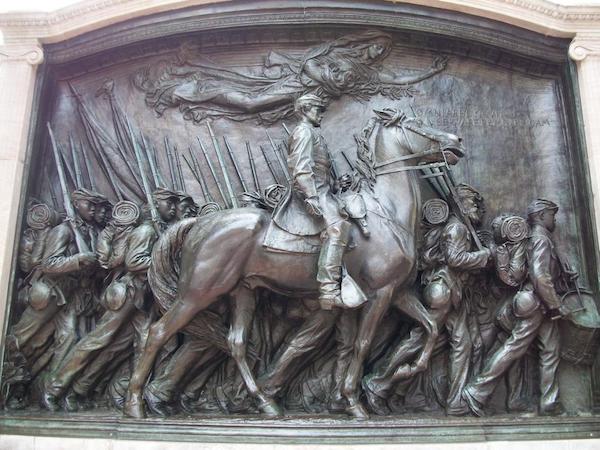
An excerpt from Robert Lowell’s 1960 poem about his artwork, “For the Union Dead:”
…Parking lots luxuriate like civic
sand piles in the heart of Boston.
A girdle of orange, Puritan-pumpkin-colored girders
braces the tingling Statehouse, shakingBottom of Form
over the excavations, as it faces Colonel Shaw
and his bell-cheeked Negro infantry
on St. Gaudens’ shaking Civil War relief,
propped by a plank splint against the garage’s earthquake.
Two months after marching through Boston,
half the regiment was dead;
at the dedication,
William James could almost hear the bronze Negroes breathe.
The monument sticks like a fishbone
in the city’s throat.
Its colonel is as lean
as a compass needle.
He has an angry wrenlike vigilance,
a greyhound’s gentle tautness;
he seems to wince at pleasure
and suffocate for privacy.
He is out of bounds. He rejoices in man’s lovely,
peculiar power to choose life and die—
when he leads his black soldiers to death,
he cannot bend his back.
The 54th leaves Boston in this scene from the film Glory, which remains, in my mind, the finest Civil War film yet made. Frederick Douglass watches from the reviewing stand and, as fine as the soldiers are, it’s the reaction of the Black Americans in the crowd, and Col. Shaw’s reaction at seeing his family, that move me most:
Black troops played roles in the combat careers of two Arroyo Grande settlers. At the December 1864 Battle of Nashville, this old man, Otis Smith, a Huasna Valley farmer, earned the Medal of Honor for seizing the battle flag of the 6th Florida Volunteer Infantry in the Union assault on the Confederate flank atop Shy’s Hill, the high point that guarded the city.

Once Smith had carried the Florida regiment’s position, the rest of the Confederate line crumbled. Their commander, John Bell Hood, ruefully said that he’d never seen an army flee in such disorder. This is a replica of the flag that Smith captured—which would have meant fighting or killing five or six men to get to it. The original, with some corners missing—souvenirs for the men of Smith’s 95th Ohio Volunteer Infantry—is on display in the Florida Museum of History today.
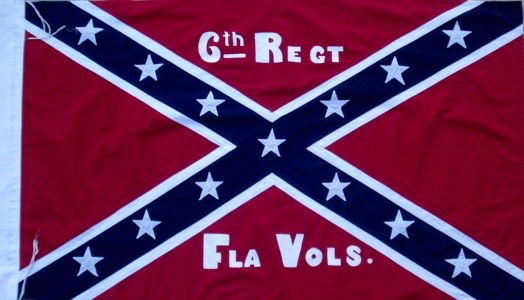
This is in no way intended to denigrate Smith’s bravery. He deserves his Medal of Honor. But the story isn’t complete until you know the whole of it, and that involves Black soldiers. Smith’s regiment was able to stampeded the Floridan’s, on John Bell Hood’s extreme left, in part because of what happened earlier in the day. Three regiments of what were then called U.S. colored troops attacked Hood’s center. They were repulsed with heavy casualties; afterward, the Confederate officer in charge of the position praised them for their bravery.
Hood noted that. As a result, he shifted troops away from his flank to his center. That left the depleted 6th Florida, already miserable from soaking overnight rain, unprepared for the ferocity of Otis Smith and his comrades. Black men had made his moment of glory; they may in fact have saved the life that still marks lives in Arroyo Grande today. The Mankins brothers, managers of Brisco Lumber and members of a family long noted for cattle ranching and community service, are descendants of Otis Smith.
The second incident, involving another Huasna Valley farmer, Adam Bair, remains one of the saddest moments of the Civil War. It bears reminding that recent scholarship has revised the casualty count from the traditional statistic of 620,000 dead to 750,000 or more. That is the modern equivalent of eight million Americans lost.
Among them were the soldiers who fought in the Crater in 1864, the victims of racism on the part of their own leader, a hero of Gettysburg, George Gordon Meade.
From an earlier blog post about the Battle of the Crater, witnessed by Adam Bair:
https://jimgregory52.wordpress.com/2021/06/19/they-would-charge-into-the-city-if-the-order-were-given/
 A Work in Progress