
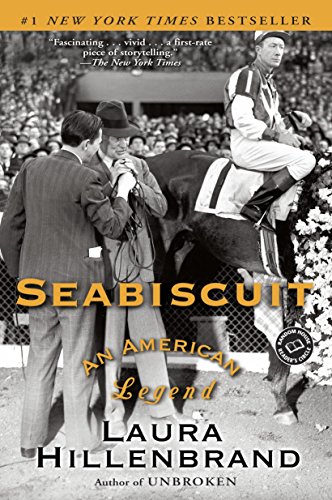
I don’t think it’s possible to tell you how much I love this book. It was so inspirational and so instructive—about horses and horse-racing, about which I know little–but being immersed inside stables and jockey’s locker rooms and the Santa Anita grandstands, with smells ranging from liniment to buttered popcorn, was one of the most vivid reading experiences of my life.
What’s just as impressive as the racehorse is the book’s author.
Laura Hillenbrand was essentially paralyzed by Chronic Fatigue Syndrome (her New Yorker account of her disease is haunting) and she persisted in researching and writing a book interrupted by days when all she could bring herself to do was crawl out of bed to fix a bowl of corn flakes.
Although I come from a family familiar with horses—my father and my sisters—I am not. (I raised chickens.) But the writing of Hillenbrand and of Elizabeth Letts (The Perfect Horse) was so powerful that it led me to write perhaps the best essay I’ve ever written, “Sheila Varian’s Perfect Horse,” about a “blocky little mare,” an Arab, who became the national champion cow horse in 1961.
Central to the Hillenbrand book and to its film adaptation is the great match race between Seabiscuit and War Admiral in 1938. It figures, oddly, in a recent event in our lives: my much-loved brother-in-law, a Naval Academy grad and retired Navy Captain, died recently. When my wife, her sister Robin, her brother Dana and my son John went to Virginia for the funeral, they encountered something I’ve heard of before. They were Californians and once that was discovered, some of the East Coasties snubbed them. Not all of them, to be sure, but there was a discernible distaste in the air, as if those who had known and loved Captain Steve the longest were pretty much Neanderthals.
The film Seabiscuit was on the television yesterday and, of course, I misted up during the final sequence when the ‘Biscuit, recovered from the injury that had nearly led to him being put down, wins the 1940 Santa Anita Derby. It’s glorious filmmaking.
But it’s not the centerpiece. For me, that would be the 1938 match race between the little California horse and the Kentucky-bred and East Coast darling, War Admiral, a magnificent athlete.
The way that race was run made me feel better about being a Californian; the way the film portrayed it—down to the elegant pre-race narration by historian David McCullough—reminded me of the mare Ronteza, Sheila Varian’s Arabian, Sheila took on twenty male competitors and Ronteza took on twenty Quarter horses in 1961 and they beat them all. There is nothing I love more than a good underdog—in this case, underhorse—story.
Forty million Americans listened to the great match race call that day in 1938. That’s because of the point Hillenbrand’s book makes: Seabiscuit was their horse, the underdog champion of an underdog people—Hitler dismissed Americans as “a mongrel race”— in the transition years between Depression and War, when they would prove that they were champions, too.
Somehow the 1942 photo below is consistent with Seabiscuit’s legacy. The statue dedicated to him was installed at Santa Anita in 1941. The following year, the racetrack became an assembly center for Japanese Americans, headed for desert camps, who slept in the track’s stables. Here, internee Lily Okuru, Japanese American— poses alongside the Biscuit. The horse and the young woman, and her people, shared remarkable similariies: They were unappreciated, sometimes reviled, banished, loyal without reservation to those who loved them, courageous in combat—whether on Caliornia racetracks or Italian battlefields—and Seabiscuit, like 120,000 of Lily Okuru’s people, were Californians.

 A Work in Progress