
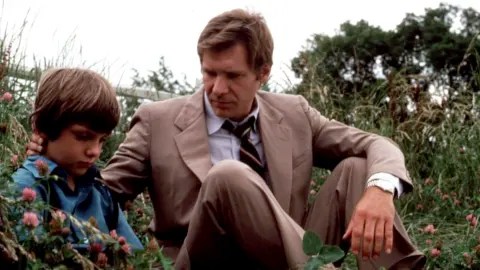
We are rejoicing 80-year-old Harrison Ford’s fifth and probably final Indiana Jones film, and we are right to do so. I have enjoyed the series, perhaps the interplay with Sean Connery in The Last Crusade the most—oh, and that zeppelin scene.
Both Indy and Han Solo are heroes. For Ford, that’s a problem, even though the mythologist Joseph Campbell aptly described Solo as a hero who didn’t know that he was a hero.
In an interview with Chris Wallace on CNN, Ford himself bristled at the interviewer’s use of the word “hero.” He was not a hero, he insisted, and he didn’t play heroes. He was instead an actor playing the roles of fallible men.
That’s what is so appealing, to me, about John Book in Witness, a film I’ve watched three times in the last month. (It’s a good Dickensian name, by the way: Ford’s detective is honest; he lives by the book, but, unlike the Amish, he’s not of the book.)
Book is a fallible man, but in his bedrock integrity—and in his vulnerability, a dangerous term to use because of its Wokiness—he reminds me of another Harrison Ford detective, Deckard, in the remarkable 1982 film Blade Runner.
In Witness, Ford’s character is allowed so many unheroic moments, including in the way he wolfs down a Philadelphia hot dog to pause, a little ashamed, when he realizes that the witness and his mother are praying over their meal. (It pains me a little, too, to see Detective Book drinking bleak squad-room coffee out of a Styrofoam cup, but that’s another subject altogether.)
Yes, the audience cheered when Book punched out the lout with the tight jeans and the razor-cut hair who was decorating Alexander Gudonov’s face with the ice-cream cone, but that was chum for the movie sharks. Me, too. I cheered with everybody else.
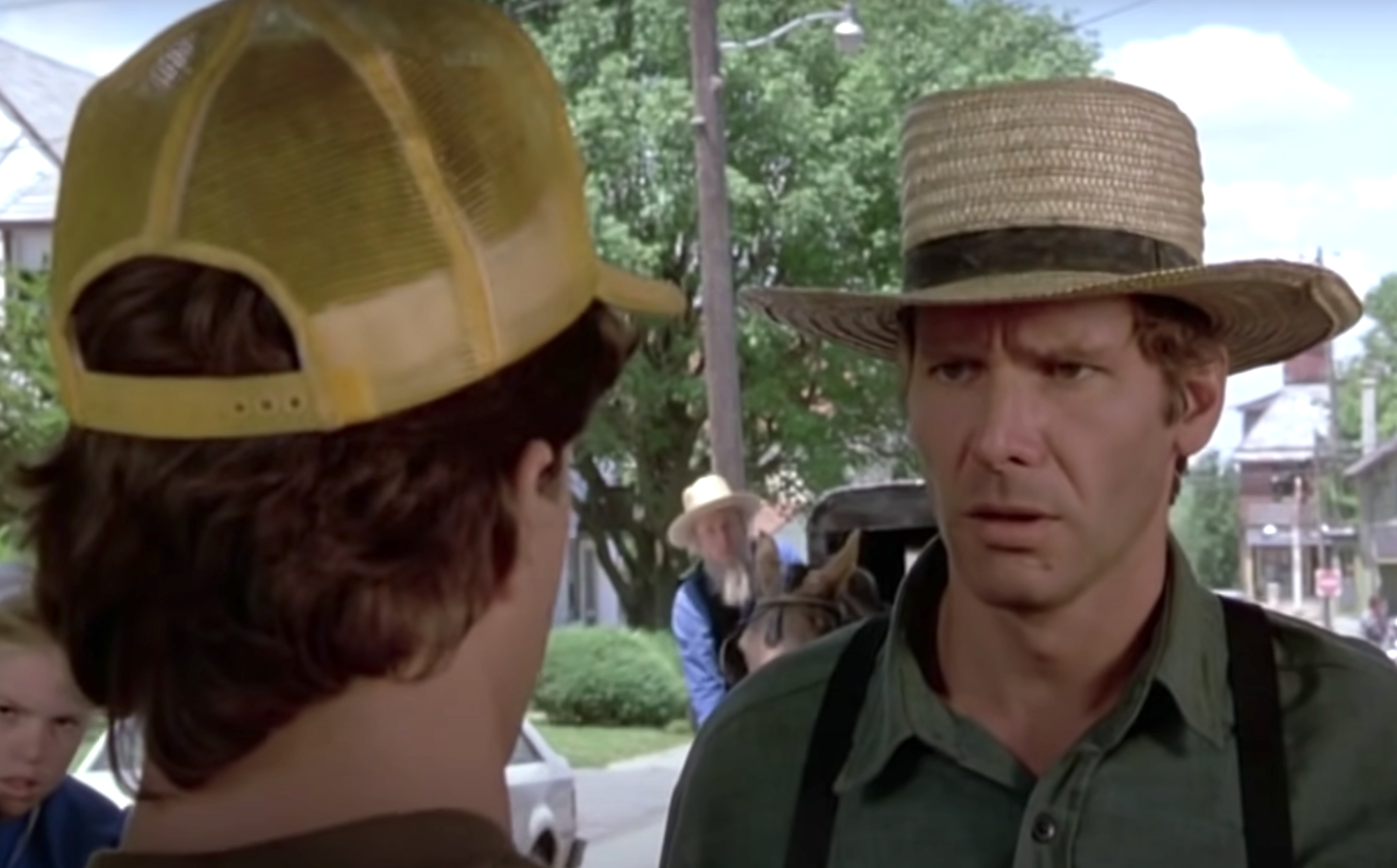
The moments that amazed me, though, came in Ford’s eyes, in his terror as the two detectives search for Book in the barn (The suffocation in corn scene was borrowed from Frank Norris’s muckraking novel The Octopus. The villain is suffocated in a ship’s hold being filled with San Joaquin Valley wheat.), or in the intensity of his look as he urges the little boy, Lukas, to run to the neighbor’s farm.
Lukas begins to run, but returns, rings his grandfather’s barnyard bell and so summons the neighbors, who run to the Haas farm. It’s there where John Book, backed by Amish in dense cornfield ranks, confronts his nemesis, Detective Capt. Schaeffer, and in a near-tearful fury, wears him down.
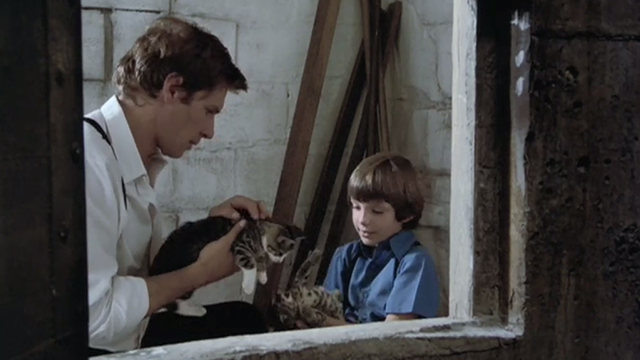
The love story is inevitable, and Kelly McGillis is radiant, but to me, the real heart of the story is John Book’s love for the little boy. One of the film’s small miracles is the perpetual motion machine Book builds for his friend, the witness—Ford was a carpenter once, too, and that’s where the scar on his chin came from—and another is the brief scene where Lukas introduces Book to what is miraculous to all little boys, a litter of kittens.
I love this film, too, because it was directed by Peter Weir, an Australian and one of my favorite directors, who gives us such a sensitive and powerful look into Amish life. I do not know how he did it.
Maybe it’s a romanticized look, and yes, I flinch at the seeming subservience of women, but the barn-raising scene is so evocative to me, especially today, because we Americans are so bitterly divided. The embrace, even if it’s temporary, of Book into the wider community in this scene reminds me of the better angels of our nature.
It took an outsider, an Aussie, to give us such an authentically American vision— one, again, that has such potential power in what it teaches us.
I cautioned against romanticizing the Amish, but it’s a bigger mistake to underestimate them and their faith. I made this video to introduce my high-school history students to these people. The word “remarkable” seems appropriate, I think.
And it’s a remarkable film, down to its end.
John Book stands on the porch and Rachel in her doorway at the film’s’s end, in a scene framed the way John Ford would’ve composed it as he did in My Darling Clementine and The Searchers. Like Wayne in the latter film, Book in his frame, on the porch, is straddling a no-man’s land. Rachel, in hers, stands in doorway shadows that are Rubenesque, as is the generosity of her body, as, most of all, is the brilliance of her beautiful eyes. McGillis’s Rachel would’ve made Rubens weep.
And what is Book to do?
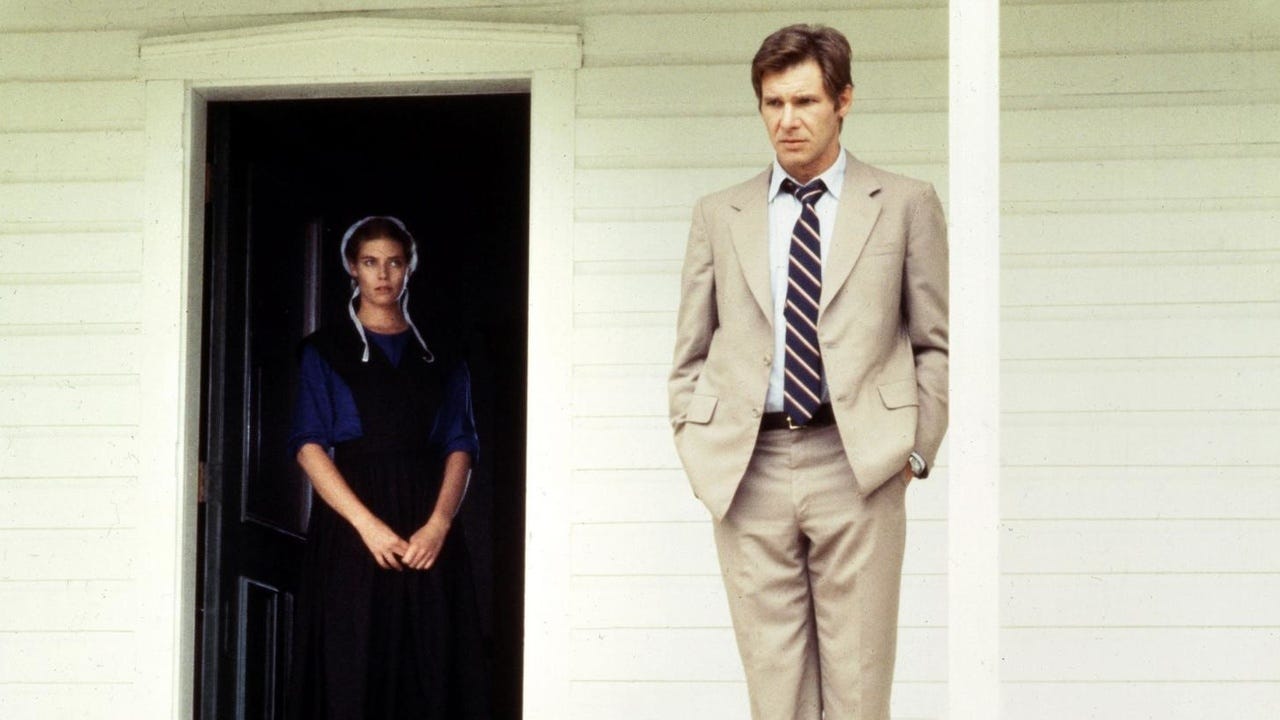
He takes so long to make up his mind, and when he finally walks away to that beat-up little VW wagon, his body is heavy with grief. Even that wordless moment is a tribute to Ford’s acting.
Why did he leave in such pain? Well, there were Rachel and Lukas and Eli, the grandfather. and Book was a man without a family. He was was profoundly urban and secular and modern. But in his world, poisoned by crooked cops, he’d escaped for a short time to find that there is such a thing as moral certainty.
That is a dangerous concept, to be sure—one National Socialism held dear, for example. What makes Witness true to the heart is that the moral certainty Book encounters, ironbound as it is by 17th-Century dogma, is leavened by compassion and generosity. Gott ist die liebe.
Goodbye, English.
 A Work in Progress