

Lt. Robert Gregory, 1944; Vin Scully, about 1950
I grew up and I live in Arroyo Grande, in southern San Luis Obispo County.
San Luis Obispo County is pretty much evenly divided between Giants and Dodgers fans. We’re just above the cliffs, sometimes pink and sometimes gold at sunset, and the yucca spikes of the Gaviota Pass, which is where I believe Southern California begins. We refer to ourselves up here in SLO County as “The Central Coast.” But my baseball is Southern Cal. I grew up aDodger fan.
The fact that that my late father-in-law, Gail Bruce, who was kind of a surrogate father–I loved that man—was once a 49ers end cuts me no slack. Neither does my abiding love for San Francisco. My wife and I just visited and she took a picture of the alley named for Dashiell Hammett and she found the marker where Miles Archer, Sam Spade’s detective partner, was murdered.
But I am passionate, too, about Raymond Chandler and his detective, Philip Marlowe.
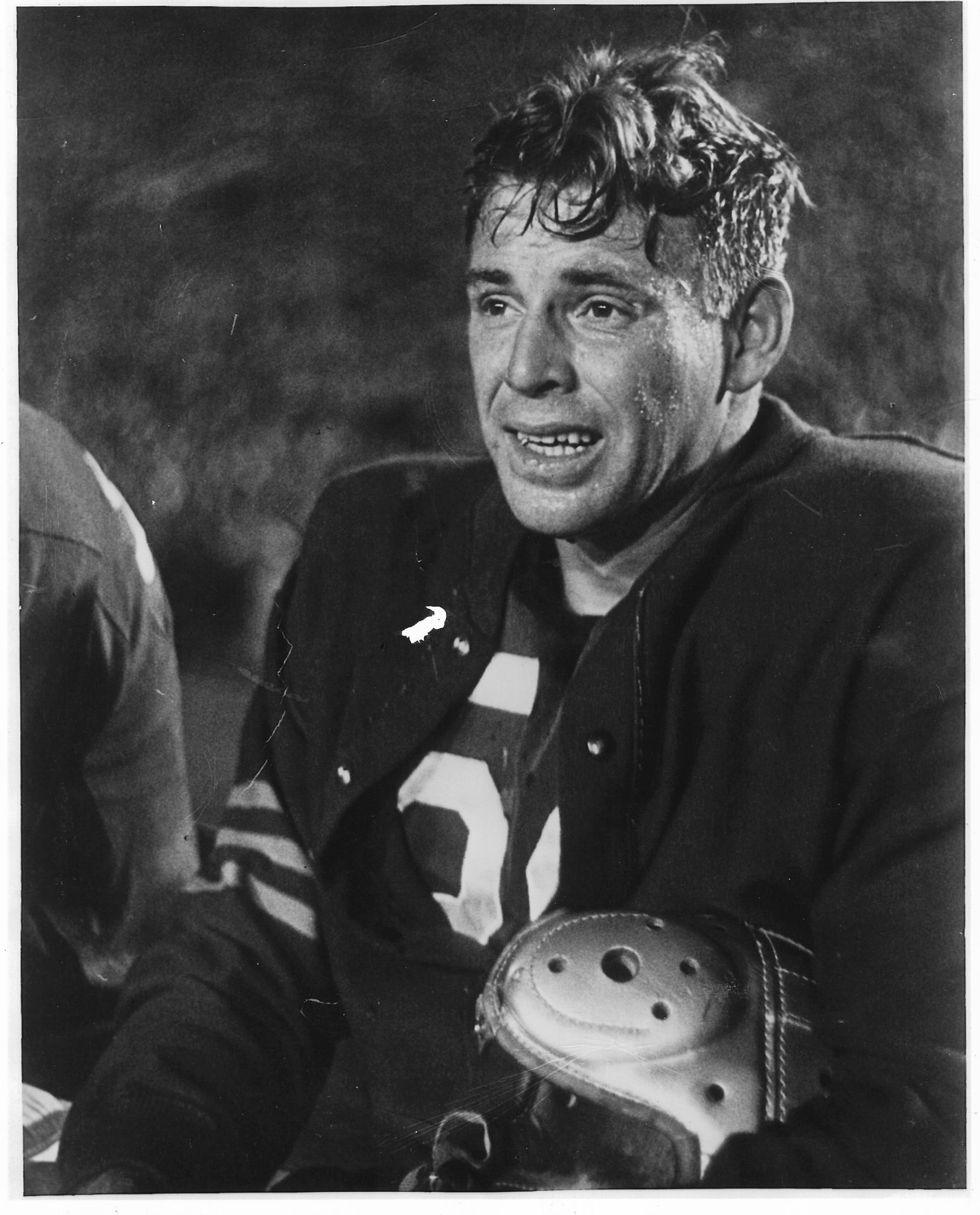
Gail Bruce, San Francisco 49ers, 1948-1951
To Giants fans around here, I am a disgrace.
The division here reminds me of my Dad, who grew up in the Ozarks during the Great Depression. Missouri was bloodily divided during the Civil War. The wound didn’t heal.
In 1935, at the Texas County, Missouri, Fourth of July, an old Confederate snapped during the “The Star-Spangled Banner” and went after an old Yankee, once a drummer boy, with his Barlow knife.
In their personal Gettysburg, the two upset tubs of potato salad and platters of fried chicken and honeyed ham and sweet potato pies before young, strong men pried them apart and held them until the sheriff came.
By then, the onetime Confederate was jubilantly holding the onetime drummer boy’s ear aloft.
When Dad told that story, it was 1935 again and he was seventeen again. He was a marvelous storyteller.
The Dodgers-Giants divide here is less violent but just as deep. As a little boy, I feared two men: Soviet Premier Nikita Khrushchev and Giants cleanup hitter Willie McCovey.
I am a Dodgers fan because I love Vin Scully.
Sandy Koufax was my other Dodger hero, and his retirement, when I was fourteen, hurt. When I learned what pitching had done to his arm, that hurt even more.
My relationship with my father was shot through with hurt. He was brilliant–-the comptroller for San Luis Obispo’s Madonna Construction, he of the hot-pink Inn–-but Dad had demons, too. He was a hard drinker and that made him fearful.
But he had moments of intuitive kindness, and, as a Sixties teen, I was no angel. Once, in high school, Dad sensed that I was deeply depressed. I was. I’d just dropped acid. I sneaked home in the morning dark, but the drug’s aftereffects stuck to me like nightmare cobwebs.
He took the day off from work and scrambled some eggs. Then we sat down in front of the television and watched the 1970 World Series.
Brooks Robinson, as he’d done to the 1966 Dodgers, scrambled the Reds.
I got my feet on the ground again.
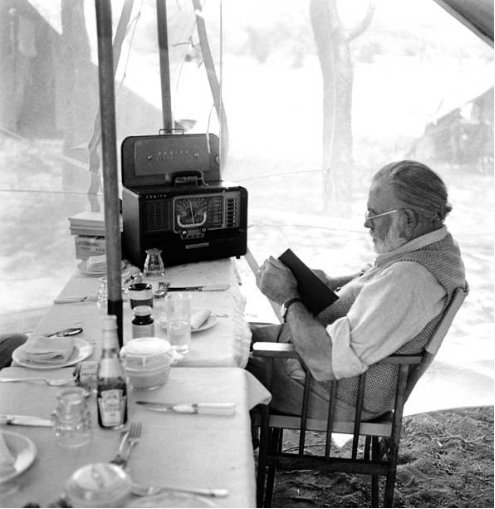
I was closest to Dad when we were close to a radio—sometimes, a Zenith Transoceanic, whose twin I’ve seen in photos next to Ernest Hemingway in Kenya. Dad had introduced me, at sixteen, to For Whom the Bell Tolls, and when Robert Jordan breaks his leg near the novel’s end, mine began to hurt as I was reading. John McCain loved that book, and me, and Dad.
Of course, Dad and I listened to the call of Koufax’s perfect game. In the ninth, we didn’t breathe much. When Koufax struck out the side, he hugged me.
Because Dad so hard and often worked late, I often listened to Dodger games by myself on a little transistor radio with a single earplug. Vinny was my radio father. He was that way to hundreds of thousands of little boys and girls he’d never meet.
Sometimes, especially during a home stand, when games ran into extra innings, I’d fall asleep with his voice in my ear, only to have the Farm Report wake me the next morning.
Dad died in a morning dark in 1985. Vinny died a year ago August 2. Death is both a coward and a liar, as Milton noted. I became a high school history teacher because my father and Vin Scully taught me how to teach.
The teenaged students I loved so much resembled the fans in the Coliseum, where I saw my first Dodgers game in 1958, against Stan Musial’s Cards (the Gashouse Gang was Dad’s team growing up). Even then, just seeing the game wasn’t enough for Dodger fans. Transistor radios and Vin’s stories made it real.
I became determined to make history real, too, from Botticelli to Wasily Kandinsky, from Elizabeth I to Lincoln, from Emily Wilding Davison to Rosa Parks.
Last week, I got a message from a former student who’d visited the Uffizi. She stood transfixed before Botticelli’s Birth of Venus.
Now, she told me, she understood why I was so passionate about a painting that was completed in 1486.
My older son, John, was just three days old when Scully called Gibson’s home run in 1988. I felt completed. Now, after Dad, Gail and Vinny, I was a father, too.

John and me, October 1988
 A Work in Progress