
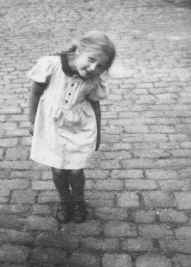


Some of my favorite World War II photos include children. The first is of a little Berlin girl, soon after the war’s end. She is meeting her first American, a G.I. in the 77th Infantry Division.
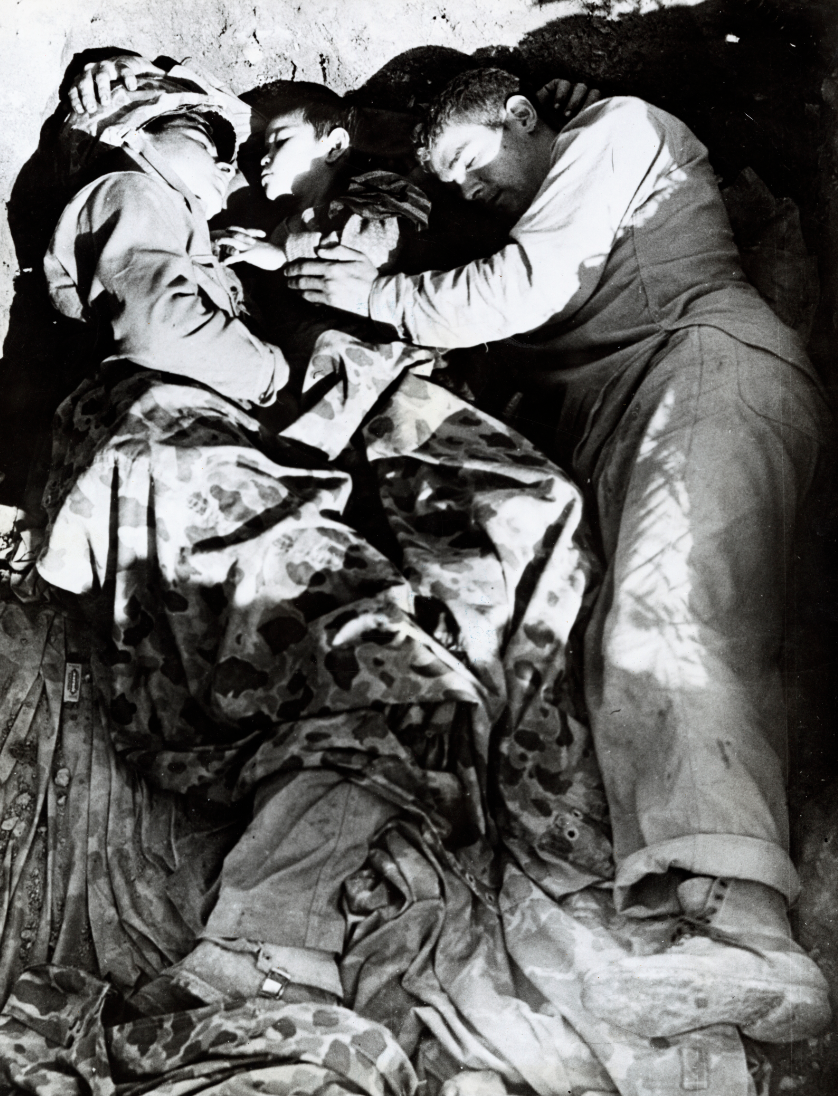
The second gets me misty. The little boy lost his immediate family in the horrific battle for Okinawa. The two young Marines cared for him until relatives were found.
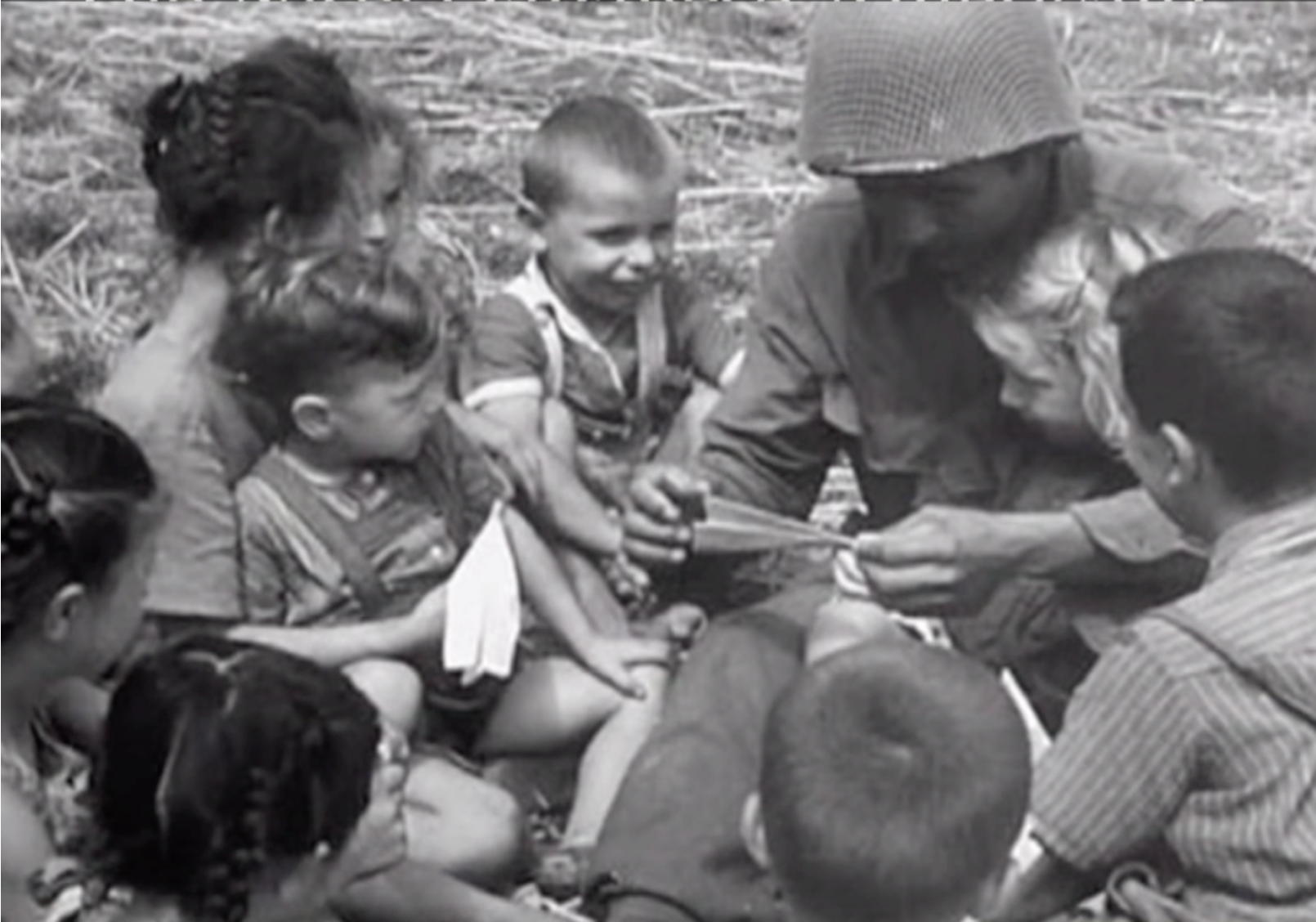
A Nisei G.I. with the 442nd Regimental Combat Team teaches a rapt audience how to make a paper airplane. His arm’s around a little girl who’s nestled close to him. I suspect that in this moment she feels safe, probably for the first time in a long time.
In England, shortly before D-Day, a G.I. gives a British lady help with the jump rope.
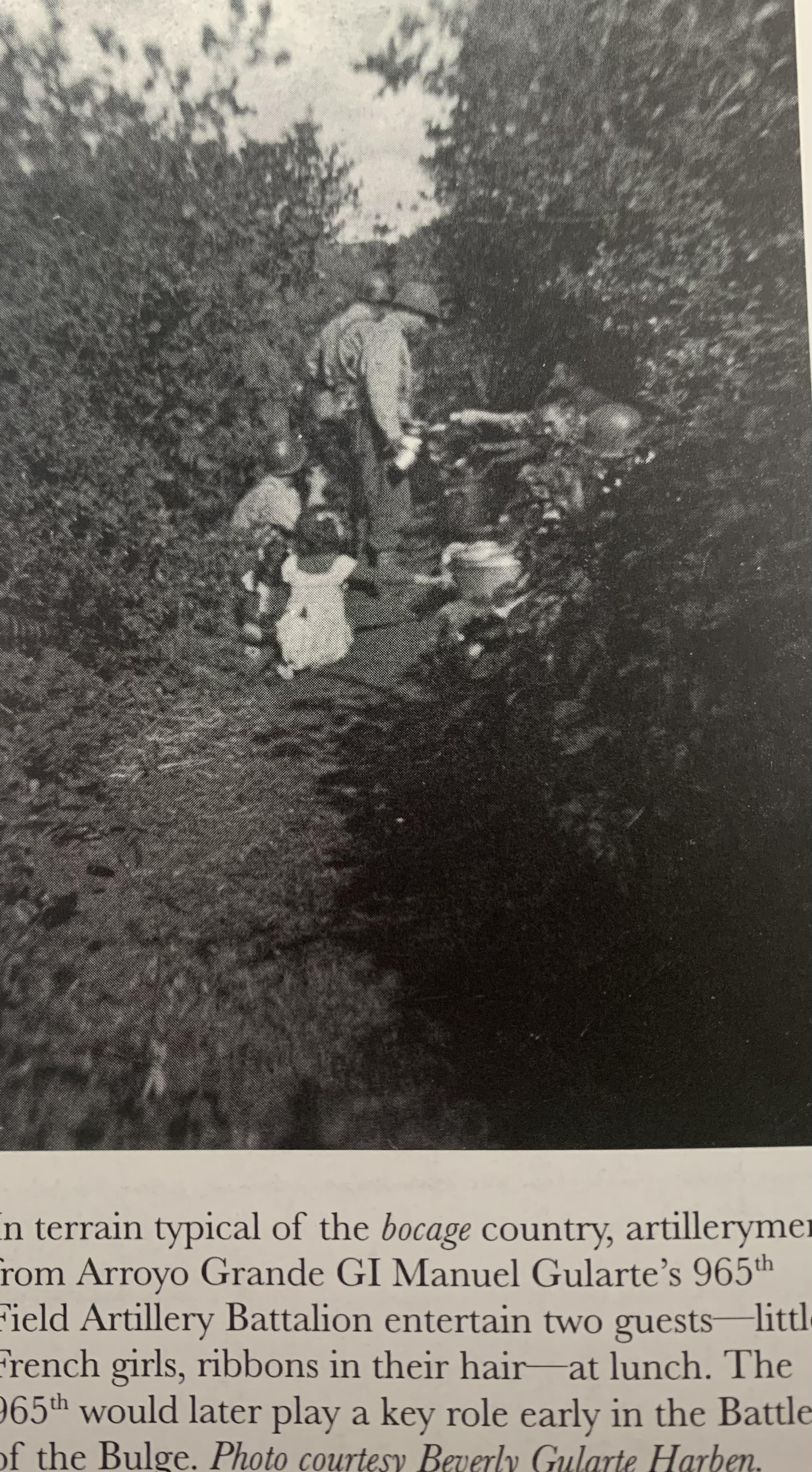
Manuel Gularte of Arroyo Grande and his comrades entertain guests for lunch in Normandy. Manuel’s brother, Frank, was killed on the German border just five days before his son, Frank Jr., was born at the Mountain View Hospital in San Luis Obispo.
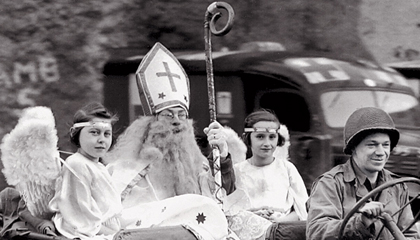
And in Luxembourg, Christmas 1944, while the Battle of the Bulge is raging nearby–there’s an amazing Battle of the Bulge museum in Diekirch, Luxembourg–a G.I. playing St. Nicholas, flanked by two angels, heads out to distribute gifts. Note the expression on the jeep driver’s face.
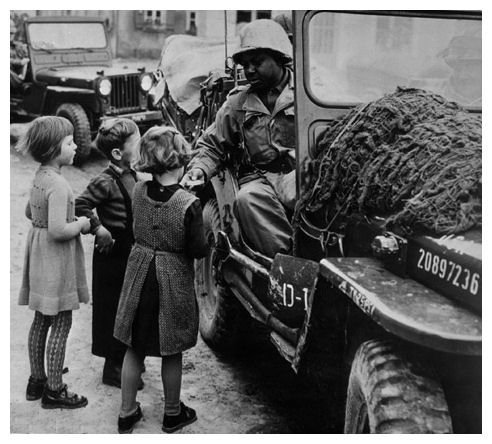
Finally, a soldier, I suspect a member of the famed Red Ball Express, makes friends with a little refugee while another little girl–her sister?–makes sure that she doesn’t leave her doll behind.
I am not naive enough to suggest that all Americans were angels. They weren’t. There were rapes, murders, thefts. Racism was a given and violence, especially attacks on Black G.I.’s, was commonplace, at its height in 1943. In New Zealand, American Marines attacked Maori soldiers for entering the bar where the Yanks were drinking beers.
Filipino-Americans were subject to some of the most virulent and racist invective–you can find examples in the old Arroyo Grande “Herald-Recorders”–and they responded by becoming some of the finest infantrymen of the war.
While their parents and grandparents were behind barbed wire, Japanese-American G.I.’s were marked by the frequency of their Purple Hearts, by Bronze Stars that should’ve been Silver Stars, by Silver Stars that should’ve been Medals of Honor. Nearly 1,000 of them were killed or wounded in October 1944 to break through and rescue a Texas National Guard Unit–240 justifiably terrified 19-year-olds- surrounded by the Germans in France’s Vosges Mountains.
These weren’t hyphenated Americans. They were Americans.
My parents’ generation was condemned before the war by sociologists who saw them as self-indulgent and frivolous. They proved the eggheads wrong. Spectacularly. That’s why I write about World War II so much.
In my book Central Coast Aviators in World War II, I wrote about a brilliant man named John Keegan:
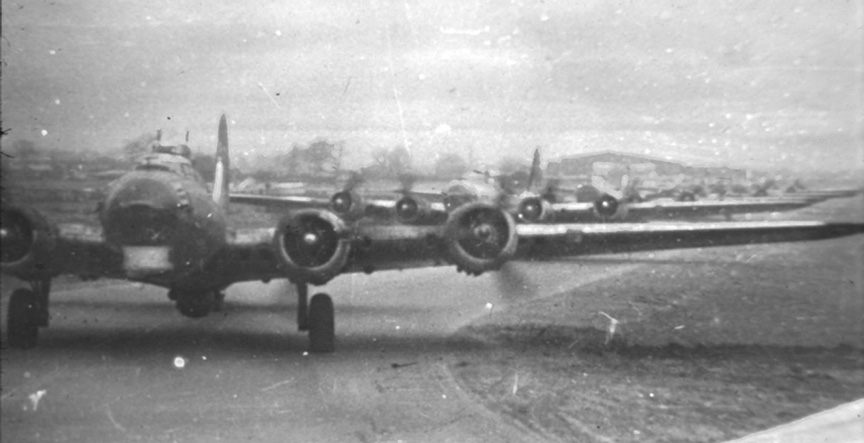
If there was a military historian with a gift close to Shakespeare’s, it was another Englishman named John Keegan. Keegan was a little boy in the English countryside, in Somerset, when the Americans began to arrive in late 1943 and into the spring of 1944. Little English boys had lived for years with the deepest of privations—thanks, in large part, to the U-boat campaign that had nearly starved Shakespeare’s “sceptred isle” to death—and then the Americans came. They were, as Keegan later said—for once at a loss of words while narrating a documentary on the 1918 turning point of World War I—“Well, they were Americans!” By which he meant they were boisterous, cocky, well fed, well clothed and, thank God, friendly, with an innocence and immediacy that was distinctly American. Their World War II counterparts taught English boys baseball, and they flirted with their big sisters and married some of them—but most of them not—which meant that little boys Keegan’s age would inherit littler half-Yank nieces and nephews. Most of all, they were generous. There seemed to be no end to their Hershey bars (there wouldn’t be after the war, either, when, during the Berlin Airlift,one of Arroyo Grande bomber pilot Jess Milo McChesney’s comrades, Gail Halverson, air- dropped Hershey bars, floating on little parachutes, to the hungry children of blockaded Berlin) and no end to the rough affection for children that came with these big, loud men from across the sea.
And then they were gone. Keegan has vividly described the early morning dark when that happened, when the chinaware and modest family crystal on every shelf in the Keegan home began protesting, rattling an alarm soloud that it woke the family up, if the motion beneath their beds hadn’t already made them sit bolt upright. The anxiety of Keegan’s family, their neighbors and other families all across East Anglia was relieved only when they went outside. Then anxiety gave way to wonder. They could feel in their breastbones the vibrations—“the grinding forced you to the ground,” Keegan remembered—of the engines of thousands of airplanes, but they could see only dim red and amber lights in the sky, heading east, toward France. Some of the Americans Keegan had learned to love so quickly, his heroes, were on those airplanes, and tens of thousands of more, his heroes, were riding deathly pale on landing craft corkscrewing in foul Channel waters, and they were all headed for Normandy.
It was D-day.
A (wonderful) AGHS German teacher, Mark Kamin, was leading a group of students on a tour of Bavaria. I think they were waiting for their bus when an older German woman approached them.
“You’re Americans, aren’t you?” she asked Mark.
Yes, we are, Mark replied
Her eyes began to fill with tears. “I just wanted to thank you,” she said, “for how kind your soldiers were to me when I was a little girl.”
We are so divided now, but these photos of men long dead fill me with hope. Their generation lit a path for us to follow. It’s up to us to find it.
 A Work in Progress