
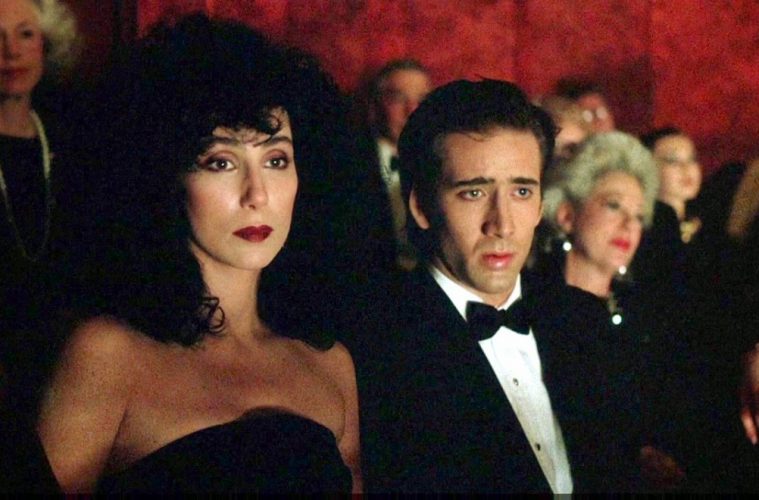
Rose: Do you love him, Loretta?
Loretta Castorini: Ma, I love him awful.
Rose: Oh, God, that’s too bad.
I was surprised that Moonstruck was on this morning. I was not surprised that, while I started watching halfway through—Rose is undergoing her transformation at the hair salon, and then she buys the shoes, “ruby slippers” and that drop-dead dress— I had to watch it to the end and then all the way through Deano’s voice and the credits.
What a marvelously written film. The words made the actors wonderful. So I had to look it up. It had some Nora Ephronesque elements, and, for romantic comedies, she was one of our greatest screenwriters— but she’s not Italian. Nope. But neither is the screenwriter for this Moonstruck. John Patrick Shanley is (obviously) Irish-American. But his early years equipped him to write the Academy Award-winning screenplay script for this film.

So I looked Shanley (above) up on Wikipedia. Here’s why he has the chops for this New York love story:
Shanley was born into an Irish-American family in The Bronx, New York City. His mother worked as a telephone operator, and his father was a meat-packer. The neighborhood Shanley grew up in was considered very rough.
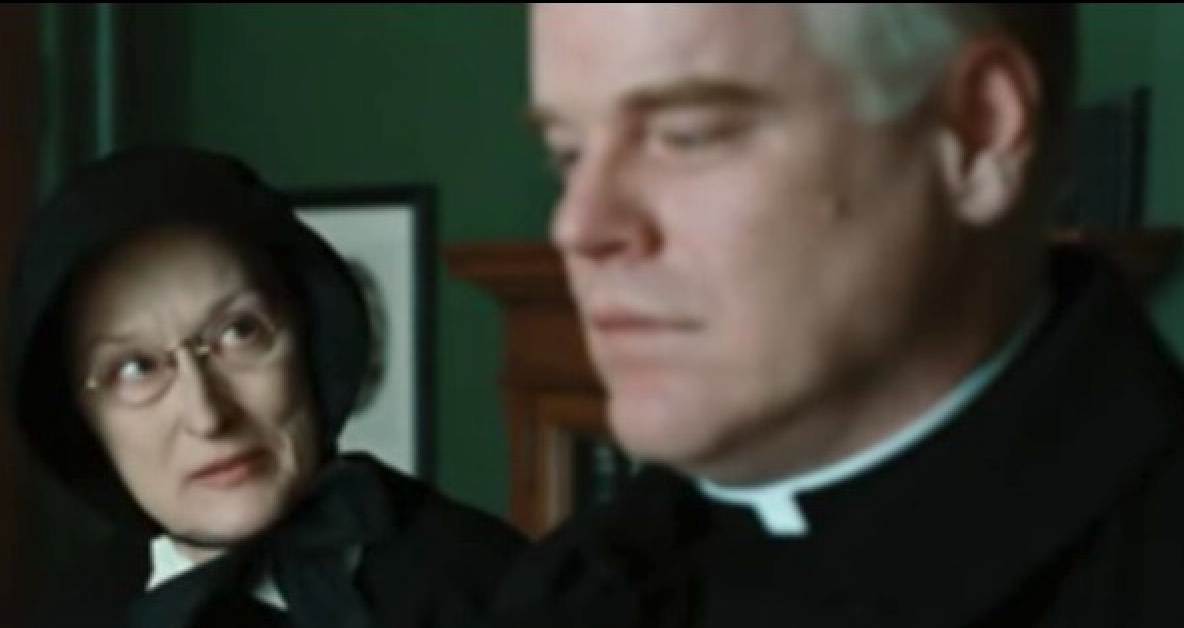
Shanley’s academic career did not begin well, but ultimately he graduated from New York University with honors. In his program bio for the Broadway production of Doubt: A Parable, he mentions that he was “thrown out of St. Helena’s kindergarten, banned from St. Anthony’s hot lunch program and expelled from Cardinal Spellman High School.” He was heavily influenced by one of his first teachers, Sister Margaret McEntee, on whom he based the character of Sister James in his play, Doubt. While at Cardinal Spellman High School, he saw two school productions that influenced him: The Miracle Worker and Cyrano de Bergerac.
After his freshman year at New York University, Shanley was put on academic probation. He then enlisted in the United States Marine Corps, serving in a stateside post during the Vietnam War. Following his military service, he wrote a novel, then burned it, and returned to the university with the help of the G.I. Bill, and by supporting himself with a series of jobs: elevator operator, house painter, furniture mover, locksmith, bartender. He graduated from New York University as valedictorian in 1977,with a degree in Educational Theatre, and is a member of the Ensemble Studio Theatre.
What makes this film such a treat for me are both the unexpected turns, like the “love him awful” exchange, and the revealed wisdom that mark Shanley’s dialogue.
Ronny Cammareri: You’re gonna marry my brother? Why you wanna sell your life short? Playing it safe is just about the most dangerous thing a woman like you could do. You waited for the right man the first time, why didn’t you wait for the right man again?
Loretta Castorini: He didn’t come!
Ronny Cammareri: I’m here!
Loretta Castorini: You’re late!
Loretta Castorini: Bless me, Father, for I have sinned. It has been two months since my last confession.
Priest: What sins have you to confess?
Loretta Castorini: Twice I took the name of the Lord in vain, once I slept with the brother of my fiancé, and once I bounced a check at the liquor store, but that was really an accident.
Priest: Then it’s not a sin. But… what was that second thing you said, Loretta?
Rose: Have I been a good wife?
Cosmo Castorini: Yeah.
Rose: I want you to stop seeing her.
[Cosmo rises, slams the table once, and sits down again]
Cosmo Castorini: Okay.
Rose: [pauses] And go to confession.
Rose: No, I think the house is empty. I can’t invite you in because I’m married. Because I know who I am.
Rose: Why do men chase women?
Johnny: Well, there’s a Bible story… God… God took a rib from Adam and made Eve. Now maybe men chase women to get the rib back. When God took the rib, he left a big hole there, where there used to be something. And the women have that. Now maybe, just maybe, a man isn’t complete as a man without a woman.
Rose: [frustrated] But why would a man need more than one woman?
Johnny: I don’t know. Maybe because he fears death.
[Rose looks up, eyes wide, suspicions confirmed]
Rose: That’s it! That’s the reason!
Johnny: I don’t know…
Rose: No! That’s it! Thank you! Thank you for answering my question!
Loretta Castorini: Where are you taking me?
Ronny Cammareri: To the bed.
Loretta Castorini: Oh, God. I don’t care. I don’t care. Take me to the bed.
And then there’s this moment, when, for once, the director tells you all you need to know without being pushy about it. It’s the morning after the opera, and it’s all over for Loretta. She’s in love.
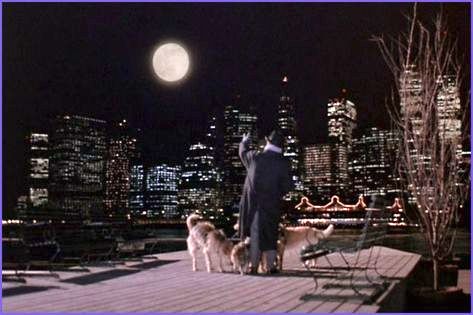
(I’d be remiss if I didn’t mention the heartache of seeing the World Trade Center towers that live on in the shots that establish this as a New York film. I feel the same pang of sadness for two more films I enjoy, Working Girl and Gangs of New York.)
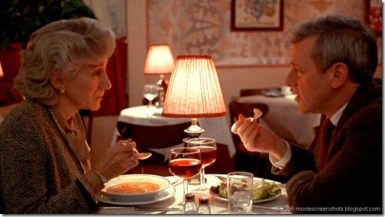
Olympia Dukakis, whom we lost two years ago, won the Academy Award for Best Supporting Actress, and she is somehow both regal and funny, even when the funny bits are a little rueful, as they are in her bittersweet scenes with the late John Mahoney, the university professor who chases his coeds—he reminds Rose that her own husband is being unfaithful—which leads to the eternal questions she asks: “Why do men chase women?”
I guess I’ll have to add this film to the list (Casablanca remains at the top, with John Ford’s The Searchers and the first two Godfathers close behind) of films I could watch a thousand times. I owe its screenwriter at least that many thanks.
 A Work in Progress