
His mind was a museum of uncatalogued exhibits.
–John Steinbeck on Hazel, Cannery Row.
Yup. Guilty.
I can’t always “access” Wes Anderson films, but there are two I’ve loved: The Grand Budapest Hotel and Moonrise Kingdom. My oddly working mind (SEE: James Burke, The Day the Universe Changed) moves laterally rather than straight ahead, so sometimes I make odd connections, in this case, between disparate directors, Terence Malick and Wes Anderson.
Maybe three directors, if you count the Andersenesque Jojo Rabbit.
All of them, by the way, make liberal use of one of my favorite actors, Sam Rockwell, whom I’ve loved ever since Galaxy Quest. Someone wisely put together all the Rockwell scenes in Jojo. I won’t show the last one, but here are a few. The film’s director, New Zealander Taika Wititi, did a brilliant turn as Hitler, who appears periodically in little Jojo’s dream dialogues.
But today’s date in history came thirteen years after the Reich collapsed. In January 1958, two teens, Charlie Starkweather and Carl Fugate went on what was called a “murder” spree” from Nebraska to Wyoming. There were eleven killings in all. Charlie got The Chair. Springsteen wrote “Nebraska” about the pair. Here, from what might be my favorite Springsteen album, the artist sings the film:
The teenaged criminals had confirmed what we all knew about teenagers anyway: They were damned dangerous. James Dean and Natalie Wood, Elvis and “Jailhouse Rock,” (Pat Boone was the Elvis antidote) Ed Byrnes (“Kookie”) and his comb, pointy sweaters (Jayne Mansfield, Marilyn Monroe), Rockand/or Roll, including Little Richard and Chuck Berry, in a time when Black people were to be invisible except for pancake mix Jemimas and Central Pacific porters. When they became visible, they often died. It was that way in the the abject horror paranoia generated when a Black youth (Emmett Till) from up north wolf-whistling at a pretty White woman down in Mississippi, a story that was probably fabricated.
So Charlie and Caril had an enormous impact, far, far beyond the Badlands. (So, thankfully, did Emmett Till, or rather, Mamie, his mother.)
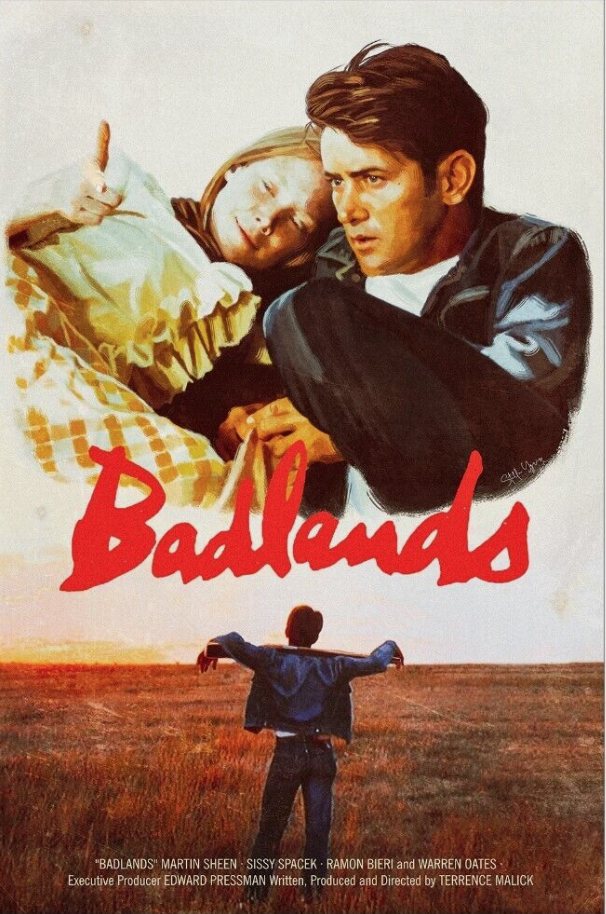
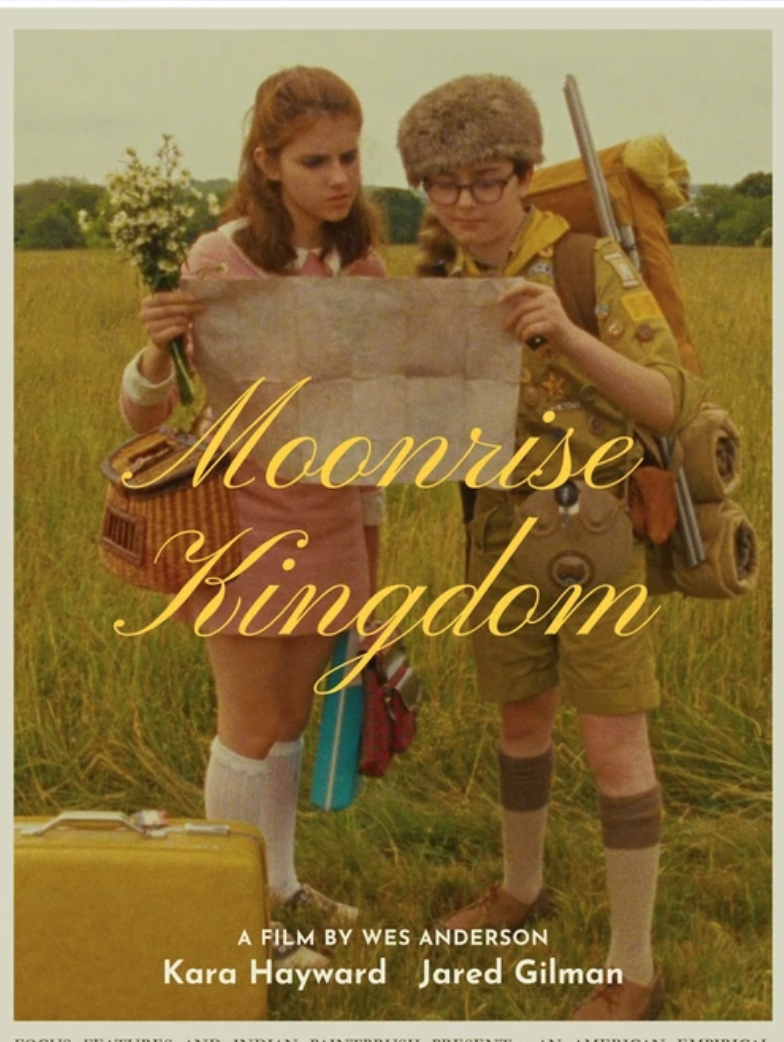
So it suddenly occurred to me, because of today’s date in history, that Moonrise was an homage to Terence Malick’s Badlands, about the two teen killers, and I am fond of Malick. I once wrote a big essay about his Days of Heaven, with Richard Gere, of whom I am not fond.
Just one similarity involves goofy dances.
When I realized the connections, I had to share it with my wife.
Elizabeth looked at me oddly. Heck, I looked at me oddly. Then I did a Google and found six or seven other people, some of them film critics, who’d already made that connection.
Two mixed-up and misunderstood kids, kind of vaguely in love but clearly devoted to each other, some random violence (a stabbing with scissors in Moonrise) police pursuit (Bruce Willis is endearing as the cop in the Anderson film) and final standoff, on the prairie in the older film and on a rooftop in a driving rainstorm on the newer. Even writing this pains me, but a dog is killed, to no purpose and for no purpose, in each film.
Badlands, thanks to its succession of cars, is a picaresque film, moving in not very much time but through an immense amount of space, in a genre invented by Cervantes, but, thanks to our vastness, perfected in America–Huck Finn, The Travels of Jamie McPheeters, True Grit and The Good Lord Bird are just a few examples
So maybe I’m not exactly Hazel after all (he was among many children and his Mom was tired the day she named him).
Maybe almost best of all, Badlands was the film whose introductory music, “Gassenhauer” (“Street Song”) enchanted me. So here it is, in the YouTube link below. There are a couple shootings in the video montage, so be advised. But this film remains indelible in my memory. So are Malick’s images of the American countryside. And, just one more point? Without all that blood dripping down her (Carrie), Sissy Spacek is luminous.
 A Work in Progress