
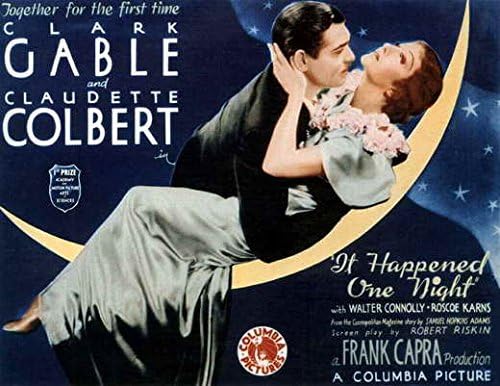
I love the Turner Classic Movie hosts because I learn so much from them. Last night’s host—it’s the annual “Month of Oscars” series—Dave Karger, taught me a lot about It Happened One Night, so his introduction made me watch it more closely than I ever have before. Among the items Karger pointed out:
–The studio that produced it, Columbia, was a shoestring operation in danger of going under. This film saved it.
–The resemblances to my favorite film, Casablanca, are amazing. Nobody expected either this film or Casablanca to be very good. Gable had gotten into the doghouse with his contract studio, MGM, so they lent him to a studio made of tin, Columbia, with the thought of disciplining him.
–No matter how much the Gable and Colbert seemed to enjoy each other, Colbert confided after It Happened had wrapped that she’d just finished the most awful film.
She was, as Bogart deadpanned in Casablanca, misinformed.
–It Happened One Night won won five of the most prestigious Academy Awards: Best Picture, Best Director, Best Screenplay, Best Actor, Best Actress. That had never happened before, on one night nor on any other in particular.
It must’ve helped hat Gable was the King of Hollywood (yes, I know about the bad teeth and the urban legend about the the fatal hit and run.) I’ve always been interested in Gable—I started out as a reporter, and it was Teacher’s Pet, with Doris Day, and not GWTW, which would’ve been one of my parents’ first “date”movies in 1940—that first attracted me. But I’ve also always been interested in Carole Lombard, too.
When I showed a similar film in spirt to It Happened One Night—My Man Godfrey—with Lombard and William Powell, to my U.S. History classes (Gregory La Cava directed), they loved it and they learned from it. That intersection between the privileged rich and us plebes attracted them immediately and it held them. They learned empathy from a film made before their grandparents were born.
And, of course, Lombard was madly in love with Gable, learned to hunt and fish because he loved to hunt and fish. She didn’t have to learn anything about dogs—I’ve written before about her love for them—because Gable loved them, too. Including Irish Setters. (We’ve had two, among many pound puppies in our thirty-seven wedded years, named Mollie and Brigid.)
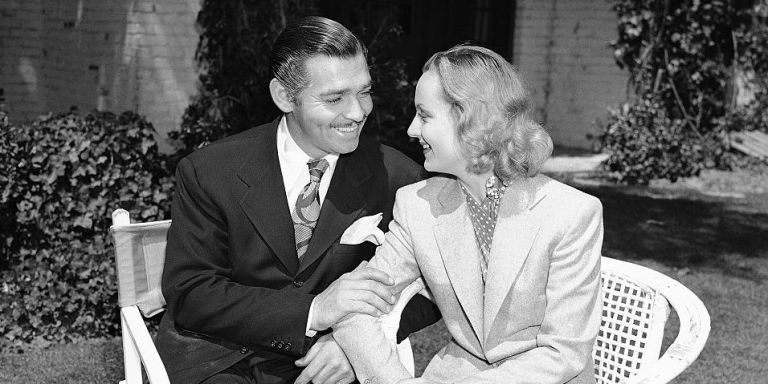
Those two, Gable and Lombard, like Elizabeth and me, finally found each other, married. Tragically, Lombard died in an air crash soon after Pearl Harbor, during a War Bond Drive. It’s an incredible and incredibly sad love story.
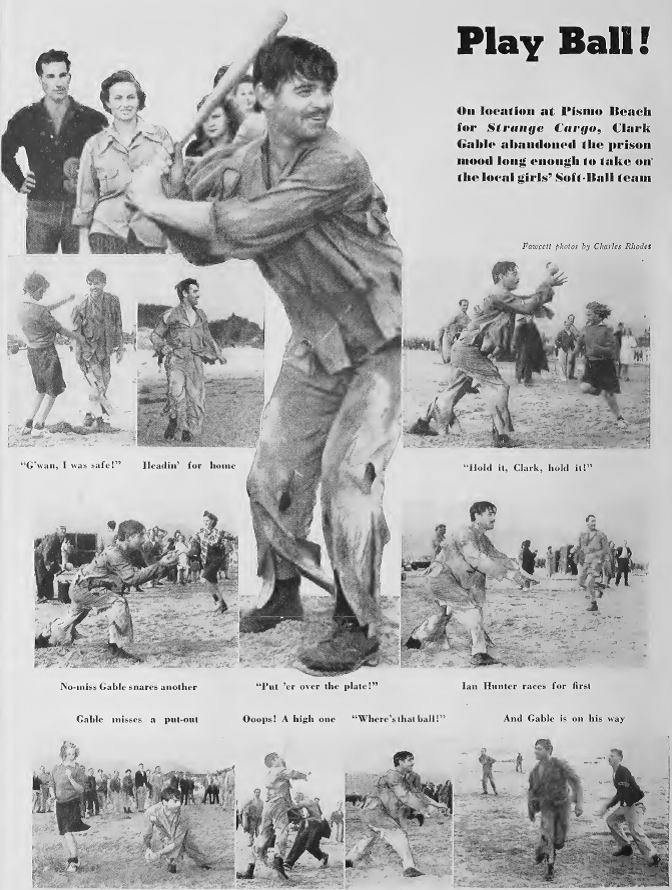
The two were part of our history, San Luis Obispo County’s history, too. They’d been guests at the Hearst Estate in San Simeon and, six years after It Happened. Gable and Joan Crawford filmed Strange Cargo in Pismo Beach, stayed at the Landmark Hotel, which is still there, on Price Street, and one day, The King of Hollywood thrilled a group of San Luis High kids by joining them in a pickup game of softball n the beach.
But here are some of the things that caught my eye in last night’s viewing, thanks to Dave Karger’s inspired introduction:
A quick summary: Claudette Colbert (Ellen) is running away from her father–she gracefully dives from his Florida yacht and swims to shore—so that she can marry a man, King Westley, an aviator who looks like Howard Hughes, as played by Bela Lugosi. He’s a creep. So she’s incognito and riding an interstate bus north when she runs into Gable’s reporter, Peter. Peter needs money and Ellen, the runaway heiress, is his scoop. Ellen needs Peter’s street smarts. So they become uneasy seatmates on a northbound bus.
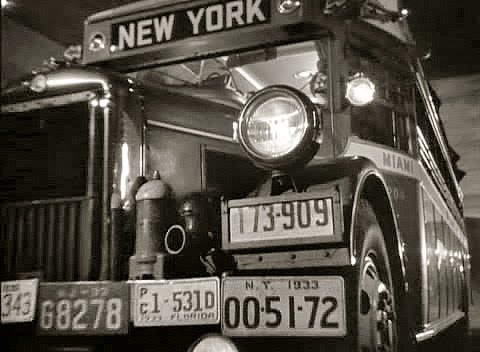
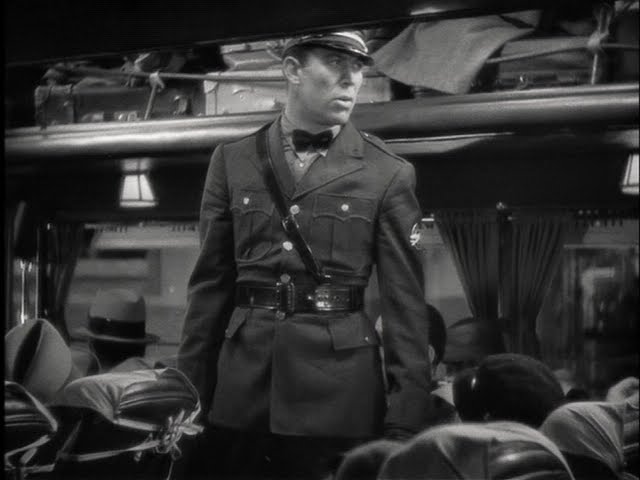
The bus alone is amazing: It’s big and square with fog lamps and headlights and an air horn that blasts when it pulls out of the terminal. It’s a damned impressive Atlantic Greyhound. So’s the driver: the first one is Ward Bond, who will have a bigger role in Capra’s postwar It’s A Wonderful Life, where he’s the Bedford Fall cop. But he’s uniformed impressively as a Greyhound driver, too, from his Sam Browne Belt to his soft high-topped boots.
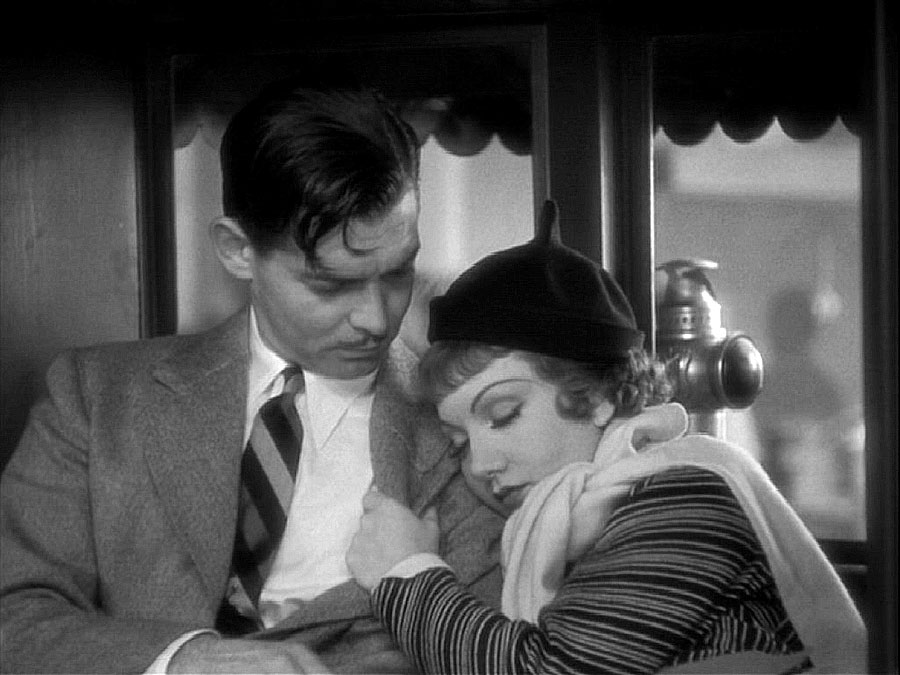
It’s all over for Gable, even though his hard-boiled reporter type won’t admit it, in the first night on the bus, when Ellen falls asleep against Peter. She is, let’s face it, adorable.
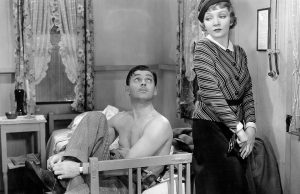
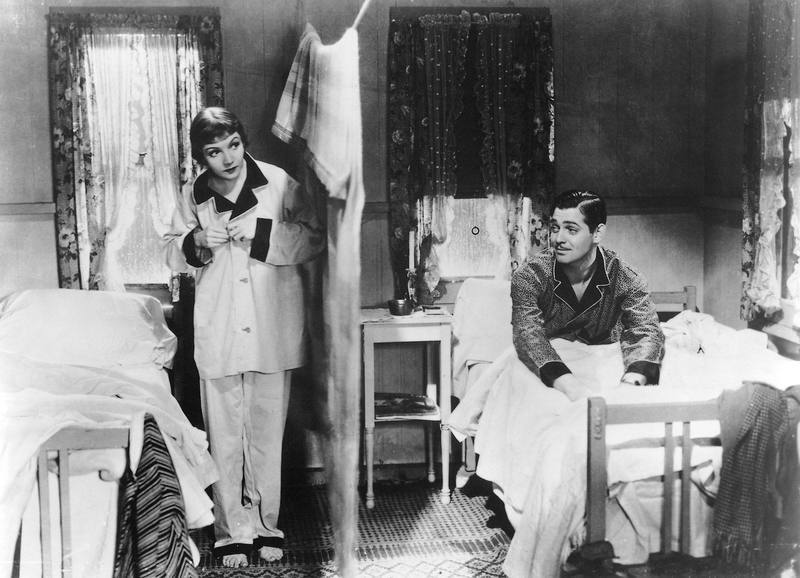
But the two, as is required, fuss and fight. She doesn’t carry cash. He doesn’t have it to begin with. So, when the bus runs up against a bridge washout, they have to share a room at an overnight camp. That, of course, leads to the film’s most famous scene, where Gable undresses and reveals to the world that Peter does not wear undershirts. I guess Jockey took a hit after that scene. He loans Ellen his best pajamas and erects a divider—“the Wall of Jericho”—between their beds for decency’s sake. The next morning, when Ellen clumps to auto court showers in Peter’s overcoat and oversized shoes, Colbert somehow makes even a clumsy walk seem charming.
Still, you’re glad when spoiled Ellen has to learn to stand in line in a place that closely resembles the Weedpatch Camp in The Grapes of Wrath. Another part of this film’s allure is its uncanny ability to transport you back to 1933, when it was shot, and to the Great Depression.
Ellen’s lucky to have that shower, and those pajamas and that overcoat and those shoes—-and the toothbrush and toothpaste that are Peter’s little gifts.
And therein lies Peter’s charm. He’s cocky, a big drinker, insubordinate and not quite as smart as he thinks he is. He passes himself off as an expert at hitchhiking, piggy-back riding and the art of dunking a doughnut. But he is also, with the exception of stealing Alan Hale’s Model T and tying the man to a tree (Hale deserved it, if only for his awful singing), he is decent. He is, to use an old-fashioned word that needs desperately to be revived, honorable. He is also generous; he is, to borrow Joseph Campbell’s remarkable observation about Han Solo, “a hero who doesn’t know that he’s a hero.”
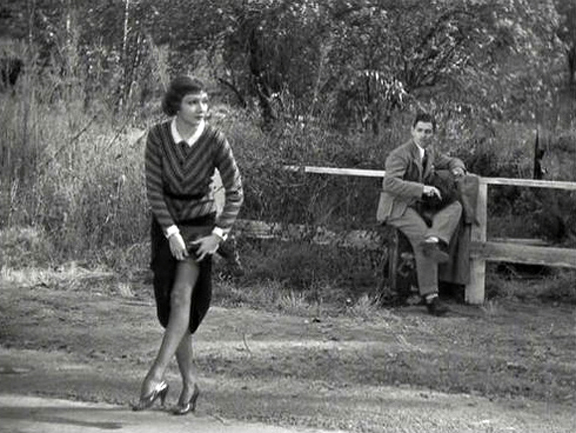

And Peter makes breakfast, too. The doughnut-dunking scene meant a lot to me. The film was made in 1933, when the Depression was at its depths, and the care with which Peter and Ellen share a breakfast— two eggs, two doughnuts, two cups of coffee—made me a little hungry and made me, in some silly way, want to march in and add hash browns, ham, biscuits and gravy and another pot of coffee. That kind of extravagance—the big breakfasts I love so much— just wasn’t there in 1933.
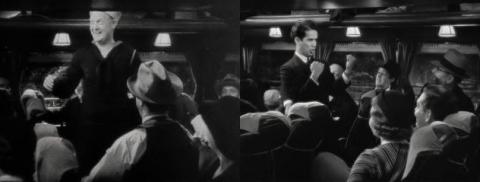
The intimate scenes between the two principals are barbed and funny and eventually they are…well, intimate…but one of my favorite scenes comes on the crowded bus, when the passengers joint in three rousing choruses of “The Daring Young Man on the Flying Trapeze,” which includes a sailor whose verse is pretty racy for 1934 (“His eyes would undress every girl in the house…”) and who looks remarkably like Popeye, who would also sing this song.
I noticed for the first time that the third and final verse is led by the director. That is Frank Capra, painfully young but already wise enough to know that we Americans are at our best when we are together, even if singing this song, than we are when we battle each other. The one painful part of the film comes when the bus stops and a Black man, ringing a bell, bellows out what’s on the menu in Stepin Fetchit English. He’s a moment of comic relief, a kind of cinematic comma, and while Capra has so much to offer modern, divided, Americans, this scene, mercifully brief, hurts.
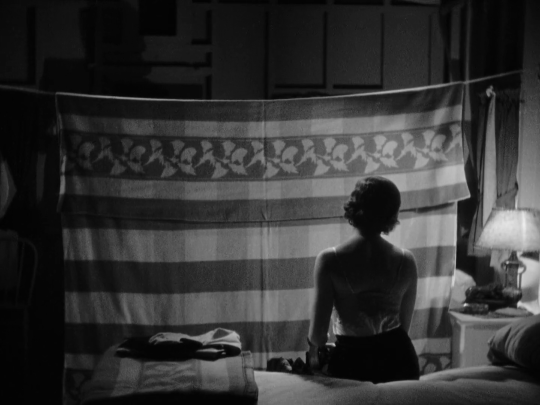
The battle between Ellen and Frank begins to end in their stay at another auto court, considerably more rustic than the first, when the blanket goes up again. This is Ellen, on her side, as she realizes that she’s in love with the arrogant man on the other side and not with the man she’s running away to for her New York wedding. This might be the film’s most poignant scene.
When her intended arrives at the wedding in his ludicrous gyrocopter—wearing a top hat, which you wish the rotors would lop off, along with his head—Peter is in the den of Ellen’s father, demanding he be paid for his efforts in returning the prodigal daughter home.
That amounts to $39.60.
That seals the deal for Ellen’s father. His sideways whispers as he takes her to the altar lead to her to dump King, Mr. Hughes-Lugosi, right then and there. Gasps ensue.
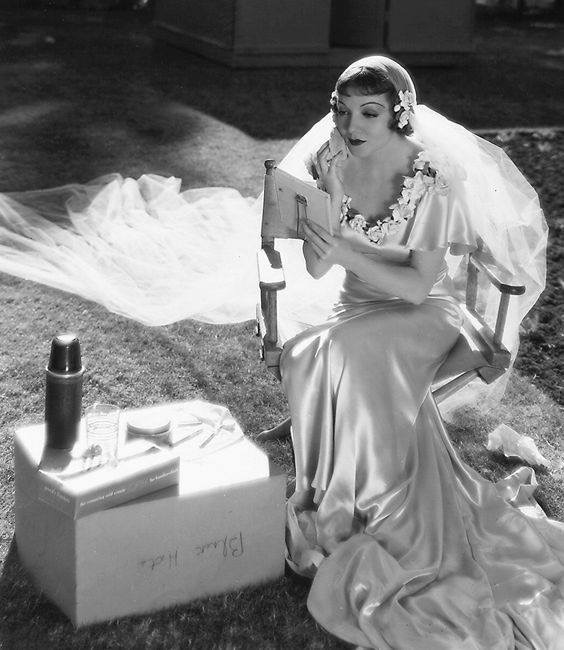
I don’t know how many runaway bride films have been made, but this one has set the standard, as far as I’m concerned. Ellen’s breath-taking wedding gown, satin, is stunning, from the cloche headdress (like Colbert’s bob, it’s on the edge of going out of style) to the train which trails behind her, by about the length of three freight cars.
A little earlier, stuck at a crossing in his Model T, Peter waves jauntily at a freight car loaded with what were called “hoboes” in 1933. My grandfather John let men like these stay the night at his farmhouse on the Ozark Plateau while my grandmother made them bacon and eggs. They were poets, engineers, one a classical violinist who played by the warmth of my grandmother’s stove.
Decency.
So Ellen, quite sensibly, runs away to her destiny.That would be with Peter.
The Walls of Jericho come down later, in a third auto court somewhere in Michigan, maybe in the Upper Peninsula, where Gable would’ve found fine fly-fishing. That would mean trout frying for breakfast, just like Hemingway’s “Big Two-Hearted River.” That’s another meal altogether, of course, but. there’s a common link between Hemingway’s prose, and Capra’s films. They are miraculous to me. They are miraculously American.
A little meal was the centerpiece of this little film. It Happened One Night, I think, is the equivalent of a breakfast of one egg, one doughnut, and one cup of coffee. By the time it’s over, you realize, in making every bite count, that it was perfect.
 A Work in Progress