
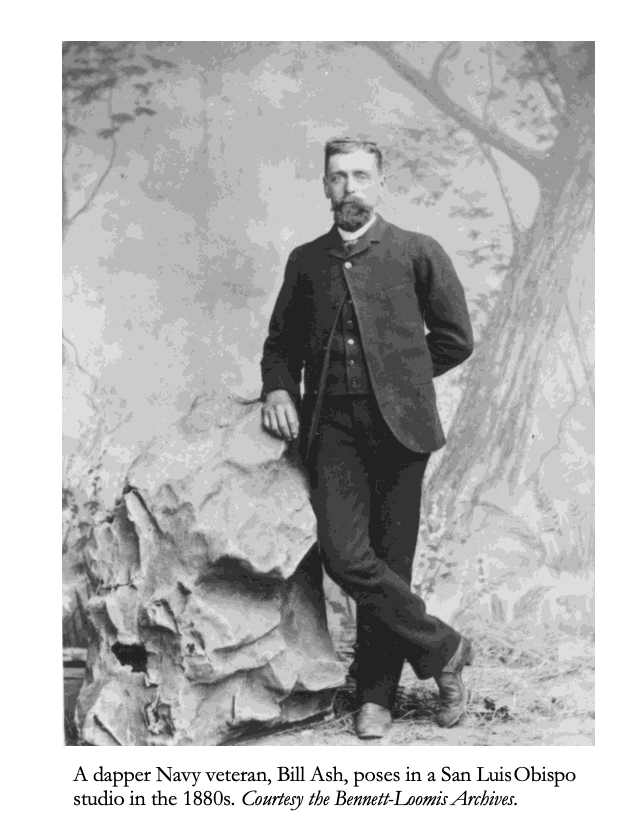
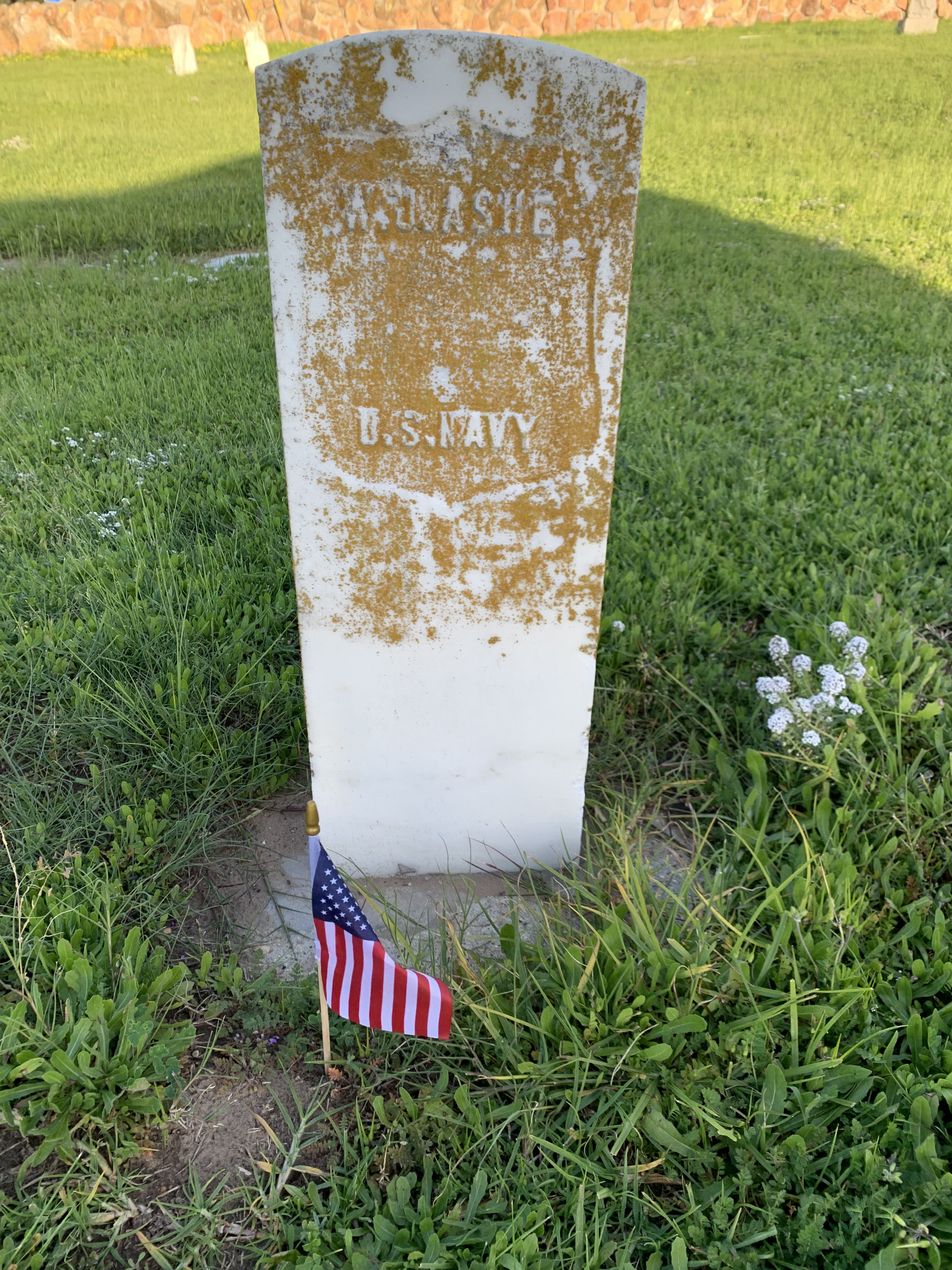
We can’t even get his name right. The majority of newspaper and official records spell it the way I did in the caption above, from the Civil War book Patriot Graves. But Bill Ash’s tombstone adds an “e”—Ashe—as does the tombstone of his son, both buried in the Arroyo Grande District Cemetery. A researcher nicknamed “Big Sur Baby,” who is diligent and valuable, lists at least one other name for him, “Charles Lewis,” on the website findagrave.com. There may have been at least one more name he gave himself in what turned out to be a relatively short life.
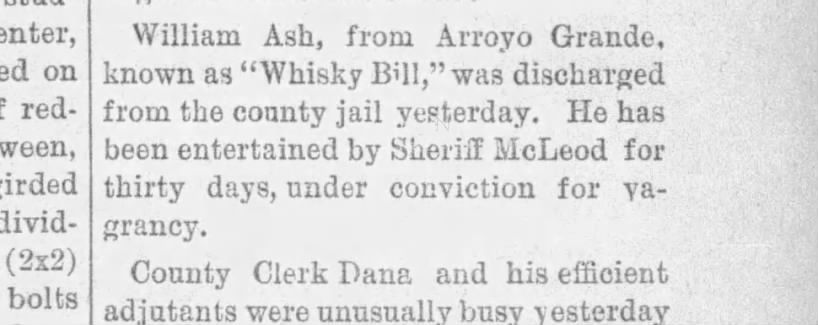
He was known, sadly, as “Whiskey Bill.” In this June 1889 clipping, he’s a guest of San Luis Obispo County Sheriff A.J. McLeod:
:
But in May 1861, he was a different man, an enlistee in the United States Navy only a month after the attack on Fort Sumter. Here’s the record:

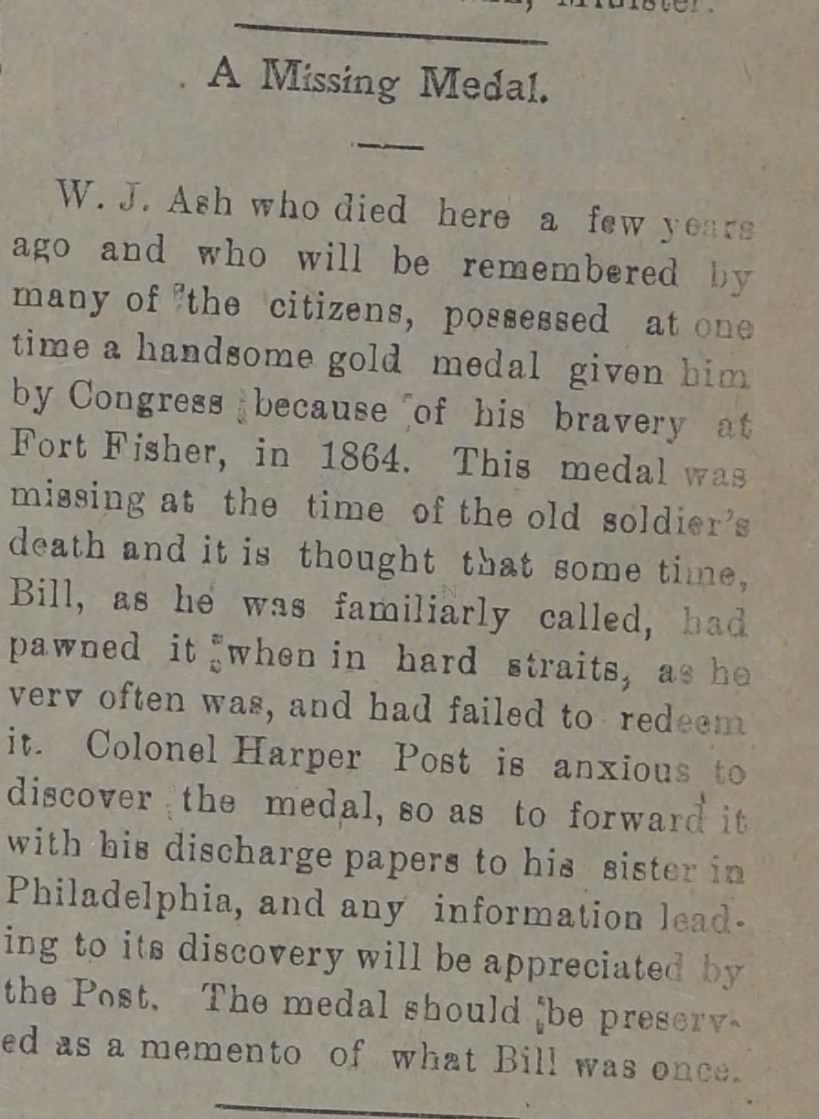
He’s a little fellow, about my size–it was more “average” in 1861–and his prewar occupation was, in fact as a “mariner,” so he was not a fresh fish in Lincoln’s navy. He’s twenty-six, born in Philadelphia, but I haven’t been able to learn much more than that. He’s enlisted for two years, but he served far longer than that. This poignant story is from an 1898 Arroyo Grande Herald-Recorder. I guess Bill Ashe needed whiskey money:
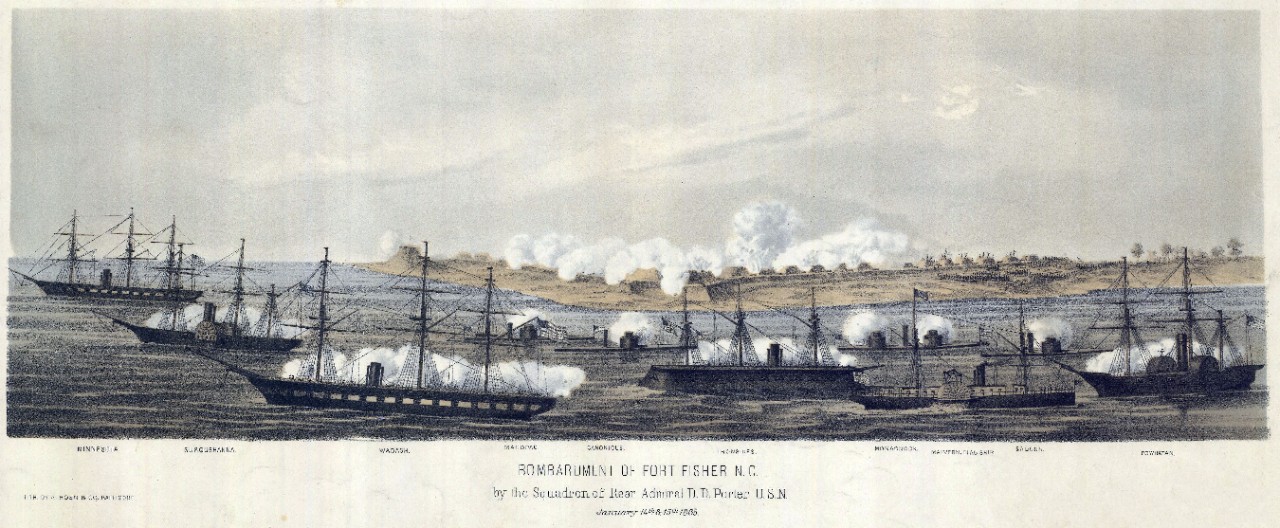
He wasn’t an “old soldier,” of course. He was a sailor, and a member of David Porter’s North Atlantic Fleet, seen in this photo leaving for Fort Fisher, a Confederate stronghold guarding Wilmington Harbor, North Carolina, in December 1864.
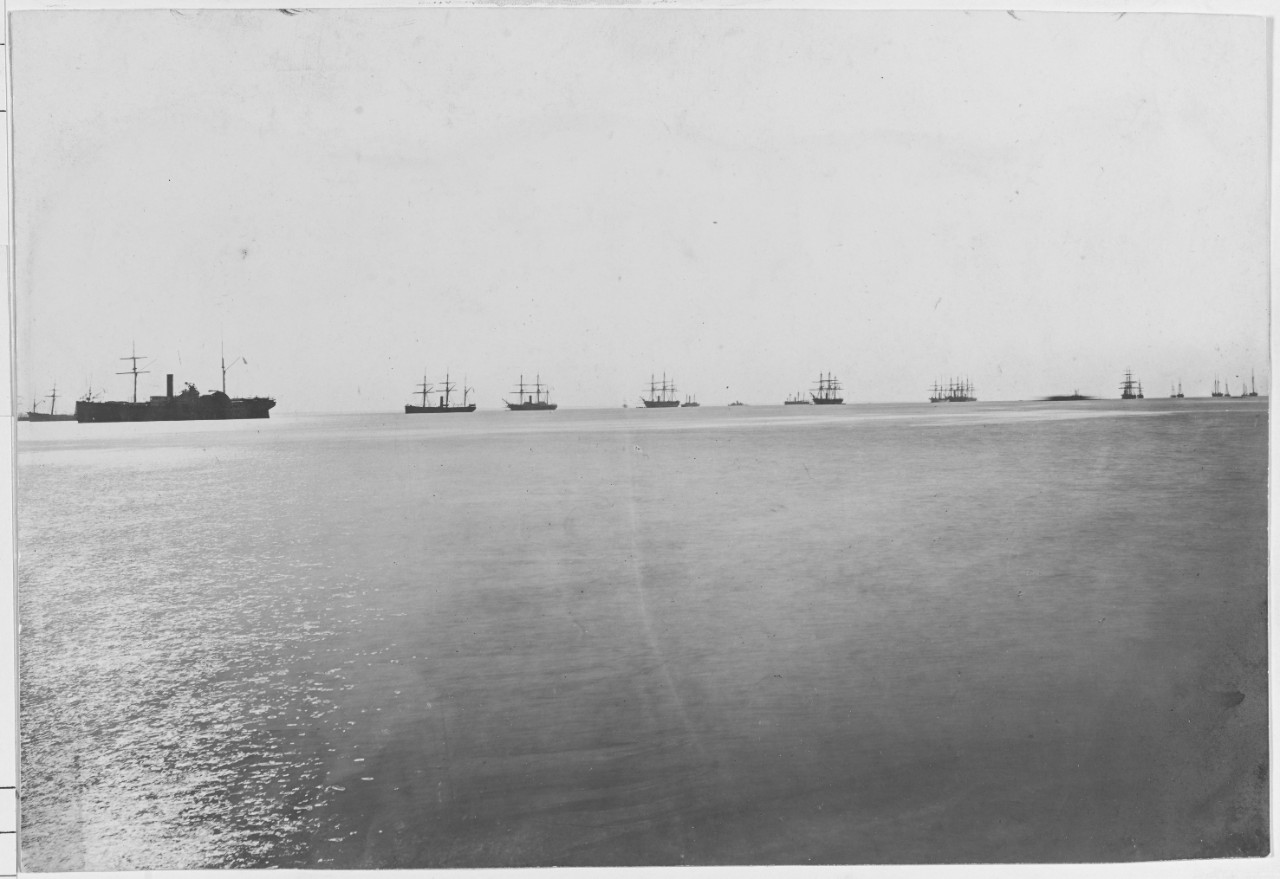
The assault was commanded by Gen. Ben Butler, notorious for his corruption as a military governor in New Orleans, and by Admiral Porter, who’s had a brace of warships named for him. Despite what was the heaviest naval bombardment in history up to that time, the 1864 assault ultimately failed.
I cannot find a record—yet—of that handsome gold medal that Bill Ashe earned and I wondered how he might’ve earned it. Bombarding an enemy fort from a relatively safe distance doesn’t seem to be heroic, unless you’ve actually done something like that.
Then I found this illustration from a U.S. Navy website:

So it’s possible that Ordinary Seaman Ashe earned that recognition for heroism on dry land, on the kind of frontal assault that reminds you of the doomed one undertaken by the 54th, on Fort Wagner, in the film Glory.
Bill survived Fort Fisher—it would fall the following year, 1865, a moment featured in Spielberg’s Lincoln, when the president’s about to tell his Ethan Allen story.
Ashe would be a Navy man for a long time. Big Sur Baby notes that one of his ships was the USS Jamestown, a sloop of war. This wouldn’t have been his ship at Fort Fisher—Jamestown was then in the Pacific, protecting merchant ships and whalers from Confederate commerce raiders.
After the Civil War, Jamestown remains a presence in the Pacific, showing the flag as far west as Tahiti and as far north as Sitka, until, in 1872, she becomes a shipboard training school at Mare Island, San Francisco. That’s the year when we find Bill again in this Navy record:

He’s an Old Salt now—thirty-eight years old—and has acquired, along the way, two tattoos: a ballerina on one hand and his initials “W.A.” on the other. After 1872, I was able to find a couple of possible Bill Ashes in northern California, but the next solid lead came in my hometown, Arroyo Grande.
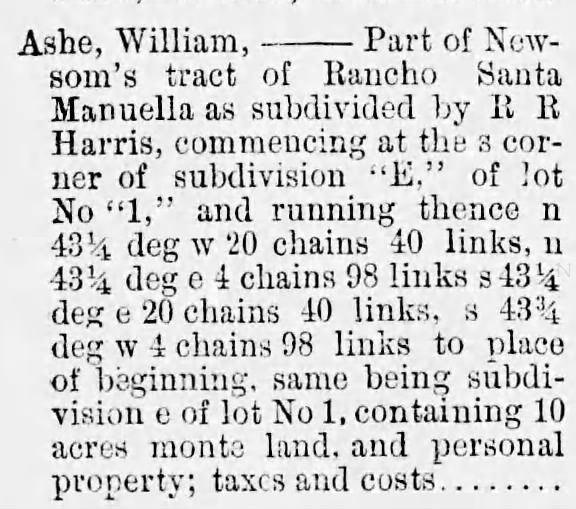
This notice, in February 1882, reveals that Ashe has acquired ten acres of land in the Upper Arroyo Grande Valley, potentially bottom land passed down from town founder Francis Branch and his son-in-law, David Newsom. But there’s a caveat: It’s “monte land,” which means that, like most of the Arroyo Grande Valley, it’s still covered by monte–a dense mixture of scrub, including willow, that was as sharp as razor wire. That’s why Branch’s vaqueros wore leather chaps: chasing a runaway calf into the monte would cut a cowboy’s legs to pieces without the protection of his chaps.
So you guess that Bill began to clear his ten acres. My friend, historian Shirley Gibson, has told me that Bill was an extraordinarily hard worker who, in the years after this, took his pay in whiskey for clearing the monte off his neighbors’ land.
I am not sure what happened to Bill. It’s likely that he’d always struggled with alcohol addiction. While I am no psychiatrist, Bill’s seemingly precipitous decline may have begun with a brief life recorded by this tombstone in our cemetery:
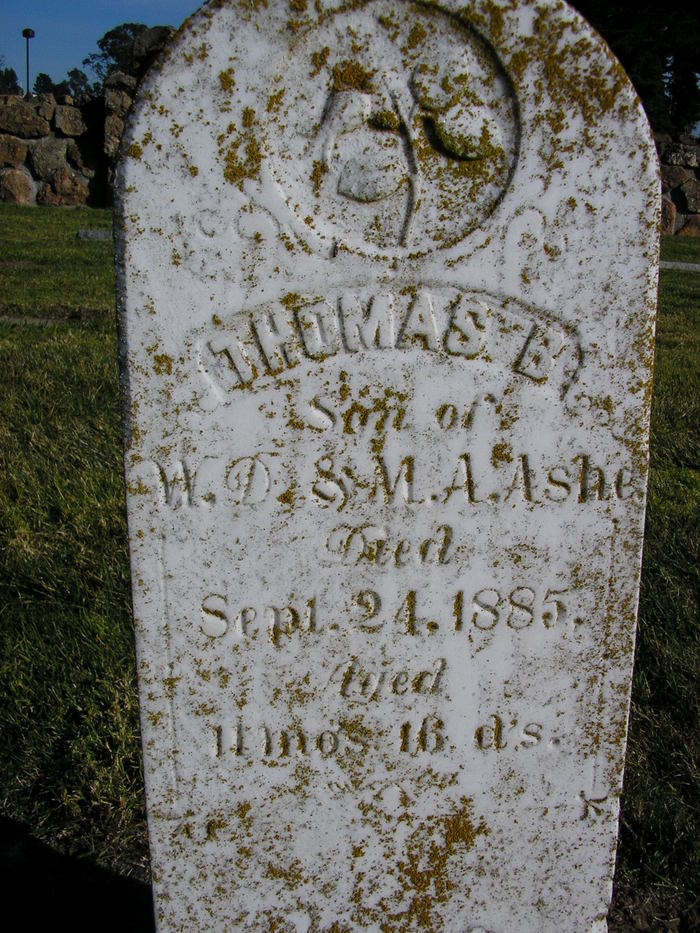
I haven’t been able to find out a record of Mrs. Ashe, but the fact that Thomas’s age was calculated down to the days is revelatory to me. Bill would have been fifty-one in 1885, and Thomas, a name I’m fond of, must have been a great gift to him at that age. For a man whose life might’ve seemed to have reached its zenith at Fort Fisher in 1864, this little boy pointed to the future. You wonder if Bill’s future died, too, on September 24, 1885.
Four years later, Ashe is the guest of Sheriff McLeod, only to be humiliated in the local paper.
But in January 1892, the county Board of Supervisors reminded the navy veteran—and the rest of San Luis Obispo County, too—that they remembered “what Bill was once.” A road tax is levied on the farmers of the Upper Valley, with this notable exception in the language of the ordinance:
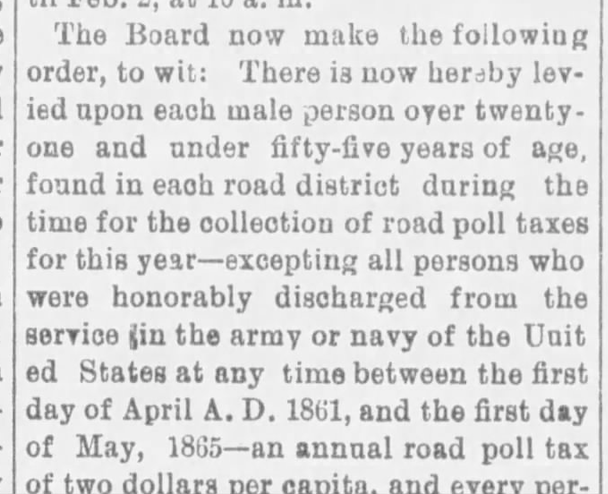
There were plenty of Army veterans in the Upper Valley—Erastus Fouch and Sylvanus Ullom, Gettysburg veterans, are just two examples—but there is only one Civil War navy veteran in our history, the only one buried in our cemetery, and that’s Bill Ashe.
Ashe’s death, from a stroke, came soon after this seemingly minor honor from the gentlemen who made up the Board of Supervisors. Twenty-eight years after— and a continent away from Fort Fisher, North Carolina—I don’t think the honor they paid Bill Ashe was in any way “minor” to the Supervisors.
The most memorable navy battle of the Civil War began today. On March 8-9, 1862, USS Monitor fought her duel with CSS Virginia in Hampton Roads, Virginia, and the little Monitor, with her rotating gun turret, presaged an age of American battleships that would dominate the U.S. Navy until December 7, 1941, when Arroyo Grande lost two sailors on USS Arizona.
So it’s a good day, March 8, to remember a Union Navy sailor like Bill Ashe. I will take him a little American flag tomorrow.
 A Work in Progress