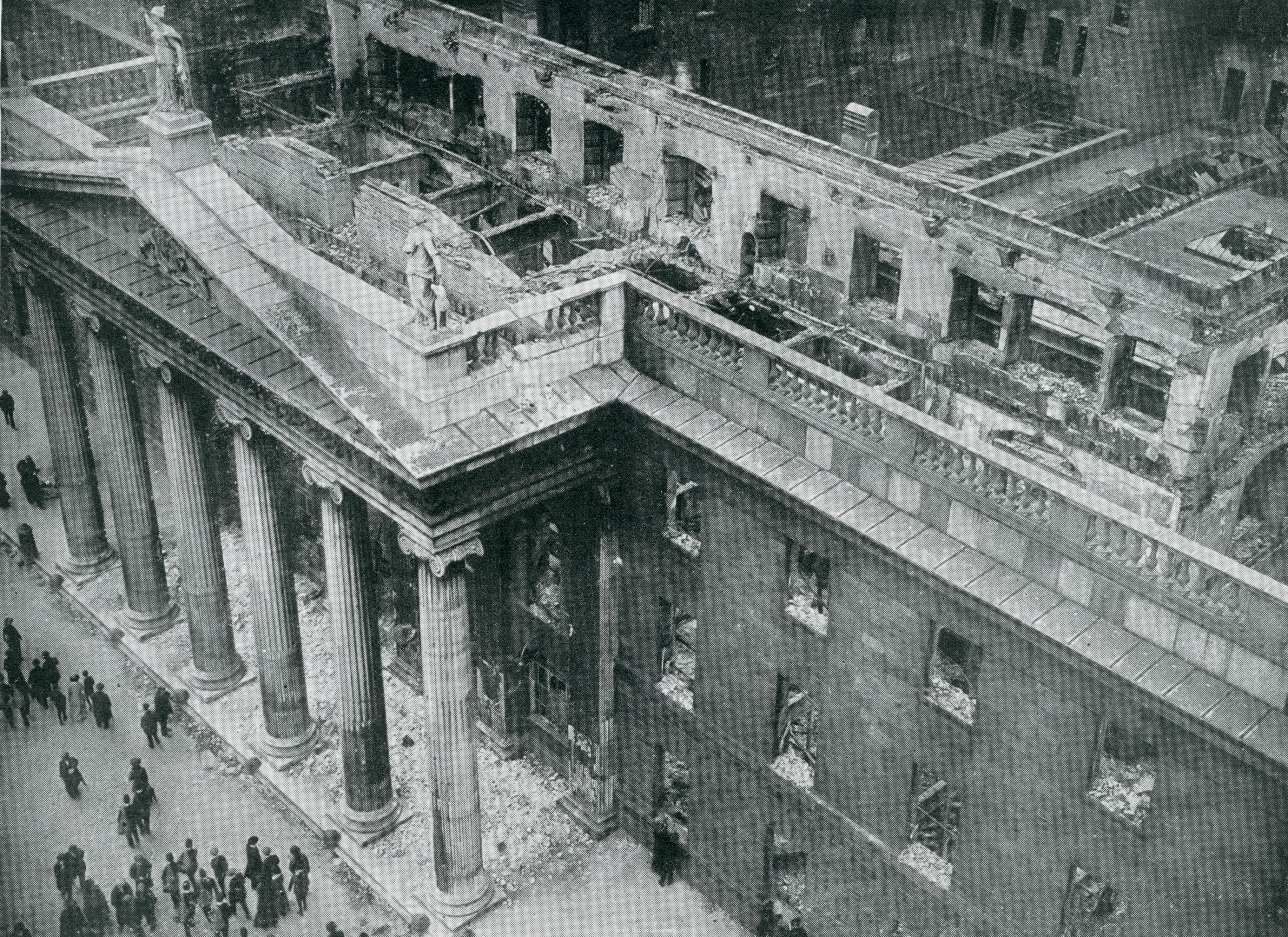
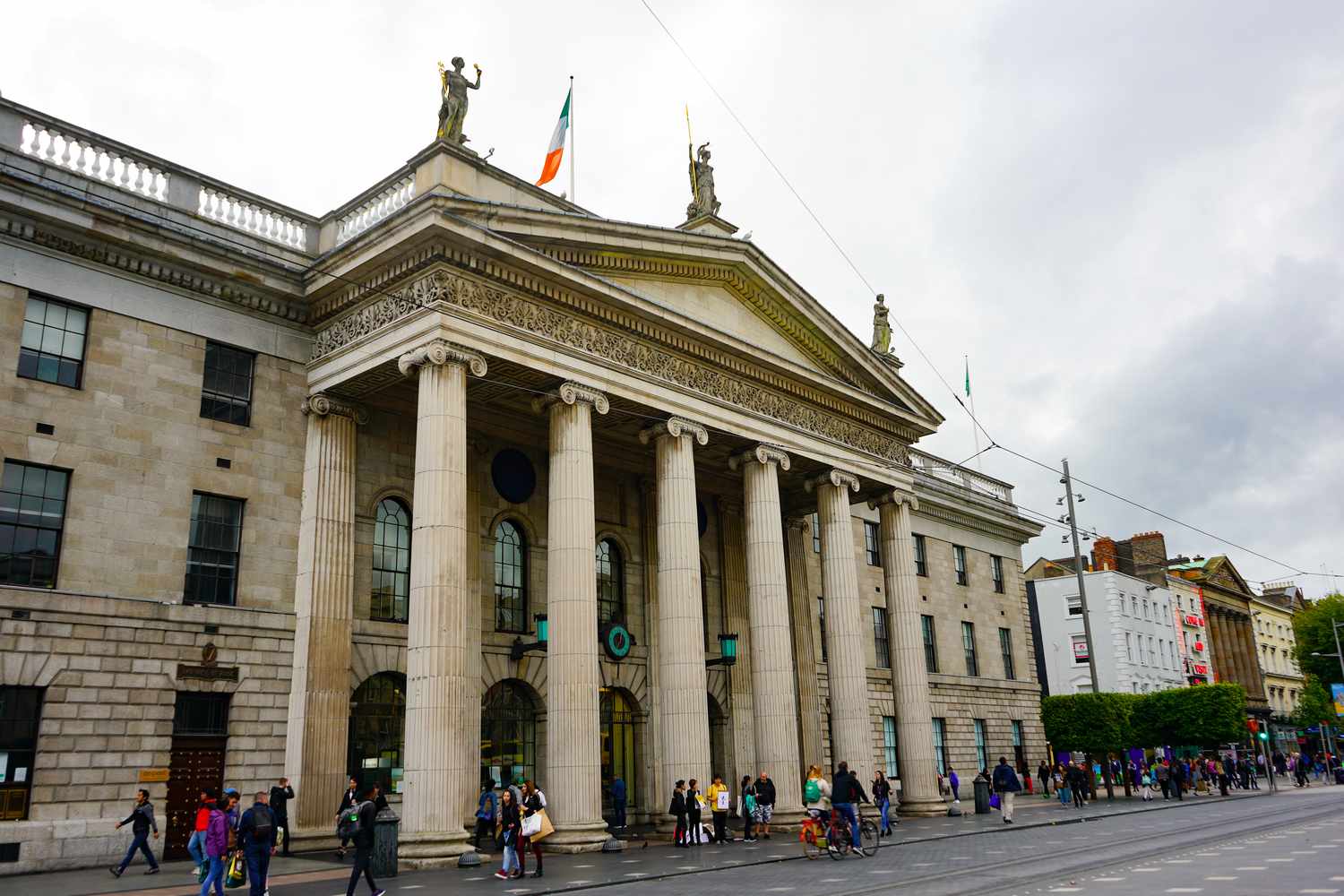
When we took our high school students to Ireland many years ago, we of course visited the General Post Office, the GPO, the headquarters and last stand of the Easter Rising in 1916. And, yes, you can still the gouges and chips left by British Lee-Enfield rifles (the same weapon that killed American civil rights leader James Meredith) in the columns and the face of the graceful Neoclassic building on O’Connell Street. That attempt to free Ireland from British rule was a disaster: poorly conceived, poorly equipped, a grand vision of noble Romantics. When they surrendered, they were vilified by Dubliners as they were led off to gaol.
This clip, from MIchaell Collins, captures the end of the Rising (Alan Rickman is Eamon de Valeara, the future president of the Irish Republic.)
The Rising didn’t work. It was the executions that did. Sixteen rebel leaders were shot (one hanged) at Kilmainham Gaol. One of the rebels, James Connolly, had been so badly wounded in the assault on the GPO that he had to be propped up in a chair for his firing squad. Another, Joseph Plunkett, was given the brief mercy of marriage to his sweetheart, Grace Gifford, on May 3, 1916. The couple were allowed ten minutes together. Plunkett was shot the next morning..
Grace kept his eyeglasses, and they are now on exhibit at the Kilmainham museum. She was later a prisoner there, where she painted the image of Our Lady on one wall of her cell.
The British made a mistake in executing the sixteen men. The prisoners whom Dubliners had hissed in April had become martrys by May.
We had an uncommonly wise bus driver on that student tour to Ireland. “JIm,” he said to me, “the winners write the history. The losers write the music.”
And so that is what the Irish did.
This song, with Sinead O’Connor and the Chieftains, memorializes The Rising. (The Middle Eastern place–names refer to distant battlefields where irish soldiers were giving their lives for the British Empire; the “LIffey” is the river that bisects Dublin and connects to the Irish Sea.)
It’s the same old theme/Since 1916 …
As Faulkner famously—and accurately—proclaimed—“The past isn’t dead. It isn’t even past.” That snatch of lyric above comes from eighty years after the Rising, in a song that led to one the most extraordinary music videos ever made. From Dolores O’Riordan and The Cranberries:
So history has a habit, life the cottony contrails of an overhead jet, of leaving a trail behind it. The problem with Irish history—or, in my experience, wtith Mexican history or Civil War history—is that the vapor trails far above us, unlike those of airliners, never quite go away.
And this is “Zombie,” as performed by Australians. Some of them have Maori ancestry, some had parents from Singapore or Indonesia, and maybe some are descended from the Irish banished to Australia when it was a penal colony. The losers write the music, Ken said. There’s not a loser in this video. For a few minutes, they are, instead, Irish. Every last one of them.
 A Work in Progress