
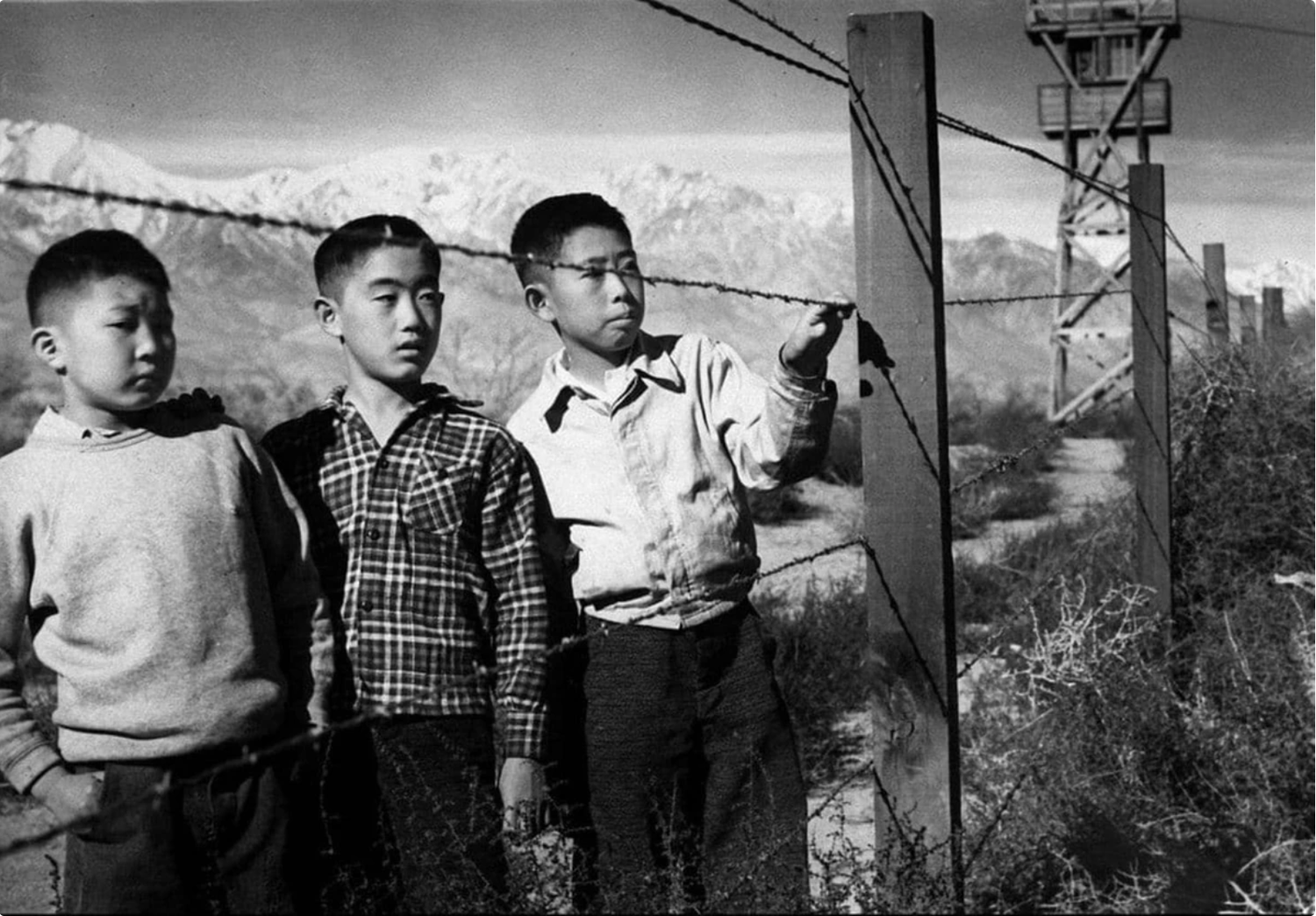
I am to speak briefly as a small part of a bigger event this morning at 10 a.m., for the performance of a musical piece called “Behind Barbed Wire.” I think this is what I will say.
Because I graduated from and taught at Arroyo Grande High School, I needed my school to bring clarity to what I have to say today.
Twenty-five of the 58 members of the Class of 1942 were Nisei. They’d played basketball–the 1941-42 starters included three Nisei players. So were the quarterback and halfback for that year’s football team.
So were the teens who’d played baseball for Juzo Ikeda and Vard Loomis.
The principal’s secretary was Nisei. So was the assistant editor of the “Aerie,” the yearbook, and the sports editor of the “Hi-Chatter,” the school newspaper. So were three officers in the ASB. So was the student speaker for the FFA’s parent night.
The previous year, so was the winner of a scholarship as the high school’s outstanding student So was the senior recognized as the outstanding science student.
Most of them been seventh and eighth-graders at the new Orchard Avenue School, a WPA project completed in 1937. Their fathers, as volunteers, landscaped the new schoolgrounds. At a PTA function that year, their mothers shared a tea ceremony with their friends.
Five years later, this all changed. 1400 of our neighbors in in San Luis Obispo County and northern Santa Barbara County were sent into exile. This is what that was like in Arroyo Grande.
On April 30, 1942, South County families met waiting buses at the high school, outside what is today the Paulding Gym, and there was a poignant moment when the Woman’s Club brought box lunches from the French Café, in the Olohan Building, for the long ride to the Tulare fairgrounds.
The loaded buses then would’ve crept down Crown Hill in low gear, on their way to the two-lane 101 on the western edge of town. Their passengers, crammed inside with their luggage crammed in the bellies of the buses, would have passed, along Branch Street, familiar places, from E.C. Loomis and Son at the base of Crown Hill to the twin churches, Methodist and Catholic, just before the 101.
The Nisei children and teenagers who grew up here, who had never known any other place, did not know whether they would ever see these places again, all the little shops they’d known all their lives.
Many of them wouldn’t.
Just past the churches, the buses turned north to make the connection for the long, colorless journey into the San Joaquin Valley.
If you grew up in Arroyo Grande, as I did, that day was, in peacetime, almost the equivalent of Christmas Eve. One of the teenagers on one of the buses remembered, years later, that it was the day before trout season opened.
The Manzanar Fishing Club risked getting shot by creeping beyond the wire to fish for trout at night. There are Gila Trout in the Gila River beyond the wire of our neighbors’—our ancestors’— desert camp. I don’t know if there we were similar subversive trout fishermen there.
I hope so.
One of the Manzanar fishermen said, “When you’re fishing, you forget everything that’s wrong.”
Today, of course, we are here to remember instead.

 A Work in Progress