I guess that sometimes videos go viral. Less often, they go cosmic. That’s the case with this young man. It began when Henrick Christiansen decided to try out the food in the Olympic Village. It was unremarkable.
Until the chocolate muffin.
Thus began a love affair, and evidently one the American men’s gymnastics team share.
But only Henrik made a series of delightful videos to pay tribute to this new object of his affection.
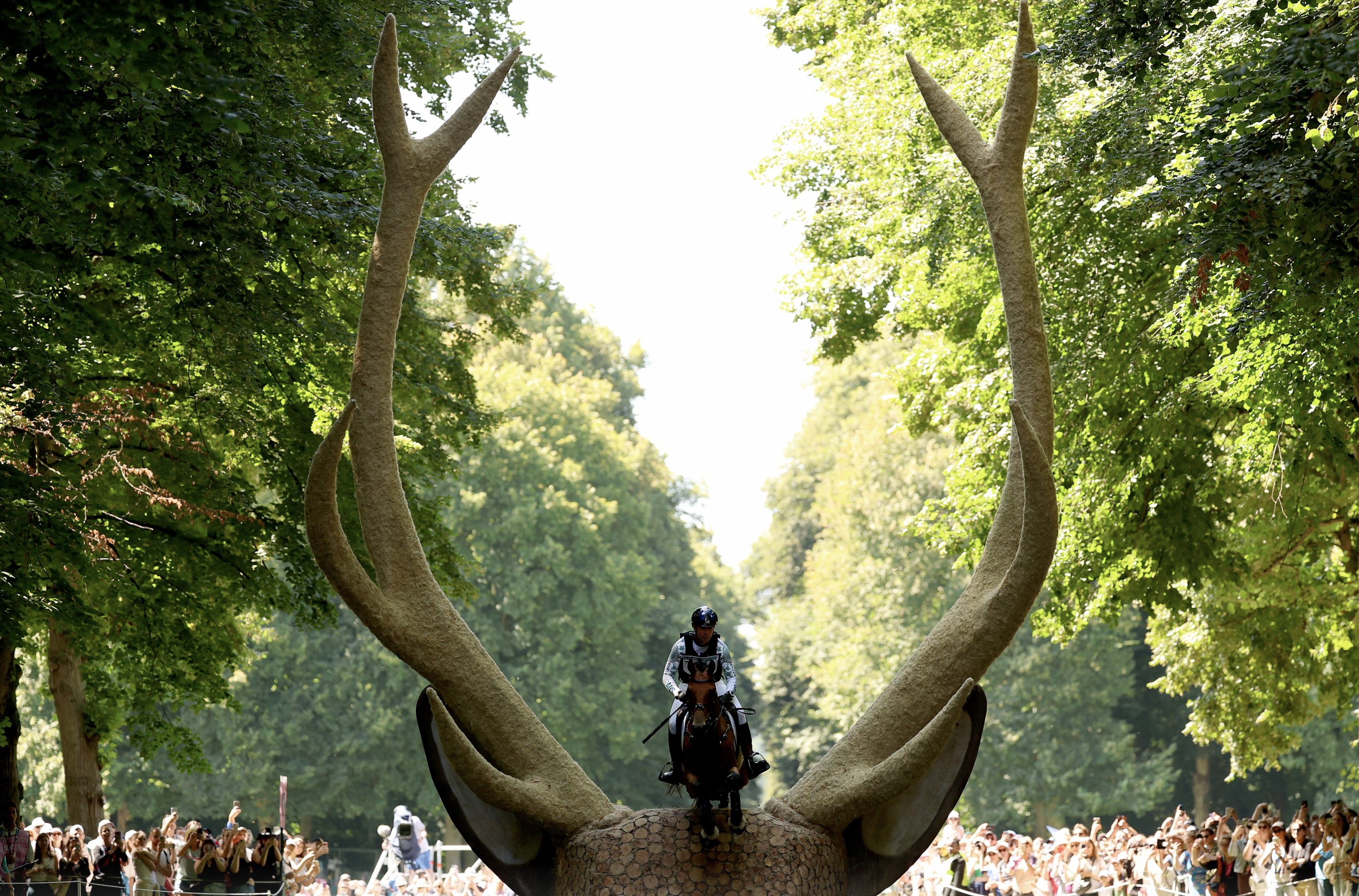
Laura COLLETT (GBR) & LONDON 52 compete in the cross country phase of the eventing competition at the Paris 2024 Olympic Games – Versailles, Paris, France 28 July 2024 – photo Jon Stroud Media
What a setting for a memorable event in the 2024 Paris Olympics: Day Two in the equestrian competition along a cross-country course laid out in Louis XIV’s Versailles.
Moroccan rider Slaoui riding Cash in Hand. AP Photo
Versailles, after all, began as a hunting lodge. The Atlantic
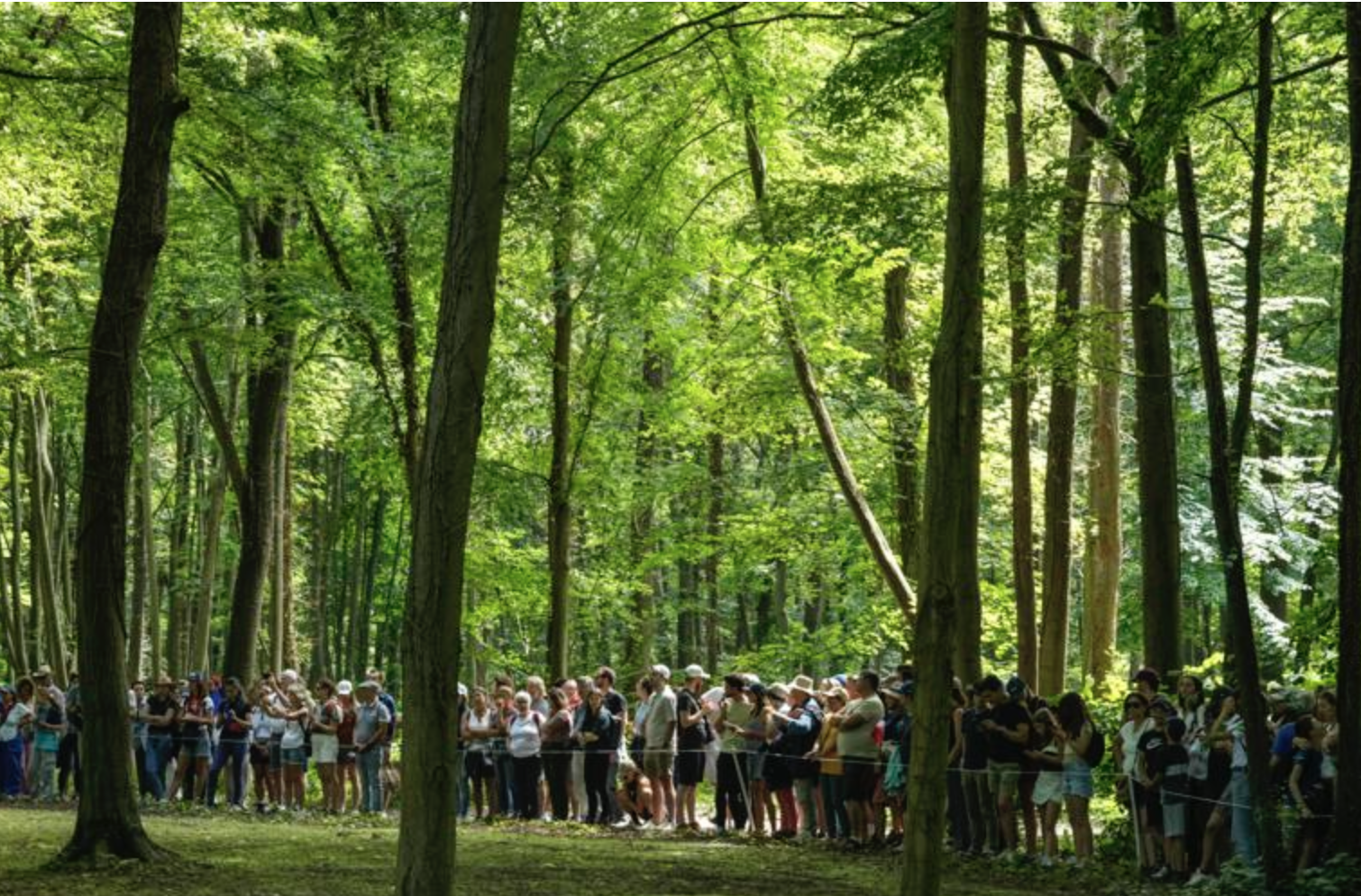
The two AP photos suggest that some of that forest where nobles once hunted survives today. When a baby deer, confused, jumped into the Grand Canal during the competition, eight or ten manly French firefighters jumped in to save her.
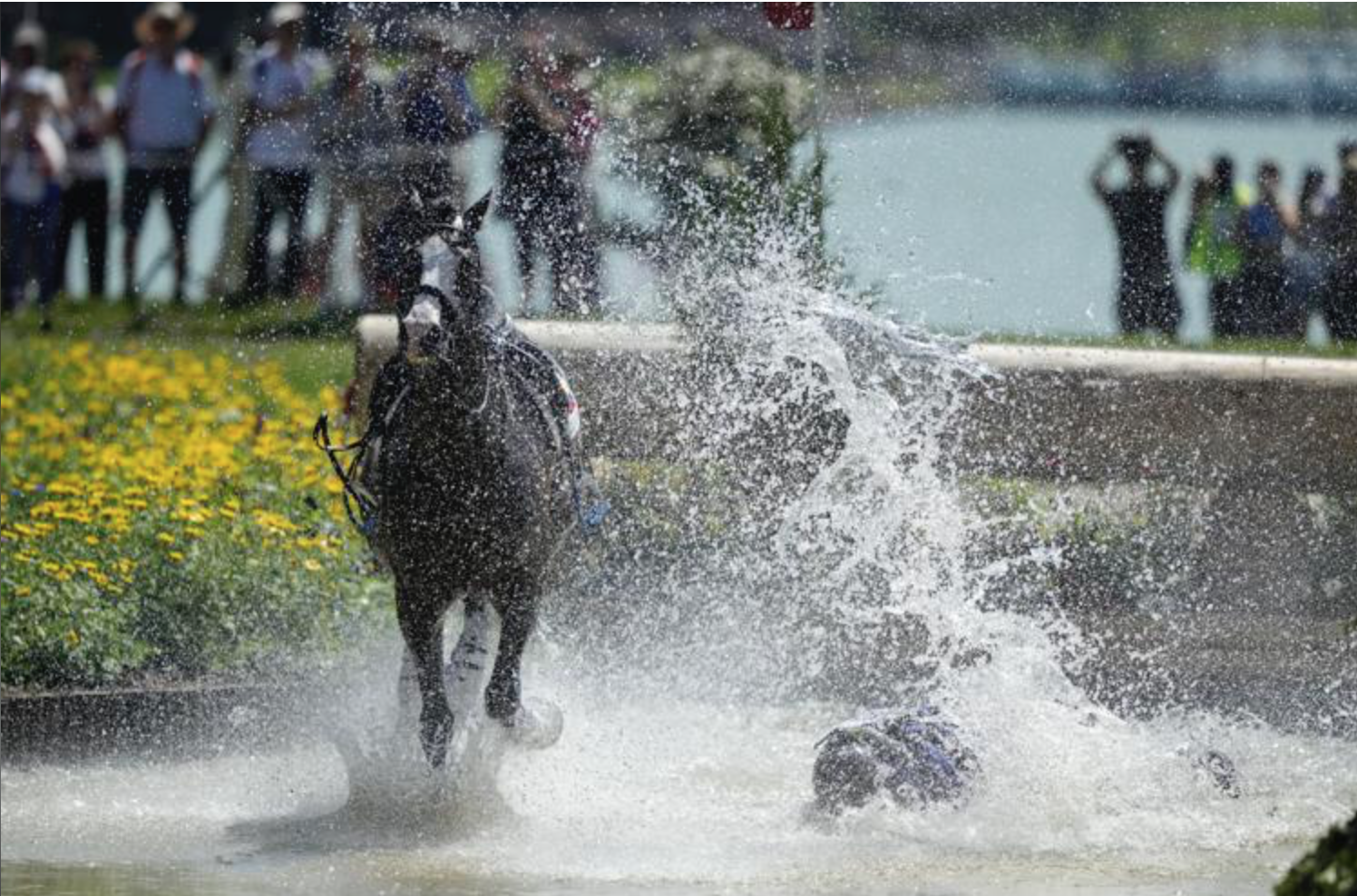
Versailles’ beauty may have been lost on this rider, from Ecuador.
But there were some beautiful jumps. Video by maetam2803
The Gold Medalist team: Germany’s Michael Jung and his whimsically named gelding, Chipmunk. This was Jung’s third gold medal. Chipmunk seemed unfazed, with a deceptively easy gait that belied how much ground he was covering on the cross-country course. They were amazing.
So this was an appropriate place for this competition. There were plenty of les gloires to go around.
I was on the rowing machine that goes nowhere (“Louie Louie” on the earbuds made me zip a little), when this little number popped up on one of my playlists.
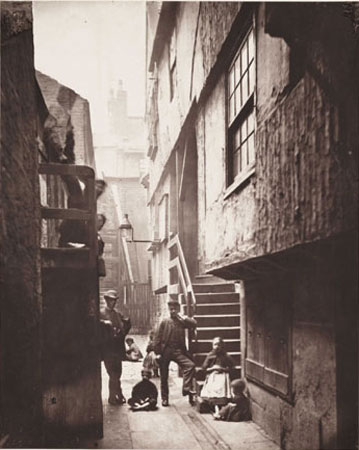
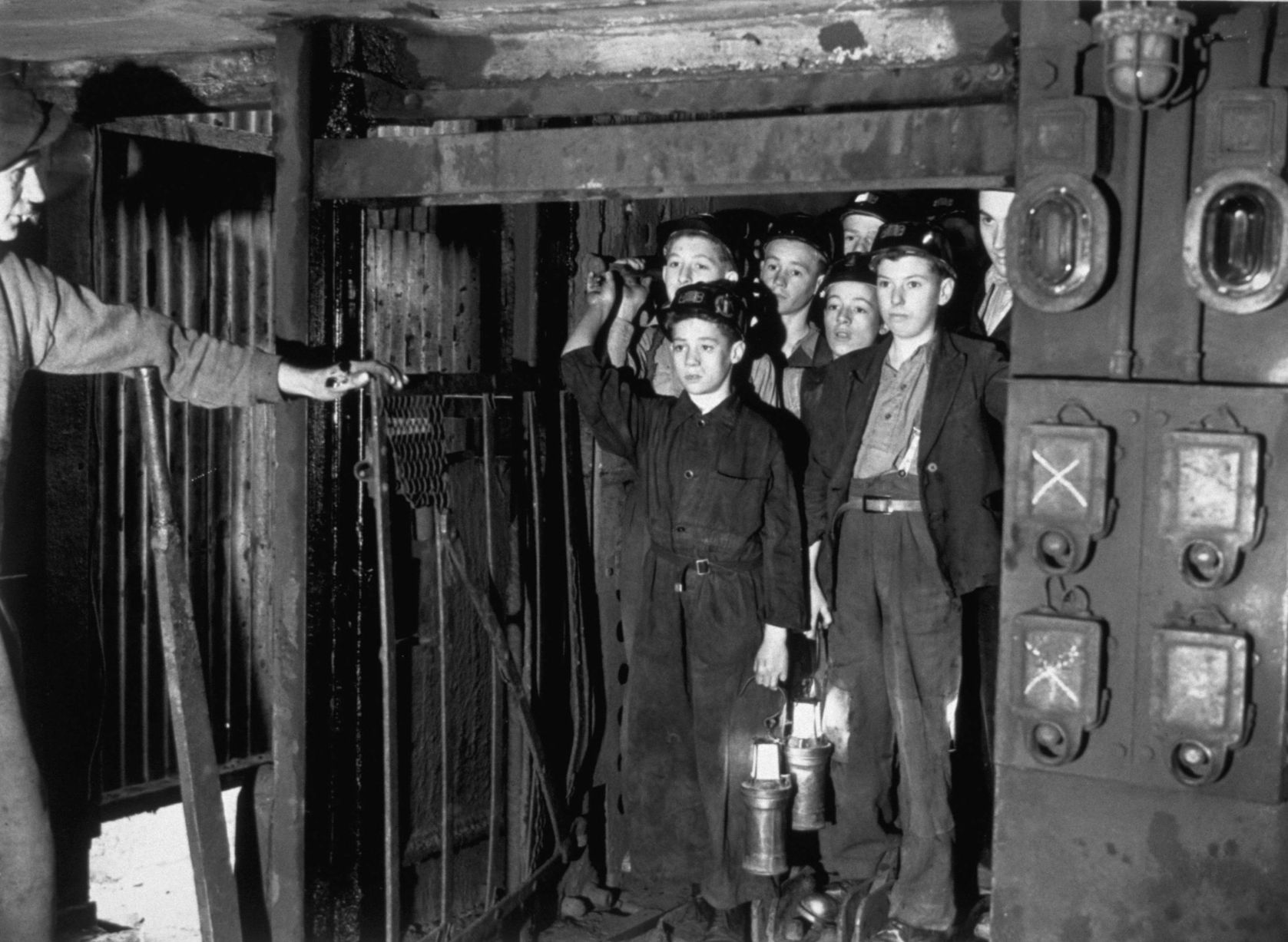
The Animals, from 1965. The lead singer, Eric Burdon, remains one of my favorites, with a surliness quotient, when he looks into the camera, that is sublime. They dress like Beatles. They don’t act like Beatles. And the lyrics, for a historian, are sublime: The sun didn’t shine in working-class tenements like this in Victorian/Edwardian London, in the photos below. Young women did die before their time was due—or, in 1965, were artlessly-smudged television models– often violently, and fathers did lie abed, worn out from factory labor or from the mines. These things lasted into the Animals’ childhoods. This is a wonderful song and a wonderful artifact, come to think of it.
Burdon was born into a working-class family, in Newcastle, which is about as working class as British history allows. “Coals to Newcastle” is an old British saying that refers to doing something useless. You didn’t need to take coals to Newcastle. They had plenty already.
In working-class London tenements, the sun might appear for only two hours a day–and not at all in wintertime.
They Tyne River, Newcastle, 2015
“Salt of the Earth,” from one of my favorite Stones albums, Beggars’ Banquet. This little sing-along includes Jagger’s muse, Marianne Faithfull, Moonie from The Who, and a remarkably youthful Keith Richards. This is an anthem, and it looks as if they’re all having great fun singing it. Perhaps with some psychedelic additives. They’re not industrial workers here; they appear to be farmhands out of a Thomas Hardy novel, like Far from the Madding Crowd.
Marianne Faithfull, about 1965
Thirty years later, Faithfull covered John Lennon’s “Working Class Hero.” I bought her album, Broken English, brought it home, put it on the turntable, and then paralysis set in after the this song had ended. It is enormously painful.
“Factory Girl” is from the same album, Beggars Banquet, that includes “Salt of the Earth.” . I’ll try out the lyrics video first:
The same song, from Madams Pants, a Japanese cover band. The lyrics may be a little uncertain, but that’s a fine mouth harp. And, I could be wrong—is there a Japanese version?—but another member of the group appears to playing the bohdran, the Irish hand-held drum.
Elizabeth and I recently watched Billy Elliot, the wonderful film about a kid from a tough union town who wants to become a dancer, and it reminded me of this lesser-known working-class song from 1973, by a British group, The Strawbs. I like its anthem-like sound, too.
And we do love that film—that’s Billy, learning ballet from a chain-smoking dance teacher and, in the final scene, with his immensely proud Da in the audience, Billy bursts onto the stage in Swan Lake.
This song was one of my favorites when I was a working-class teen. I didn’t work all that hard, mind you, but The Easybeats expressed exactly what I felt about Fridays. And I like the pinstripes in this video. Posh.
A decade or more later, The Waterboys, a Scots band, cast their workingman’s hopes far beyond a mere Friday. The lyrics, and then a performance, of “Fisherman’s Blues,” also the marvleous opening song to the Irish comedy Waking Ned Devine.
Fisherman’s Blues
I wish I was a fisherman Tumblin’ on the seas Far away from dry land And its bitter memories
Casting out my sweet line With abandonment and love No ceiling bearin’ down on me Save the starry sky above
With light in my head You in my arms
I wish I was the brakeman On a hurtlin’ fevered train Crashing headlong into the heartland Like a cannon in the rain
With the beating of the sleepers And the burnin’ of the coal Counting the towns flashing by In a night that’s full of soul
With light in my head You in my arms
For I know I will be loosened From bonds that hold me fast That the chains all hung around me Will fall away at last
And on that fine and fateful day I will take thee in my hand I will ride on the train I will be the fisherman
With light in my head You in my arms
Light in my head You in my arms Light in my head You
Light in my head You in my arms Light in my head
It was Sting who reminded us of the work that gave us the Industrial Revolution in the first place. Yes, these are English coal miners.
If we cross The Waters to America, we come, finally, to this fellow. This is a wonderful working-class song, among many of his, so many written from a workingman’s perspective. The thrill of this performance, I guess, as so often happens with his concerts, is as much in the audience—Catalan, in this case— as it is in the band.
If you think these are out of order, because of the dates, you’d be wrong. Just as the American flag is always on its own right, in Flag Etiquette, so is Sandy Koufax always in the center. Someday, when his career is over, Clayton Kershaw will share the center with Sandy.
But it struck me—I saw my first Dodger game at the Coliseum, in 1958, against my Dad’s childhood team. Dad grew up on the Ozark Plateau, and so they were the once-upon-a-time Gashouse Gang, but a newer edition.
I was too little to realize the importance of the players I was seeing, including Stan Musial. And Gil Hodges. And Duke Snider. There’s a little bit more about that game in one of the links below.
Since I live in Arroyo Grande, San Luis Obispo County, it’s a little like a Border State, as Missouri was during the Civil War. In terms of numbers, we’re pretty much fifty-fifty when it comes to whether you are a Dodger or a Giant. What made me a Dodger—and my father, as well—was of course, Vin Scully. I became a history teacher and then a writer because both men—Vinny and my Dad—were marvelous storytellers.
But, to give you an idea of how biter the divide is here in San Luis Obispo County: Three years ago, I presided at the wedding of Kelly, a much-beloved former history student of mine. During the reception, I struck up what began as a pleasant conversation with a very young man. About thirty. Handsome and articulate. When I let out that I was a Dodger fan, his face froze. He never spoke to me after that.
Thank goodness I could retreat to my wife, Elizabeth, another Dodger fan, despite the fact that her Dad, Gail Bruce, had once been a 49er. A couple of dances with her made me feel better.
But now I might have to move to El Lay, given the lineup of Bobbleheads above. And I’ve written about all three of them because I admire them so much.
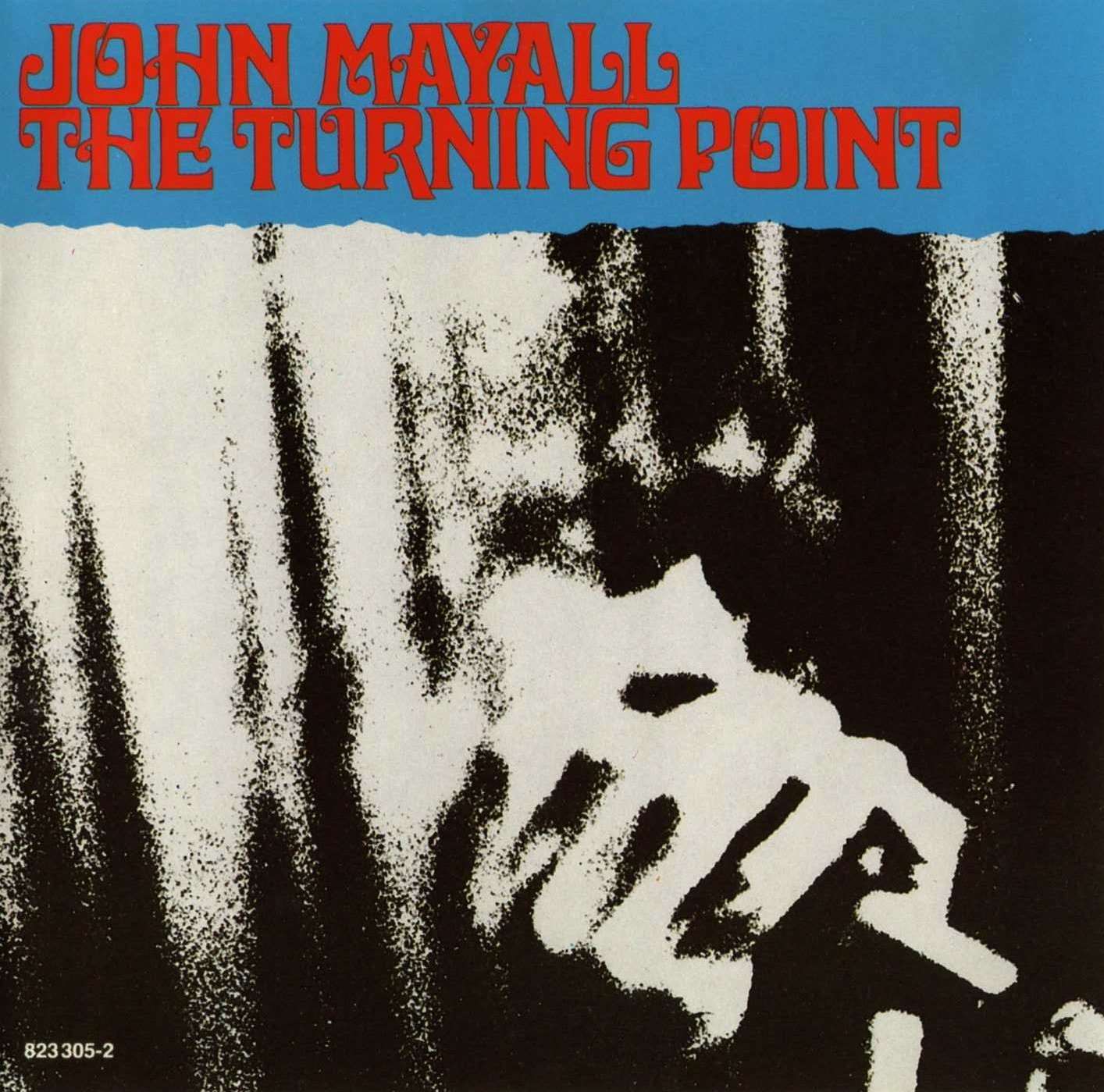
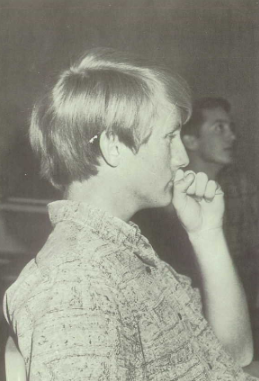
I first heard this song when I was eighteen, and my friend Paul Hibbard’s house in Arroyo Grande, not far from Sambo’s (later Francisco’s, now a derelict) where we drank endless cups of coffee and talked about Life and Stuff. I thought Paul immensely wise, older than his years, and a kind of hero. Him introducing me to this John Mayall album, and to this song, only confirmed my feelings about him. That’s Paul, in the photo from the 1969 AGHS yearbook.
So did this man confirm my feelings about Mayall. This is one of those “First Time Hearing” YouTube videos, and they’re so often young Black People, but this man has a few miles on him and he may not have heard Mayall before, but he knows music.
The best part, I think, is watching this man’s face. Then it gets better, when he admits how jealous he is. Of Mayall’s audience fifty-five years ago.
So what? Here’s an excerpt from one of my favorite British newspapers, The Guardian:
Eric Clapton* fled the Yardbirds in the spring of 1965, dismayed by the prospect of their latest single, For Your Love, bringing commercial success and thereby compromising his musical integrity. The 20-year-old guitarist found comfort in the arms of John Mayall, who welcomed him into his band, the Bluesbreakers. Within weeks their relatively purist approach to the blues, while not producing hit singles, had put them among the hottest attractions on the UK’s club circuit.
In Mayall, the young blues-hungry audiences knew they were in the presence of a slightly older figure whose knowledge and understanding of the idiom gave him an immense authority. In Clapton they had an idol who was one of their own.
In those days, it was instructive to see Mayall and his musicians on two occasions either side of Clapton’s arrival: the first time on a club tour accompanying the veteran American guitarist T-Bone Walker, playing the role of devoted and self-effacing disciples; the second time, suddenly bathed in the glow of cult worship.
He had come from Manchester to London in 1963 with a record collection that included Muddy Waters, Elmore James, Robert Johnson, Sonny Boy Williamson and many other more obscure bluesmen and women. He and Alexis Korner, a man of similar vintage and tastes, encouraged their acolytes to share and absorb the music they loved, eventually adopting it – in an audacious but ultimately fruitful act of cultural appropriation – as their own language.
Out of Korner’s Blues Incorporated and Mayall’s Bluesbreakers flowed a stream of prodigies who were soon ready to head off in their own directions. When Clapton left Mayall after a year – and one hugely influential album, Blues Breakers – to form Cream, he was replaced by the 19-year-old Peter Green. When Green left a year later, taking the group’s drummer, Mick Fleetwood, and bassist, John McVie, with him to form the first version of Fleetwood Mac, his place was taken by the 17-year-old Mick Taylor. Two years later Taylor would accept an offer from the Rolling Stones.
While they were with Mayall, they became the young gods of the club scene: a new generation of note-bending guitar heroes, beautiful long-haired boys whose skills had been attained through long hours of bedroom practice and were now delivered to audiences mesmerised by their virtuosity…
So thank you, John Mayall, and thank you YouTuber Barri, who doesn’t yet know that he’s made a new friend. I never heard nothing like this, either.
P.S.: Two of the Mayall proteges cited in the Guardian article:
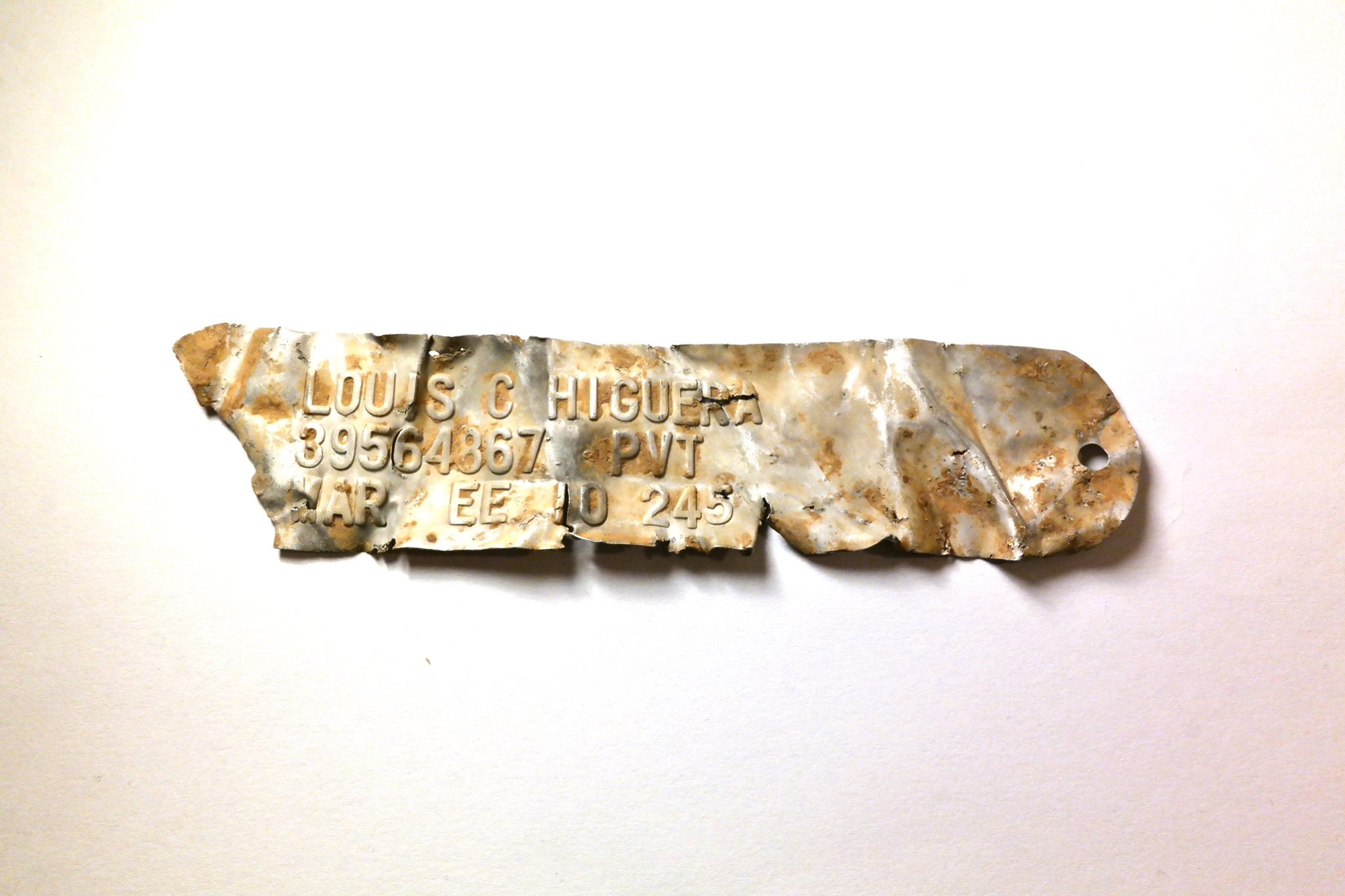
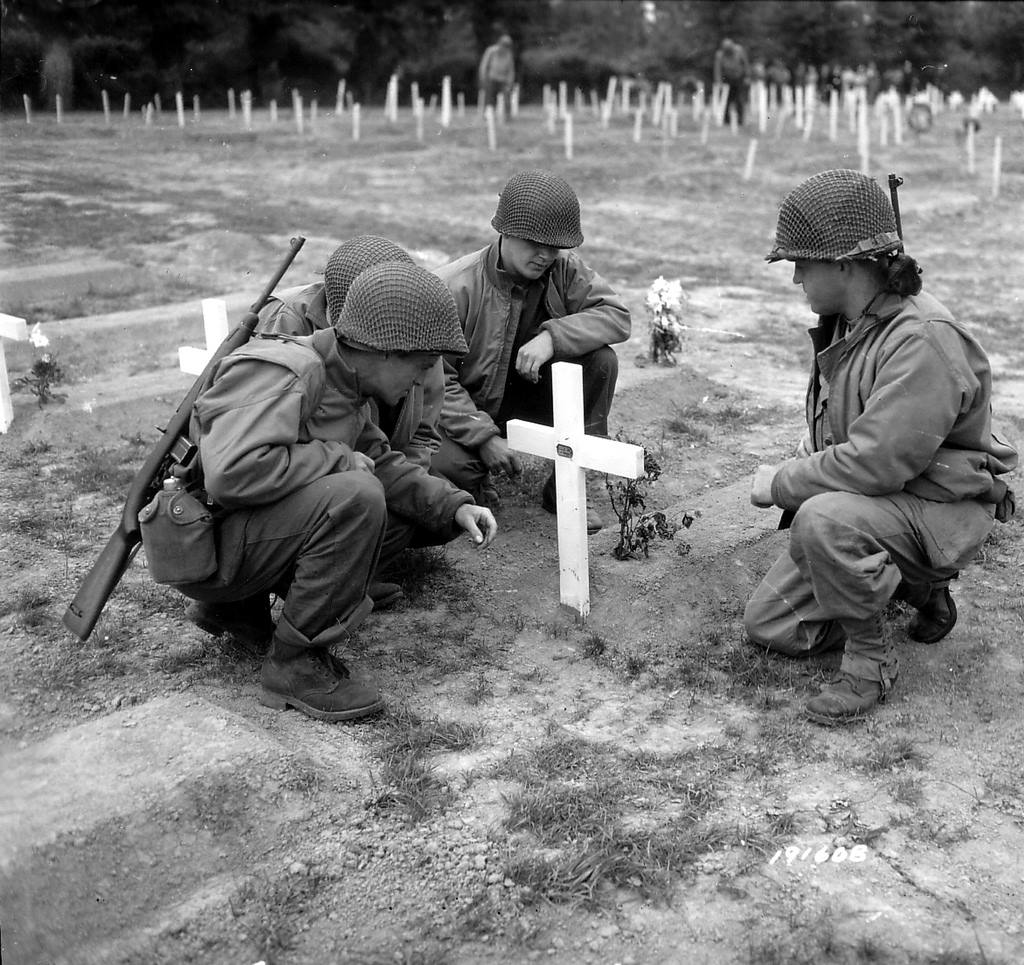
(Above) A fallen G.I.’s dog tag; comrades visit a friend’s grave in World War II Europe
The South County Historical Society and the Oceano Depot Museum had a potluck together yesterday (Sunday, September 22). The food was wonderful, and so was my chance to see Depot Curator Linda Austin again. It was Linda who discovered her inner pit bull and the power of her bite when, in 2017, she was instrumental in bringing the long-missing remains of Oceano Marine George Murray home to lie with his mother. Linda is one of my heroes.
Pvt. Murray had been missing since November 1943, when he was killed in the few seconds after his landing craft’s ramp collapsed onto the beach at Betio during the Battle of Tarawa.
Pvt. Murray’s funeral, Arroyo Grande District Cemetery
So maybe what happened today at the potluck was because of Linda. While I struggled with a glutton’s plateful of potluck goodies, I struck up a conversation with a woman, about my age, sitting next to me. You know how you can tell almost immediately that you’re going to like someone? That happened. We began to talk about our families.
Hers was from Minnesota. So was part of mine, the Irish half, homesteaders in Meeker County.
She did not know Meeker County. Her family lived so far north in Minnesota that they might’ve been honorary Canadians. Her Dad bought a little piece of property there with a pond, and I got the sense that he would sit by it, silent, for hours.
The silence was a manifestation of PTSD. He was a World War II vet and had seen some terrible things. Because he refused to talk about the war, his children knew nothing about his Army career except that he’d served in the Pacific. My friend John Porter’s dad, Asa—we have his uniform on display in the Heritage House Museum—had served in New Guinea, where even the birds are poisonous, the spiders are the size of catcher’s mitts and the diseases that killed soldiers there begin with jungle rot and continue in a list that would fill Roget’s Thesaurus.
Pacific duty lay several rings inside Dante’s Hell.
I learned, over rhubarb pie, that her father was a farm expert and after the war became, with a doctorate, a United Nations farm expert. He devoted the rest of his life to helping the poorest learn to prosper.
He was, to use one of my favorite terms, a mensch.
But he never talked about the war. It never left him alone, either, which makes the rest of his life, and what he did with it, almost Homeric.
So I began to learn about his veteran during the meal at the Depot Museum, and my interest was piqued. Then I got cocky.
May I have your Dad’s name? I asked my new friend. They’re having a family reunion in Minnesota this year, and, given the fact that they’re all Boomers, like me, this might be their last. If I could find her Dad’s name, I could perhaps find his service number, maybe his regimental and divisional assignments, which meant that I’d have the chance to finally tell this man’s children what he’d done in World War II.
I should never get cocky. I came home and started the research. What I found revealed no unit, no regiment, no infantry division, no combat.
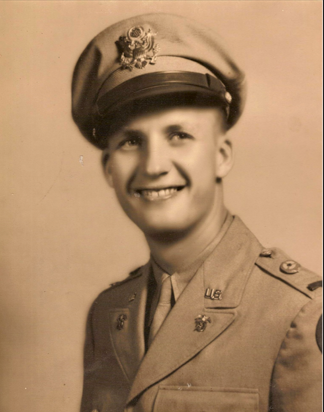
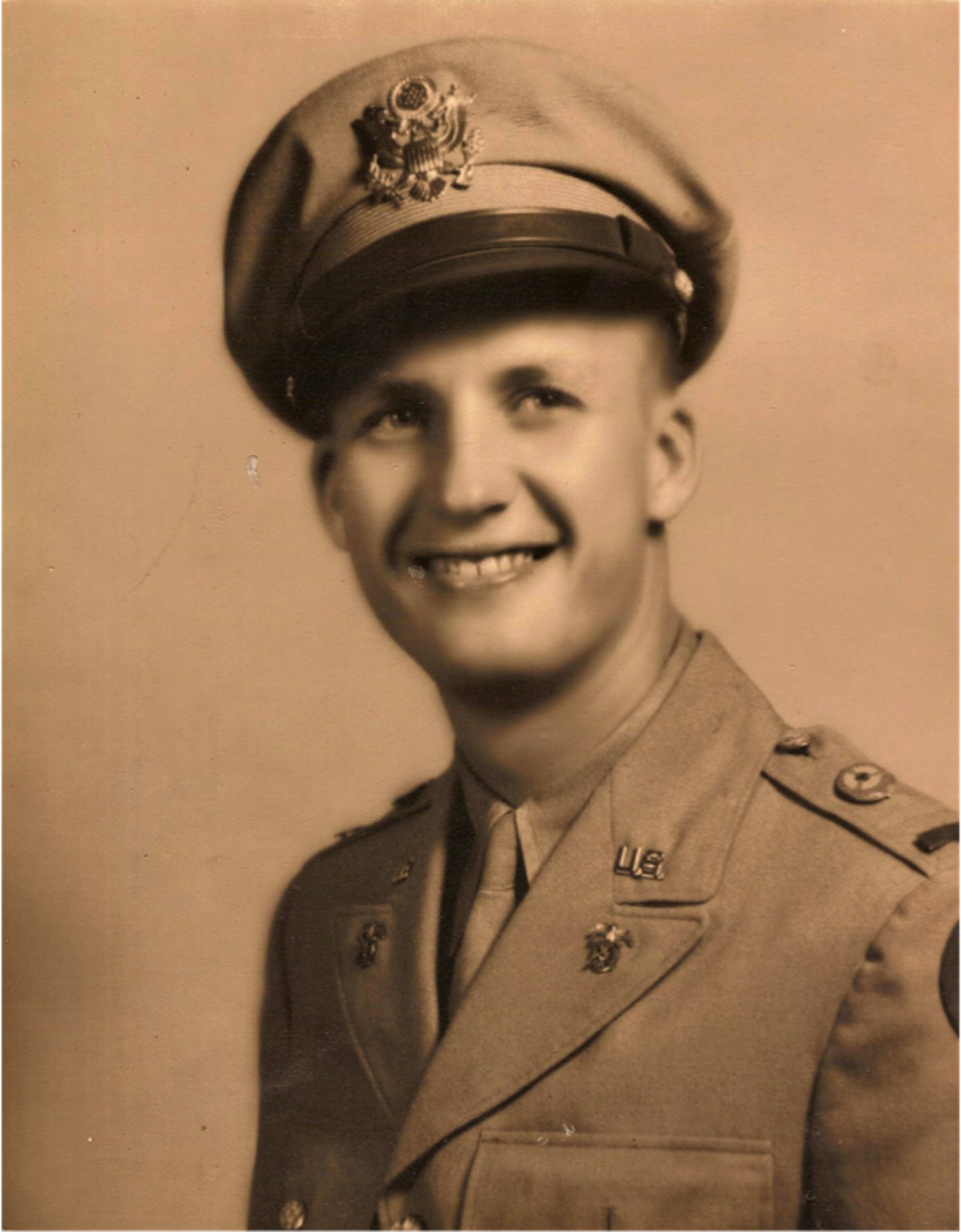
In November 1944, late in the war, he’d received his commission as a Second Lieutenant in the Quartermaster Corps, the supply arm of the World War II United States Army. My Dad’s Quartermaster commission had come earlier that year—both men had joined the Army in 1943— and he went to England in July 1944, armed with a typewriter and an adding machine. He was a pencil-pusher, charged with keeping the army, still trapped in desperate fighting in the Normandy hedgerows, the bocage, with enough gasoline to keep their tanks running.
Lt. Dad, 1944
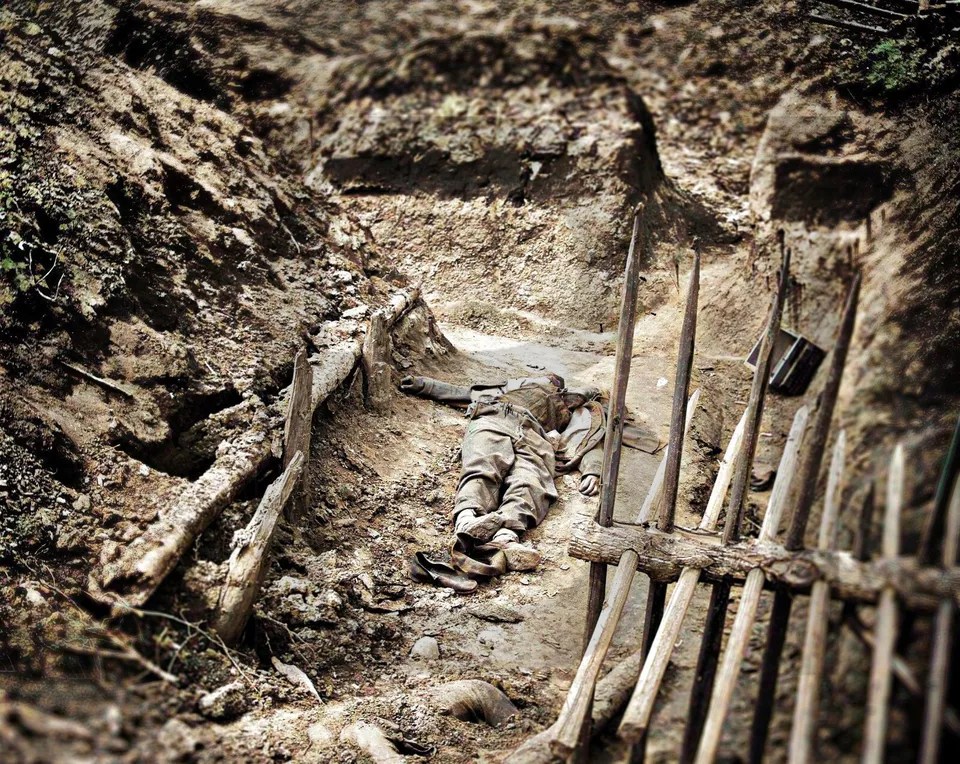
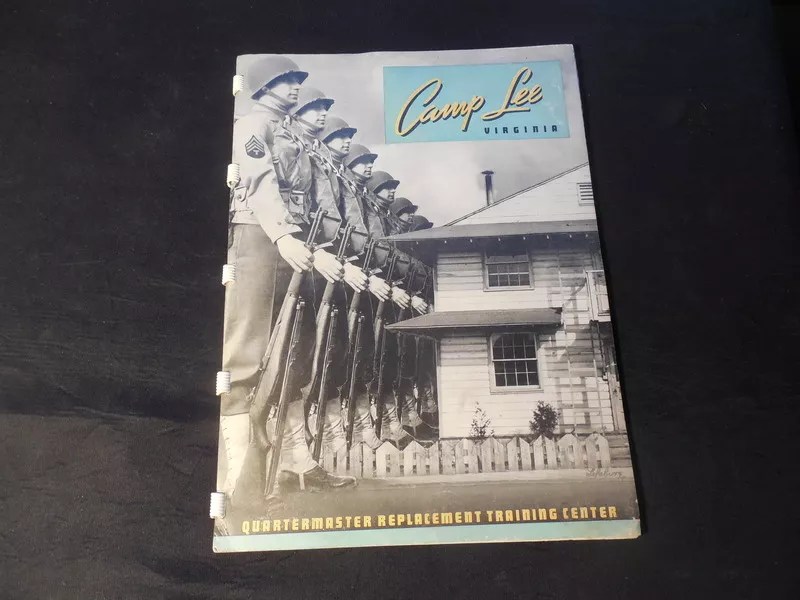
I’ve told lot of stories about my Dad, but before he went to England, on a troopship crammed with Black Quartermasters, who turned out to be devoted and inventive and courageous soldiers—the truckers of the “Red Ball Express”—he’d done his training at Camp Lee, Virginia, near Petersburg, where the United States had invented trench warfare in 1864-65.
A dead Confederate in the Petersburg trenches, 1865. At right is an abatis, interlocked spikes that would presage World War I barbed wire.
Dad wouldn’t have known it then, but his Midland English ancestors settled in Petersburg in the 17th Century, became vestrymen in the Episcopal Church, married into the Washington family, and claimed to own human beings, a detail which compelled them to go to war against the United States in 1861. I am named for two Confederate officers.
To my delight, I discovered that my lunchmate’s father had trained at Camp Lee, too. So now I am contemplating buying this Camp Lee yearbook on eBay:
My own father’s Quartermaster career was spent filling out forms, fielding furious and profane phone calls from regimental commanders on Omaha Beach, trying to locate tankers that may or may not have been sunk by U-boats and organizing Quartermaster companies and the shipping that would take them to Normandy.
He worked with an office of enlisted men who presented him, in teasing admiration, with a beautiful, diploma-like certificate for “Meritorious Drinking Under Fire” for refusing to abandon his pint of bitters in a London pub during a V-1 raid.
A V-1 “buzzbomb”–the British also called them “Doodlebugs.” Their sound was ugly, but when the engine cut out, the silence was worse. The bomb was going to fall where it wanted to.It was a perfect weapon for killing innocents.
It wasn’t V-1 raids that caused his nervous breakdown; it was, instead, the grind of endless eighteen-hour workdays. By the fall of 1944, he was used up. My Dad, a brilliant man, had made the dreadful mistake of making himself indispensable.
His C.O. was a good one. He put Lt. Robert W. Gregory on a train north, headed for Edinburgh, for a week of R & R. A week there, with my father dense in Scots, who are warm and friendly people, effected the cure.
Dad went back to his war.
The war’s end changed him. For one, he began to meet Germans, whom he liked, and to see the vastness of the damage the war had inflicted on them, which he hated.
Then came his last Quartermaster assignment: training nineteen-year-old infantrymen, full of imagined ferocity, eager to kill truckloads of Nazis. But the war in Europe had ended.
He had the thankless task of a teacher trying to teach unwilling students, shifting those teenagers’ focus from imagined combat glories to graves registration, to the disinterment and reburial, in military cemeteries, of men their age or not much older. Many military cemeteries had already been established by V-E-Day, but many G.I.’s had been buried quickly and were scattered, alone and in bunches, in barnyards and wheatfields, in dense hardwood forests and in marshes, even in little family cemeteries, from Normandy to the Elbe.
This is a terrible thing to say, because it’s true. In historian and Harvard president Drew Gilpin Faust’s This Republic of Suffering, in the Civil War, there were often no remains at all, thanks to high explosives or to Southern farmers’ hogs, who left no traces of the nineteen-year-old Yankees, save perhaps the soles of their shoes, who’d been lost in Virginia or Georgia or Mississippi.
Faust’s book revealed how hard it was to deal with death on an industrial scale, and how hard it was for families to deal with a loved one who had truly vanished.
In 1945 Europe, Quartermaster troops, working with the Army’s Medical Branch, were given the duty of finding this war’s dead, and many of them would never be found, either. I was once talking about this to a class of my Arroyo Grande High School history students, and I had to stop. I was starting to cry.
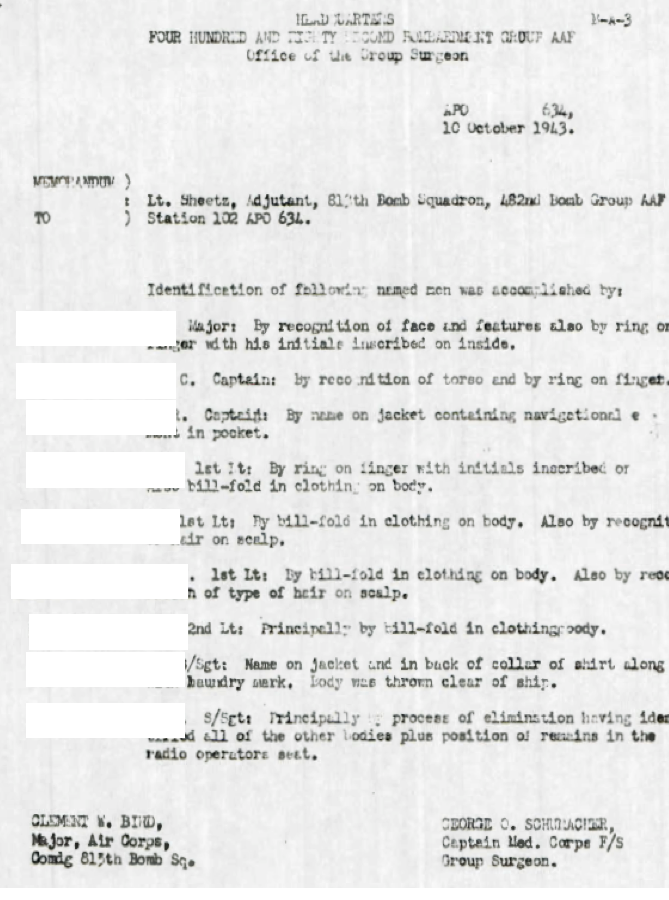
Dogtags had made the process easier, but Identifying the dead, even those just dead, was a terrible assignment. These are the victims of an accidental English air crash, a B-17. in 1943 England. One of them was an Arroyo Grande boy. This is how they were identified.
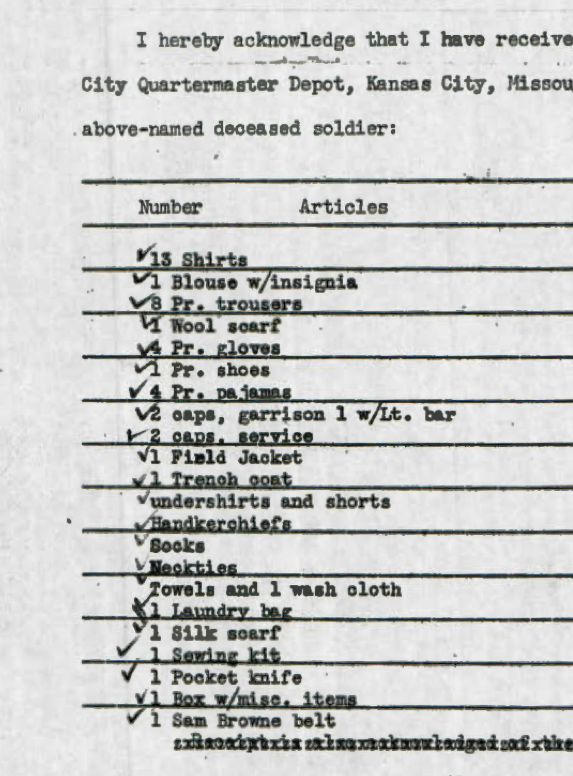
Another duty that fell on Quartermasters was in meticulously cataloging a dead soldier’s personal effects and then packing them into footlockers for shipment home. That took time. Here are the personal effects of the Arroyo Grande airman killed in the 1943 crash.
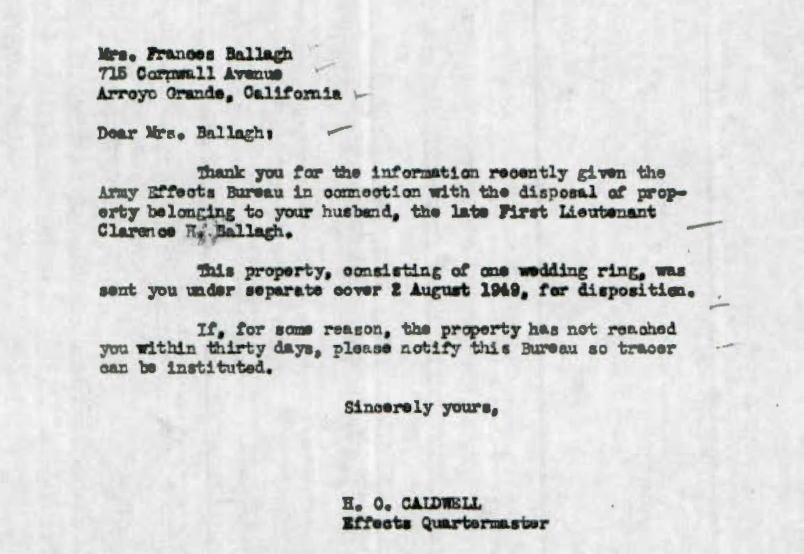
It would take six years for his wedding band to be returned to his wife.
My hunch is that I shared lunch with a woman whose father, already a 1940 graduate in ag science from the University of Minnesota (only 4.6% of Americans graduated from college in 1940) and headed for a postwar doctorate, who saw service on three fronts at the end of the war—a singular fact for any officer— was indispensable.
That would explain why World War II followed him without mercy until the end of his life in 2002. I think it’s very likely that he took part in finding, identifying, and re-interring the remains of young men in military cemeteries, in three different combat theaters, where their families might know that they were finally safe.
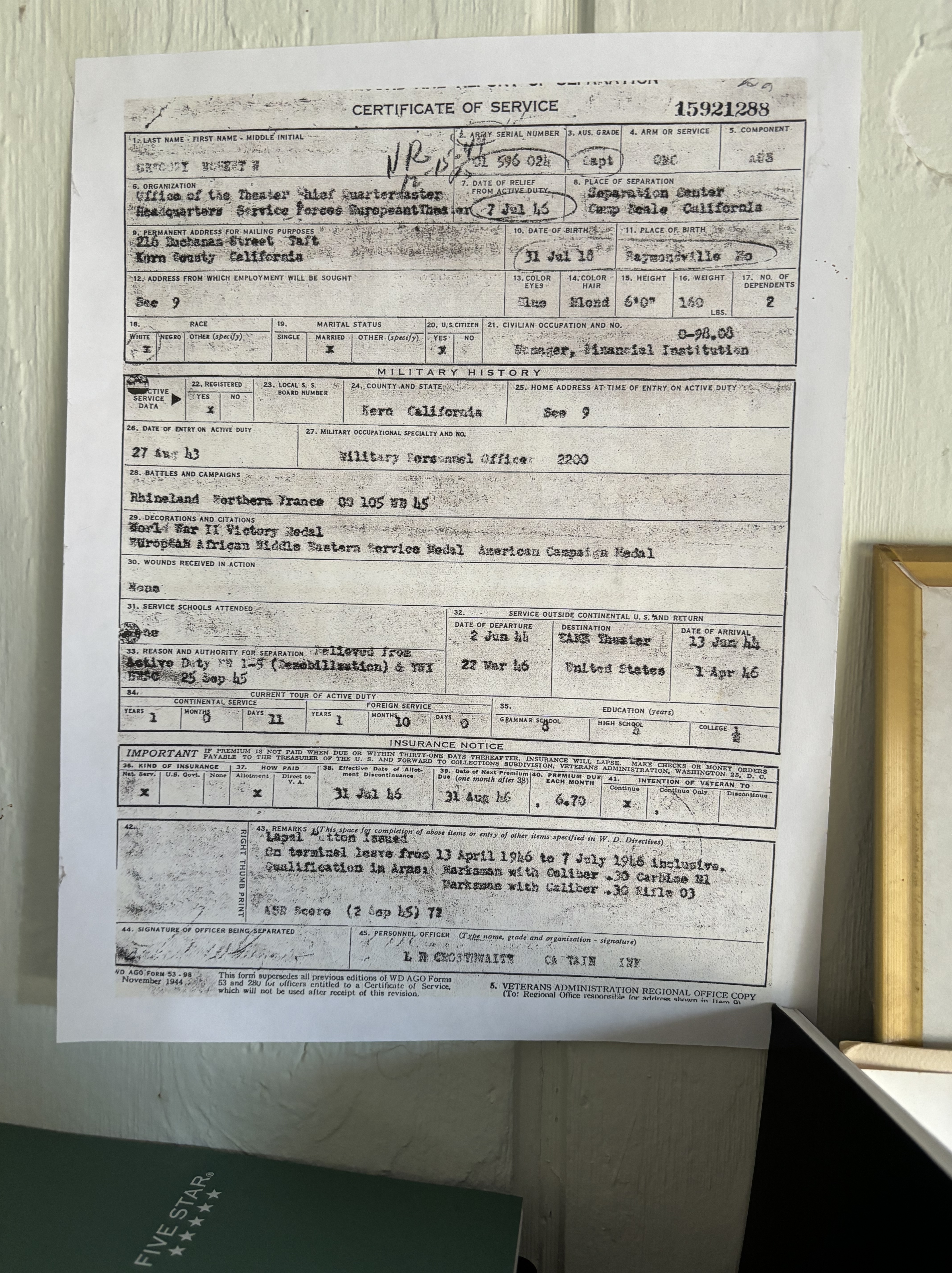
Since so many World War II Army records were destroyed by a tragic 1973 fire in the St. Louis Repository. I don’t know that I’ll ever be able to confirm if this was, indeed, this man’s duty. This single sheet is all the official evidence I have of my father’s service.
But if my hunch is right, it’s no wonder that the rest of another Quartermaster officer’s life included deep currents of sadness, and it’s no wonder that the war was far too painful for him to talk about with the children who loved him.
It was just as impossible for him to talk about this subject with his grandchildren. I taught one of them, and she is going to be a nurse. He would be immensely proud of her. This is not a hunch. It’s a certainty.
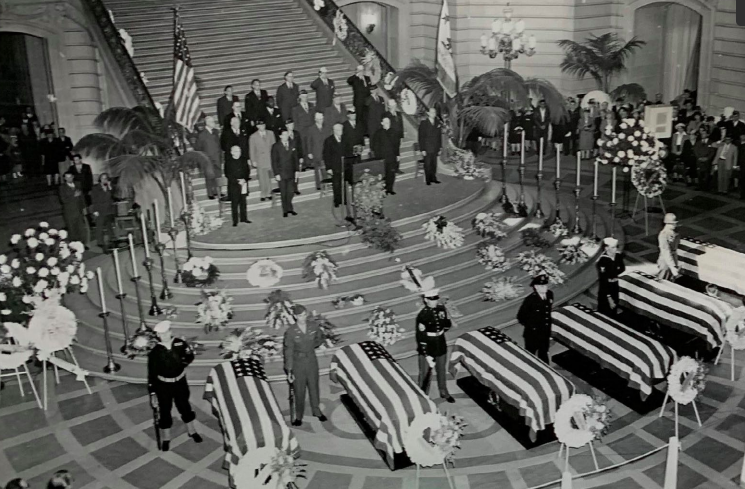
The first fallen Americans to come home were honored in 1947 San Francisco.
Her grandfather’s suffering was the product of a soldier’s heroism and a decent man’s compassion. This man, marked by those qualities, devoted his life to using science to save lives.
I can’t tell you how much I love this song. I was doing some local history research when I made a connection with Pan American extending its routes into Rio in the early 1930s, at the same time that Halcyon’s Sigurd Varian was flying seaplanes into Mexico and Central America.
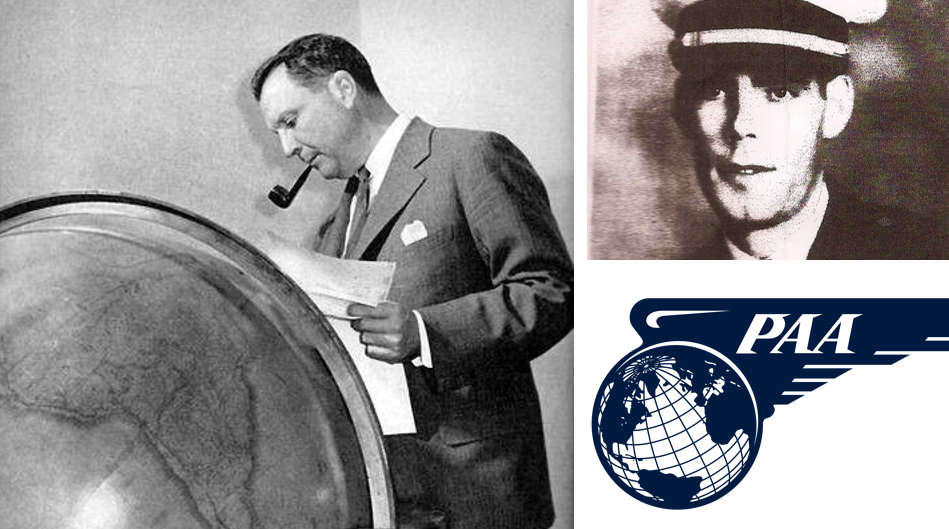
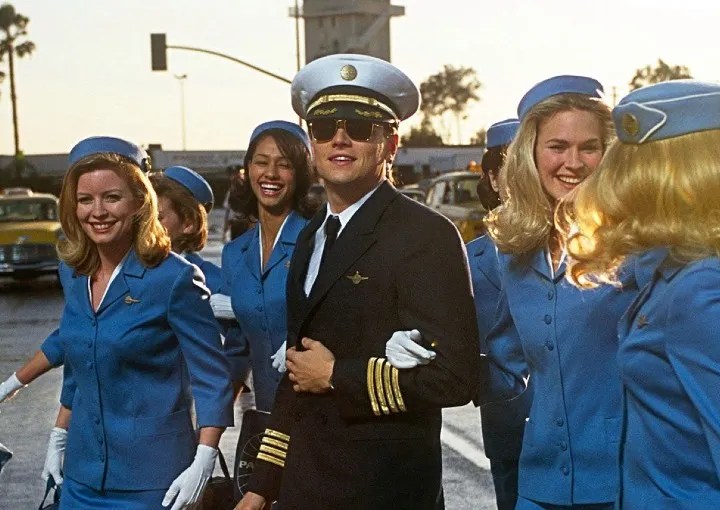
Above: Juan Trippe, a handsome Sigurd Varian at upper right; Alec Baldwin as Trippe in Scocese’s The Aviator; Leo Dicaprio, in the film that changed by mind about Leo Dicaprio (I loved this performance, and his Howard Hughes was several notches higher), as a bogus Pan Am pilot in Catch Me If You Can.
“Mas, Que Nada” (roughly translated: “So WHAT?”) was first performed by Jorge Ben in 1962.
Sergio Mendes and Brasil ’66, a group I still love, quickened the tempo and made the song a big hit.
It’s such an infectious, happy song. I like this version, very close to that of Brasil ’66:
But the “Playing for Change” people do a marvelous version, as well, a little downtempo and likely closer to the song’s original version (if you’re down in the dumps, may I also recommend, from Playing for Change, “Guantanamera,” Cuban, and “La Bamba,” Mexican.)
There’s even a choral version. I like this one. Dang, they’re cute. (They also do a fine version of Annie Lennox’s “Walking on Broken Glass.”)
Finally, this is my favorite version. I can’t tell you how many times I’ve posted this on Facebook and then taken it down, lest I be accused of being a dirty old man, a label I cannot abide. Nossa is a French group, and they are gorgeous and sexy (equal time: so’s the young man wo pursues them through Rio alleys). But this video makes me happy, because they are beautiful, but they’re not the most beautiful element of the video.
The street dancing scene, albeit brief, is the beautiful part. There’s a little girl, about twelve, multiracial, learning the dance’s elbow moves, then there’s a a young Black man, a dancer, with tight curls, whose smile is ebullient. Because the Nossas are so glamorous, the camera doesn’t stray from them for too long. It’s those two minor players, however, who generate inside me little waves of volcanic joy.
We’re struggling just now with the idea of being a multiracial society. So has Brazil struggled.
Among the immigrant families that have enriched Arroyo Grande history are the Coehlos, from Brazil. Growing up with them has enriched my life immensely. And, as beautiful as Nossa is, they are no match for Mrs. Coehlo, maybe the most beautiful woman, along with my Mom, that I’ve ever known.
She, born in Rio, like her husband, Al, used to drive by our house on Huasna Road in a navy-over-powder blue 1954 Cadillac (Mr. Coehlo, a farmer, did well because he worked so hard) and the eight-year-old me would run out to the front yard to wave to her. I was a hopeless Romantic even then.
So this video, and this song, make me happy. Seeing Mrs. Coehlo made me happy. This song, that place, that family, that mother, refresh the waters that are my hope.
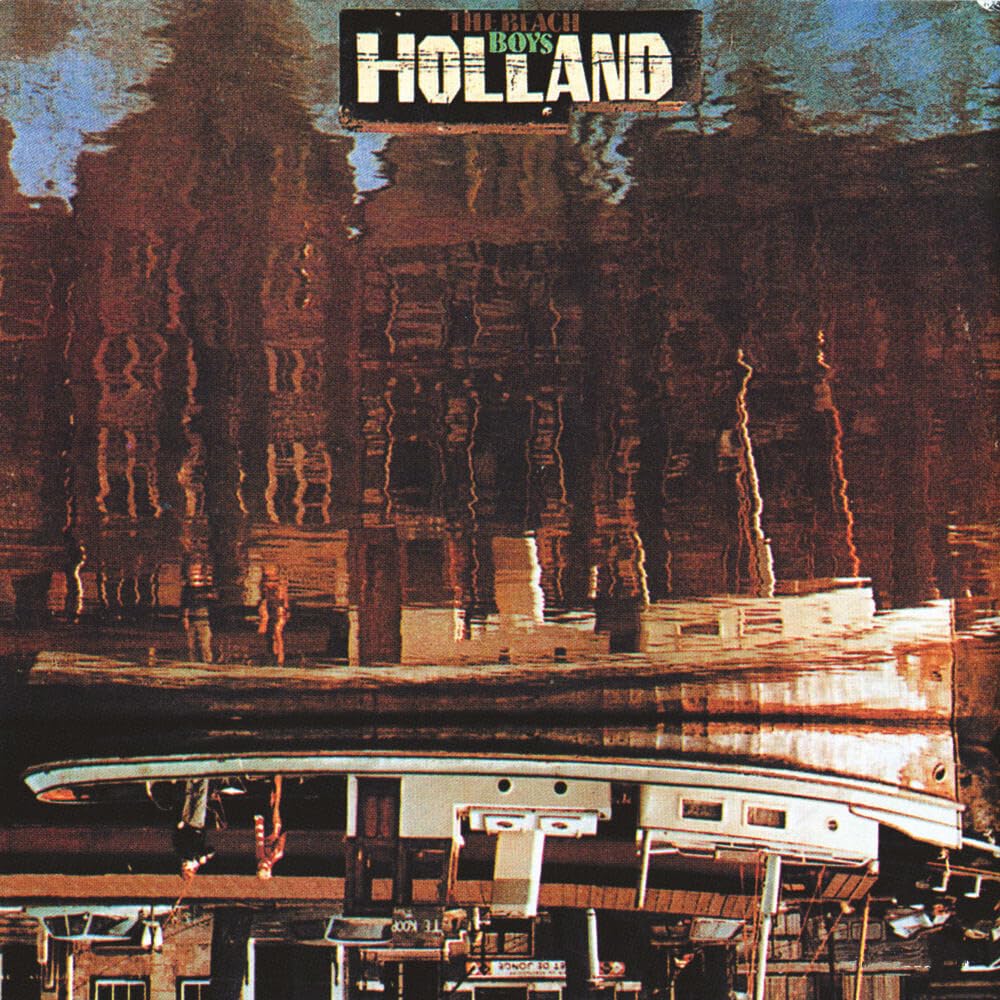
Yes, I know. Pet Sounds is the masterpiece—the album that goaded the Beatles into recording Sgt. Pepper—but this 1973 album remains one of my Beach Boys favorites. It cites Morro Bay, borrows from the Carmel naturalist poet Robinson Jeffers, and begins with this elegant song. What makes it unique is that the lead singer isn’t Brian Wilson, nor Carl, nor Al Jardine, nor is it Mike love. The singer on the album and in the video was South African Blondie Chaplin, a temporary Beach Boy who belongs in the Beach Boy Pantheon for All Time and Then Some.
This guy belongs, too.
And then there’s this band, one of my all-time favorites. This is the studio cut rom the album Native Sons–Los Lobos are, of course from L.A.
Oh, and why do I love Los Lobos so much? A brief aside, with a different song. Watsonville High School, 1989. I know this has nothing to do with Holland. I don’t mind that if you don’t.
This version of “Sailor” is sublime. Darius Rucker (Hootie and the Blowfish) has a gravelly, immensely soulful voice that fits the song exactly. Ray Charles and Darius Rucker. Oh, my.
Foxes and Fossils, a cover band that features old farts like me and, as a complement, young women, do the song justice, too. The lead singer is fine, but what gives this live version its Beach Boys lift are the not the Fossils, but the background harmonies from the Foxes.
And I wish we had Jimmy Buffett’s sweet face for this video, but we do have his voice, and I’m pretty sure he wouldn’t mind the visual images.
And, of course, Brian Wilson was the song’s co-writer, and he’s been on my mind a lot lately. Here are the lyrics, and they fit him exactly in this fearful stage of his life—one I’ll face soon—and these words, and that life, even now, remain beautiful to me.
I sailed an ocean, unsettled ocean Through restful waters and deep commotion Often frightened, unenlightened Sail on, sail on sailor
I wrest the waters, fight Neptune’s waters Sail through the sorrows of life’s marauders Unrepenting, often empty Sail on, sail on sailor
Caught like a sewer rat alone but I sail Bought like a crust of bread, but oh do I wail
Seldom stumble, never crumble Try to tumble, life’s a rumble Feel the stinging I’ve been given Never ending, unrelenting Heartbreak searing, always fearing Never caring, persevering Sail on, sail on, sailor
I work the seaways, the gale-swept seaways Past shipwrecked daughters of wicked waters Uninspired, drenched and tired Wail on, wail on, sailor
Always needing, even bleeding Never feeding all my feelings Damn the thunder, must I blunder There’s no wonder all I’m under Stop the crying and the lying And the sighing and my dying
Sail on, sail on sailor Sail on, sail on sailor Sail on, sail on sailor Sail on, sail on sailor Sail on, sail on sailor Sail on, sail on sailor Sail on, sail on sailor
Twenty-seven-year-old Robert MacIntyre won the Scottish Open today
And it was a bonnie putt that won the tournament. MacIntyre was headed for a playoff–tied at seventeen under–and it was this put that would make that happen, because he hit it too gently. It died at the cup.
And this young man became the first Scot to win the Scottish Open in 25 years.
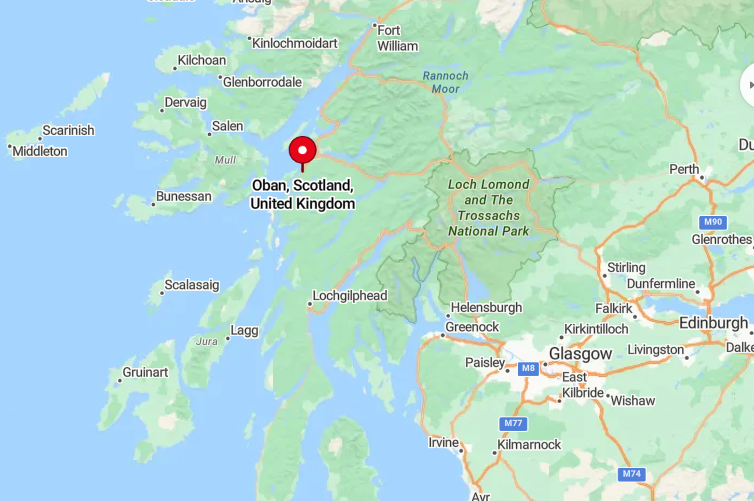
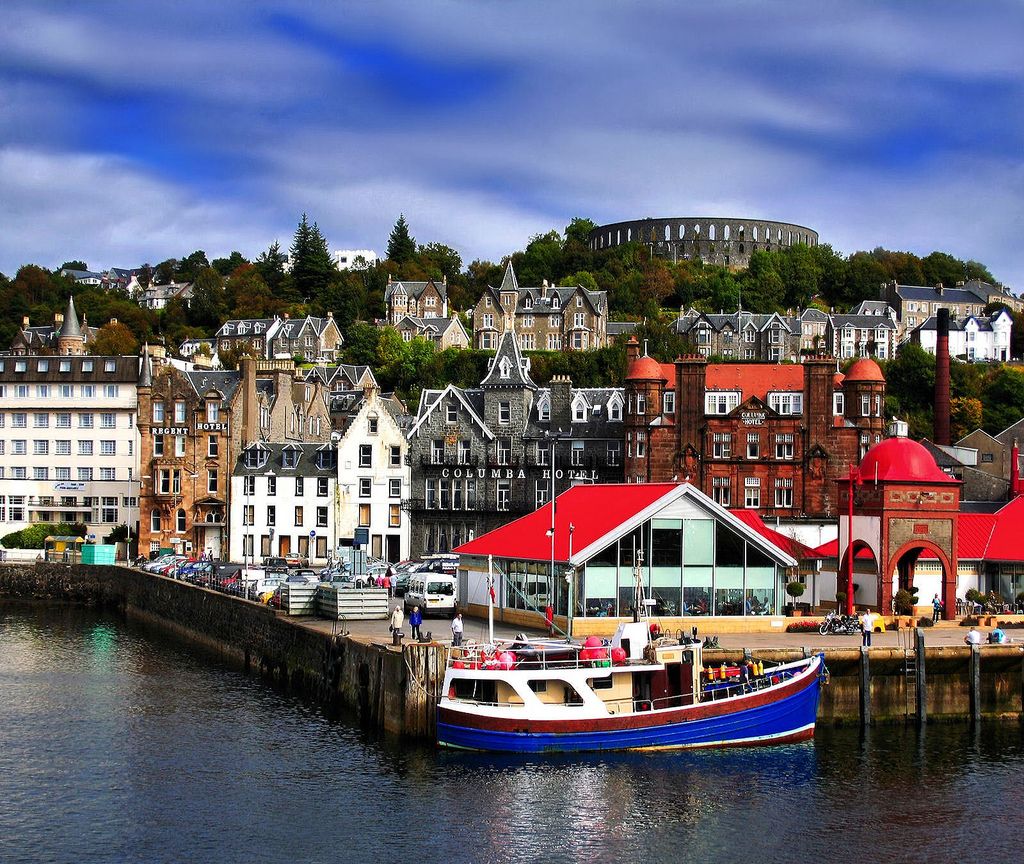
He’s a small-town boy. Oban, on the west coast, is about 24,000 people. Here it is on a map. I post this for all the lovely names in that part of Scotland, including Oban.
It’s kind of a touristy town, I guess, and this photo suggests why that is so. Oban is lovely, too.
The victory came on the Renaissance Course, also in the west of Scotland, so when that putt went in, the crowed was even more jubilant than the guy who won the tournament. Scots, to counter the impression Elizabeth and I have of them, are not “dour.” They are warm and friendly and given to moments of great jubilation. Like this one:
This was Robert’s first PGA Tour win, earlier this year, in the Canadian Open, and he’s sharing a hug with his caddie. That’d be his Dad, Dougie.
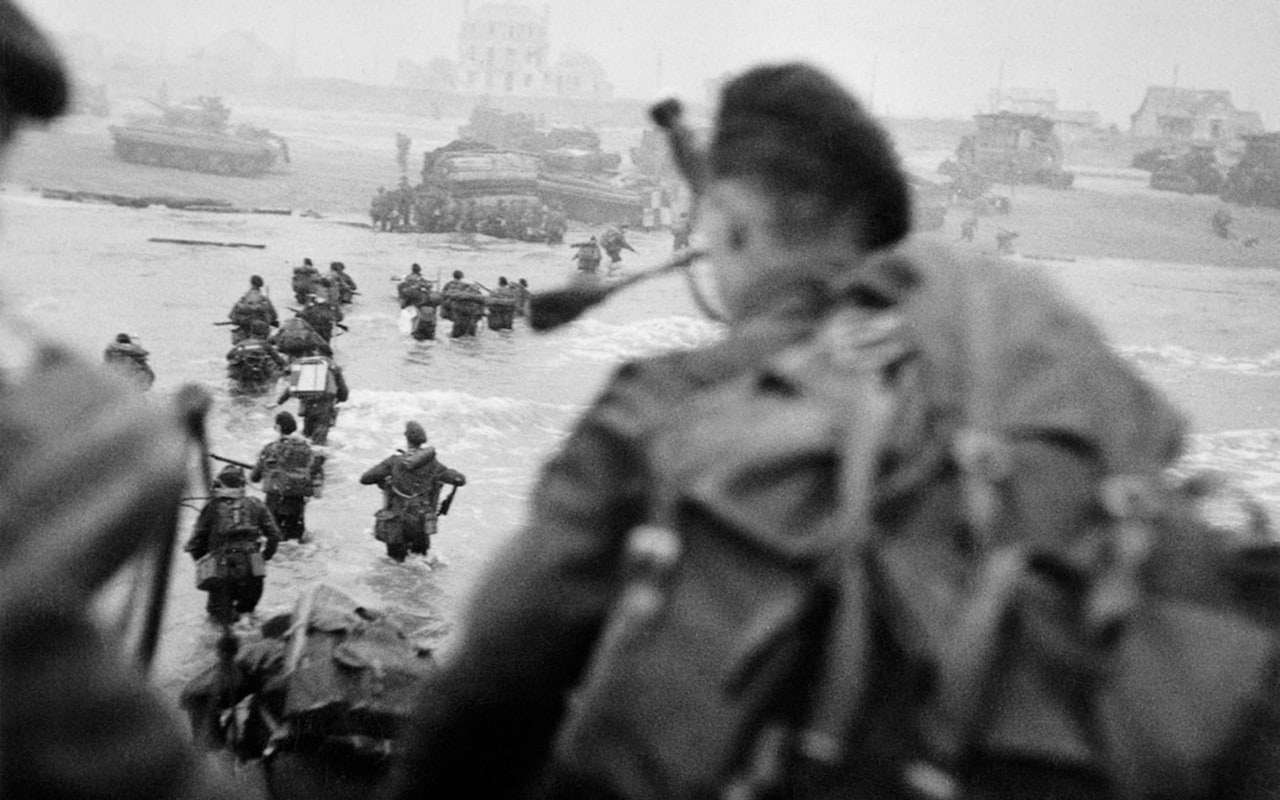
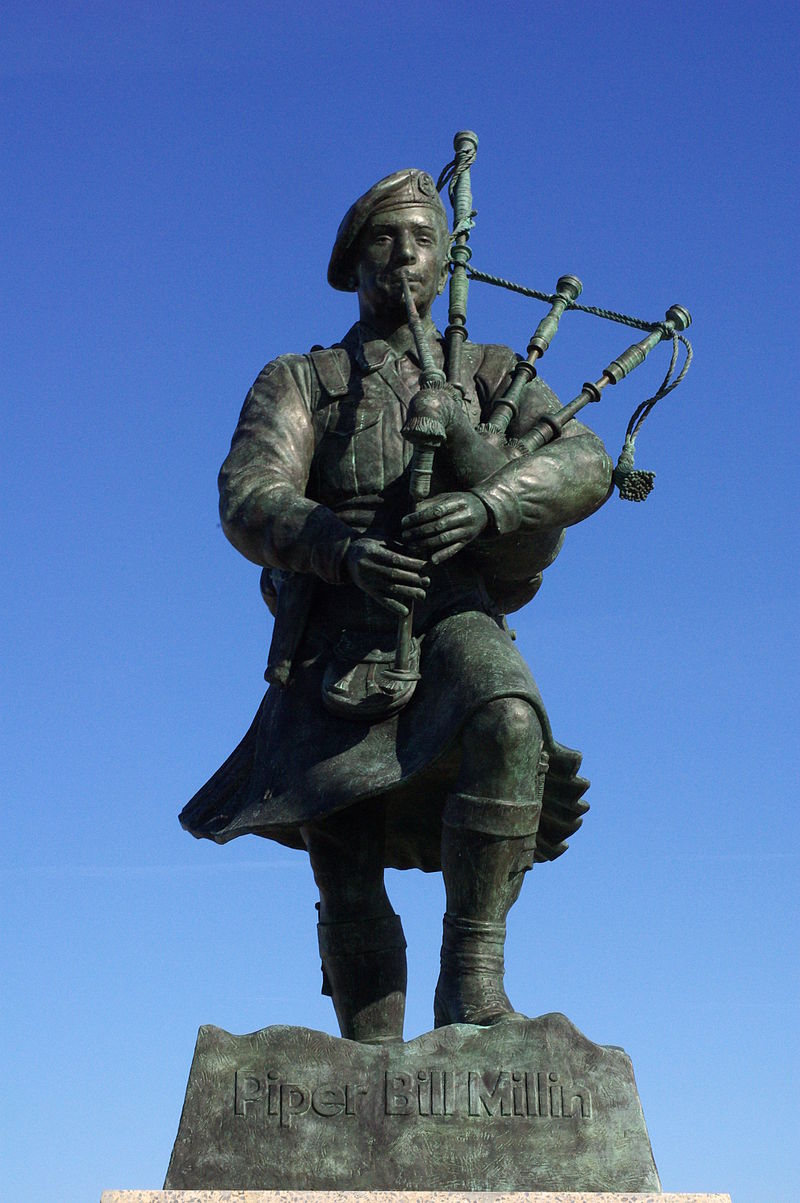
And a Scot winning the Canadian Open is perfect for history, as well. This is Sword Beach on D-Day and you can see a young bagpiper getting ready to offload. He’s with a British regiment, but Bill Millin is actually Canadian. There’s a statue for Bill, there today.
So I think this calls for bagpipes. These pipers are marching across a bridge near Arnhem, Holland–the “Bridge Too Far” in Corneilus Ryan’s wonderful book, key in Operation Market Garden, the attempt to force a crossing over the Rhine and into Germany in September 1944. It was Field Marshal Lord Montgomery’s scheme, and it was a disaster.
My Dad—Lt. Dad, in this photo, when he served in London as Quartermaster, befriended a Canadian bagpiper from a Canadian regiment, the Princess Pats. He was one of the last pipers alive in that regiment, in 1944. The rest were two or three years dead, in temporary graves in North Africa.
And, as always—maybe it’s my Dad— no matter where I start, I come back again to my hometown. Operation Market Garden included two South County soldiers. Art Youman was promoted to sergeant for his leadership in Holland. His commanding officer was Dick Winters, Easy Company–the “Band of Brothers.”
Lt. William Francis Everding, from Oceano, another 101st Airborne paratrooper, was killed in a fierce German counterattack on the Dutch village into which he’d parachuted at the beginning of Market Garden.
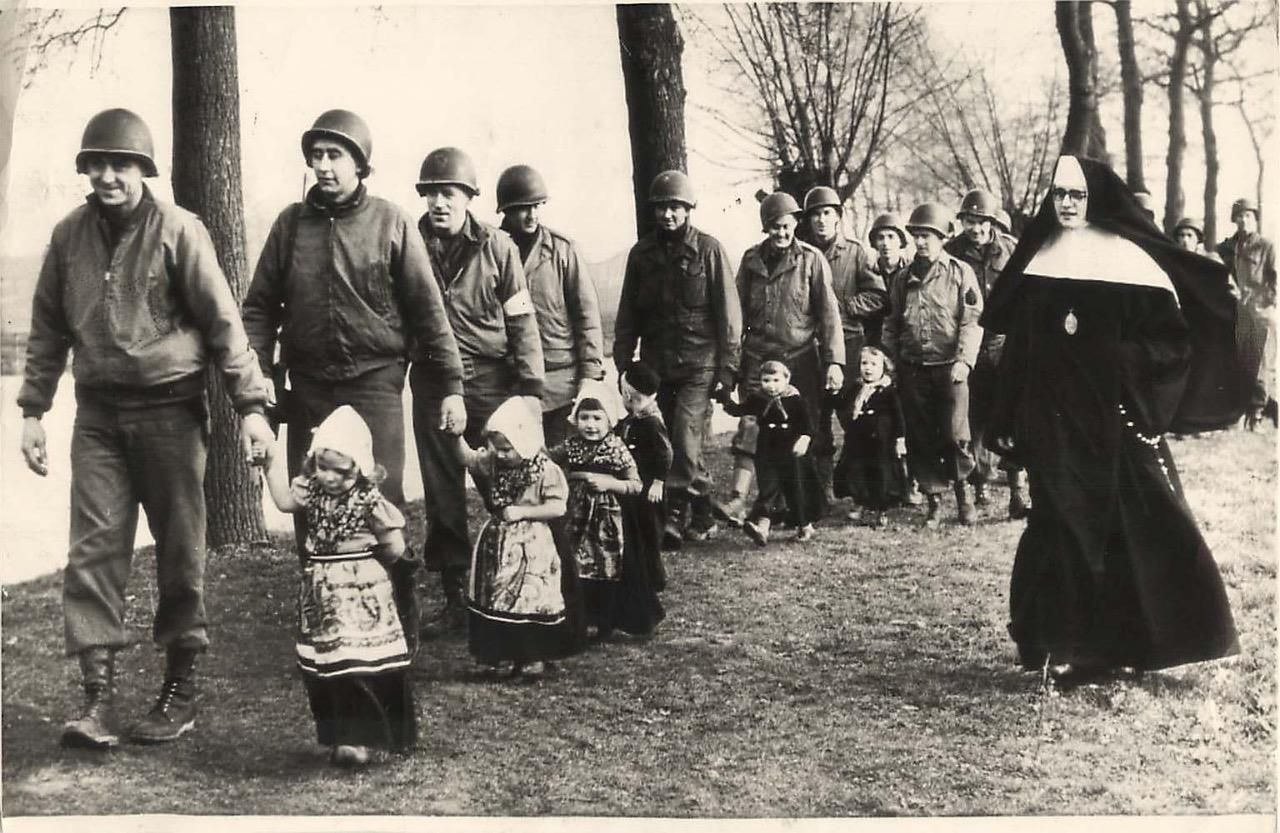
Holland was eventually liberated. This photo gives you a feel, I think, for how Yanks felt about the Dutch.
Scotland is 5,000 miles away; Holland a bit farther than that. But the fact is that bagpipers crossing the John Frost Bridge—and, of all things, a Scots golfer who loves his Da–can have an emotional wallop on this extremely amateur historian—that means something.
I think it means that we, all of us, no matter how distant we might be in time and space, are somehow bound together in deep and passionate ways that we’re not meant to understand or to see, except in brief moments when our peripheral vision allows us to see them. What follows is a flash, very warm and very brief, of recognition. We are ennobled then. Robert MacIntyre’s victory today ennobled me. It made me so happy that I married a woman with deep ancestral roots in Scotland.





















 A Work in Progress