
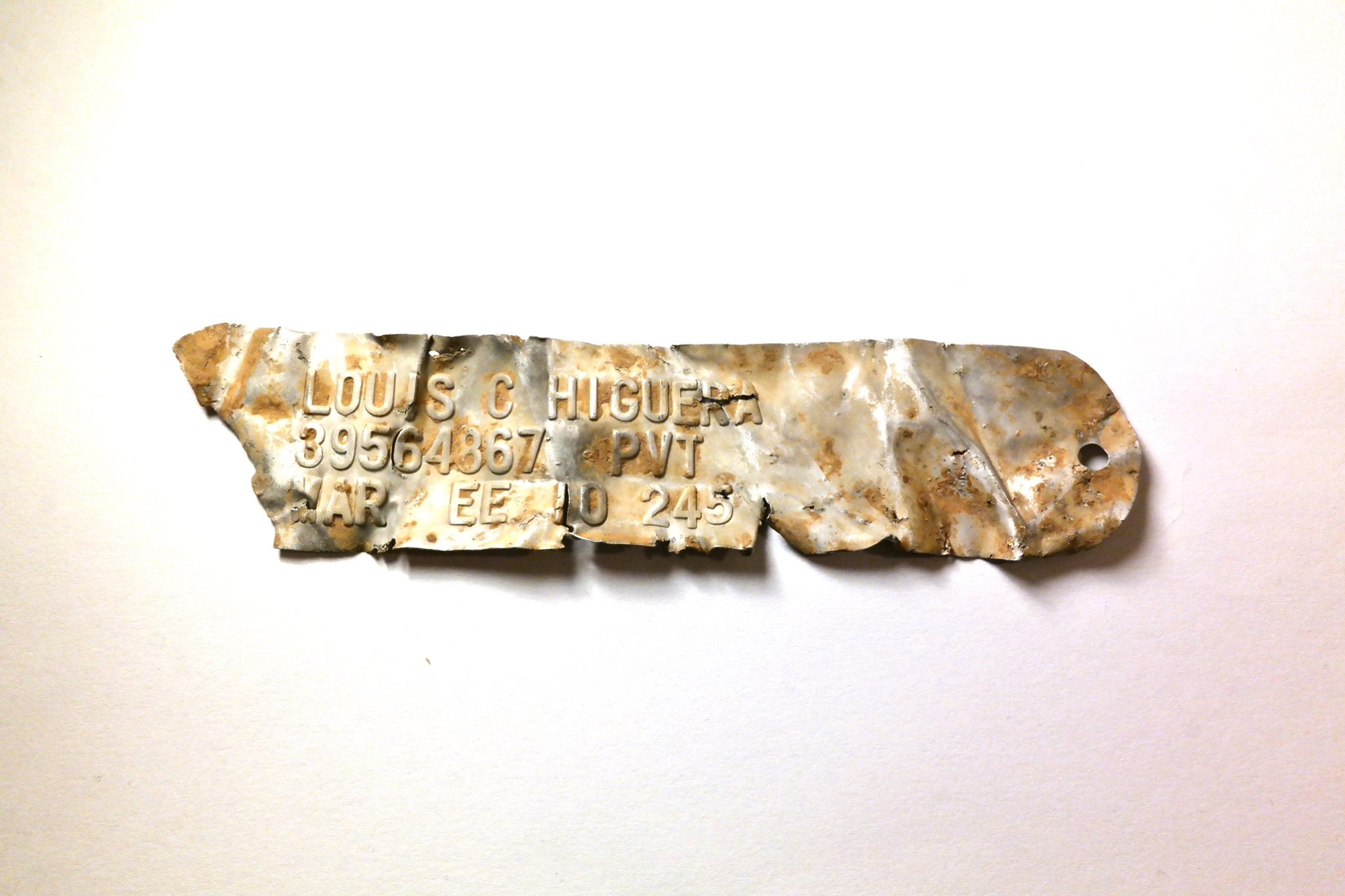
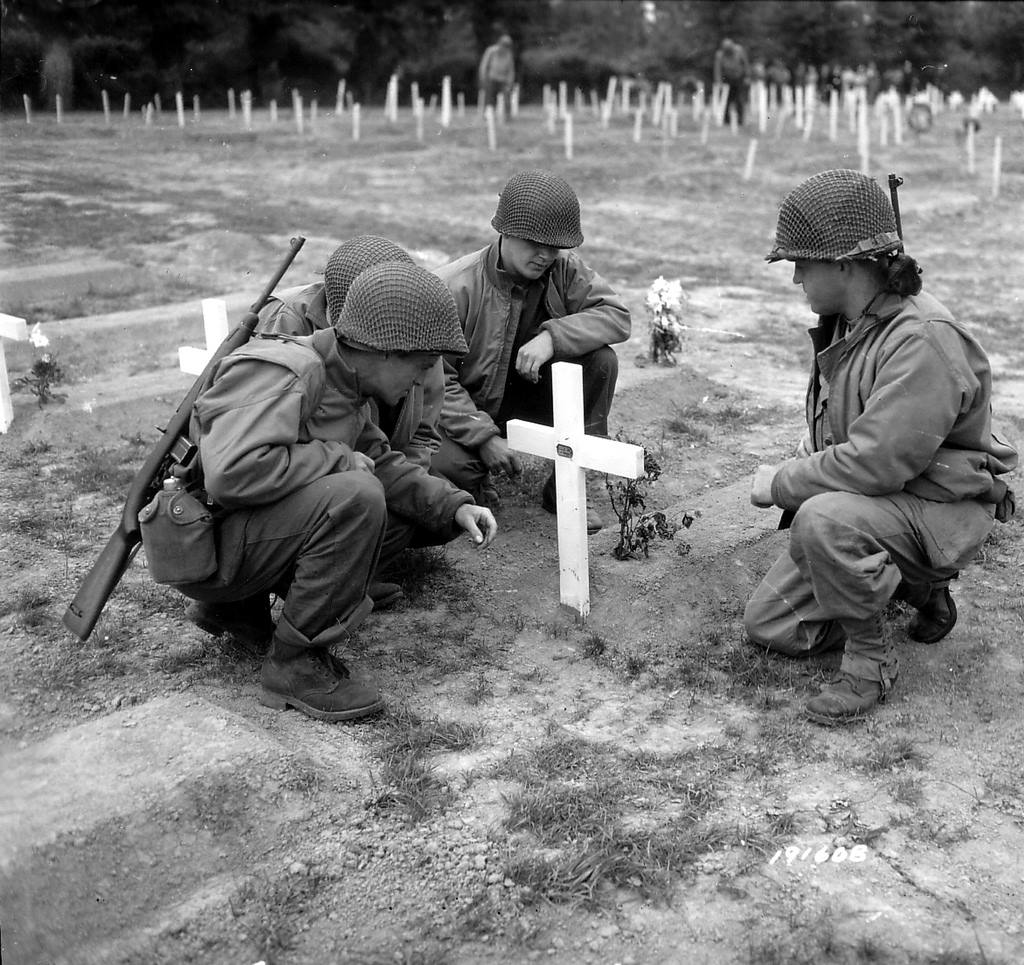
(Above) A fallen G.I.’s dog tag; comrades visit a friend’s grave in World War II Europe
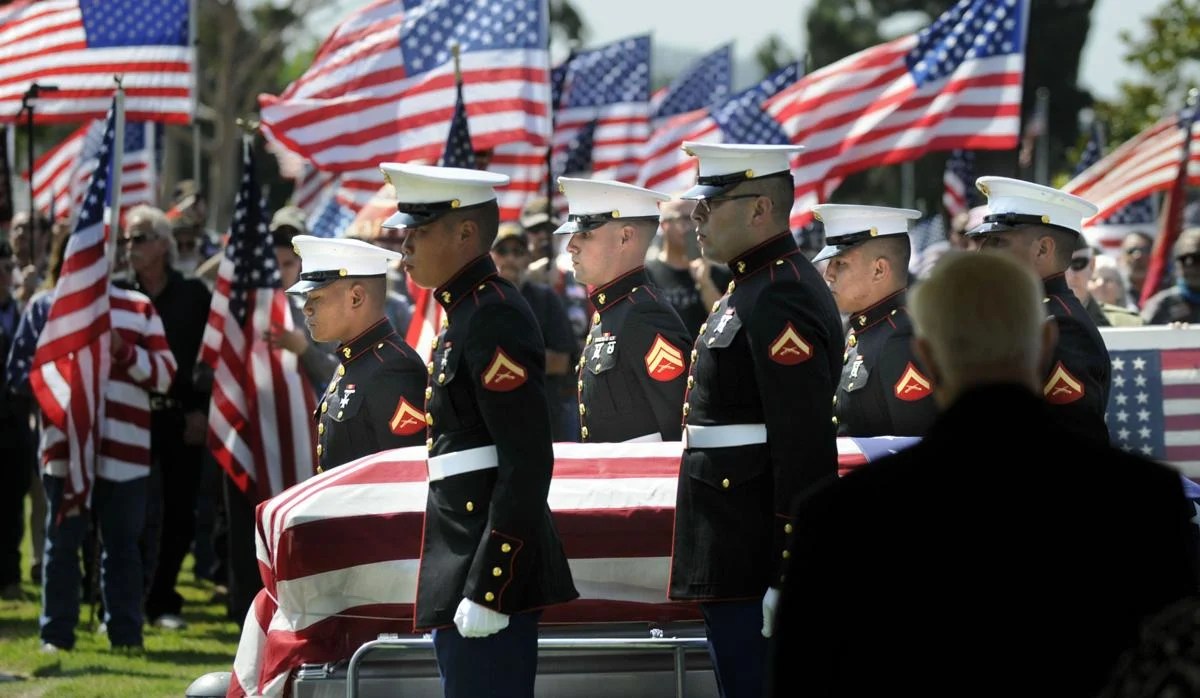
The South County Historical Society and the Oceano Depot Museum had a potluck together yesterday (Sunday, September 22). The food was wonderful, and so was my chance to see Depot Curator Linda Austin again. It was Linda who discovered her inner pit bull and the power of her bite when, in 2017, she was instrumental in bringing the long-missing remains of Oceano Marine George Murray home to lie with his mother. Linda is one of my heroes.
Pvt. Murray had been missing since November 1943, when he was killed in the few seconds after his landing craft’s ramp collapsed onto the beach at Betio during the Battle of Tarawa.
So maybe what happened today at the potluck was because of Linda. While I struggled with a glutton’s plateful of potluck goodies, I struck up a conversation with a woman, about my age, sitting next to me. You know how you can tell almost immediately that you’re going to like someone? That happened. We began to talk about our families.
Hers was from Minnesota. So was part of mine, the Irish half, homesteaders in Meeker County.
She did not know Meeker County. Her family lived so far north in Minnesota that they might’ve been honorary Canadians. Her Dad bought a little piece of property there with a pond, and I got the sense that he would sit by it, silent, for hours.
The silence was a manifestation of PTSD. He was a World War II vet and had seen some terrible things. Because he refused to talk about the war, his children knew nothing about his Army career except that he’d served in the Pacific. My friend John Porter’s dad, Asa—we have his uniform on display in the Heritage House Museum—had served in New Guinea, where even the birds are poisonous, the spiders are the size of catcher’s mitts and the diseases that killed soldiers there begin with jungle rot and continue in a list that would fill Roget’s Thesaurus.
Pacific duty lay several rings inside Dante’s Hell.
I learned, over rhubarb pie, that her father was a farm expert and after the war became, with a doctorate, a United Nations farm expert. He devoted the rest of his life to helping the poorest learn to prosper.
He was, to use one of my favorite terms, a mensch.
But he never talked about the war. It never left him alone, either, which makes the rest of his life, and what he did with it, almost Homeric.
So I began to learn about his veteran during the meal at the Depot Museum, and my interest was piqued. Then I got cocky.
May I have your Dad’s name? I asked my new friend. They’re having a family reunion in Minnesota this year, and, given the fact that they’re all Boomers, like me, this might be their last. If I could find her Dad’s name, I could perhaps find his service number, maybe his regimental and divisional assignments, which meant that I’d have the chance to finally tell this man’s children what he’d done in World War II.
I should never get cocky. I came home and started the research. What I found revealed no unit, no regiment, no infantry division, no combat.
In November 1944, late in the war, he’d received his commission as a Second Lieutenant in the Quartermaster Corps, the supply arm of the World War II United States Army. My Dad’s Quartermaster commission had come earlier that year—both men had joined the Army in 1943— and he went to England in July 1944, armed with a typewriter and an adding machine. He was a pencil-pusher, charged with keeping the army, still trapped in desperate fighting in the Normandy hedgerows, the bocage, with enough gasoline to keep their tanks running.
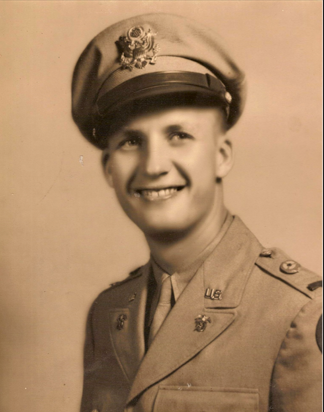
I’ve told lot of stories about my Dad, but before he went to England, on a troopship crammed with Black Quartermasters, who turned out to be devoted and inventive and courageous soldiers—the truckers of the “Red Ball Express”—he’d done his training at Camp Lee, Virginia, near Petersburg, where the United States had invented trench warfare in 1864-65.
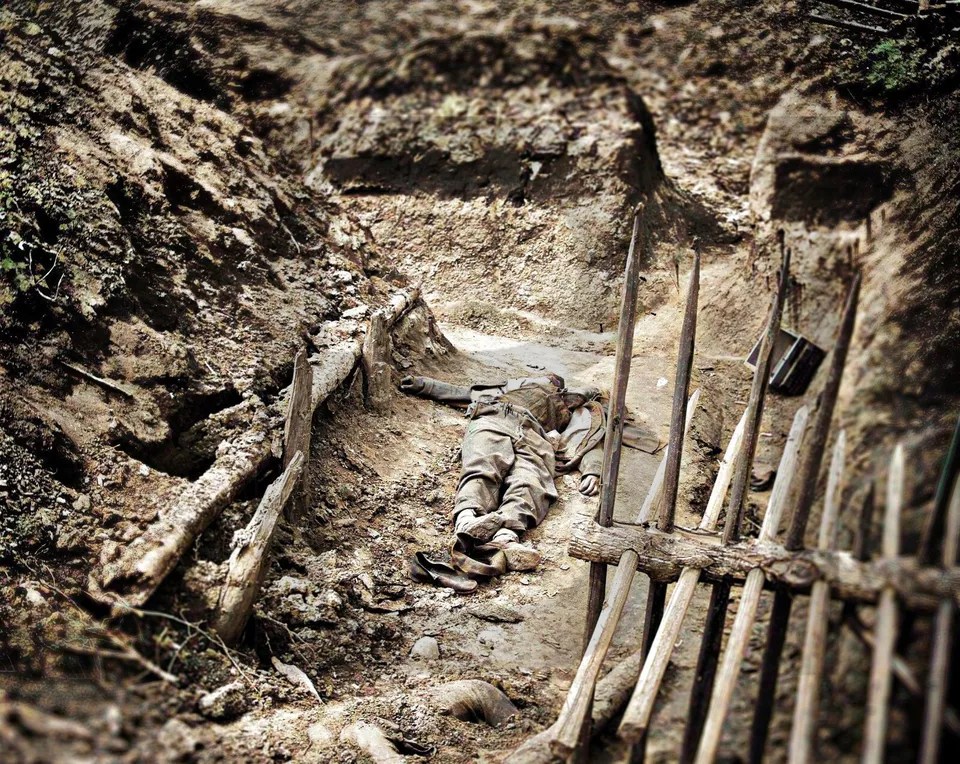
Dad wouldn’t have known it then, but his Midland English ancestors settled in Petersburg in the 17th Century, became vestrymen in the Episcopal Church, married into the Washington family, and claimed to own human beings, a detail which compelled them to go to war against the United States in 1861. I am named for two Confederate officers.
To my delight, I discovered that my lunchmate’s father had trained at Camp Lee, too. So now I am contemplating buying this Camp Lee yearbook on eBay:
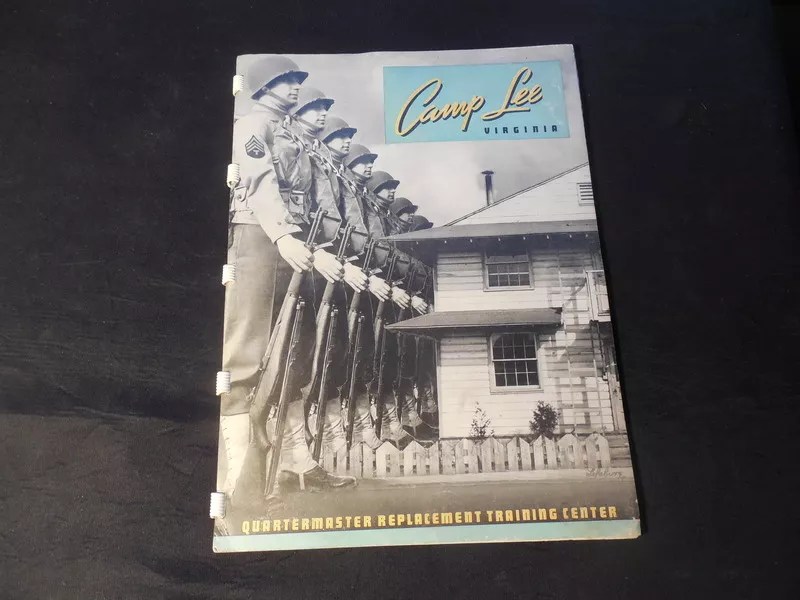
My own father’s Quartermaster career was spent filling out forms, fielding furious and profane phone calls from regimental commanders on Omaha Beach, trying to locate tankers that may or may not have been sunk by U-boats and organizing Quartermaster companies and the shipping that would take them to Normandy.
He worked with an office of enlisted men who presented him, in teasing admiration, with a beautiful, diploma-like certificate for “Meritorious Drinking Under Fire” for refusing to abandon his pint of bitters in a London pub during a V-1 raid.
It wasn’t V-1 raids that caused his nervous breakdown; it was, instead, the grind of endless eighteen-hour workdays. By the fall of 1944, he was used up. My Dad, a brilliant man, had made the dreadful mistake of making himself indispensable.
His C.O. was a good one. He put Lt. Robert W. Gregory on a train north, headed for Edinburgh, for a week of R & R. A week there, with my father dense in Scots, who are warm and friendly people, effected the cure.
Dad went back to his war.
The war’s end changed him. For one, he began to meet Germans, whom he liked, and to see the vastness of the damage the war had inflicted on them, which he hated.
Then came his last Quartermaster assignment: training nineteen-year-old infantrymen, full of imagined ferocity, eager to kill truckloads of Nazis. But the war in Europe had ended.
He had the thankless task of a teacher trying to teach unwilling students, shifting those teenagers’ focus from imagined combat glories to graves registration, to the disinterment and reburial, in military cemeteries, of men their age or not much older. Many military cemeteries had already been established by V-E-Day, but many G.I.’s had been buried quickly and were scattered, alone and in bunches, in barnyards and wheatfields, in dense hardwood forests and in marshes, even in little family cemeteries, from Normandy to the Elbe.
This is a terrible thing to say, because it’s true. In historian and Harvard president Drew Gilpin Faust’s This Republic of Suffering, in the Civil War, there were often no remains at all, thanks to high explosives or to Southern farmers’ hogs, who left no traces of the nineteen-year-old Yankees, save perhaps the soles of their shoes, who’d been lost in Virginia or Georgia or Mississippi.
Faust’s book revealed how hard it was to deal with death on an industrial scale, and how hard it was for families to deal with a loved one who had truly vanished.
In 1945 Europe, Quartermaster troops, working with the Army’s Medical Branch, were given the duty of finding this war’s dead, and many of them would never be found, either. I was once talking about this to a class of my Arroyo Grande High School history students, and I had to stop. I was starting to cry.
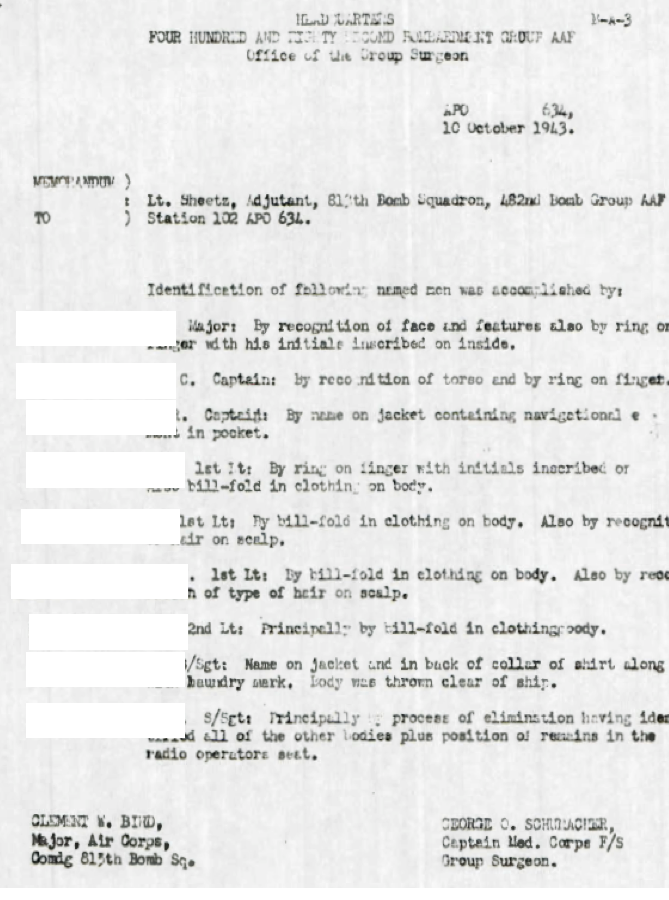
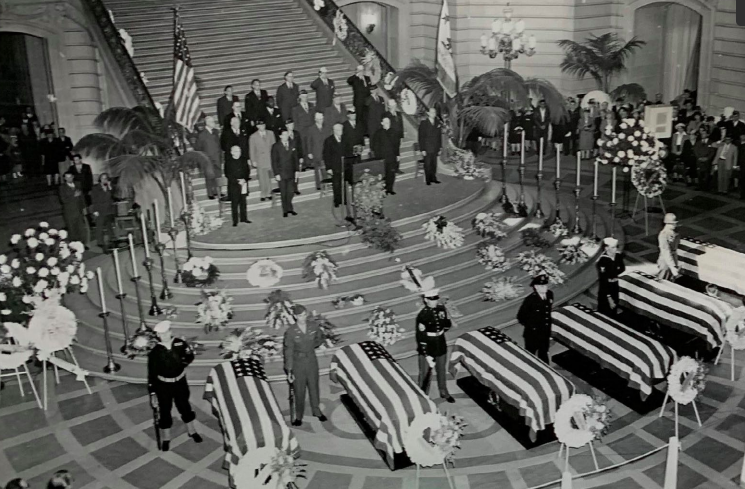
Dogtags had made the process easier, but Identifying the dead, even those just dead, was a terrible assignment. These are the victims of an accidental English air crash, a B-17. in 1943 England. One of them was an Arroyo Grande boy. This is how they were identified.
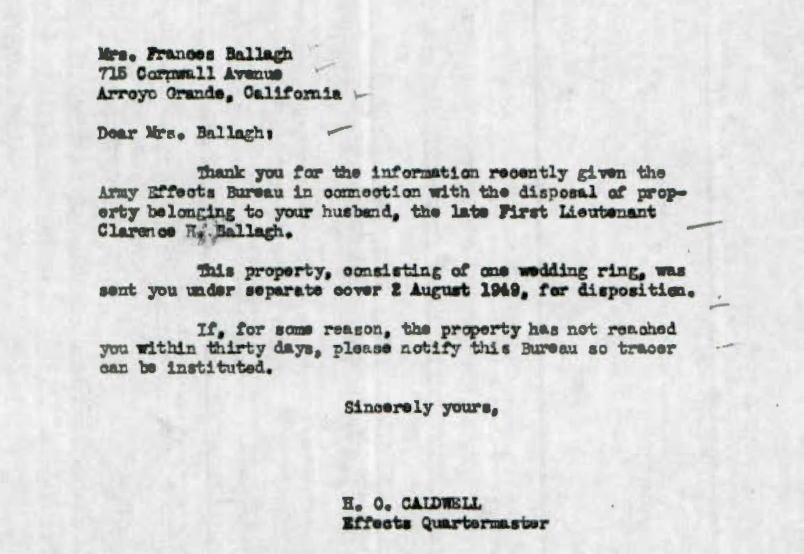
Another duty that fell on Quartermasters was in meticulously cataloging a dead soldier’s personal effects and then packing them into footlockers for shipment home. That took time. Here are the personal effects of the Arroyo Grande airman killed in the 1943 crash.
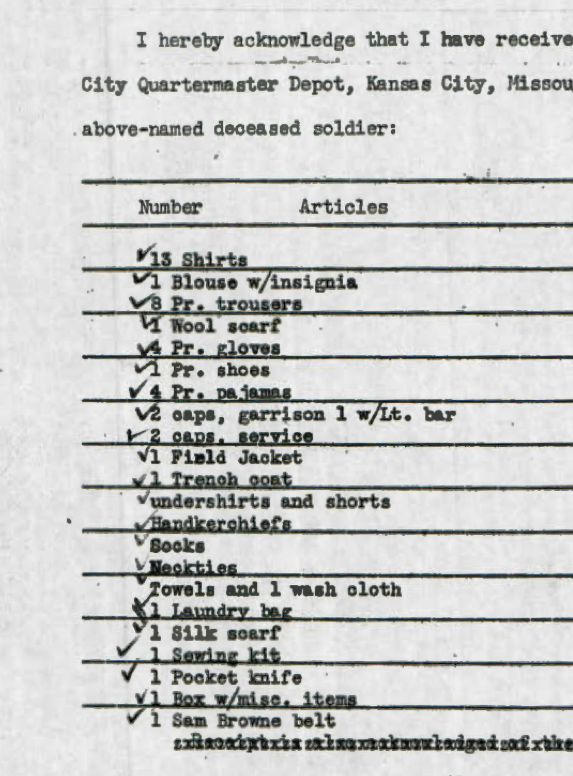
It would take six years for his wedding band to be returned to his wife.
My hunch is that I shared lunch with a woman whose father, already a 1940 graduate in ag science from the University of Minnesota (only 4.6% of Americans graduated from college in 1940) and headed for a postwar doctorate, who saw service on three fronts at the end of the war—a singular fact for any officer— was indispensable.
That would explain why World War II followed him without mercy until the end of his life in 2002. I think it’s very likely that he took part in finding, identifying, and re-interring the remains of young men in military cemeteries, in three different combat theaters, where their families might know that they were finally safe.
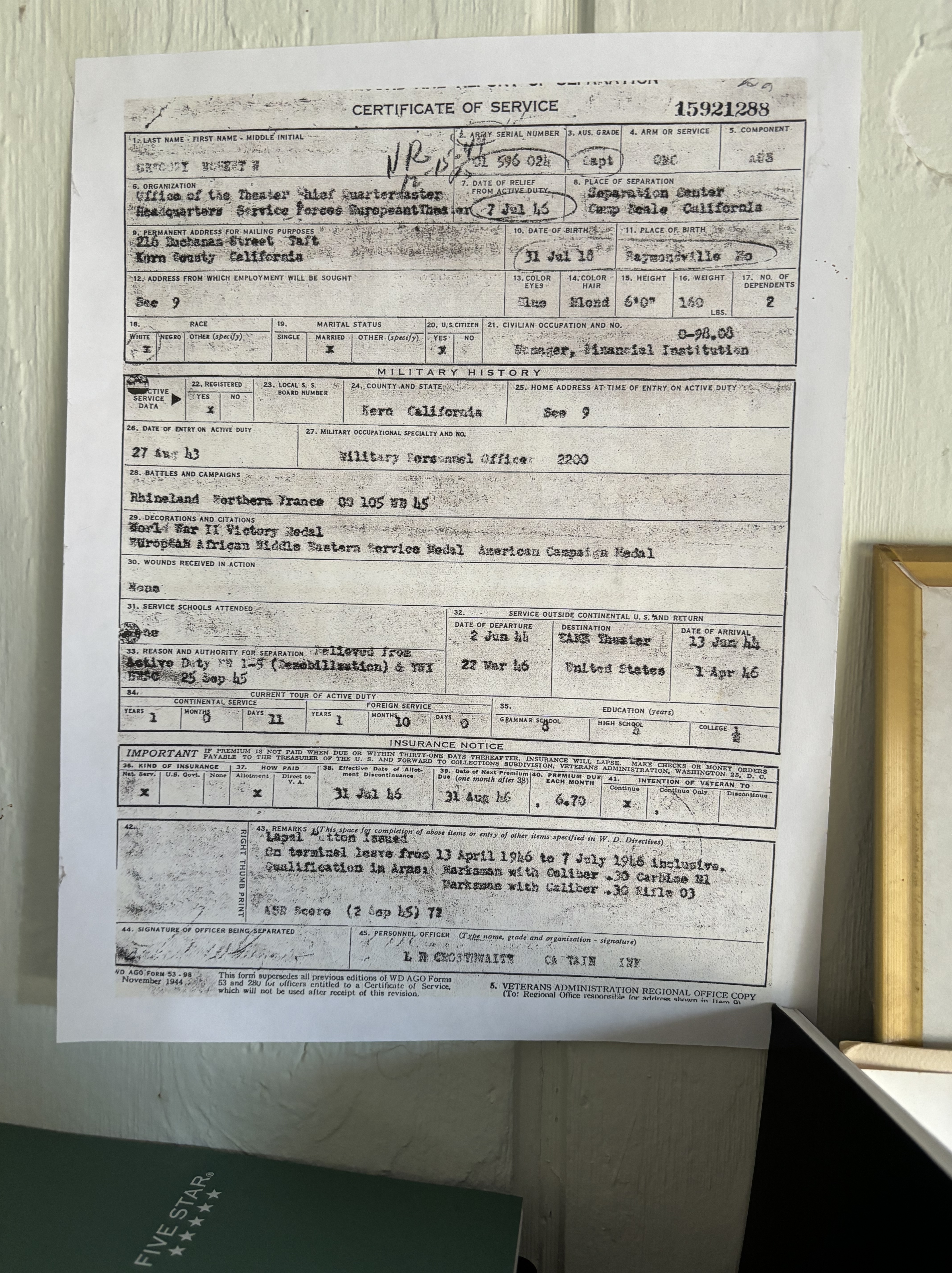
Since so many World War II Army records were destroyed by a tragic 1973 fire in the St. Louis Repository. I don’t know that I’ll ever be able to confirm if this was, indeed, this man’s duty. This single sheet is all the official evidence I have of my father’s service.
But if my hunch is right, it’s no wonder that the rest of another Quartermaster officer’s life included deep currents of sadness, and it’s no wonder that the war was far too painful for him to talk about with the children who loved him.
It was just as impossible for him to talk about this subject with his grandchildren. I taught one of them, and she is going to be a nurse. He would be immensely proud of her. This is not a hunch. It’s a certainty.
Her grandfather’s suffering was the product of a soldier’s heroism and a decent man’s compassion. This man, marked by those qualities, devoted his life to using science to save lives.
That makes the most sense of all.
 A Work in Progress
Thank you Jim for this wonderful article. You have great insight plus heart, and I liked the way you wove both our father’s military service into something positive and meaningful.
LikeLike
Thank you so much, Cheryl. Be assured that I think you Dad was a great man.
LikeLike