
Please forgive this reflection, but this is how I think, and this is how I taught history.
* * *
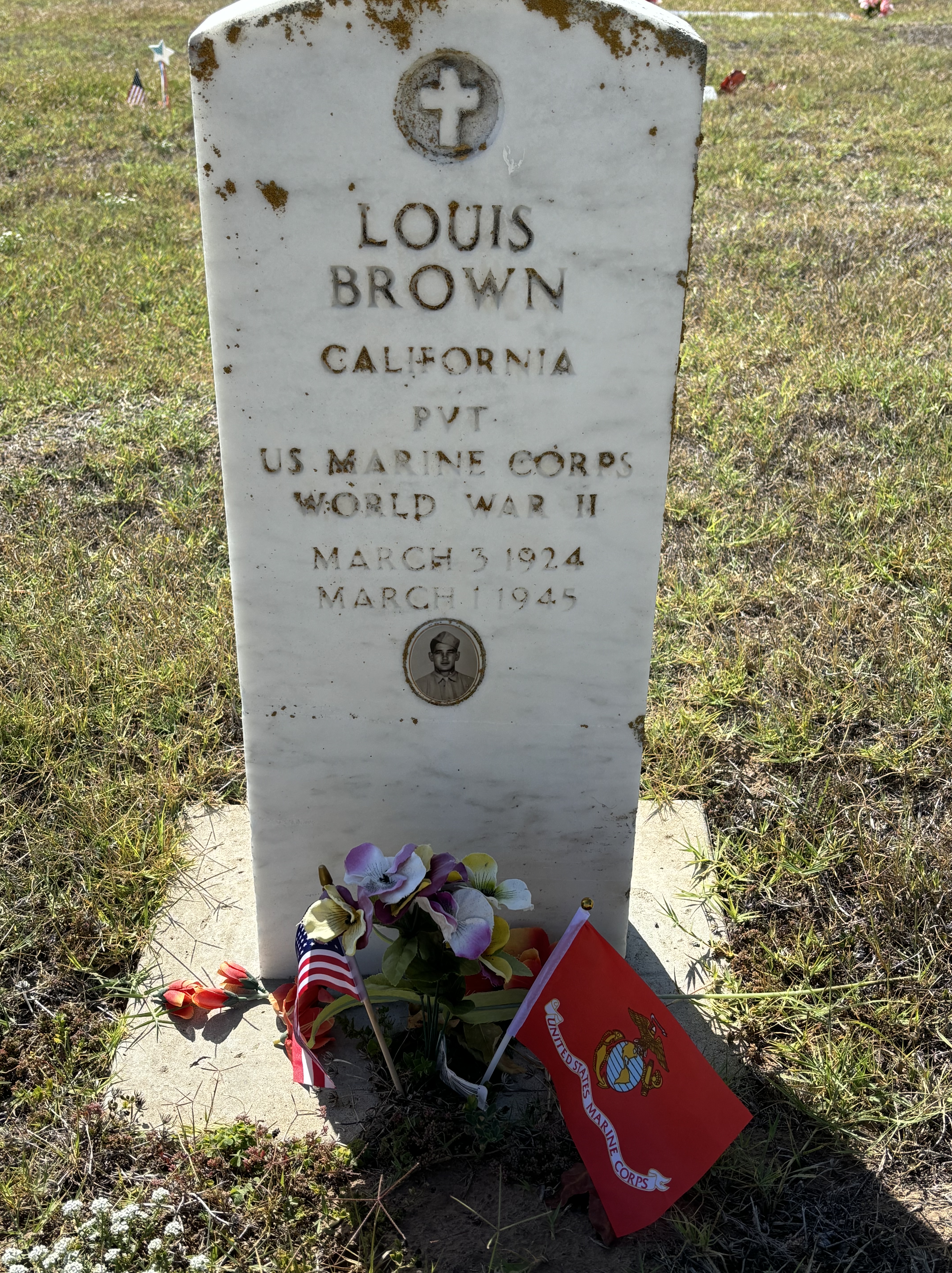
Pvt. Brown’s flags were threadbare–the American flag was gone–so I needed to take care of business.
On the way to his grave, in he IDES section of our cemetery, a big Dodge pickup was parked in the drive-path, the driver’s side door open. . Next to it was an older woman, a term, at seventy-two, that I use heedlessly, kneeling in front of a grave that was almost knee deep in flowers, surmounted by a happy pinwheel.
I don’t know why I say things like this, but I do.
“That is beautiful!” I told the lady.
She smiled and then her shoulders sagged. “My daughter. She’s been gone twenty-seven years.”
“I am so sorry.” The obligatory and stupid response. “I’m going to visit a Marine killed on Iwo Jima.” I had to repeat it. We’re both a little hard of hearing.
She put her hand over her mouth for a moment. “He died for his country.”
“Yes, he did, and he helped me to write a book about Arroyo Grande and World War II. He was the inspiration. I owe him so much.”
She liked that, I think, but we were still standing by her daughter’s grave, in the sun, and it was a little warm.
I don’t know why I do this, but I do. I had Private Brown’s flags in my left hand, so I reached out to her with my right. We held hands for a moment. I didn’t squeeze hers too tightly; she was wearing rings, one of them I am sure a wedding band.
“God bless you,” I said. I do know why I said this. Yes, I do. That’s the way my mother raised me.
After I’d tended to “my Marine”–he got fresh flags (needs new flowers), I ran my fingers over the smooth glass that covers the oval portrait on his tombstone, used the tombstone to get my my 72-year-old feet again, and gave its rough top a few pats with the palm of my hand. Then I began to walk back to my car.
The woman was still there, but this time, in the shade, thank goodness. She was kneeling at another grave, like her daughter’s, rich with flowers.
I didn’t bother her this time. I left her alone there, in the shade. She was by now standing but looking intently at the tombstone.
The past, Faulkner famously wrote, isn’t dead. It isn’t even past. I hope that the devotion the woman showed has been inherited by her grandchildren and great-grandchildren. I suspect that it has.
 A Work in Progress