
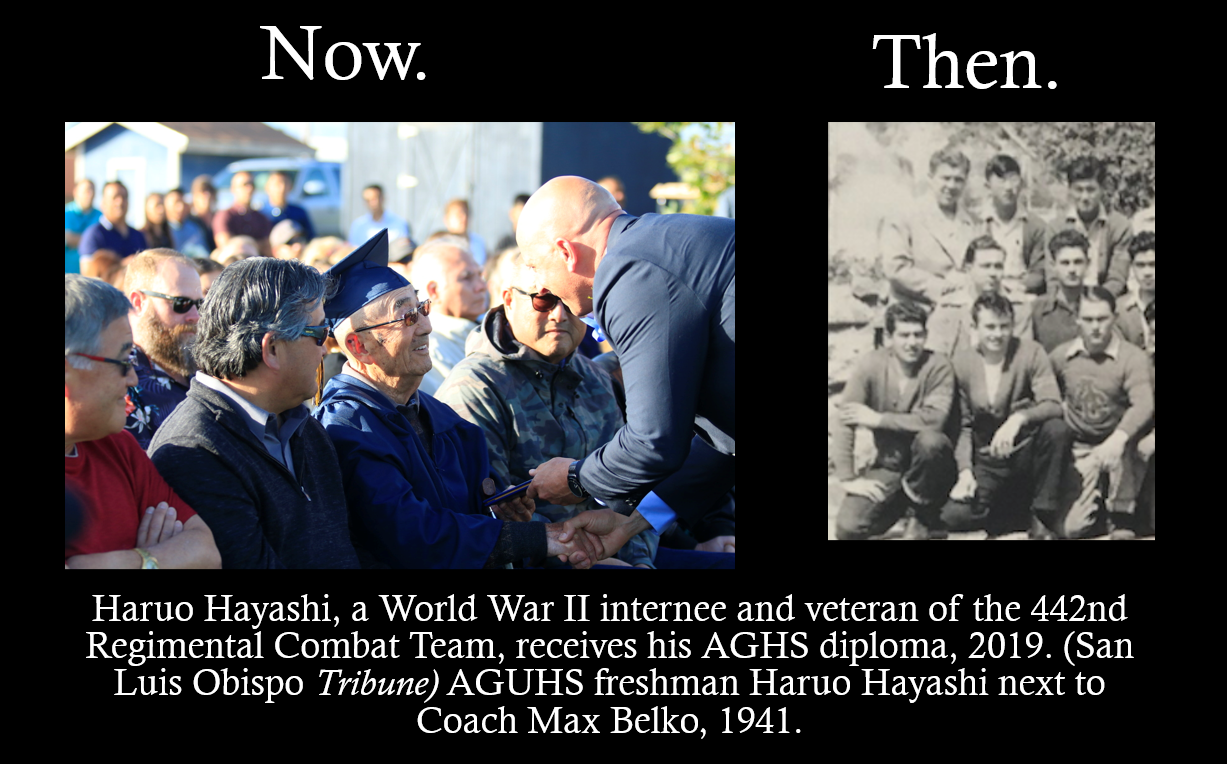
I don’t post this to be bragging.
Wait. Maybe I do.
But I post so much, espeically on Facebook, about history stuff that I hate the idea of me sounding like I am bragging. My Irish-American mother had, as one of her central teachings, that there was no sin quite so terrible as the sin of Pride.
Here’s the deal, Mom. I am now seventy-two, and I have enough stories inside me for two lifetimes. Each story I write takes days of research. Each of the little books I’ve written represent a year of work.
If I don’t get the stories I have left out, they will be lost.
Mom died when I was seventeen, but, as I once told my high school students, she was alive in me every day I taught them. She was right there beside me. Her passion was social justice.
It was Dad’s voice alive in me in the stories I told the teens I loved to teach, at both at Mission Prep and then at my Alma Mater, AGHS, and there’s no better way to teach history than to tell stories. My father was a mesmerizing storyteller. He was right there beside me, too.

So the little stories I post on Facebook—and the marvelous, evocative stories told by my friend Michael Shannon, who grew up near us in the Upper Arroyo Grande Valley–are begging to come out. Michael’s stories a lyrical and vivid and, given his four generations in Arroyo Grande, they have roots that make them even more authentic and timeless.
As soon as Michael and I think of one story, another one surfaces. I was asked recently to give five or six examples of acts of kindness, selflessness or sacrifice from Arroyo Grandeans from our past.
I wrote twelve.
Seven more are waiting to be written.
Michael could double those.
Both of us are in our seventies. Neither of us, I think, writes to show ourselves off. We write, instead, to show off people from our hometown’s past whose lives were marked by grace, or generosity, by sacrifice or by courage.
Most of all, Michael and I are drawn to stories about people whose lives were marked by kindness.
These people are our heroes.
I’ve written, too, about our town’s failures–the mob that descended on Chinatown in 1886 and forced the residents to flee, the double lynching a few weeks later, the ugly bigotry directed at Filipino immigrants, the few locals, motivated by envy directed toward the Japanese immigrants who’d become so successful, who applauded Executive Order 9066.
The fact remains that the heroes far, far outnumber the cowards from our past.
They have to be written about. They have to be remembered. In however many years I have left to me, I want to be part of remembering them.
Here is one of my favorite stories; I’ve told it many times before, but for some of you, this might be the first time.
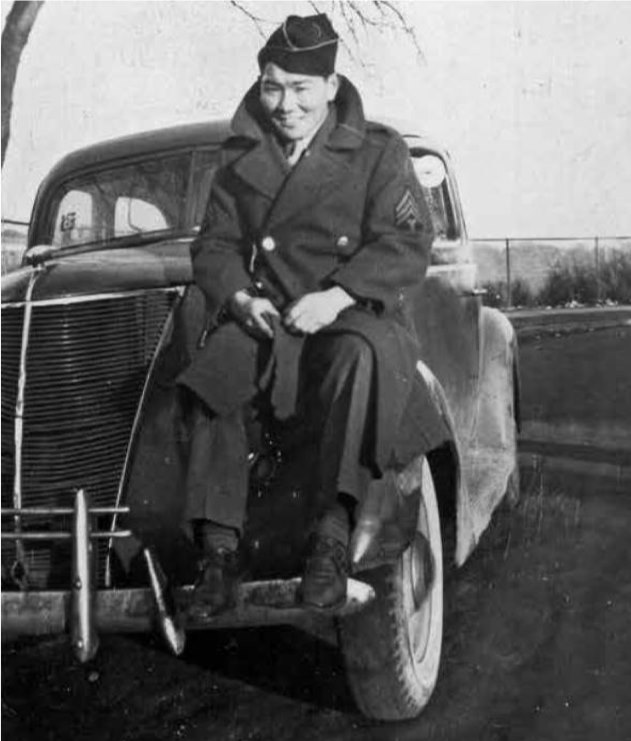
AGUHS grad and Army Intelligence Officer George Nakamura, posing on the car (note the bald wartime tires) when he was studying his family’s Japanese in, of all places, Minnesota. Some of his instructors would’ve been intelligence officers, too. Many of them were women.
Nakamura was part of a team attached to–and meant to spy on–Mao Zedong’s guerrillas as they fought the Japanese in the mountains of Ya’Nan Province.
Nakamura disguised himself as a Chinese peasant to go behind Japanese lines to rescue a downed American flier. He was twenty years old.
When he turned twenty-one, the former sports editor of the AGUHS “Hi-Chatter” had so charmed his hosts that they threw him a birthday party. Somebody had a record player.
So the female fighters took turns dancing with the former editor of the AGUHS “Hi-Chatter.”
One of them was a famous prewar film actress, Jiang Qing.
She was the boss’s wife. The woman who danced with Nakamura would be far more famous by her married name: She was Madame Mao.
That’s a hell of a story. There are thousands more from this little town. There are so many stories; there is not nearly enough time.
 A Work in Progress