

It’s a simple matter of justice, you see. This article is from Heritage Press, the South County Historical Society’s newsletter. If I can find a restaurant that makes chapulines tacos, I am willing to try one. I am willing to be photographed. My eyes, of course, will be closed.
(I made a similar vow about Humboldt squid, so voracious that they are devastating West Coast fisheries. I guess they will eat anything, including the occasional Coast Guard cutter. (I recommend the Calamari Fries at Rooster Creek Tavern in Arroyo Grande.)
Anyway, here’s the grasshopper story.
The Great Grasshopper Invasion of 1934
By Jim Gregory, South County Historical Society President
It must’ve seemed Biblical. In the summer of 1931, swarms of grasshoppers descended on Iowa, Nebraska and South Dakota and began eating crops down to the roots.
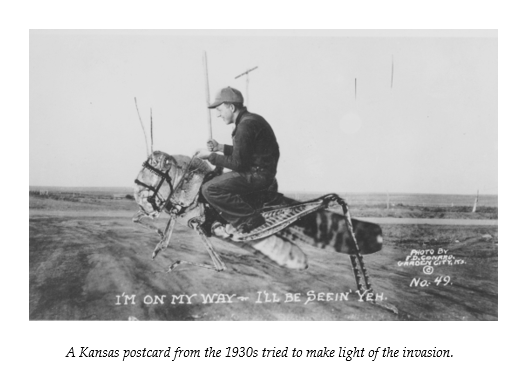
Another infestation in 1937 Colorado led to the intervention of the National Guard. Guardsmen used flamethrowers to attack the insects.
In 1934, it was Arroyo Grande’s turn. Grasshoppers were the last thing County farmers needed.
The Depression had hit county agriculture hard. The total value of crops in 1929 San Luis Obispo was $12 million; by 1933, with the collapse of farm prices, the figure was $6 million. Poignant anecdotal evidence of the impact on farms can be found in the frequency of legal notices—foreclosure sales—in newspapers from the time.
1933—possibly the depth of the Depression—was accompanied by a singularly dry year in Arroyo Grande. By the end of 1934, over seven inches of rain had fallen. At the same time in 1933, the total was only a little over two inches.
The head of the New Deal’s Soil Conservation Service was struck by what overcultivation and dry weather had done to the canyons north and east of town. Arroyo Grande’s soil erosion was, he wrote, the worst he’d seen in the United States. (The Dust Bowl was yet to come.)
The Dust Bowl was yet to come.
Dry conditions are ideal for grasshopper eggs. So in the spring of 1934, swarms began appearing in Suey Canyon, east of Santa Maria. That was ominous.

In 1873, a grasshopper infestation literally seemed to explode from Suey Canyon. L.J. Morris, a Santa Maria justice of the peace in 1873, wrote that “they came in great clouds, miles in extent so thick that they obscured the sun and the day grew as dark as deep twilight.”
“They settled down on the first bit of greenery they saw,” Morris continued. “They stripped young orchards in a twinkling…nothing was left but the little stubs of the trees, every shred of bark gone.”
Now, in 1934, history was repeating itself. This time, the grasshoppers descended on cars traveling between Santa Maria and Nipomo, fouling radiators and so obscuring windshields that drivers had to pull off the road.
“The Tar Spring Road,” an April Arroyo Grande Herald-Recorder reported, “was a moving mass of hoppers from Newsom Canyon…to the Andre Dowell alfalfa field.”
Cars traveling between Nipomo and Arroyo Grande had to pull over to the side of what was then the two-lane 101. Grasshoppers had so fouled their windshield wipers that they no longer worked, and the air along the road was so thick with uncrushed grasshoppers that it resembled the Valley’s famous tule fog.
And they had the same appetite their forebears had demonstrated 1873.
Town blacksmith Jack Schnyder was proud of his new lawn, which he wet down to discourage ethe grasshoppers, but they “dug it out by the roots.” The bean crop in Tar Springs Canyon was completely destroyed.
They descended on other parts of the county, as well. In Cambria, known for dairy farming, milk cows refused to go out to pasture—the grasshoppers terrified them. Cal Poly students lit backfires to deprive them of vegetation as they closed in on San Luis Obispo.
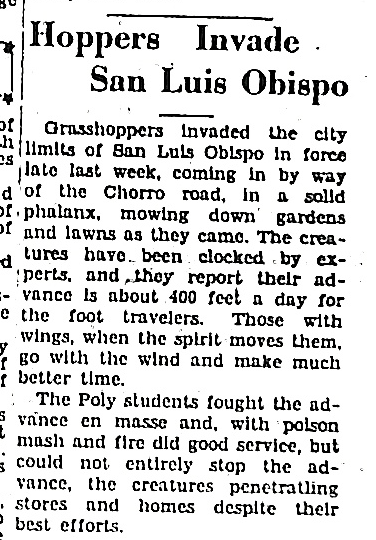
Local ranchers met in Edna to come up with a plan which they presented to the Board of Supervisors, where Supervisor Asa Porter of the Huasna Valley acted as their spokesman, successfully securing county funding for fighting the pests.
Poison mash was one antidote. A helpful article in the Pismo Times included a recipe for poison mash, which included citrus fruits, two quarts of molasses, bran and a pound of white arsenic. The mixture was spread over farm fields in the hope that the grasshoppers would take the bait.
Sadly, what seemed to end the 1934 infestation were the grasshoppers themselves; having devoured so many crops in their fields and so much pastureland, they moved on.
But they threatened to return. “Grasshoppers Hatching in Nipomo Area,” a Herald-Recorder front-page headline announced in July 1935. The Farm Bureau and area farmers crossed their fingers and hoped for fog: cool, damp weather destroyed grasshopper eggs effectively.
Just in case, the county had twenty tons of poison mash in reserve.
I few days ago, I wrote a little about one of my favorite film directors, Terrence Malick, whose visual sense is astounding. In this sequence from his Days of Heaven, you can see what grasshoppers can do. Actually, these are locusts, but I looked it up, and the difference, scientifically explained, confused me.
Are Grasshoppers and Locusts the Same?
Locusts belong to three specific Acrididae subfamilies: the spur-throated, band-winged, and slant-faced grasshoppers. With this in mind, they are, technically, grasshoppers.
What sets locusts apart from other grasshoppers is their behavior. Only the grasshoppers in these specific subfamilies have the ability to become locusts because no other species are able to exhibit the necessary behaviors.
Locusts, I guessed, are marked by hanging out on street corners, wearing black leather jackets, smoking Camel shorts and rubbing their legs insolently at passers-by.
Locust or grasshopper, this film clip shows you why, South County 1934 farmers, I will be your Retribution.
 A Work in Progress