• About
  • The Germans

A Work in Progress

A Work in Progress

Category Archives: American History

Sambo’s, Arroyo Grande, 1969

07 Sunday Mar 2021

Posted by ag1970 in American History, Arroyo Grande, Personal memoirs, Uncategorized

≈ Leave a comment

I have no idea how this is is going to end up, so I might as well begin.

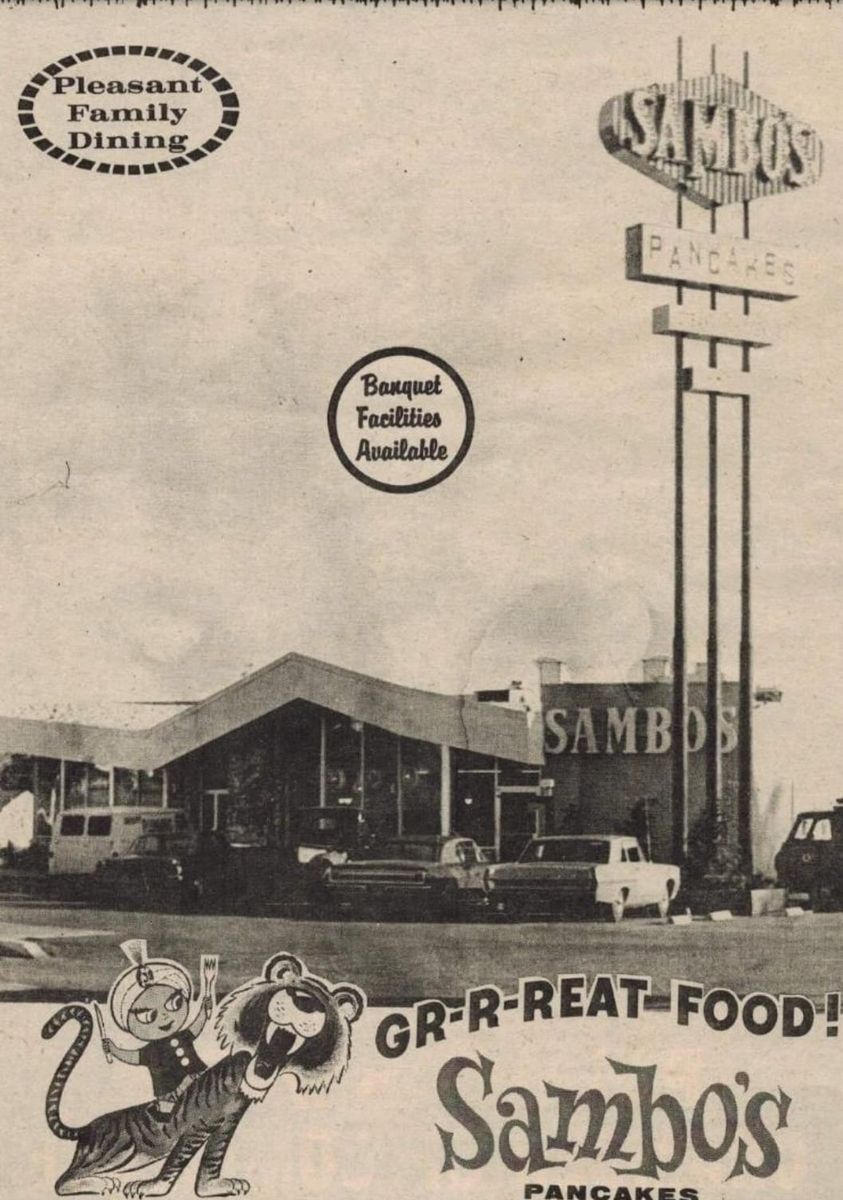
This place became, much later, Francisco’s Country Kitchen, which I came to love both for its biscuits and gravy and for the density of the newspaper racks out front. They will demolish it soon, and that makes me fearful. No so much for losing the building, which is a minor example of a style that considered Moderne sometime between Sputnik and Apollo 13, but because even the most transitory spark lit by the wreckers might ignite fifty years of kitchen grease with the explosive force of a typical B-52 payload.

I’m just glad we live on the far side of Grand Avenue.

But before it was Francisco’s, it was Sambo’s, a story that had always charmed me—imagine tigers spinning themselves into butter, I thought, at four, and imagine how delicious they would be!—but became politically inconvenient many years later after the summit of my time there. That was about 1969.

Ten years after, it was still one of my favorite places. When I was a newspaper reporter for the Telegram-Tribune, I interviewed Leroy Saruwatari there for a feature on the demise of Arroyo Grande’s once-vast walnut orchards. Leroy told me about the perpetrator—husk fly larvae, which are so voracious and pitiless that you wonder why the orchards didn’t collapse, on their own, into sawdust–but he also told me a little about his family, perhaps the first Japanese immigrants to the Arroyo Grande Valley. They came here about 1903. Leroy didn’t know this, but that interview in a booth at Sambo’s so moved me that it would pay off thirty-seven years later when I wrote a little about his family in the book World War II Arroyo Grande.

Sometimes, years after the interview, I would stop in for a coffee or even a breakfast, take a booth to myself if it was during the slack in the morning shift, and furtively stare at the men sitting at the stools along the counter. They were farmers, come in for breakfast and coffee and gossip during a slack time for them, at a midpoint between sunrise and lunch.

Some of them wore green John Deere hats, many more wore the same felt hats typified by Bogart and made unfashionable by JFK, who hated hats. My father’s, with a broad brim and a silk ribbon and bow, lived out its life hidden— neglected except by me, who took it down and tried it on as a child—in the upper reaches of a narrow closet in our home on Huasna Road. Dad’s hat was pristine. The farmers’ hats were dented and stained by the traces of loam that is a compound of Upper Valley soil and irrigation water. Perhaps they’d blown off their heads while they towed a harrow into a field to break it up for a new crop of peppers or cabbage or pole beans.

I was far too shy to sit among them. So I just sat in my booth, waited for my order, and watched them quietly. Had I been a teenaged girl and had it been twenty years earlier, they would have been my Beatles and I would have been screeching. Thank the Good Lord for timing.

I am, after all, the grandson of a farmer from the Ozark Plateau who wore overalls all his adult life, who raised corn and milo and soybeans and—he was considered odd for this—ginseng, who slaughtered hogs in December and who, even into his sixties, was the most graceful waltzer in Texas County, Missouri. The line of teenaged girls waiting their turn to dance with Mr. Gregory did not amuse my grandmother.

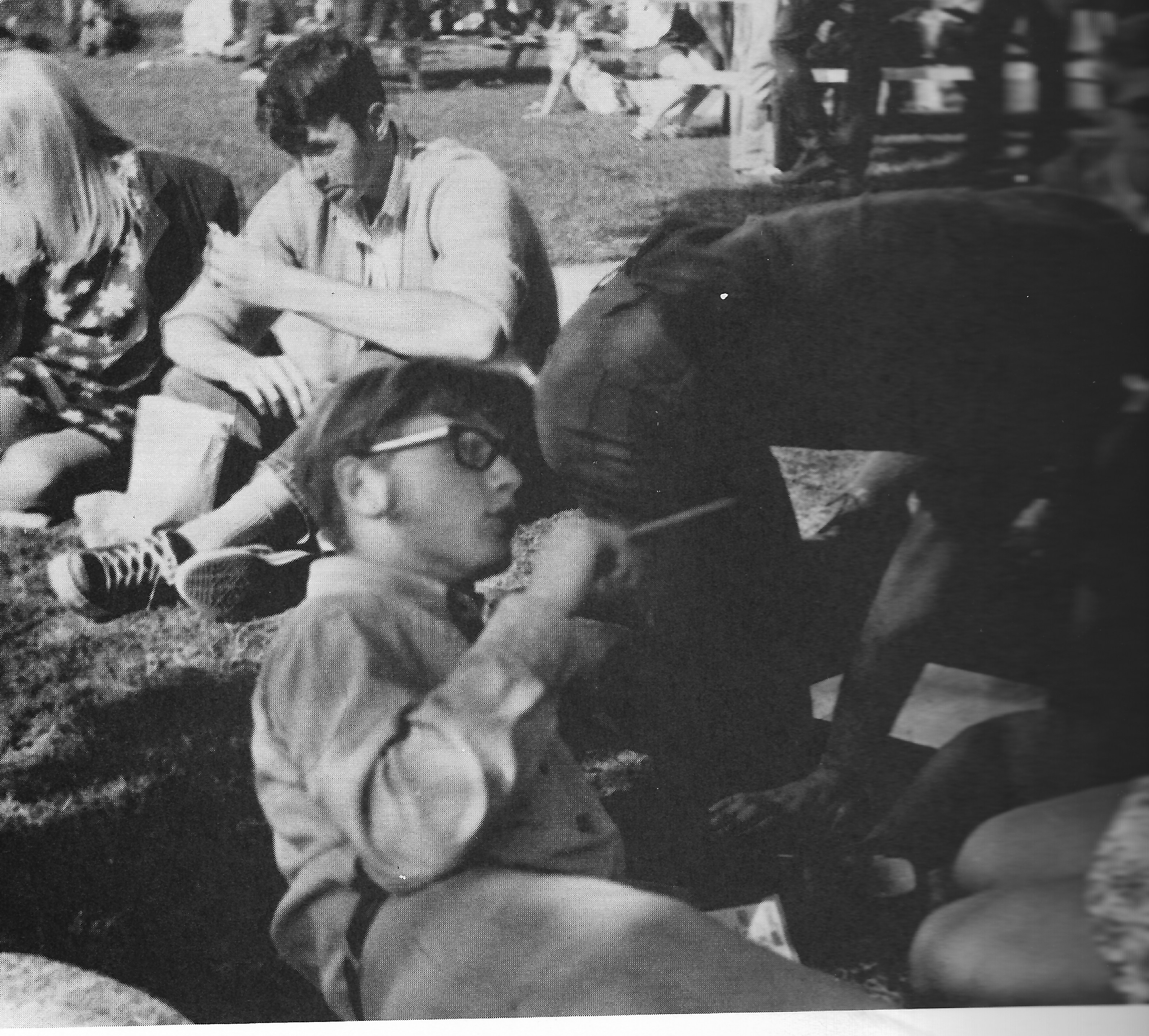
And years before I sat quietly watching the farmers at the Sambo’s counter, this was me.


See? I’m being pedantic already. I’m a senior at Arroyo Grande High School, in the Quad, and quite full of myself. Probably I’m at the midpoint of a book–you can see one just beneath my legs—and probably it’s Herman Hesse or Kurt Vonnegut. My victim—you can just see her kneecaps—is my girlfriend, Susan. Susan was—is— extraordinary. She was bright and lovely and, by God, she had tamed a raccoon. She was a horsewoman and she loved my little sister, Sally, so sometimes she’d appear in our driveway and ask to take my seven-year-old sister for a ride. She’d keep one arm around Sally, the other controlled the reins, and they’d ride through Kaz Ikeda’s cabbage fields and talk. My little sister is bright and lovely, too, and I think that a small part of her was formed on those quiet horseback rides.

The rear end belongs to Jack. Just beyond him, with a sandwich, is Clayton, a Canadian transplant whose family settled near the mouth of Lopez Canyon where they raised horses, too. Next to Clayton, the young woman is Lois. Lois was stunning. She had beautiful wide eyes with impossibly long eyelashes and a breathy voice—a little Marilyn Monroe-ish—that devastated every seventeen-year-old male within fifty yards of that tree in the Quad of Arroyo Grande High School.

They chopped the tree down, many years later.

But Lois brings me back to Sambo’s, because her boyfriend was Paul. Paul was my classmate and intellectual soulmate. He may have turned me on to Hesse—“turned me on” was a stock phrase in 1969— and, for a brief time, to psychedelics. Paul was kind of shambly and self-effacing; he sometimes threatened to disappear inside the clothes that seemed just a little too big for him. But he was also brilliant—not just in English but also in mathematics and science and all the other subjects in which I was not at all brilliant.

Lois adored him. So did I.

Paul’s family lived in the blocks of houses bounded by Grand Avenue and the 101. (Another family I loved, the Hirases, lived there, too.) So it was natural, when I visited him, that the meeting adjourned to the nearby counter at Sambo’s, just a short walk away.

We were quiet during our visits there. In 1969, after an AGHS football game, Sambo’s was besieged and had to surrender to hordes of teenagers who ordered enough cheeseburgers and fries to ensure the eventual but inevitable cardiac occlusions, who shouted at each other from three booths away and experimented with how far they could shoot—at each other— a crinkled soda-straw wrapper from the end of its plastic muzzle.

[I didn’t order a cheeseburger. My favorite was a short stack of pancakes with scrambled eggs and blackberry syrup. This might still be one of my favorite meals.]

But we must have been exasperating. I am not sure this is so, but I expect it is: The waitresses’ hair was tied into tight ponytails behind or lacquered beehives above to keep their hairdos out of the food. You could almost see the ponytails come undone or stray strands of beehive, like little blond flags, wander away under the stress of serving teenagers with no more discipline than your typical Capitol Hill mob.

But that was after games.

Paul and I were quiet at our counter seats—the bank opposite from the one where I watched the farmers so many years later—and all we wanted was coffee. I could be wrong, but I believe Sambo’s had a policy then was can be briefly summarized: We are the Marianas Trench of Coffee. For ten cents.

So Paul and I, no matter how different we were—he was far brighter and more worldly; he smoked Winstons and I smoked Camel Filters–would sit there, exploring the depths of Sambo’s Coffee Policy, and we would talk about Hesse and Vonnegut and Steinbeck, about Squares, which included Richard Nixon, about film, about the White Album and about the one passion that we shared above all others: Eric Clapton, Jack Bruce and Ginger Baker, from the supergroup Cream.


“Ya need more cream for your coffee, Hon?” That was the waitress. I can’t remember her name. Since I was seventeen and she was in her mid-forties, she seemed to me a relic from Egypt’s Middle Kingdom. She moved noiselessly on white nurses’ shoes from one bank of the counter seats to the other; she pinned her orders to the cook’s wheel and spun it with great authority, she knew how much to talk and when to shut up.

And she called me “Hon.” [Yes, I know. ALL waitresses call you “Hon.”]

My mother had just died, in 1969, and this waitress was about Mom’s age. Gravity— and doubtless some heartbreak, which is none of my damned business –was beginning to pull the features of her face to the south but their counterpoint was the discipline of her beehive, Peroxide Harlow, which towered defiantly north.

And not only did she put up with us, the pretentious punks that we were, but she never failed to glide back to us for refills, which I always looked forward to. There I was, sitting next to a friend whom I loved and having my cup filled by a woman whom I loved, too. She didn’t know that.

But when she asked quietly “More coffee, Hon?”—I know now this was simply because she had no idea what my name was—for just a moment, Sambo’s restored my mother to me. I wasn’t the only one, either, looking for his Mum that year.

The Men Who Knew Too Much

18 Monday Jan 2021

Posted by ag1970 in American History, Uncategorized

≈ Leave a comment

By 1957, over 35 million prescriptions for the sedative Miltown had been written, overwhelmingly for American women.

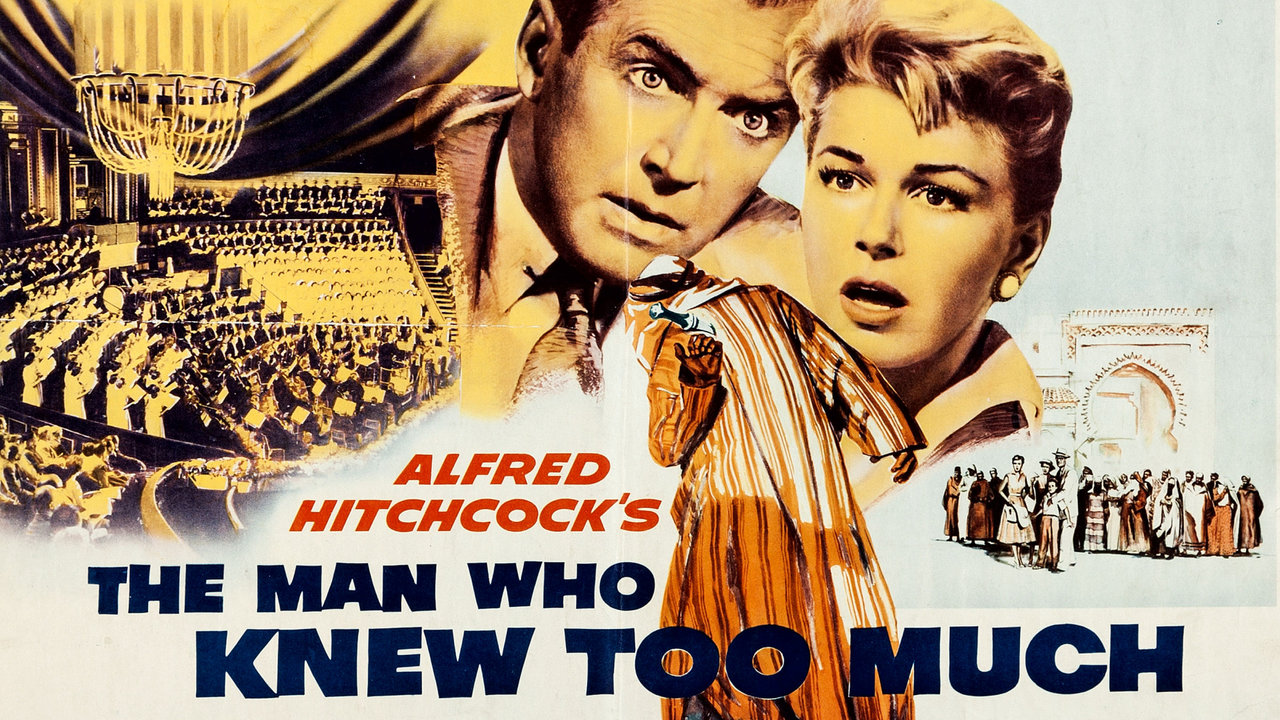
Being a History Guy, and knowing that, it startled me in the midst of watching a 1956 Hitchcock film I otherwise enjoy. This one:


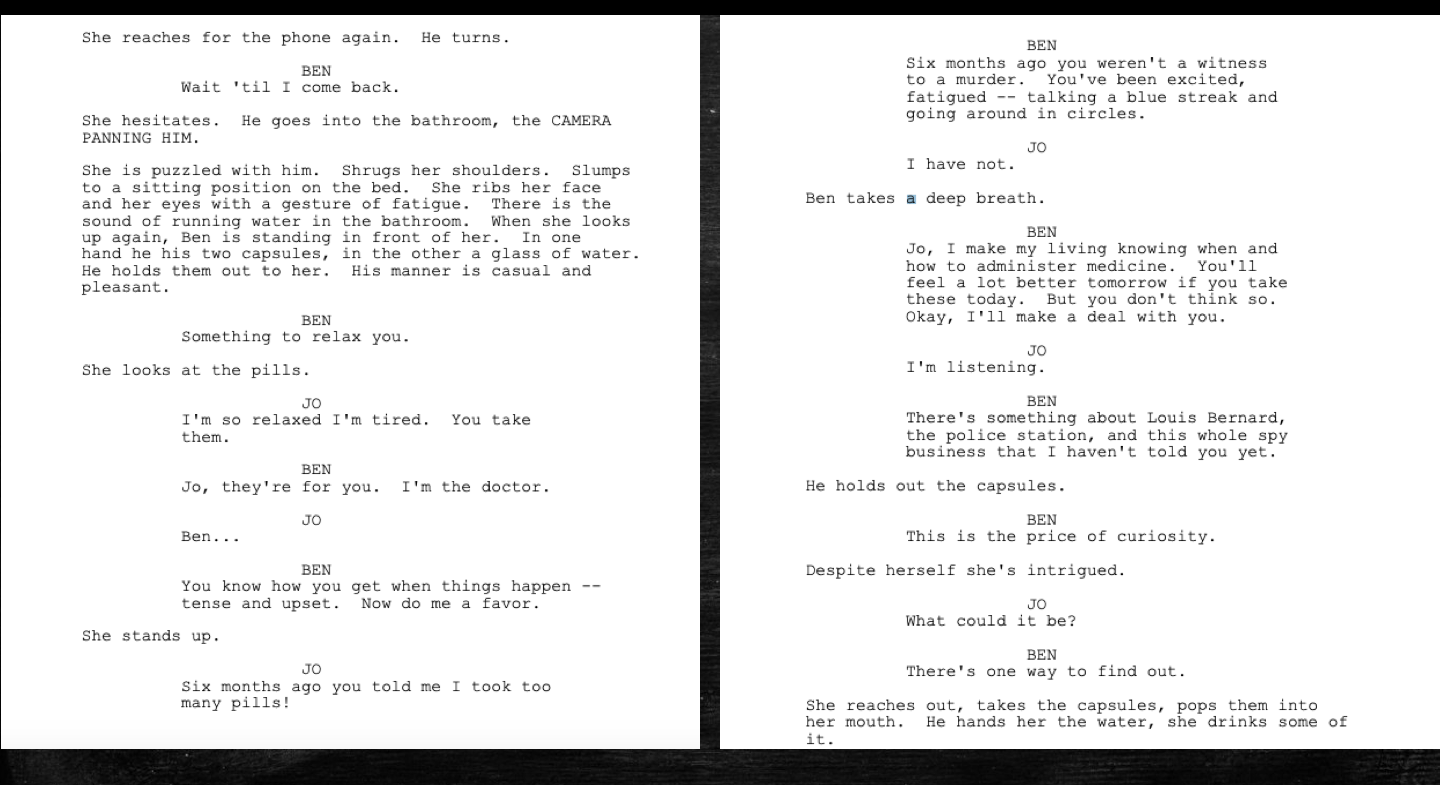
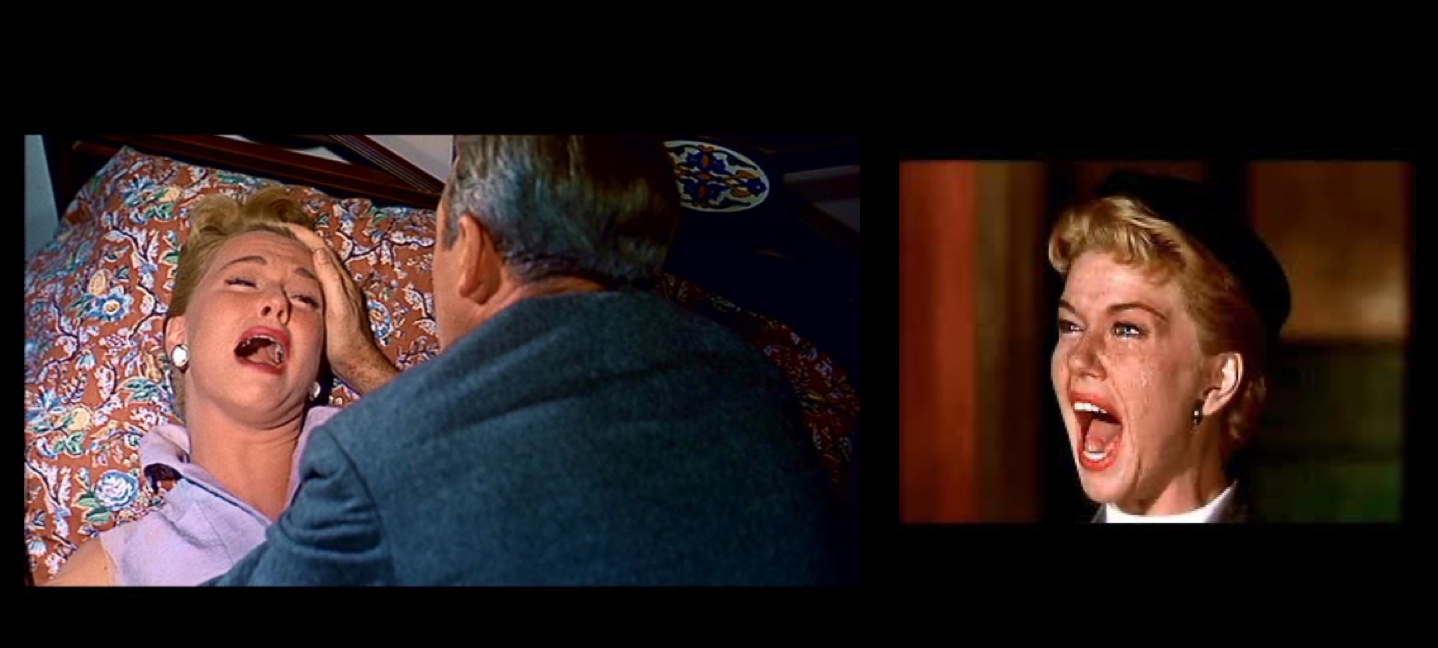
The film scene that brought me up short happens in a Marrakech hotel room, when James Stewart’s Dr. Ben Makenna must disclose to his wife, Doris Day’s Jo, that their young son has been kidnaped. This is how Dr. Ben breaks the news, with the help of Modern Pharmaceuticals:


To her credit, it’s Jo who finally realizes that the man Ben is looking for in London—the lead to their missing son— is not a man named Ambrose Chapell, but a church called Ambrose Chapel. While she runs to the phone to summon the authorities, Ben gets into a manly fight inside the chapel and is cold-cocked by blackjack. Later, in the Albert Hall, Jo gets to scream, throwing off an assassin’s aim, while Ben gets into a manly fight with said assassin, who falls, kerplop! to his death, making a new hole in the Albert Hall. [Sorry. Arcane Beatles reference.]


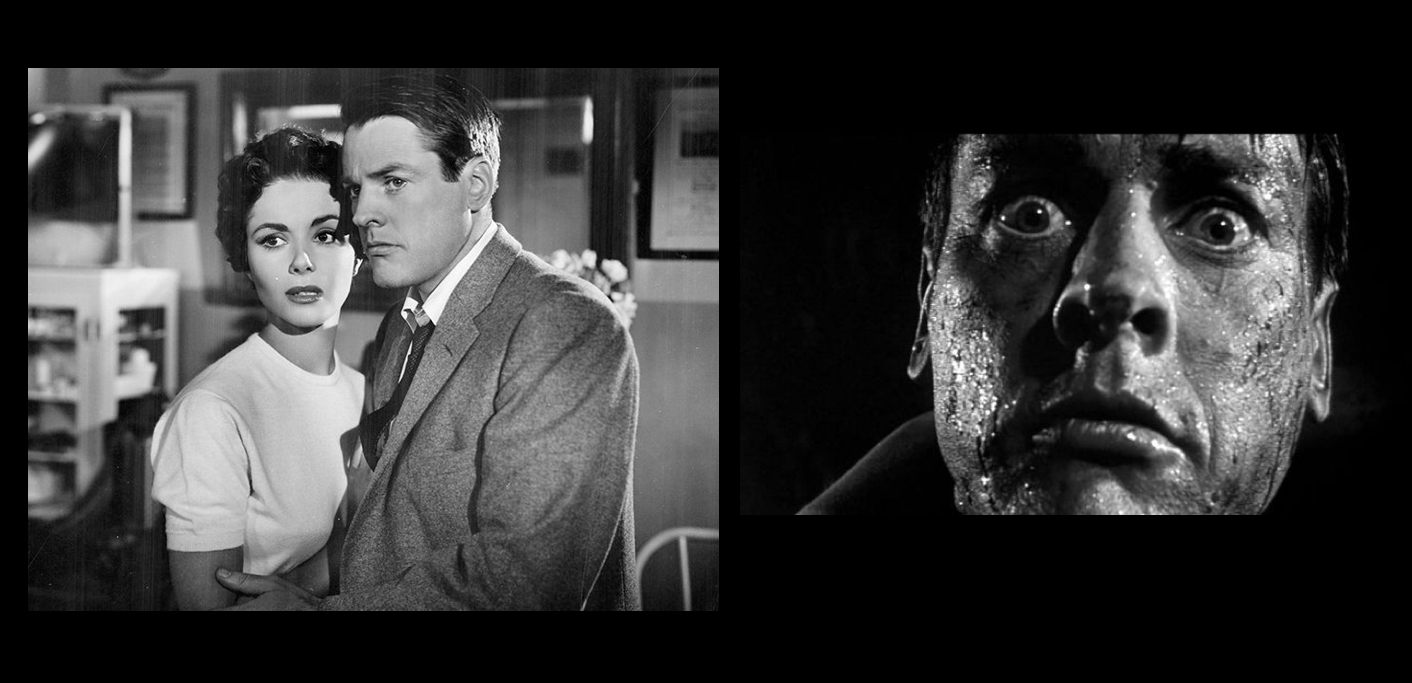
This scene reminded another 1956 film, Invasion of the Body Snatchers, in which Dr. Miles J. Bennett, played by Kevin McCarthy (Not the funny one. He’s still the House Minority leader.) repeatedly urges his beloved, Becky Driscoll (Dana Wynter), amid all the poddage, “TAKE TWO OF THESE!” Sometimes they seem to be Miltown or Librium; in one scene I think they’re dexedrine—so Becky can run faster, I suppose. They don’t do her any good—nor Dr. Miles J. Bennett. Becky becomes a 112-pound snow pea. Bennett winds up loony alongside the 101.


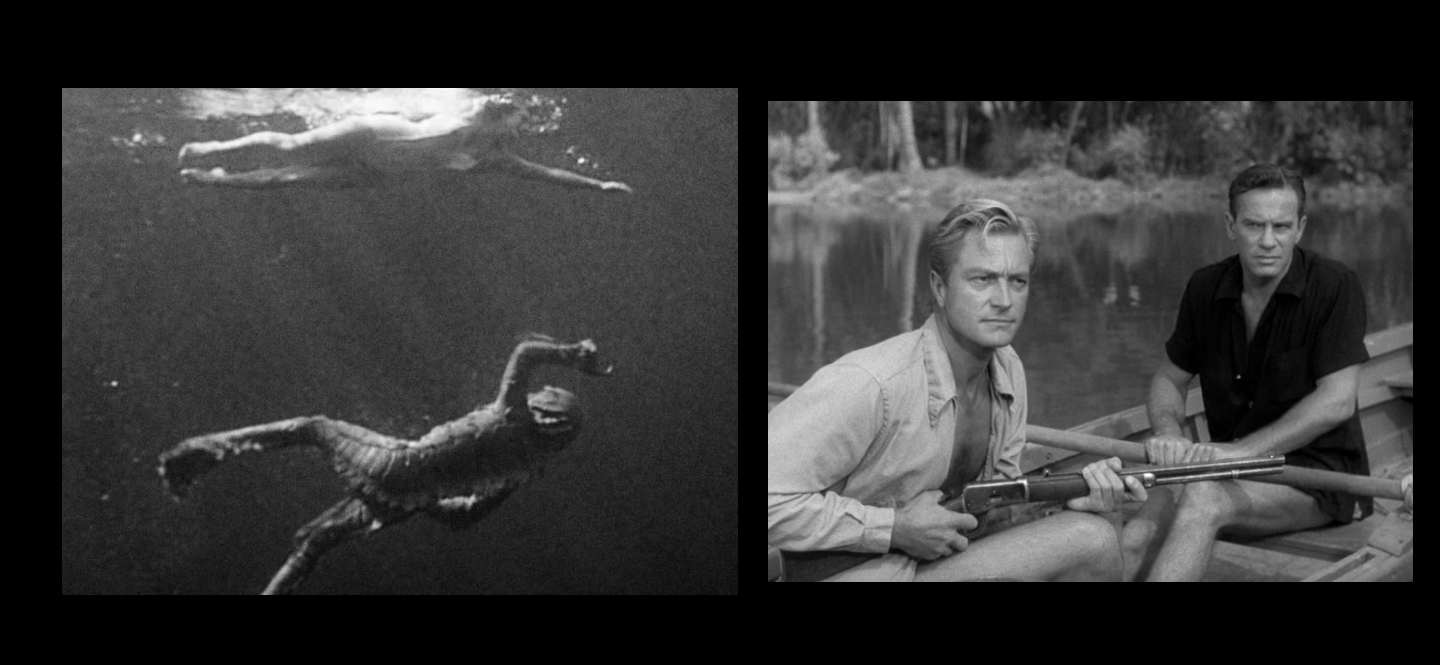
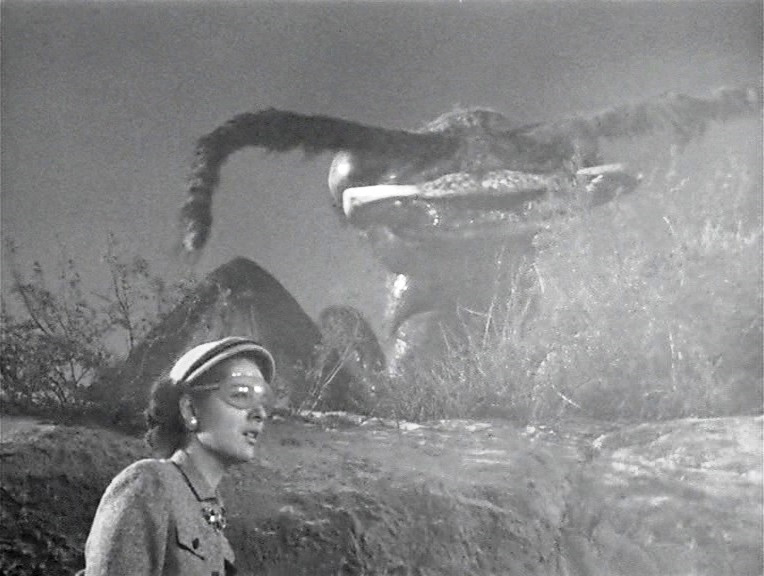
A kind of Female Learned Helplessness theme can be seen throughout Fifties films. Creature from the Black Lagoon’s Julie Adams (1956) gets to swim fetchingly and faint a lot, but only the boys have access to the cool stuff, like the lever-action Winchester and what appears to be a Jumbo Economy Size Spear Gun.

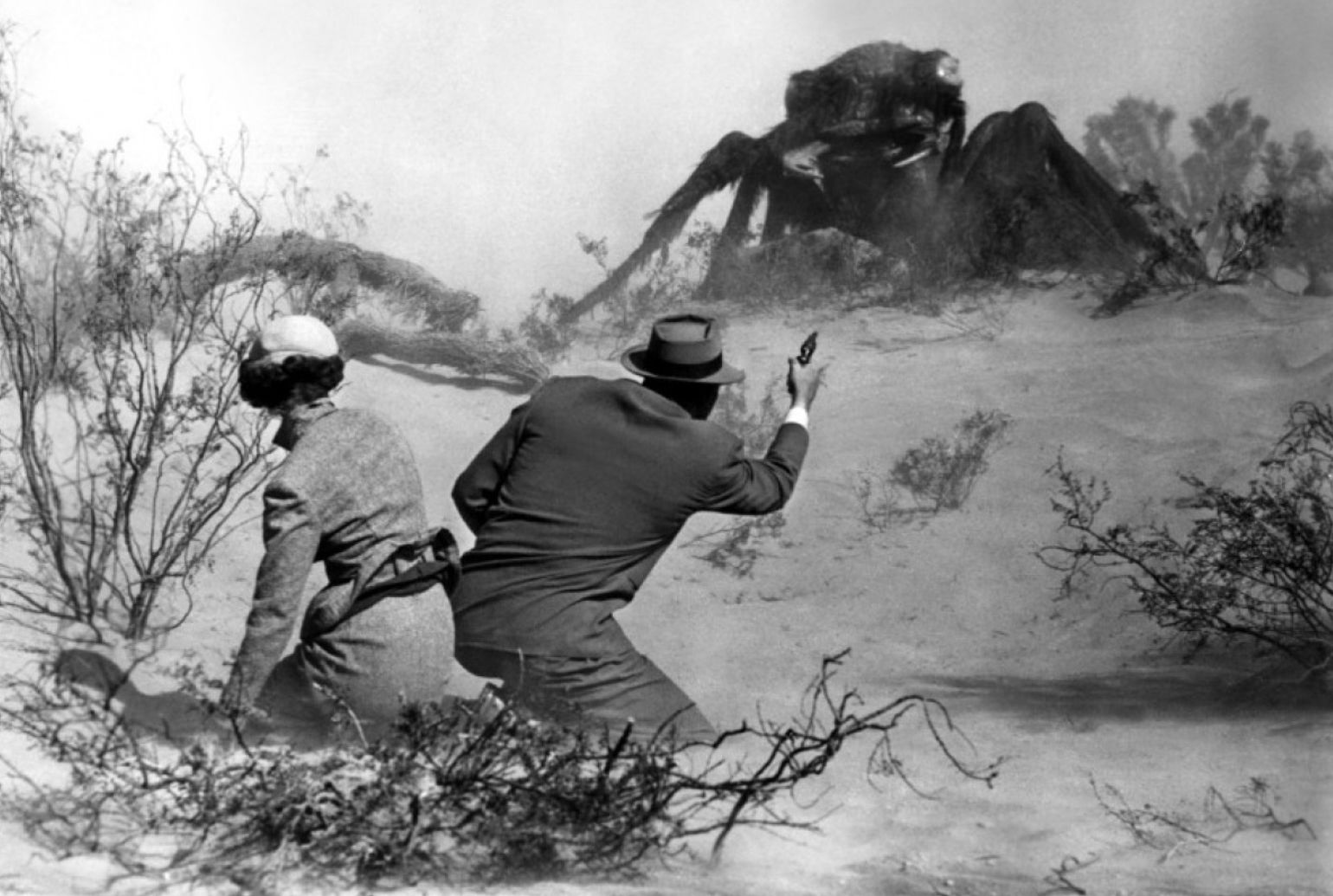
The same holds true for the 1954 classic and I think one of the best scifi/horror films ever made, Them! It’s established pretty early on that Joan Weldon’s Dr. Patricia Medford is by far James Arness’s (FBI agent James Graham) intellectual superior, but who goes wandering absent-mindedly through a desert dense with drooling Atomic Ants the size of RVs? Yup, The girl.

Tum-te-tum-te-tum. I wonder what’s under that sagebrush over there?

Arness somehow manages to discourage the ravenous ant with a snub-nosed Detective .38 Special, which I find not convincing at all.

For God’s sake, Agent Graham! He wants the Juicy Fruit in your pocket!

But does Dr. Patricia Medford get to use any weapons? Especially the flamethrowers? Nosirreebob. Those are left to Arness and the unfortunate James Whitmore, who gets squished by Ant Mandibles. Medford gets a half-hug from James Arness.

[Are you beginning to see why I liked Alien’s Ripley so much?]

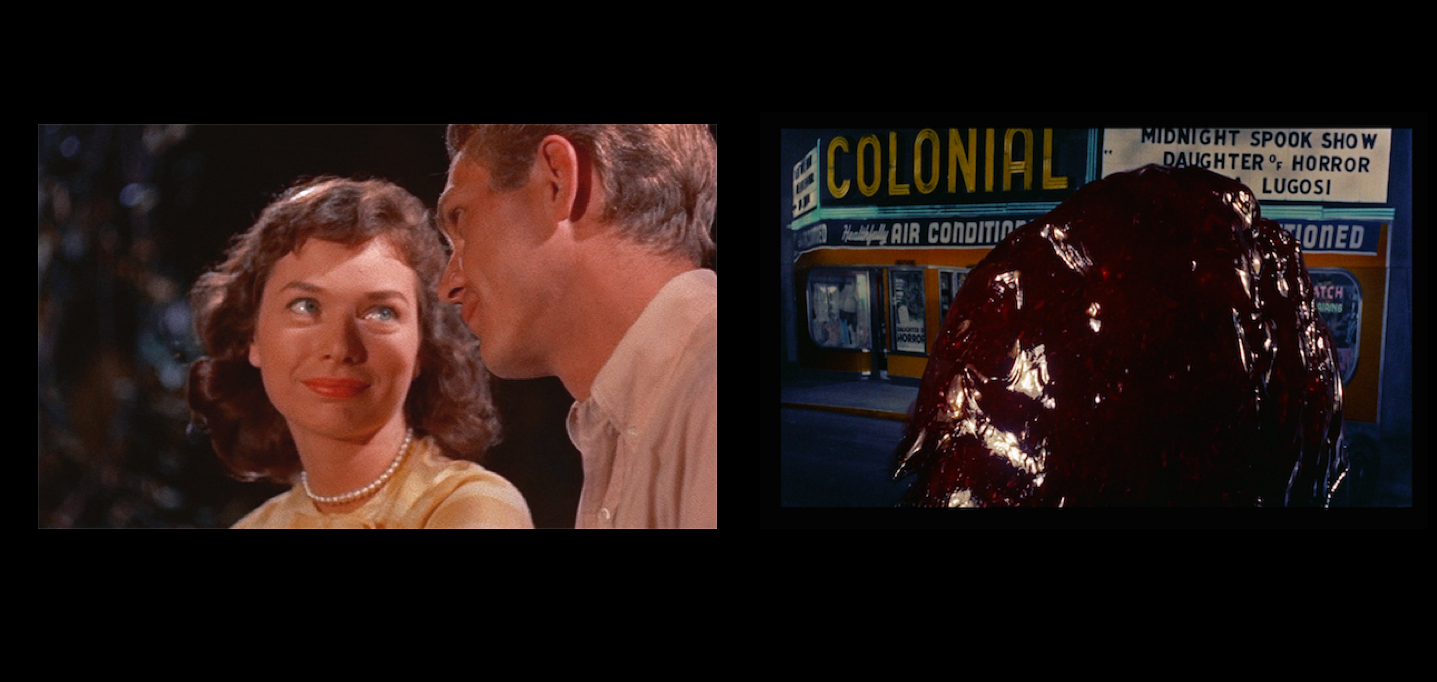
Aneta Corsault and Steve McQueen; the Blob emerges from the movie theater sliding effortlessly across Main Street thanks to all the popcorn butter he’s consumed. Or, “she.” Let’s be fair.

The one film where the female lead gets something close to Equality in Pluckiness would be in another favorite, 1958’s The Blob, where Steve McQueen and Aneta Corsault get to rush around what seems to be an incredibly obtuse San Joaquin Valley town. Even for the San Joaquin Valley. They’re trying to convince their elders that a huge ball of Olallieberry Jam from Space has eaten an old man, but not his dog, the town doctor and, alas, his nurse and the most of the Class of 1960 at the movie theater. They get a lot of “Crazy kids!” and “They’re just teenagers!” but Aneta doesn’t panic, does her own fair share of rescuing, and just as the Blob is about to eat the diner she and McQueen are sheltering in (Warning to future Blobs: The sheer volume of cheese, hamburger meat and onions stockpiled in a typical 1958 diner is enough to kill most alien life forms), she doesn’t get gypped out of any cool weaponry. McQueen figures out that Blobs don’t like cold and he spritzes it with a fire extinguisher.

Sensibly, Corsault moved from the San Joaquin Valley to Mayberry, North Carolina, where she changed her name to Helen Crump, took a teaching job, and began dating Sheriff Andy Taylor. They will go steady in a noncommittal way for what seems like twenty years until, one season, Miss Crump just up and disappears. I bet she left behind a drawerful of ungraded social studies reports about Our Latin American Neighbors. Except for Paraguay. Nobody ever wants to do a report on Paraguay.

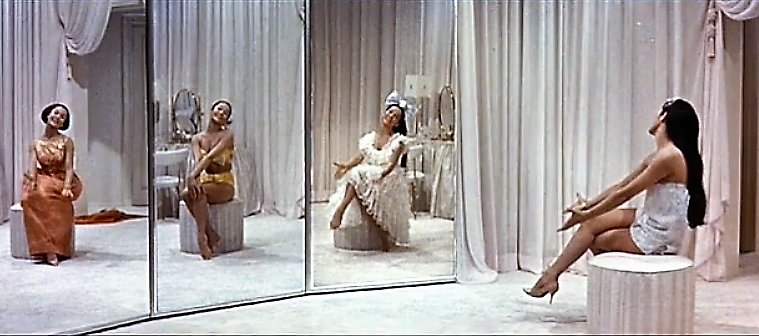
One of Corsault’s contemporary actresses, Nancy Kwan, starred in 1961’s Flower Drum Song, a Rodgers and Hammerstein film so condescending that it reminds me of Quint from Jaws dragging his fingernails down the chalkboard, but for two hours.

She sang a song called “I Enjoy Being a Girl.”

I can’t imagine why.


Our Mountain

Featured

Posted by ag1970 in American History, Arroyo Grande, Uncategorized

≈ Leave a comment

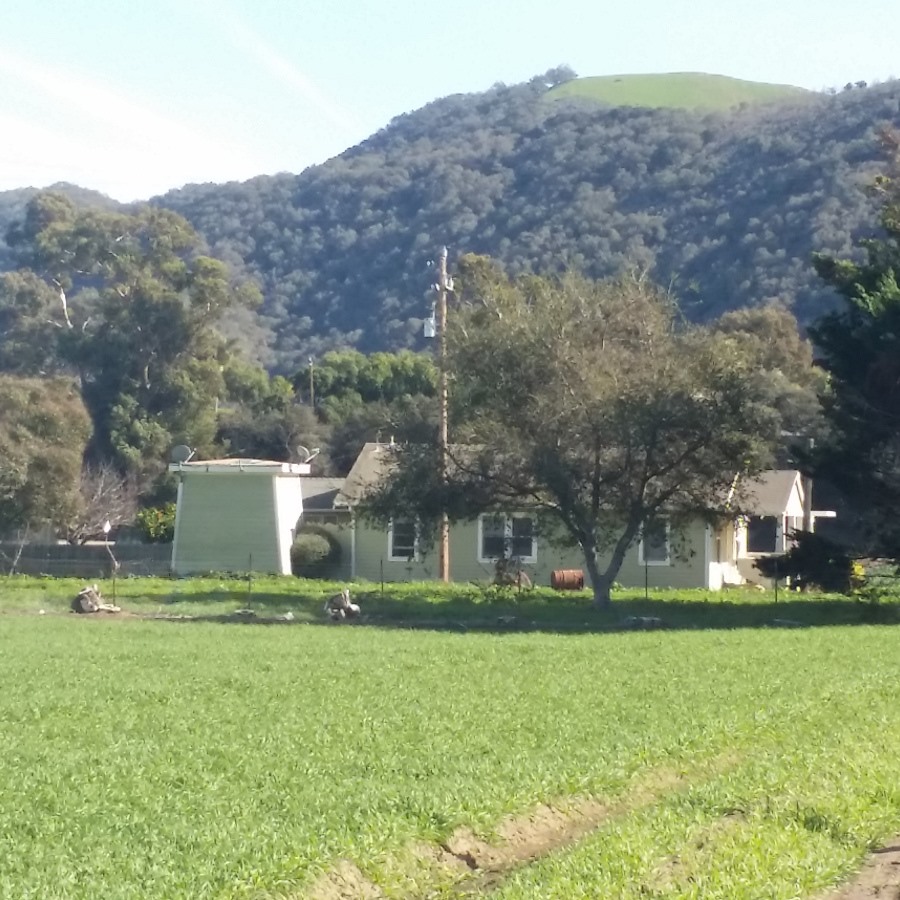
This photo was taken near the intersection of Huasna Road and Lopez Drive, where I grew up. Here is the story of the mountain in the photo.

This view is what would we could see very morning from one of our living room picture windows, but, for the sake of accuracy, in this order:

  • Mom’s roses. Sutter Golds were among her favorites.
  • Pasture, with Morgans, whose discharge made the roses grow. Cars would stop to watch the foal, a little stallion made up of 78% legs.
  • Row crops, with the occasional crop duster dipping saucily beyond the power lines. Sometimes they were peppers, sometimes pole beans. A little up the Valley, Mr, Ikeda favored cabbages, which are blue. Just a tad to the left of the cabbages was the beaver dam into which I fell while fishing. Ineptly.
  • The Coehlo place (Kathy). Her Dad carved a model of the old St. Patrick’s Church that was astonishing.
  • The McNeil place.
  • The Shannon place.
  • Various pumphouses and barns.
  • The man who had an airplane in his yard. Just in case.
  • By the early 1960s, just a tad to the left and atop another hill, the Ikeda place.
  • In the late 1950s, Dona Manuela Branch’s redwood home–she’d come to the Arroyo Grande Valley, pregnant, in 1837–had been just a tad more to the left. When I was very little, the home burned in the night. It gave off a spark as bright as Venus. Only the palm trees that had shaded the home, its gardens and had once shaded the family at barbecue remain today. The Ikedas take respectful care of Manuela and her family, maintaining the graveyard up a little canyon five hundred yards away from the home her devoted children had built for her.

So I grew up with this mountain, sort of. It always looked to me like the top of a head with a receding oak tree hairline.

Once there was a brushfire that came up behind it and framed the top, like the sun’s aureola at full eclipse, and that became a passage, fifty years later, in a chapter about the Battle of Petersburg. It went like this:

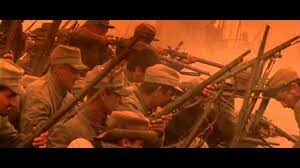
The Third Battle of Petersburg began in the pitch-black pre-dawn of April 2, 1865. A Union army surgeon, watching the assault from a federal fort, could see nothing until the combined muzzle flashes of thousands of Confederate rifles lit the horizon the way a brush fire will when it crowns a hilltop. When a line of flashes went black again, the doctor knew that the Union assault had carried the Confederate entrenchments.

One day, when I was in my early teens, I decided to climb it. You could access it from behind the Cherry Apple Farm. I was by myself, which was stupid, and forgot about the poison oak, which was stupider.

It took me two hours.

When I reached the top of the mountain I considered to be very close to my own personal property–emotionally, if not legally–I found out I hadn’t reached the top at all.

What neither the photo nor my many morning views as a little boy revealed was that this was actually two mountains: There’s a razorback ridge in front and, behind it and beyond it, the bald man with his receding hairline of oak trees.

I was kind of angry. It took me until almost dark to get back down, by which time my family assumed I’d been eaten by cannibals, which meant that the Eskimo Pies brought us by Frank the Foremost Dairy delivery driver–a consistently cheerful man– would last a little longer.

So it turned out that I climbed mountains just as ineptly as I fished. I would live to climb a few more. I’d help the Mission Prep kids whitewash the “M” on San Luis Mountain and fell off it twice more, spraining an ankle both times. I am not going back.

Now people live on that mountain. This kind of audacity would never have occurred to me when I was thirteen. It may seem pretentious to call it a “mountain.” Visit the Midwest. It’d be a veritable Matterhorn to folks north of the Ozark Plateau.

You can still see the backside of this mountain, but from the Nipomo Valley, to the right off the 101, as you drive north from Santa Maria. The hairline is flipped as if it were a reversed photograph.

I hold it no hard feelings. Seen from Nipomo, it’s a little bare and humbled without the oak-studded proscenium seen from its Arroyo Grande side. This gave the mountain a little romance to a little boy looking sleepily out the window on a cold morning.

Climbing it–and then finding out that I hadn’t climbed it at all–taught me a lesson in humility that I need to re-learn every day of my life.

For Yoshi, who never came back

Featured

Posted by ag1970 in American History, Arroyo Grande, California history, History, Uncategorized, World War II

≈ 3 Comments

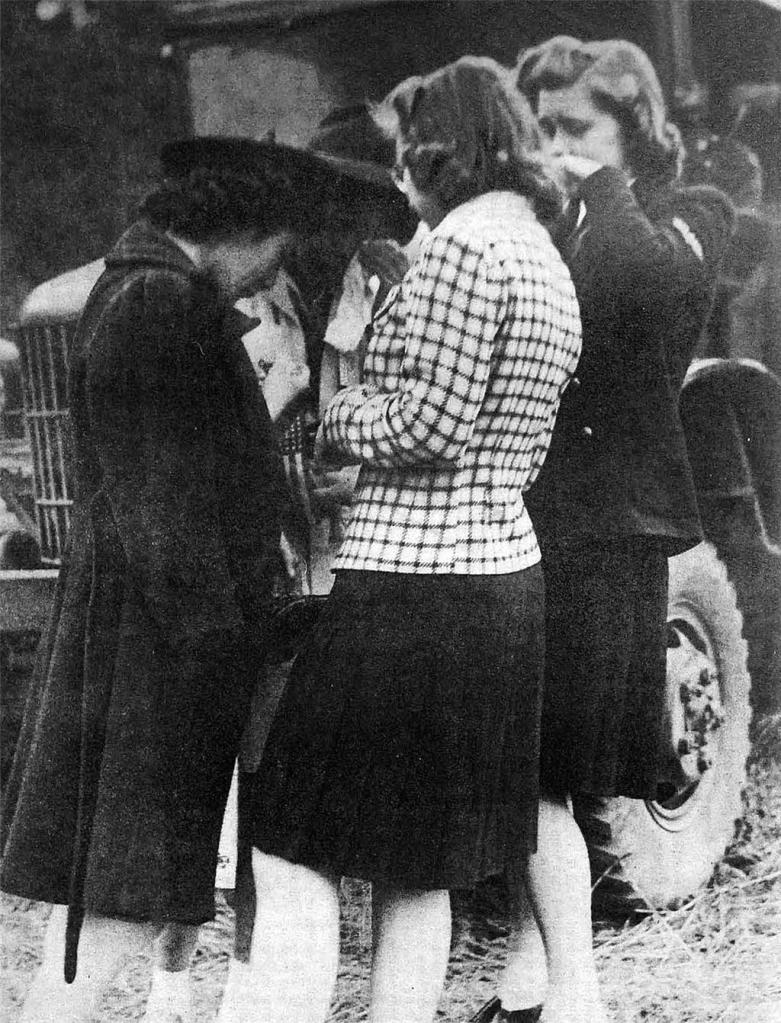
This photograph was taken on Bainbridge Island, Washington, on the day Executive Order 9066 was executed and these friends were separated.

There’s a good chance they never saw each other again.

When the buses came to take our Arroyo Grande, California, neighbors away on April 30, 1942, many of them—less than half—came back. I grew up here, and I don’t recognize many of the surnames in the old high school yearbooks.


One woman told me this: On the day the buses came to the high school parking lot, her mother saw a line of high-school girls, some Japanese, some not, walking up Crown Hill, walking up toward their high school, holding hands and sobbing.

Arroyo Grande’s Japanese-Americans went first to the Tulare County Fairgrounds, where they slept in livestock stalls, and then to the Rivers Camp in Arizona, where the temperature was at or above 109 degrees for twenty of their first thirty days there.

I interviewed a remarkable woman named Jean a few weeks ago. She is 94, is briskly intelligent, articulate and gracious. Her father owned the meat market on Branch Street in Arroyo Grande, population 1,090 in the 1940 census, and when his Japanese-American customers, farmers, came in to settle up before the buses came, he refused to take their money. “You keep it,” he told them. “You’re going to need it.”

When they came home three years later, he extended them easy credit until they could begin to bring in crops again. Jean showed me her father’s business ledgers, so I have no reason to doubt it when she told me that every one of those farmers paid her father back. In full.

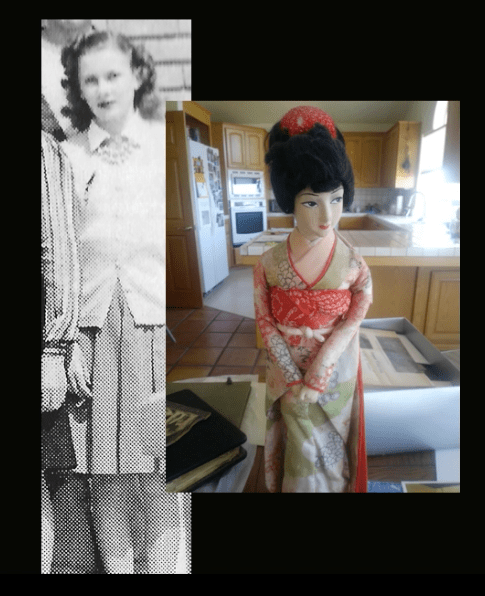
This is Jean as a high-school freshman. The doll, with her handmade kimono, came to Jean from Gila River in gratitude for her family’s friendship. For their loyalty.

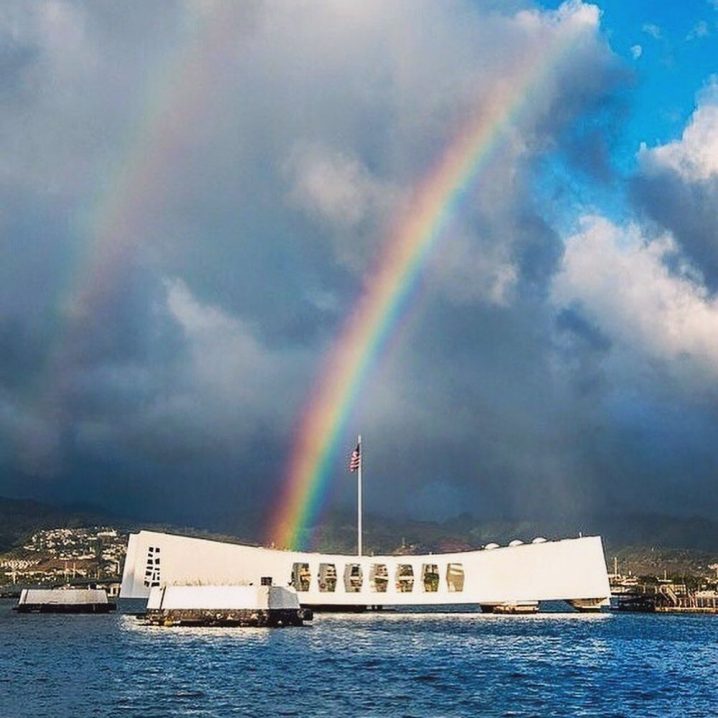
At ninety-four, that loyalty runs in Jean as deeply as it ever has. One of her best high-school friends was named Yoshi. I can find a photo of the two together in second grade. I found a photo, too, of two second-grade boys in the Arroyo Grande Grammar School in 1926. They would die, about twelve minutes apart, on USS Arizona.

Yoshi’s brother became a war hero. He won a battlefield promotion to lieutenant when he went behind Japanese lines in China to rescue a downed American flier.

Yoshi’s brother brought that flier in and made him safe. Jean never saw Yoshi again and, because of April 30, 1942, there is a part of her that can never feel safe.

The war, at its outset for America, killed two of our sailors. It would claim many more local young men, killing them in Ironbottom Sound off Guadalcanal and on the beach at Tarawa. It would kill a young paratrooper in Holland during Operation Market Garden. It would kill, with a sniper’s bullet, a tank-destoyer crewman on the German frontier three days before his first child, a son, was born.

The war killed neither Jean nor Yoshi. They remain its casualties, nonetheless.

We had to stop the interview for a moment. In remembering her friend, Jean was fighting hard to stop the tears. One escaped. That moment taught me so much history, and with such intensity, that I almost couldn’t bear it.

Classmates, Shipmates

Featured

Posted by ag1970 in American History, California history, History, Uncategorized, World War II

≈ Leave a comment

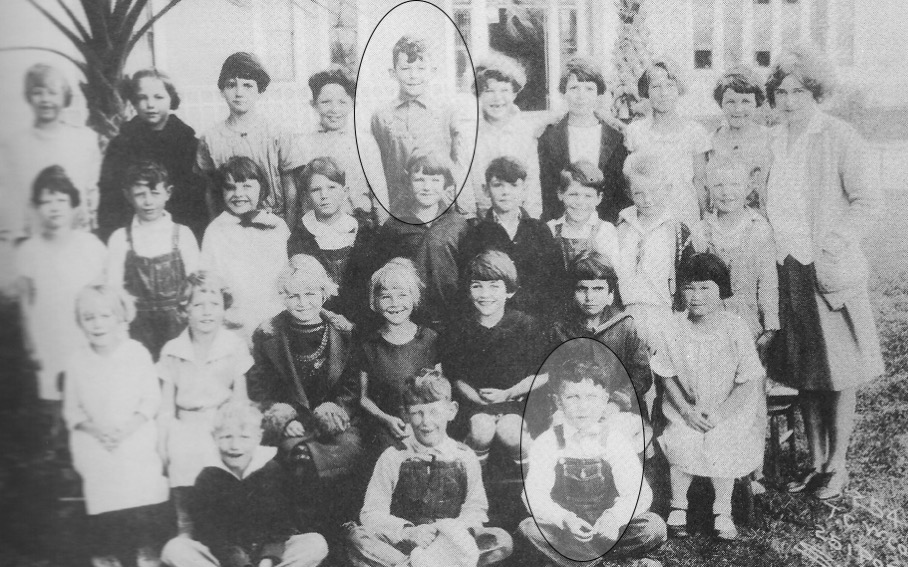
I was browsing an early 1980s version of Yesterday, Today and Tomorrow, the South County Historical Society journal, and I found this photograph of the Arroyo Grande Grammar School second grade in 1926-27.

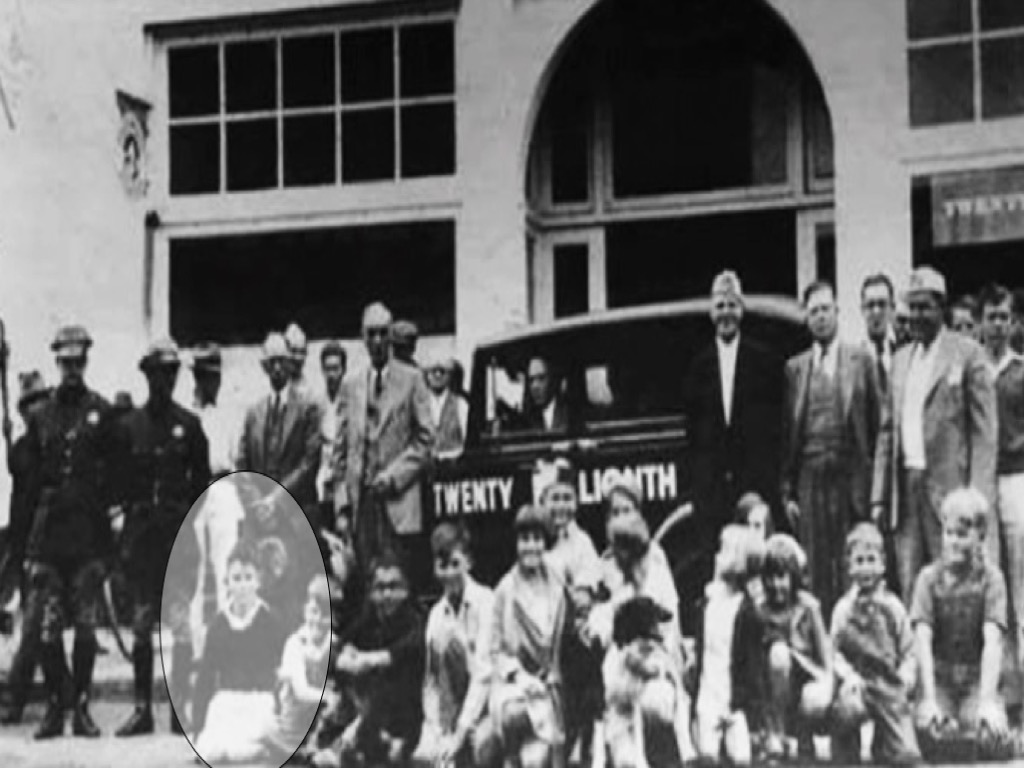
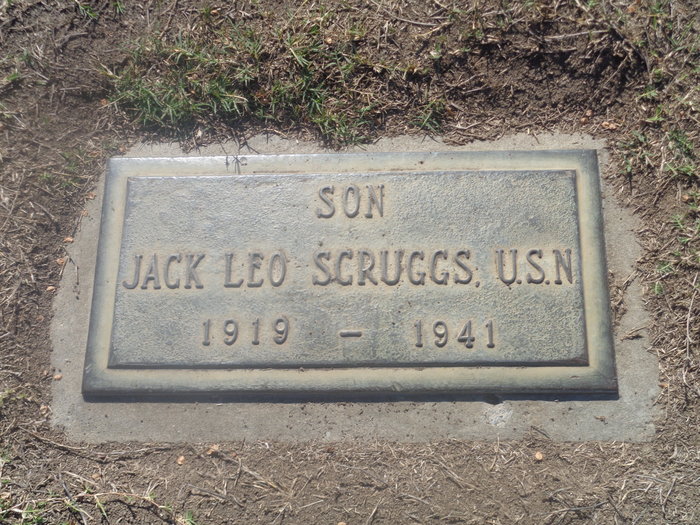
The two boys who are circled are Wayne Morgan (top) and, in the front row, Jack Scruggs. Wayne’s father, Elmer, was a partner-owner of the Ford agency, today’s Doc Burnstein’s Ice Cream Parlor. Jack’s father had lost his farm earlier in the 1920s; at the time the class photo was taken, he worked with an oil prospecting company exploring the Huasna Valley.

That’s Wayne in the front, in a photo taken during this Ford Model A’s nationwide tour in 1931 (the car, fully restored, is owned by a Michigan car collector).

Nine years later, Wayne would join the Navy.

By the time Wayne Morgan graduated from eighth grade, Jack Scruggs’s family had moved to Long Beach. Both boys were musicians–Wayne played violin in Mr. Chapek’s orchestra (he was also an avid Boy Scout), but Jack would make music his career.

In 1940, Jack joined the Navy.


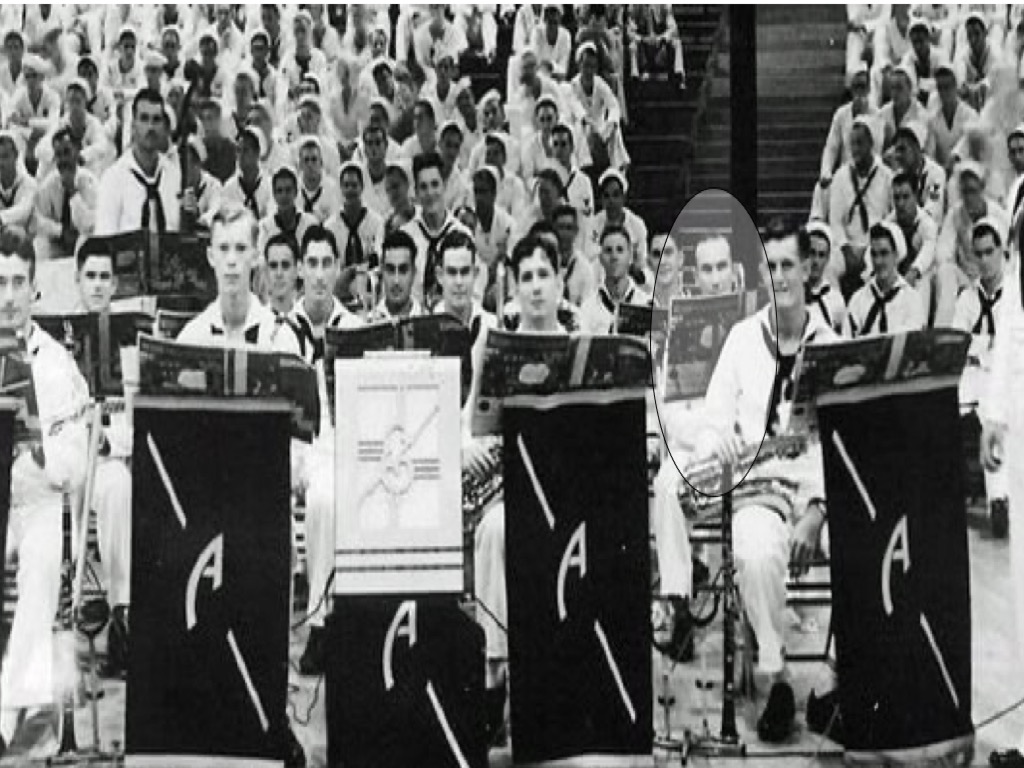
Jack is circled in this photo taken on November 22, 1941, during a Battle of the Bands competition among the ships of the Pacific Fleet. Jack was a trombonist in Navy Band 22–the band of USS Arizona.

So there’s a very good chance that the one-time classmates had a reunion on the great ship.

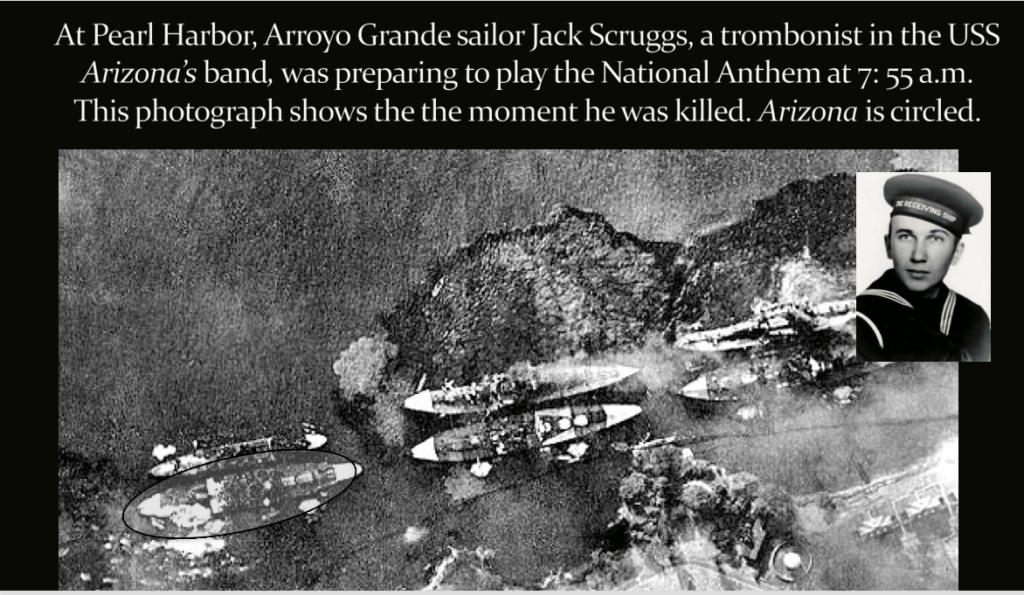
The tragic part of the story, of course, is that both were killed on Arizona. The concussion from a near-miss killed Jack just before 8 a.m. as the band was preparing to play the National Anthem during the colors ceremony. Wayne died about ten minutes later, when the ship blew up. So were all of Jack’s bandmates, killed at their action stations in the Number Two gun turret, just inboard from where the fatal bomb struck.

A few weeks before the attack, Jack had played “Happy Birthday” on the accordion for Rear Adm. Isaac Kidd’s wife–Kidd flew his flag on Arizona. All that was found of him after the attack was his Annapolis class ring, fused to a bulkhead.


Jack’s body was recovered; he came home to Long Beach. Wayne rests with his shipmates.

185086433_1510535707


I knew both were from Arroyo Grande, population 1,090 in 1940. I thought it extraordinary that two young men from such a small town wound up serving on the same ship. I had no idea that they were in the same grammar school class. 

Sometimes even the smallest footnotes in history tell compelling stories.


Huasna Road spirituality

09 Saturday Jan 2016

Posted by ag1970 in American History, California history, Family history, History, Personal memoirs, Teaching

≈ Leave a comment


1929425_1124481235982_1907209_n

Mom and Roberta, 1943


I think about my Mom a lot in January, the month when she was born, and in March, the month when she died. She never said any of the things below, but I decided to try to say them for her as authentically as I could. What lessons did I learn from her when I was a little boy?  I decided on ten. I’ll never get the wording exactly right, and I’ll never be able to articulate all the lessons, because so many of them were nonverbal and taught by example. Ours was not a peaceful home, nor was it always a happy one, but there were times when my mother’s parenting was, as I think about it more than fifty years later, actually quite inspired.


Ten Lessons

  1. Each of our lives is tuned differently, so each of us produces a different tone. It’s the melodies that please God most.
  2. Books, and music, and ideas, and politics, and God, and talk. That makes this place, five thousand miles away from Ireland, an Irish house.
  3. You young people might be all right after all. Ringo makes me think so. He looks just like a Basset hound!
  4. Faith is stronger when it’s tempered by doubt. The men they tried at Nuremberg were True Believers.
  5. Those people working the pepper field over our pasture fence don’t look like us, and they don’t speak our language. How lucky we are to have them so close.
  6. You’re the one that burns a little hotter than the others. I need to be patient because I love you.
  7. We owe the poor our love and respect; we owe the rich prayers for good eyesight. It’s so hard to see a carpenter’s son planing His father’s wood from the great heights that they inhabit.
  8. There is no forgiving intentional cruelty.
  9. I will raise singular daughters and honorable sons.
  10.  Life inflicts terrible wounds and unbearable pain. Just hang on. If the pain continues, just hang on. A time may come when you need to let go of it. Say goodbye with love.

Dad and the German Major

06 Wednesday Jan 2016

Posted by ag1970 in American History, Arroyo Grande, Family history, History, World War II

≈ Leave a comment


003 (1)


I’ll be sending two copies of the book World War II Arroyo Grande to young active-duty soldiers. This makes me a happy new/old writer: one reason I wrote the book, I think, was to reintroduce the World War II generation to my generation and to my students, and I’ve always had a soft spot for students who’ve gone into the service. I’m also very happy that I’ll be sending a copy to Judith, a favorite student who achieved the highest grade ever in my U.S. History classes. Judith is from Germany. She loved learning American history.

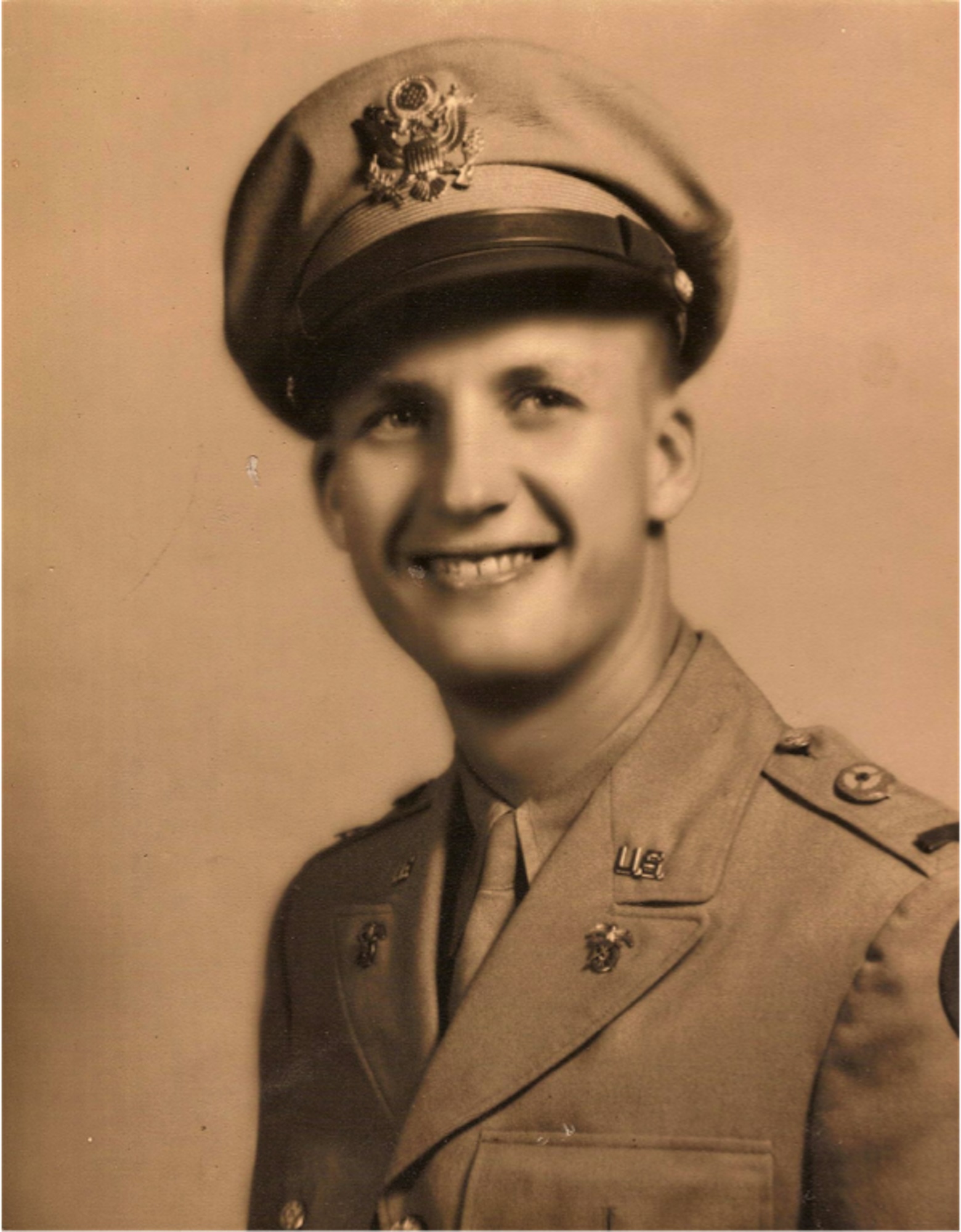
The photo is of my father when he was a young man on active duty in 1944. I’ve told Judith this story, but once the war had ended in the spring of 1945, Europe went hungry–the Continent’s infrastructure had been obliterated by ground combat and by the Allied air campaign. The footage of German kids eating out of garbage cans in 1945, in the long months before the Marshall Plan, always stunned my students. In the meantime, thousands of POW’s in our care died of hunger or of opportunistic diseases because civilians got first priority for food, and there never was enough.

A Wehrmacht major, who outranked my father, then a U.S. Army captain on occupation duty, somehow latched onto him and for a few weeks became his personal bodyservant: the German officer cooked for him, cleaned his quarters, washed and pressed his uniforms, the works.

He did that because Dad was a Quartermaster officer and so had access to food. (A year before, my father repaid an English family’s kindness to him with a bag of oranges. The mother’s British reserve crumbled. She wept. Her family hadn’t seen oranges in five years.) The young German officer wanted to live: his pride meant nothing when compared to the wife and children he wanted in his arms again once he was cashiered. My father was his ticket home.

In summer, he would begin the long walk home along roads choked with refugees and gaunt, tired soldiers. Dad never learned what happened to him but hoped, in talking about him years later, that the German major had lived a long and happy life. What started as a relationship of expedience had begun to edge into a friendship. Perhaps, very faintly in the recesses of my imagination, there was the unspoken thought that my student Judith was the major’s great-granddaughter. I owed it to this soldier to be the best teacher I could be for her.

The tough American soldiers of Easy Company–-the “Band of Brothers”–-liked the English, for the most part, loved the Dutch, but, like my father, felt most at home with Germans.

It does make you wish that British Pvt. William Tandey had shot Hitler in 1918, when he had the man in his sights at Marcoing. We could have done without Clemenceau as well, I guess, in his 1918-19 incarnation, but a younger Clemenceau had done great good for France and for the revolutionary ideals of tolerance and of the equality that citizenship confers.

These are ideals that Hitler despised because, of course, they included Jews, like Alfred Dreyfus. Clemenceau had been one of Dreyfus’s most adamant defenders. Dreyfus was a good French soldier, but the older Clemenceau dominated the drafting of a foolish, vindictive peace treaty dictated, in his mind, by a generation of good French soldiers whose bones littered the nation’s soil. Even today, farmers in northern France, in turning over fields there, find the bones of boys their harrow blades.

A generation after that war, there were more good soldiers, good young men on both sides who in a better world should never have been enemies. But they didn’t live in a better world; theirs had been penetrated by evil.

Americans had fought a war in the face of great evil once before. There was a lull in a Civil War campaign that gave a Union army band, its vast audience in bivouac, time enough for a concert. Confederates on a nearby hillside were listening. One of them called “Yank! Play one of ours!” So the band played “Dixie,” and at the song’s conclusion, both sides erupted, thousands cheering, tossing their caps in the air. They embraced a vivid moment when they were at peace together, before the close-quarters murder so characteristic of that war—and, sadly, so necessary for its resolution—resumed.

Similarly, once their war was over, a German soldier reached across the divide to make a necessary peace with my father. I hope my book will allow two young soldiers today to reach across the divide that time imposes to meet other young soldiers, including some who died such a long time ago. In a small way, it gives them life again.

Walt Whitman may have articulated this idea best in what I think is one of his finest poems, “Crossing Brooklyn Ferry.” Time and distance avail not, Whitman wrote. They are irrelevant. Indeed, when you read the poem you have the uncanny sense that Whitman is reading with you, just over your shoulder, or that you’re leaning on the ferry’s rail, together with the old man, the harbor’s breeze in his whiskers.

In the same way, we are all of us on the road together in the journeys of our lives. I think that sometimes, without recognizing them, we walk alongside our ancestors, and among them is the German major who yearns for home.

Gisela’s murder

03 Sunday Jan 2016

Posted by ag1970 in American History, History, News

≈ Leave a comment


Gisela Mota


Gisela Mota became the mayor of Tenmixco, Mexico–in Morelos, the state of a hero of mine, Emiliano Zapata–on Friday. She’s seen here at her swearing in. Yesterday, Saturday, drug cartel gunmen shot her to death outside her home.

I hate drugs because they are so much more insidious than bullets. So it’s jarring when a little research reveals that recent marijuana legalization may have been the most effective tactic yet used against the Mexican cartels. They are losing a significant part of the immense flow of dollars that sustains them. They are hurting.

So was a recovering heroin addict I knew once. But he was having a far, far easier time than the guy trying to kick his—legal—prescription painkillers. That man was going to pieces. Both  were sick men; I’m not sure why they’re alive, but not this vital young woman. None of this makes sense to me.

Two more things, in our relationship with Mexico, don’t make sense to me, either:

  • In the wake of NAFTA, American corn producers dumped their product on the world market a decade ago. They generated a wave of foreclosures on small Mexican farms and the resultant migration, now subsiding, that Mr. Trump wants to end with a wall.
  • If you know our history of alcohol abuse, from the very beginning of the nation (it was, ironically, corn alcohol at the beginning), then you know that we are not noted for our impulse control. So it’s not supply, but instead American demand for drugs that helps to fuel the cartel crossfire that kills so many innocent Mexicans.

“Poor Mexico,” the poet Octavio Paz once wrote. “So far from God, so close to the United States!”  Few nations are so tightly linked yet so insistent on denying their kinship. The first victim of the Mexican Revolution was an El Paso housewife hanging out her laundry, killed by a bullet that crossed the border. More than a century later, the cartel murders represent the worst violence since the Revolution, which killed a million people, or one of every ten Mexicans.

Somehow, the drug violence must stop. I don’t know how to stop it. But I know that this not what Zapata died for when he, too, was assassinated in 1919. I know, looking at Gisela’s image, that the Mexican people have been cheated again, robbed of a young woman of promise in the young part of a year that now promises nothing at all.


Swing Kids

22 Tuesday Dec 2015

Posted by ag1970 in American History, Film and Popular Culture, World War II

≈ Leave a comment

20151222_140005

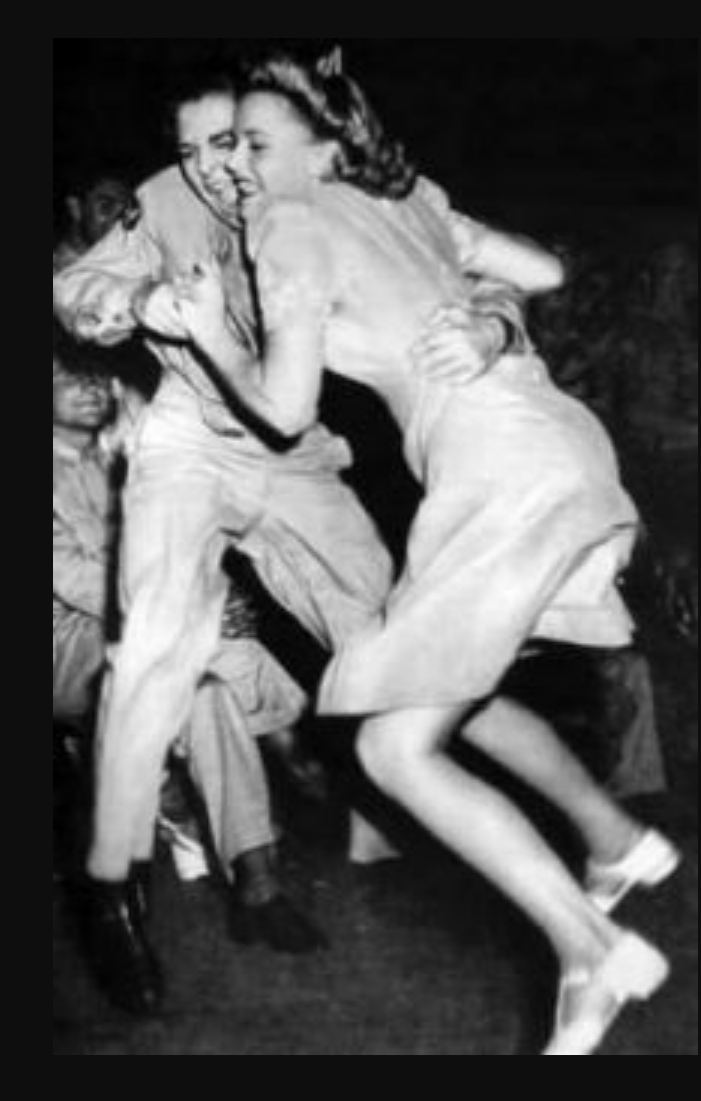
Whatever else I’ve said about the World War II generation–how sad but inevitable, our Sixties falling-out–there’s one more bit of praise: great music, and these young people could dance, a social rite mine left behind.

I put this together, part of a cycle of slide presentations, just in case they’re needed for whenever the book signing will be. Don’t want bored folks.

We open with a smidge of Andrews Sisters, a little silly, and then three Glenn Miller hits: the silky, evocative “Moonlight Serenade,” and then two go-to-war rousers, “St. Louis Blues March” and “American Patrol.” I wonder where Dad was when he first heard these songs? He still remembered “Bluebirds Over (the White Cliffs of Dover”) and, of course, “Der Fuhrer’s Face.” And maybe a French tune or two better left in French.


https://drive.google.com/file/d/0B05dFICUx2kGZWRDZ1BwR1ViaUk/view?usp=docslist_api

Power struggle in the fields

19 Saturday Dec 2015

Posted by ag1970 in American History, California history, History, The Great Depression

≈ Leave a comment

CCP_98107047

Monterey County Sheriff, right, 1936, and deputies.

This photo reminded me immediately of Rod Steiger’s superbly-acted redneck sheriff in the film In the Heat of the Night. But these are Californians, not Mississippians, and these men, according to the scholarship I’ve been trying to digest so far, were representative of an alliance of reactionary forces that dominated California between 1933 and 1938. Whether they were representative of San Luis Obispo County remains to be seen.

What made up that coalition? To borrow Renault’s quote from Casablanca, they were the usual suspects: Harry Chandler’s L.A. Times, the Hearst newspapers, the L.A. District Attorney and the LAPD, the Chamber of Commerce, Pacific Gas and Electric Co., and Associated Farmers, a powerful anti-labor lobby (they blocked literally hundreds of bills in the state legislature that would have provided laborers with a minimum wage, with decent housing, even a bill that would have required employers to provide drinking cups) that also organized resistance to and suppression of strikes. They had professionals whose specialty was busting strikes. They wore revolvers on their hips, like Henry Sanborn, a national guard officer who organized hundreds of paramilitary “deputies” in the 1936 Salinas lettuce strike, a strike provoked by the growers themselves when they locked workers out of the packing sheds. The growers, in fact, had already built a big stockade, complete with concertina wire, in anticipation of a strike. “Don’t worry,” they told alarmed packing-shed workers before the lockout. “That’s for the Filipinos.”

By the way, the one dissident in the state’s economic power structure, an ardent New Dealer, was A.P. Giannini, founder of the Bank of Italy, by now the Bank of America.

75600162

Another disturbing trend was the extent to which this coalition depended on the newly-founded California Highway Patrol. In Salinas and other places, including in a brief mention in an article about Nipomo, the CHP constituted a kind of rapid-repsonse strike suppression force and one, unlike the “deputies” and their baseball bats in Salinas, that was heavily armed.

In the history of American labor disputes, like the 1894 Pullman Strike, this traditionally had been the role of government: to uphold capital and to suppress labor. TR’s intervention in the 1902 Pennsylvania Coal Strike represented a rare departure, because he demanded that both sides come to the bargaining table or he’d use the army to take over the mines. Neither management nor labor were pleased with the president, but the strike was settled. When TR’s cousin became president, capitalists, including California growers, were outraged that the government seemed to side so clearly with workers, what with the Wagner Act (which did not extend to agricultural workers; FDR didn’t want to alienate Southern Democrats and their planter-supporters), with health inspections of labor camps, and with occasional attempts by the federal government to settle strikes (one such attempt had a Labor Department official beaten, stripped, and left in the desert of the Imperial Valley).  The Arroyo Grande Herald-Recorder at this time regularly railed against the excesses of this activist government on its editorial page while its news page primly reported another schedule of AAA subsidy payments.

Frustrated as they were with FDR, growers and their allies obviously took on the strikers, not the federal government.The easiest way to sanction strikers, and to make labor organizers “disappear” (Temporarily. Usually.) was to arrest them for vagrancy, since they clearly weren’t working. That was the pretext used by SLO County Sheriff Haskins, backed by 200 instant deputy sheriffs, in the 1937 pea strike, in April. It worked; that strike, centered in Nipomo, ended pretty quickly. So had another one farther north, in January, in and around Pismo Beach, organized by Filipino laborers against Japanese growers. It was over in thee weeks, with some violence–fights between strikers and scabs–and it ended with a negotiated settlement. The growers didn’t negotiate with the strikers, by the way. They negotiated with the Chamber of Commerce, which dictated the settlement. Curious.

California Filipinos were militant and angry–the late-breaking little story below is from 1934–and probably for good reason. Several sources I’ve read place them at the bottom of a kind of racist continuum with whites at the highest level, followed by Japanese, then Mexicans, and finally Filipinos, who were housed in filthy camps, frequently harassed by police, and seen as sexual predators, with their invariable target, of course, white womanhood.This, too, sounds like 1930s Mississippi as much as 1930s California.

11.16.1934

There was racial tension, as well, between Japanese growers, who had a generational head start, and their Filipino workers. Japanese growers in the Los Angeles area did not have a good reputation for treating their workers well, but LA was, again, a focal point for anti-labor resistance. I’m suspending judgment on local Japanese growers–my friends are from some of those families–until I can learn more. I’ve found no connection so far with between them and Associated Farmers, and, unlike the growers in the Salinas Valley or the San Joaquin Valley, these were small-scale farmers: the Ikeda family, for example, farmed no more than 100 acres, and much of that land was leased. The problem with that analysis is that these growers worked in concert, in what is today POVE, so potentially they might have represented thousands of acres of peas under cultivation. But it’s the Herald-Recorder that really comes off badly–this was before editor Newell Strother’s time–its editorial columns are firmly on the side represented by Associated Farmers, and its news columns, especially in their treatment of Filipinos, are openly racist.

One 1937 story details an Oceano raid on a hall holding taxi dances–Filipino men would buy a ticket and dance with a female, invariably Caucasian, since Filipinas were not allowed to immigrate. The raiders were sheriff’s deputies, including the baseball-bat variety seen in the Salinas lettuce strike. Several, including the girls, were arrested, and the Herald-Recorder reported that one Filipino laborer had bought more than 200 dance tickets from one of the arrested taxi dancers.

I guess this detail in the story was meant to provoke a sharp intake of breath on the part of its white readers. The taxi dancers were white, their patrons weren’t, and the miscegenation laws were still on the books in California.

Tensions began to ease by 1938, partly because the economy was beginning to recover, partly because a reactionary governor, Frank Merriam, was replaced by a more moderate one, Cuthbert Olsen, but also because both state investigations (one young attorney-investigator was Clark Kerr, the future UC President) and a federal one, led by Progressive Sen. Robert LaFollette, embarrassed Associated Farmers with their own conduct: they’d denied their workers basic civil rights, including due process, relied on violence, were indifferent toward inadequate and unhealthy housing conditions, used industrial espionage on a large scale, and frequently cut wages, continuing to claim that they could only pay what the market would bear when, after their 1933 low point, crop prices had begun to recover and would rise steadily into the war years.

If it sounds like I’m taking sides, I’d agree cheerfully. Objectivity demands that historians sometimes take sides, because historians must make informed judgments based on empirical evidence. History does not judge this alliance of big business, big agriculture and state police power well. The powerful brought that judgment, in their seeming victory over the strikes of the mid-1930s, on themselves.

← Older posts
Newer posts →

Subscribe

  • Entries (RSS)
  • Comments (RSS)

Archives

  • April 2026
  • March 2026
  • February 2026
  • January 2026
  • December 2025
  • November 2025
  • October 2025
  • September 2025
  • August 2025
  • July 2025
  • June 2025
  • May 2025
  • April 2025
  • March 2025
  • February 2025
  • January 2025
  • December 2024
  • November 2024
  • October 2024
  • September 2024
  • August 2024
  • July 2024
  • June 2024
  • May 2024
  • April 2024
  • March 2024
  • February 2024
  • January 2024
  • December 2023
  • November 2023
  • October 2023
  • September 2023
  • August 2023
  • July 2023
  • June 2023
  • May 2023
  • April 2023
  • March 2023
  • February 2023
  • January 2023
  • December 2022
  • November 2022
  • October 2022
  • September 2022
  • August 2022
  • May 2022
  • April 2022
  • March 2022
  • February 2022
  • January 2022
  • December 2021
  • November 2021
  • October 2021
  • September 2021
  • August 2021
  • July 2021
  • June 2021
  • April 2021
  • March 2021
  • February 2021
  • January 2021
  • December 2020
  • November 2020
  • August 2020
  • July 2020
  • June 2020
  • May 2020
  • April 2020
  • January 2020
  • December 2019
  • November 2019
  • October 2019
  • September 2019
  • August 2019
  • May 2019
  • April 2019
  • March 2019
  • February 2019
  • January 2019
  • December 2018
  • November 2018
  • October 2018
  • September 2018
  • July 2018
  • June 2018
  • May 2018
  • April 2018
  • March 2018
  • February 2018
  • January 2018
  • December 2017
  • November 2017
  • October 2017
  • April 2017
  • March 2017
  • December 2016
  • November 2016
  • October 2016
  • September 2016
  • August 2016
  • July 2016
  • June 2016
  • April 2016
  • March 2016
  • February 2016
  • January 2016
  • December 2015
  • November 2015
  • October 2015
  • September 2015
  • August 2015
  • July 2015
  • June 2015
  • May 2015
  • April 2015
  • March 2015
  • February 2015
  • January 2015
  • December 2014
  • November 2014
  • September 2014
  • August 2014
  • July 2014

Categories

  • American History
  • Arroyo Grande
  • California history
  • Family history
  • Film and Popular Culture
  • History
  • News
  • Personal memoirs
  • Teaching
  • The Great Depression
  • trump
  • Uncategorized
  • World War II
  • Writing

Meta

  • Create account
  • Log in

Blog at WordPress.com.

  • Subscribe Subscribed
    • A Work in Progress
    • Join 69 other subscribers
    • Already have a WordPress.com account? Log in now.
    • A Work in Progress
    • Subscribe Subscribed
    • Sign up
    • Log in
    • Report this content
    • View site in Reader
    • Manage subscriptions
    • Collapse this bar

Loading Comments...