My friend Tony Hertz just posted gentle advice from a vet. When a dog has to be put down, they want us with them. I was with Mollie–Molliebears–when Dr. Murphy helped her make that transition.
It was such a painful experience, but it moved me deeply. I at least felt confident, in talking softly to her in those last moments, that she knew how very much we loved her.
When her head fell into my hands, I was disconsolate for the rest of the day. What brought me back is my belief, no matter how irrational it might seem, that we will see each other again. That will be a joy beyond imagining.
Here’s to you, Mollie, our darlin’ Irish girl. We will love you until the end of time, and beyond it, too.
The tears now running down my cheeks are proof of that.
I am admittedly a little nutty about this airplane. I fell in love hard many years ago when we took the boys to a P-51 Mustang Fly-In at the Santa Maria Airport. The planes, even though they weren’t piloted by small, wiry 23-year-olds but by middle-aged men with enormous amounts of disposable income, have a mystique that is their own.
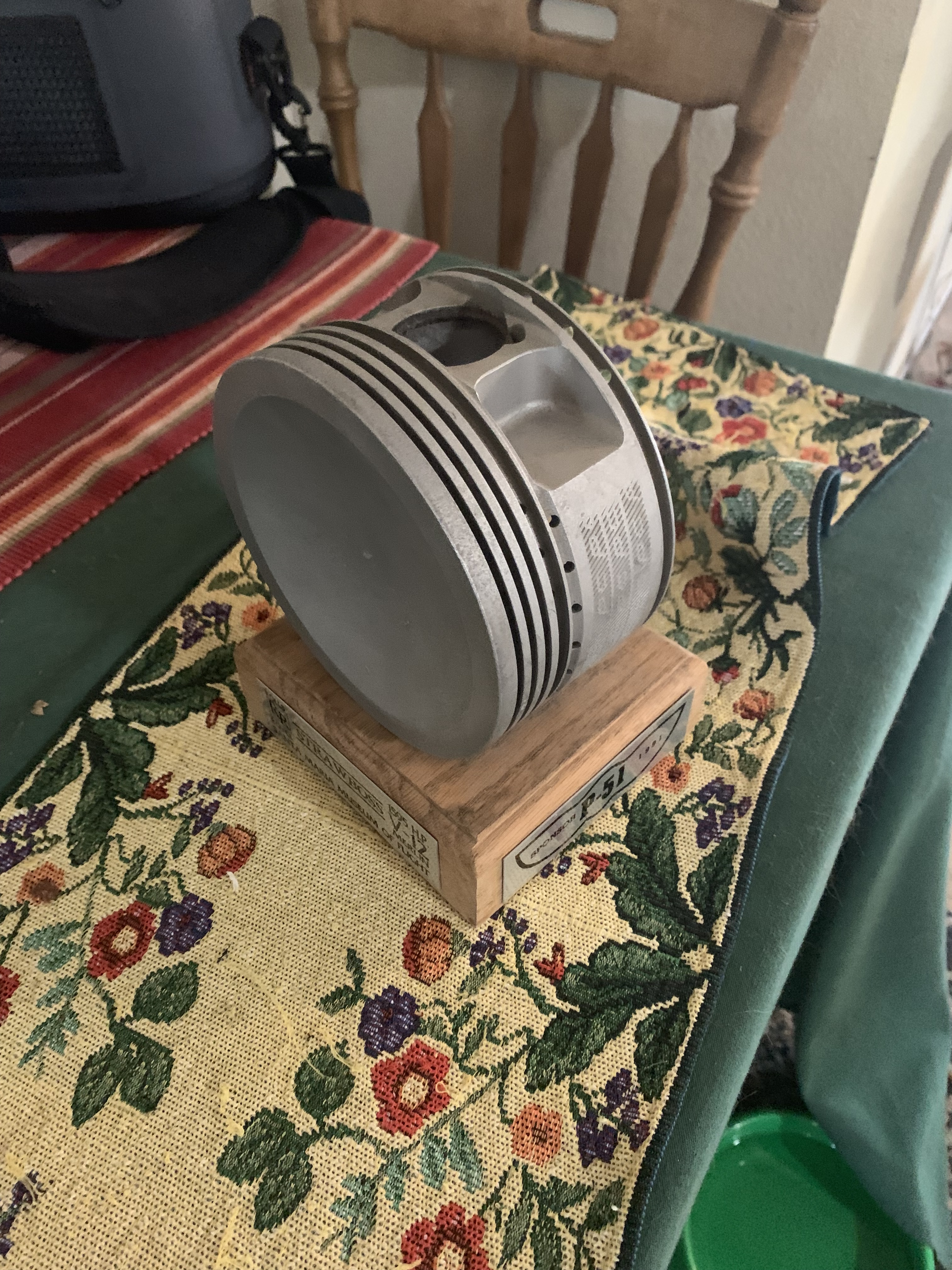
This piston head, which I treasure (along with my Civil War bullet, my fragment of the Berlin Wall and my piece of oak from HMS Victory), was a Christmas gift.
And here are the obligatory stats:
Wingspan: 37 feet Length: 32 feet Maximum Speed: 437 miles per hour Cruising Speed: 275 miles per hour Maximum Range: 1,000 miles Engine: Packard Rolls Royce Merlin V-1650-7 (1,695 hp)
The engine was miraculous and the sound it produced—nicknamed “whistling death”—was unforgettable, I guess especially if you were a German soldier. Near the sad end of Saving Private Ryan, P-51’s make a brief star turn as the Panther tank closes in on the doomed Capt. Miller:
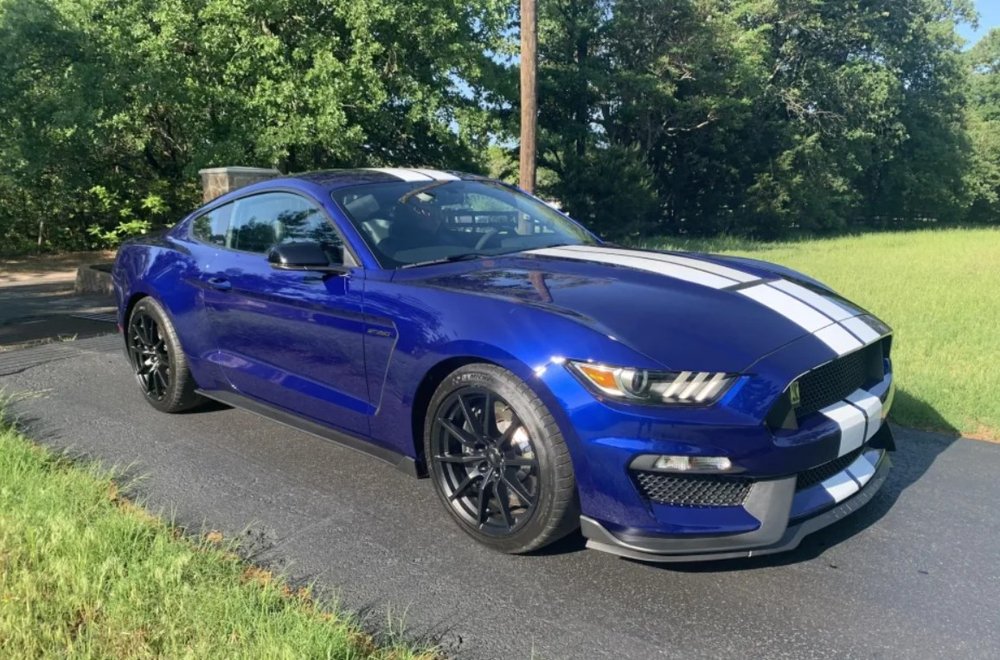
The sum total of my mechanical abilities consists of reaching into my wallet for my AAA Card, but there are certain engine sounds that are unforgettable. Yesterday I watched, mouth flopped open, as a late-model Mustang, I think a Shelby GT350, pulled up next to me and then made a stately left turn; the driver punched it once he’d passed the intersection and the result was a kind of deep bubbling sound that you could almost feel in your breastbone. It was beautiful.
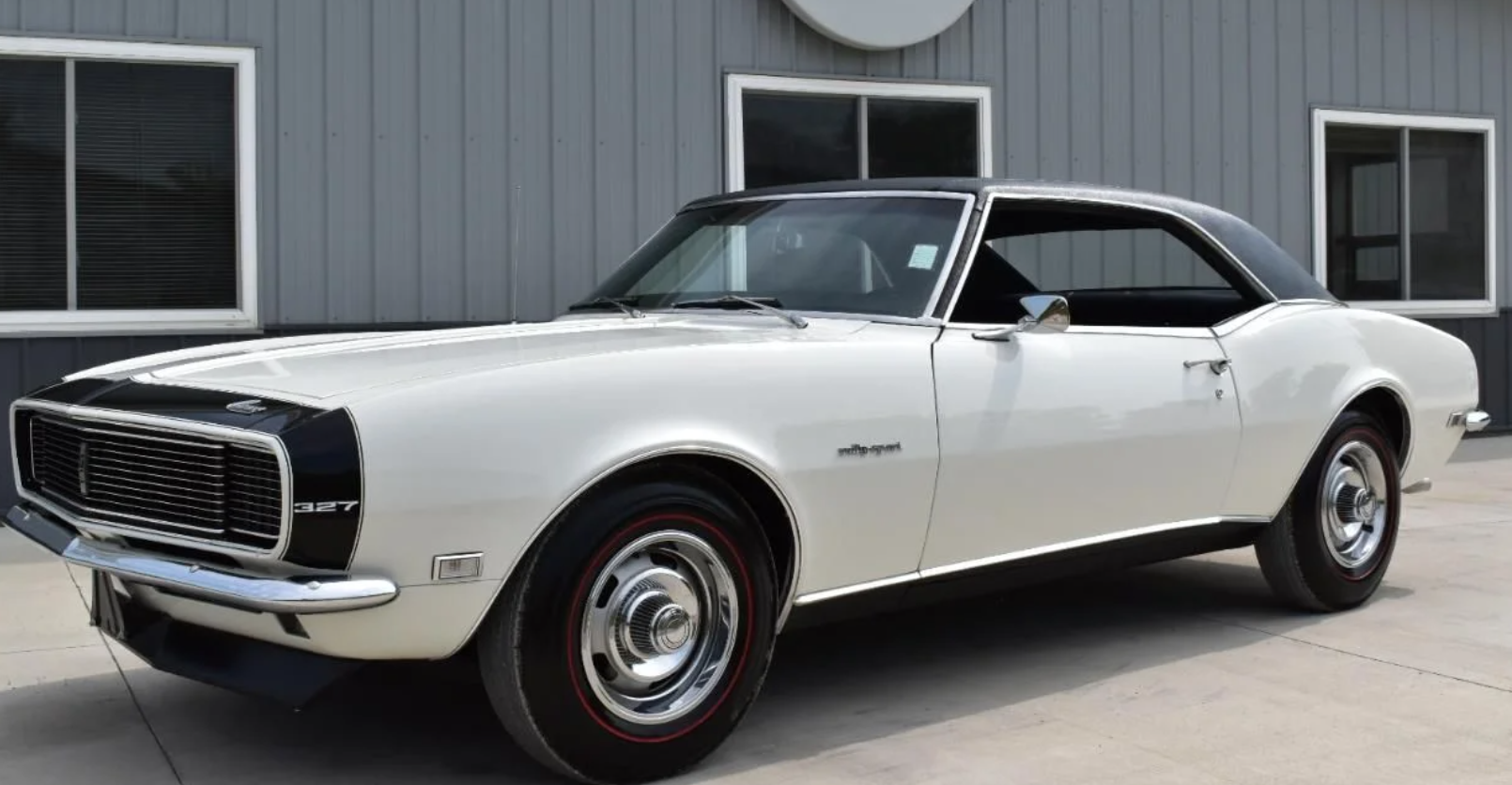
We can’t afford to fix it up yet, but we have my late mother-in-law’s 1968 Camaro Rallysport in the garage. (Hers has wire wheels. Very cool.) It has a 327 V-8 and when it was running, entering freeways driving this car was one of the great joys of my life. From inside the passenger compartment, it was more of a guttural rumble with the bubbles hovering in two-part harmony just above it. For those of you of a Certain Age, it was the Righteous Brothers of automobile engines. Since you hit 65 mph so quickly, it was a little sad—like that last bite of an In-And-Out burger—when you let off the accelerator. Sigh.
One more: Like the Mustang, the Harley-Davidson has an inimitable sound. My dear friend David Cherry once owned a Harley 45 Flathead with a suicide shift (a gearshift on the left side near the footrest) and when he bought it, I followed him as he drove it back to our apartment in San Luis. That might’ve been the one day the bike actually ran; it became a collection of discordant parts in many boxes and I’m not sure David ever had the chance to rebuild it. But following him home was a happy day. He was happy. The Harley was (momentarily) happy. Hearing that sound, even inside my car’s compartment, made me happy.
Here’s a photo of a restored 1948 45, I think the same year as David’s bike:
This British guy (no helmet law?) demonstrates the sound of his Harley; this late-model bike sounds mellower than Dave’s old-school Harley, but you get a sense of the sound anyway.
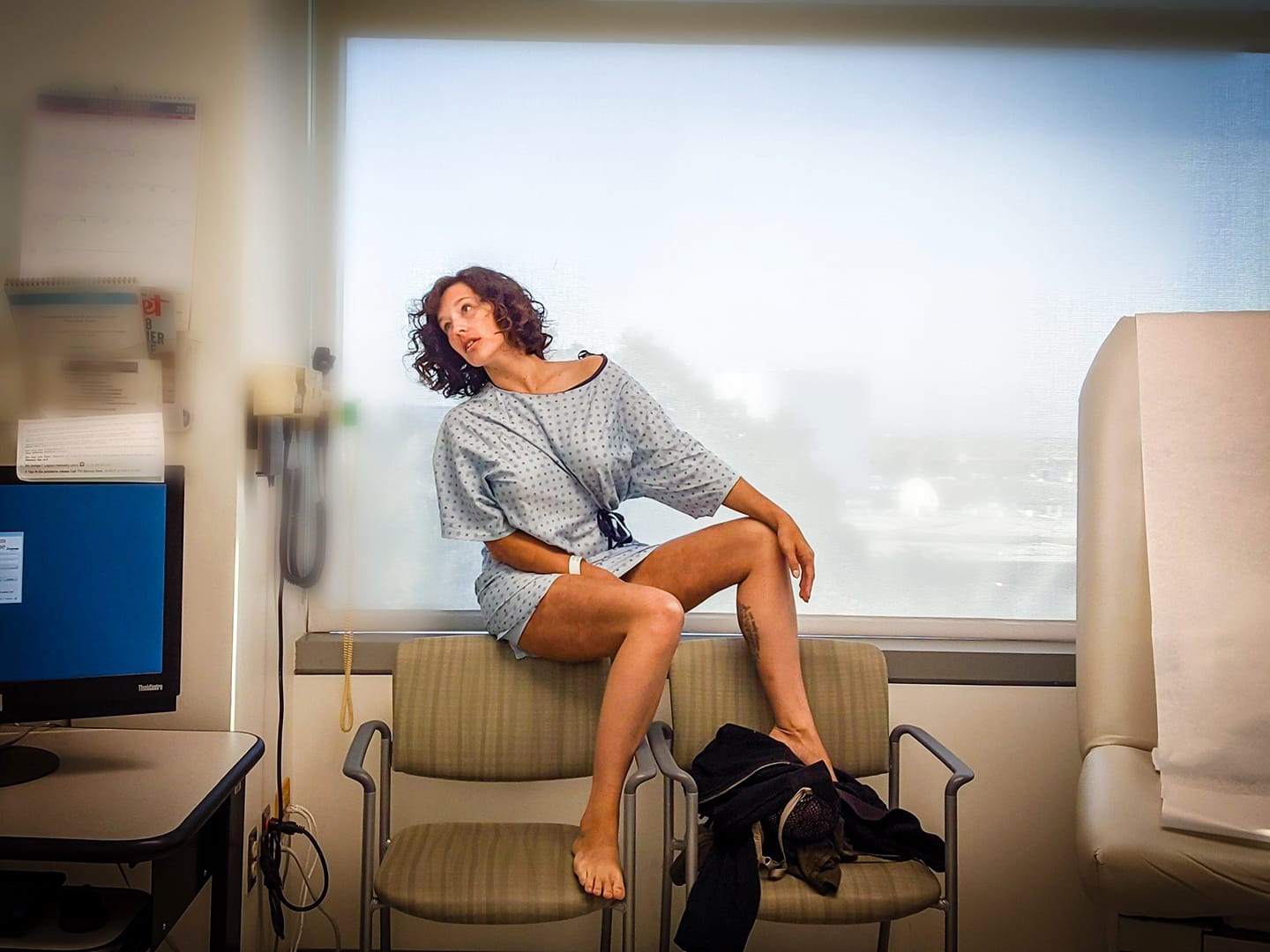
Britt did Vargas Girl poses–her way of mocking cancer— during her stays at Children’s Hospital in Duarte. This one was taken just before her seventh round of chemotherapy.
There is so much to say about Britt, whose life was so vast.
But there’s one thing that I need to say:
Britt and I are total nerds, and it is Star Trek that has makes this so.
Before we knew that, she was my student in AP European History at Arroyo Grande High School. That’s when I realized, in reading her essays, that she was gifted beyond measure.
I was adamant about writing clear essays. It brought out my Napoleonic Complex, and maybe Mussolini, too.
When you have seventy history essays to grade, you play a trick on yourself. You grade in a nice coffeehouse with a latte nearby. And you bunch essays in groups of five so you can take a moment for a break at the end of each group.
On your break, you take a sip of your latte and glare poisonously at the other people in the coffeehouse because they are having fun.
And at the bottom of each group of five essays you insert one that you know will be good. They are the correctives to the bloopers you can find in student essays, like the classic Abraham Lincoln was born in a log cabin he built with his own hands.
Britt’s essays were always at the bottom.
She sat in the first desk in the third row from the bank of windows in Room 306 at AGHS. She was quiet. When she asked a question, it would be a zinger, albeit one marked by guileless curiosity. The question revealed, too, that her mind traveled at warp speed in galaxies far beyond ours.
But a Britt question could take me in a different direction, far beyond my lecture notes. Suddenly, she reminded me, it was story time. This was why I became a history teacher.
So we might leave London in 1666 to visit London in the summer of 1944. There, on a barstool in his favorite pub, was Lt. Dad, enjoying a pint of Watney’s Red Barrel.
There was an air raid going on.
In between the wails of the sirens, you might hear the ugly growling cough of a V-1 flying bomb high above Regent’s Park. But my father refused to take shelter. It was a matter of principle. He refused to abandon his pint to Nazi Terror.
And so he won an honorary commendation for Meritorious Drinking Under Fire.
I think Britt liked that story.
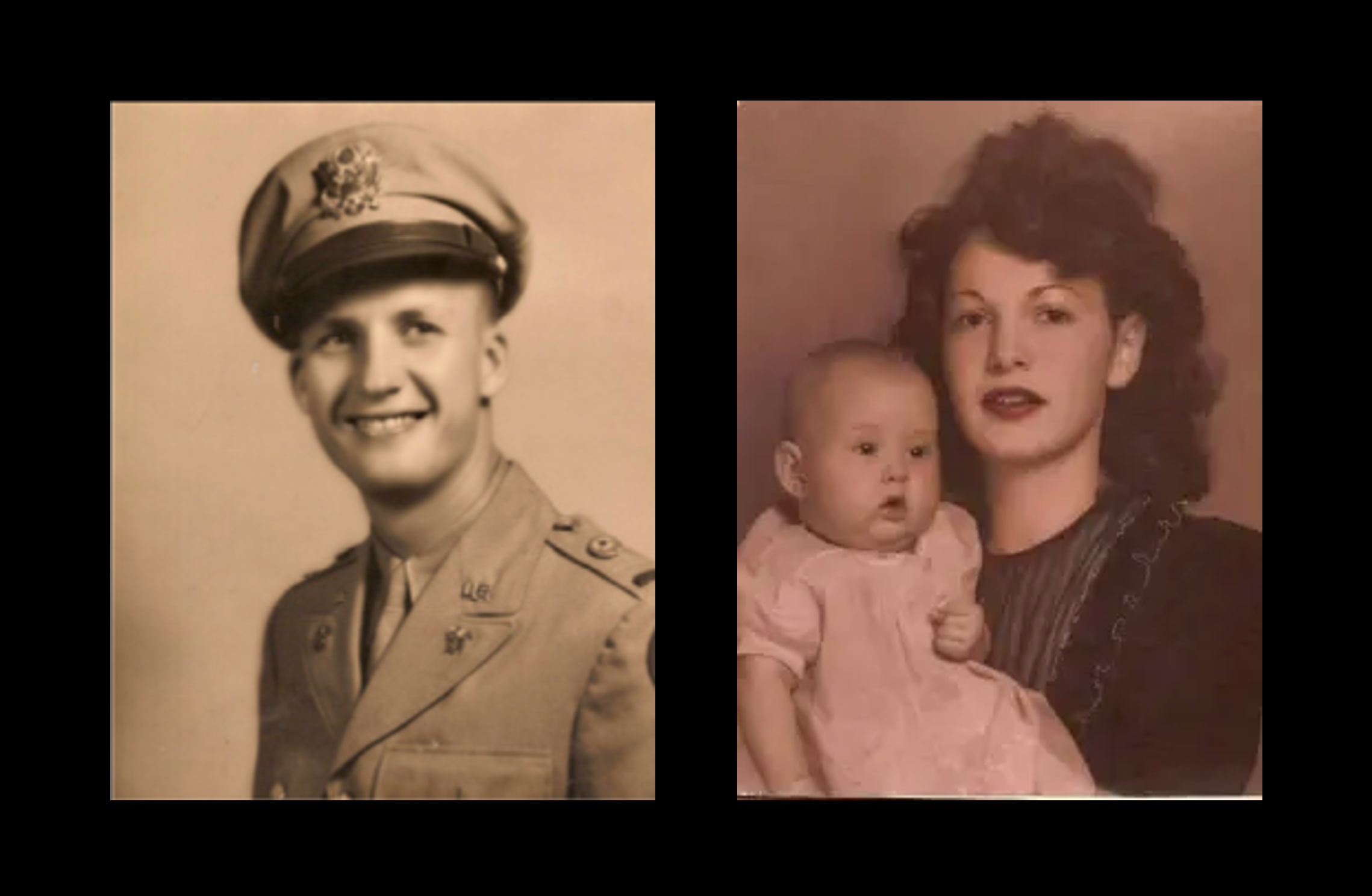
Here are Lt. Dad, 1944 and Mom with my big sister, Roberta, 1943.
Her fifth-grade teacher, Mary Hayes, told my wife Elizabeth that she’d had the identical experience. Britt was quiet in class and then she’d ask a question that left Mrs. Hayes, just like me, gobsmacked. Both of us adored her.
Years after high school, Britt and I found each other on Facebook, my preferred method for procrastinating. That’s when I began to follow her writing career. I found out, too, that we were brother and sister Trekkies.
The breadth of Britt’s writing, from political commentary to gender issues to the arts, was vast. She was insightful, funny, and, when it was deserved, she could use ink to draw blood.
She had discovered her voice. Rather, she had revealed the voice that had been there all along.
And she was wicked funny.
–She described the barren planet where Luke Skywalker grew up as “the Modesto of the Star Wars Universe.”
–Excited by the prospect of a film that would reunite the original cast of Star Trek: The Next Generation, she wrote “That’s right, everyone. Set your phasers to ‘cry’.”
–She wrote about Kyrsten Sinema, “our manic-pixie senator from Arizona,” and archly compared her to Veruca Salt, the brat who disappears down a garbage chute in Willy Wonka.
She interviewed actors and writers and producers in the Star Trek franchise we both loved. So we remember together Tribbles, Romulan Ale, Jefferies Tubes, McCoy snapping “I’m a doctor, dammit, not a coal miner!” and Picard snapping “Shut up, Wesley!”
We were both big fans of Captain Janeway from the series Voyager.
Janeway adored Irish Setters. Elizabeth and I have had three Setters grace our lives.
We admired her love of coffee. When Voyager’s food replicator broke down, Janeway, in her withdrawals, wanted to strangle the ship’s cook, who’d offered a kind of interstellar Sanka. The cook was irritating, so we empathized with Janeway.
Britt did a piece on the Star Trek Series and ranked them from worst to best. “Best” Honors, according to Britt, went to Deep Space Nine, about a space station that was kind of a 24th Century Dodge City,with Avery Brooks’s Benjamin Sisko and Terry Farrell’s Jadzia Dax.
Dax and Sisco.
What stunned me is that this was my favorite, too, but I never had the courage to come out and say it. Britt did.
But it was Gates McFadden, Dr. Beverly Crusher in The Next Generation, who sent Britt a video message of comfort that comforted me, too.
Gates McFadden, as Dr. Beverly Crusher, in the Captain’s Chair, where she had every right to be.
I’ve taken comfort, too, in two Star Trek films. In The Wrath of Khan, memorable for Ricardo Montalban’s impressive pectoral muscles, Spock saves the Enterprise.
He does so by jump-starting the warp drive, which involves inserting himself into the matter-anti-matter chamber. And so he dies.
They shoot Spock out into space in what looks like a jumbo Prozac capsule.
And, of course, in the next film, The Search for Spock, he comes back, all of him, including the arched eyebrow.
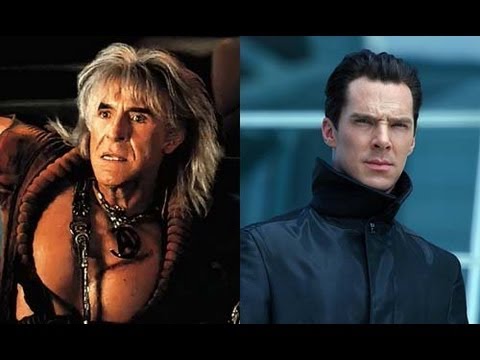
Elizabeth and I were watching 2013’s Star Trek: Descent into Darkness, in which Khan is played by Benedict Cumberbatch, who looks and sounds nothing like Ricardo Montalban.
However, since Cumberbatch was once spotted country-western line-dancing at the Madonna Inn, near where both Britt and I grew up, I will let this go.
Two Khans
This time, to save Enterprise, it’s Chris Pine’s Kirk who likewise enters the matter-anti-matter chamber, which in my mind resembles an immense and lethal lava lamp. And so he dies.
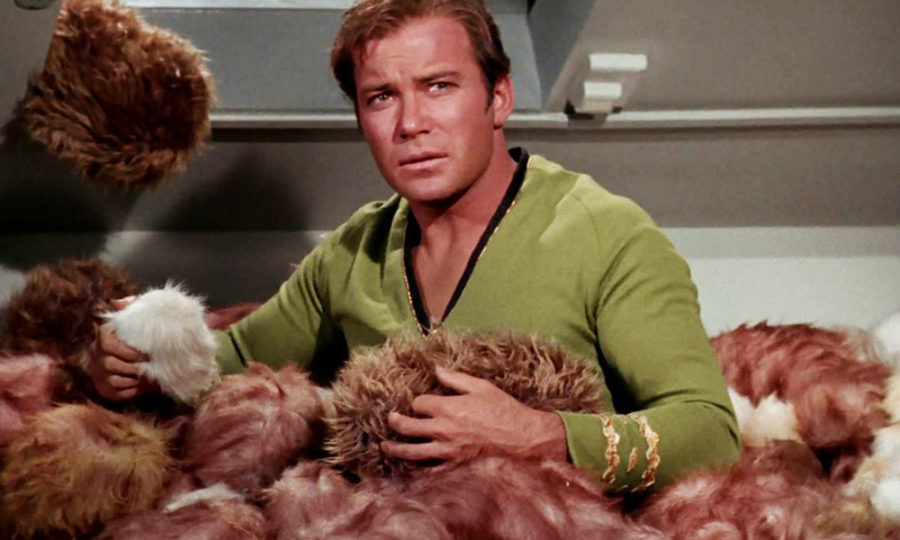
It’s Bones, of course, who saves him. It’s complicated, but essentially he revives Kirk with the help of—wait for it— a tribble.
Shatner’s Captain Kirk awash in tribbles, who are both charming–they purr–and reproductively alarming.
Coming back to life after death isn’t confined to altar boxes or the toolboxes of science fiction writers.
Five years ago, I lost another student, Dawn, to cancer. In my heart, she is Britt’s twin. They share the same audacity.
Both grew up in small towns, but both made careers in L.A., Dawn in film casting and Britt in writing about film.
Dawn Marie Deibert, 1969-2020
I heard this at Dawn’s memorial. This is a true story.
Just before she died, a visitor wheeled Dawn into the garden. It was a sunny day and there were two dragonflies flitting among the flowers. Her friend pointed them out, but Dawn had seen them first.
They were her father and grandmother, she explained, come to be with her.
A few days later, when it was over, the visitor left Dawn’s darkened sickroom and walked into the sunlit garden.
Just above her shoulder, there was a dragonfly.
“Hello, Dawn,” the visitor whispered.
Hello, Britt. Your life was vast. So is our love for you.
Britt and her beloved husband Devin, as imagined by artist Jessie Ledina
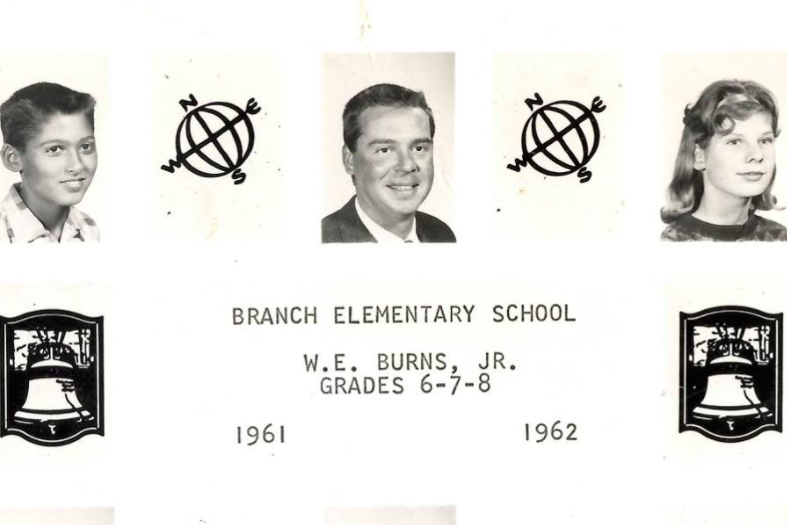
This photo comes from the year Dad was the clerk of the Branch School Board, and bids were being submitted for the new school. Mr. Burns drove a white-over-gold Dodge Polara with a big V-8. I have never forgotten seeing him speed down Huasna Road toward the four corners–he had to be doing 70 mph–because his passenger, picked up at the County Airport on Edna Road, was a construction company comptroller trying to get his boss’s bid in on time.
I don’t know whether the guy made it.
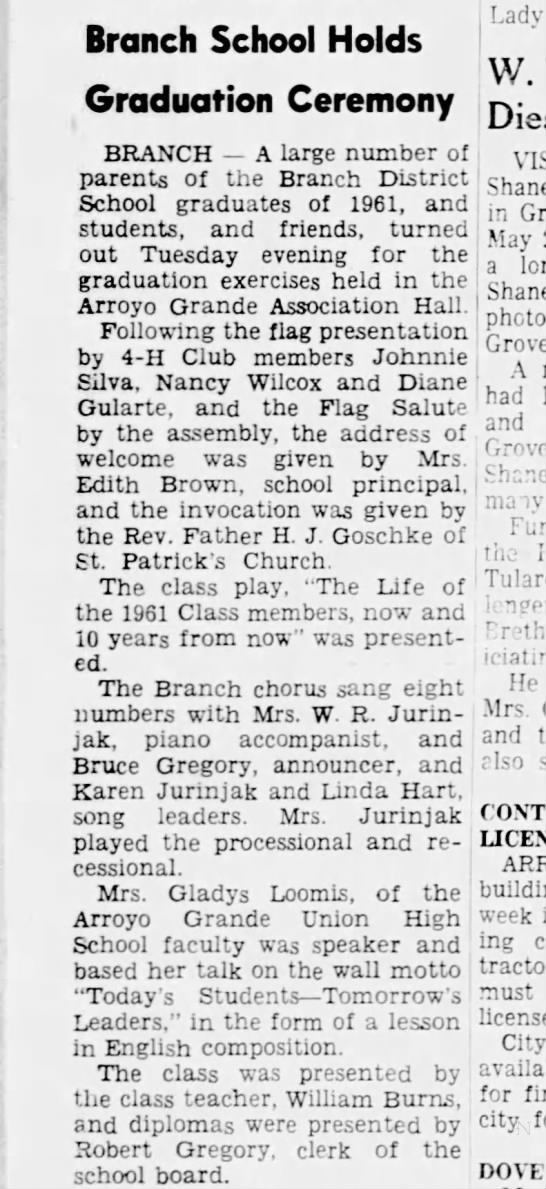
This article, from June 1961, cites Mr. Burns, my big brother and my Dad—and Mrs. Vard (Gladys) Loomis, who would’ve been a dignitary to us. She was a woman of great dignity, so the term “dignitary” fits exactly. The ceremonies were at the IDES Hall because the old 1880s two-room schoolhouse couldn’t hold any more kids–we were Boomers, after all, and there were immense and inconvenient numbers of us—so the big kids, 7th and 8th graders, had their classes at the Hall until the new school could be built.
I wish this story had a happy ending. It doesn’t. Midway through one school year, Mr. Burns was fired. I’m still not sure of the cause, and I don’t want to know. No one talked about it then, and I don’t want to talk about it now. It may have involved his corporal punishment of a student who refused to do her homework. I don’t think that was the case because, just a few years before, I’d seen two Branch teachers, Mrs. Brown and Mrs. Fahey, work over Danny Hunt in the hallway of the old school. They used those hardwood rulers with the sharp copper inserts along the edges and Danny was crouched in the fetal position–and whimpering–while two teachers I loved worked him over like Bad Cop-Bad Cop. To say that I was shaken is an understatement. That was sixty years ago.
Nothing happened to them. Those were less litigious days, and country schools were their teachers’ fiefdoms.
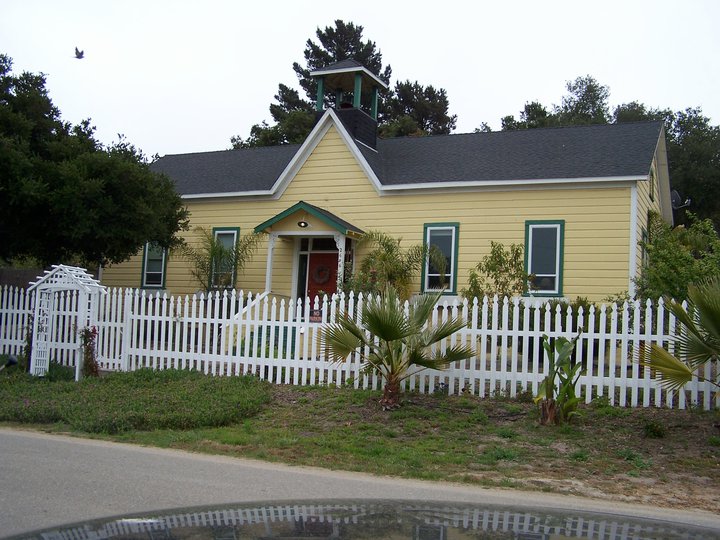
The Old School. It was pink in our day.
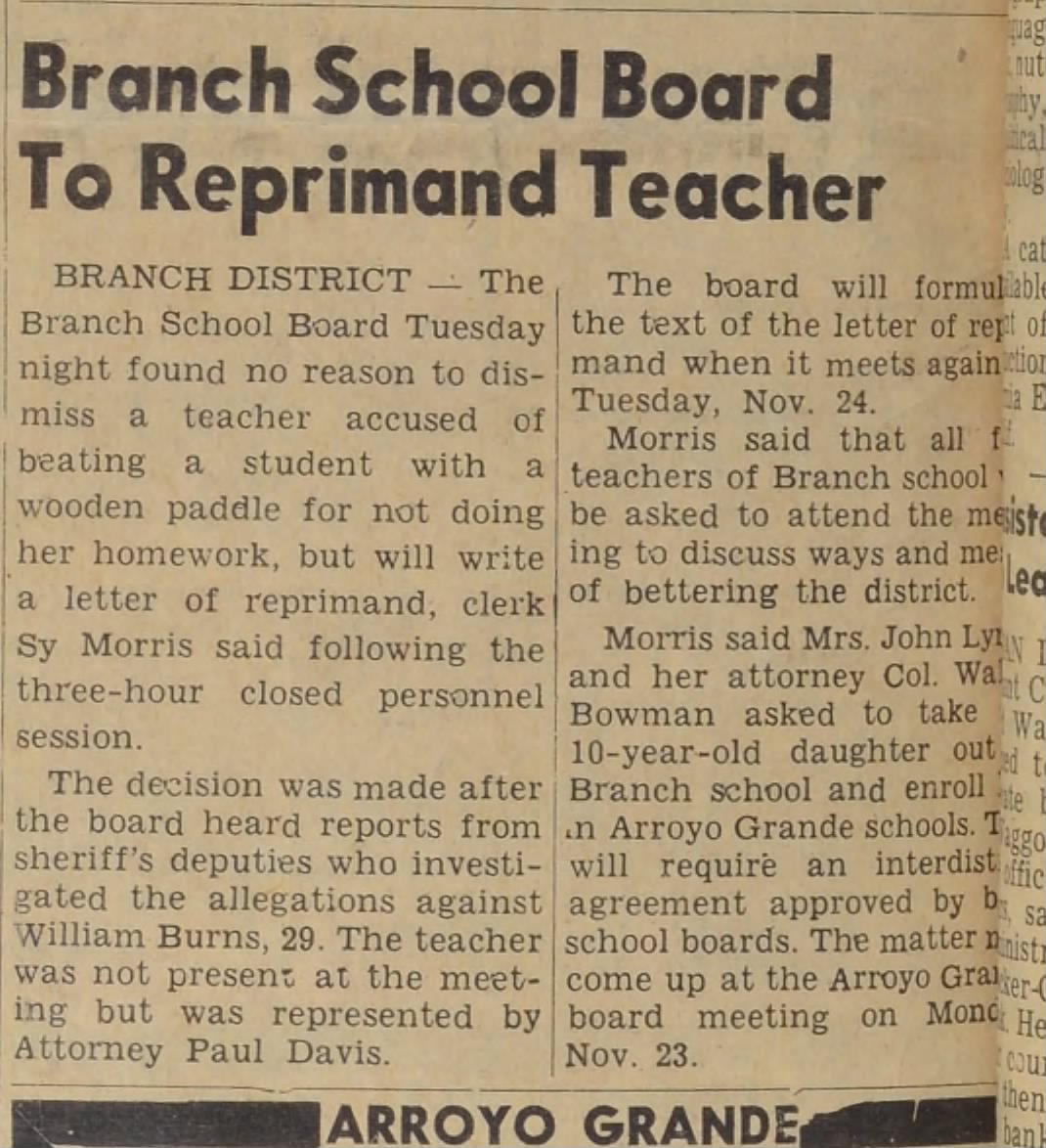
So maybe Mr. Burns did something even worse than what the article below suggests.
From 1965.
It’s absurd, of course, but I’ve been trying to look for him for years. I think I have an obituary, in Los Angeles, but I’m not sure of it. I think I have a wedding, in Monterey, in 1976, and she is lovely in her high school yearbook photo. It might just be the same William Edward Burns–the age, 36, fits. She is Marcia Katherine Ross, 25, and the two were married the day after Christmas.
And, of course, this couldn’t be Mrs. Burns, not at all. I don’t have any conclusive proof of what happened to him–or even any conclusive proof that he was heterosexual, which is irrelevant– not even after years when I periodically take time to look for him on genealogical and newspaper websites.
The point remains: He screwed up. He did something I never would’ve done as a teacher.
Mr. Koehn replaced him–he would be my algebra teacher later, in ninth grade, on Crown Hill, which remains the only year in my formal education that I enjoyed math. He decided, in P.E. to introduce us to golf and brought thirty aged short irons, some with wooden shafts, and a hundred whiffle golf balls to school and we fifth and sixth graders had the time of our lives, swinging without mercy. Our beloved bus driver and custodian, Elsie Cecchetti, was less than thrilled with the divots that swinging without mercy leaves behind. Many years later, when I took my students to Normandy and we saw the enormous craters left by the D-Day gunfire of Allied naval ships, I was suddenly reminded of what we kids had done to Branch School’s front lawn.
We missed Mr. Burns, though. He was charming and unforgiving, inspirational and demanding, sometimes generous and sometimes mean.
But my family, including my big sister, who taught with him at Branch, loved him. My big brother and I loved him because of his intelligence, his wit and his passion–and, frankly, because he was the first male teacher we’d ever had.
And what this flawed man wrote in that old Thesaurus remains one of the greatest gifts of my life:
I think–but I’m not sure–that this is the old Journalism classroom at Cuesta College, where classes were taught by a gifted instructor, Bob Tomlinson–gifted, most of all, in teaching the ethics of good reporting–and where the campus newspaper, TheCuestonian, was once produced. It was still in the Eleanor Roosevelt green-over-khaki paint scheme back in our days.
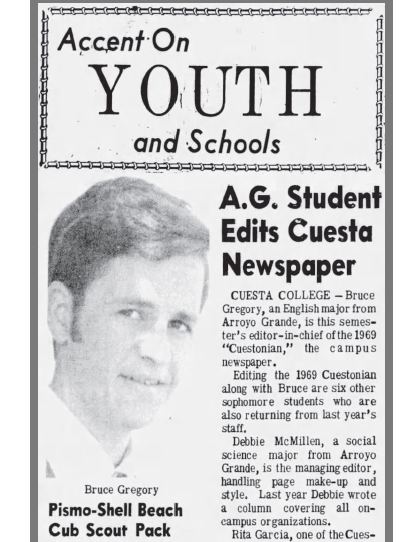
“Our days” because The Cuestonian is an old Gregory family tradition. My big brother Bruce, AGUHS ’66, was the editor in 1968-1969 and he developed a crush on one of his reporters. Fifty-two years later, Bruce and Evie are still married.
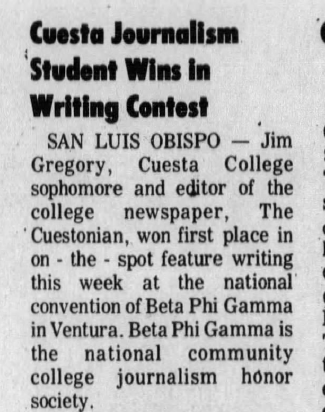
I, AGHS ’70, was the editor a few years later and we won, for such a little punky junior college operating out of World War II barracks, an embarrassing amount of awards, in statewide competitions, in writing, photography, graphics and page design.
You don’t judge a newspaper by its barracks.
This was the convention where one of the speakers gushed about a hot young television news talent named “Brokaw.“
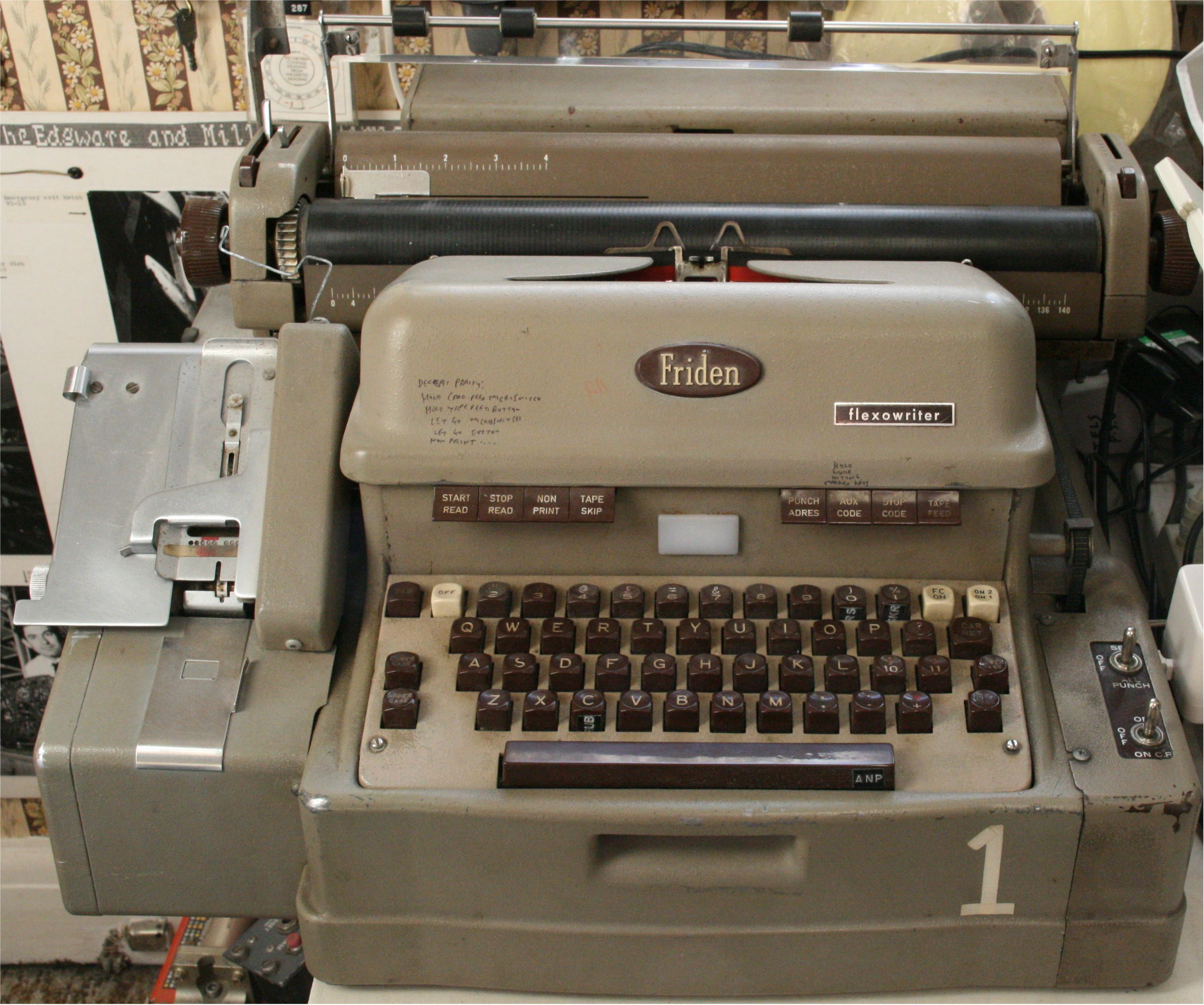
Once you went up the steps, Mr. T’s office was inside the window to the left. He had no more room than a submarine ensign, because most of the office was filled with a monstrous machine called a “Justowriter,” which allowed the keyboard operator to type up the news stories which emerged in a perforated pink ribbon and then, through some alchemy still mysterious to me, the pink ribbon was translated into news columns. (In my imagination, the Justowriter—that’s one of the great beasties below— was steam-powered and drove monstrous pistons, but’s that’s just my imagination.)
The window to the right was my turf and that of the News Editor. We had, at age nineteen or twenty, our own DESKS and so felt immensely important. We filled the room with clackety-clack typewriter noises and immense blue clouds of cigarette smoke–smoking was as fundamental a part of news reporting as were the press passes tucked into the ribbon of your fedora.
Oh, right. We didn’t wear fedoras anymore.
The biggest part of the building was the journalism classroom, edged with banks of tabletops. When it was time to go to press, the desks were cleared away–the process for staging a square-dance in a Victorian one-room schoolhouse was much the same–and the banks of tabletops came alight in the panes of glass that punctuated them.
That’s where you laid out the newspaper, on the glass panes. You’d lay down a big sheet of blue-checkered paper (blue doesn’t pick up in offset photography) and the news stories composed on the Justowriter appeared as long printed columns. They were affixed to the page, guided by the blue lines now transparent in the light, with wax and you rolled them onto the paper with little plastic rollers.When you needed more room, you clipped the end of the story, which is why journalists are trained to get all the good stuff into the lead, or first paragraph, and the ones just following.
Clipping the ends off of stories generated immense emotional anguish from the reporters who’d written them. Me too.
In the back of the building was the darkroom. The reporters did not go into the darkroom. That was the place for more alchemy and photographers (Nikons, Pentaxes, Minoltas)–the ones who used something called “film” that had “speeds,” like Pan X and Plus X–were a justifiably prickly lot.All of them kept the door to the darkroom shut not just out of necessity but because they remembered the story of the great combat photographer Robert Capa, who shot seven rolls of film on Omaha beach on D-Day, was nearly killed seven times, and when the film was shipped back to the darkroom in London, the processor ruined six of them. Even the seventh roll was damaged–it still produced the immortal image below.
So we left the photographers alone, out of respect.
I sometimes wondered if they might not be working out a way to make moonshine out of developer fluid back there.
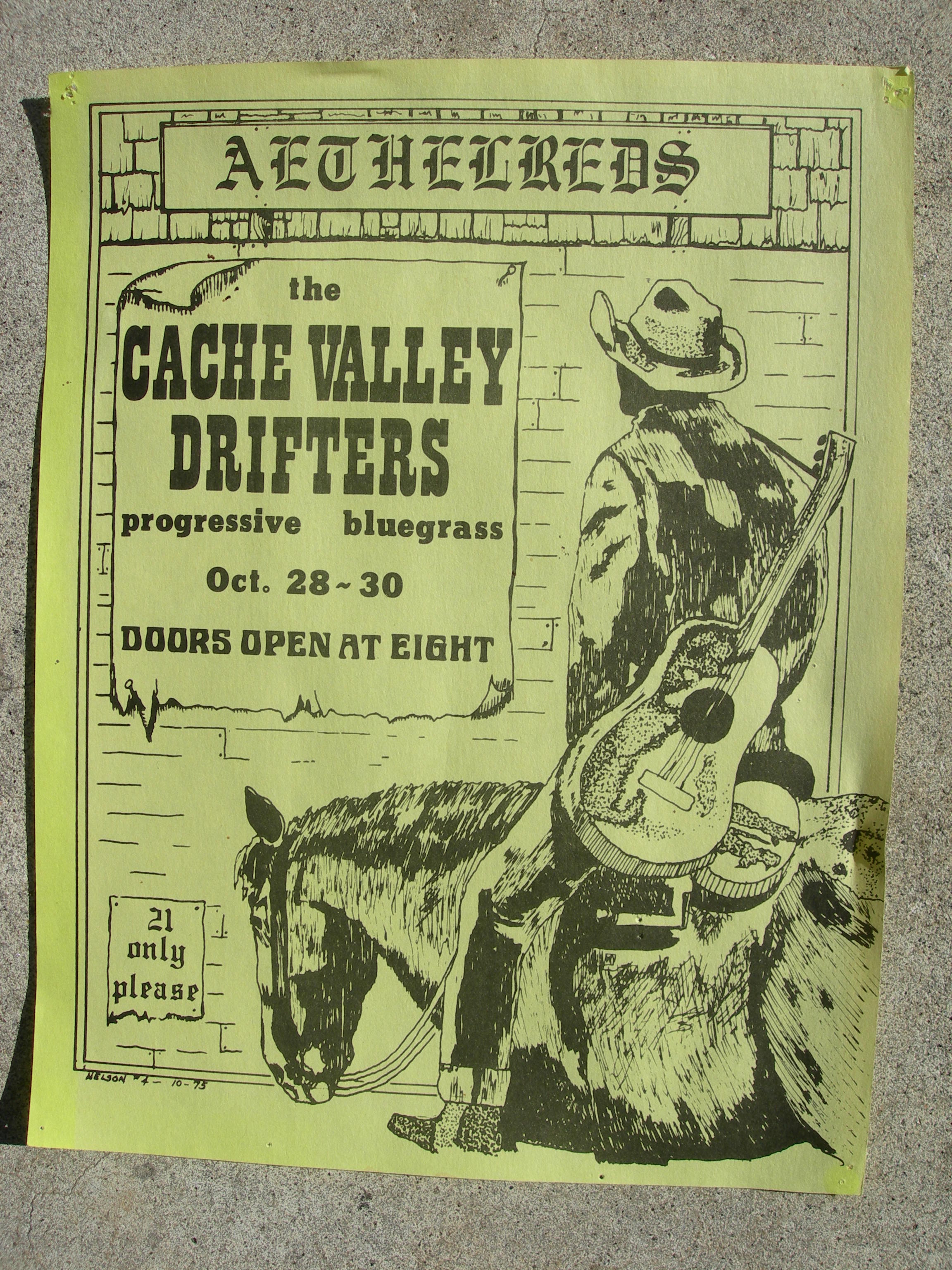
However, I was the only one who could actually go back there from time to time, because sometimes we had to trim headlines, not just stories, and we had a camera called a strip-printer that generated headlines along a strip of photographic paper one letter at a time–in Bodoni Bold. I got to be the Strip Printer Guy, which, just as Aethelred’s Bar on Monterey Street–the Hippie/Biker place that featured incredible bands- had a forever impact on my hearing, the strip printer did the same for my vision.
Putting the paper to bed–a process that sometimes lasted until the wee hours–meant me taking the assembled pages in a big box to Kent Blankenburg’s house–Kent and his brother, Dick published the Five Cities paper, which I still miss– in Arroyo Grande and pretty much throwing them out of the car onto his front porch.
Then I’d drive back to Madonna Plaza Shopping Center (Our Motto: “The wind doesn’t blow here. It sucks.”) to what I think was a Straw Hat Pizza Parlor where all of us would consume obscene amounts of pizza and a platoon or so of ice-cold pitchers of beer or Coca-Cola.
Ah, youth, when we had the metabolisms of muskrats.
We had some great news stories then. A small plane crashed into the roof of the gym where all of us Cuesta students pulled punch cards to register for classes. There was a Vietnam War protest with pallbearers carrying an empty black coffin and I interviewed one, a helicopter pilot in the war, who was both stricken by his experience and one of the most gentle persons I’ve ever met.
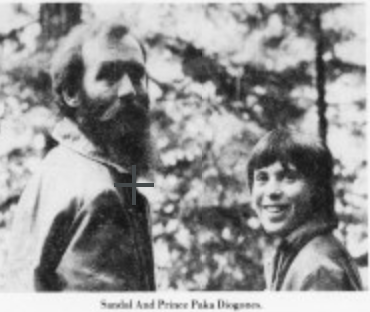
I got to interview a guy who lived on a boat in Morro Bay Harbor, and he was a happy fellow because of it. Moored nearby was the houseboat of two legends, Sandal and his son Paka, reclusive and gentle folks, artists, who took injured seabirds into their care and hand-fed them fish scraps until they were strong enough to fly again.
I got to interview the Black Panther Bobby Seale and the classic film director King Vidor and, during a journalism convention at a hotel in Sacramento–I was within a Frisbee toss of Gov. Ronald Reagan, the guest speaker– I accidentally stepped on state Attorney General Evelle J. Younger’s hand as he came up the stairs that I was descending and he tripped, falling flat on his face.
Evelle J. Younger was the California Attorney General. I didn’t like the way his bodyguards looked at me.
The cafeteria was just behind the journalism building, and the only good thing about the cafeteria was Ginger the Checkout Lady, given to smoking 100-mm cigarettes, wisecracking and referring to you as “Hon.” Ginger was a hoot. The food was not. Then the district somehow, either through divine intervention or Trustee Vard Loomis, one of my heroes, hired a European chef named Maurice who made marvelous lunches.
Swedish Meatball Day meant a throng of nineteen-year-old nouveaux Hippie peacenik students packed at the cafeteria doorway–another surplus Army building–trying to claw each other’s eyeballs out before Maurice ran out of meatballs.
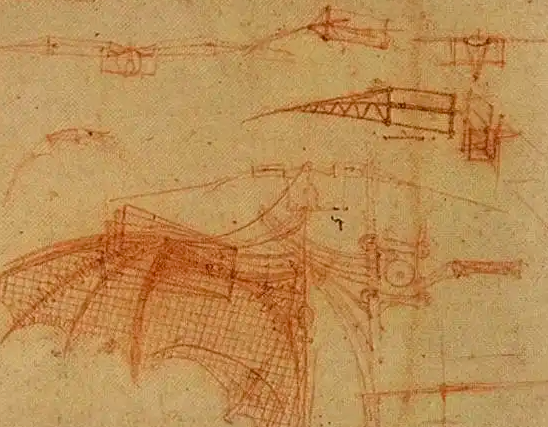
One of my favorite stories was about a slightly mad Canadian artist who took up residence in the Art Department–more barracks, the Art Department was, but augmented by Dali-esque murals–and began building an exquisite wooden replica of a Leonardo da Vinci flying machine. He was going to fly it. He gathered a little coterie of students who believed that he was going to fly it–one volunteered to be the co-pilot– and so they all worked on it merrily together, over there in the Art Department, and I still, to this day, believe it would’ve flown had not the mad artist’s sister driven down from British Columbia to take him, under sedation, back home.
The best part was TheCuestonian staff. I’ve read similar stories about Admiral Nelson’s captains, about the artists and writers who produced the classic Warner Brothers cartoons (Bugs Bunny, Daffy Duck, Elmer Fudd) and, in the book and film “The Right Stuff,” the Mercury astronauts. Gifted people in groups like these last no longer than snowflakes in March, so it remains one of the greatest honors of my life that I got to work with such talented, and now, from the great distance and advantage I have in age, such outrageously young women and men.
This is a story I heard today. I won’t get the details exactly right, but even so, this is a true story.
A young woman went to visit her friend, afflicted with cancer. When she entered the sickroom, she knew immediately that the end was pretty close.
–Would you like to go outside for a bit?
–Yes. I’d like that.
So the visitor wheeled her friend out to the garden where there would be sunlight and warmth and a little breeze.
There would be flowers.
There were two dragonflies flitting about the flowers. The visitor pointed them out, but her friend, Dawn, had seen them first.
She knew who they were. Her father and grandmother had come to be with her, she announced with confidence from her wheelchair.
I think that death confers on people who’ve lived good and unselfish and courageous lives—all of these describe the Dawn’s life, the young woman in the wheelchair— a wisdom near the end that we cannot understand. It gives them a clarity of vision that allows them to see what we cannot see.
It wasn’t long until death came. The visitor—a real friend, the friend of this person, now dying—Dawn had always drawn people to her the way flowers draw dragonflies—-came to visit on the last day. It would be presumptuous to call it the “final” day, because I believe that all of us will embrace each other again someday, and it will be a long time before we let go and step back, smiling, to regard each other in perfect wonder.
But when that day was over, when Dawn summoned the courage to give up her struggle, the visitor left the sickroom and walked into the sunlit garden.
Just above her shoulder, there was a dragonfly.
“Hello, sister,” the visitor whispered.
This is Hozier, and he’s singing an old Irish song of farewell, “The Parting Glass.”
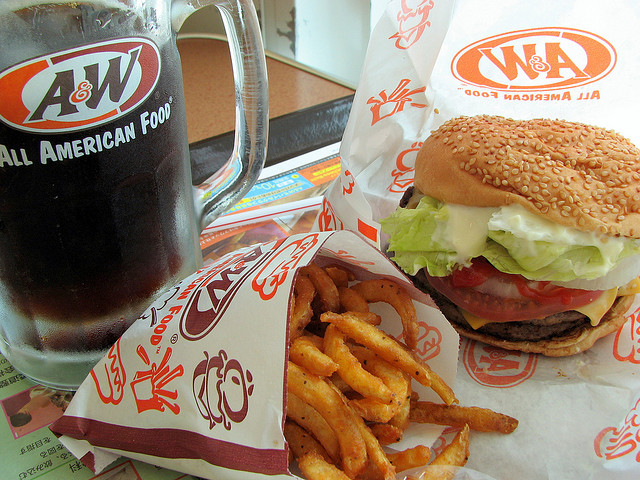
There used to be an A & W Root Beer restaurant on Grand Avenue. It isn’t there anymore. It was right across Grand from Young’s Giant Food, which isn’t there anymore, either.
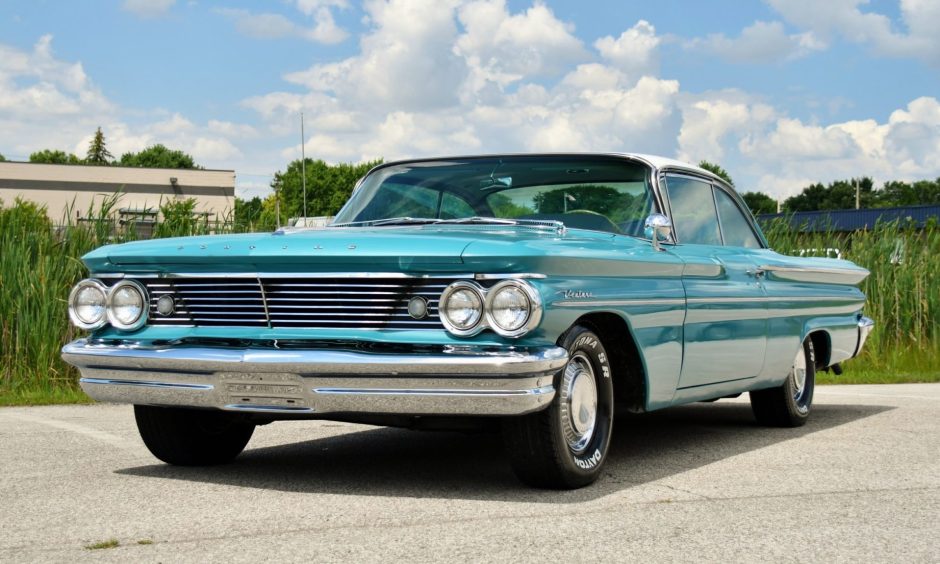
A Pontiac Ventura. My sister’s was red over white.
But when I was little, this was high living: My sister, Roberta, would take Mom and me and later little sister Sally to the A & W in her 1961 Pontiac Ventura.
I believe that it was dangerous to drive a 1961 Pontiac Ventura in the San Diego area. Fighter jets from the Naval Air Station might mistake it for an aircraft carrier and try to land.
But a car that size was made for drive-in meals.
They had car hops, teenaged girls, at this A & W, and I believe, if I’m not mistaken, that they were on roller skates. They’d glide out to take your order and then glide back to place it. They’d hook a tray to the driver’s side door and, with great dignity, roll out again to lay the feast thereupon. It was Roberta, since she was driving, who distributed the goodies.
The smell, of burger and bacon and fries was unendurable. Roberta was never fast enough for me. Many years later, I saw the film Reefer Madness. At one point, one of the hopelessly addicted 1940s teenagers blurts “I NEED SOME REEFERS!” I was like that, but it was with hamburgers.
A nostalgic view. They’re all so white.
My invariable order: A root beer freeze, a Teen Burger (bacon and cheese, then a novel innovation) and fries. It was a substantial meal and required a nap afterward.
Alas, my cardiologist would whip me with a stethoscope if I ate a meal like that today.
Mom always got the Mama Burger and Sally the Baby Burger. Of course.
But it was a different America then. We had big cars like Pontiacs–eleven miles per gallon, thank you very much–so immense that they were mobile dining rooms, and we had vast and limitless cattle ranches devoted solely to Teen Burger production. There would always be plenty of gasoline, we believed, and you could always eat plenty of hamburgers.
Then they shot the president and the whole shebang started to unravel.
Early in World War II, my Dad was stationed at Gardner Field in Taft. He was a marksman with both the 1903 Springfield and the M1 Garand, which is just above middling, but he was lethal when handling a shotgun. His last shotgun was a lovely Spanish over-and-under, and when Dad led a cock pheasant, the bird was doomed. No matter. The Army sent him to London with a typewriter and adding machine. He was a Quartermaster officer.
Dad, on the right, with a Winchester Model 12, about to go hunting with a neighbor in rural Missouri.
One of his jobs was to organize and dispatch gasoline supply companies to Omaha Beach, where George Patton would promptly steal them.
Another young man stationed at Gardner Field flew P-51 Mustangs into combat and, oh yes, broke the sound barrier two years after the war had ended.
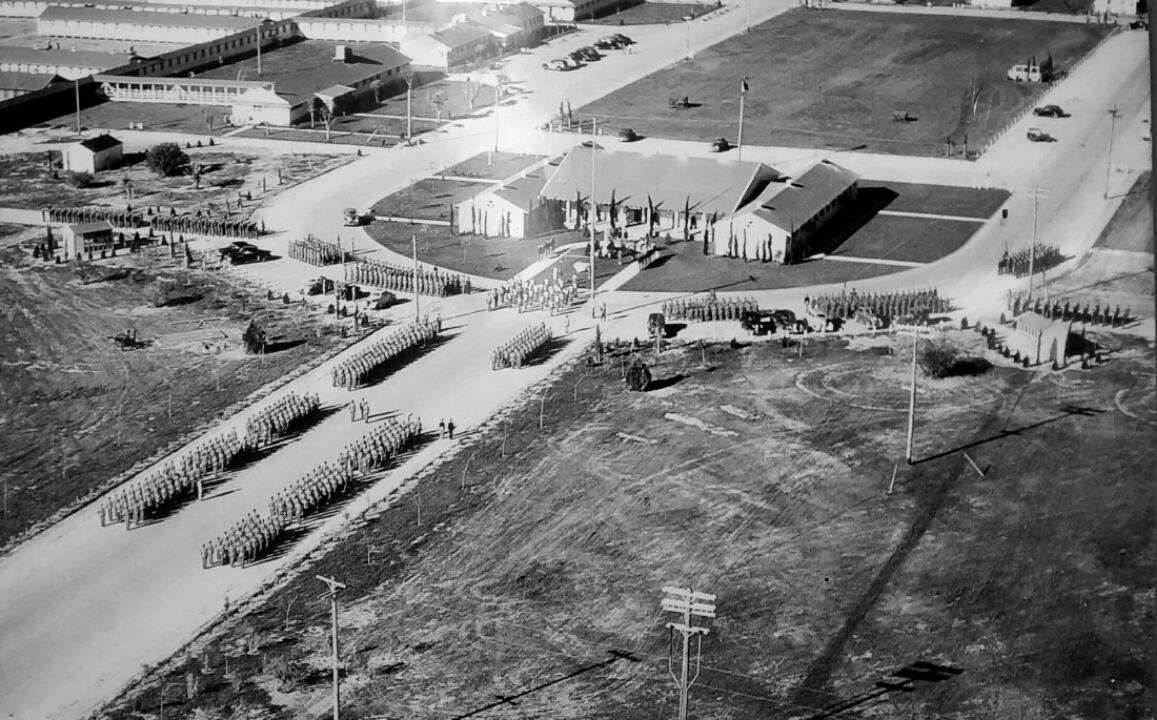
Gardner Field, Taft, during World War II
Here’s one way that fellow entered my life. Elizabeth and I were on a JetBlue flight from somewhere to somewhere else when the pilot’s voice came over the intercom:
“Ladies and gennulmen. If y’all look out the starboard side of the cabin you’ll see a cloud that looks jes’ like a little ol’ puppy dog.”
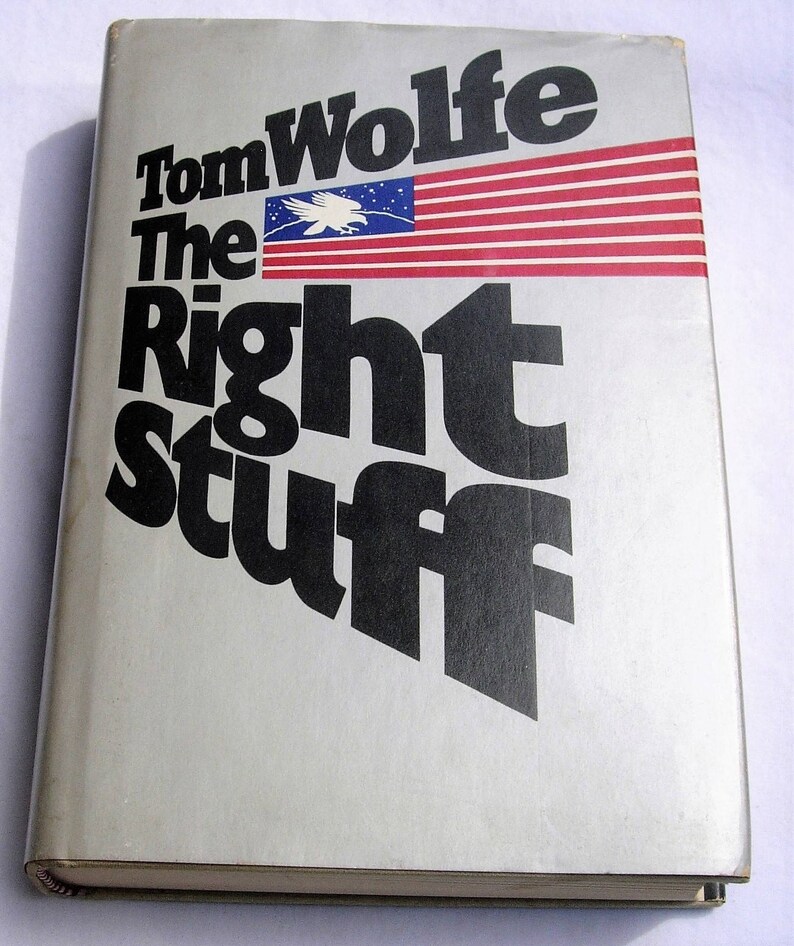
Because I’d read and so enjoyed the writing of the late Tom Wolfe, I realized suddenly where that voice came from. This passage is from The Right Stuff. It’s kind of fun.
Anyone who travels very much on airlines in the United States soon gets to know the voice of the airline pilot… coming over the intercom… with a particular drawl, a particular folksiness, a particular down-home calmness that is so exaggerated it begins to parody itself (nevertheless!—it’s reassuring)…the voice that tells you (on a flight from Phoenix preparing for its final approach into Kennedy Airport, New York, just after dawn): “Now, folks, uh… this is the captain… ummmm… We’ve got a little ol’ red light up here on the control panel that’s tryin’ to tell us that the landin’ gears’re not… uh… lockin’ into position when we lower ’em… Now… I don’t believe that little ol’ red light knows what it’s talkin’ about—I believe it’s that little ol’ red light that iddn’ workin’ right”… faint chuckle, long pause, as if to say, I’m not even sure all this is really worth going into—still, it may amuse you…
…Well!—who doesn’t know that voice! And who can forget it!—even after he is proved right and the emergency is over.
That particular voice may sound vaguely Southern or Southwestern, but it is specifically Appalachian in origin. It originated in the mountains of West Virginia, in the coal country, in Lincoln County, so far up in the hollows that, as the saying went, “they had to pipe in daylight.” In the late 1940’s and early 1950’s this up-hollow voice drifted down from on high, from over the high desert of California, down, down, down…into all phases of American aviation. It was amazing. It was Pygmalion in reverse. Military pilots and then, soon, airline pilots, pilots from Maine and Massachusetts and the Dakotas and Oregon and everywhere else, began to talk in that poker-hollow West Virginia drawl, or as close to it as they could bend their native accents. It was the drawl of the most righteous offal the possessors of the right stuff: Chuck Yeager.
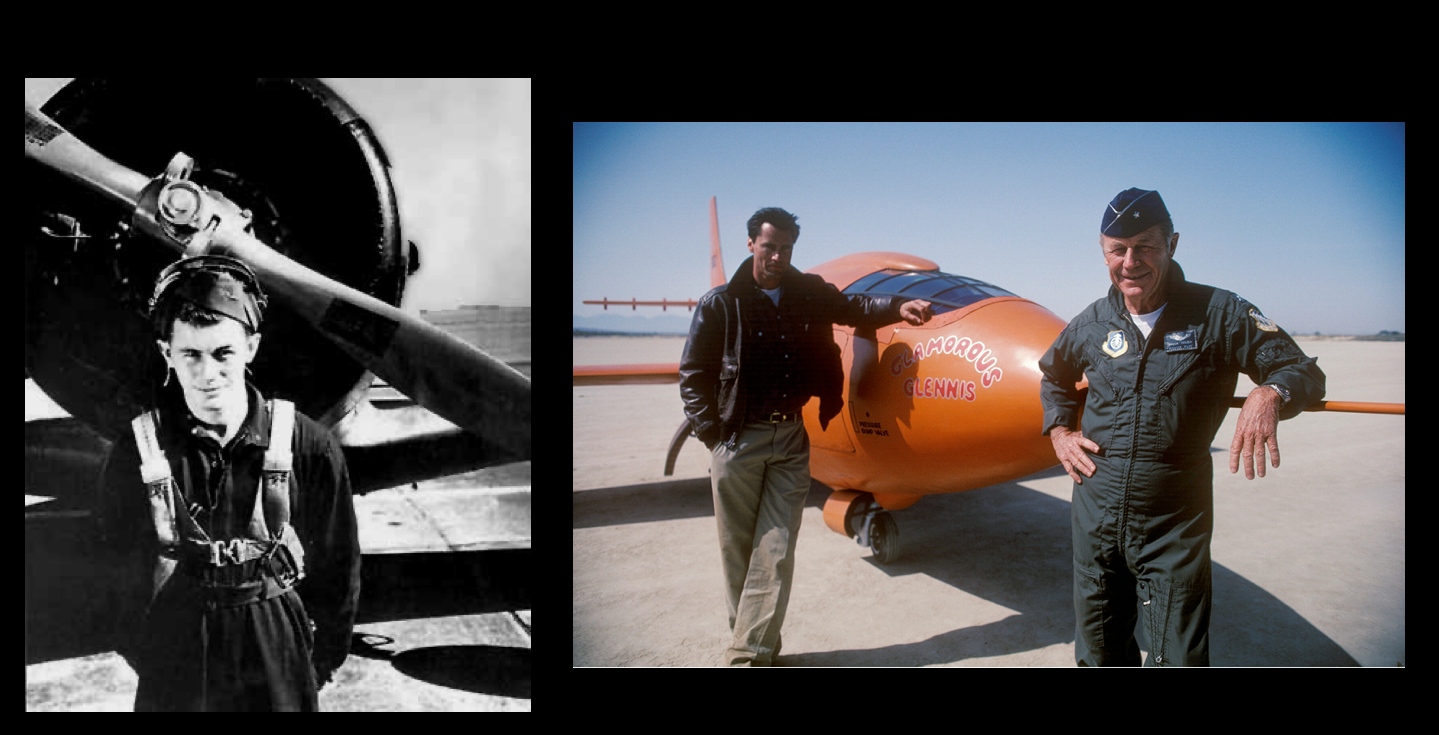
Young Yeager at Gardner Field in front of the BT-13, a trainer that shook so violently that student pilots called it the “Vultee Vibrator.” (Right) Actor Sam Shepherd and Yeager with a replica of the Bell X-1, the jet in which he broke the sound barrier. With a broken arm.
Wolfe became one of my role models as a writer, along with Ernest Hemingway, Hunter Thompson, Graham Greene, Bruce Catton, Dave Barry and Barbara Tuchman. The film version of The Right Stuff included a masterful performance by playwright/actor Sam Shepard, who comes face-to-face with the real Chuck Yeager, a bit player, in a couple of scenes. This, the crash of an F-104 Starfighter–the West Germans called the Starfighters we foisted on them “Widow Makers”–is a stunning bit of filmmaking.
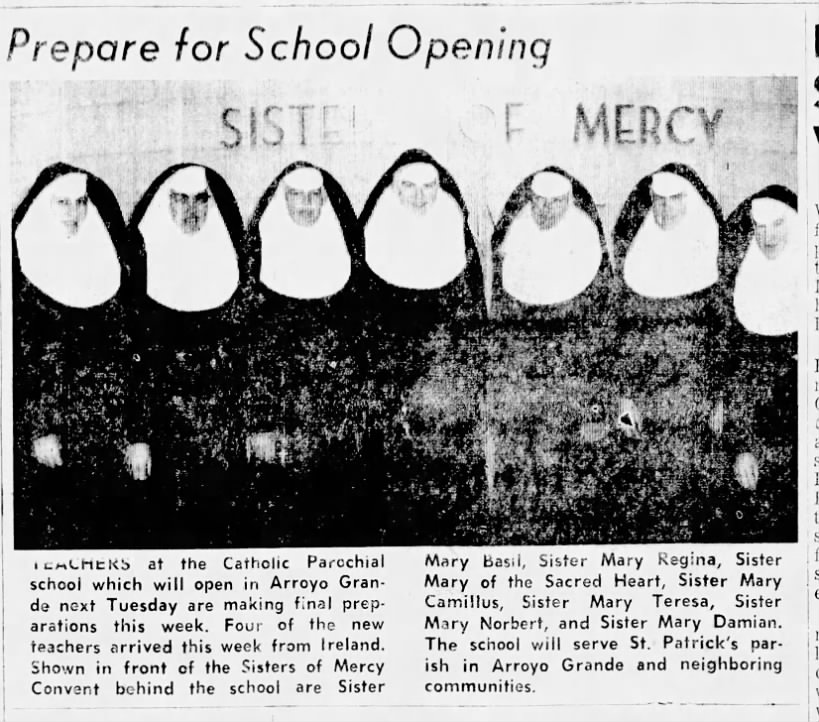
Our dear friend Sister Teresa O’Connell died in May at 90. She taught at St. Patrick’s in Arroyo Grande and Elizabeth and I taught with her at Mission in the 1980s and 1990s. Here’s the two of us back then:
As a member of the Sisters of Mercy, Teresa spent most of her life teaching young people. But when she returned to Ireland, she found a new calling in ministry to the elderly. Hers was such a rich life.
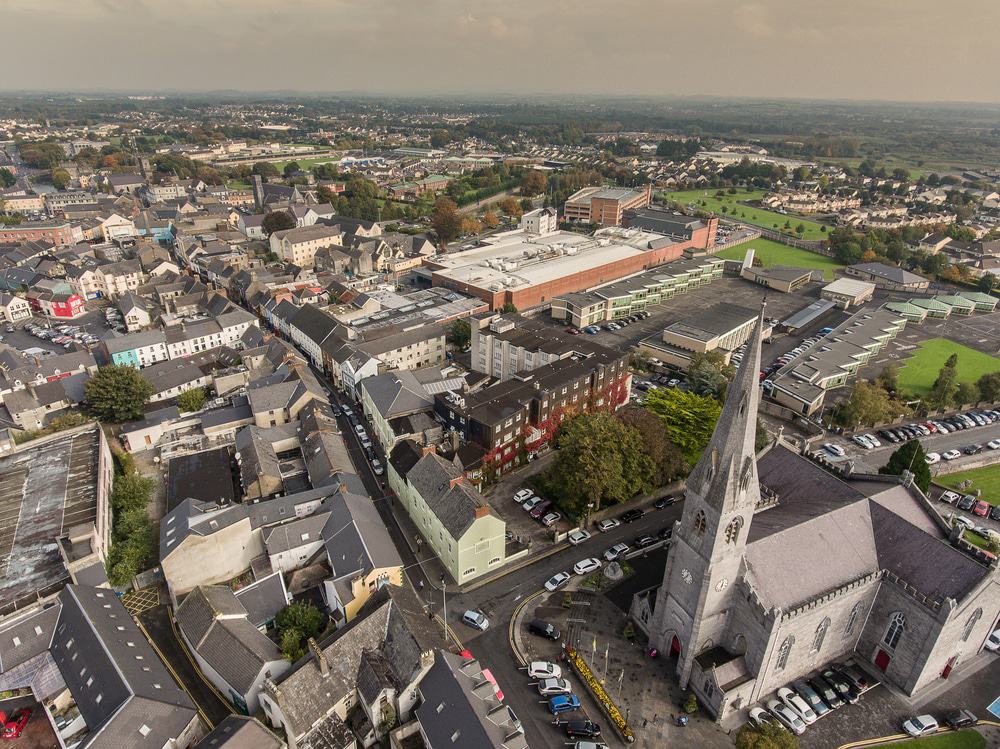
Elizabeth and I “attended” her funeral at the Ennis Cathedral–it was four a.m. our time–thanks to the internet. It was a six-priest funeral Mass with a couple of Monsignors included. Behind the altar, It was like the Irish Catholic equivalent of the 1927 New York Yankees.
It was the least they could do for her.
Here are two views of the church.
I made the mistake of starting to do some research on Ennis, because in thinking of Irish history as a road, every few miles you are confronted with a sad detour. The cathedral was built in 1828, which in itself is significant, because the Penal Laws enacted at the end of the 17th Century–that would’ve been when Great Britain, after the insolent Popery of King James II, was once again securely and relentlessly Protestant under William and Mary–forbade the building of new Catholic churches in Irish cities. The ban, then, lasted until the English were long past the Stuarts and running toward the end of their Hanoverians.
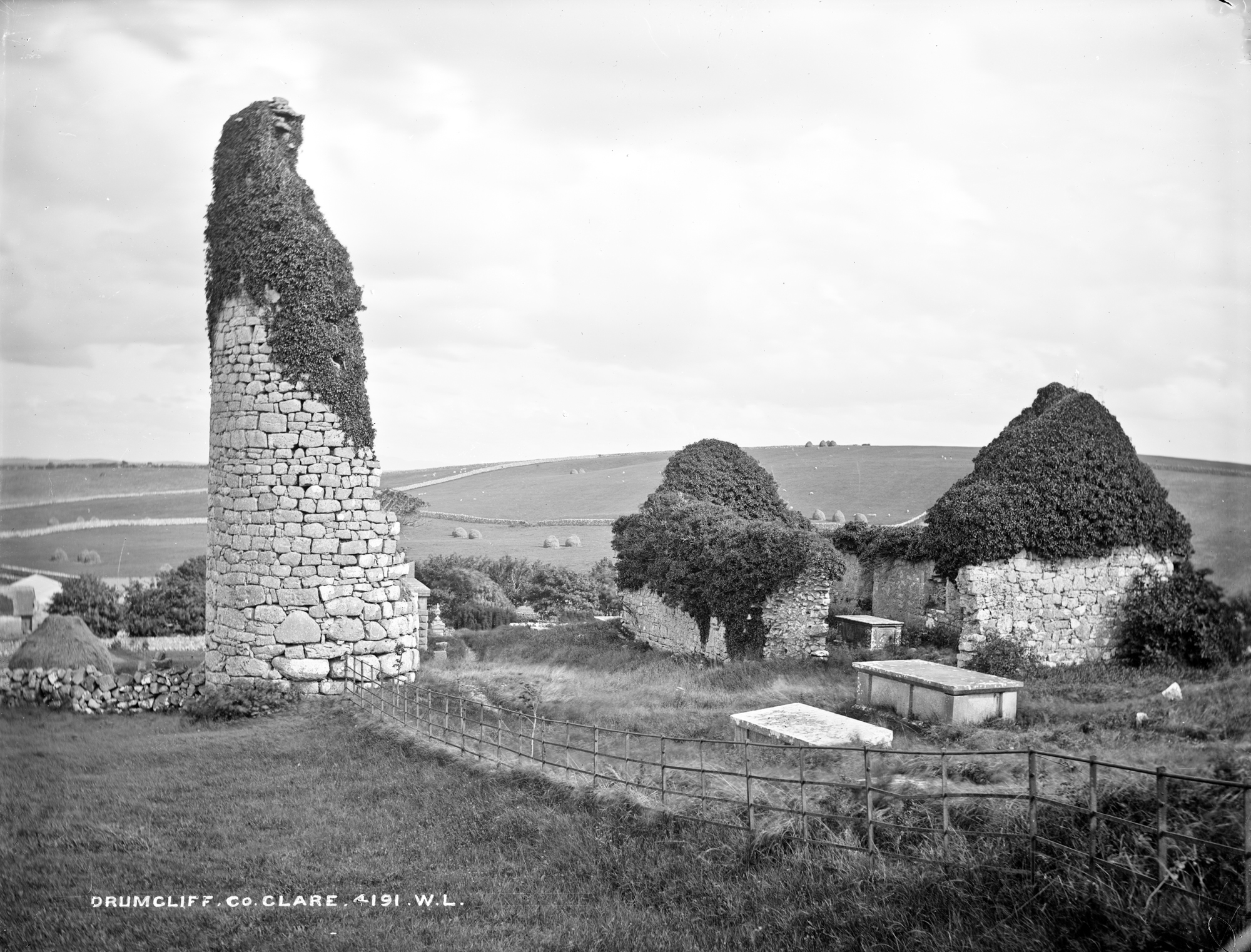
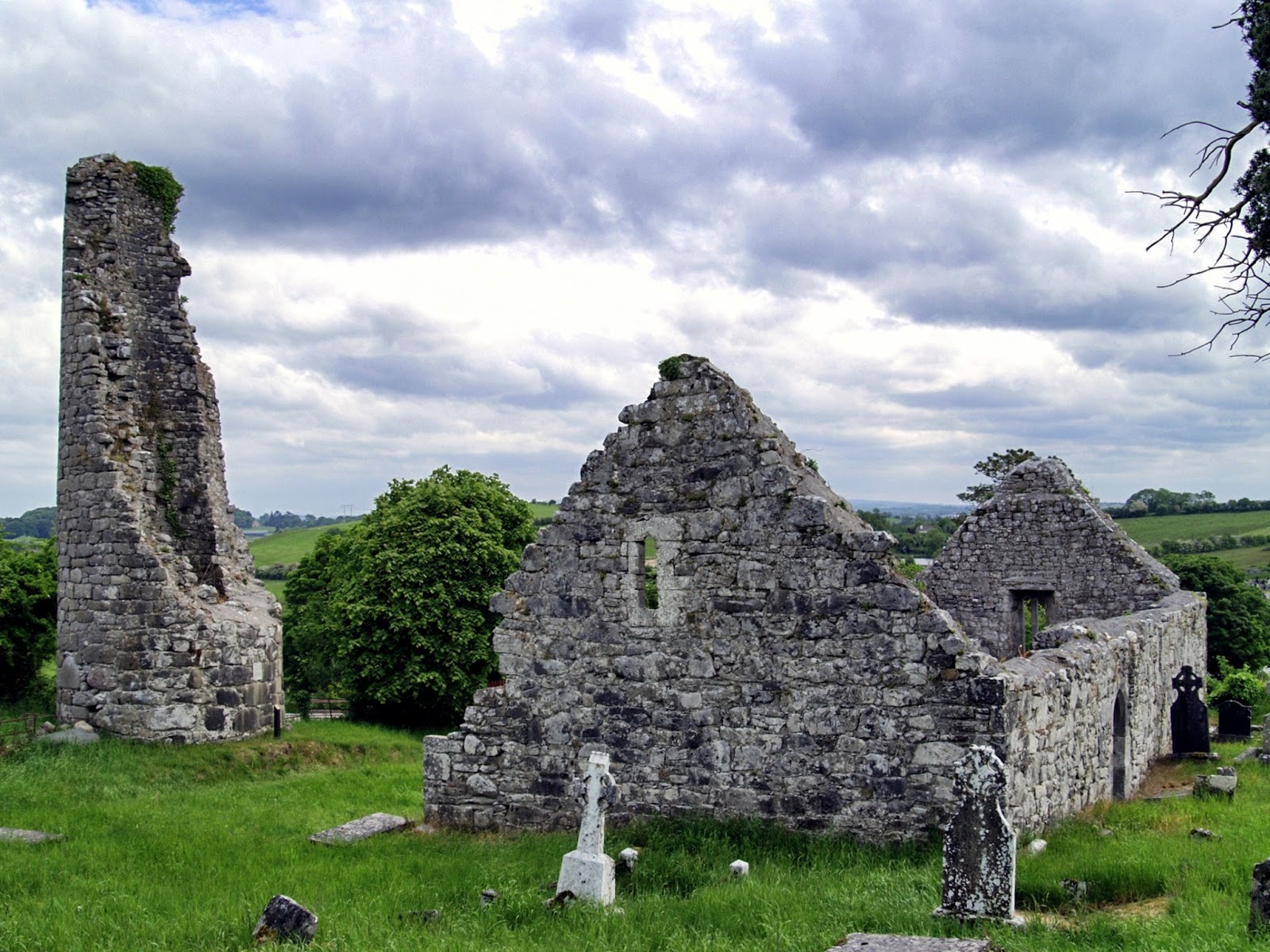
I looked up the cemetery where Sister is buried. It’s Drumcliff, Ennis, County Clare. It’s rich in Irish history, too.
This photo shows the tower and ruined abbey church at Drumcliff. The cemetery adjoins the ruins, on a steep hill that one guide says is windy but strangely serene. Another guide says this: “The existing church ruins are from the 15th century with bits of 10th and 12th century architecture incorporated into it, suggesting it was built on the site of at least one earlier church.”
The earlier church may have been founded by St. Conall. He lived in the 7th century.
When you grow up in a place whose oldest landmark dates to 1772, your history is an eyeblink next to Ireland’s.
The cemetery itself represents one of those sad detours in that history. From a County Clare genealogical website:
Itis impossible even to guess how many persons are buried at Drumcliffe [sic]: so many graves were never marked at all, countless others have no inscriptions, and the multitudes who lie in the cholera grave, the Famine grave pit beside it and the pauper plot closer to the road, will never be identified by the names they bore in life.
Cholera was a terrible killer in the first half of the nineteenth century; it killed Londoners in their thousands, as well as the Irish, until Joseph Bazalgette designed and built a network of intercepting sewers that carried the Thames River’s sewage out to sea.
Ireland, of course, was far behind in engineering projects as grand as this one.
“The Famine grave pit” is mentioned in passing. Perhaps many of those people were on their way out of Ireland. We once saw a massive green in Galway, one of the Famine ports of exit, also in the west, beneath which thousands of destitute Famine victims are buried. They’d almost made it. It’s probable that the people buried in Drumcliff, like those in Galway, died, enfeebled by starvation, of opportunistic diseases like typhus.
At least the paupers are symbolically remembered. Many of them ended their lives in a nearby workhouse. Here is their monument:
Pauper’s Memorial, Drumcliff
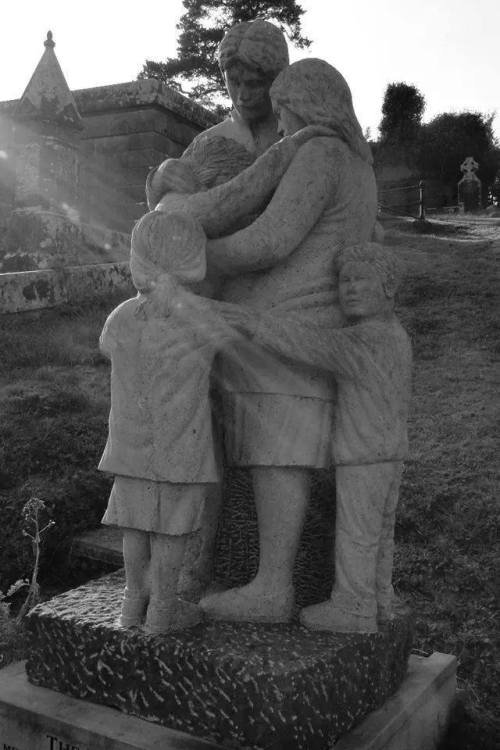
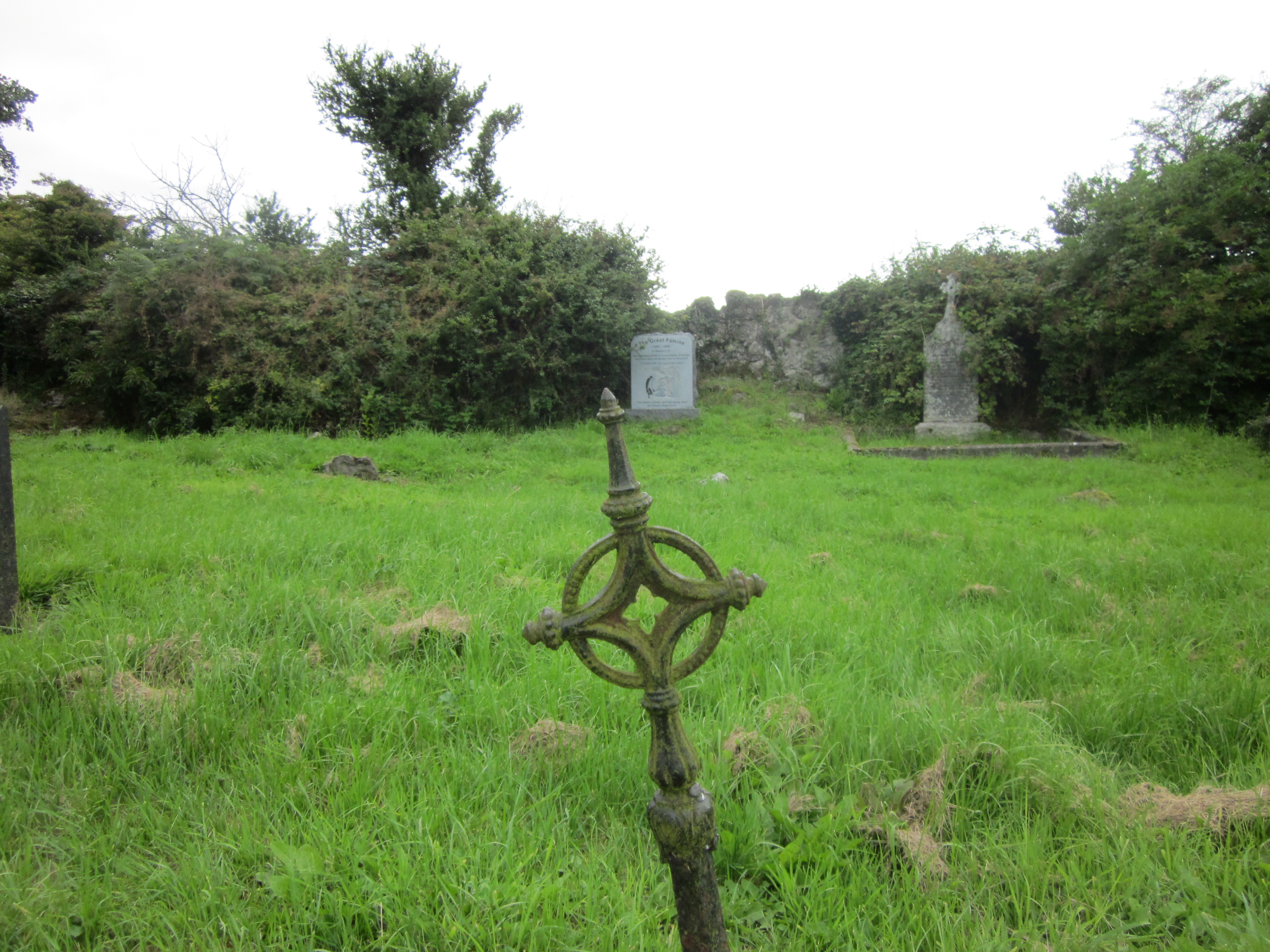
The Famine Grave
It’s a windy but strangely serene place.
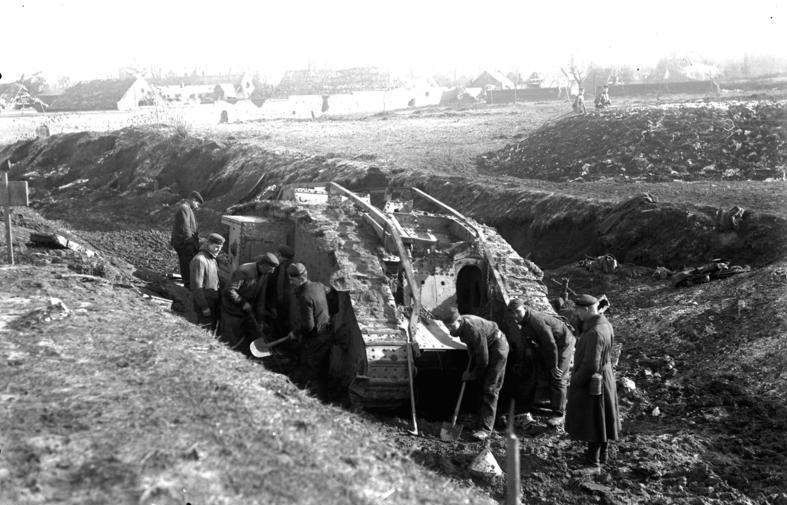
And then you reach the 20th century. There are Great War soldiers buried here: over 200,000 Irishmen fought for the British between 1914 and 1918. Drummer John McMahon served in the King’s Own’s Scottish Borderers, in a battalion that had survived Gallipoli; it’s possible that his death, in July 1917, came in Palestine. Thomas Moody served in the Irish Guards; his death, in November 1917, must’ve been at the Battle of Cambrai, which, like Bazalgette’s intercepting sewers, began as a landmark for modern technology. The British launched a massive attack spearheaded by Mark IV tanks, an innovation in warfare. By the second day of the attack, half the tanks had broken down, and that’s when the Germans responded. Moody probably died in their counterattack, the biggest assault on the British Expeditionary Forces since 1914. It was in that ealier assault–the the First Marne, in September 1914, the battle that stopped the Germans short of Paris, when Parisian taxicabs carried poilus to the front in relays–that claimed artilleryman Michael O’Brien, another soldier buried in Drumcliff.
German soldiers inspect a British tank wrecked at Cambrai.
Of course, the Great War was punctuated by the Easter Rising in Dublin. You can still the gouges British bullets left in the columns of the Neoclassic General Post Office, where the rebels held out for six days during Easter Week 1916. The Dubliners jeered the Irish Republican Army rebels as they were led away, after their surrender, by British forces.
The General Post Office, O’Connell Street, Dublin, after the Easter Rising. Nelson’s Column, to the right, was later blown up by the IRA.
Then the British began executing them, granting one, terribly wounded, the privilege of being shot while seated in a chair. That was a mistake. Now they were martyrs.
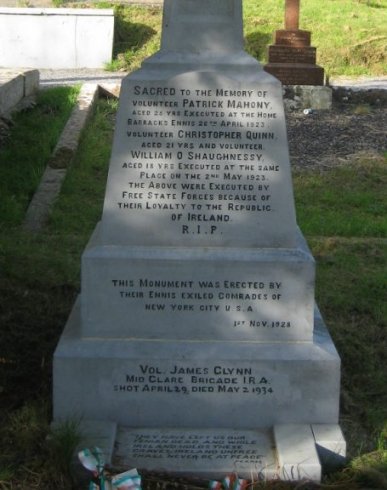
And that leads to one more place in the Drumcliff Cemetery: An IRA Memorial.
Irish rebels memorial
Maybe it’s typical that this memorial was made possible by expatriates, Irish living comfortably and happily distant in New York. What it commemorates might be too painful to remember for the people who live in Ennis today. The four Irish Republican Army men cited on this monument were killed in The Troubles, but not by the English. Three of the four were shot by firing squads made up of fellow Irishmen during the Civil War of 1922. Two were eighteen years old. They were Republicans executed by soldiers of the Irish Free State, the government that shot three times as many Irish revolutionaries in 1922 as the English had during the rising of 1919-1921.
One of the eighteen-year-olds wrote this on the eve of his execution:
Home Barracks, Ennis
Dearest Father,
My last letter to you; I know it is hard, but welcome be the will of God. I am to be executed in the morning, but I hope you will try and bear it. Tell Katie not to be fretting for me as it was all for Ireland; it is rough on my brothers and sisters–poor Jim, John, Joe, Paddy, Michael, Cissie, Mary Margaret–hope you will mind them and try to put them in good positions. Tell them to pray for me. Well father, I am taking it great, as better men than ever I was fell. You have a son that you can be proud of, as I think I have done my part for the land I love. Tell all the neighbours in the Turnpike to pray for me. Tell Nanna, Mary and Jimmy to pray for me, Joe, Sean, Mago, Julia, Mrs. Considine and family, also Joe McCormack, the Browne family, my uncle Jim and the Tipperary people which I knew. I hope you will mind yourself, and do not fret for me. With the help of God I will be happy with my mother in Heaven, and away from all the trouble of this world, so I think I will be happy...
…Dear father, I will now say goodbye – goodbye ‘till we meet in heaven.
I remain, Your loving son, Christie
County Clare is famous for goodbyes. The Cliffs of Moher (above) might have been the last many Famine emigrants to America saw of Ireland. A windy and wild place, they are remindful of the title Leon Uris chose for a book he and his wife Jill wrote about Ireland: “A Terrible Beauty.”
Sister Teresa, even in her rest, cannot escape the long road of Irish history that has carried so many travelers—including my own family—on the journeys of their lives. Hers ended in Clare, a place, like the rest of Ireland, so marked by sadness. But sadness is not a dominant Irish trait—the last thing the Irish lost during the Famine, one chronicler noted, was their sense of humor—and it was service to others, not sadness, that dominated Teresa’s life.
I’ve been to Ireland and don’t know that I’ll ever get the chance to go again. If I do, God willing, there’s a place in the Drumcliff Cemetery that needs beautiful flowers and a pinch of California topsoil, perhaps from a field that adjoins St. Patrick’s Church, a parish five thousand miles away from County Clare.
September 1963: Off the airplane and into the classroom. Teresa is third from right.
Elsie Cecchetti. San Luis Obispo Tribune; photo by Vivian Krug
Elsie Cecchetti was our bus driver. In the same way that Louis Tedone was SLO’s baby doctor. Elsie was everybody’s bus driver.
Yes, I go back to the days of Branch School’s yellow pickup with bench seats and the tarp overhead, when we bounced happily over creek crossings.
We waited for her at the Harris Bridge.
I think she had mechanical problems one morning–and it was a cold one–when Mary Gularte took me inside from the bus stop for some sopa. That was a good morning.
Both Mary and Elsie called me “Jimmy.”
We tormented Elsie with “99 Bottles of Beer on the Wall” and then, in 1964, with “She Loves You,” ” I Want to Hold Your Hand” and she always headed us off in “The Name Game” song, before we got to “Chuck.”
And I always looked over the edge of the bus window as she drove confidently up Corralitos Canyon. There were some good drops there, but Elsie knew what she was doing. At the Canyon’s end, past the Dentons, she made a three-point turn that the California Department of Motor Vehicles should have filmed for posterity.
If there was a girl on whom I had a crush–and this was frequent–I looked a long time out the bus window after we’d dropped her off.
I once saw Elsie’s wedding photo, the day she married George, on the steps of Old St. Patrick’s on Branch Street. She was so beautiful that she took my breath away.
But she cleaned up after us at school.
She chewed us out when when we were jerks.
She laughed when we tried to be funny.
She cocked an eyebrow dubiously when we had excuses for being late.
But my most vivid memory is the day she cried. We were on our usual route with most of the stops ahead of us, near what is today Lopez Drive and Cecchetti Road, when she stopped the bus.
The old farmhouse, where she’d made a home and a family, was on fire. And it wasn’t just smoke. It was violent–big, ugly orange flames and billowing, acrid black smoke. Elsie threw the lever that opened the bus doors and stood at the bottom of the steps and she began to sob.
I don’t know–I was only about eight–that any of us, fifteen or so of us, had ever seen an adult in such pain.
And it wasn’t just an “adult.” It was Elsie.
I guess then we heard sirens from the CDF and they knocked the fire down, but it was too late. I don’t remember that part.
What I do remember is walking the rest of the way home in complete silence. We were shocked because we realized, just then, how much we loved Elsie and just how cruel life could be even toward the people we loved the most.
What we began to learn from her, in that terrible moment, was empathy.
Even a school-bus driver can guide you toward wisdom. I finally understand, now that she’s gone, that it was Elsie who always got me home again.



















 A Work in Progress