
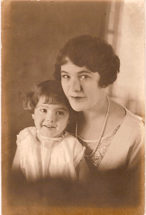
My mother and grandmother, about 1925.
What’s hard about doing your family tree is finding some branches you’d rather break off. The one that comes to mind is the ancestor with 19 slaves in the 1850 census, identified only by gender and age, as if they were machine parts rather than human beings. That’s not the case with my Grandma Kelly. When she died in Cambria in 1974, I think she’d finally found some happiness in that beautiful place. She deserved it. Her life, I now realize, represents a significant slice of California’s economic history, and the wealth the Golden State has generated came because of people like her, proud independents whose only wealth was their determination to keep going.
When I was little she took us out to lunch at a restaurant, now torn down, where the Carl’s Jr. is today on the northern edge of San Luis Obispo, off Santa Rosa. When the waitress handed out the menus, her eyes widened and locked on Grandma’s bracelet: It was made of gold nuggets.
I found out a lot I didn’t know researching my Mom’s family tree over the summer. Emma Martha Kircher—my Grandma Kelly—was born in a mining town now underneath Lake Shasta–Kennett, California–and the nuggets on her bracelet were her father’s. Charlie Kircher, the son of German immigrants from Baden-Wurttemberg, refugees from the humiliating collapse of the German revolution of 1848, was a restless Kansas farmer who came west in a lesser-known California Gold Rush near the turn of the century.
Kennett was at its epicenter: From the photographs it’s a town that looks like a Universal Studio version of Dodge City; later photos, by the 1910s, show a huge and menacing copper smelter—the industry that sustained Kennett after the gold ran out—dominating the little town.
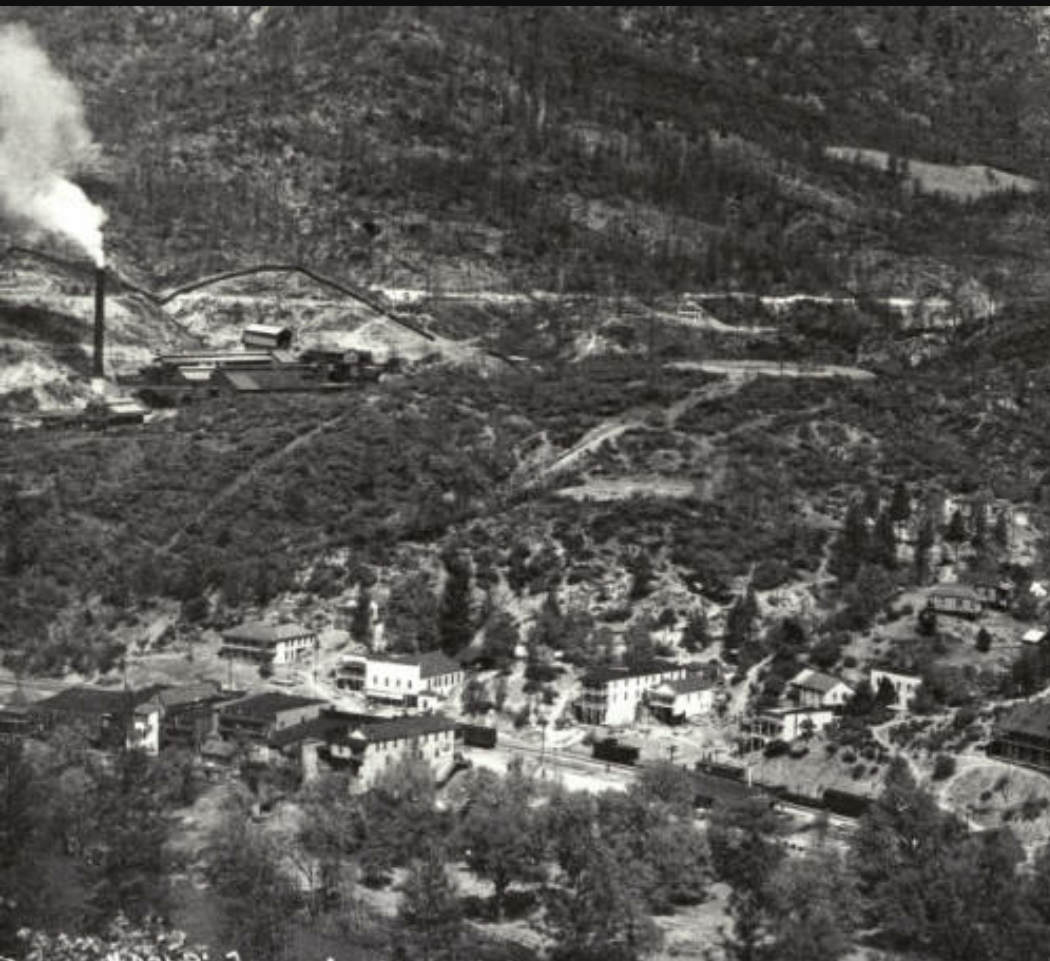
Charlie Kircher, my great-grandfather, was not the romantic figure I thought him to be, not a hardy 49er with shovel, pan, and cradle. He was a company man. The mine where he worked—the Uncle Sam mine—eventually would yield over a million dollars in ore, and one of his jobs, as a chlorider, was to separate the gold ore from the rock in which it was embedded. It wasn’t romantic at all—it was tedious, smelly, but important to an industry that could be immensely destructive: the photographs of what hydraulic mining, for example, did to the land of Shasta County are as shocking in their way as the photographs of bombed-out German cities at the end of World War II.
But it’s here where Charlie seems to have found his vocation, and it’s in Kennett’s goldfields where he set down his roots. He married a 14-year-old native Californian, Nellie Wilson, in 1894, and the couple promptly produced three children: my grandmother, Emma Martha, born in 1895, Violet, in 1898, and Charlie Jr., in 1900.
My grandmother’s earliest memory was of “a house on stilts.” I had visions of her living over the Sacramento River—I seem to 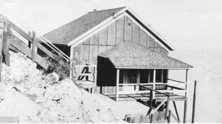 remember an urban legend that Country-Western star Merle Haggard owned a house like that over the Kern River with a trap door to facilitate fishing. That wasn’t Emma’s situation at all: her house was terrifying. It was a Company house for a Company man, built flush into the steep sides of Iron Mountain, and below the stilts is a sheer drop, seen in an old photograph, that makes it a miracle she survived her childhood.
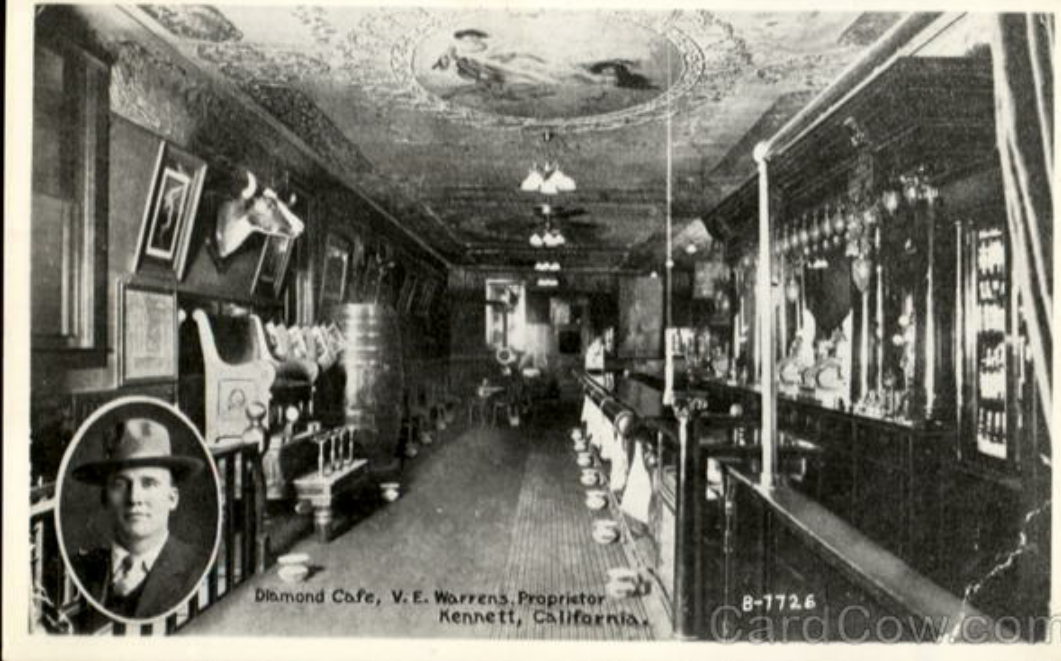
She attended a school, a little steepled building, in Kennett, which was also graced with a Methodist Church and the two-story Diamond Saloon and Hotel (V.C. Warrens, Prop.): an interior shot from a UC Davis collection shows a long bar with a militia-line of brass spittoons along the rail and an ornate ceiling with plump, gauzily and vaguely-dressed females and an attendant cherub or two for class.
Kennett was a tough town. Charlie Kircher was a tough man. The records note a “crippled right hand,” but he may have used the good one liberally. Nellie would divorce him and had remarried by 1906; although the three children would follow Charlie to Burbank in 1910, later, the youngest, Charlie Jr., would lie about his age to join the World War I Navy, quite probably to put some ocean between himself and his father.
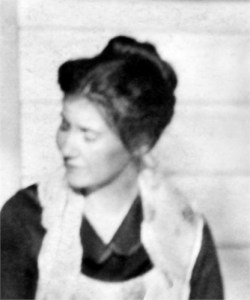
My great-grandmother, Nellie Wilson Kircher.
That’s when Charlie Kircher’s trail disappears. I can find no record of his death and my Grandmother never discussed him and very rarely discussed her early life. I never met her sister and brother.
I can pick up the thread of her life again in Taft, California, a town just over the San Luis Obispo county line that resembled Kennett in every way except for one: the source of wealth was oil, not gold.
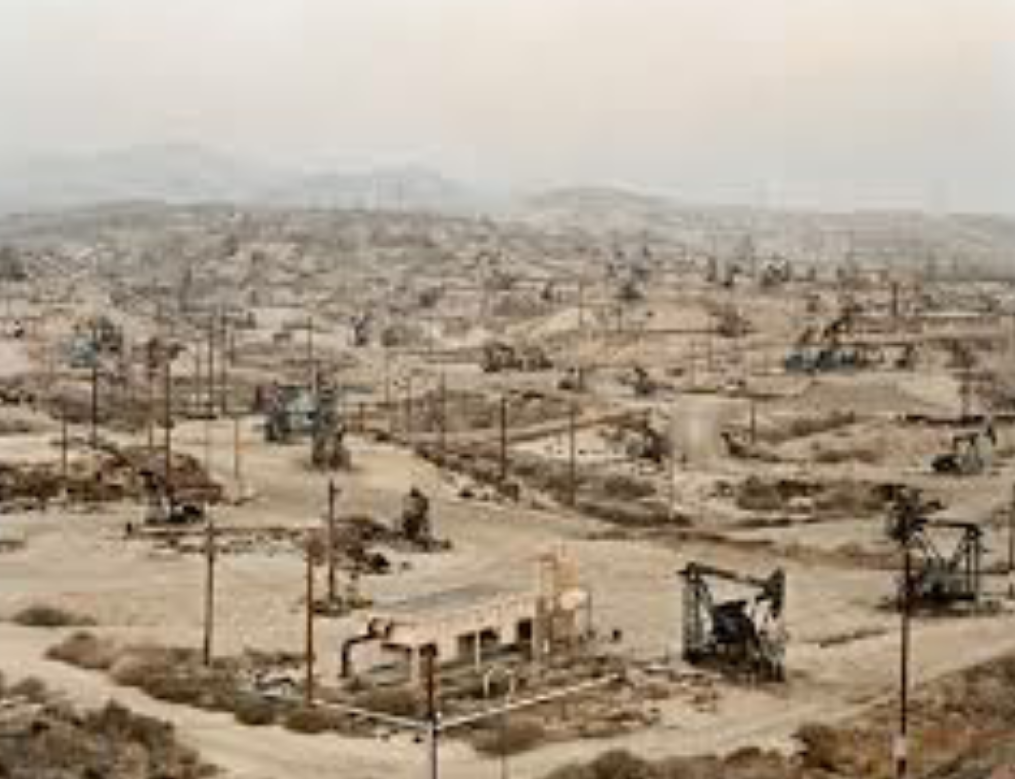
Emma Martha Kircher met my Grandfather—they’d marry in July 1920 in Bakersfield—whose job descriptions over the years more or less connect with the oil industry and also with the fact that he couldn’t seem to hold a job for very long.
There’s only one photograph of him, now missing—a handsome Irishman, Edmund Keefe, in a grand three-piece suit and a Homburg hat, his hands wrapped proudly around my toddler mother, Patricia Margaret Keefe. His eyes are fixed on her and the part of the face you can see below his hat brim is creased by a wide smile. Edmund’s father had come to North America as a Famine baby, but in a miraculous way: The Keefes’ English landlord, Lord Fitzwilliam, had paid the passage to Quebec for his starving County Wicklow tenants, an act of seeming generosity that would make my own life possible.
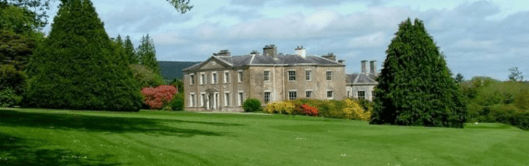
Fitzwilliam estate, Coolattin, County Wicklow
It also made it possible for Fitzwilliam to replace Irishmen with sheep–far more pliable and almost as cheap to feed.
The Keefes had farmed in Ontario and worked as migrant laborers in the Pennsylvania oilfields before the family settled and homesteaded for many years in Minnesota. Thomas Keefe married into another Wicklow family, the Foxes, so profoundly Catholic that they produced a somewhat frightening nun, Sister Loretto, who made it her life’s mission to minister to unwed mothers.
Sister Loretto, in an old newspaper photograph.
“He was a bad man,” my step-grandfather said of Edmund Keefe, and that’s about all I know of him. I know he liked to drink. I know he liked to borrow cars that didn’t belong to him, and I know that the Taft Police Department and the Kern County Sheriff knew him far better than I ever will. He disappeared in the 1920s—one version has him running off with Shell Beach restaurant owner and businesswoman Mattie Smyer.
Before she moved here, she was a whorehouse Madam in Taft. She became a restaurateur—today, Mattie’s old place is McLintock’s Restaurant. When the War came, Mattie’s contribution to defeating the Axis was a stable of girls behind the restaurant and in little multi-doored houses across Highway 101, near the sea.
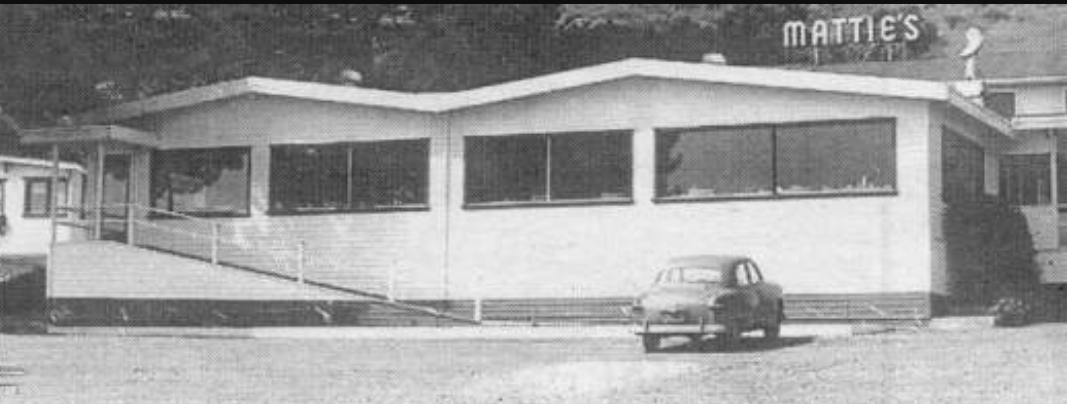
The Mattie connection was something we discovered years after, when my parents made the innocent mistake of taking Grandma to dinner to Mattie’s Restaurant for her birthday. Midway through the main course, after an epic personal struggle, her face began to twitch and she burst into tears. Much later, I found out why: Edmund Keefe may have been a bad man, but he was also, according to my uncle, the love of my grandmother’s life.
But none of us—not a private detective my parents hired, nor hours of research on my part—has ever uncovered what happened to him.
He wrote a one-act play about a young married couple, which he titled “Emmeline.” It, too, has disappeared.
So Emma Martha Keefe was a single mother in an oil boomtown and she was heartbroken. She worked as a waitress in a Taft 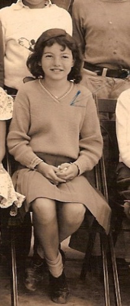 coffee shop where “extra sugar” meant a good stiff belt of Prohibiton-era Canadian whiskey—possibly landed at Spooner’s Cove at Montana de Oro–in your coffee. She and my mother lived close to the bone; their poverty is revealed in an old school picture of my Mom, a jaunty little beret on her head, sweater and pleated skirt–and that Irish smile I would grow to love so much–but her shoes are beaten and scuffed.
Emma resisted, but eventually accepted, the courting of another man, another Irishman, a Taft police constable, George Kelly, my step-grandfather, our Gramps. This man was my real grandfather. He was soft-spoken, gentle, tall and slender, a natural carpenter, gifted with children–I am so happy my toddler older son, John, got to meet him twenty-five years ago.
Gramps was a tough, too, and strong as an ox. He and my Uncle George, a big man and bigger than his Dad, used to have little handshaking contests every time they saw each other after an absence. Gramps always won: he was a bone-crusher. There’s a story of him getting jumped by three oilfield roughnecks in an alley during the 1930s, and of an assisting officer arriving at the scene to discover that Gramps was the only combatant both conscious and vertical.
It was Gramps who, at lunch one day, casually mentioned that Mattie was leaving Taft for Shell Beach, and she was putting on a big yard sale. The furniture was elegant. Grandma wouldn’t hear of it. “Not,” she sniffed, “from THAT woman.”
Later, she surreptitiously drove by the yard sale. She made a few more passes. Very slowly.
Fifty years later, when I spent the night at my uncle’s house near Sacramento, I slept on a Mattie Smyer couch in a living room surrounded by Mattie Smyer end tables, lamps, china cabinets and easy chairs. It was beautiful stuff–if one can use the word “voluptuous” to describe an elegantly curved floor lamp, then this was libido-driven furniture.
The Kellys eventually would move to Williams, in Colusa County, raise almonds, where the earliest memory I have is of falling down Gramps’s ranch-house steps. I still have the scar on my knee. I still remember the look of concern on Gramps’ face as he scooped me up in his arms.
When the pair came to visit us in Arroyo Grande, there was inside me the kind of trembling excitement a little kid feels on Christmas Eve. Grandma talked about politics, but also about Hollywood scandals–Elizabeth Taylor and Richard Burton seemed to share equal time with the Berlin Wall and the Mercury astronauts–and teased Gramps, a quiet man but a remarkably funny one, without mercy. He had learned after years of marriage how to be her straight man, Burns to her Gracie Allen. He adored her, and sometimes, in mid-needle, Grandma would stop suddenly and regard him with a smile. You could see that she had learned, after years of marriage, to adore him, too.
The only part I hated about their visits was when it came time for them to leave, and I would watch their car until it was gone, and still watch awhile after. Maybe, I must have thought, they’ve forgotten something and will have to come back.
When they retired to Cambria in a house built in large part by Gramps, then in his sixties, on a lot she’d been wise enough to buy when it was cheap, they lived quietly and putting on the Ritz consisted of going to an all-you-can-eat family restaurant off Highway 1. It wasn’t fancy. Grandma Kelly had no need for fancy. The wealth she had was in living life, in enduring unimaginable heartbreak and in enduring bleak poverty, and through all of that, she was most truly herself in those moments I caught her smiling at Gramps.
In those moments of delight, it was as if she was were five years old again but, somehow this time, her father, Charlie Kircher, was carrying her down Iron Mountain, carrying her away forever that horrific house on stilts and lifting her gently onto the back of the pony every little girl dreams of.
 A Work in Progress