• About
  • The Germans

A Work in Progress

A Work in Progress

Category Archives: Teaching

Huasna Road spirituality

09 Saturday Jan 2016

Posted by ag1970 in American History, California history, Family history, History, Personal memoirs, Teaching

≈ Leave a comment


1929425_1124481235982_1907209_n

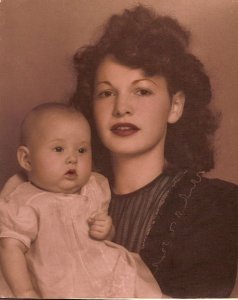
Mom and Roberta, 1943


I think about my Mom a lot in January, the month when she was born, and in March, the month when she died. She never said any of the things below, but I decided to try to say them for her as authentically as I could. What lessons did I learn from her when I was a little boy?  I decided on ten. I’ll never get the wording exactly right, and I’ll never be able to articulate all the lessons, because so many of them were nonverbal and taught by example. Ours was not a peaceful home, nor was it always a happy one, but there were times when my mother’s parenting was, as I think about it more than fifty years later, actually quite inspired.


Ten Lessons

  1. Each of our lives is tuned differently, so each of us produces a different tone. It’s the melodies that please God most.
  2. Books, and music, and ideas, and politics, and God, and talk. That makes this place, five thousand miles away from Ireland, an Irish house.
  3. You young people might be all right after all. Ringo makes me think so. He looks just like a Basset hound!
  4. Faith is stronger when it’s tempered by doubt. The men they tried at Nuremberg were True Believers.
  5. Those people working the pepper field over our pasture fence don’t look like us, and they don’t speak our language. How lucky we are to have them so close.
  6. You’re the one that burns a little hotter than the others. I need to be patient because I love you.
  7. We owe the poor our love and respect; we owe the rich prayers for good eyesight. It’s so hard to see a carpenter’s son planing His father’s wood from the great heights that they inhabit.
  8. There is no forgiving intentional cruelty.
  9. I will raise singular daughters and honorable sons.
  10.  Life inflicts terrible wounds and unbearable pain. Just hang on. If the pain continues, just hang on. A time may come when you need to let go of it. Say goodbye with love.

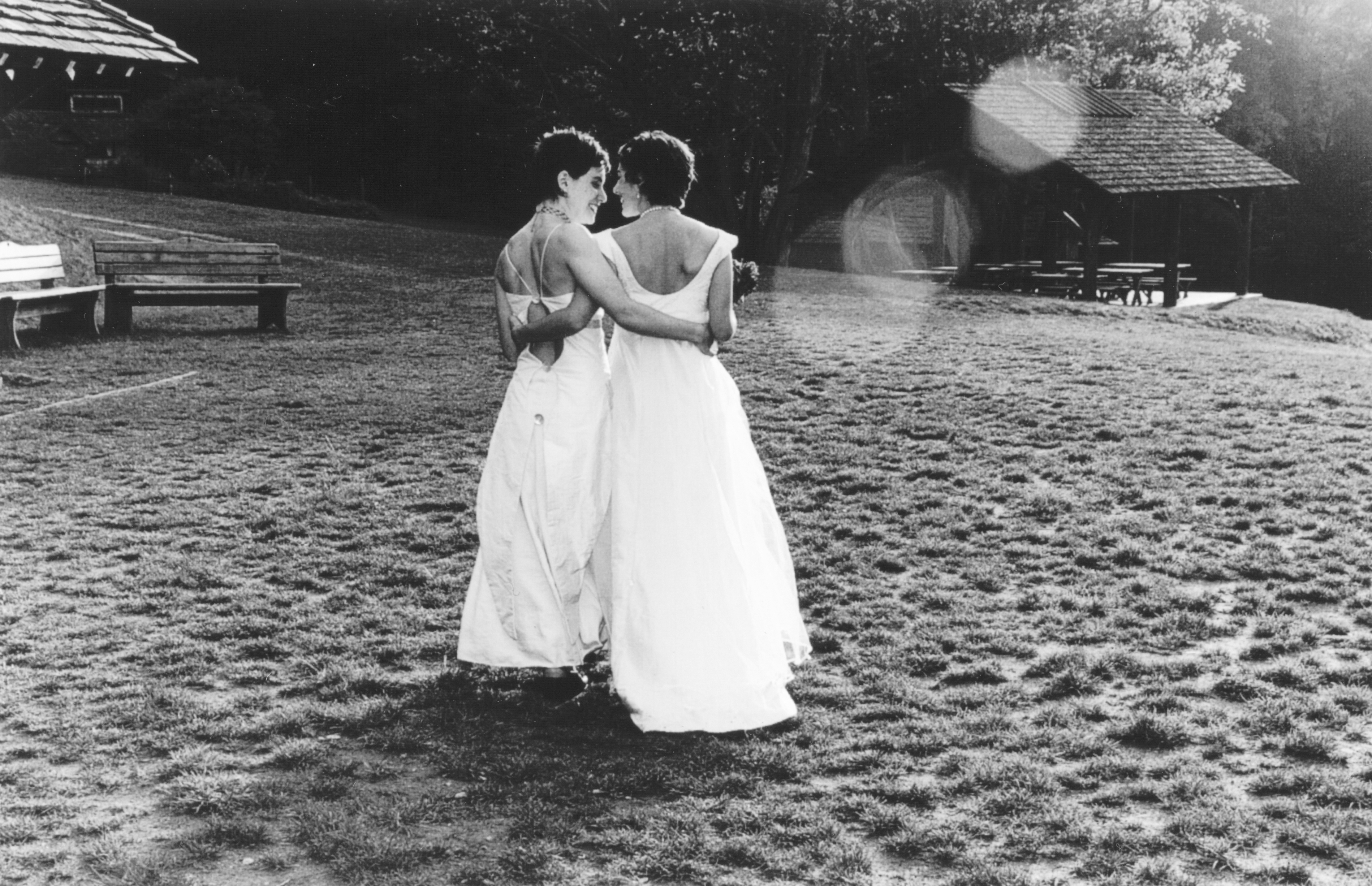
Two brides.

05 Tuesday Jan 2016

Posted by ag1970 in Family history, News, Teaching

≈ Leave a comment

2-brides-wedding-style-page

I’ve been seeing a lot of this in recent years on Facebook: a former female student gets married. To another female. So I guess I’ll keep this as a link on Facebook, rather than a direct entry, to avoid the stone-throwing.

But, again, you’re dealing with my Irish mother’s son, and she’s the Irish mother who loved God with her mind as much as her heart: she amazed priests, to the point of devastation, with her knowledge of theology. Her first prime directive, similar to Christ’s, was that love is a gift from God. From that flows a corollary: To love another human being is the most terrifying leap anybody can make, and to have the courage to commit yourself to the leap—both to the letting go, and to the hanging on on the other side—is the most perfect gift a person can give back to God.

So seeing those photos of young women who’ve made that commitment has a deep impact on me. The photos show two young women who are happy.  So they make me happy, too.

These young people, just starting new lives together, don’t need my blessing. I don’t have that kind of power, and that’s not the point I’m trying to make. I can only tell you–please forgive my forwardness–that I love you and I am very proud of you. You have reciprocated God’s greatest gift. And no stone can wound the strength in two people united together.

Before you throw yours, if you’re infuriated by my impious linkage of God with same-sex marriage, wait and listen quietly to discern whether condemnation—when you might be as confident in your faith as the Sanhedrin was in its faith when it arrested Jesus—is really what God desires. I believe from the bottom of my heart that She has a surprise for you.

A Tudor woman? No thank you.

02 Saturday Jan 2016

Posted by ag1970 in History, Teaching

≈ Leave a comment

wolfhall314
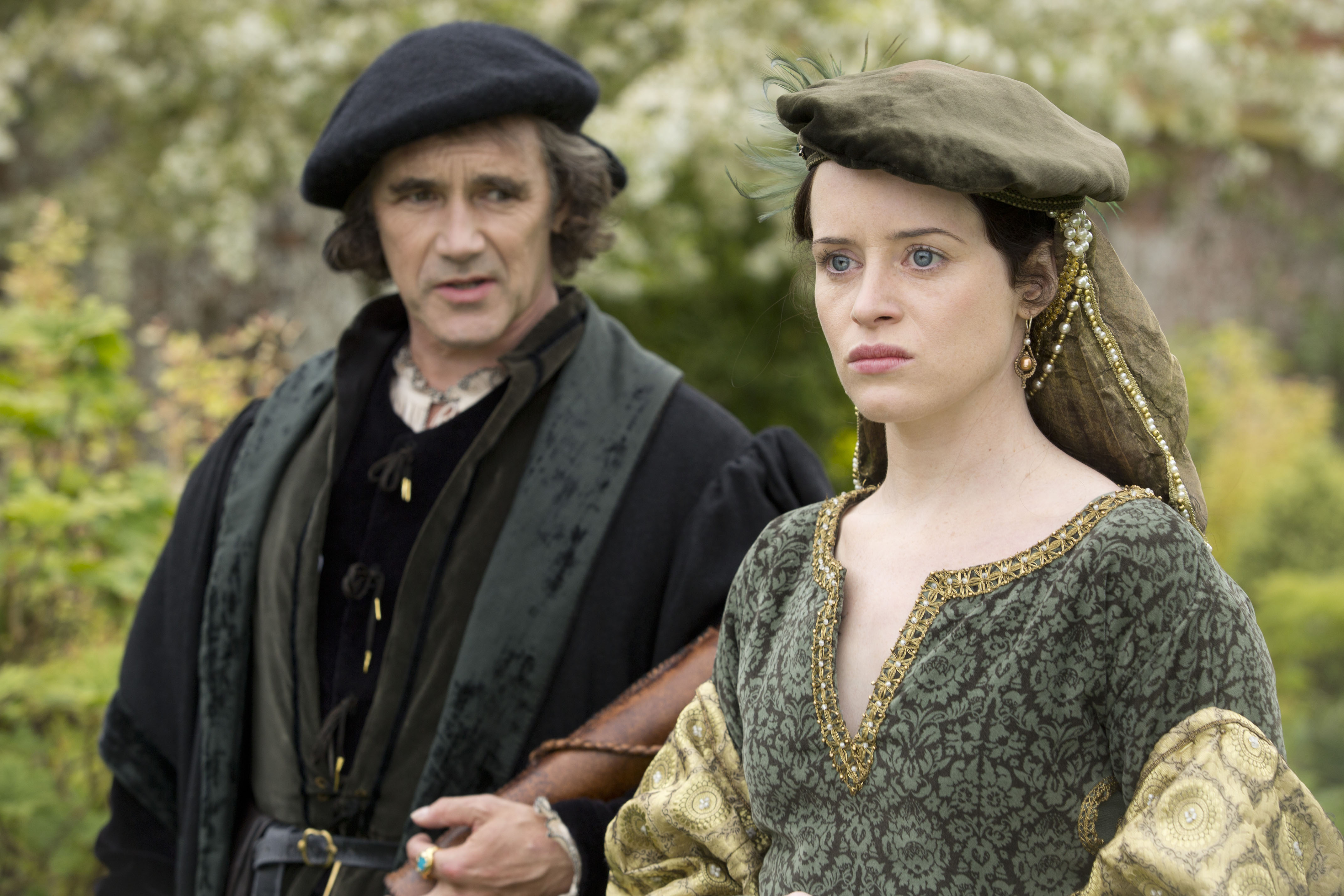
Mark Rylance, as Thomas Cromwell; Claire Foy as Anne.


It took Anne Boleyn to help me to understand why I cringe when Donald Trump asserts that he “cherishes” women. Henry VIII cherished Anne, and that diminishment is what made killing her so much easier for him.

I thought about Anne recently while watching PBS’s Wolf Hall, based on the wonderful Hilary Mantel novels, whose protagonist is Henry’s minister, Thomas Cromwell.

One of my favorite lines–Cromwell’s, and typically, it stings–involves Anne’s alleged lack of cleavage. There’s an exchange between him and Jane Boleyn, when Cromwell asks Jane, who has little love for her brittle sister, if Anne and Henry’s love has been consummated.

Not yet, Jane tells him. But Anne allows Henry to kiss her breasts.

A pause. Just a slight one.

“Good man if he can find them,” Cromwell replies, and exits.


* * *


Henry wrote about them in his love letters. He refers to Anne’s breasts as “pritty Duckys” in 1533, three years before he has her executed.

There was, by the way, bad weather in the Channel that day. Anne had prepared herself to die, only to be told the superb French executioner, her husband’s parting gift, was delayed. She had to do it all over again the next day, when he arrived and she departed.

She did so with immense courage.

Her grave is beneath the altar of St. Peter ad Vincula—I’ve taken students there–within the Tower of London, only a short walk for her ladies-in-waiting, who brought her coffin down from the scaffold, once they’d carefully wrapped Anne’s head and body in damask and reunited them inside. In reality, it wasn’t a coffin. It was a chest for storing bow staves, originally bound for Ireland to kill humbler subjects there.

It’s hard to hate Anne, with her being there the way she is. It’s such a tiny grave. So was her neck, she remarked with a laugh before the execution. Her alleged lovers, including her brother, were buried at the other end of the little chapel, and their bones now are intermingled there, as if they finally were co-conspirators, after all. But the Boleyn family was evidently a piece of work: arrogant, ambitious, tone-deaf–-much like the Greys, who beat Lady Jane all through her growing up–-they boxed her ears, punched her, flailed at her legs with a birch rod, and then they got her beheaded, still a child, in the name of their own ambition.

I would not have chosen a life as a noblewoman, I remember telling my students. The lives lived by the wives of peasants or tradesmen, I think, were in many ways more substantive: the executions, disinheritances, serial affairs, and the emotional and physical abuse so prevalent in Henry’s circle set noblewomen apart from most English women, who could count on the smallness of their rural villages for protection.

One example. No pregnant girl was left bereft. There are virtually no illegitimate births in rural England in the sixteenth century. There are plenty of marriages recorded in parish registers that produce issue in the christening books four months later. [Anne herself was heavy with Elizabeth when she finally married Henry in a midnight ceremony.] Young men, anonymous to us, were held accountable for their actions; we can’t even hold a famous man, Trump, accountable for his words.

No woman’s life was easy. But the lives of women like the Boleyn sisters or Jane Grey had such cruel edges. Their personal power was cleaved as decisively as if they’d all gone to the block.

Meanwhile, Henry’s love letters are in the Vatican Library, which seems a waste. So does his life: all the statecraft, the parsimony and the ruthlessness of his father, Henry Tudor, was wasted by Henry VIII, a soft, self-indulgent man, in the single-minded pursuit of a son of his own.

Neither Trump nor Henry, so often true of soft, self-indulgent men, show evidence of a sense of humor, so the irony would have eluded them: within Henry’s court, in her little petticoats, there was Anne’s red-haired toddler daughter, who would become twice the king her father ever hoped to be. Donald, just as oblivious as Henry was to an obviously gifted daughter, has opined, creepily, that he would date his if their lives had been different.

There’s a scene in one segment of Wolf Hall where Henry holds Elizabeth in his arms. He is enchanted, but only momentarily. Mistress Seymour catches his eye, so Henry abruptly hands the little girl off to her governess. Damian Lewis, who plays Henry, is such a good actor that you can see the king forgets his daughter in the instant he loses physical contact with her. Meanwhile, Jane might burst into flames, so intense is his focus.

I think that’s why Cromwell is so appealing in Wolf Hall. Henry’s self-absorption, like Trump’s, is suffocating, so Cromwell’s competence, which is so unlike Trump, is like a candle that won’t go out. Not yet.

Jane Seymour finally gave Henry the son he wanted, only to die after the little boy’s birth. She was another female sacrificed for her king. Henry was heartbroken. Of his six wives, Jane was the one he cherished most.

Of course, little Elizabeth would grow up to decide that she would never marry. There’s no mystery in that at all. She’d grown up in a world dominated by vain and powerful men like her father. There was nothing they had that she wanted.


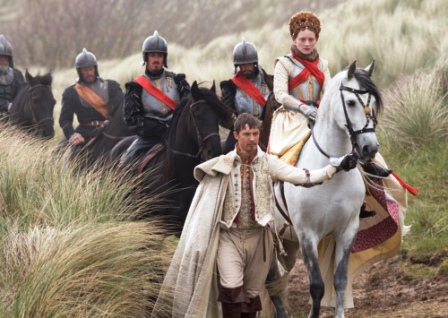
DuffontheroadtoTilbury

Anne-Marie Duff as Elizabeth, Tom Hardy as Leicester, as she approaches Tilbury to speak to her troops, assembled for the Armada invasion. Duff’s delivery of the speech is, I think, pitch-perfect.

Thinking about Umpqua

03 Saturday Oct 2015

Posted by ag1970 in Teaching

≈ Leave a comment

Tags

education, school shootings, teachers

10462813_10204064704081643_4755616275869953070_n

This is very difficult for me to share–and probably it’s just me. I need to share it in case it’s not.

All teachers, myself included, have confrontations with students. [We don’t sleep that night. At all.] When that happens, you wonder, somewhere in the back of your mind–fleetingly, because mostly you think about how badly you screwed up and how you could have handled the situation so much more effectively–if you’ve turned yourself and your kids into the next victims.

You don’t think about it every waking moment, but you certainly do when you lock the doors, close the curtains, and get them quiet for yet another lockdown drill.

And it’s not so much dying that you think about: it’s dying in such an apparently meaningless way.

I can’t imagine that my teachers ever had thoughts like mine. I also can’t imagine, with this added to the absurdity and the weight of all the expectations placed on teachers today, why any young person would want to become a teacher.

In the last few years, in the mandated anarchy of No Child Left Behind, which involved teaching to the test, and then The Common Core, which involves a curriculum of great enrichment (Not for students. For the textbook publishers who designed it),  it was the kids who saved me and my career. They kept me going.

But the shock–and, paradoxically, the monotony– of school shootings is a reality that teachers have to think about every day, and it’s poisoning our nation at its most important juncture: in the classroom, where adults and young people are supposed to be in partnership, where they are to work together to ensure that the nation has a future.

I always worked, very purposefully, to make my classroom safe for the students I loved to teach. I think I taught with high expectations, but I also wanted them to have a place–a place that belonged to them–where they would find humor, kindness, and acceptance. But neither my classroom, nor any classroom today, is a sanctuary. Not anymore.

The American Girl

20 Sunday Sep 2015

Posted by ag1970 in American History, History, News, Teaching

≈ Leave a comment

Tags

Muslim-Americans

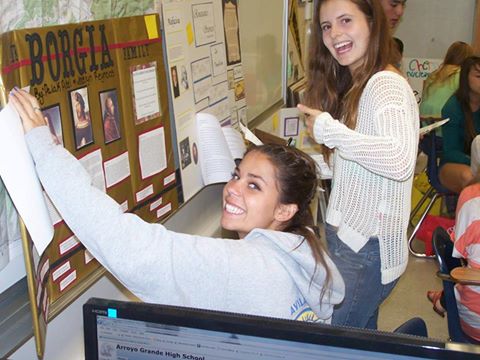
11890959_910767205680284_601602604436695615_nWhen I retired from teaching last year, it was time. I hadn’t lost my love for young people, or for teaching, but I couldn’t think of a better graduating class for my goodbyes than the Arroyo Grande High Class of 2015.

One of my very favorites—she’s just starting her freshman year at Poly—is named Leila. The smile you see on her face is a constant: she radiates the kind of warmth and openness that captures others, but there is nothing calculated in the capturing. Leila’s smile comes from Leila’s heart. At the end-of-the-year Senior Assembly, she gifted me with a farewell bouquet. She was fighting tears, and seeing her struggle to master her feelings was an even greater gift. It’s good to know the love you’ve spent means something to someone so important.

I have rarely read a college letter that brought me to tears, but Leila’s did. One part told of her family’s trip to Egypt, to visit her grandmother. I saw photos of the woman and she has a kind of Leila-ness about herself, as well.  You wonder if there are applications you can send for to become her adoptive grandson. Her health has not been good. She had to have surgery, and the passage I remember is when Leila volunteered to change the dressing on her wound. Her grandmother apologized for its appearance, but Leila did not hesitate and did not flinch, and I don’t think anything so clinical has been done with such gentleness and compassion.

The experience only reinforced Leila’s dream to become a doctor. We have common heroes–Doctors without Borders—and I could easily see Leila doing their work. I immediately thought of her while listening to an NPR story about a doctor who lost 19 of the first 20 patients he’d treated for Ebola in West Africa. It was heart-breaking, but this doctor was a man of spiritual depth. “Curing disease isn’t the most important thing a doctor does,” he said. “The most important thing a doctor can do is to enter into another’s pain.” Leila has that kind of empathy and she has the spiritual strength to sustain it.

I will come to the obvious part. Leila is an observant Muslim, and as captivating and welcoming as her smile is, there are those–some have been in the news lately–who are blind to kindness because it’s so threatening to the comfort they find in hating. Leila can take care of herself–she gets those reservoirs of strength from the deep wells her family has made for her–but she also is the kind of student who can provoke every paternal instinct a male teacher has.  You want to protect her from the blind and the bigoted who also have the unpleasant tendency to be loud.

The comfort is knowing that those people do not matter and have no enduring impact, unless you count, of course, the agonizing depth of the pain God feels when they broadcast their hatred.

I gained a lot of wisdom by talking to Haruo Hayashi in researching a book I’m writing about Arroyo Grande during World War II. In 1942, his family was among those interned Japanese-Americans who slept in stinking animal stalls at the Tulare County Fairgrounds; they were then sent to the remote Rivers Camp in the Arizona desert, where the hot winds, carrying the spores for Valley Fever, began to kill their grandparents.

When I visited the Hayashis, I saw three generations of a family whose bedrock is hard work relaxing on a Sunday, watching television, reading, raiding the refrigerator, and all of them were present, were living in the moment, and the devotion you sensed among them was unforced and unpretentious, which only made it more powerful. Haruo’s extraordinary wife, Rose, was dying. Her son, Alan, remained at her side, attentive but respectful and unobtrusive, his love for her a mirror-image of the love she’d always given so selflessly.

Haruo went through, after Pearl Harbor, the kind of bigotry that I fear so much. But, while the bigots were loud and threatening, they do not matter to him 75 years later. They were small people whose names he’s lost. He hasn’t lost the names of Don Gullickson or Gordon Bennett or John Loomis, constant friends whose constancy has lasted four lifetimes. He smiled when he remembered another name, of a tough classmate, Milton Guggia, who told Haruo he would personally beat the living crap out of any kid who called Haruo a “Jap.”

Milton Guggia. That’s a real American name.

As is Leila’s. She’s the girl who went to Proms, who served on the ASB, who played Powderpuff Football, who participated every year in Mock Trial, who played in the school band. Haruo played in the school band, too. And you can see him in a yearbook photo with the 1941 AGUHS Lettermen’s Club–his bad eyesight ruled out sports, but he managed for every team and earned his spot, with all the jocks, right next to Coach Max Belko, the kind of big, boisterous and indestructible coach whom every kid idolizes.

He was destructible, it turned out. Belko, a Marine lieutenant, died on Guam in 1944.

But there, and forever, in the old yearbook, are Max Belko and Haruo Hayashi, shoulder to shoulder: two real Americans. Leila—and Leila’s marvelous family, so much like Haruo’s—are no different. Their fidelity to each other, their quiet insistence on hard work and service to others, and the openness of their daughter’s heart–all of these have been blessings in my life. They are, I think, the kind of Americans we would all wish to be.

What do you say to a bunch of Rotarians? Mr. Gregory Speechifies.

20 Thursday Aug 2015

Posted by ag1970 in American History, California history, Teaching, World War II

≈ Leave a comment

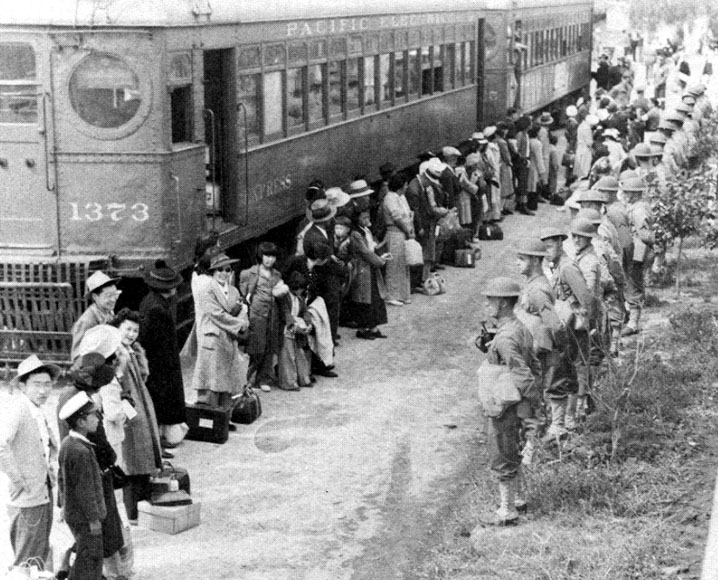
Santa Anita internees, bound for Gila River.

Santa Anita internees, bound for Gila River.

I would like to thank you because I have retired and I need you badly. Today is the first day of school, so this is the first day in thirty-one years that I have not been there.

I have not quite made it to the happy retiree place yet. I am suffering withdrawals: I get weepy when I go into Office Max because I am now irrelevant to back-to-school sales.

After thirty-one years, I can honestly say that I still loved teenagers and loved teaching them. Some people would suggest that I am mentally ill. That is a possibility.

Since that is a possibility, I am going to pretend that you are my designated sophomores. Welcome to Mr. Gregory’s history class!

As a student, my first class came just before Alaska became a state, and, although I cannot say the same about Alaska, I have never regretted that class. I went to the two-room Branch School. Actually, three rooms. One room held grades one through four. The second held grades five through eight. There was a hall in the middle where you hung your coat and where our two teachers motivated us with yardsticks.

I loved growing up here, despite the contusions, and so I had the idea to write a book about my hometown’s experience in World War II, and it found a publisher. It should go to press in November.

I had no idea how many stories a town of 1,090 in the 1940 census would yield. I don’t have time to tell them all, even though I am a history teacher and would certainly like to take that time.

I would like, with your permission, to briefly address three aspects of the war.

–First, I need to talk about what happened immediately after Pearl Harbor because those events impacted the lives of some of my best friends and some of your best Rotarians.

–Second, I’d like to give you a sense of what Camp San Luis Obispo was like during the war. At least eight different divisions—about 15,000 men each– trained here during the war, and they fought in the Aleutians, the Philippines, New Guinea, Normandy, Holland and Germany.

–Finally, I want to introduce you to a young Marine from Corbett Canyon who fought on a desolate place called Iwo Jima.

Before I tell my stories, one more point.

You are not required to like my presentation. The world is populated in part by sad people.

If by chance, you do, then the teaching I’m going to attempt today like is the teaching your children and grandchildren get every day in Lucia Mar schools.

There are Doctors of Education—a degree open to anyone who can write obscure English and collect sufficient Froot Loops boxtops—who are trying every day to confine teaching to a narrow belt on a silent assembly line. This is what we call standardized monotony.

Despite that, most Lucia Mar teachers are much like me. We are passionate about what we do. It’s not a job. It’s our calling. And our thirty-five seats are not filled by abstract manipulatives. Those are our kids. Even if we teach them for only a year, they are, and always will be, our kids, too.

* * *

On December 8, the students of Arroyo Grande Union High School gathered in their new gymnasium—a New Deal WPA work project that is today’s Paulding Middle School gym—to listen to Franklin Roosevelt’s brief but dramatic address asking Congress for a declaration of war.

Haruo Hayashi, a sopohomore, was recovering from an appendectomy when that message was broadcast. He dreaded his return to school a week later. He had no idea how he’d be received.

But nothing had changed his best friends: John Loomis, Gordon Bennett and Don Gullickson. Two of them would later fight the Japanese, but they also would write Haruo letters posted to his desert internment camp. The classmates who called Haruo a “Jap” are so unimportant now that he has forgotten their names.

But two weeks after Pearl Harbor, the war arrived offshore. Verna Nagy, a young Shell Beach resident, was looking out her picture window for a picture-postcard view of the Pacific, when the shaft of a submarine’s periscope appeared. She might have preferred the spout of a migrating gray whale instead.

 A local cattlewoman, on volunteer shore patrol between Port San Luis and Estero Bay, said she saw the sub surface. She let fly with her 30-30 carbine. The range was too great, she said later, but she had the satisfaction of seeing the crew scamper below and the captain dive the boat.

They’re plausible stories. On December 22, A Japanese submarine, I-21 had, fired a torpedo that missed its target, an oil tanker, off Lompoc. The sub headed north, along our county’s coast, in search of targets of opportunity.

I-21 found one in the little tanker Montebello off Cambria, but this time, the result was more satisfying: at 5:45 a.m. on December 23, the sub fired two torpedoes and this time one hit; I-21 surfaced and opened fire with her gun. Its report could be heard inland by residents of Atascadero, 26 miles away. The crew escaped, but Montebello went under 45 minutes after the attack began.

Within weeks, I-21 was patrolling the coast of Australia, would later shell Sydney Harbor, and would be lost with all hands near Tarawa in 1943.

So the surreal shock of Pearl Harbor, followed by the submarine attacks just off the coast, generated fear that outweighed reason. In 1942, Japanese I-boats sank four ships off the West Coast.

At the same time, German U-boats sank 70 ships off North Carolina’s Outer Banks alone. Americans from Coney Island to Miami Beach could watch as doomed American merchantmen and their crews burned offshore.

Nevertheless, it was time, some began to say, to get the Japanese out. The President of the United States, despite the strenuous objections of his own attorney general, agreed.

So, in April 1942, South County Japanese met waiting buses at the high school parking lot on Crown Hill. There was a poignant moment when the Women’s Club brought box lunches for their neighbors to take with them.

The loaded buses then would’ve crept down Crown Hill in low gear, on their way to the two-lane 101 on the western edge of town. Their passengers were crammed inside with their luggage crammed in the bellies of the buses and lashed to the roof racks.

They had to run a gauntlet, along Branch Street, of familiar places: E.C. Loomis and Sons, the Commercial Company market, F.E. Bennett’s grocery, Mr. Wilkinson’s butcher shop, Buzz’s Barber and Beauty, the Grande Theater, the Bank of America and finally, the twin churches, Methodist and Catholic.

The Nisei children and teenagers who grew up here, who had never known any other place, did not know whether they would ever see these places again. Many of them wouldn’t.

As to teenagers, there were 58 seniors in the high school Class of 1942. Twenty-five of them were of Japanese descent, so their carefully-posed senior photos bear no autographs. The yearbook came out in June. Those seniors were gone.

Just past the churches, the drivers, with their silent passengers, turned north to make the connection for the long, colorless journey into the San Joaquin Valley. They would sleep that night at the Tulare County Fairgrounds, in animal stalls that smelled of manure.

Tulare was temporary: an “assembly center.” Gila River, officially known as the Rivers Camp, would house most Arroyo Grande Japanese for the duration in the desert south of Phoenix.

Haruo Hayashi remembered the heat, which hit like a hammer-blow. Families would order swamp coolers from the Sears catalogue, which did little to help.

What Kaz Ikeda remembered was the dust. The desert winds generated terrific dust storms that hid the sun and the dust, sharp and gritty, permeated everything: bedding, nostrils and ears, the floors of the barracks, which required endless cycles of sweeping, and even the internees’ food. The dust would begin to kill older people, as well, who were susceptible to valley fever, whose spores came with the hot desert winds.

When Kaz tried to form a baseball team, it was the wind that destroyed his best efforts. Most of his players were Buddhist, and, as their parents began to die, many from lung disease, the sons observed the traditional 49 days of mourning and prayer. As a result, Kaz lost his first-string pitcher and then a catcher. Kaz’s father, Juzo, paralyzed by a farm accident, told his son that when he died, Kaz could go ahead and play the following week.

When Juzo did die, in 1943, Kaz left to top sugar beets in Utah and began to put aside a little money. Ben Dohi went to college in Missouri. Haruo Hayashi joined the 442nd Regimental Combat Team and discovered, when he tried to use the colored men’s latrine at Camp Shelby, Mississippi, that he was a white man.

By the time the camp closed in fall of 1945, only old people and children remained.

The young people who had left may have saved themselves in ways they couldn’t have foreseen. Kaz would live to be 94. Haruo, who lost Rose, his remarkable, generous-hearted wife, this summer, still lives on the Hayashi farm. Ben Dohi lives on land now farmed by his two sons.

Getting out may have been key to their long lives, because many internees would lose their health as well as their freedom. A 1997 study revealed that internees had a rate of a cardiovascular disease twice that of the Japanese-Americans who lived in the interior and so escaped internment. Many of them experienced the symptoms of post-traumatic stress syndrome, including flashbacks.

The impact of the camps would extend into the third generation, or Sansei: whose parents commonly refused to discuss the camps with their children, and this contributed to a family dynamic fraught with tension and with shame. The Sansei felt intense pressure to assimilate, which in turn generated a sense of emptiness, a loss of cultural identity, and an even more intense pressure to succeed in school and beyond—which most of them did.

Juzo Ikeda’s life had been a successful one, too, marked by hard work. But his workplace had been beautiful—green hillsides, fields of black earth and, in the distance, above the ears of his team of horses, he could see shimmering white sand dunes. He could smell the sea. In coming to America, he had set himself and his sons free.

But when death came for him, Juzo was in a makeshift hospital in a barren desert camp. He died not long after asking his son to remain loyal to the nation that had made them prisoners.

Going into the Dark: Why I Teach (and Study) the History of War

22 Wednesday Jul 2015

Posted by ag1970 in American History, California history, Teaching, World War II

≈ Leave a comment

Tags

education, Verdun, Warfare

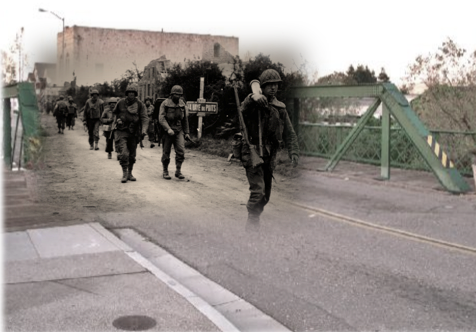
 Cover Art concept

I’ve just retired. I taught history for thirty years, and I never, never ceased to get angry when I taught Verdun, for example. The bones in the ossuary there belonged to boys like my two sons, whose parents applauded at their first steps or who cheered when they scored their first football goal. I made it my business to make my kids understand that, and so I needed to lead them into dark places, like Fort Douaumont at Verdun, a place so dark that it swallowed the light of five hundred years of Western culture.

To go inside Douaumont, to study war, does NOT mean we glorify it. Two years ago, a student told me the First World War was her favorite unit (Not mine. I much prefer La Belle Epoque.) I asked her why in the world it was her favorite, when I felt so much despair in teaching it. She replied: “Now I understand how precious human life is.”

She understood precisely why I became a history teacher.

I am now under contract to write a book about my little California farm town’s participation in World War II. That is our bridge in the photograph’s background, and one of our young men died with the soldiers superimposed on the photo, from the 79th Infantry Division.

In the process of writing this book, something extraordinary has happened within me–within my heart: The more I research these young men of my father’s generation, the more they become my sons.

Through no one’s fault, they’ve been mostly forgotten. It’s my job, as a writer and teacher, to name them and to reclaim them for a new generation. When we come to know them, we are granted the chance to embrace them, and maybe that is the force that will carry us a small step further along in our evolution.

The great Jesuit theologian and anthropologist,Pierre Teilhard de Chardin,, believed that we have a divine gift: we can evolve spiritually as well as intellectually and physically. I believe he is exactly right.

But I believe also that we cannot advance if we leave behind the boys and men I’ve met, the casualties of war. Their lives were, and are, precious, and if they could somehow save other young lives, I think they’d do it in an instant.

A North Vietnamese soldier-poet wrote that “the bullet that kills a soldier passes first through his mother’s heart.” If the young men I now know could somehow spare other mothers the pain theirs went through, then I think they would do that in an instant, too.

It is our responsibility to confront and understand the horrific violence that took their lives. I now know a farmworker who died in a Norman village called Le Bot, a B-17 crew whose ship was blown apart over the Pas-de-Calais, a Filipino mess steward–the only rating allowed him in a segregated Navy–who was lost with his destroyer in the waters of Ironbotttom Sound, off Guadalcanal.

These young men lit a path, in dying, for the living to follow. If we ignore them, we will lose the path, and the dark will have won, after all.

The Not-so-Long Goodbye

09 Tuesday Dec 2014

Posted by ag1970 in News, Teaching

≈ Leave a comment

10406775_10205398047814403_3499575547574663110_n

I had the first big wave of Reality hit me today while walking from the school library back to my classroom, during the passing period, walking through the kids with about five different “Hi, Mr. Gregorys” and one hug along the way.

It was Imminent Retirement Student Withdrawal Anxiety.

I don’t want to sound like Maria traipsing through an Alpine meadow–I rooted for the Wehrmacht in that movie–but thirty-two years ago I sat down in Cary Nerelli’s class at Morro Bay High–after years of aimlessness, numbed from some of life’s body blows– to observe for a Poly education class, and I instantly knew this was where I belonged. Now I’m 63, and this year, like every other, I have to fight the urge to blurt, “Do you have any idea how much I love you?”

We teachers deal with hope and potential, we heal heartbreak, and we take our students to places they’ve never seen–most of those lie inside themselves–and thirty years have failed to blunt the excitement I felt my first day of student teaching, when the kid with the curly hair asked me if I knew my hands were shaking, and the kid in the back complained that my handouts weren’t hole-punched.

“Punch your own damned holes!” I replied.

We got along fine after that. And we have ever since.

10838041_10205398048654424_7516305212924230169_o

Image

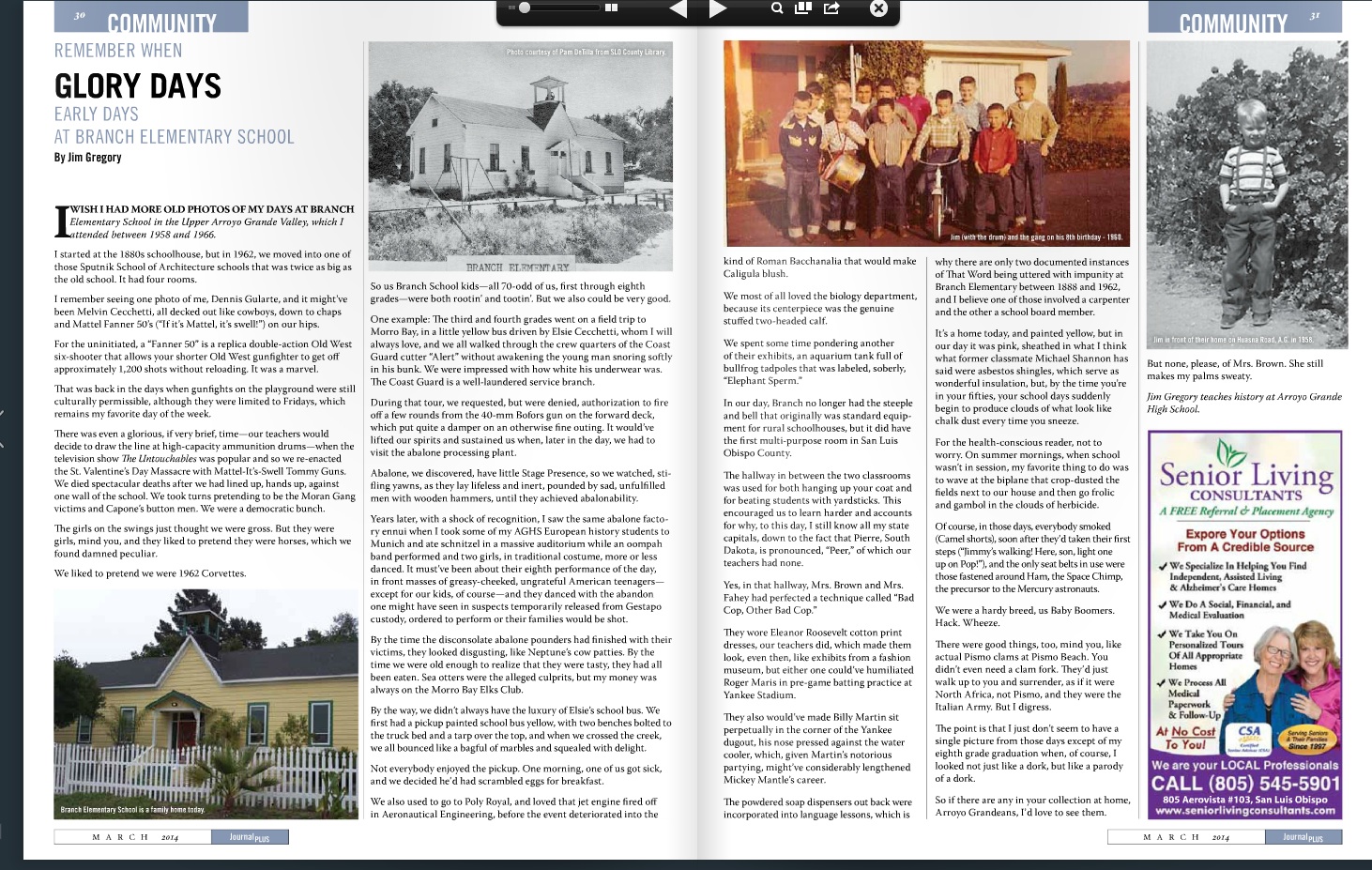
Branch Elementary, from SLO Journal Plus magazine

23 Saturday Aug 2014

Glory Days at Branch Elementary

Posted by ag1970 | Filed under American History, California history, Personal memoirs, Teaching

≈ Leave a comment

Dear Future

16 Saturday Aug 2014

Posted by ag1970 in Teaching

≈ Leave a comment

Amanda, Alaiana, Andrea, Tessa, Madi.

Amanda, Alaiana, Andrea, Tessa, Madi.

Dear Amanda, Alaina, Andrea and Tessa,

I love Madi, too, but this message is for the Class of ’15. I wish we could squeeze Leila in here, too, but she and I already had a chat sort of like this one.

I need to have it with you four, too, because, part of being Irish is going through life certain that a meteor will land on you and squash you flatter than a bug at any minute, so I’d better get this said.

You are now seniors. You are reminded to see me for a good letter of recommendation because I write a dilly.

I know I’ve stuff like this before, but I am 62, dammit, and we repeat ourselves, and it doesn’t matter, anyway: good things bear repeating, because so often in life all we hear is what we did wrong.

I have been teaching for thirty years and have taught some extraordinary young women, but I have never encountered a group—a combination of talent, intelligence, grace and determination—like you four and Leila.

I took great joy in being your teacher, and when Andrea invited me to the Progressive Dinner last year, it was one of the best parts of the entire school year (not to mention getting to hang, even if it was in a stupid school van, whose seat belts I never did quite figure out, with such beautiful young women.)

I think I’ve mentioned that I really, really wanted a little girl, but the Lord opted for boys, and if one of ‘em’s gonna be a priest, that shoots a rather large hole in any potential for granddaughters.

But that’s okay, because I think so highly of you five, and have so much affection for you—my heart gets all squishy—that you are kind of like the daughters I would have wanted to have: you are young women of great character, and it is my fond hope that you and your (female) peers will take over this country and, for once, run it right.

This has been your Official Senior Year Pep Talk, and it comes from someone who loves you all very much.

That is all. Class dismissed.

 JG

Tessa and Leila.  Leila's mother, by the way, from Egypt makes Killer baklava.

Tessa and Leila. Leila’s mother, by the way, makes Killer baklava.

← Older posts
Newer posts →

Subscribe

  • Entries (RSS)
  • Comments (RSS)

Archives

  • January 2026
  • December 2025
  • November 2025
  • October 2025
  • September 2025
  • August 2025
  • July 2025
  • June 2025
  • May 2025
  • April 2025
  • March 2025
  • February 2025
  • January 2025
  • December 2024
  • November 2024
  • October 2024
  • September 2024
  • August 2024
  • July 2024
  • June 2024
  • May 2024
  • April 2024
  • March 2024
  • February 2024
  • January 2024
  • December 2023
  • November 2023
  • October 2023
  • September 2023
  • August 2023
  • July 2023
  • June 2023
  • May 2023
  • April 2023
  • March 2023
  • February 2023
  • January 2023
  • December 2022
  • November 2022
  • October 2022
  • September 2022
  • August 2022
  • May 2022
  • April 2022
  • March 2022
  • February 2022
  • January 2022
  • December 2021
  • November 2021
  • October 2021
  • September 2021
  • August 2021
  • July 2021
  • June 2021
  • April 2021
  • March 2021
  • February 2021
  • January 2021
  • December 2020
  • November 2020
  • August 2020
  • July 2020
  • June 2020
  • May 2020
  • April 2020
  • January 2020
  • December 2019
  • November 2019
  • October 2019
  • September 2019
  • August 2019
  • May 2019
  • April 2019
  • March 2019
  • February 2019
  • January 2019
  • December 2018
  • November 2018
  • October 2018
  • September 2018
  • July 2018
  • June 2018
  • May 2018
  • April 2018
  • March 2018
  • February 2018
  • January 2018
  • December 2017
  • November 2017
  • October 2017
  • April 2017
  • March 2017
  • December 2016
  • November 2016
  • October 2016
  • September 2016
  • August 2016
  • July 2016
  • June 2016
  • April 2016
  • March 2016
  • February 2016
  • January 2016
  • December 2015
  • November 2015
  • October 2015
  • September 2015
  • August 2015
  • July 2015
  • June 2015
  • May 2015
  • April 2015
  • March 2015
  • February 2015
  • January 2015
  • December 2014
  • November 2014
  • September 2014
  • August 2014
  • July 2014

Categories

  • American History
  • Arroyo Grande
  • California history
  • Family history
  • Film and Popular Culture
  • History
  • News
  • Personal memoirs
  • Teaching
  • The Great Depression
  • trump
  • Uncategorized
  • World War II
  • Writing

Meta

  • Create account
  • Log in

Blog at WordPress.com.

  • Subscribe Subscribed
    • A Work in Progress
    • Join 68 other subscribers
    • Already have a WordPress.com account? Log in now.
    • A Work in Progress
    • Subscribe Subscribed
    • Sign up
    • Log in
    • Report this content
    • View site in Reader
    • Manage subscriptions
    • Collapse this bar
 

Loading Comments...