
In trying to come to grips with Donald Trump, I’ve been lost. I don’t have that many frames of reference–Huey Long certainly comes to mind; some say George Wallace, both men fire-throwing Populists who took on the political establishment. He has some of the tone-deafness, too, of Charles Lindbergh in his America First days. They’re all close, but I think now that Trump belongs to a different species, and its origins are European, not American.
Trump’s political, if not biological, family has its origins in the House of Saxe-Coburg-Gotha. Victoria’s family. There you’ll find his twin brother from a different mother, Kaiser Wilhelm II of Germany. The two seem to share some significant personality traits.
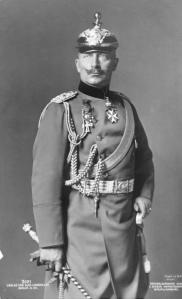
Both men are marked by deep insecurity about their physical appearances. A doctor’s forceps mangled Wilhelm’s left arm as his mother, Crown Princess Victoria, gave birth to him in 1859. His arm remained withered despite various medical “treatments,” including the new wonder cure, electricity, which caused great pain in the little boy. The adult Wilhelm took great pains to conceal his arm’s deformity, resting his left hand, for example, on the pommel of his sword in formal photographs.
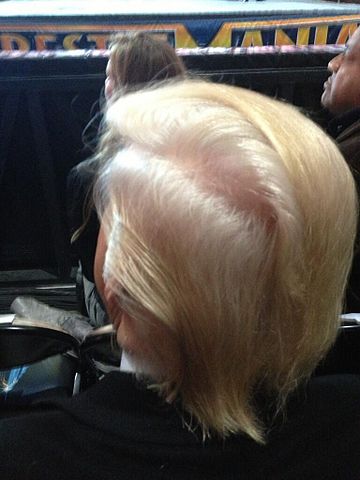
If Wilhelm suffered trauma at birth, Trump’s came in middle age. He lost his hair. Trump is absolutely truthful: that is his own hair. What he’s concealing, as elaborately as Wilhelm hid his arm, is the amount of hairspray it takes to present that hair for public consumption. He relies on the skill of his stylist, who must have as much training in combing over as a sushi chef has in preparing fugu, that potentially lethal delicacy. [Kaiser Wilhelm kept a barber, meanwhile, whose sole function was to ensure that the Imperial mustache always had the correct amount of parade-ground precision and upturn at its tips.]
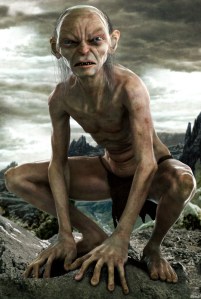
Trump’s vanity, in one way, makes him even more vulnerable than his counterpart: were the world to see him before his every-morning transformation, just before he hits the tanning booth, with an orange bald pate framed by oddly-spaced golden tresses that cover his face and fall to his shoulders, then the world, in its wisdom, would laugh him off the stage. The world has little patience for vanity as delusional as Trump’s, and that might be his undoing. Not even Americans would vote for Gollum to be our president. I think.
Both men learned to be bullies. Trump was as a child, while Wilhelm bullied as an adult and emperor, when Victoria said of him, when he was forty, that “what Willy needs is a good spanking.” Trump’s parents interceded when he was a boy and sent him to a military school to get straightened out. Wilhelm entered the German army when he was in his late teens. For both men, a military environment was their deliverance. Trump loved military school, loved following orders, loved the comfort of authoritarian structure. [He came closest to breaking the rules with his hair, which was just long enough to be fashionable but short enough to forestall demerits.]
For Wilhelm, the army provided him with a family, and one he needed badly, since his own seems to have been ashamed of him and his deformity. As Emperor, his unbounded love for the military extended to the Kaiserian wardrobe, home to over 200 uniforms to suit Wilhelm’s every mood: he could be an Admiral of the Grand Fleet of a Tuesday, a Colonel of Hussars of a Friday.
Another similarity between the two would be their illusion of infallibility. Trump will never admit to making a mistake. Wilhelm insisted that his side always win in war games. Anything or anyone who threatened the Emperor’s carefully-constructed view of himself had to be eliminated: if Trump’s catch phrase, from his television show, was “You’re fired!” then that’s exactly what Wilhelm did with such alacrity when he cashiered the grand old man, Chancellor Otto von Bismarck, Germany’s unifier, early in his reign.
The problem with infallibility is that it tends to generate a Manichean world-view: the Kaiser’s Germany was outflanked by enemies, both by his English and his Russian cousins, who had to be destroyed, and Trump classifies anyone who doesn’t agree with him as a “loser,” an enemy who must be humiliated with every vulgar weapon in his arsenal. Americans seem to love it; you see the same joy in Trump’s followers that you do in bourgeois Germans celebrating in the streets when war comes in 1914. [In Munich, you can see the future fuhrer’s face–he’s as bourgeois as they come–in the crowd. He is jubilant.]
All bullies are at heart cowards–it’s ironic that Trump’s cowardice was revealed when he ridiculed another man’s physical handicap. When the Great War began in August 1914, Wilhelm timorously asked his general staff if the mobilization couldn’t be stopped. It was too late: the troop trains had left because the military machinery Wilhelm so admired had been so well-oiled by him. At war’s end, he would go into exile in Holland; in one newsreel, he’s still in uniform with ostrich plumes and epaulets and gold braid, and there’s still a sword buckled to his left side, but he’s accompanied by an adorable little dog whose presence renders him ridiculous: the Emperor of Germany had a fondness for dachshunds.
Wilhelm’s narcissism humiliated Germany in 1918 and contributed to its destruction in 1945. Hopefully, it will not take armed conflict to reveal what a buffoon Donald Trump truly is. Let him be caught, without his handlers and his hairspray, out in a good rain, followed by a better wind, and the hair which his stylist grooms with such single-minded dedication will finally betray him. Would this be shallow of us, to judge him by his hair? Of course it would be, and that is all this shallow man deserves.
 A Work in Progress