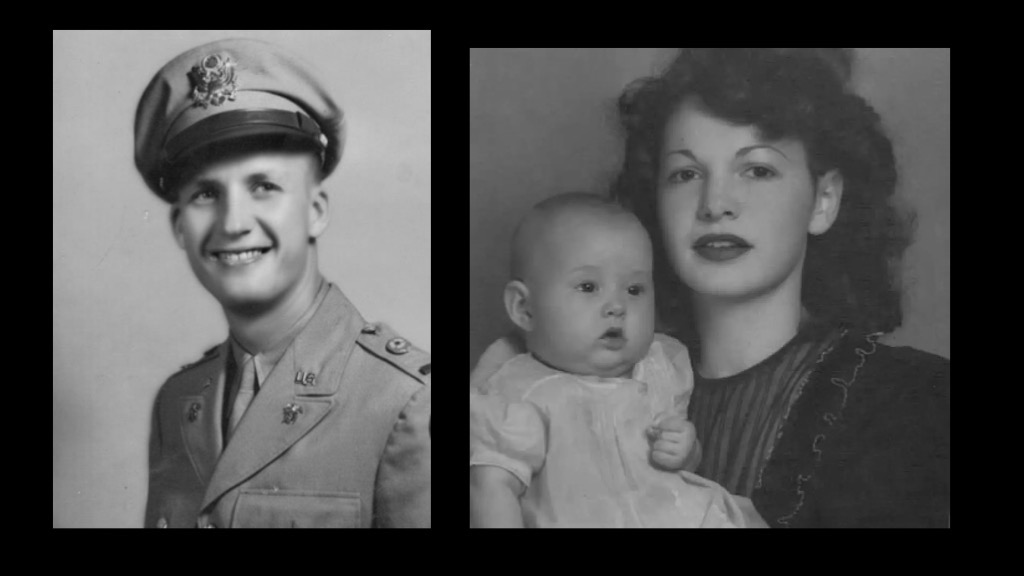
If I had to guess, I’d place this photo in about 1936, in Raymondville, Texas County, Missouri, on the northern edge of the Ozark Plateau.
That’s my Aunt Bill, my Dad, and the appropriately-named Inky the Dog.
Aunt Bill’s real name was “Mildred,” which I think she detested.
The name persisted in our family because a collateral ancestor married Mildred Washington, the great man’s aunt. They sold Mt. Vernon to GW’s father.
That’s not the story. The story’s about Inky.
Aunt Bill and Dad had to give Inky up for allegedly “bothering sheep,” which, given my experience with my big brother’s 4H lamb, is a stretch,. She was imperturbable.
But maybe Ozark Plateau sheep are more sensitive.
Inky would’ve meant a to Aunt Bill and my Dad, Their Dad–my Grandfather John–had just died in a Springfield hospital after a long struggle to overcome the injuries, including two broken legs, inflicted by a Texan driving a Ford roadster at high speed as Grandfather John crossed the road to visit his neighboring farmer and friend, Mr. Dixon.
That’s not the story. The story’s about Inky.
The Gregorys, being neighborly, found a home for Inky with a nice family in Rolla, famed for Fort Leonard Wood and for what was then called the Missouri School of Mines.
This photo was taken after all that. Inky ran away from his new home in Rolla and came back to Aunt Bill and Dad in Raymondville.
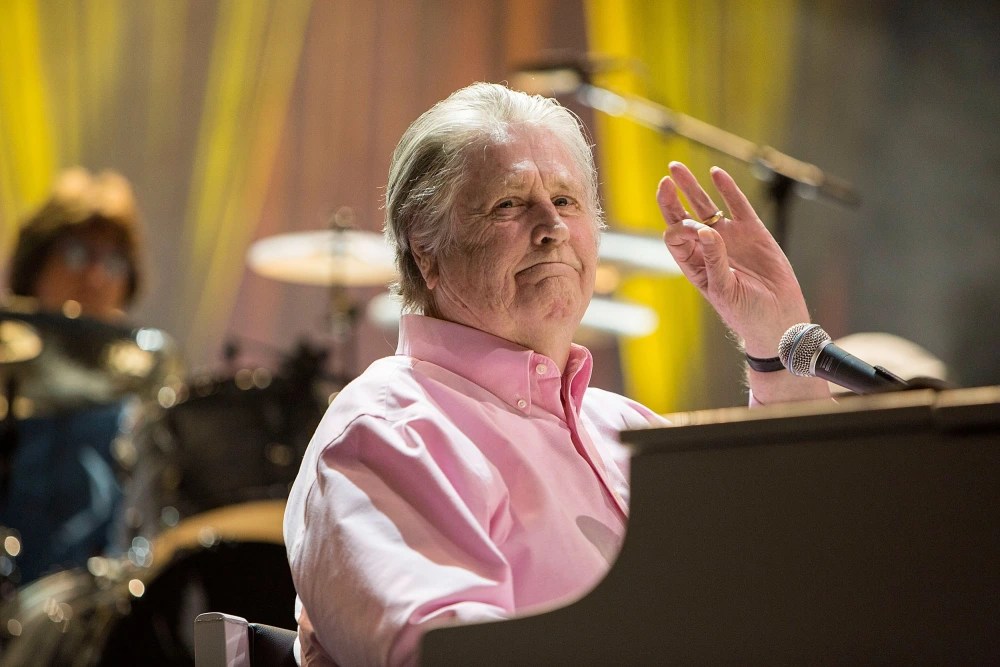
Brian Wilson died today, June 11, 2025. This was written two years ago.
I knew a little about Brian Wilson’s struggles, but I had never heard of his illness, called schizoaffective disorder, before the documentary Long Promised Road.
The Wilson brothers’ father contributed to his son’s emotional disorder, I am sure. He was abusive and a hearing loss in one of Brian’s ears has several explanations, but the most reasonable one, to me, is that his father hit him hard upside the head with the flat surface of an electric iron.
The blow to Brian’s ear was about the time the hallucinations began. Brian didn’t see things. He heard them. They were voices telling him terrible things about himself and suggesting that he do terrible things. I’ve heard those voices, all my life, but they were inside my head. Brian’s voices were out there in The World, and they were very real.
I did enough research to establish that the link between mental illness and creativity is nonsense. I still believe, though, that Wilson’s music is so beautiful because that was how he fought the voices. The only place, I think, where he could silence them was in the studio, recording music with his brothers and cousins and friends and with his wife and her sister.
I could not watch the rest of the PBS special because Brian is now so wooden. I lost my nerve. That was a bad decision on my part, but it was because The Brian Wilson that impacted my life made me all rubbery and jiggly and happy. You can’t NOT dance to, for example, “Help Me Rhonda” or “I Get Around.” I still remember, at Branch School, three lovely eighth-grade girls—Patsy Silva, Marilyn Machado, Carolyn Coehlo— (all of them from Azorean stock, by the way) dancing to Beach Boys 45’s in Mr. Lane’s room at lunchtime. I had crushes on all three, but I was just a punk kid.
That was a long time ago. As the documentary revealed, even if he’s seemingly diminished, Brian Wilson is very much alive.
And the fact that he’s even around—upright, breathing, performing, even though he’s tentative, afraid, monosyllabic—is a kind of miracle. I think the first three adjectives I just used are far more important than the last three. “God Only Knows” is the kind of music that vaporizes demons, both Brian’s and mine.
The “genius” stuff can take a back shelf. Wilson was not compared, in the documentary, to Mozart. The conductor of the Los Angeles Philharmonic chose Mahler and Schubert instead.
That’s labeling the man with not-very-faint praise. But what counts isn’t Brian Wilson’s genius. It’s his courage.
And those harmonies…
Brian could still Bring It many years later. With Al Jardine.
This song was just plain fun. From the TV show American Bandstand.
Imitation is the sincerest form of flattery: The Beatles answered “California Girls” with this song, a little more arch but just as fun. Paul McCartney in Red Square more than a few years ago.
Imitation is the sincerest form of flattery, Part II. A lovely song from Foxes (young women) and Fossils (guys my age).
Imitation is the sincerest…Part III. This live Fleetwood Mac cover of Wilson’s “Farmer’s Daughter” is haunting.
Thank you, Brian. Say hello to Sly Stone from me, will you?
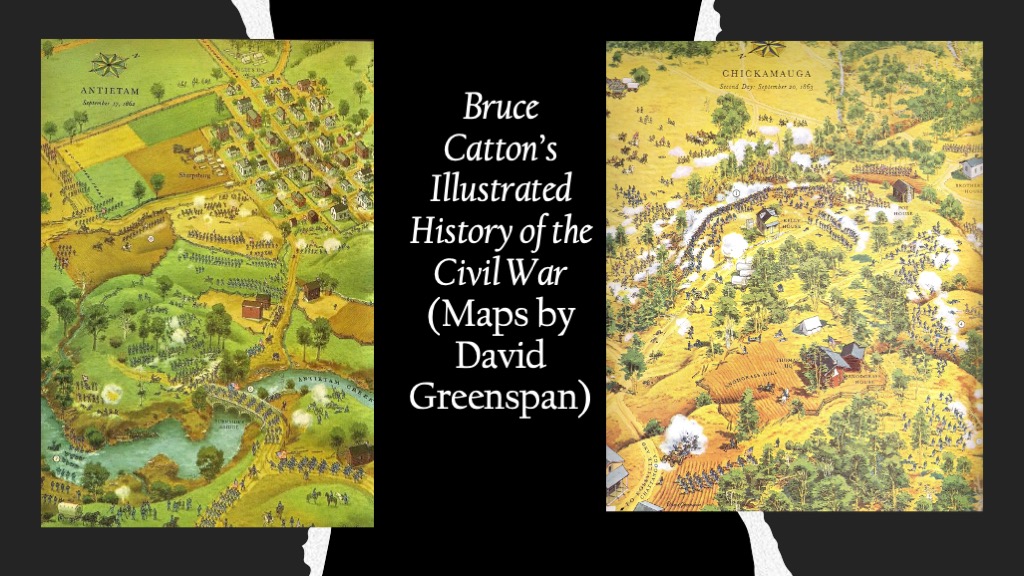
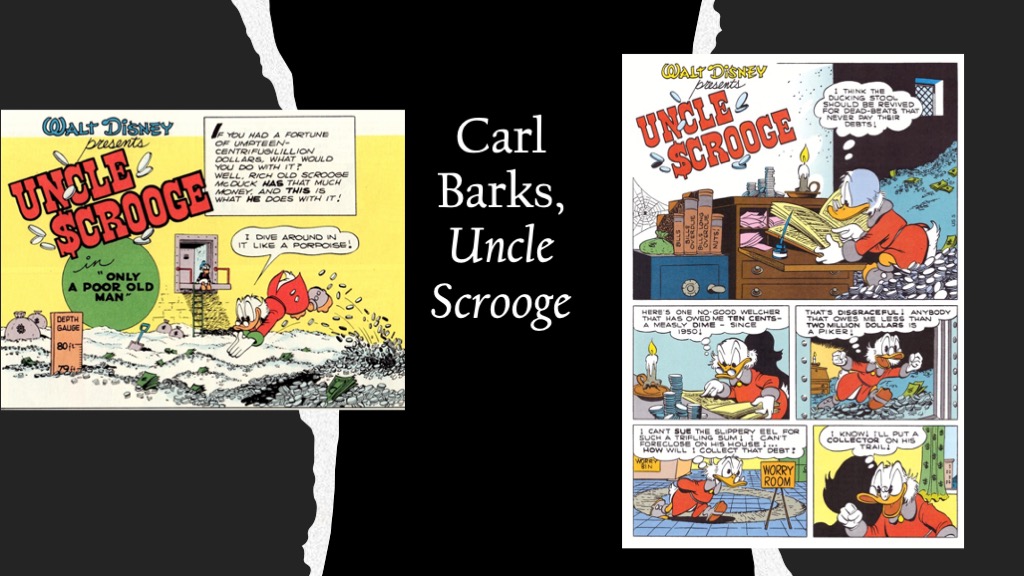
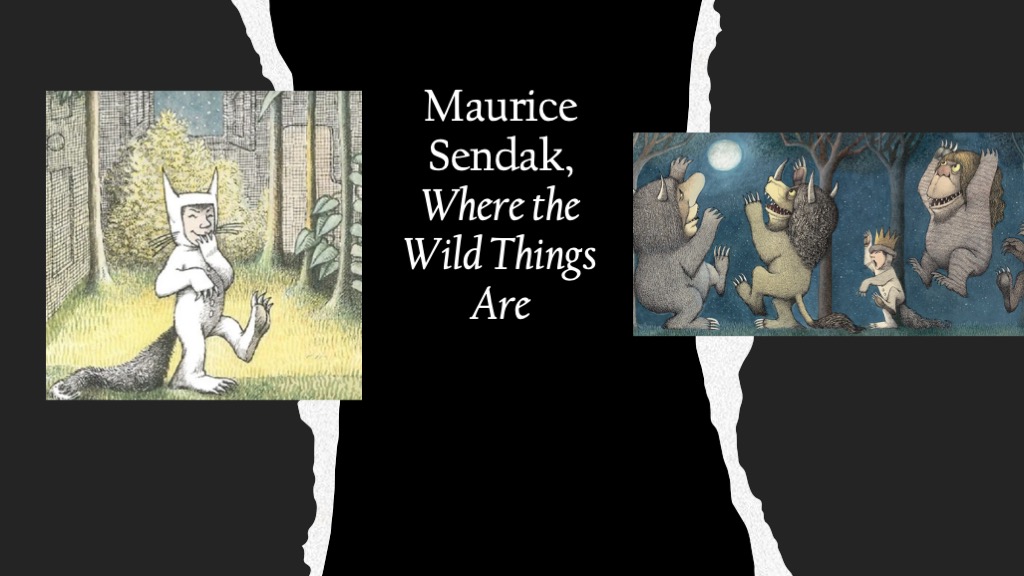
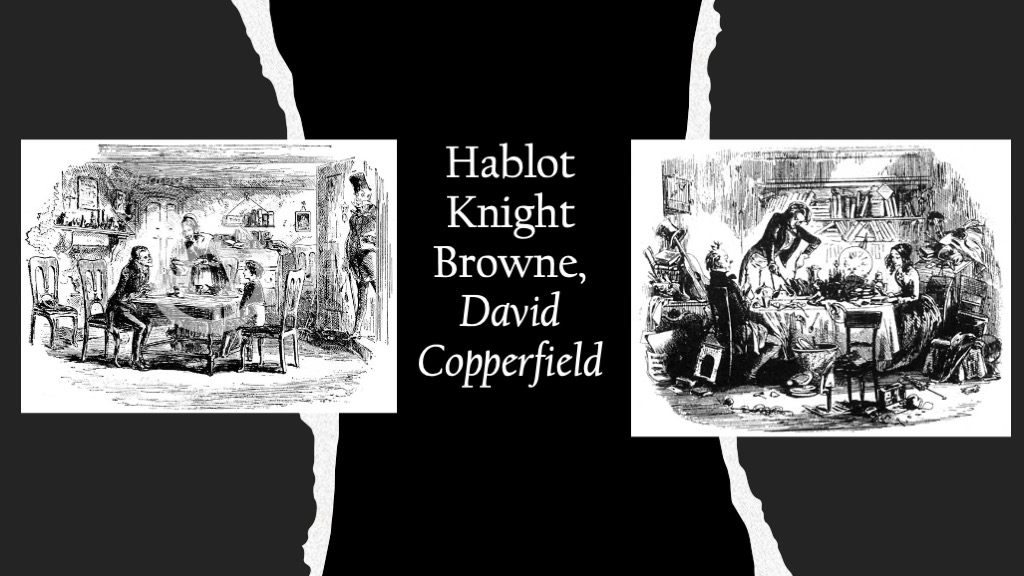
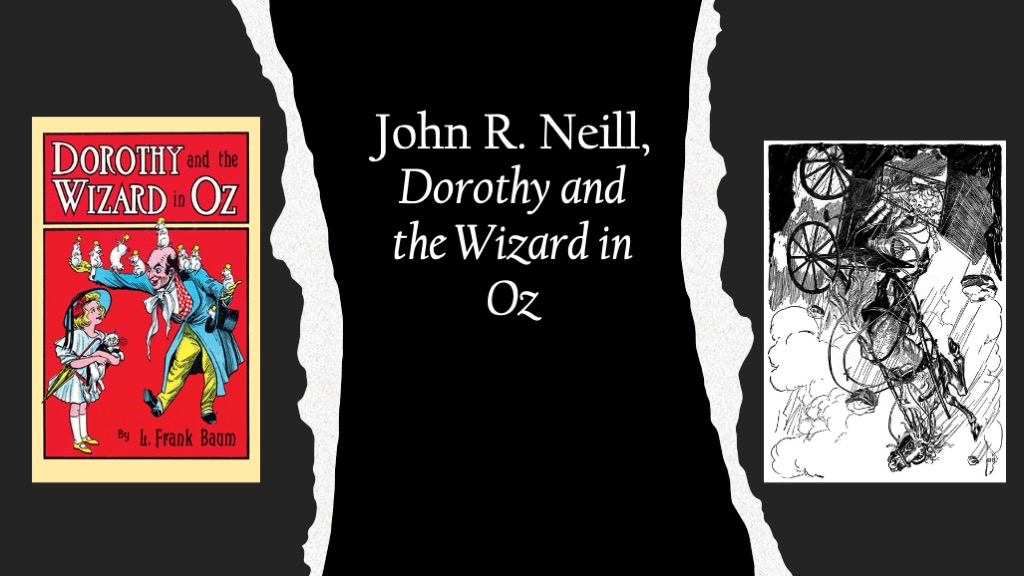
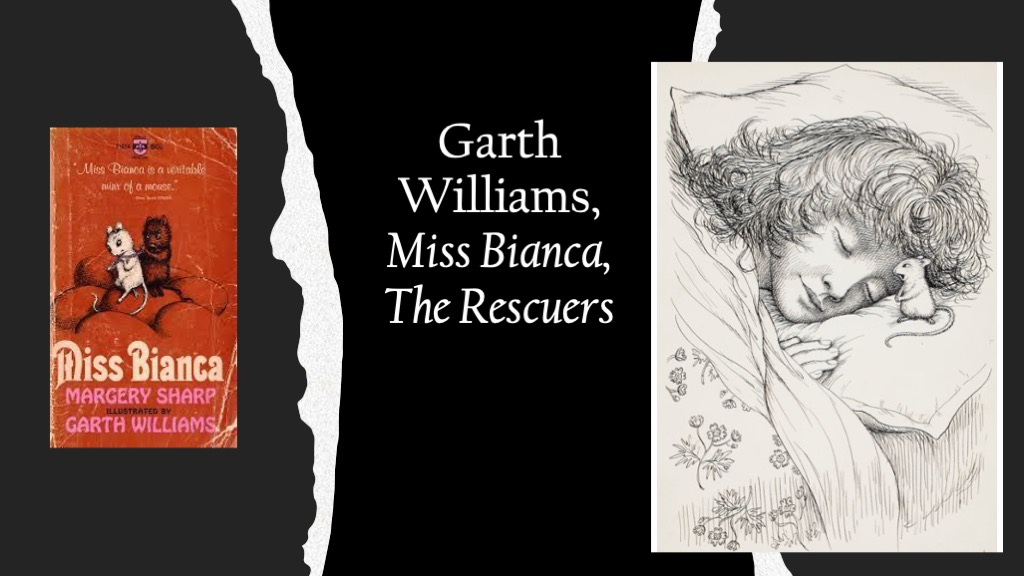
My friend Wendelin van Draanen just won a well-deserved award for her Young Adult novel The Peach Rebellion, and her writing made me reflect on the illustrators who influenced me as a child and ‘tweener. The one who doesn’t belong is Sendak, but I included him because there has never been a book that gave me greater joy to read aloud.
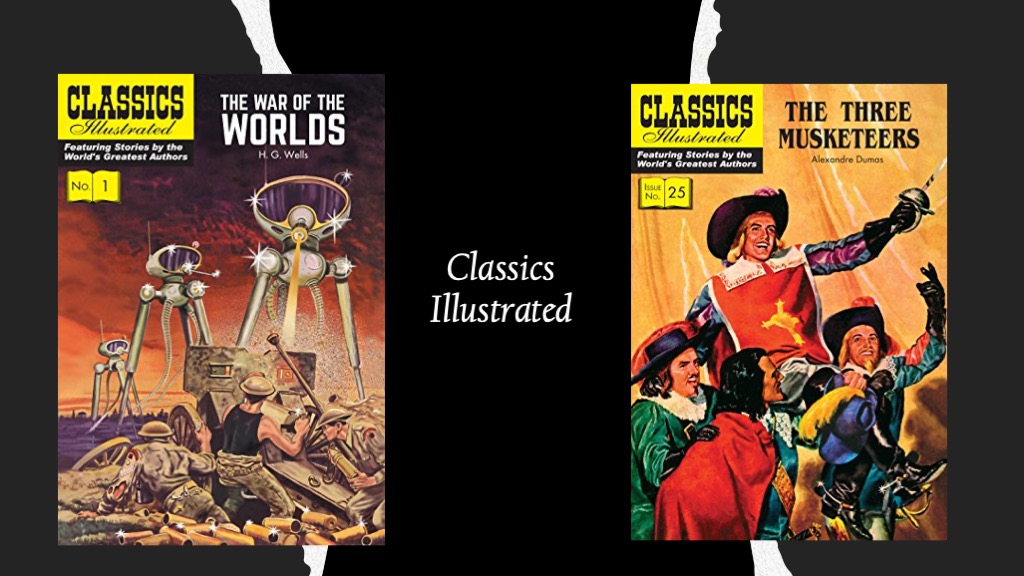
And “Classics Illustrated,” true, was an industry, not an artist, but their “War of the Worlds” scared the bejabbers out of me when I was ten. I don’t think I could’ve handled the Spielberg version unless they needed another screamer to give poor Dakota Fanning’s vocal chords a break.
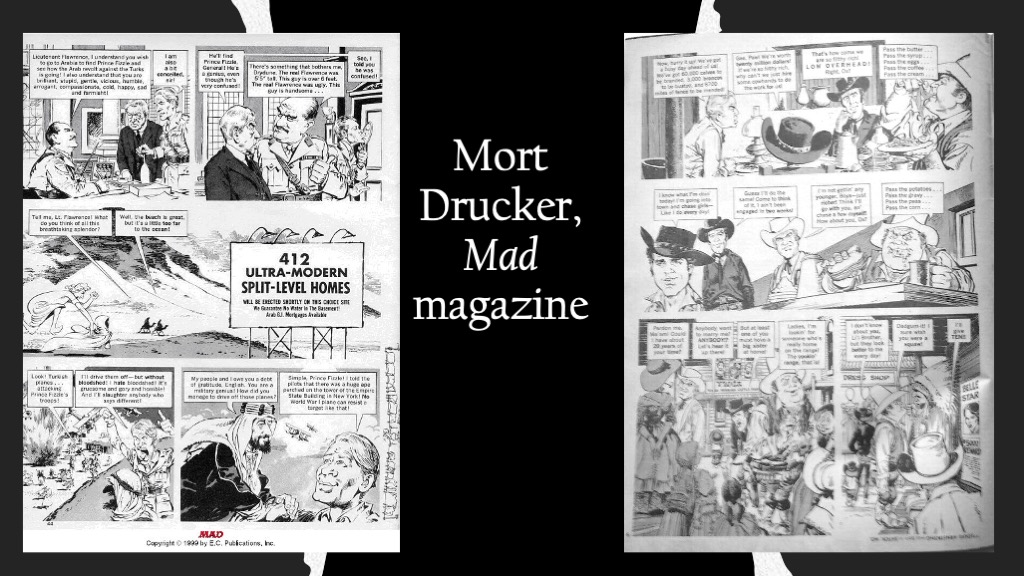
My brother Bruce had an entire drawer in our bedroom full of neatly-stacked “Mad” magazines, probably in chronological order, which I, the messy one, raided.
We also had two enormous pull-out drawers beneath our bedroom closet stocked from keel to gunwales with Disney comics, “Classics Illustrateds,” and a long-forgotten anti-Commie series, “Blackhawk,” about an international cadre of fighter pilots who did cool tricks like standing up in the cockpit to lasso Russki jets in midair.
We even had some Dick Tracy comics. When one of Dick’s fugitives refused to come out of his motel room at the end of a wing, Dick simply used his tommygun to inscribe a capital “Z” in the exterior wall. End of fugitive. I don’t think he was Mirandized.
I’d forgotten how bluntly charming Garth Williams’s Miss Bianca illustrations were. Sadly, Disney made a cartoon version with Disney art at its low point–The Rescuers were two-dimensional cutouts and Bianca’s voice was provided by Eva Gabor, who was charming in “Green Acres,” a low point for American comedic television but several notches above “Gilligan’s Island.”
I have a brief Gabor story somewhere. Remind me.
Most of these artists have one thing in common: When you’re a little boy, you can get lost inside their work. They take you to another place.
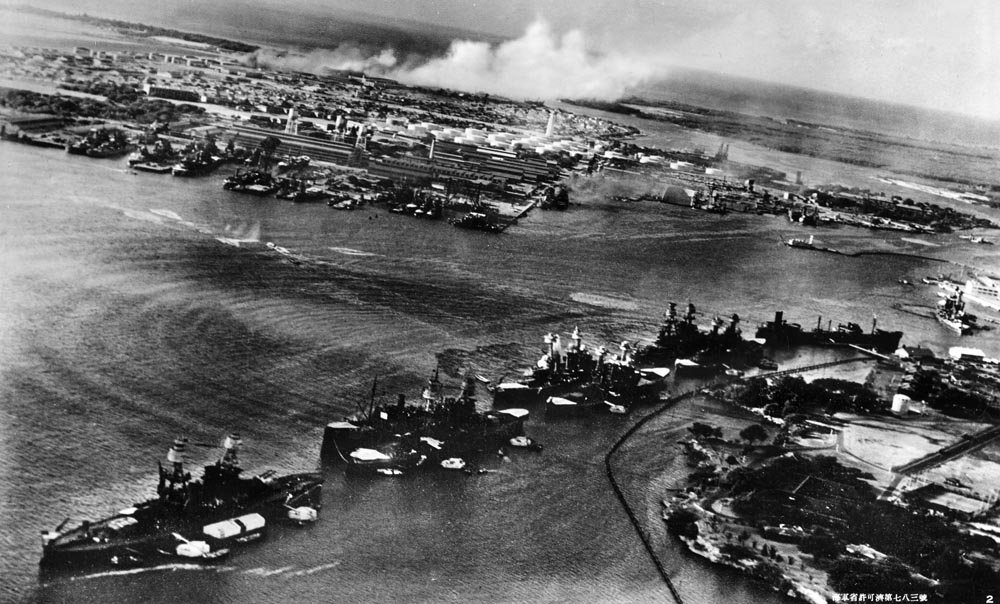
It’s one of the great stories of American naval history. At Pearl Harbor, here is the aging USS Nevada at the end of Battleship Row, at bottom left, just astern of Arizona, which is anchored inboard of the repair ship Vestal. You can see the concussions from torpedo hits on the outboard battleships ahead of Arizona. That ship has about twelve minutes to live.
The attack came during the morning Colors Ceremony, when bands played the National Anthem as each battleship hoisted its colors. The trombonist on Arizona’s band, Jack Scruggs, killed just after this photograph was taken, grew up in Arroyo Grande.
The Officer of the Watch on Nevada was Ens. Joseph Taussig, about Scruggs’s age, twenty-one or twenty-two. He was standing his very first watch while most of the ship’s senior officers were ashore. He was so green that he had to send a sailor over to Arizona to ask what size flag was appropriate to hoist for the morning formalities. Then the bombs began to fall.
Nevada’s band had begun to play the Anthem. They continued to play the Anthem. When machine-gun bullets began to splinter the teak deck, they paused for a moment, somehow resumed the song in unison, finished it, and then ran like hell for their action stations. (Arizona’s band ran for their stations in the No. 2 gun turret, near the bow and near where the fatal bomb hit. None survived.)
Lieutenant Lawrence Ruff was attending Mass on the hospital ship Solace at this moment. He immediately caught a launch back to Nevada, assumed command topside with Taussig as his anti-aircraft officer. The ensign had done something right, he would find out later: he’d left two of the battleship’s four boilers lit. It normally took a ship the size of Nevada two hours to come to full power, but two boilers were sufficient to get her underway. Ruff gave the command to make a run for the channel exit. The oldest ship on Battleship Row was the only one to steam away from the flames and smoke that blanketed the anchorage off Ford Island.
Sailors cheered as she passed.
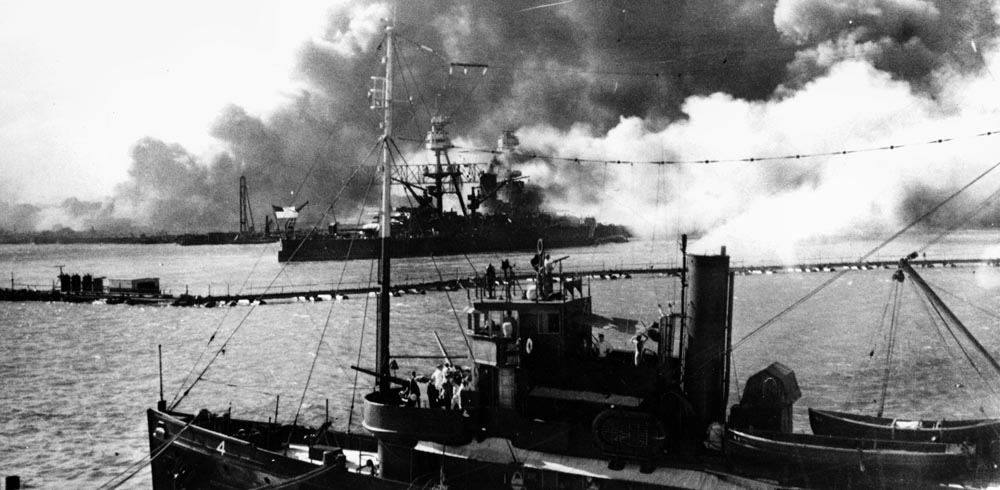
Nevada during her run for the channel.
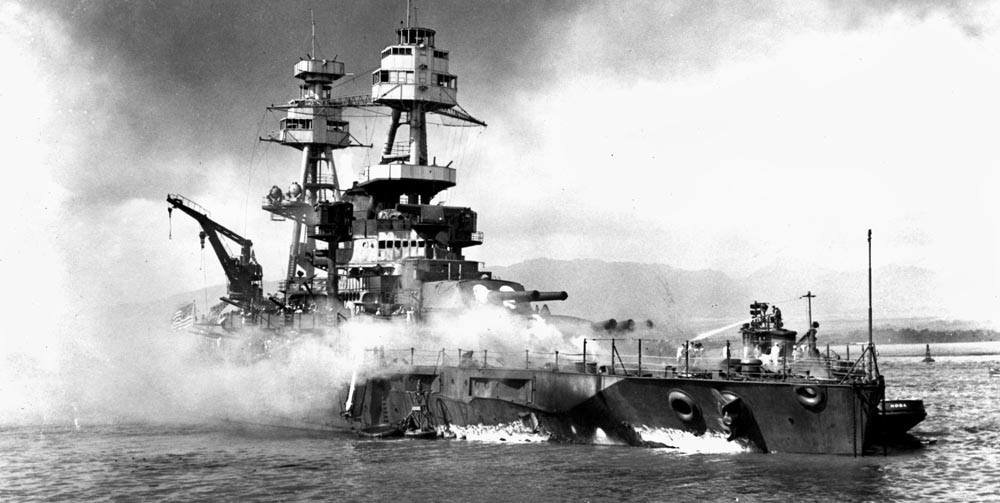
Nevada aground on Waipo Point.
Nevada didn’t make it to the open sea. Crippled by at least one torpedo and six bomb hits, she lost headway. Her run ended when Lieutenant Ruff ordered her beached on Waipo Point, leaving the narrow channel open.
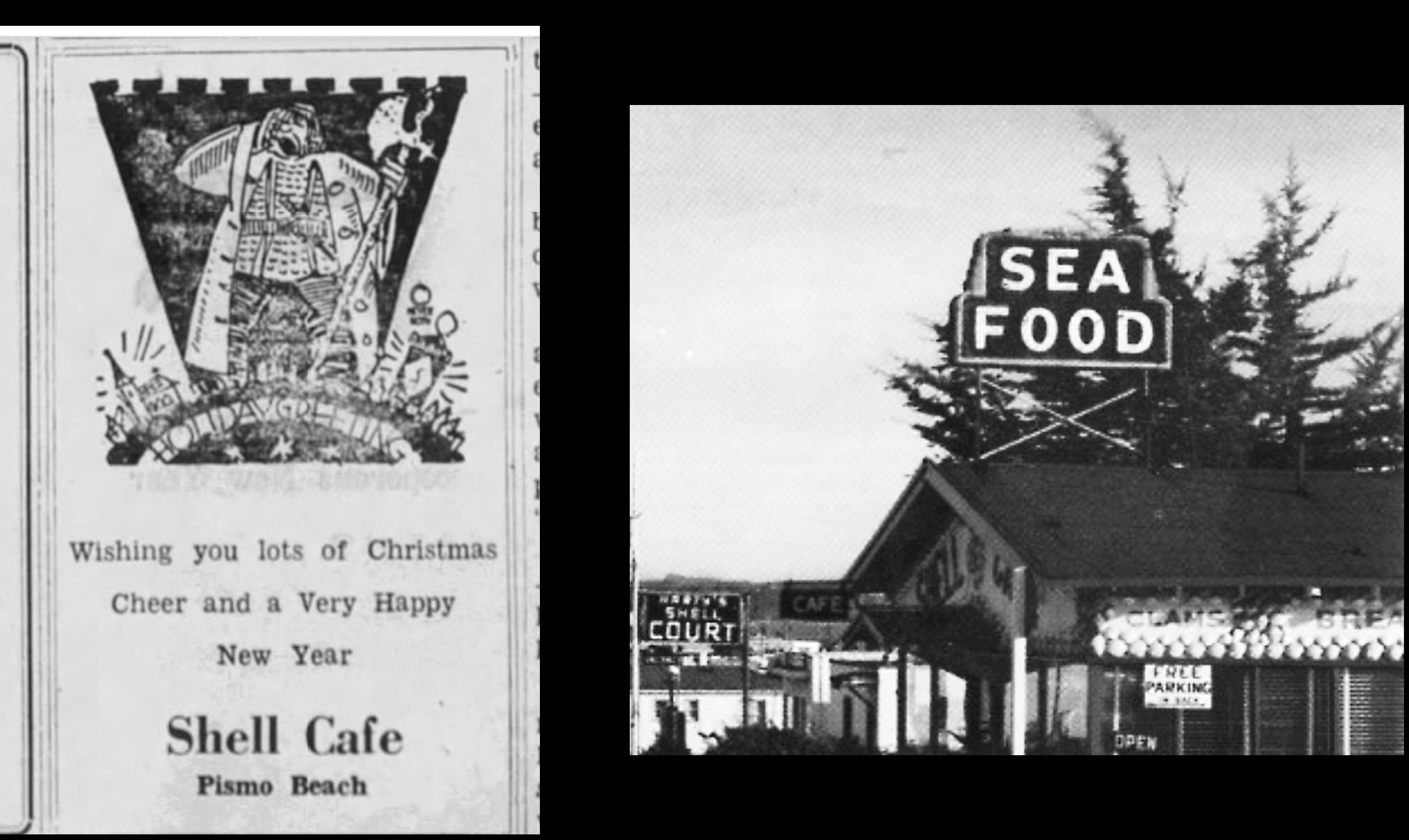
And that brings us to the Shell Cafe in Pismo Beach, at the north end of Price Street in those years. The Christmas ad is from a 1939 Arroyo Grande Herald-Recorder. (The Shell’s still around today, but in Grover Beach.)
The image of the Shell Cafe is from the Boeker Street Trading Company. Today it’s the Oasis Cafe.
It’s natural to focus on the horrific losses at Pearl Harbor, but the attackers took losses, too. Twenty-nine planes were shot down and five midget submarines sunk. Only one ship in the Pearl Harbor Striking Force, the destroyer Ushio, survived the war.
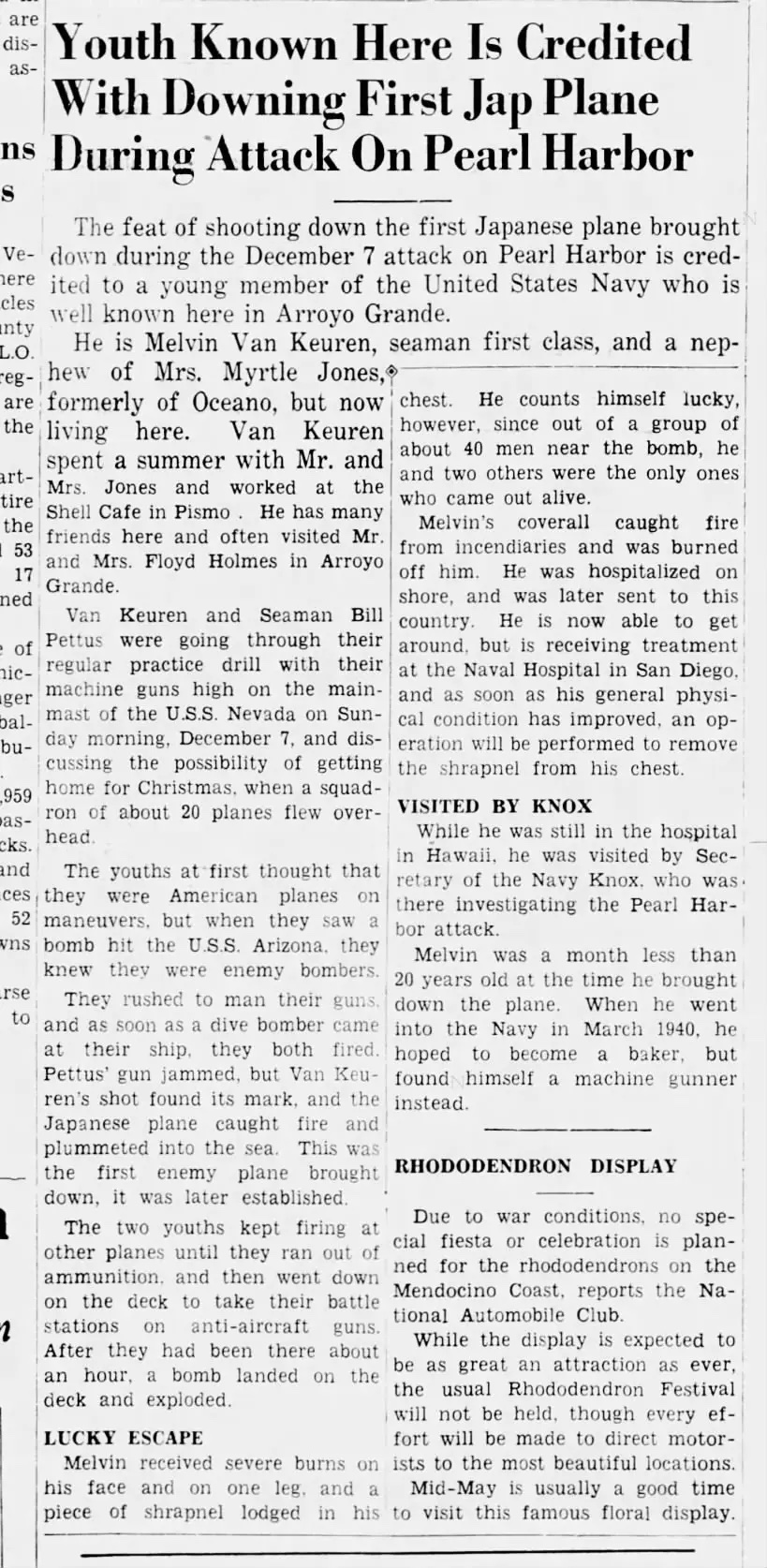
The first of the attacking planes shot down was claimed by USS Nevada. It’s better for me to let the newspaper article tell the story. From the May 8, 1942, Arroyo Grande Herald-Recorder:
“…he hoped to become a baker, but found himself a machine gunner instead.” That is a fine piece of writing.
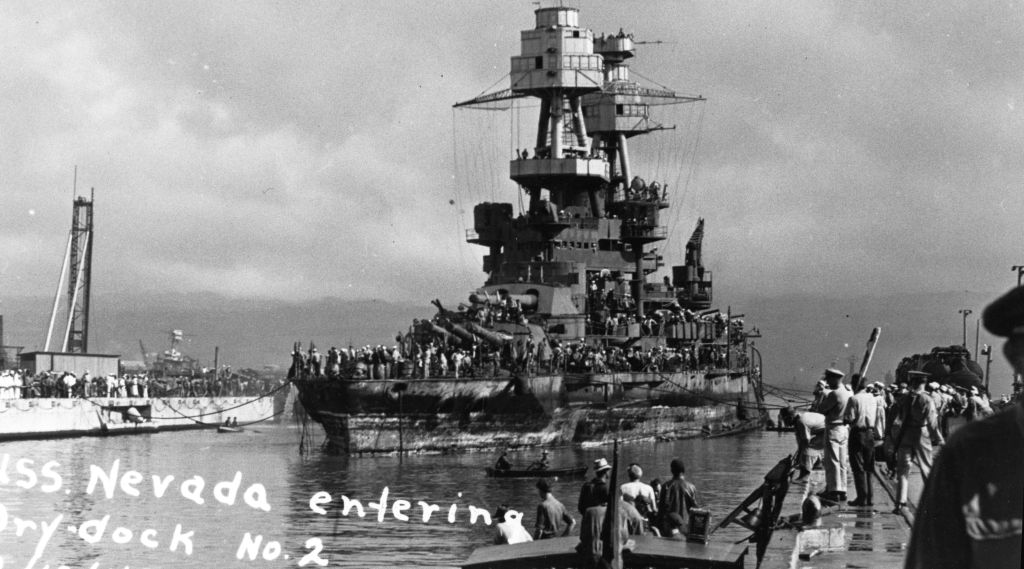
Both Melvin and his ship survived that terrible day. Here is Nevada approaching drydock after being refloated:
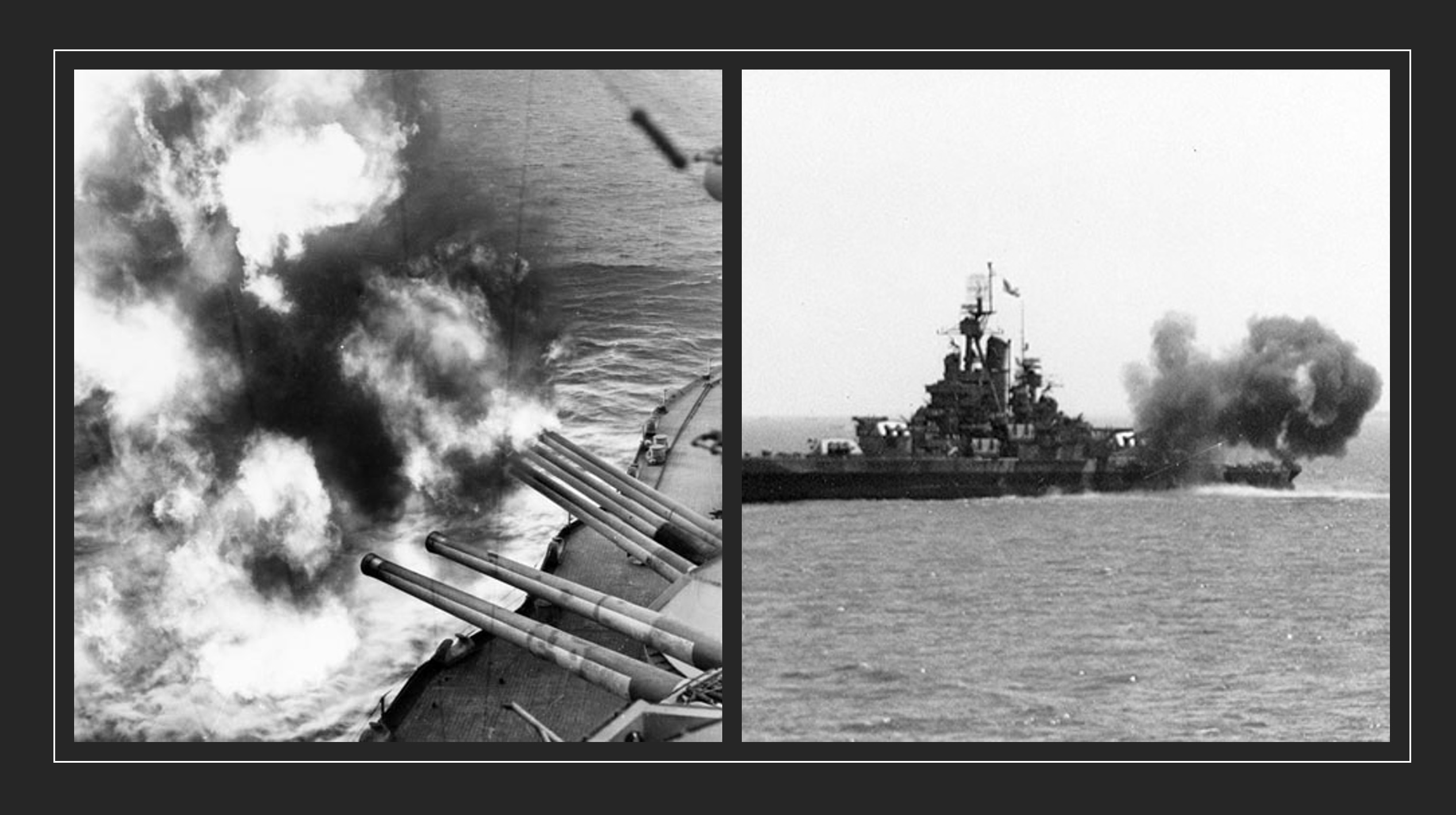
And these are her main batteries opening fire at German positions along Utah Beach on D-Day. Nevada was repaired at Pearl Harbor, overhauled and modernized at Puget Sound, and continued her war over 7,300 miles away and two and a half years removed from the place where the ship had revealed her heart in her run for the sea.
On June 6, 1944, Nevada was granted the honor of being the first ship to open fire on the invasion beaches.
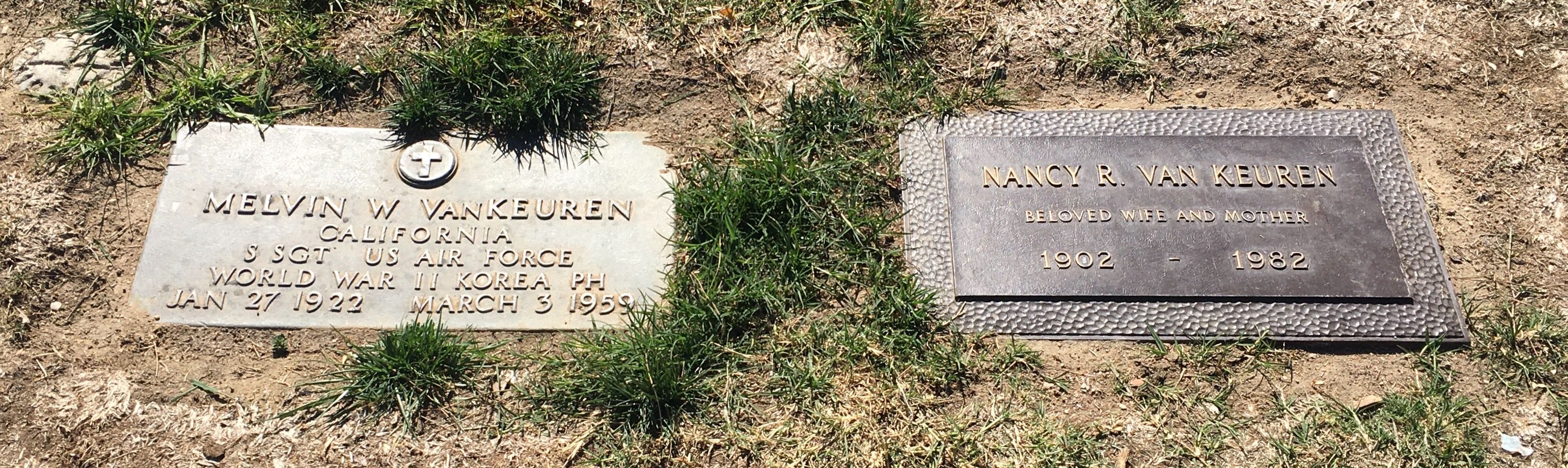
Melvin the hopeful baker survived his war, too, but his wounds sound severe. Maybe they were a factor in his premature death in 1959. He re-enlisted three times and, after the war, retired as an enlisted man in the United States Air Force. He’s buried at Forest Lawn, next to his mother.
This is his tombstone. Sadly, there’s not enough room on it to record the way he revealed his heart, too, on December 7, 1941.
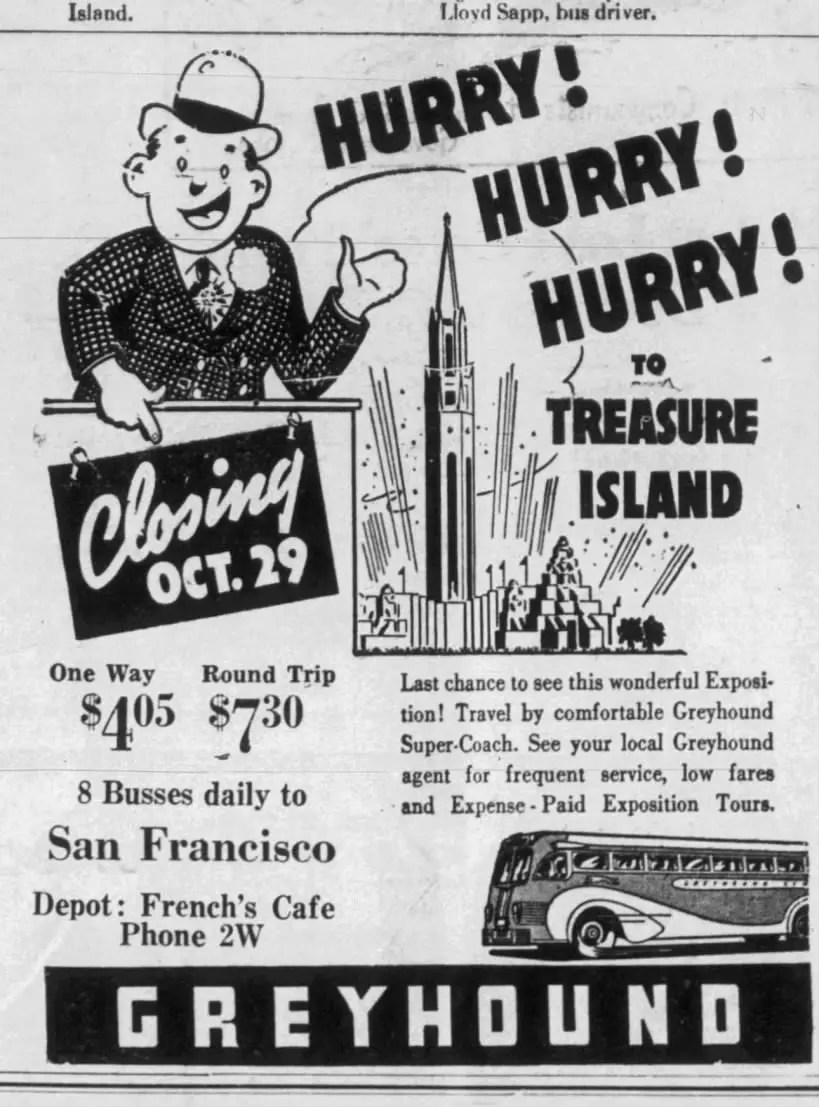
In 1939, San Francisco’s Treasure Island was the site for the Golden Gate Exposition, a showcase dedicated to a world beginning to emerge from the Great Depression. The Exposition was a masterpiece of Art Deco design and, with California comfortably distant from Europe, tinges of optimism must’ve remained awhile; I imagine the fall of France ended all that.
The Exposition even won periodic mention in the little Arroyo Grande Herald-Recorder, including this October 1939 display ad. I think the Greyhound station was in the Olohan Building, whose basement is now home to Klondike Pizza. A Klondike pizza is also good for transient moments of optimism, if I may be allowed to editorialize.
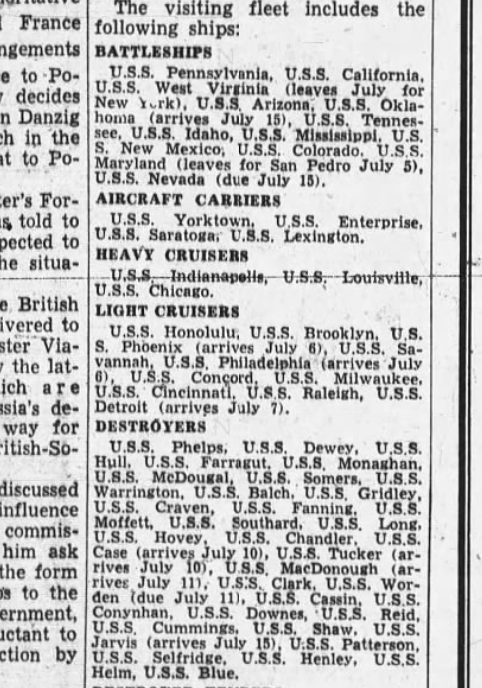
What had to be a highlight of the Exposition came in June and July 1939, when most of the Pacific Fleet, just off maneuvers, sailed into San Francisco Bay for a visit. Many years ago, my wife and my sons and I spent a delightful visit to our favorite city during Fleet Week, when we saw the Blue Angels, sailors from twenty nations, and, on a Muni Bus, a bearded lady (who was very nice) and a man who could do 360s with his dentures. I preferred the visits to the submarine Pompanito and the Liberty Ship Jeremiah O’Brien, but I’m built that way, I guess.
Here’s an article from an Oakland newspaper—with little seeming regard for what we’d call “national security” today— about the ships, and their 40,000 men, headed for the Exposition:
And here, also from British Pathe, is a remarkable video as the fleet arrives, led bybattleships, then a light cruiser and finally the preciuus carriers. And then, best of all, happy sailors coming ashore for liberty.
The scale of these ships is hard to imagine, even though they’re relatively small when compared to modern aircraft carriers. A Pennsylvania-class battleship, like the one in the video below, displaced 32,000 tons, was 600 feet long and carried a complement of about 60 officers, 70 Marines and 1,000 enlisted men. These ships were small cities. And small cities need the mail delivered, even in mid-Caribbean. This film is from the early 1930s:
And the battleship in the newsreel—you had to know this was coming—was, of course, USS Arizona, lost with 1100 crew, including two sailors who were raised in Arroyo Grande, on December 7, 1941.
Maybe it’s just me, but I am a devoted fan of American film, and as a cultural barometer, 1939 was a sign of renewed confidence in the same way the Exposition was. My parents began dating that year, when their movie dates might’ve included The Wizard of Oz, Stagecoach, Goodbye Mr. Chips, Ninotchka, Destry Rides Again and Gone With the Wind.
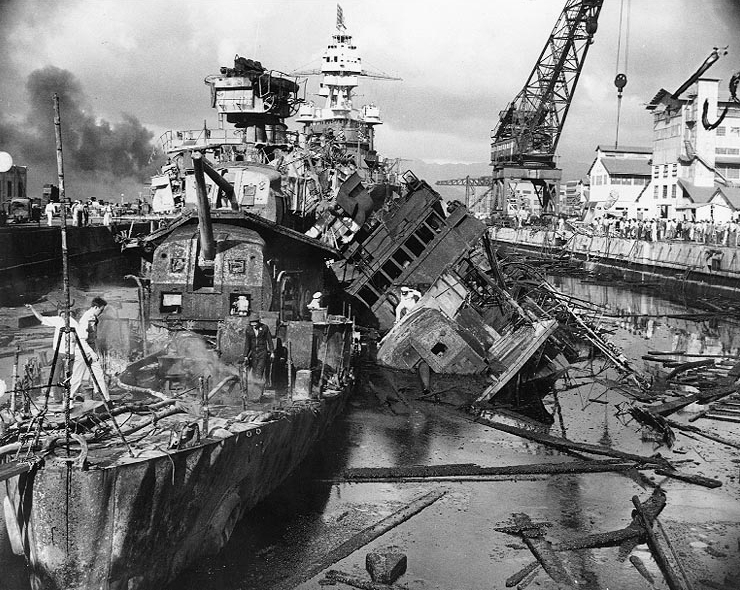
And that brief moment of renewed self-confidence, of hope, is what makes the images of these ships and their young men so poignant to me. These are the fates of some of the ships cited in the Oakland newspaper article above:
Downes and Cassin in the aftermath of the Pearl Harbor attack. The battleship Pennsylvania, also in drydock that day, is just beyond.
As devastating as the photograph above is, both destroyers were salvaged, rebuilt and returned to duty, as were the damaged battleships. One of them, Nevada, which made a heroic run under attack for the Pearl Harbor exit channel, was, on June 6, 1944, hurling 14-inch shells at the Germans defending the Normandy invasion beaches. Nevada, in fact, was granted the honor of firing the opening salvo that day.
One of my favorite lessons in U.S. History was devoted to the construction of the Oakland Bay Bridge, truly, to steal a term, an engineering marvel. It, and its sister bridge, are emblematic of the way we responded to the Great Depression.
We responded to the shattering of our confidence at Pearl Harbor with new ships and old ships pulled to the surface from Pearl Harbor mud and made new again. Vast fleets of warplanes, tanks, trucks, artillery and small arms, Spam and K-ration Lucky Strikes, a labor force that went to war— a third them women and many of them killed in factory accidents—and over 400,000 young men killed in combat, all of these made up our response.
These things happened because of a generation that, before the war, was dismissed by intellectuals as pleasure-seeking, selfish and shallow. This was my parents’ generation. My parents were hard-working, generous and deeply read. I became a history teacher because of the values they instilled in me.
Learning about the Exposition, in what remains—after a fair amount of European travel (Dublin, London, Edinburgh, Paris, Nice, Amsterdam, Munich, Salzburg, Florence, Venice, Rome) with twenty to forty of my closest teenaged friends, my students—the city I love the most. The Exposition reminded me of my mother and father and their generation. If this was a twilight time in our history, followed by four years of wartime dark, we were still here in the morning.
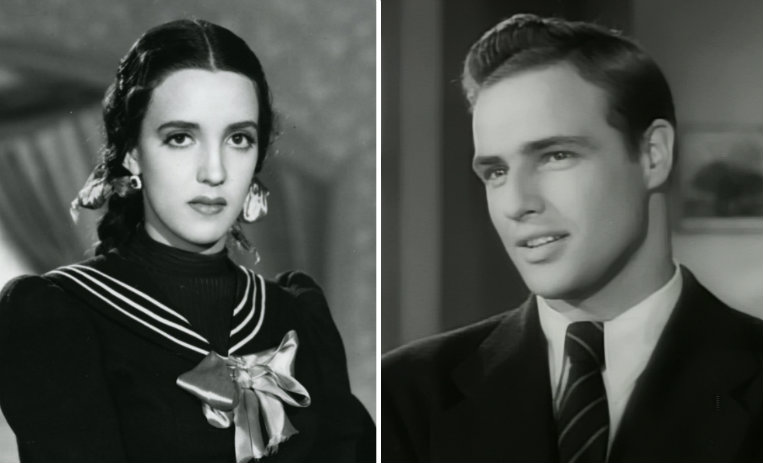
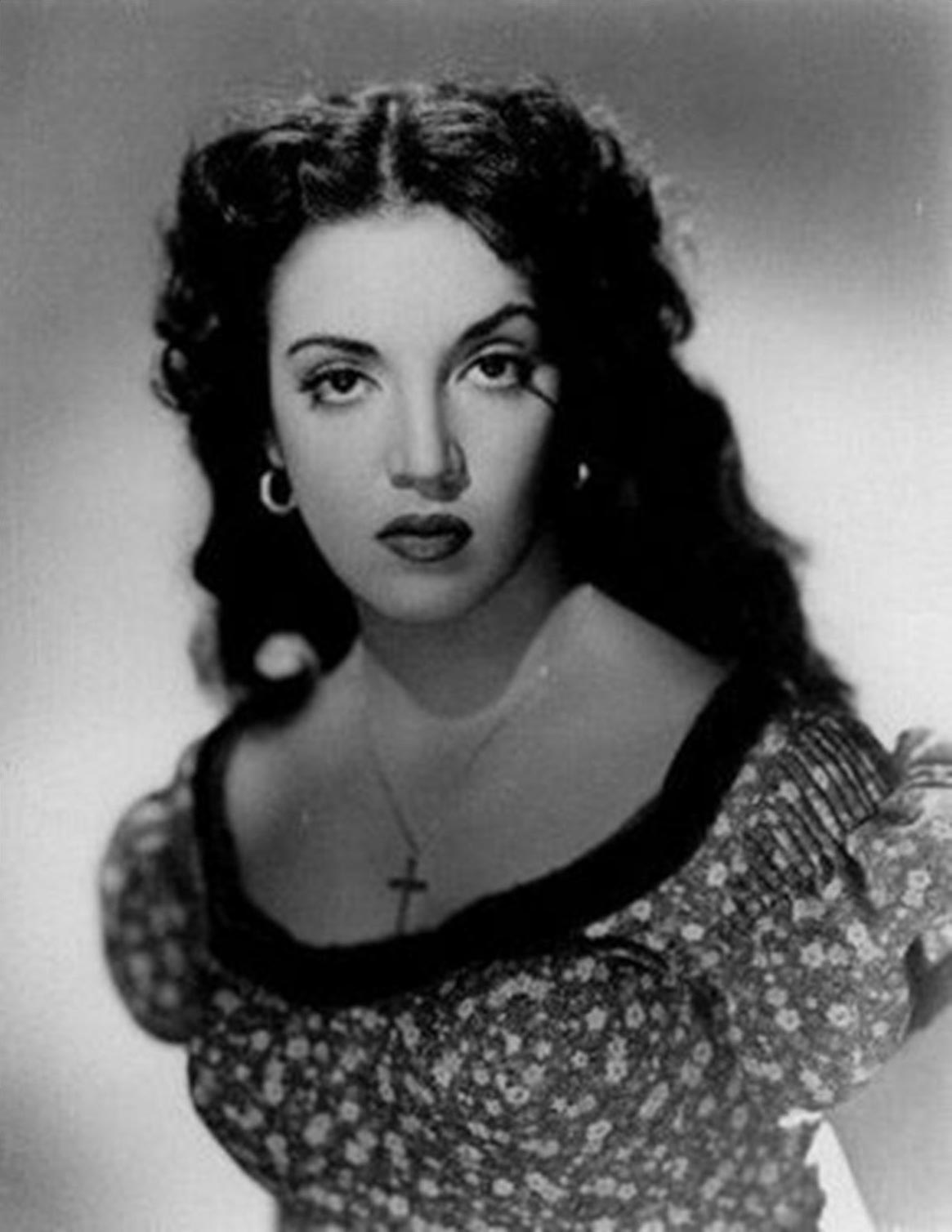
Katy Jurado had already made twenty Mexican films when Hollywood beckoned. She would make many more—both in Mexico and in the States, especially in Western roles—and I remember her best in this scene from Sam Peckinpah’s Pat Garrett and Billy the Kid.
Her other Westerns include High Noon, Arrowhead, Broken Lance and a personal favorite of mine, One-Eyed Jacks, a film made by Marlon Brando, who fell madly in love with her in the middle of torrid affairs with two other actresses. Who can blame him for falling in love with just one more?
Brando’s hijinks aside, there was, I think, a consistent feature in all the characters Jurado played, and it was in their dignity
She was born in Mexico City in 1924, when the nation was just emerging from the violence of a ten-year revolution that had claimed one million lives—one of every ten Mexican citizens. Sadly, violence marked her relatively short marriage to Ernest Borgnine. And violence is a hallmark of Sam Peckinpah films, and it’s a staple of his Pat Garrett and Billy the Kid.
This scene is no exception. Jurado plays the wife of lawman Slim Pickens, James Coburn is Pat Garrett, and they’re on Billy the Kid’s trail when they encounter outlaws holed up in a remote cabin. The gunplay follows. Jurado’s performance with a shotgun is impressive.
But the violence isn’t the memorable part. This scene moves me because of the final glances that Jurado and Pickens exchange as both of them realize that he is dying. This is marvelous, heart-breaking acting.
Bob Dylan had a minor role in this film. His song is all the dialogue this scene needed.
What a scene. What a song. What a woman.
And, of course, it’s such a fine song that I can’t leave the blog post hanging without the rest of. Dylan and Tom Petty perform “Knockin’ on Heaven’s Door” here. This is for Katy Jurado.
This is hard. My brother-in-law, Stephan Bruce, Elizabeth’s big brother, died yesterday [Saturday, April 22] at his home in Fairfax Station, Virginia. It might’ve been an aneurysm.
The photo shows Steve during his retirement ceremony from the Navy. We were there, in Virginia.
He graduated from the Naval Academy with a degree in Aeronautical Engineering and from the Darden School, University of Virginia, with a Master’s in Business. He became, among other executive jobs—the man was a natural leader– the marketing director for Kraft Foods
During his plebe year at the Academy, he was lucky enough to inherit a bunk bed with an empty bunk. Because upperclassmen dropped half-dollars atop the bunk to see how tightly it’d been made and were merciless in assigning demerits if it didn’t bounce high enough, Steve slept in the top bunk in the sleeping bag he’d brought from home in California. The bottom bunk remained pristine.
It was perhaps the best-made rack in U.S. Naval Academy history.
He was a brilliant guy, a devout Catholic, tough and hard-headed, just like his dad, Gail, the 49er. I loved both men. Steve loved our son John.
My big brother, Bruce, loves our Thomas in much the same way.
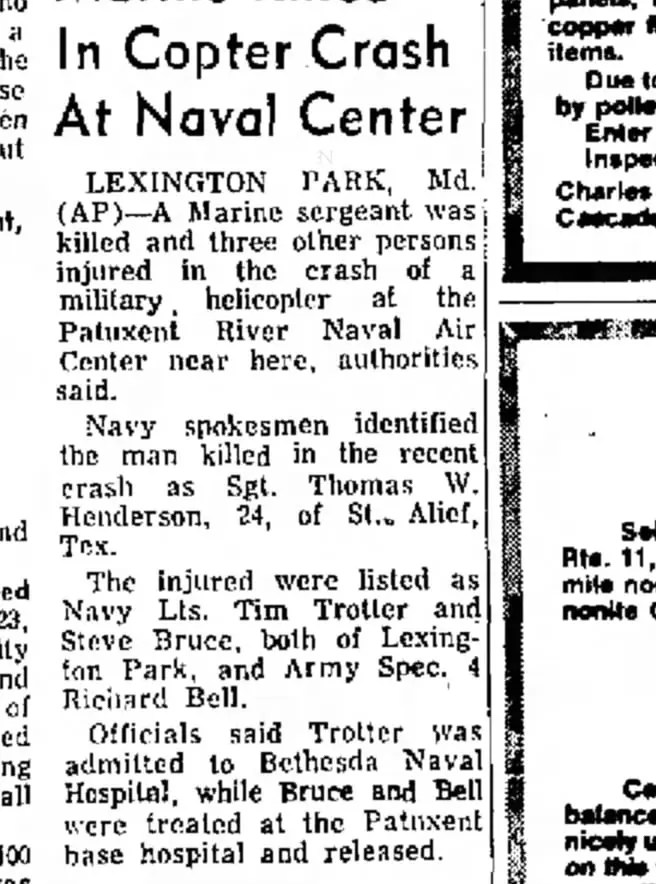
I did not realize until I wrote a book on World War II fliers how dangerous military aviation can be. Steve survived two helicopter crashes–equipment failures–flying Navy Sea Stallions.
The Daily Mail Hagerstown, Maryland • Tue, Jul 24, 1973
But my favorite Steve story came when he was piloting a Sea Stallion and it was time for lunch. The Navy, normally known for pretty good chow, had issued Steve and his crew the worst sandwiches in Western history. When they unwrapped the cellophane, the smell began filling the flight cabin. It was ghastly.
A Russian “trawler” was shadowing Steve’s carrier group in the Mediterranean Sea. So he flew low over the trawler, the Russians and the Americans waving merrily at each other. Or, more likely, making internationally recognized hand gestures at each other.
Then he made another pass. This time, the Americans threw their sandwiches at the Russians. Lunch landed with dreadful ptomaine splats on the trawler’s deck.
Yup. He got chewed out by the Admiral Commanding, up one side and down the other. But I do, especially given current events, love that story.
We will miss him so much.
* * *
April 25, 2023
I did love my brother-in-law, Steve, who died Saturday at his home in Fairfax Station, Virginia.
He loved history, so I added a little local Naval lore, too.
When Steve attended the funeral of a Naval Academy classmate at Annapolis, he changed his mind. He had planned on burial at Arlington, but the Academy cemetery moved him so much that he decided this was where he wanted to be laid to rest.
That was a couple of weeks ago.
So, the video is for Steve, because when I started researching that cemetery and discovered the company that he’ll keep–his forever shipmates–I understood his decision.
Someone is trying to tell me something and, for once, it’s not the typical condemnatory voice that I’ve lived with for seventy-one years. Today it was affirming. It began to creep up on me when I drove to do some grocery shopping at drove past a Muslim family at Elm Street Park. They had a blanket spread out in the shade and they were eating—men, women with their hair covered, little kids. When I drove back home, the blanket was folded and all of them were standing in a circle and holding hands and, I think, singing. To paraphrase a song by Sting: Muslims love their children, too.
It then dawned on me: Ramadan is over. That didn’t hit me until I got home and remembering my beloved student Leila, a devout Muslim, I got little tears in my eyes. Leila had tears in her eyes when, as part of a school assembly that honored retiring teachers, she presented me with a bouquet of roses. She is compassionate, considerate, respectful and she has a first-rate mind—an engineer’s mind, but one driven by a deeply humanitarian heart.
That was the second international moment. The first came when I saw this version of the !Xhosa wedding song on a South African variant of The Voice. The young woman, named Siki Jo-An, is twenty-five and she’s from Elizabethtown.
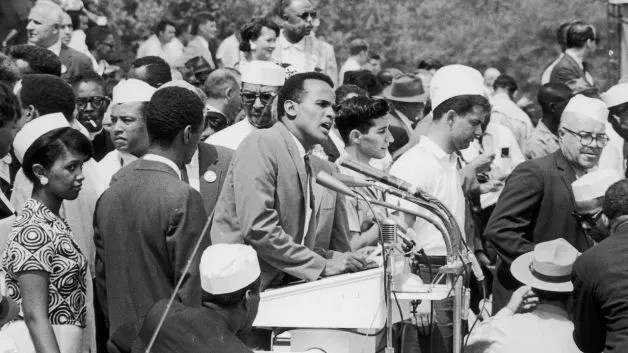
I first heard this song, performed by Miriam Makeba, whose clicks are profound, when I was a little boy on Huasna Road and Mom had both double albums of Harry Belafonte’s concerts at Carnegie Hall. Our cabinet stereo, big as a coffin, also served for the Stones albums I smuggled out of my brother’s bedroom and for my copy of the White Album, which, yes, I did play backward. Paul was dead.
But no albums were played so much as Belafonte’s. I realize now that the man was a fundamental part of my education, along with the braceros who worked the fields just beyond our pasture fence and the food–sopa, sushi, lumpias–that were part of what made growing up in Arroyo Grande so formative for me.
Belafonte’s songs ranged from “Hava Nagela” to “John Henry” to “Sylvie” to “La Bamba.” Since he was Jamaican, perhaps his most famous song endures because of the film Beetlejuice. It’s a marvelous moment.
Maybe it’s because of the braceros, but maybe my favorite song from those albums was his take on “La Bamba.” You can hear Belafonte dancing on the album, but it would be many, many year later, thanks to this video, that I got to see him dance. And, yes, is Spanish is beautiful.
So here’s a Mexican song performed by a Jamaican. Belafonte gave me the education I needed to marvel, sixty years later, at a Muslim family celebrating together, happy together, on the shaded lawn in the Elm Street Park in the town that is my home—and theirs.
Oh, and dinner? Pesto pasta. As American as my collateral ancestor, the president’s aunt, Mildred Washington.
Here are “Mas Que Nada,” from Brazil, by Jazz singer Carol Albert–she gets the song, as do her musicians (the trumpeter is incredible) and backup singers–and “Guantanemara,” from Cuba, by the wonderful Playing for Change people.
And I don’t want to end with even that song. An old American favorite was another South African song written in 1939. It became a Tokens hit in 1961 America. Ladysmith Black Mambazo, “discovered” by Paul Simon in the 1980s, performed the song here, circa 1990, with an a cappella group from London’s East End, the Mint Juleps.
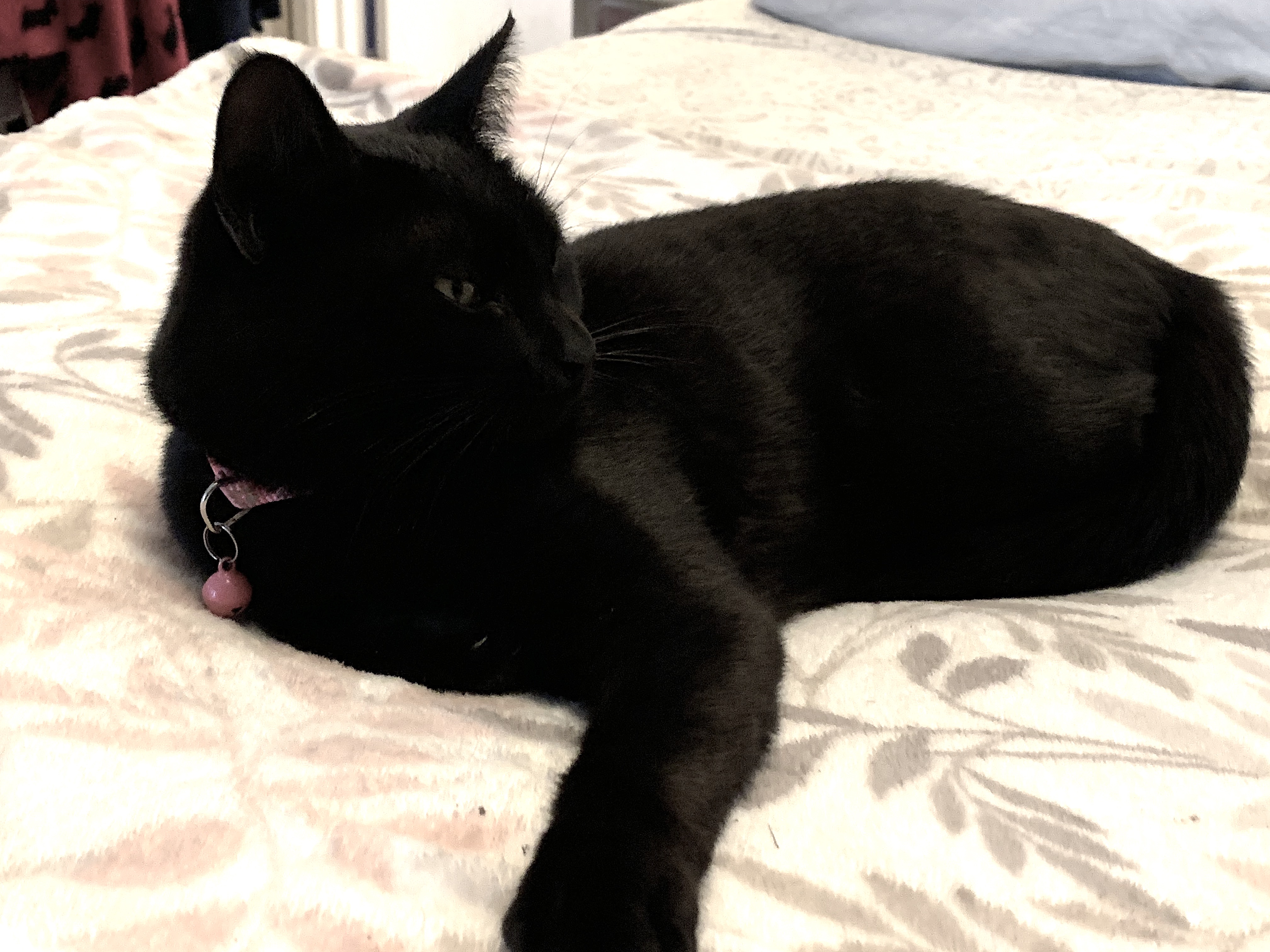
Hattie, whom I refer to, in greetings, as “Sweetie Pie.” Caveat: The girl’s a predator par excellence.
Hattie is just about ten months old. She’s the junior member of the family menagerie. She’s pretty quiet today, spent most of the day sleeping on our bed. I think I know why. Yesterday I found the field mouse she’d gifted us with behind the chair in one corner of the bedroom. Both Rigor and Mortis had set in. Poor mouse. He had a handsome tail.
I think he must’ve put up a helluva fight, because of the way Hattie’s behaving today. He might’ve been the mouse equivalent of the Quarry brothers, San Francisco fighters from more than a few years ago—Jerry and Mike—who also put up a helluva fight before, invariably, losing. Jerry, the heavyweight. lost to Muhammad Ali, which is nothing to be ashamed of.
I think that Mike, a middleweight, lived in San Luis Obispo for a time.
Fortunately, unlike the Quarrys, this mouse did not shed copious amounts of blood. Hattie must have killed him outside and brought him in for us—I looked but could not find a recipe for bacon-wrapped mousies—and then she kind of forgot. I’d already moved him when she went looking behind the chair, emerging with a slightly puzzled look.
Hattie is an uncommonly beautiful cat—I love cats, especially black cats—but it’s really hard for me to compartmentalize the “Hello-Sweetheart” with the “Predator-Killer.” Elizabeth rescued what she thought was a hummingbird from her last week. It turned out to be a huge moth. Thank goodness. The bell collar has helped a little, but not before we discovered, behind the same chair, enough bird feathers for a Lakota chief’s war bonnet.
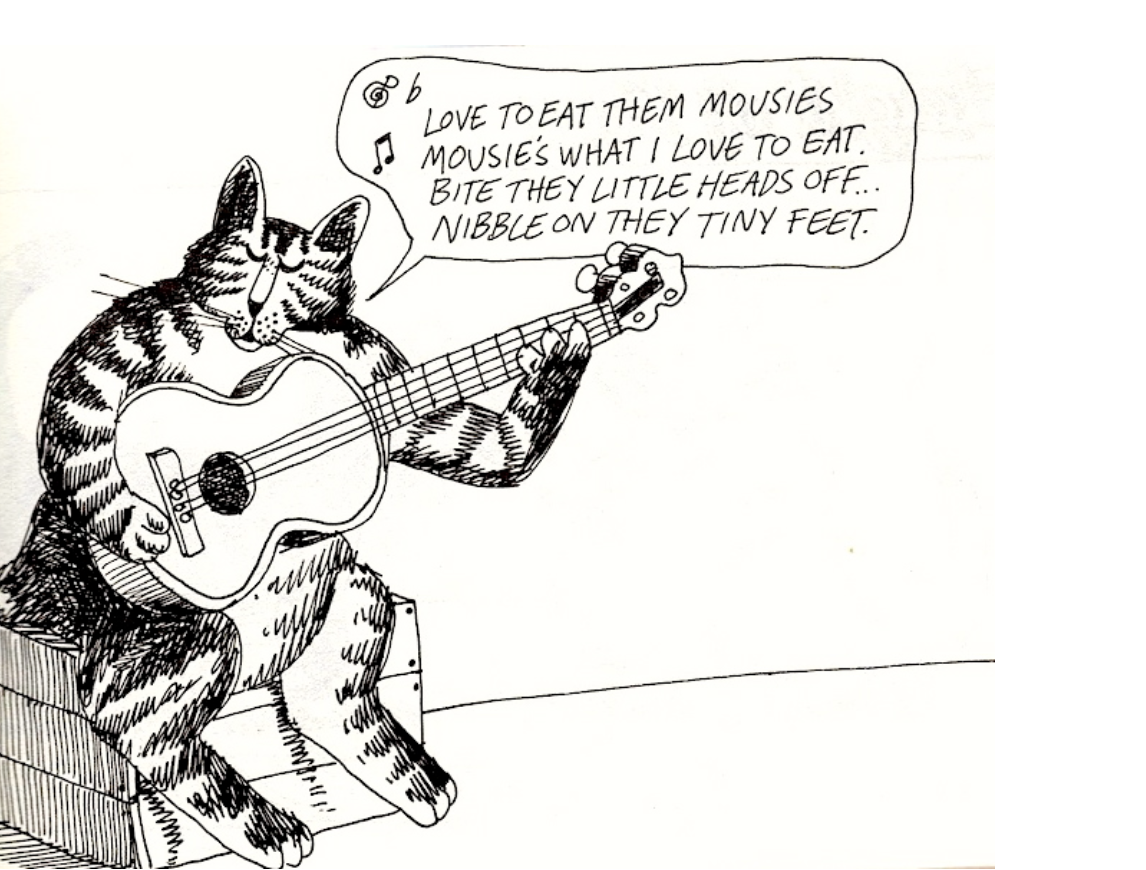
I was, of course, reminded of this classic Kliban cartoon:
The poor little fellow, wrapped inside a paper towel and buried in the trash to go out tomorrow, reminded me of the Notorious Gregory Mouse Story.
When the boys were little human-type fellows, we hit on the misguided idea of going to the pet store in Los Osos to buy them some mousies. “They’re males,” the clerk assured us. He was in error.
Within a short period of time—it seemed like about thirty minutes—our mousie cage in the kitchen of our home was alive with little, little, LITTLE mousies. They were adorable, true, but their numbers were alarming. As you know, Elizabeth and I love Irish Setters, and their litters are often around nine or ten puppies. Or more. Romy, in the photo below, became a Mommy to fifteen in Coventry, England.
Mousies demonstrate the same reproductive talent, but their litters arrive about every—oh, for the sake of argument–about every thirty minutes.
The plot thickened. Sometimes we’d turn on the back porch light and would be charmed at a little raiding party of raccoons, family units, who finally made us realize that we had to bring the dog kibble inside the house and not leave it in the garage. They look like little burglars, with their raccoon masks.
What we did not plan on were the wild field mice that were out there in the Los Osos Wilderness along with the raccoons, possums, skunks and the occasional Wildebeest.
The wild field mice—at least the Frat Brothers among them—somehow found their way into the kitchen and began Making Whoopee with our far more sedate domesticated pets. So our mouse family grew, but with a difference: the new generation, half-wild, had the most incredible leaping ability. Sometimes we’d wake at night and here soft little bonks.
Bonk.
Bonk.
Bonk.
Bonkbonkbonk.
We finally realized—if you’re sensing a certain denseness here, we were not expert rodent people–that the bonks were the sounds of their little skulls hitting the top of the mouse cage as they jumped up and down, with all the joy but not nearly the grace of dancing young Masai warriors.
There are some problems that won’t go away, and Elizabeth informed me, pointedly, that this was one of them. I’m a little ashamed because this is what I decided to do.
I took the bonk-bonk cage across South Bay Boulevard to a lovely vacant lot near Los Osos Middle School–cypress, sweet-smelling sage and sand. I do not remember how I did it, exactly, because it’s darned hard to hide a cage full of adrenalized half-wild mice. Maybe I had a big overcoat, I don’t know.
But I found a pleasant spot—a dell, you might call it—and opened the cage.
The mousies began to dart out like little furry punctuation marks. The less daring among them waited. Then there was a little furry river of mousies, Yearning to be Free.
And then, of course, I was even more shameless. As our mousies disappeared into the vastness of the Los Osos Savannah, I sang the theme to the film Born Free.
I am not making this up.
Hattie, of course, would have been overwhelmed. There’s only so much prey one little predator can handle, after all, all by herself. I feel badly for the gift she brought us, but, as cold as it might sound, one dead mouse is preferable to two dozen lively little bonk-bonks.
Oops. Make that two dead mousies. Elizabeth just found another.
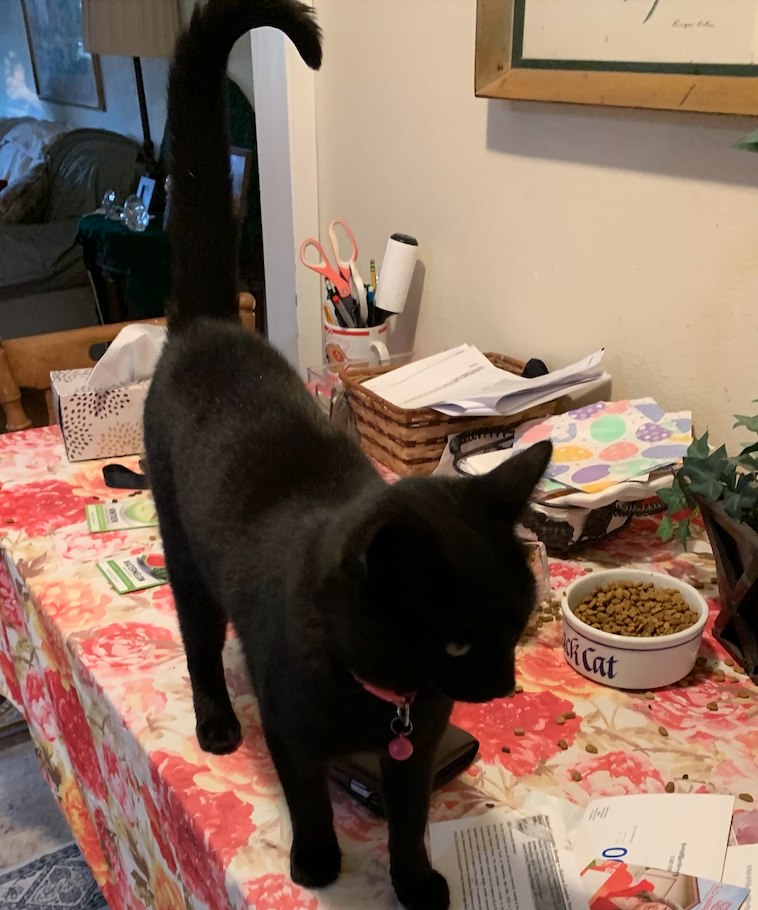
The bulk of Hattie’s diet is on our kitchen table, in kibble and canned form.
For those of you keeping score at home, here’s the theme from Born Free (1966), a marvelous little film about Elsa the Lioness.
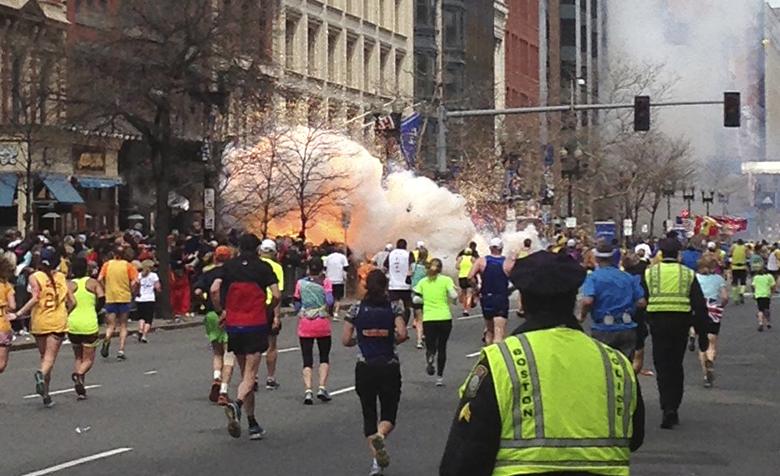
The Boston Marathon was today. It was the tenth anniversary of the bombing. What I remember is that children were killed and some runners lost their legs. But I remember, too, Boston policemen and policewomen running toward the explosion, and the volunteers who came out of the crowd to shepherd victims to ambulances.
The marathon is run every year, with the Covid exceptions, to mark another date in our history that qualifies for the Dickens allusion. The towns of Lexington and Concord are nearby, and on April 19, 1775, 800 British soldiers and marines marched on Lexington to seize a cache of arms reportedly stored there for the use of the American militia, the Minutemen.
The march, made at night, must have been terrifying for the British soldiers, unsophisticated young men for whom military service was the way out from stinking slums and cholera, or, if they were Irish, the way out from starvation.They did not know that Paul Revere and William Dawes were out there, riding ahead of them, to sound the alarm at their approach.
But all along the road, in the dark, they could hear dogs baying and church bells ringing.
When they reached Lexington, they might’ve found the response to the alarms laughable. A motley and very small crew of militia awaited them. What followed was David v. Goliath. Round One to Goliath.
But that was Lexington. These are twin battles—Lexington and Concord—and on the way back to Boston from Concord, the Minutemen ambushed the British and began to winnow them down. Three hundred of the 800 young men come here from an ocean away were casualties— killed, wounded or missing.
I am not a student of the American Revolution. I can tell you the names of several Civil War generals’ horses and I can describe, pretty accurately, the fate of Torpedo Squadron 8 at the Battle of Midway in 1942.
But in 1988, television reminded me of Lexington and Concord in the form of April Morning, a made-for-television film based on the novel by Howard Fast.
It sticks in my mind because James Lee Barrett wrote the script and his son, David, was one of our students at Mission Prep. The film sticks, too, because of its talented cast: Tommy Lee Jones, Robert Urich (if you’re keeping score at home, Jones would have to hang Urich in Lonesome Dove) and Meredith Salenger, the teenaged protagonist in a remarkable Disney movie about the Great Depression, The Journey of Natty Gann.
While April Morning isn’t, in my mind, in the same league as Natty Gann, the other reason it sticks in my mind is this scene, when the British arrive in Lexington. It’s terrifying—the drums contribute–and it reminds us that figures from the 18th century were not faintly comical bewigged men, nor were they submissive women. (I give you Abigail Adams or the appropriately-named Ruth, Salenger’s character, in April Morning as examples. )
Policewomen ran toward the bomb in 2013.
One more point: Confederate volunteers in April 1861 and rioters in January 2021 seemed to believe that they were carrying on the tradition of the Minutemen.
These groups were misinformed and manipulated; demagoguery is a tragic American political tradition.
And the grievances the Minutemen had were not “YOU WILL NOT REPLACE US,” a chant illuminated by the hardware-store Tiki Torches at Charlottesville six years ago. Their grievances, in 1775, make up two-thirds of the next year’s Declaration of Independence.
The thought would’ve been inchoate, but the militia on Lexington Green knew, somehow, that they were there to build a nation, not tear it apart.










 A Work in Progress