
The Interwar Years v. Today
14 Friday Feb 2025
Posted in Uncategorized
14 Friday Feb 2025
Posted in Uncategorized
08 Saturday Feb 2025
Posted in Uncategorized
Because one of my secret alternative careers was to become an advertising copywriter (like my friend Dave), I’ve been paying close attention to the Super Bowl ads now available for preview.
I dig the flying Pringles mustaches and the Affleck brothers’ ad for Dunkin’ Donuts, and the ad where David Beckham discovers that Matt Damon is his long-lost twin brother. I am a big Matt Damon guy.
But this ad, for Michelob Ultra, just might be my favorite so far.
There are several reasons for this. O’Hara has been in many of the Christopher Guest “mockumentaries” (“Best in Show,” “A Mighty Wind,” for example) AND she co-starred with Guest’s collaborator, Eugene Levy, in “Schitt’s Creek.”
Her costar in this commercial is Willem Dafoe, who had perhaps the most epic movie death in history (“Platoon”) and was brilliant in a very small film, “At Eternity’s Gate,” about Vincent van Gogh.
My favorite role of his, however, is as the angelfish in “Finding Nemo.”
Also, as annoying as we are, the Boomers win one in this ad.
Oh, and the game? Kansas City is beautiful–it has hills!–and I visited the city several times when I was a student a Mizzou.
The connections go farther back: Kansas City operatives from the famed Pendergast Machine left a bank bag full of $5 bills on my grandmother’s kitchen table just before every election in Texas County, Missouri, in the 1920s and 1930s.
(The farmhouse is still there, but with a satellite dish.)
Grandma Gregory was the party’s County Chair. My teenaged Dad handed out the fives as voters, Hill People, proud and hungry and barefoot, waited to vote.
So I have a lot of very personal connections to KC.

But I think I’m rooting for the Eagles. Saquon Barkley, dumped by the Giants, just might be one of the most amazing comeback stories in NFL history.
And, to be sure, the Chiefs will be back another year. How can I compare, as a history teacher, their QB, Patrick Mahomes, to Figures from History?
Okay. Here we go:
–Mozart
–Leonardo
–Gene Wilder in “Young Frankenstein.” Okay, and as Willy Wonka, too.
–Louis Armstrong
–Emily Dickinson
–Aretha Franklin
–Walt Whitman
–The opening paragraph to Steinbeck’s “Cannery Row.”
–The closing paragraph to Fitzgerald’s “The Great Gatsby.”
–Linda Ronstadt
Yeah, Mahomes is THAT good.

05 Wednesday Feb 2025
Posted in Uncategorized

By now all the world knows that I am off-the-charts ADHD, which is small freight for this story. This story is about dogs.
But the way I’ll tell it—God Bless thirty years’ worth of history students who had to suffer this—reflects that ADHD thing. I don’t think or write or speak in a linear fashion. I move laterally. One thing reminds me of another and I’ll go there, then to the next topic (they’re like stepping-stones across a garden pond), and then another until, almost invariably, I’ll come home again. The sigh of relief in my students was visible and audible.
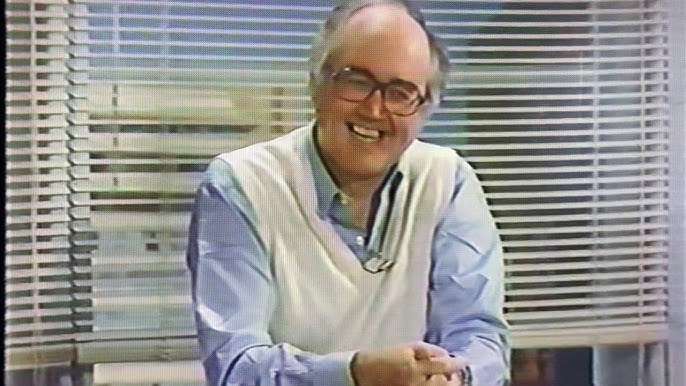
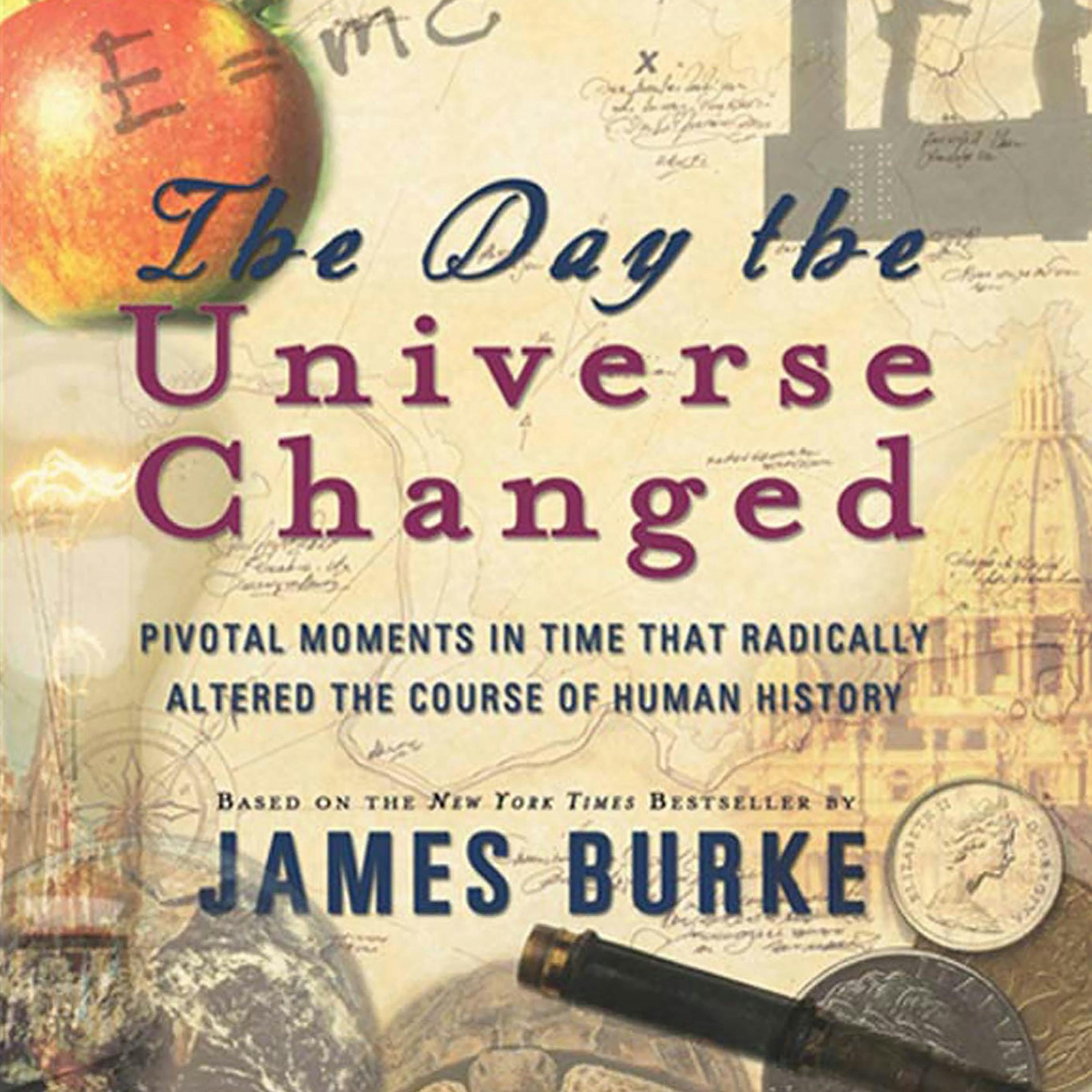
If I had a storytelling mentor, other than Dad and Dan Krieger, to point to, it would be the scientific historian James Burke, who thinks laterally, too, which is one of the great blessings of his 1980s show, The Day the Universe Changed, a staple in my AP European History classes at AGHS.


But this isn’t about James Burke. It’s about Irish Wolfhonds. I saw a lady (not this one) walking her Wolfhound across Elm Street, near the park, and I rolled down my car window:
WHAT A GORGEOUS DOG! I opined. Vigorously. Loudly. I had to struggle not to fall out of the car. She blushed and smiled, so I made her happy. I was maybe happier. You don’t see many Irish Wolfhounds (we’ve been Mom and Dad to Mollie and Brigid, two Irish Setters, and to thirty-eight years’ worth, in our marriage, of a parade of much-loved Pound Puppies.)
Now then, you might ask, why get so exercised about Irish Wolfhounds?
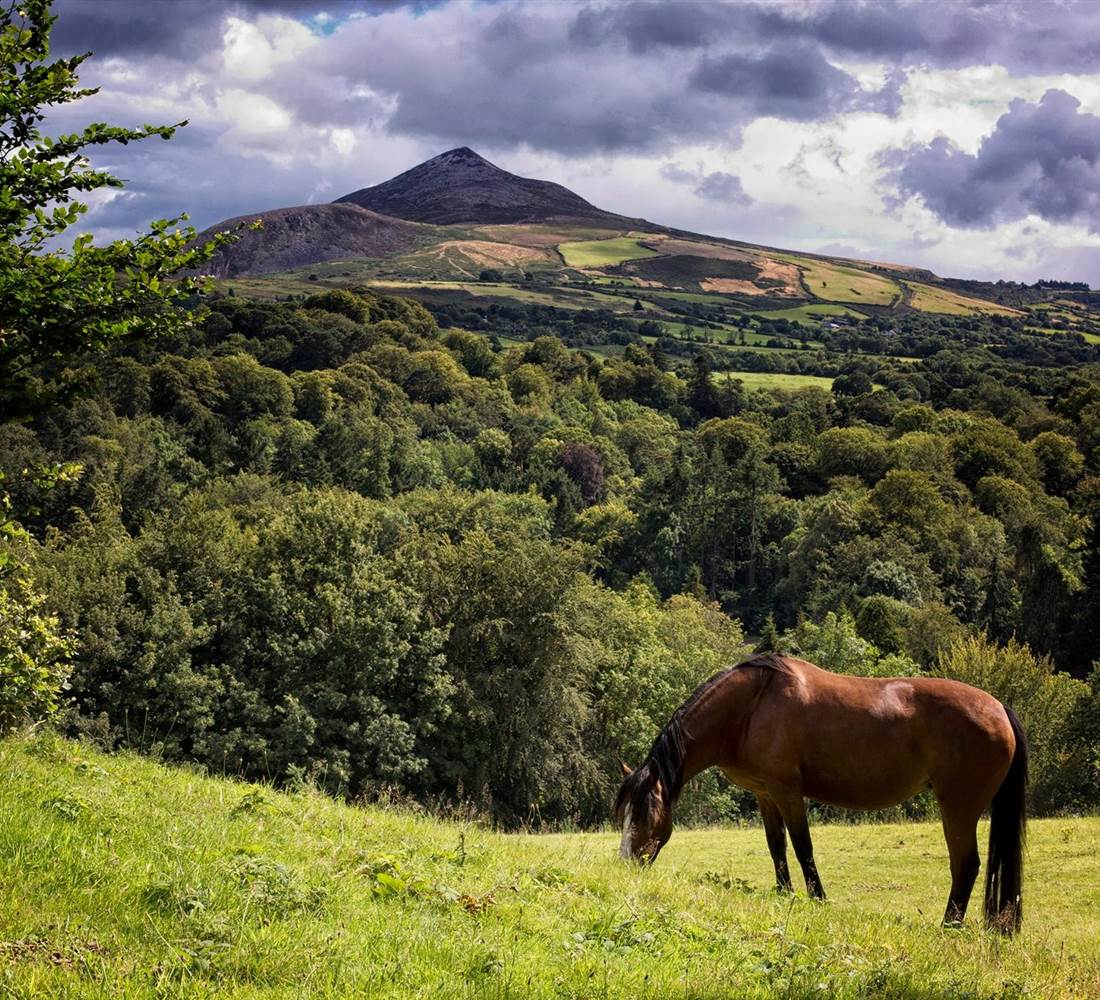
Those of you keeping score at home might remember that I’m about half Irish, and that half comes from County Wicklow, where Mom’s ancestors, Famine refugees, came from. That’s Sugarloaf Mountain in Wicklow, and the requisite horse, Wicklow’s known for them, racers and jumpers and hunters and draught horses and homeless horses who go a-begging, dolphins that leap high above the Irish Sea and rainbow trout the size of Daschshunds.
(Elizabeth and I love Dachshunds, especially the long-haired variety. They look like miniature Irish Setters.)


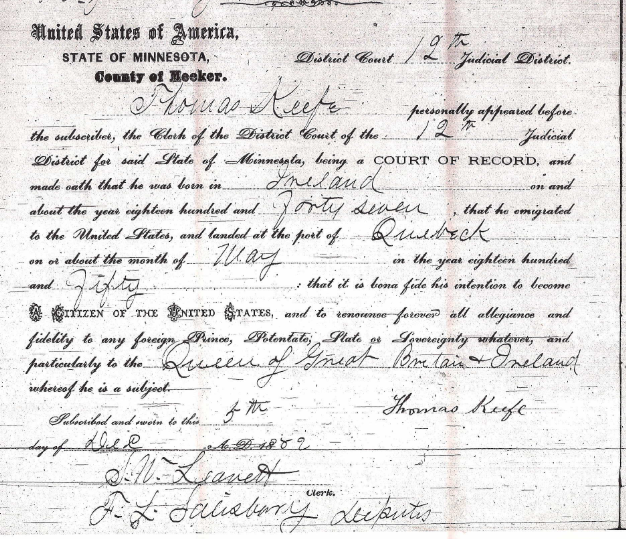
Mom’s ancestors did not come to America. They were Canadians first. This is my second-great-grandfather’s citizenship oath, sworn just before he took up farming in Minnesota.
Great-great-grandfather Thomas Keefe, before he came to Minnesota, farmed in Cobourg, Ontario. Well, son of a gun.


Father Francis Duffy came from Cobourg, Canada, too, where he’d taught in colleges and seminaries. My ancestors became Minnesotans; Father Duffy became a New Yorker, which is why his statue overlooks Times Square today. (We saw it when our niece, Emmy, graduated from NYU. Duffy and Emmy: Two great honors.) Pat O’Brien played Duffy in The Fighting 69th, the World War I regiment in which Duffy had served as regimental chaplain. You can’t go wrong with casting Pat O’Brien as an Irish priest, or his costar, James Cagney, as an Irish-American soldier.
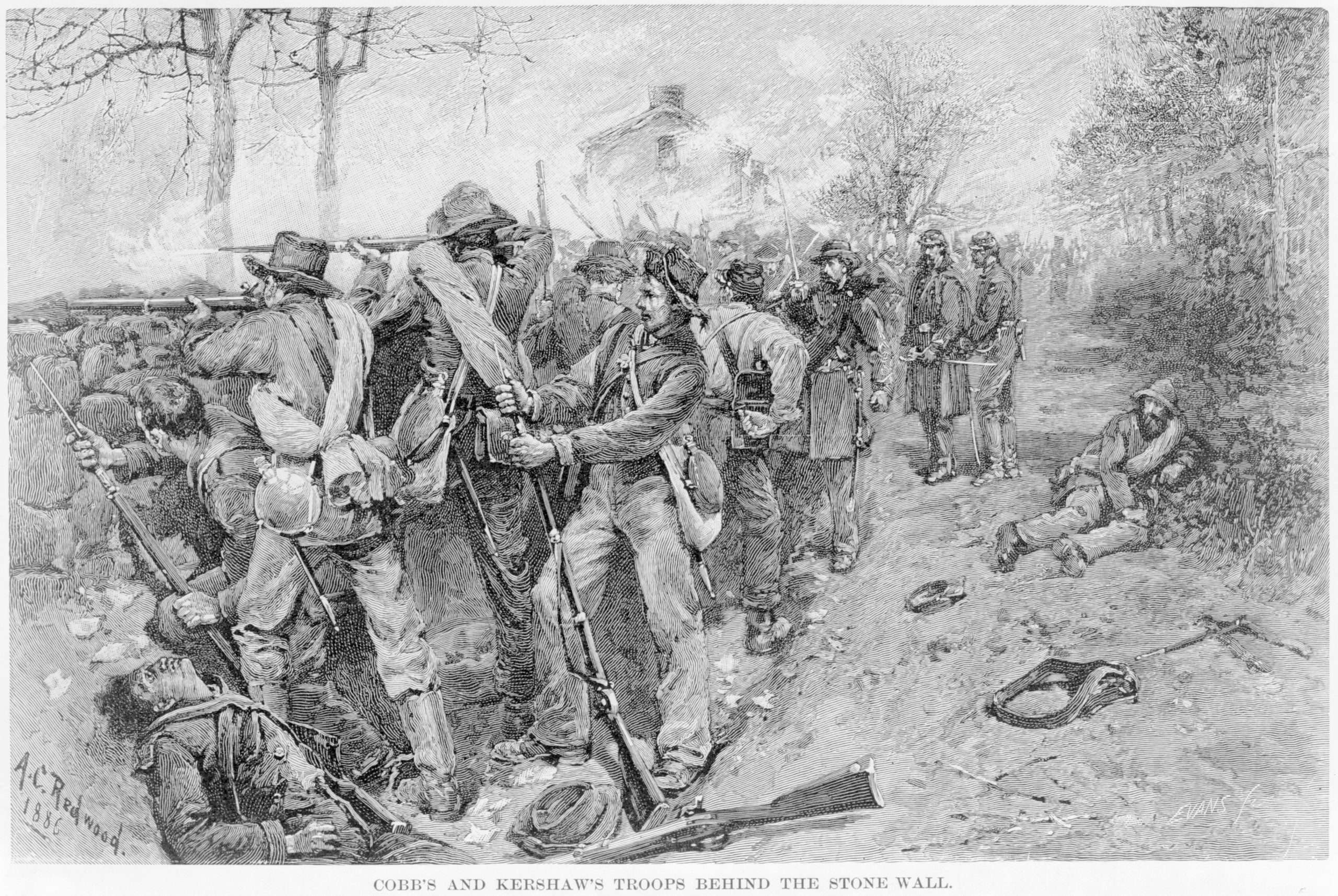
The First World War wasn’t the 69th’s first war. They suffered terribly in the Civil War, especially at the December 1862 Battle of Fredericksburg, where 2/3 of the parent Unit, the Irish Brigade, were killed, wounded or missing. They’d been ordered to assault a stone wall atop a place called Marye’s Heights. Here are two images from different sides of that stone wall, which remains today.


And here is the 69th’s Civil War battle flag. Next to it are the colors of the 24th Georgia. There were so many Irish immigrnts to that part of Georgia that the 24th’s flag includes the Irish harp, as does the 69th New York’s.


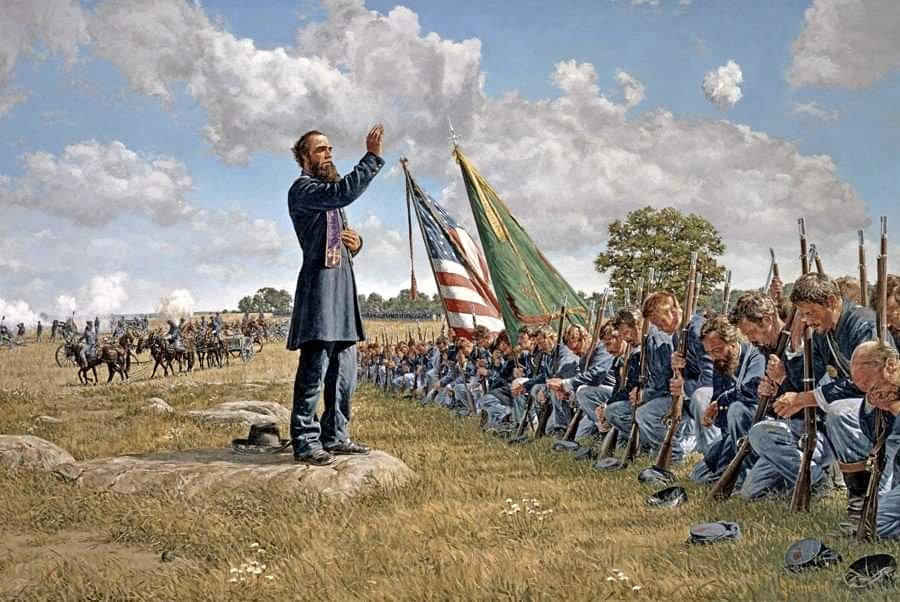
The 69th New York’s war wasn’t close to being over. Eight months later, they and the Irish Brigade were at Gettysburg, where Father William Corby, from the Congregation of the Holy Cross—the order that staffs the University of Notre Dame—granted absolution to the unit before they went into battle. (I suspect that a few Methodists and Episcopalias were kneeling the last rows.)

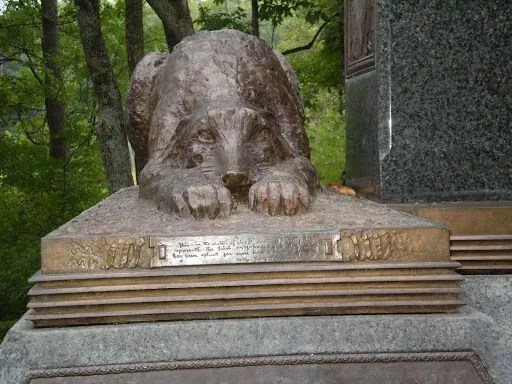
And here the 69th New York’s memorial at the military park today. Look at its base.


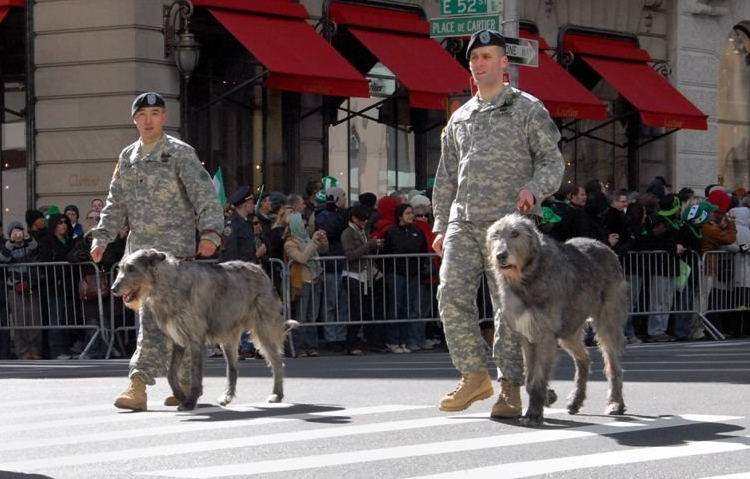
It’s an Irish wolfhound, and so are these, leading the 69th in New York City’s St. Patrick’s Day Parade. It’s a tradition.
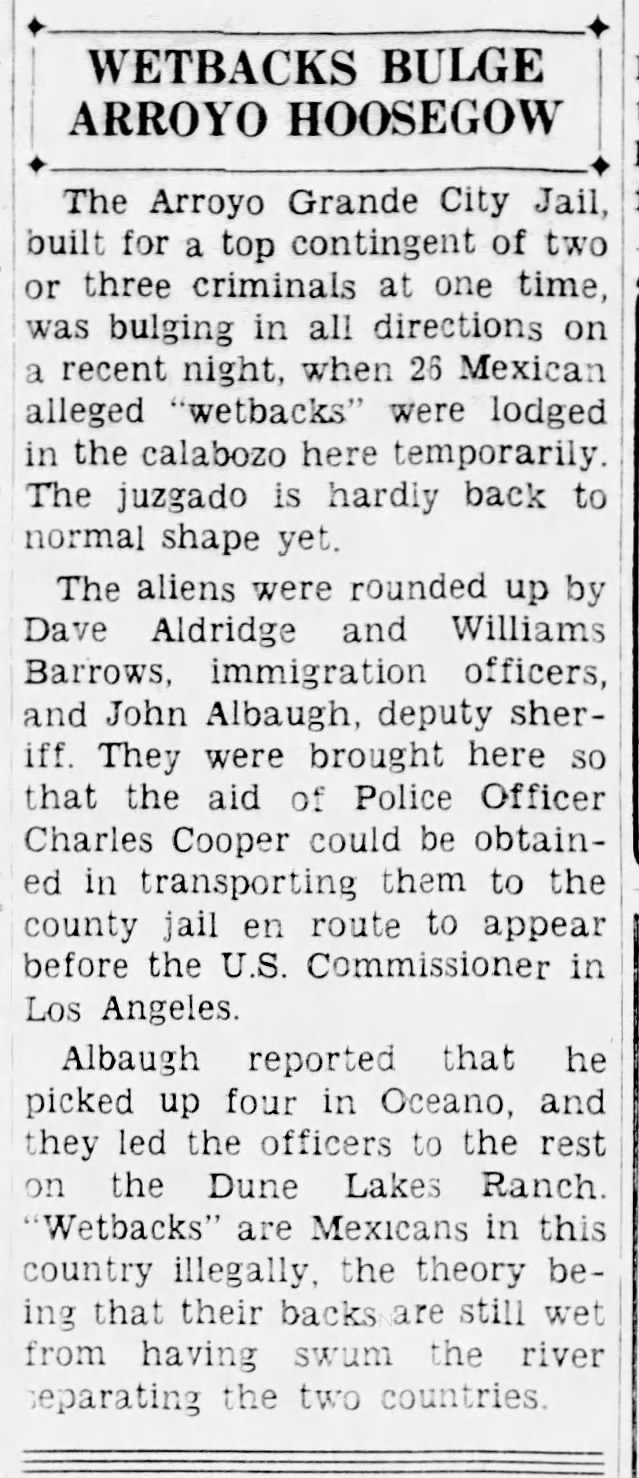
Now, to square the circle of my lateral thinking, I need to come back to my starting point. This story began in Arroyo Grande. This is where it ends, at the end of this little video.
04 Tuesday Feb 2025
Posted in Uncategorized
Better to let them die, and decrease the surplus population. Ebenezer Scrooge, “A Christmas Carol,” 1843
USAID is a criminal organization. Elon Musk, 2025.
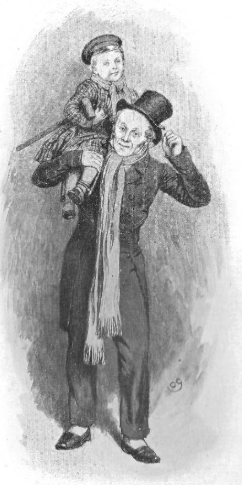
Dickens lives among us. So do Hunger and Want. Scrooge meets them here, thanks to the Ghost of Christmas Present.
Here, Musk carries Li’l X, his son, in the Capitol. Bob Cratchit carried Tim, too, for the simple reason that his son could not walk.


So this song is for you, Elon Musk. I hope that ghosts of children come with it. They will begin to visit come Monday, because they will begin to die this weekend.
Had these children lived, they would’ve remembered the gunnysacks filled with American wheat brought up by great harvesters, belching blue diesel smoke, in South Dakota and and rice harvested, winnowed from drained fields by big combines, from the Sacramento Delta. Their parents would’ve explained to them what the flag on each gunnysack meant.
But by Monday, they’ll be as dead as Marley. Mankind was my business! he wailed to Scrooge, bound by his chains punctuated by strongboxes. Marley, too, was wealthy. The wealth of his agony, in death, was too much to bear.
As to Elon Musk? I don’t know what he’ll experience once he dies, but the children who survive Monday will never forget him. He’s the man who will have taken their brothers and sisters away from them.
This is for my parents. They both experienced want in the Great Depression. Mom’s ancestors were Famine survivors from County Wicklow, Ireland. Dad did see, quite literally, bloody footprints in the snow left by the proud mountain people of the Ozark Plateau.
Both of them knew that there was a better way to treat hungry children. This is what I mean. This is what they taught me, in the link below.
03 Monday Feb 2025
Posted in Uncategorized
24 Friday Jan 2025
Posted in Uncategorized
Kathe Tanner covers the North Coast for the Tribune, my old (if brief) paper from many years ago, and she is excellent. This story made me a little sad. I’m hoping Leffingwell’s closing is a mere demographic blip, soon to be restored by a few more students who deserve a school like this.
I did. My career at AGHS was never particularly distinguished, but my GPA nosedived in 1969. There was chaos at home, including Mom’s death, and I had some excellent teachers, but I could’ve used a place like Leffingwell where there was a better chance for teachers to grow into mentors, when they weren’t surrounded by 35 teenagers in an American Government class. “Continuation School,” in the late 1960s, was pejorative, a place for knuckleheads and girls who got pregnant. (Like my friend Bonnie, who Elizabeth and I found waiting tables at Bob’s Seafood in Morro Bay many years later. I adored Bonnie in 1969; I admired her—it was the weekend just before her daughter graduated from Cal Poly—even more when Elizabeth and I met her over fish and chips.)
I later found out that Bonnie, years later, took her own life, just as my mother had in 1969.
Despite my dismal high school career, I went on to teach Advanced Placement U.S. History and Advanced Placement American Government at Mission Prep in San Luis Obispo. Someone in administration must’ve lost their mind, a suspicion confirmed eleven years later when I was suspended from my teaching position for insubordination. The same kind of catastrophic lapse in judgment came fifteen years later, when they decided I should be Lucia Mar’s Teacher of the Year.
Bosh.
In Lucia Mar, at AGHS, I taught Advanced Placement European teacher, and there was at least one colleague who couldn’t resist needling me for teaching “easy” kids. (I only got the job because the previous AP teacher, a little soft on Hitler for my taste, resigned to take a higher-paying job in another high school.)
I understood my colleague, even though the little barbs she threw drew blood. I was not particularly good at teaching the “regular” kids—there isn’t a good word to describe the vast, and important, in-betweens—10th Grade World History. It took my passion for the subject and a year’s maturity (mine and theirs) to make me love teaching 11th Grade U.S. History.
But I found out something else in the interregnum. Between leaving Mission and beginning at my Alma Mater, AGHS, I taught for a year in Atascadero Unified. It was Night School. I was assigned every student who’d failed World History or U.S. History—or both—and they had to get through me to graduate high school. They were the “retreads.”
Napoleon could not begin to imagine the immensity of my power.

I also taught GED for adults (thank God for the student who helped me to teach math) and, in one of the richest experiences of my teaching life, I taught an adult how to read.
I didn’t have that much fun until, at AGHS, Mr. Goossen tapped me to teach a study hall for at-risk kids. When my class filed in the first day, I felt a quiver of fear: one of them, Jack Raymond, had a lacquered Mohawk. In technicolor. I was doomed. There was no way I could teach to a Mohawk.
The one thing I had going for me was that they were expected to begin each class by journaling. I collected them periodically, read them and commented on them. In the process, I found out f that many of my study hall charges were very bright—-some of them brighter than I–and some of them lived in directionless homes, slept on dirty sheets at night, had lost someone whom they loved, frequently a role model, and they loved the constancy of their closest friends, always music and almost as often a cat or dog.
I thought Jack was smiling at me insolently sometimes. It turned out later that he liked my sense of humor.
The honor in teaching AP students was in their drive, their curiosity, their willingness to learn the craft of writing. In teaching “retreads,” I discovered in my students the immensity of their compassion and the incredible courage it took for them just to come to school, to come to my class, every day. I certainly didn’t have that kind of courage in high school. I missed a lot of classes.
We were assigned Melville’s Moby-Dick as 11th-graders and I conveniently came down with strep. That meant that I could cover myself with blankets, stretch out on the sofa with our West Highland White Terrier, Winnie, asleep on my feet, and begin to learn more about whales than I ever wanted to know.
But I was safe. I didn’t have to go to school.
That’s when and where I learned to be a Retread.
19 Sunday Jan 2025
Posted in Uncategorized


I was all a-melt over a Newfoundland Mom and her puppies (eleven!) I saw on Animal Planet yesterday. When she got stressed out, she went swimming.
Then I found out my friend Erica Mueller had a Newfoundland named Fergus. What an outstanding name! When Fergus needed decompressing, they’d take him to river to swim, upcurrent, until he was finally tired out.
I bet it took Fergus a long time to tire out.
That led me to pondering Irish Setters. They love the water, too—note the difference between Mollie, our first Setter, and Wilson, our first Basset, at Laguna Lake, in the photo below.
Setters are also field dogs. I feel sorry for the grouse in that first photo, but when Elizabeth comes home, Brigid heads for the toy basket and emerges triumphant with a doggie toy in her mouth, just for Mom.


Fergus and Brigid behave the way they do because of their breeding, whatever that means, I guess it’s in their DNA.
But I wonder if part of them is beyond DNA.
Maybe it’s even Jungian, as in Carl Jung, the pioneering psychotherapist and theorist who believed in the “collective unconscious,” a kind of memory pool that all humans share. It goes back, Jung argued, to our ancestral human mother, the woman some physical anthropologists refer to as “Mitochondrial Eve.”
She was African. So, of course, were the women warriors in Black Panther. Damn. I hope I got some of that DNA.
I don’t know that this is true. But one of my heroes (because he looked and sounded like my Grandpa Kelly) is the mythologist Joseph Campbell, who pointed out that there is a version of the Cinderella story in virtually every culture.
I once watched the actor Wes Studi–Magua in Last of the Mohicans–and this man, who had played such a cruel character in this film, had little children at his feet rapt on the PBS show Reading Rainbow while he read them, so gently, a Native American version of “Cinderella.”
I was rapt, too. So here, Campbell and Studi, are two great storytellers:


One of my favorite poets, despite his verbosity, a sin I share, is the American Walt Whitman, who believed that all of us, living and dead, are bound together by a kind connection, a kind of spiritual film that presaged Jung, that makes us all brothers and sisters. Midway through his poem “Crossing Brooklyn Ferry,” you suddenly get the intense feeling that the old fart, Whitman, is watching you, just over your shoulder, as you read the poem he wrote in 1856.
He’s got a little smile on his face, Whitman does.

Maybe it was Whitman’s poem that made me love this 1988 film opening, even with the Big Hair, so very much.
When the Twin Towers come into view, they hurt. I cannot see them now, but Nichols’ introduction reminds me that even the vanished Towers are are part of me, too.
Maybe even the sixteenth century is part of me.
I was watching parts of the two “Elizabeth” films with Cate Blanchett this morning–that’s her coronation portrait below.
My ninth great-grandmother, Lady Elizabeth Gelsthorpe Gregory, died in the great queen’s reign, three years before the Armada, and is buried beneath the concrete of this little London church.


My Elizabeth says that we Gregorys have very distinctive mannerisms, like the way we tilt our heads just before we have something meaningful to say.
And here comes Brigid with a toy chicken in her mouth.
You have to wonder: Did Lady Elizabeth tilt her head in the same way that my big sister does today?
Did my cousin Roy, killed by Waffen-SS troops on the doorstep of a French church in January 1945, do the same thing?
And if Roberta and Roy had that little tic, doesn’t that mean that, even with the intervention of so many years, that all of us are much, much closer to each other than we think we are? Don’t we, all of us, belong to each other? The poet John Donne certainly thought so.
But maybe now that’s the kind of thinking, in my case thanks to dogs, that will get you into trouble.
17 Friday Jan 2025
Posted in trump, Uncategorized
This beautiful and poignant painting is by the late Tom Freeman. I’ve used it several times, since I write so much about World War II, including the two Arroyo Grande sailors lost when Arizona blew up on Sunday, December 7. 1941. I loved teaching United States History, and this ship is so evocative of one of the sharpest turning points in our past.
Monday’s turning point—the Inauguration—is so sharp that it could, metaphorically at least, break our necks.
This might well be our last weekend as a free people. We might have thought this so on December 8, when vast Japanese fleets and air armadas were rumored off San Francisco, when Germany, who declared war the next day, seemed so invincible. It took us nearly four years to make ourselves free again.
I wonder if we’ve lost the will to be free—it’s hard work, true— in 2025. Now we want to be the tough guys the Japanese thought themselves to be in 1941. They wanted a free hand in China. We want Greenland and the Canal and maybe even Canada. We are ambitious, aren’t we? And both the Japanese and the Germans, two nations in the grip of racism, wanted to punish anyone whom they considered their inferiors. Now we want to be the punishers.
My fears about us, today, were heightened by brief glimpses—about all I could take–of this week’s Senate confirmation hearings. They included an alcoholic misogynist who will preside over Defense, a Wall Street player who believes in the magic of tariffs—someone needs to explain the Great Depression to this man— and in the wisdom of tax cuts for the wealthiest Americans, a state attorney general, a 2020 election denier, who thinks Justice has been “weaponized,” and, today featured the DHS-Secretary designate, who dragged her hunting dog into a gravel pit and shot her dead.


What I saw was appalling. All of them were evasive when they weren’t being hyperbolic. All of them lied about the policies they would enforce or choose not to enforce, just as three Supreme Court nominees lied. All of them had kissed the generous rear (wisely, from the great distance that separates D.C. from Mar-a-Lago) of the man who’d nominated them. They were beholden to him, afraid of him. He was the audience they were playing to.
Of course, they were all Republicans. But these are all Republicans, too. From “Truth Social” Wednesday, as quoted by NPR:
“As of today, the incoming Trump Administration has hired over 1,000 people for The United States Government,” Trump’s post reads. “They are outstanding in every way, and you will see the fruits of their labor over the coming years. We will MAKE AMERICA GREAT AGAIN, and it will happen very quickly!
“In order to save time, money, and effort, it would be helpful if you would not send, or recommend to us, people who worked with, or are endorsed by, Americans for No Prosperity (headed by Charles Koch), ‘Dumb as a Rock’ John Bolton, ‘Birdbrain’ Nikki Haley, Mike Pence, disloyal Warmongers Dick Cheney, and his Psycho daughter, Liz, Mitt Romney, Paul Ryan, General(?) Mark Milley, James Mattis, Mark Yesper, or any of the other people suffering from Trump Derangement Syndrome, more commonly known as TDS. Thank you for your attention to this matter!”and his Psycho daughter, Liz.
These people—not to mention scores of Democrats, are among the Enemy Within. The Democrats might find themselves in prison if Trump, the man Scots refer to as the “Cheetoh-Faced Shitgibbon”—can move fast enough before the midterms.
That’s what he wants to do, with his seventh-grade command of his emotions, his language, his nation’s history (he did not know who won World War I; a speech he gave on Gettysburg reads like seventh-grade crib notes) and of his curious middle school/Mean Girls definition of “treason,” the crime he asserts that was committed by Liz Cheney, Adam Schiff and Gen. Mark Milley.
The Americans who voted for the Shitgibbon, who will, of course, pay a terrible price, given his designs on Medicare, Medicaid, Social Security, on the prices they’ll pay, inflated by his tariffs, on the fecklessness of industrialists, enriched by the Trumpian tax cuts and freed to visit on their employees the kind of cruelty depicted by Upton Sinclair, even by Charles Dickens.
The testifiers remind me of the ghastly Edgar Allan Poe story, “Hop-Frog; Or, the Eight Chained Ourang-Outangs.” A despotic ruler throws a costume party. His high-born guests, like the president-elect’s oligarchs and nominees, think themselves so far above the common folk that they make fun of them. They are especially merciless toward the king’s court jester.
But it’s the court jester who proposes the costume party. All agree that it’s a splendid idea.
The jester also provides the costumes—the orangutan costumes—tight-fitting and doused in alcohol. Once the party’s underway, he sets his tormenters alight.


This is easily one of Poe’s most dismal stories, and as you may have noted, he is not one of our more cheerful writers. I don’t advocate this fate for the potential Cabinet officers who are testifying this week. But if they are someday consumed by fire, the agent that starts it will be, of course, hairspray.


Their boss, disappointed, will turn on them, as he has on nearly everyone else who has served him.
Or, if Justice and the FBI and his other Cabinet officers survive Trump, there is still a chance, a slight one, given recent history, of their jail time sometime after 2028.
As for the rest of us, I’m reminded of the late cartoonist/satirist Walt Kelly, who created a swamp inherited by a variety of creatures, including Pogo the Possum. Kelly was one of the few—others were CBS newsman Edward R. Murrow and The Crucible’s Arthur Miller—to finally come around and confront Sen. Joseph McCarthy and his communist witch hunts. This might be the wisest remark Pogo ever uttered.
It fits seventy years after the Army-McCarthy hearings that finally brought Joseph McCarthy down.
McCarthy’s chief counsel, of course, was Roy Cohn, one of President-elect Trump’s mentors.
The turning point came in a confrontation between United States Army counsel Joseph Welch and Sen. McCarthy. It was an indelible moment, captured live on television, then in its infancy.
I do not know if we can find another Joseph Welch. But, in just my family’s humble past, we found a sailor and a soldier who gave their lives for us, in December 1941 and January 1945, respectively. We have Irish immigrants who worked in Pennsylvania oilfields, homesteaded on the Minnesota prairie, grew oranges in Southern California. We have a woman—my paternal grandmother—who was one of the first delegates to a national political convention, in Madison Square Garden in 1924. We have a woman—my maternal grandmother—who grew up in a rough gold-mining town and learned to cook from Chinese immigrants. My paternal grandfather was so devoted to education on the Ozark Plateau that they dismissed classes in Texas County, Missouri, on the day of his funeral in 1933. My maternal grandfather was a cop in a tough oil-town, Taft, who once laid out three roughnecks, cold as tinned sardines, in an alleyway after they’d jumped him. He helped a lost little boy, terrified, find his way home. We have a railroad engineer who drove the Great Northern Empire Builder until the day he died at the controls. We have an Irish immigrant nun who devoted her life to orphans in the Albany orphanage that was once the home of Hamilton’s Schuyler sisters.


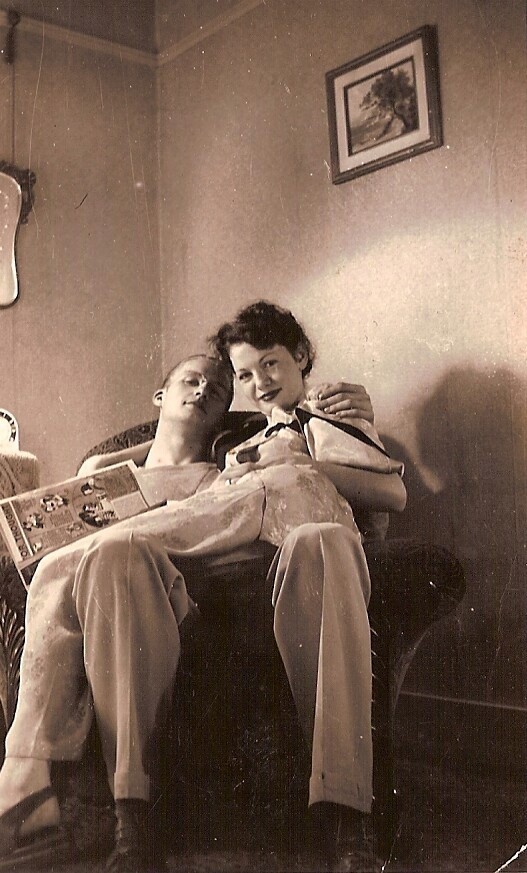
And, of course, we have my folks, in the photos just above, who taught me many things, including the deep love I have for my country, including and despite its faults. They made me, without knowing it, a history teacher.
There’s just the faintest chance that in this immense reach for power that begins Monday, Donald John Trump will soon find himself outnumbered by people of character. Nearly all of them, including my family members, are dead now. They are ghosts. Maybe Trump, if he’s lucky, will suffer a Dickensian fate, like Scrooge’s redemption.
Or maybe, finally, in the depth of his cruelty, Poe will catch up with him instead.
13 Monday Jan 2025
Posted in trump, Uncategorized
Tags
If you know history—worse, if you teach it, which steers you into confrontations you don’t want—your tolerance for ignorance dissipates. This quote is a favorite of ignorant people.
Of course your ancestors came here the “right way,” especially if they came between 1880 and 1914. We had another ten years before we would subdue the first immigrants—the Lakota people—at Wounded Knee, and we still had a vast continent to fill once we’d accomplished the extermination, or near-exterminations, that we’d always glorified, from Puritan sermons to the the pronouncements of the first governor of California to breathless newspaper dispatches from the Black Hills, and its gold deposits, in the 1870s.
So your ancestors—Italians, Poles, Russian Jews, Bohemians. Irish and the largest immirant group, Germans–were needed to fill the empty space in this map. Their influence remains: In Texas, there are many little towns where “Texas German,” is the second language. Missouri River towns have names like Versailles, Vichy, Hermann. In my hometown, Arroyo Grande, Califronia, what is now Cherry Avenue was dense with Bohemian families.

We were starved for people. Unless, of course, to use a few examples, you were Chinese (denied with the Exclusion Act), Japanese (The “Gentleman’s Agreement”) or Filipino (citizens and then, on a Congressional whim, not citizens. Filipinas were not allowed to come to America.)
“Illegal Aliens” are driven by the same desires that motivated Italians, Russian Jews or the Irish: poverty, persecution, starvation. But not even the “coffin ships” that claimed so many Irish immigrants can compare to the agonizing deaths in our Desert Southwest today.


The great irony is that we are as starved for people now as we were in 1880. The vastness now is not calculated in land, but in the passing of Americans from my generation—the so-called” Boomers”—who, liked the migrants, leave nothing behind when they die: the American birth rate in 2023 was half that of 1957, in the midst of the Baby Boom. And the Boomers are retiring—or dying—so it’s we account who for the gap today, generational rather than geographical, that so closely resembles the emptiness between the Mississippi and the Pacific in 1880.
But these people are not welcomed, ostensibly because they came here the “wrong way.” They came here because death squads killed friends or family members, because climate change has reduced fields of corn to crisp rows resembling papyrus, because there are no jobs for young people in bifurcated economies marked by the vast divide between landowning elites and landless farmworkers.
What would you do in the same circumstances? Illuminate me.
12 Sunday Jan 2025
Posted in Uncategorized
I don’t think there’s any recent event that’s had had such an emotional impact on me as the fires. They have reminded me, for one example, that I remember dinosaurs.
Remembering dinosaurs–in my case, the Shell Beach brontosauraus–for someone about to turn seventy-three, means that death doesn’t carry the freight it had when I was twenty-three, about when I saw the actor John Houseman in the film “Paper Chase.”
The fires reminded me that John Donne was right:
Death, be not proud, though some have called thee
Mighty and dreadful, for thou art not so;…
This is an old man’s hand. That’s not the centerpiece of this blog post, which is about hope and remembrance.
I have noticed, too, the kind of crepe-y skin that the actress Jane Seymour deplores is starting to appear on the undersides of my forearms, and on my borther Bruce’s. Shoot howdy, I rememer Seymour as Kate, the incredibly evil lover of Adam Trask in the miniseries East of Eden. She wone a Golden Globe, more power to her, becuase I despised her.
Her lover/husband, Adam Trask, was played by Timothy Bottoms. To show you how slyly the years have paaaed, Elizabeth and I enjoy immensely an AnimalPlanet show about Bottoms’s son, Buckeye, now a vet in Hawaii. He has all of the compassion that Kate lacked. And he adores his Pittie cross, who goes with him everywhere.
Buckeye’s Pop was the star in another generational film, The Paper Chase, about Harvard Law, whose pivot was the incredible actor/director John Houseman, imperiorus as Timothy Bottoms’s torts professor. (“Bottoms’s” is a peculiar construction, isn’t it?) And Bottoms ahd the great good luck to fall in lvoe with Lindsey Wagner, his torts professor’s daughter and later The Bionic Woman.


You would think, wouldn’t you? You would think that this blog will be filled with self–pity? You would be right, because I have a lot of that trait, in addition to the aging hands. I used to remember the names of the horses of virtually every general in the Civil War. Now I can’t rember the name of the actress in Alien. (It was Sigourney Weave.) I get my facts wrong far, far more tha I used to.(San Luis Obispo muscian Louie Ortega never played for Whale’s Knees, I was bluntly and correctly informed. I keep making my big siter a year olde than she really is. The declination of my night vision means that I get lost on Elm Street in Arroyo Grande, when I look anxiously for the big lights that illuminate the shopping center where I worked, at Kinney’s Shoes, fifty-five years ago.
And then there’s this.
This is part of my workout yesterday, and I’m proud of it, but it’s faint echo my twenties, I benched 200 lbs with reps–when I was a wee fellao— went shopping in SLO for polo shirts whose sleeves would stretch because my bicps strained them. I was a hunka hunk.
And I was a flaming asshole.
I will be seventy-three this month. Now it takes me a full minute to shift from my left to my right side in bed. (Someimes I have to shift Walter the Basset Hound first, which is roughly equivalnet to benching 200 lbs.) When I’m awake and more or less conscious, everything hurts. The distanc between me an dthe quarter I dropped on the kitchen floor seems just a bit farther than the distance between Oxnard and Arroyo Grande.
When I have to show my ID for groecery shopping, I like to joke that “I was around when dinosaurs roamed the Earth.” Which I was, if some of you remember the Shell Beach Brotosaurus.
No, just in case you were waiting for me to feel sorry for myself, here just a few things I rmember from my impossibly long time on this here Planet Earth. And the wrinkles on that old, old hand? They make me very happy. Even the cheesy ones, which remind me that the one thing—maybe the only thing— I’m not afraid of is dying. Not that I’m in a hurry, mind you.
I remeber the first video; I adore the second, and there’s nothing I loved teaching quite so much as the third.
So there. Death be not be proud. You don’t scare me. Not one damned bit.