• About
  • The Germans

A Work in Progress

A Work in Progress

Category Archives: World War II

American Twilight: The Golden Gate Exposition of 1939

Featured

Posted by ag1970 in Arroyo Grande, California history, Uncategorized, World War II

≈ Leave a comment

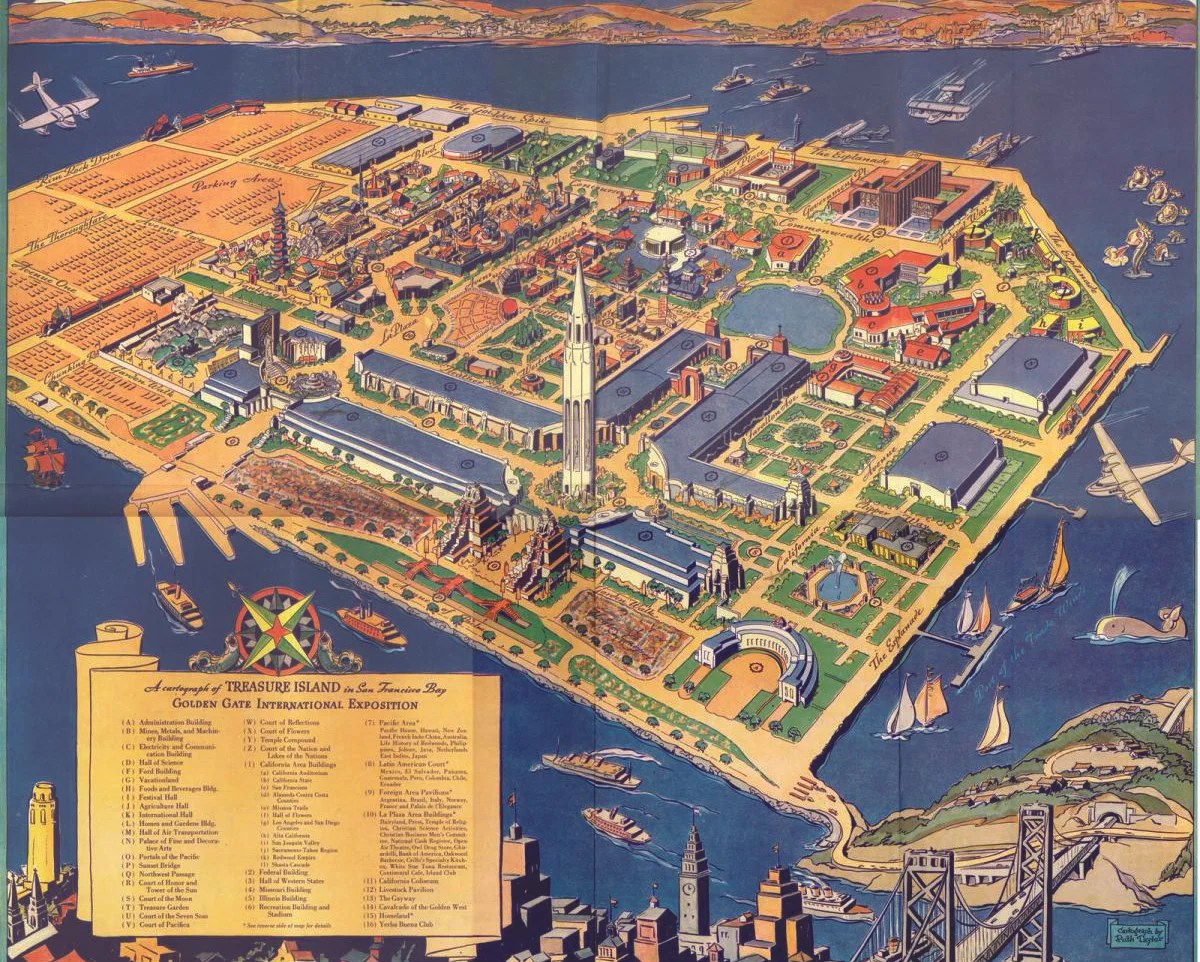
In 1939, San Francisco’s Treasure Island was the site for the Golden Gate Exposition, a showcase dedicated to a world beginning to emerge from the Great Depression. The Exposition was a masterpiece of Art Deco design and, with California comfortably distant from Europe, tinges of optimism must’ve remained awhile; I imagine the fall of France ended all that.

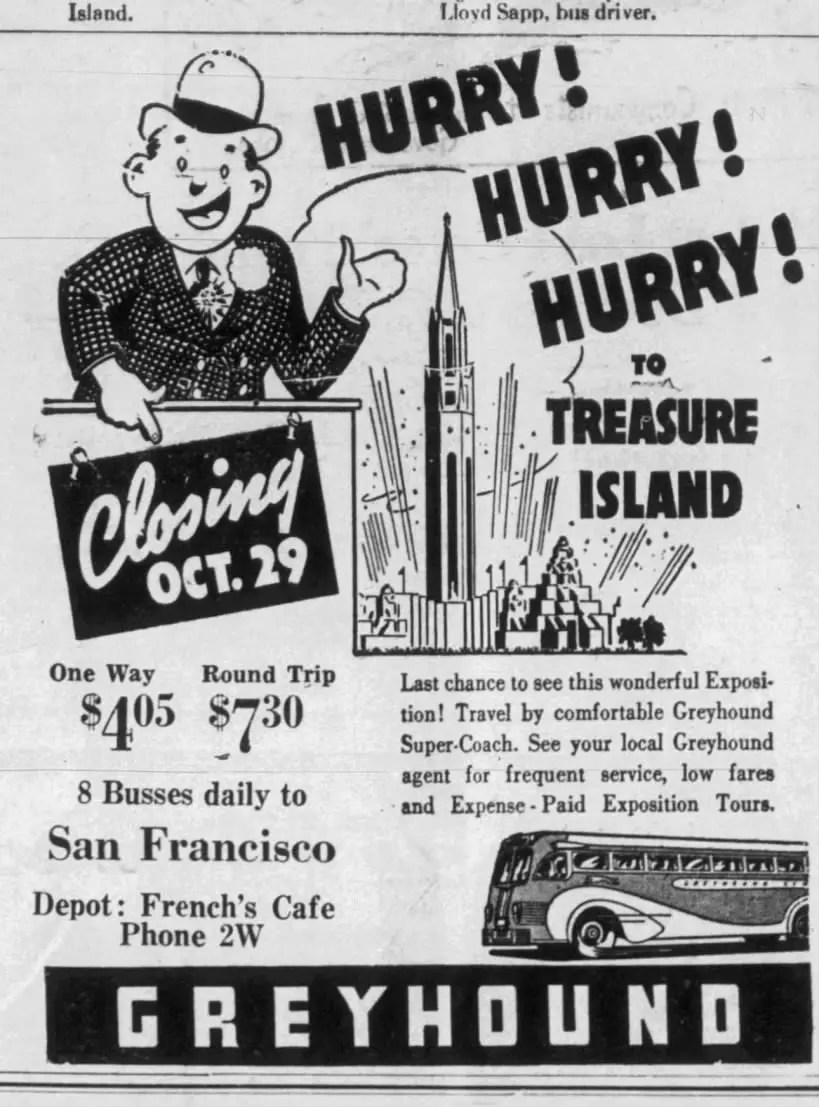
The Exposition even won periodic mention in the little Arroyo Grande Herald-Recorder, including this October 1939 display ad. I think the Greyhound station was in the Olohan Building, whose basement is now home to Klondike Pizza. A Klondike pizza is also good for transient moments of optimism, if I may be allowed to editorialize.
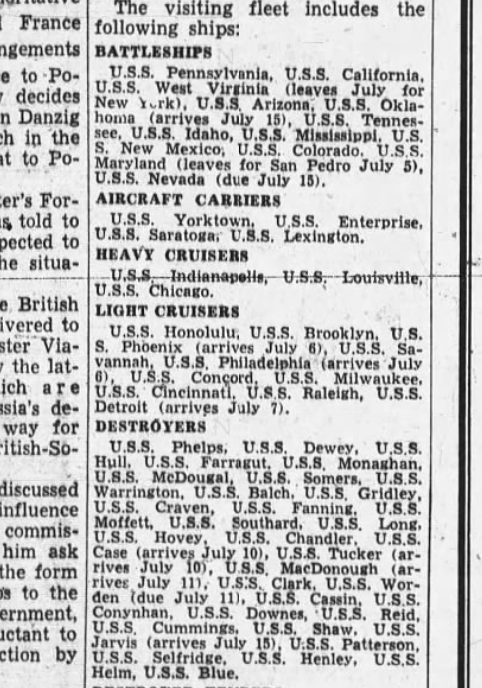
What had to be a highlight of the Exposition came in June and July 1939, when most of the Pacific Fleet, just off maneuvers, sailed into San Francisco Bay for a visit. Many years ago, my wife and my sons and I spent a delightful visit to our favorite city during Fleet Week, when we saw the Blue Angels, sailors from twenty nations, and, on a Muni Bus, a bearded lady (who was very nice) and a man who could do 360s with his dentures. I preferred the visits to the submarine Pompanito and the Liberty Ship Jeremiah O’Brien, but I’m built that way, I guess.

Here’s an article from an Oakland newspaper—with little seeming regard for what we’d call “national security” today— about the ships, and their 40,000 men, headed for the Exposition:

And here, also from British Pathe, is a remarkable video as the fleet arrives, led by battleships, then a light cruiser and finally the preciuus carriers. And then, best of all, happy sailors coming ashore for liberty.


The scale of these ships is hard to imagine, even though they’re relatively small when compared to modern aircraft carriers. A Pennsylvania-class battleship, like the one in the video below, displaced 32,000 tons, was 600 feet long and carried a complement of about 60 officers, 70 Marines and 1,000 enlisted men. These ships were small cities. And small cities need the mail delivered, even in mid-Caribbean. This film is from the early 1930s:


And the battleship in the newsreel—you had to know this was coming—was, of course, USS Arizona, lost with 1100 crew, including two sailors who were raised in Arroyo Grande, on December 7, 1941.

Maybe it’s just me, but I am a devoted fan of American film, and as a cultural barometer, 1939 was a sign of renewed confidence in the same way the Exposition was. My parents began dating that year, when their movie dates might’ve included The Wizard of Oz, Stagecoach, Goodbye Mr. Chips, Ninotchka, Destry Rides Again and Gone With the Wind.

And that brief moment of renewed self-confidence, of hope, is what makes the images of these ships and their young men so poignant to me. These are the fates of some of the ships cited in the Oakland newspaper article above:

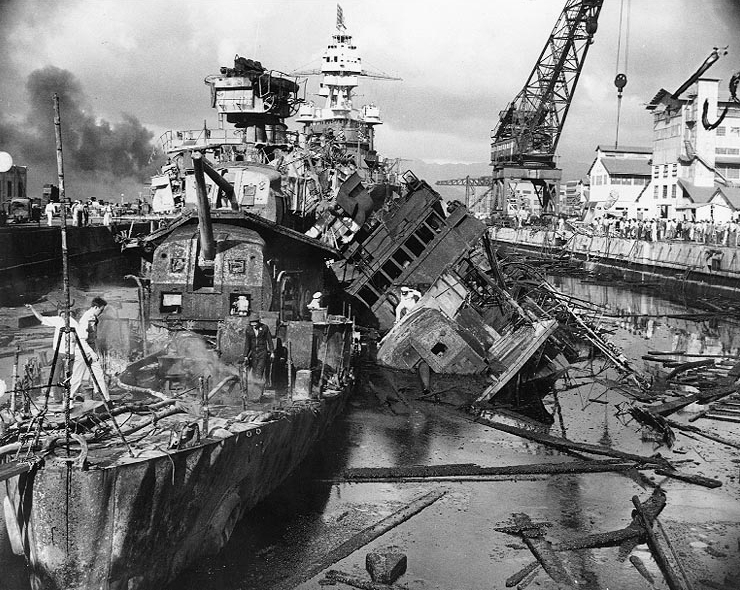
Downes and Cassin in the aftermath of the Pearl Harbor attack. The battleship Pennsylvania, also in drydock that day, is just beyond.


As devastating as the photograph above is, both destroyers were salvaged, rebuilt and returned to duty, as were the damaged battleships. One of them, Nevada, which made a heroic run under attack for the Pearl Harbor exit channel, was, on June 6, 1944, hurling 14-inch shells at the Germans defending the Normandy invasion beaches. Nevada, in fact, was granted the honor of firing the opening salvo that day.

One of my favorite lessons in U.S. History was devoted to the construction of the Oakland Bay Bridge, truly, to steal a term, an engineering marvel. It, and its sister bridge, are emblematic of the way we responded to the Great Depression.

We responded to the shattering of our confidence at Pearl Harbor with new ships and old ships pulled to the surface from Pearl Harbor mud and made new again. Vast fleets of warplanes, tanks, trucks, artillery and small arms, Spam and K-ration Lucky Strikes, a labor force that went to war— a third them women and many of them killed in factory accidents—and over 400,000 young men killed in combat, all of these made up our response.

These things happened because of a generation that, before the war, was dismissed by intellectuals as pleasure-seeking, selfish and shallow. This was my parents’ generation. My parents were hard-working, generous and deeply read. I became a history teacher because of the values they instilled in me.

Learning about the Exposition, in what remains—after a fair amount of European travel (Dublin, London, Edinburgh, Paris, Nice, Amsterdam, Munich, Salzburg, Florence, Venice, Rome) with twenty to forty of my closest teenaged friends, my students—the city I love the most. The Exposition reminded me of my mother and father and their generation. If this was a twilight time in our history, followed by four years of wartime dark, we were still here in the morning.






The Lost Boy

18 Saturday Feb 2023

Posted by ag1970 in Uncategorized, World War II

≈ Leave a comment

Jerrold W. Reed

The past isn’t dead. It even isn’t past.

–William Faulkner


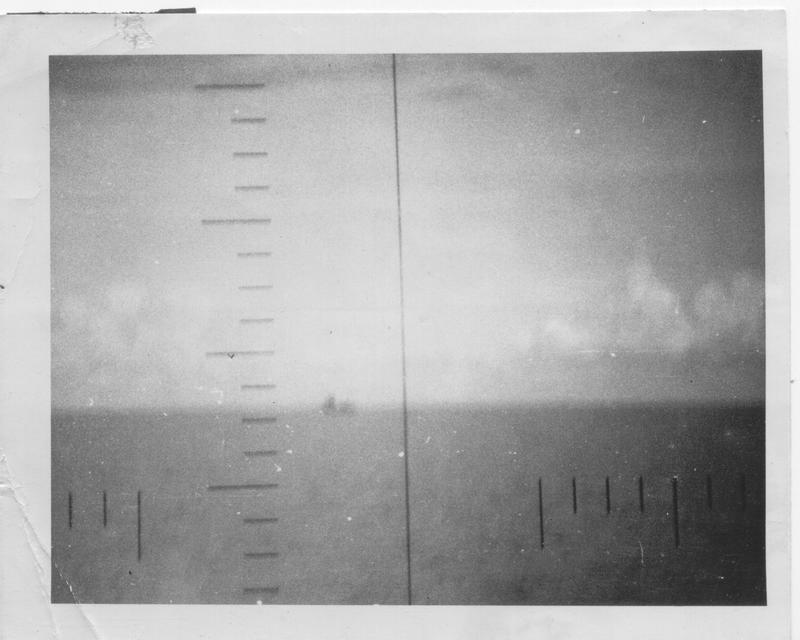
The American submarine Albacore holds one of the most distinguished service records in the World War II Navy. She is credited with ten confirmed sinkings and three probables One of her victims was a light cruiser, 3300 tons, and another, astoundingly, was the aircraft carrier Taiho, 30,000 tons, seen here in the sub’s periscope just before she was sent to the bottom.


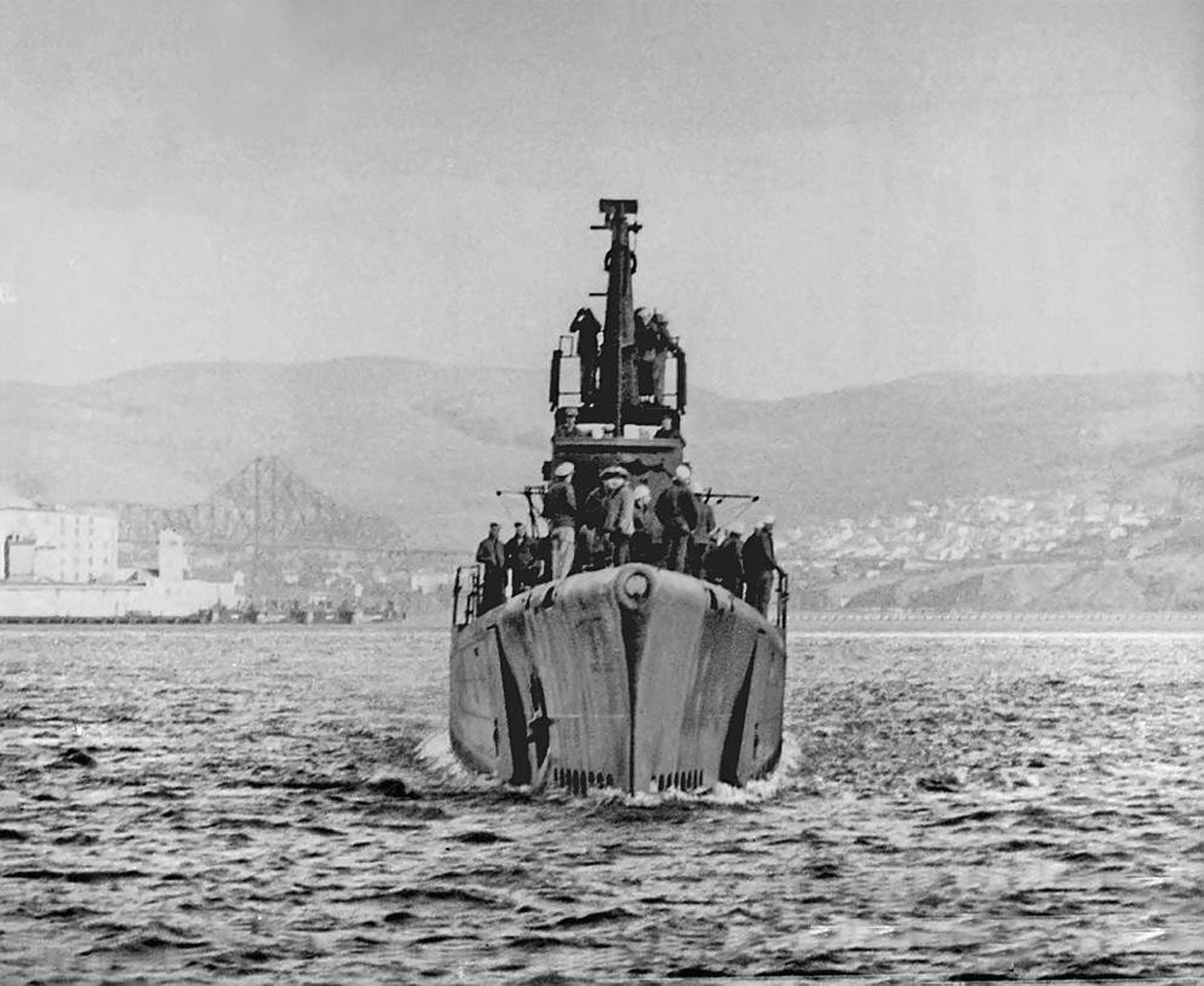
Albacore was on her eleventh patrol when she hit a mine of Hokkaido, the northernmost Home Island, in November 1944. She sank with all 85 of her crew. This is the submarine in San Francisco Bay for her final refit in May 1944.


Albacore was lost for seventy-nine years, until last week, when Japanese marine archaeologists found her at 800 feet. This is one of the photographs they took; more will follow once they can send a submersible to more fully explore the wreck which is, of course, also a tomb. It will be treated with respect.


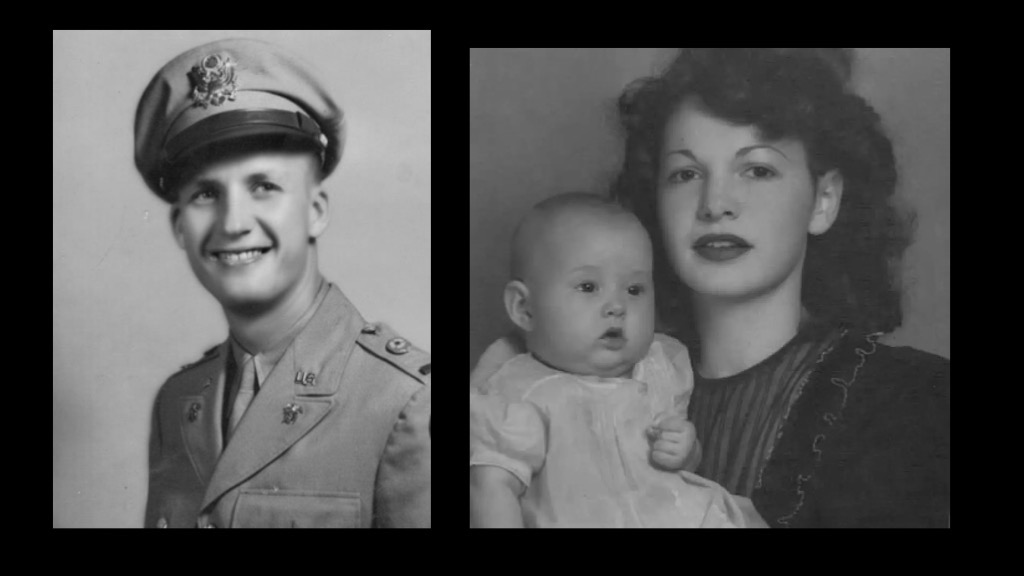
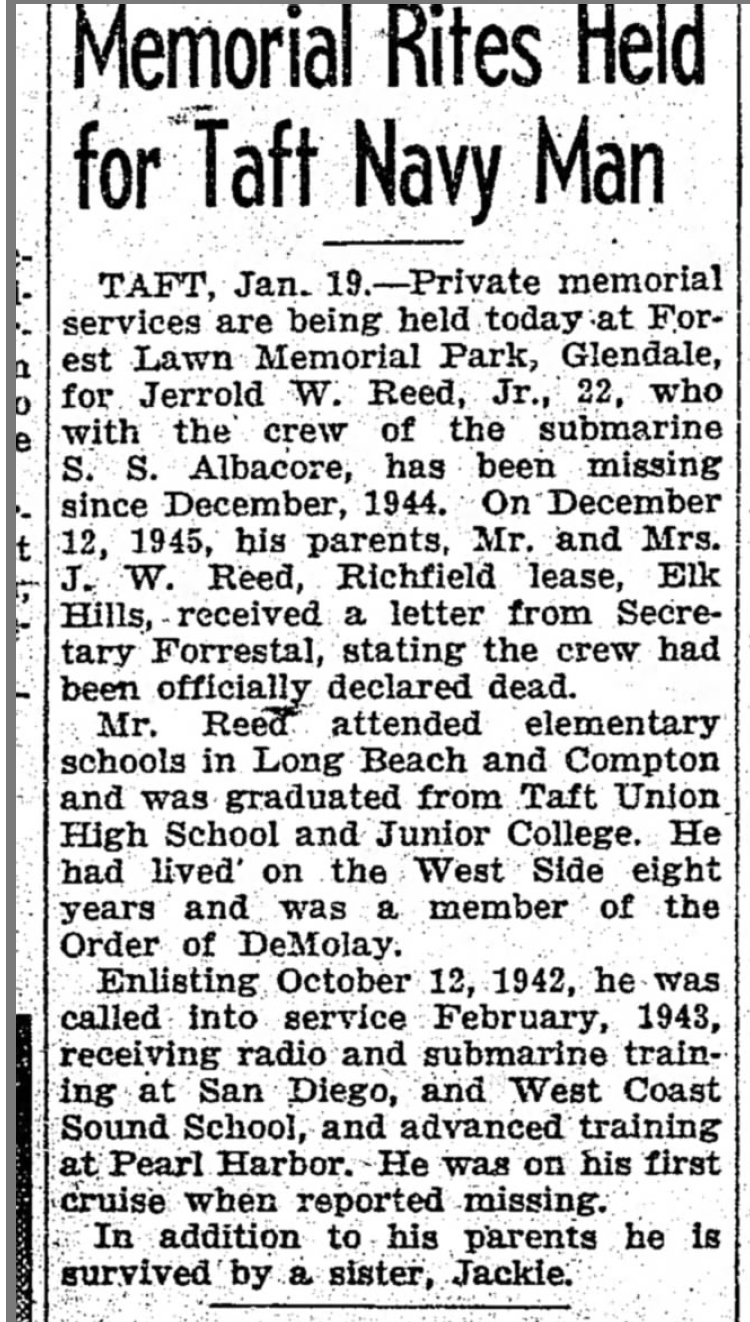
One of the Americans lost was a twenty-two-year-old seaman from just over the county line, from Taft, where I was born. Jerrod Reed joined Albacore’s crew on October 24, 1944, when she left Pearl Harbor. The sub topped off her fuel tanks at Midway and then headed for the Western Pacific, for Japan, and there Albacore disappeared.

It was determined later that she’d struck the mine on November 7. Seaman 1/c Jerrod Reed’s combat role in World War II lasted two weeks.

From a January 1946 edition of the Bakersfield Californian:


You can find poignant records of World War II servicemen online, on the website ancestry.com Among the records are their draft cards. Here is Jerrold’s (if you’re familiar with Taft, his home address isn’t unusual at all):


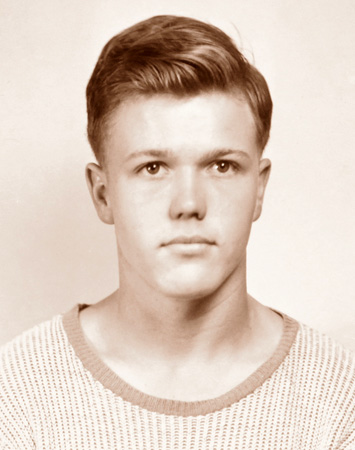
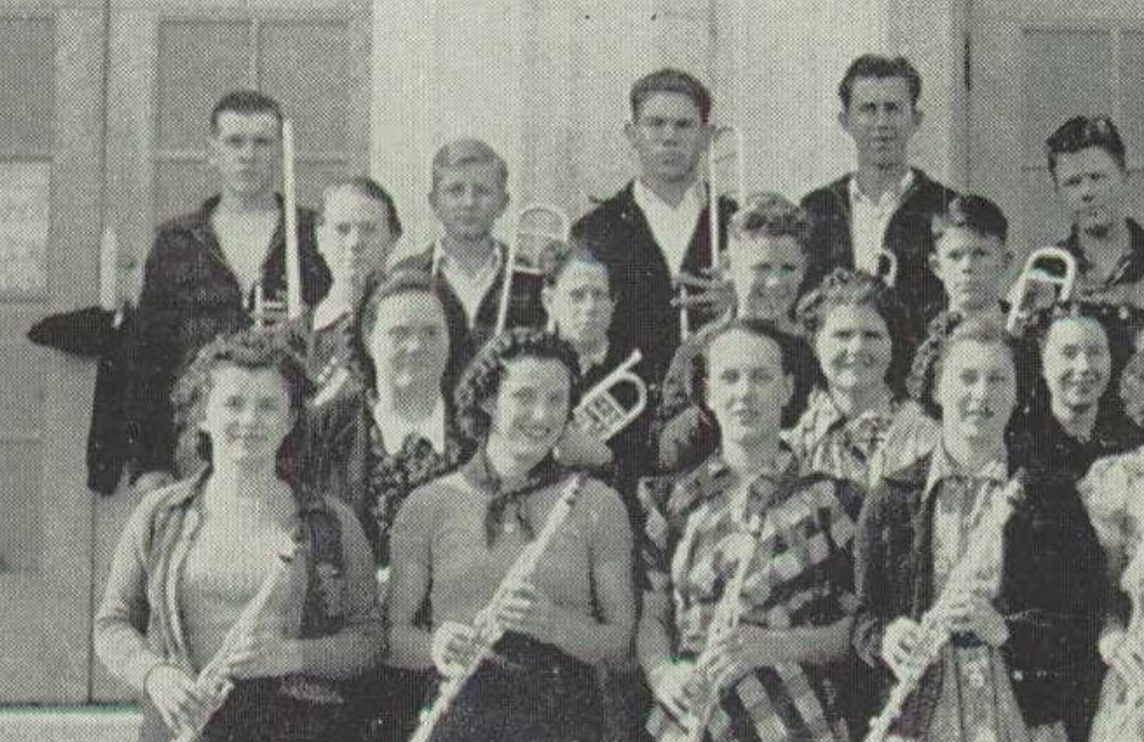
I found him again in the 1939 Derrick, the Taft Union High School yearbook. He’s at top, at far right, a trombonist in the school band. He, of course, has a counterpart here in Arroyo Grande: Jack Scruggs, the trombonist on Arizona’s band, was killed on December 7 by bomb concussions—near misses— off the battleship’s stern moments before fatal bomb forward blew the ship apart.


He’s such a nice-looking young man, and maybe that’s where the hurt comes from from a terrible event that happened seventy-nine years ago.

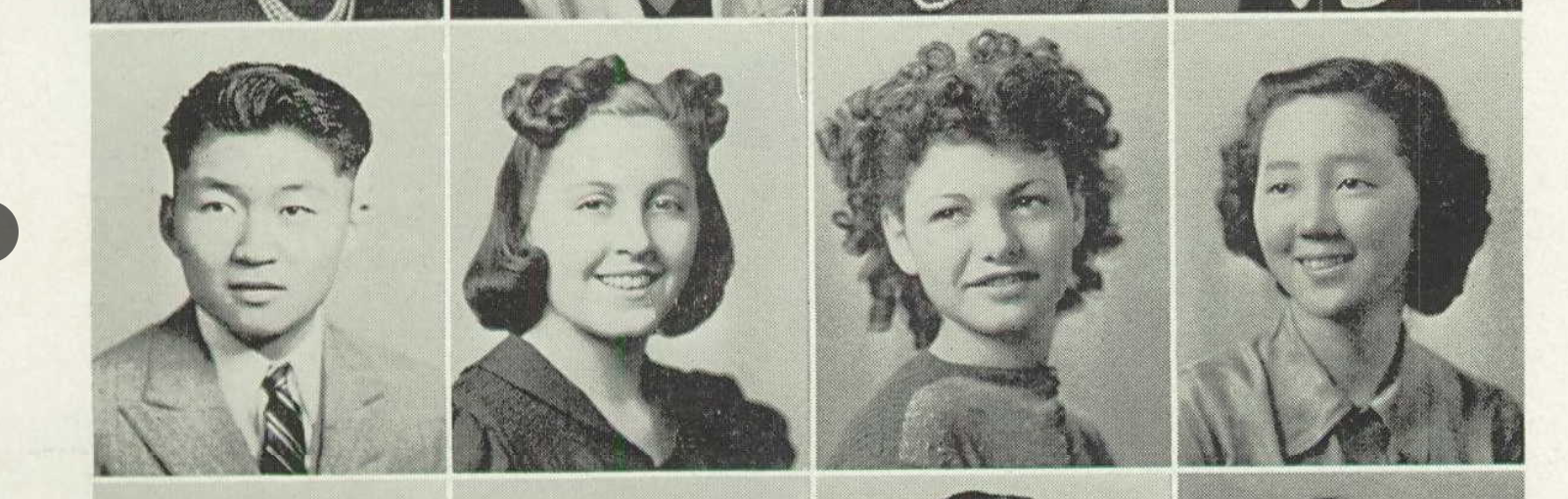
I think the girl with the curly hair is nice-looking, too. This photo is from the same 1939 Taft Union High School yearbook, and that girl, a senior, was a classmate of Jerrold’s.

That’s my Mom.


December 1944: The Ardennes, Belgium

21 Wednesday Dec 2022

Posted by ag1970 in Uncategorized, World War II

≈ Leave a comment


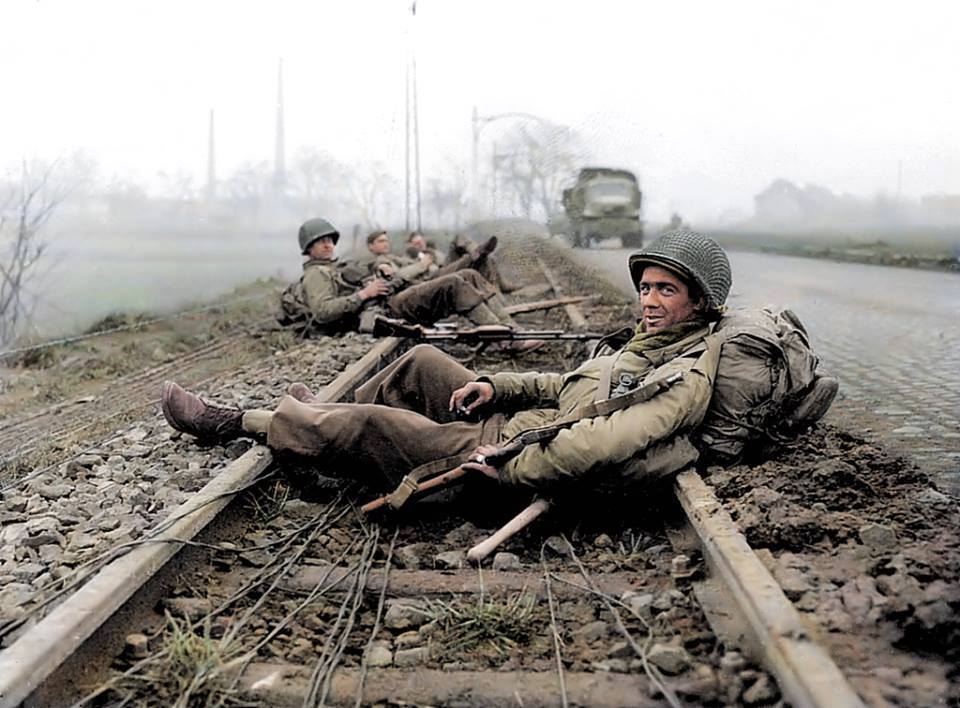
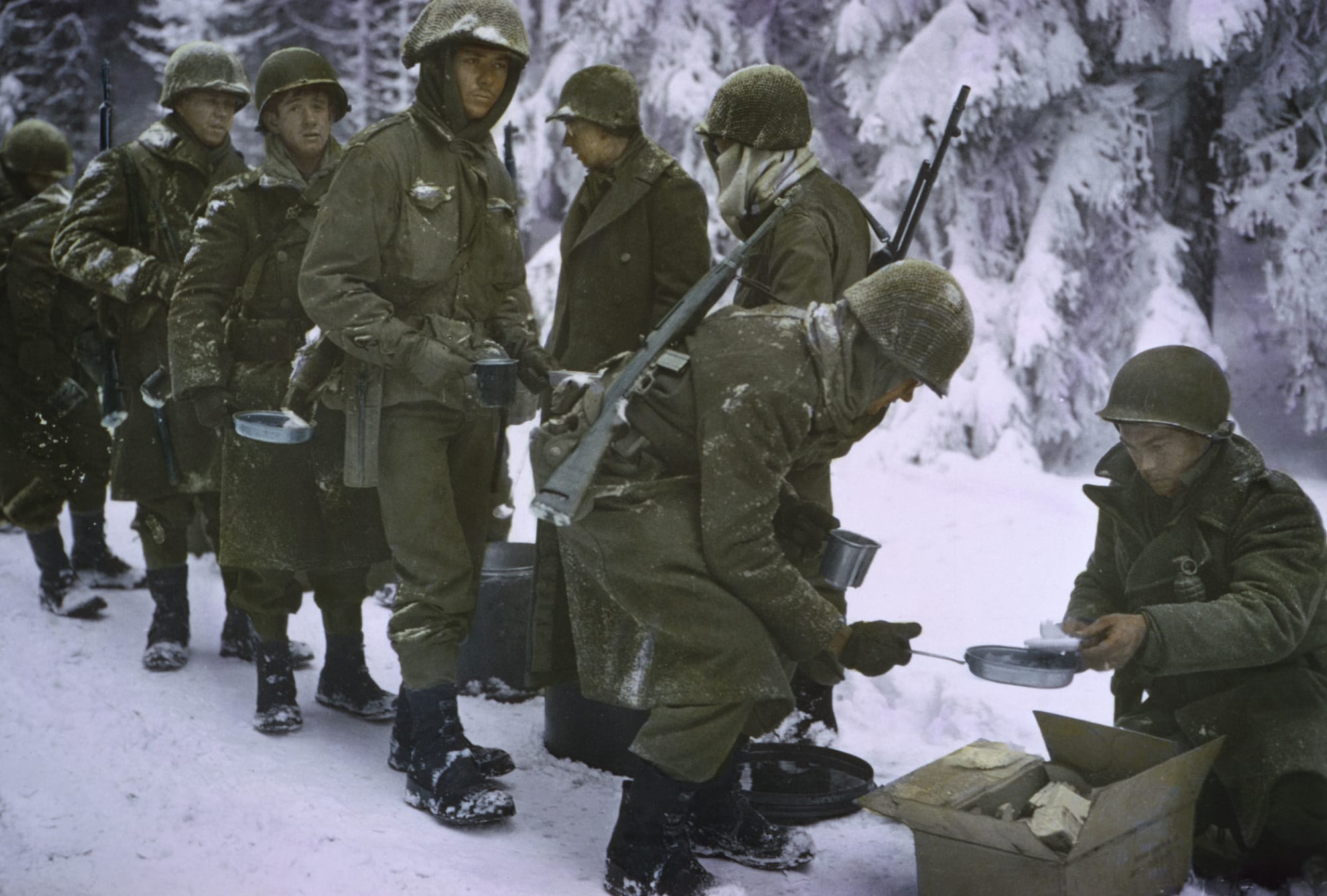
This photo was taken on December 21, 1944.

These GI’s are members of the 104th Infantry Division, the “Timberwolves.” The division had done part of its training at Camp San Luis Obispo. Now, six months after they’d arrived in Europe, these GI’s take a smoke break during the Battle of the Bulge, the horrific weeks-long battle fought in the Ardennes. The photo was taken just inside Germany, but the Bulge crossed several borders. The heaviest fighting for men like these would last into late January and it would come in the mountains and dense forest that mark the Ardennes.

It was the coldest winter in Europe in thirty years.

I’ve never seen a starker contrast in borders than the one between Holland and Belgium. Holland is flat enough to roll a tennis ball for miles, and the roads help. They’re smooth and noiseless. In the pastures that flank Dutch roads, the happiest cows I’ve ever seen would placidly watch the tennis ball roll by.

Then you see the Belgian border. The Ardennes, mountains and forests, rise so suddenly that I was reminded of that terrific animation of Paris rising in the film Inception.

And so the Ardennes is where Americans like these GIs in the 104th were essentially inhaled by the urgency of the the Battle of the Bulge, which had caught the Allied high command, suddenly desperate for riflemen, flat-footed.

Because they were mostly replacements, rookies, the high command hadn’t listened before the battle opened to the reports of tank engines and trembling trees shedding snow beyond the American lines. Sherman hadn’t listened to the reports of movement in the trees near Shiloh Church, either.

Then the Panzers came, followed by the infantry who were, along with Caesar’s Third Gallica and Thomas Jackson’s Confederate “foot cavalry,” possibly the finest soldiers in history.

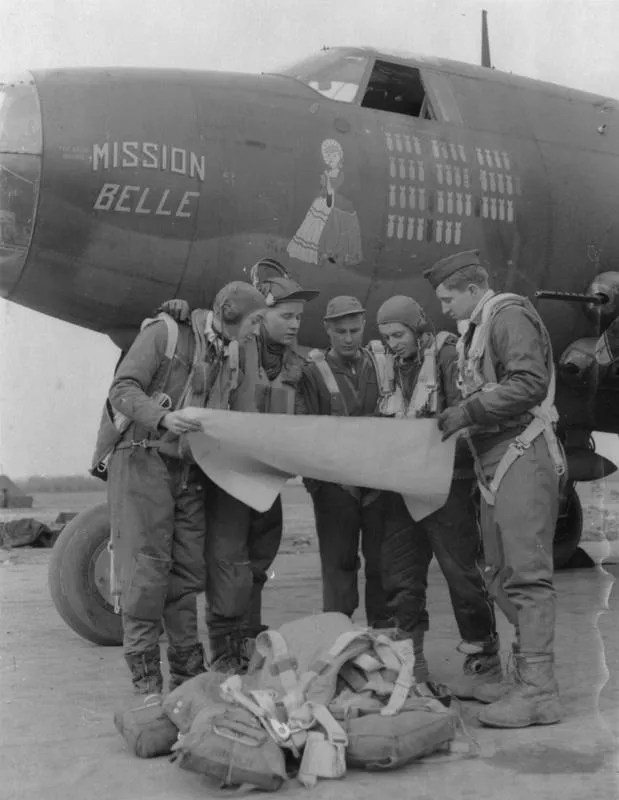
Art Youman of Arroyo Grande, of Easy Company, was there, too, in Bastogne. So was James Pearson of Templeton, lost with his B-26 crew—their plane, “Mission Belle,” is seen here with an earlier crew (they look young, don’t they?)—shot down over a Belgian town, Houffalize, the day after Christmas. So was Manuel Gularte of Arroyo Grande, a crewman on a 155-mm “Long Tom” cannon whose work had helped to delay the German advance on a Belgian town, St. Vith.

Once again, I am stunned by a “cow county” so small—33,000 people in the 1940 census—soon to be outnumbered by 96,000 servicemen from Camp Roberts in the north to Camp Cooke, near Lompoc–that contributed so significantly to World War II.

I heard a war story I did not want to hear a few days ago. It was a guy about my age, maybe with the tread worn down a bit more than mine, but his Dad was a member of an Army cavalry scout unit during the Battle of the Bulge.

They were among the units that found the bodies of more than eighty GIs who’d been machine-gunned—murdered—by a Waffen-SS unit in Malmedy, Belgium on December 17. They had surrendered and were unarmed.

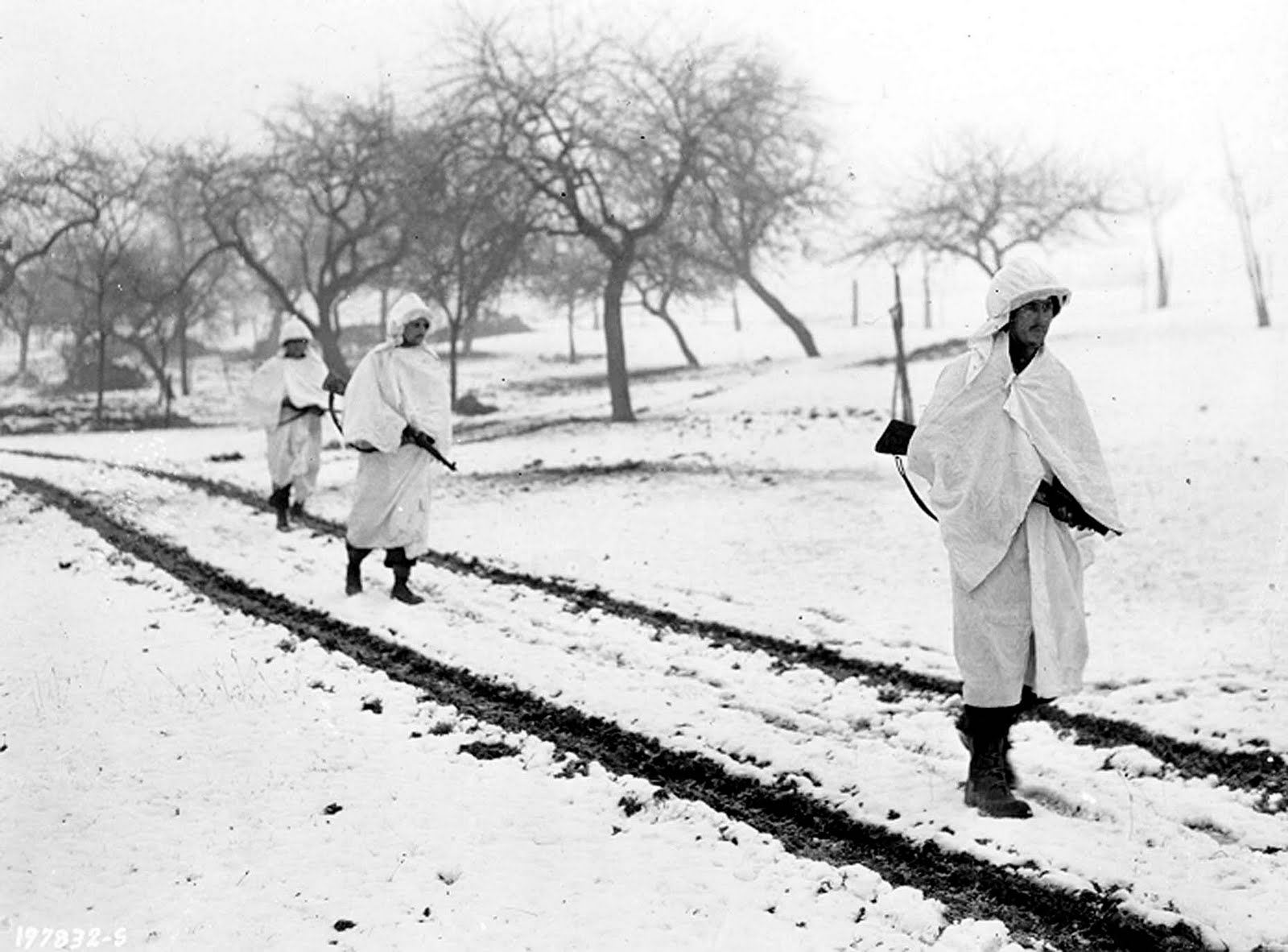
Three Americans on patrol, Luxembourg, during The Bulge.


His father’s unit stopped taking prisoners after that, the man told me. And so the Germans they murdered for the next six months became some of the fifty million casualties this war produced, in a war that demonstrated that humans were as efficient at killing as the Spanish Flu, with its fifty million victims, had been in 1918.

It was a horrific war in which Americans were not blameless. In writing Central Coast Aviators in World War II, I noted that airmen could never completely rid themselves of the memory of burning human flesh that came to them in updrafts over cities like Dresden or Tokyo. The Army executed 102 GIs for crimes against civilians during World War II, so we were capable of much more personal brutality, too.

But it’s a telling statistic that, in nation fighting to preserve democracy and destroy the racism fundamental to National Socialism and to Japanese chauvinism, that 83% of the soldiers executed for rape were Black Americans. The irony would’ve have escaped us then and would probably escape 30% of voting Americans today.

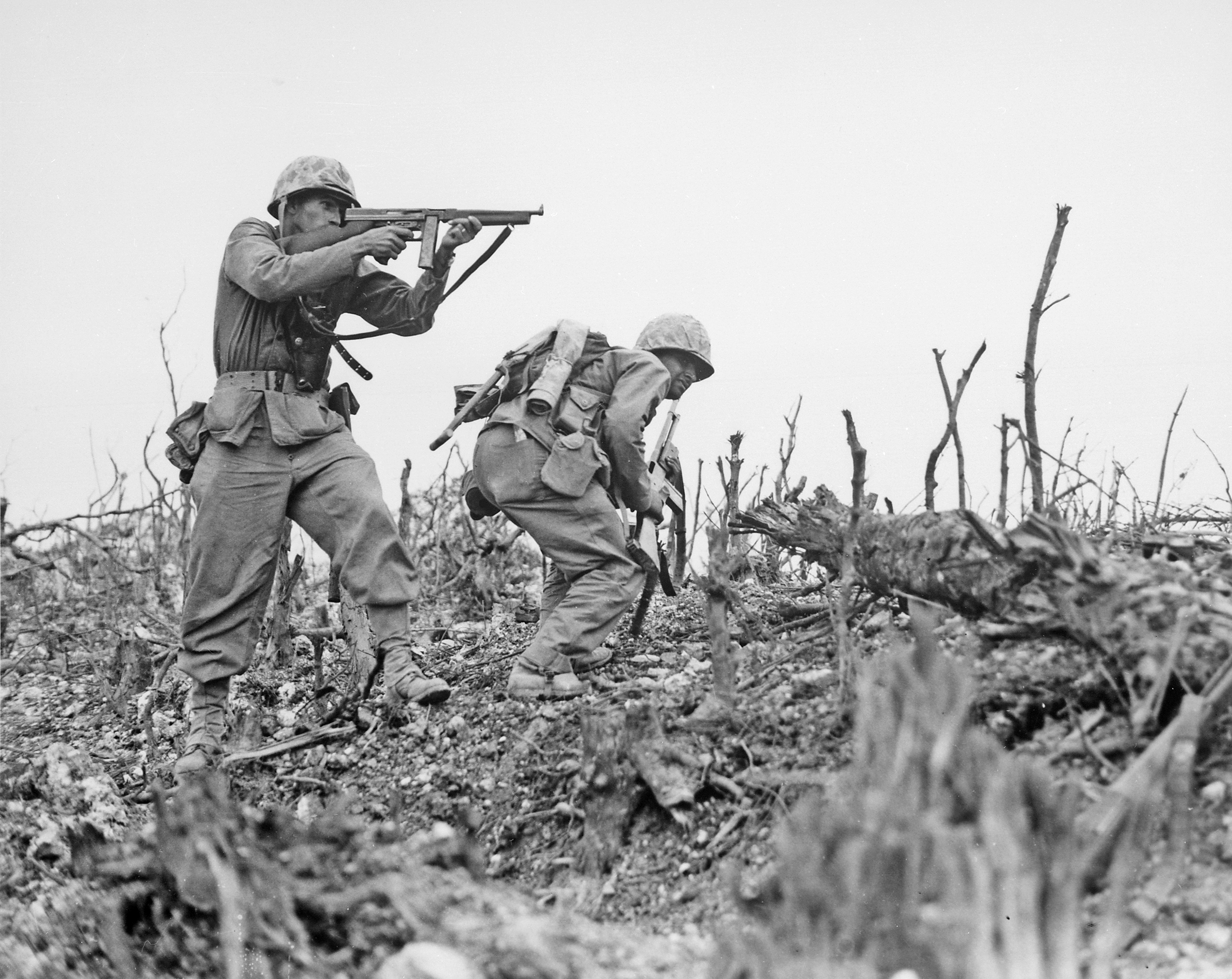
A Marine, a member of the First Marine Division, fires a burst from his Thompson submachine gun on Okinawa. John Loomis of Arroyo Grande was at Okinawa as a member of the First.


And, as to the debasement that war can confer, even on Americans: in Eugene Sledge’s masterful With the Old Breed at Peleliu and Okinawa, he remembered a fellow Marine absently tossing pieces of coral, like basketball free throws, into the skull of a dead Japanese soldier; the top of the man’s skull had been neatly sheared off by machine-gun bullet or a shell fragment. Even Sledge, who was not a blameless man—war debases all in mostly equal measures—was sickened.

Fifty thousand Americans grew sickened by the war and deserted. For a time, a gang of them took control of Paris and tried to run the place the way Capone had run Chicago.

The miracle, one author has noted, is that only fifty thousand GIs deserted.The vast majority didn’t. Here, they were farm boys and Poly students (usually one and the same) and store clerks, farm laborers and high-school football heroes, even the guys with Coke-bottle glasses whom nobody took seriously–not until they proved to be someone different altogether in places like the Ardennes.

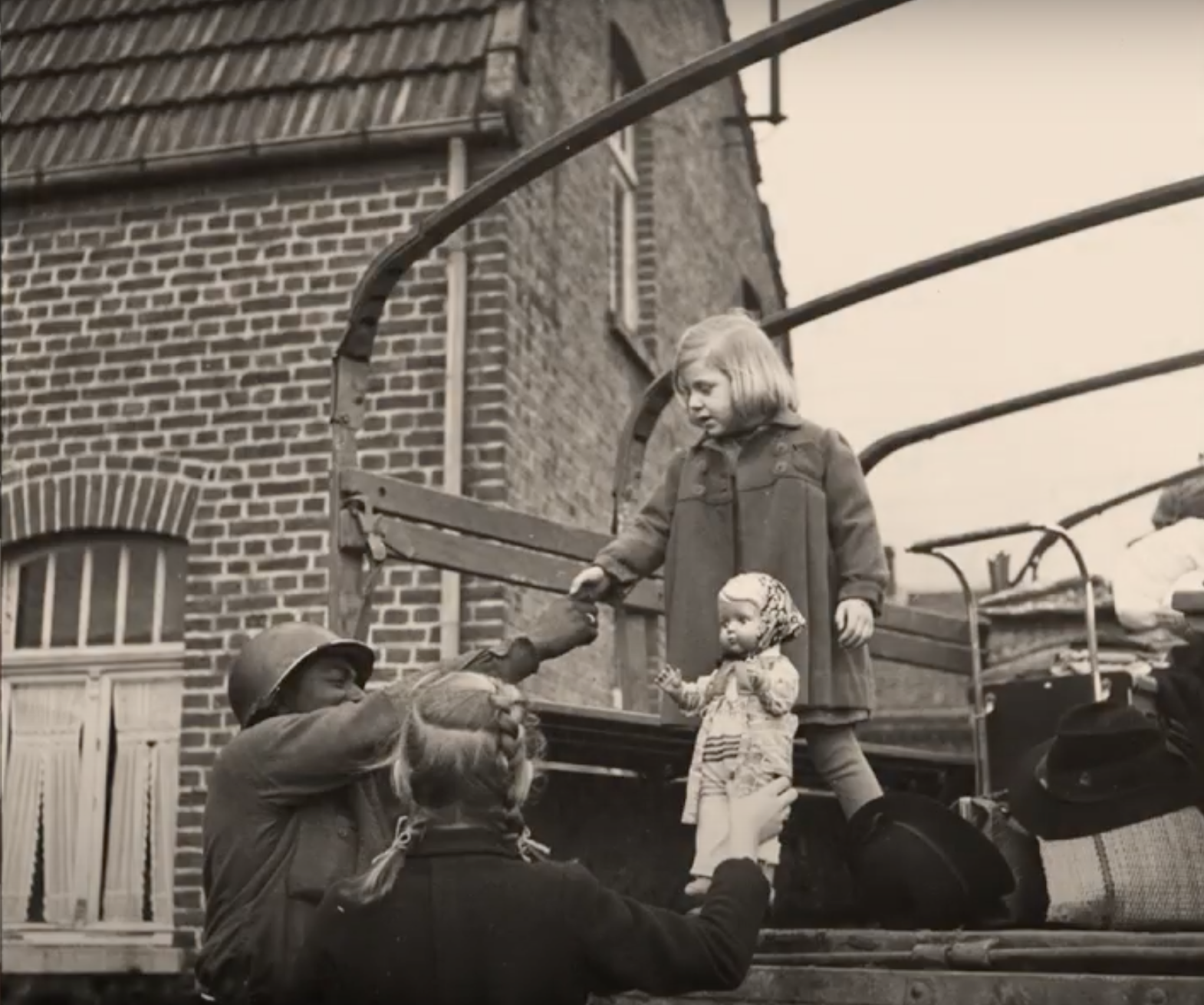
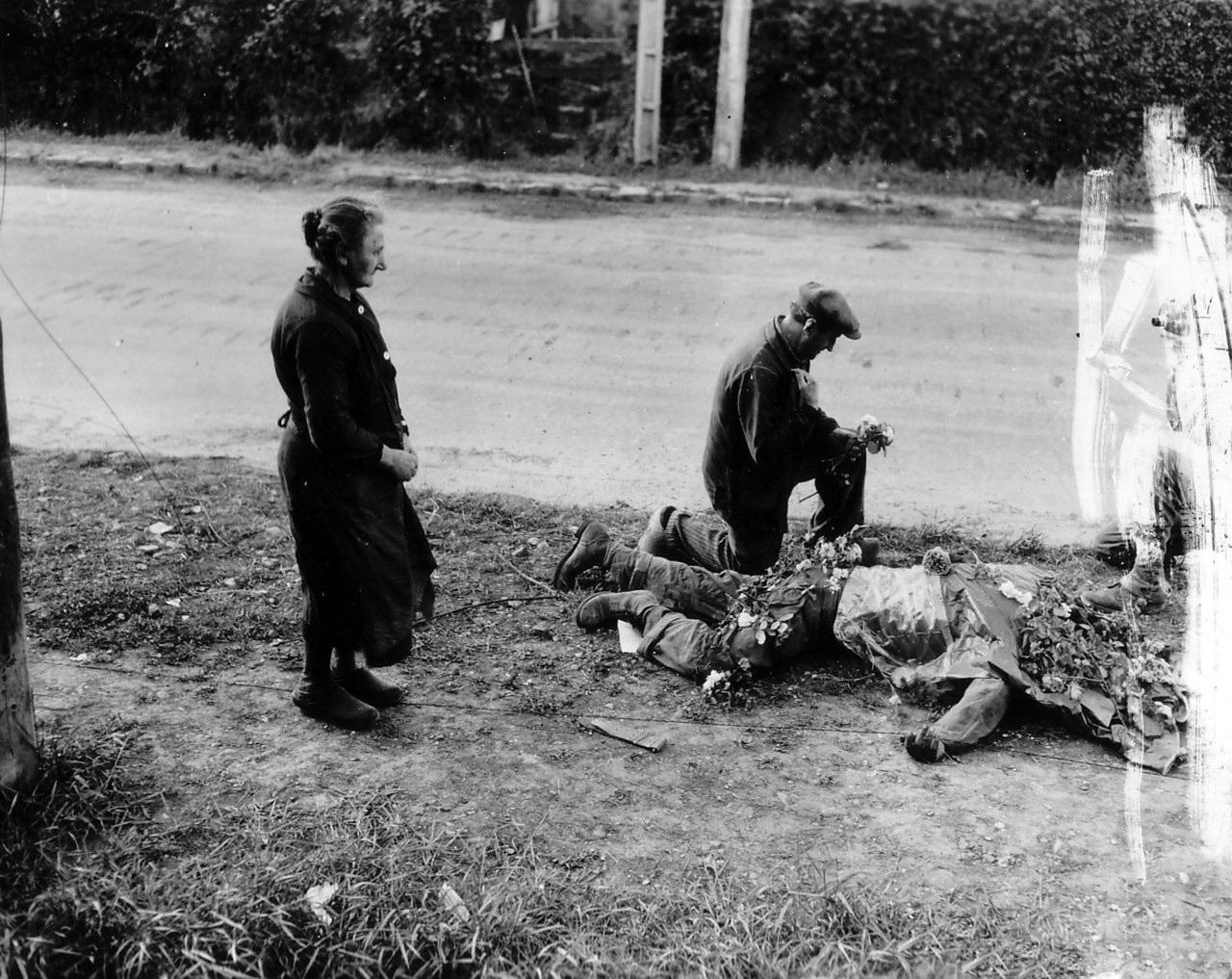
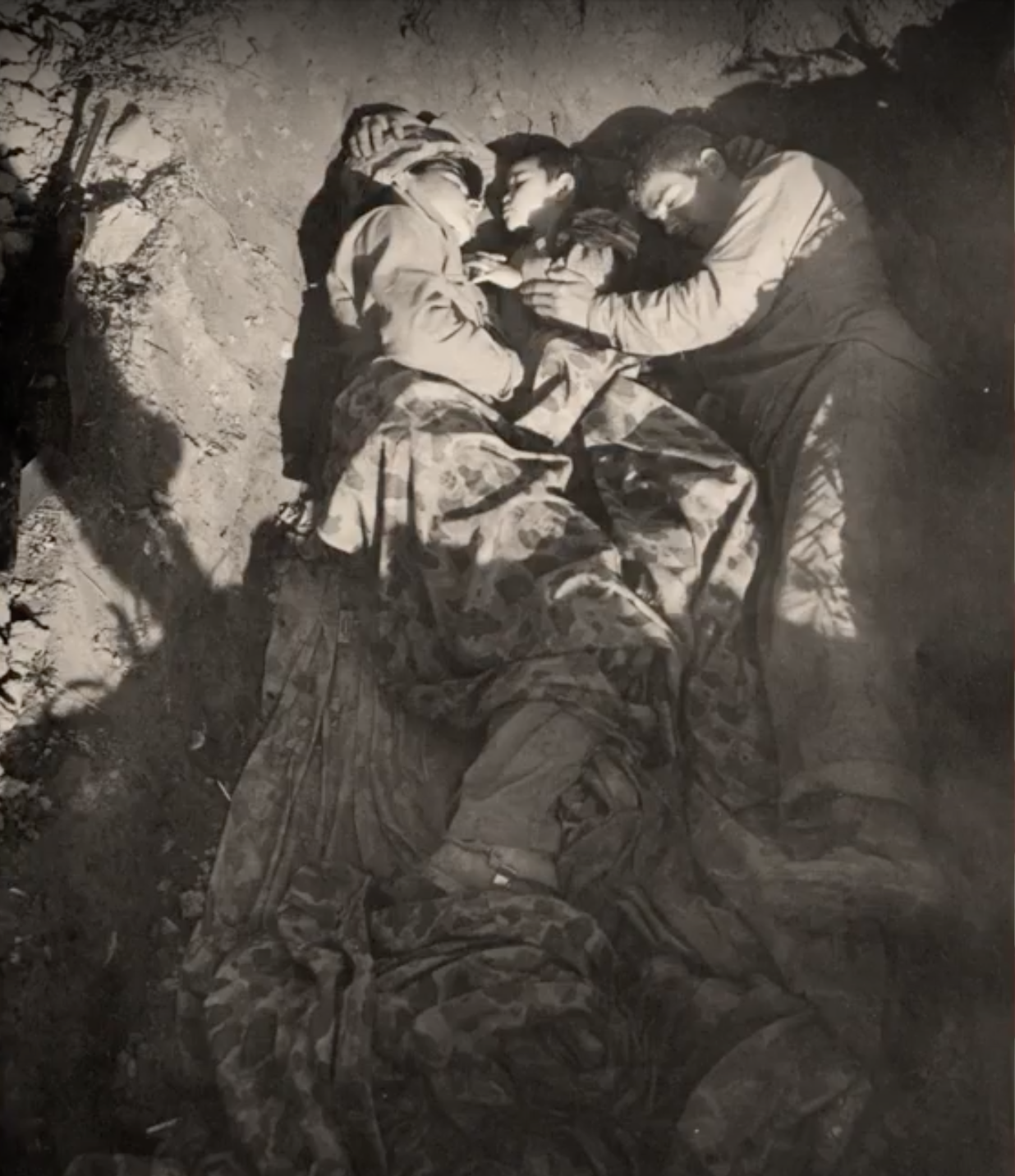
They constantly amaze me. I keep returning to them because the debasement of recent history compels me to. I have learned that the cruelty of war, a cruelty some of them practiced, is always overwhelmed by other, more important, American traits: generosity, humanity and courage. We must not forget that.

An Army Quartermaster truck driver makes a friend, 1944.
An elderly French couple honors an American paratrooper, killed in Carentan, Normandy, on D-Day.
These Marines “adopted” this little boy, orphaned by the terrible fighting on Okinawa.

The Ever Popular Pismo Poko Parlor, 1938-1942

20 Friday May 2022

Posted by ag1970 in Arroyo Grande, Uncategorized, World War II

≈ Leave a comment

A friend asked me about a token found–I presume by a man with a metal detector–that read “Club Poko, San Luis Obispo.” (You can find sometimes on eBay, similar tokens to one of Pete Olohan’s saloons on Branch Street.)

A search revealed no stories or ads on a Club Poko in San Luis Obispo.

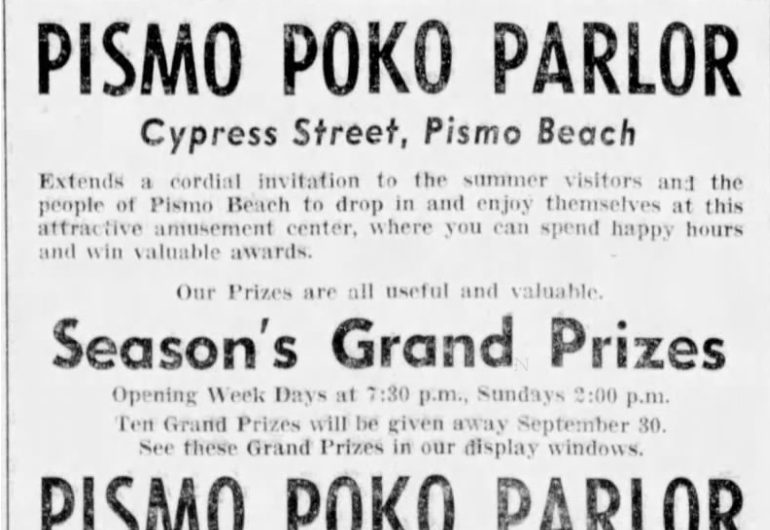
However, there was Pismo Poko, an arcade/amusement parlor at 520 Cypress, Pismo Beach, which seems to have operated between 1938 and 1942. More on these places:

* * *

1930s Arcades

Arcade patrons flocked to coin-operated peep show machines, shooting galleries, grip and strength testers, stationary bicycles, slot machines (in some areas), machines that dispensed fortunes or candy, and other mechanical amusements they could play for as little as a penny.

During the 1930s, David Gottlieb’s Baffle Ball

(1931) and Raymond  Moloney’s Ballyhoo

(1932) introduced pinball to arcades. As pinball designers added bumpers, flippers, and thematic artwork, pinball surged in popularity, even as some local legislators banned the game because they associated it with gambling, organized crime, and delinquency. Nevertheless, over the next three decades arcade owners replaced many older mechanical novelty games with pinball machines and electromechanical baseball, target shooting, horse racing, shuffleboard, [foosball] and bowling games. Pinball machines ruled arcades until the late 1960s when new more sophisticated electromechanical games such as Chicago Coin’s Speedway.

–Rochester NY Democrat and Chronicle

Why “Poko?” From an article on arcade games:

Poko-Lite was produced by Glickman Co. in 1937. Glickman Co. released 19 different machines in our database under this trade name, starting in 1937.

Other machines made by Glickman Co. during the time period Poko-Lite was produced include Treasure, Sailorettes \’42, Scandals 1942, Anti-Aircraft, and Archery.

This game appears on a list of games manufactured between 1931-1939 which was published in the January 1940 issue of the Coin Machine Journal.

* * *

Pinball machines had an unsavory reputation in the 1930s-1940s; they were perceived as akin to slot machines, a form of gambling. A dozen were seized by the SLOPD in August 1941 for operating without a city license; in January, there’d been a spirited City Council debate on whether to allow them at all. They voted to license pinball but ban taxi dances. So it goes.
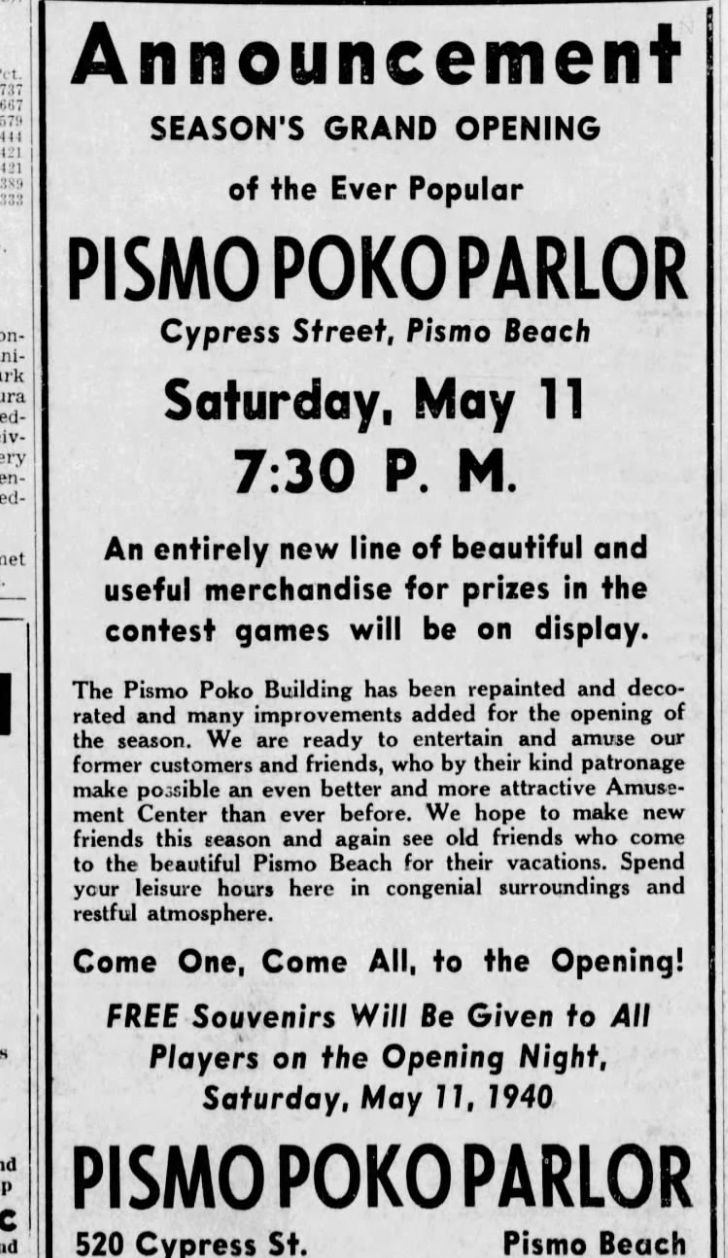
Here’s a display ad for the Pismo place from May 1940:


Another 1940 ad from the Telegram-Tribune:

520 Cypress is today the site of a modern motel, which straddles the corner of Main and Cypress.

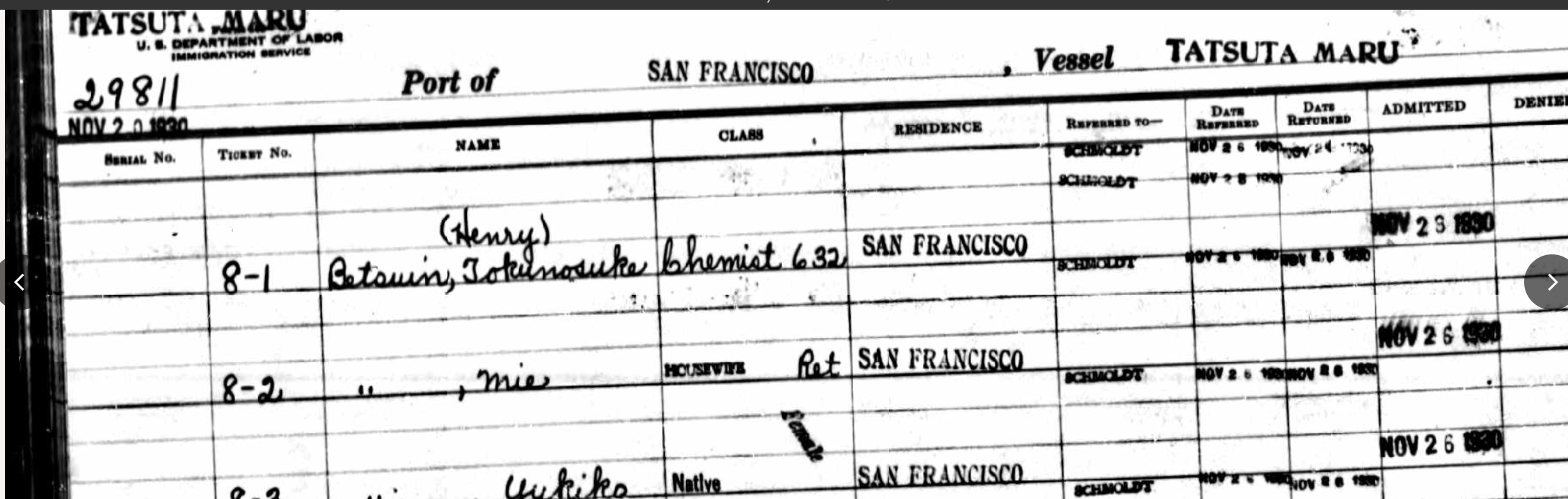
Why did Pismo Poko go out of business, evidently in 1942 (there are no newspaper references thereafter, but plenty of both display and classified ads between 1938 and 1942)? The influx of local soldiers would’ve made Henry T. Betsuin, Prop. a fortune.

So I looked him up. “Betsuin” sounded Filipino to me, which made sense, since Pismo had a vibrant Filipino community (almost all men; Filipinas were not allowed to immigrate.)

There wasn’t much on him except for this curious note on a ship arrival in San Francisco from Kobe:


“Tokunosuke” is definitely a Japanese name; but he seems to have gone by “Henry T.” instead. If he was Japanese, that explains why Pismo Poko disappears after 1942. Henry T. would’ve been in an internment camp. 

So, if that didn’t exactly answer the question, it raised several new ones–and it led me down a sad path, to the impact of Executive Order 9066, whose 80th anniversary we’re observing this year.

The combat photographers

13 Sunday Mar 2022

Posted by ag1970 in Uncategorized, World War II

≈ Leave a comment

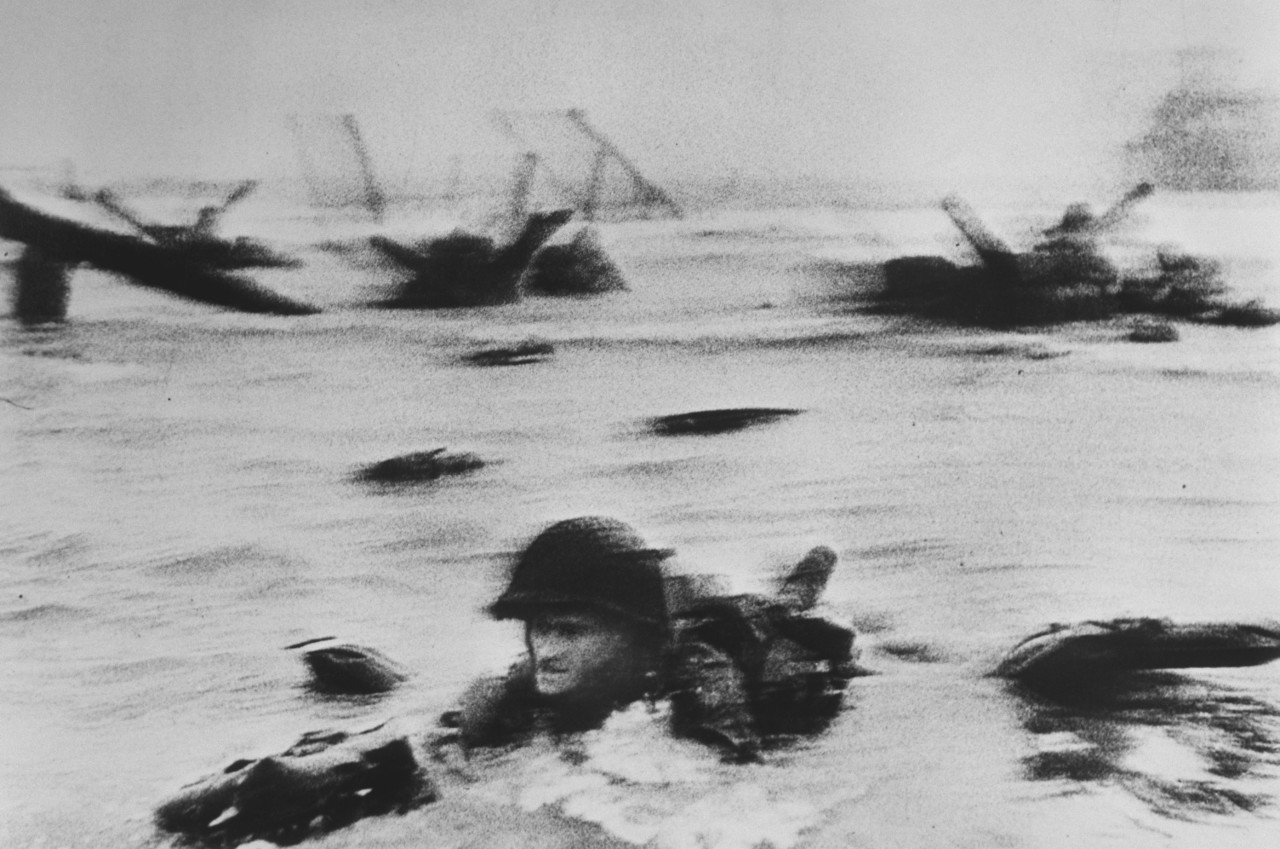
Photographer Robert Capa captured a GI amid beach obstacles struggling to reach Omaha Beach on D-Day. Even the shots that survived the Time-Life London processor, like this one, were compromised–this somehow made them even more powerful.

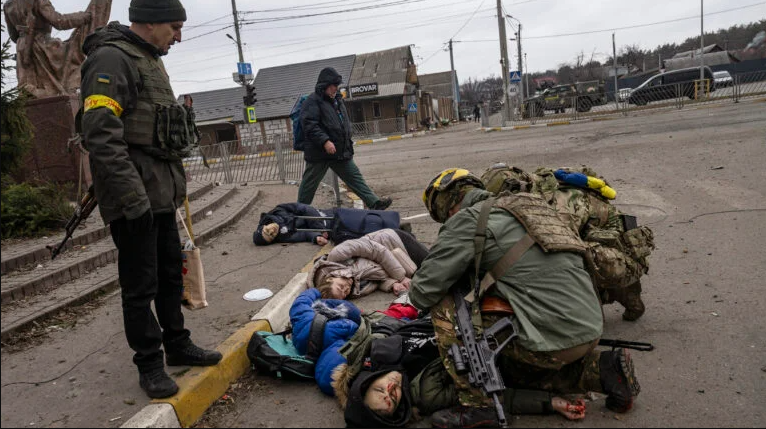
Irpin, Ukraine, Sunday, March 6, 2022

Some are condemning the work of New York Times photojournalist Lynsey Addario, who captured the indelible image of the Ukrainian family struck down by a mortar round in the city of Irpin.

I disagree vehemently. If you Google “Alexander Gardner Antietam,” you’ll find the most horrific photographs of the casualties of war ever published, the record of what remains the single deadliest day of combat in American history, in September 1862

Unlike Gardner’s images, Addario’s was relatively restrained–the family likely died from the concussion of the mortar round’s impact or the needle-like shrapnel that the detonation can generate. They almost appeared asleep, which, to me, made the image even more powerful and even more moving.
They were, in death, so oddly beautiful and so completely innocent. I couldn’t look away from the image until I finally had to. Maybe, in losing their lives, in the anger their innocence provokes in us, they will save the lives of many others.

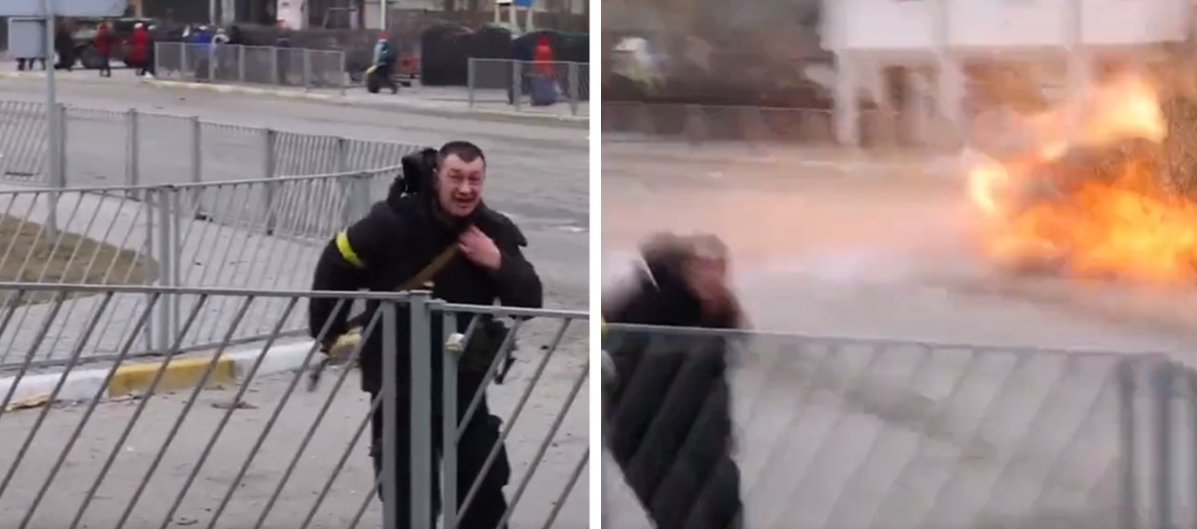
There’s another side to this terrible event. A video captured this man, a volunteer, at the moment the mortar round detonated. He disappears, and then, in a dense layer of concrete dust, someone seems to drag his inert body away.

You can hear Addario and other journalists shouting “Shit! Shit! Shit!” when they see the family across the street.

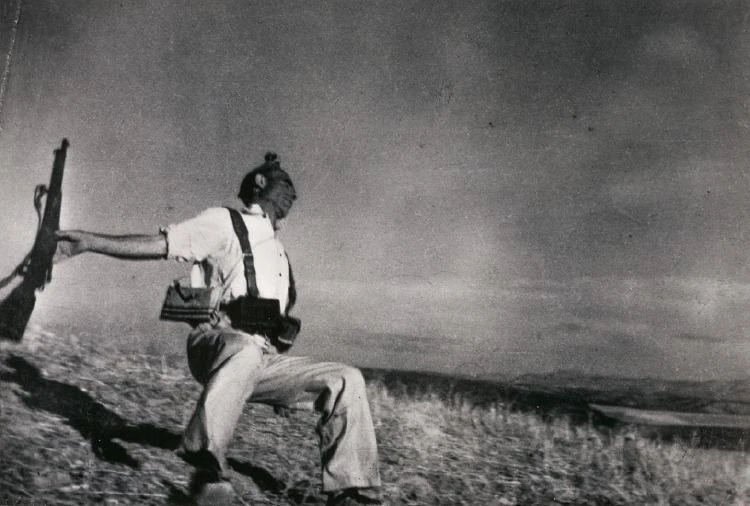
Robert Capa captured the moment of a Spanish Loyalist soldier’s death in Spain in 1936, during a war that seems to parallel Ukraine’s war today. Eight years later, after surviving the carnage in the assault on Omaha Beach, eight of the nine rolls of film that Capa had shot that morning were ruined in a London photo lab.

That’s not the whole story, and the whole story is about the value of human life. Addario found out that the man in the video, the Ukrainian volunteer who disappeared in the dust of the explosion, had in fact survived.

That was important to her. Another photojournalist captured Addario’s image moments before the fatal mortar round, when other rounds were landing all along the street where she was shooting.
The man in the video, in this image, had pushed Addario to the ground and he was covering her body with his.
He was willing to offer the American stranger his own life.

I’ve been agonizing, as all of us have, over Ukraine. When I found out that Addario’s protector had survived, I let out, involuntarily, something that approached a sob.

Ukraine is so instructive. In my memory I haven’t seen anything like this since Rwanda, when the depths of depravity–in today’s case, Putin’s–are offset, if only incrementally, by human beings with far less power but far more courage, far more generosity of spirit.

In the middle of reporting the genocide in Rwanda, with a parade of refugees walking painfully—toward safety, they hoped—behind him, the superb CBS News correspondent Barry Petersen, during what might well have been a live shot, suddenly realized the enormity of what he was covering. He began to cry.

It was one of the most powerful moments of reportage I’ve ever seen. Petersen reminded us that these faraway people—Black people—were our brothers and sisters, a concept that many Americans still have difficulty understanding. Petersen’s tears affirmed our shared humanity.

And so I found another brother in the man whose name I don’t know who more than likely saved Lynsey Addario’s life, This was so that she could take the photograph that has reminded us, too of our humanity, of the family that my heart will remember until the moment of its last beat.

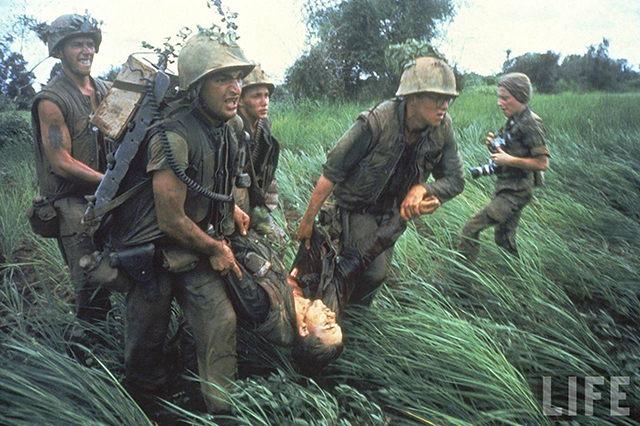
Marines carry a dead comrade to a helicopter, Vietnam, 1966. Photographer Larry Burrows would be killed in this war five years later.


The Medic

11 Friday Mar 2022

Posted by ag1970 in Arroyo Grande, Uncategorized, World War II

≈ 1 Comment

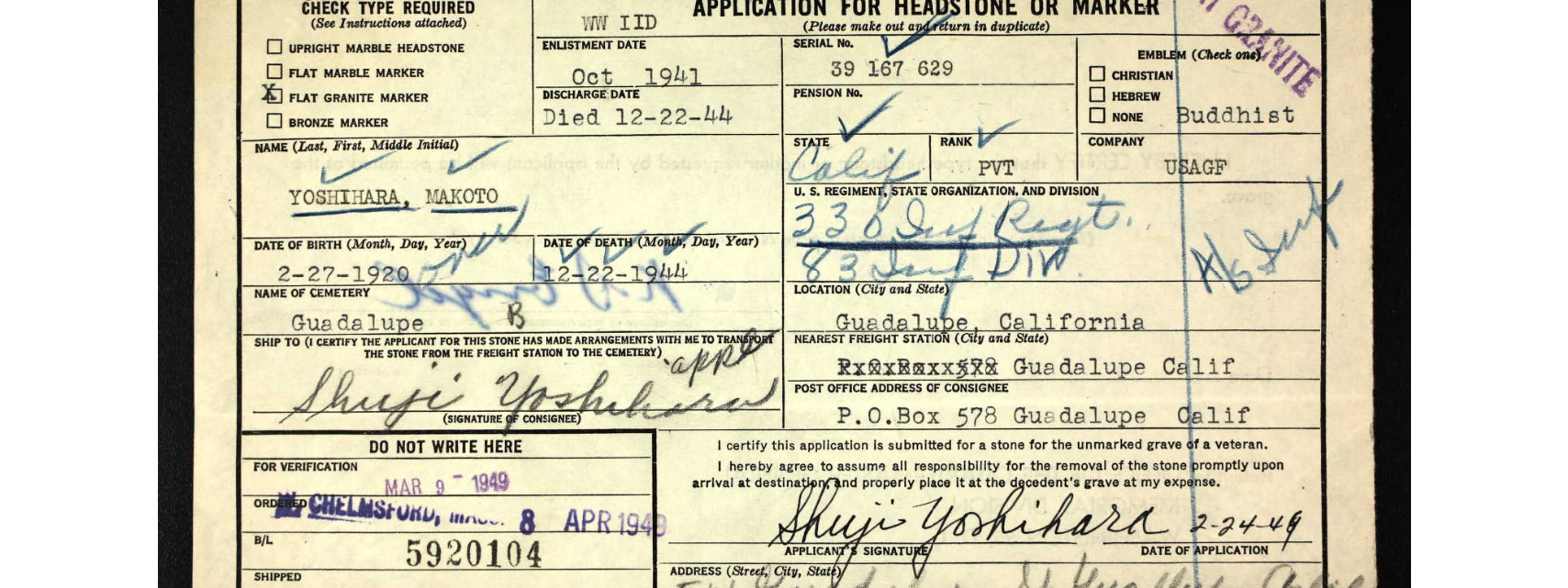
Pvt. Yoshihara’s grave, Guadalupe.

I’m speaking in Santa Maria next week about our county’s World War II commemoration—the eightieth anniversary of the war, and of Japanese internment—when I wondered if any Santa Maria Nisei (second generation Japanese-Americans) had been among the town’s 55 wartime casualties.

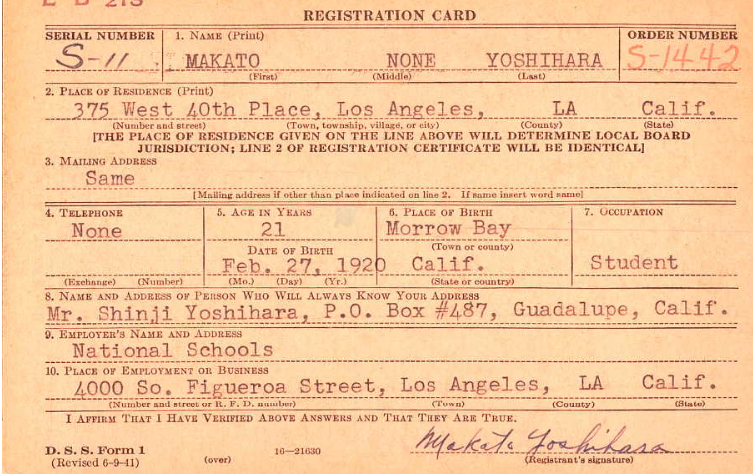
Because of his surname, Makoto Yoshihara was at the bottom of the list.

He was actually born in Morro Bay; his parents moved to Guadalupe where they ran a boarding housel and pool hall. Makoto played football for the Santa Maria Saints, joined or was drafted into the Army in October 1941. His parents, like our Arroyo Grande neighbors, went to the Rivers Camp in the Arizona desert. The photo below shows evacuation day in Guadalupe, and I knew that Guadalupe had a prominent Japanese-American presence, but the numbers surprised me: Two hundred people were taken from Arroyo Grande, 400 from Santa Maria, but 800 from little, beautiful Guadalupe.

April 30, 1942.

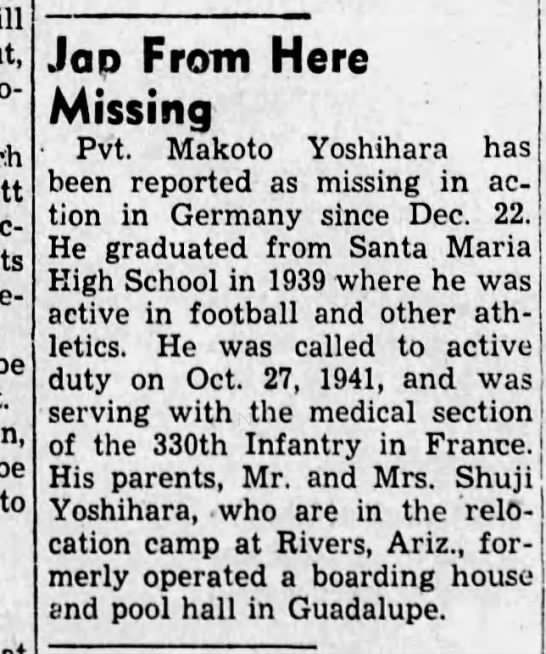
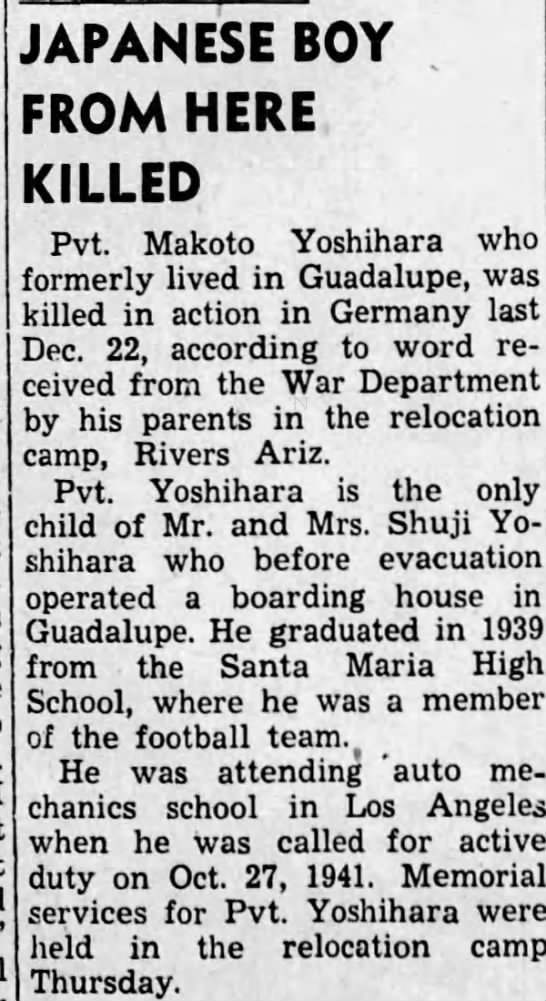
About two and a half years later, the insult heaped on our neighbors would be intensified by the headline that first reported Makoto’s fate. From the January 25, 1945, Santa Maria Times:

It is, of course, jarring to read. A month later, once Makoto’s death is confirmed, the newspaper softens its tone:

And you’re relieved at the slight change in tone until you read where his parents received that terrible telegram from the War Department. Everyone—everyone—behind barbed wire in the desert would’ve known almost instantly what had happened to Mr. and Mrs. Yoshihara’s son. The tarpaper barracks walls would’ve done nothing to soften the sound of a mother’s weeping for her only child.

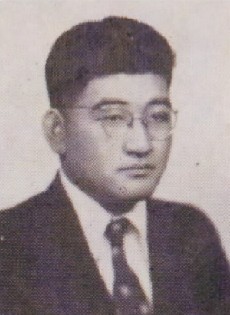
Makoto had wanted to be a mechanic. This must be his high school senior photo. He looks like a serious young man.


Which is why the Army—my father, a World War II veteran, would claim to be surprised by this—did something right. They made this serious young man a medic.

Another surprise came, at least for me, in the article with the insulting headline. Makoto was not a member of the famed 100th/442nd Regimental Combat Team, nor—since served in the European Theater—was he a Nisei intelligence officer, like so many local men were, the ones who underwent, at Camp Shelby, Mississippi, the same tough training that the 4-4-2 endured.

Makoto instead served in the 83rd Infantry Division, a unit that had a thoroughly White pedigree—the 83rd was traditionally an Ohio outfit, from the state that produced a batch of mediocre presidents, and here, probably the only Nisei among 10,000 White boys, was Makoto Yoshihara, the medic from Guadalupe, California. The Ohio boys probably had never seen the ocean. Makoto probably never got the chance to see fireflies, one of the natural wonders that make Midwestern summers, despite their oppressiveness, delightful.

He must’ve been lonely. And, if only at first, he must’ve endured racist attempts at humor.

The only other local Nisei G.I. I know of that served in a non-Nisei unit was Arroyo Grande’s Mits Fukuhara, who served in a tank battalion; Mits and his battalion missed the fighting because the war ended before they could join it.

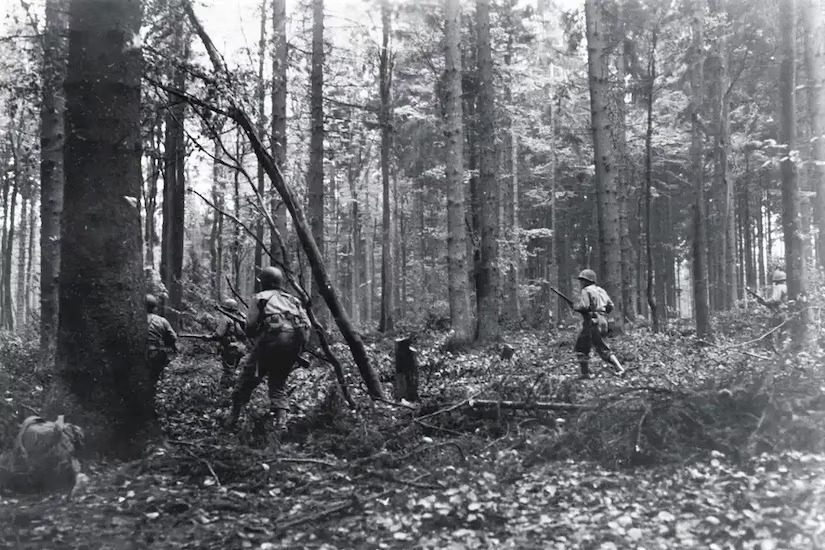
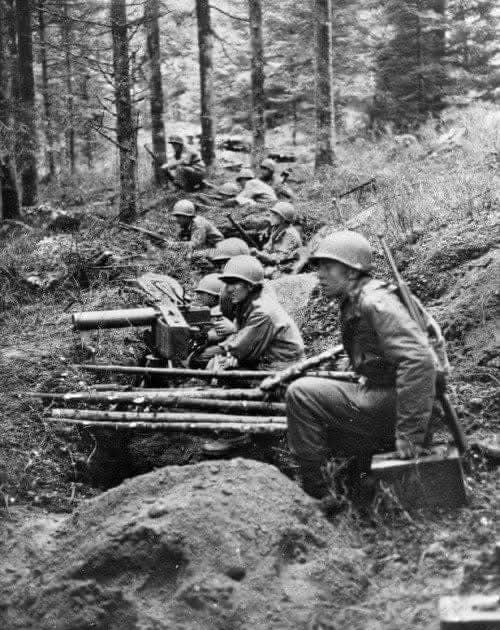
Makoto didn’t miss the fighting; in fact, he saw some of the worst combat of the Americans’ war. The 83rd and his regiment, the 330th Infantry, got into a slugging match with the Wehrmacht in the Huertgen Forest in September 1944—the photos below give an idea of the terrain there— in a horrific battle that would last for two months. The nearest approximate I can think of in the American experience would’ve been the Battle of the Wilderness in 1864, where dense forest broke Grant’s infantry companies down into little knots of men, separated by trees and dense foliage that made it impossible to see each other—or the enemy. Lee’s men appeared as shadows, mirages, and disappeared in the smoke, because the muzzle flashes from Enfields or Springfields set the Wilderness afire. The fires burned the wounded alive.


(In 1945, after Germany’s surrender, fires swept the Huertgen and detonated unexploded artillery shells. The war hadn’t ended at all for the scores of German civilians killed by buried ordnance that had been intended for soldiers.)

The battle for the Huertgen was a debacle. The Americans suffered nearly twice the casualties the German defenders did and they had to pull back and reorganize in December.

Somehow Makoto Yoshihara survived those two months in the forest.

And then, in December, the 83rd Division would face the Germans again in the massive offensive that we remember as the Battle of the Bulge, fought during one of the coldest winters in Europe in thirty years.

Makoto didn’t have to face that second, epic battle. Somewhere in the not-quite-lull in between, he died. The divisional after-action reports for the day he died, December 22, are bland; they suggested units relieving other units and the straightening of lines; battlefront housekeeping. But when you get down to the battalion level, the reports cite heavy German resistance, nighttime attacks, and cold. Always the cold.

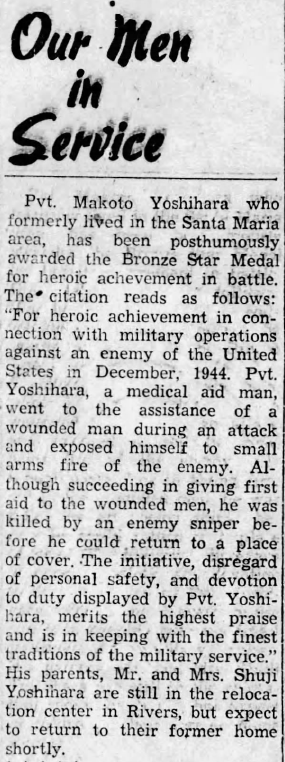
The way he died once again confirms the Army’s wisdom in assigning him to the 330th’s Medical Detachment. The Santa Maria Times kind of redeems itself, thanks to the Bronze Star citation’s wording, in this article from September 1945:

Makoto died saving a brother G.I.’s life because medics were favored targets for snipers; if you can kill a medic, the five or six wounded soldiers he might’ve saved will die, too.

(Above): Tragic bookends: Makotto’s draft card, its spelling uncertain, and his family’s application for a military tombstone.


Makoto died 5,000 miles away from Guadalupe’s row crops, its Mexican restaurants, honky-tonks and the sand dunes and the vivid ribbon of ocean beyond.

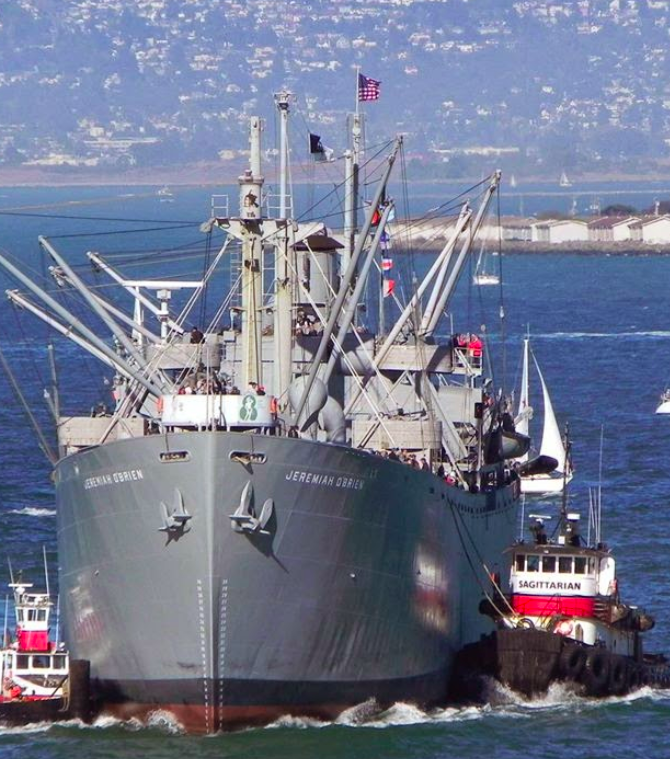
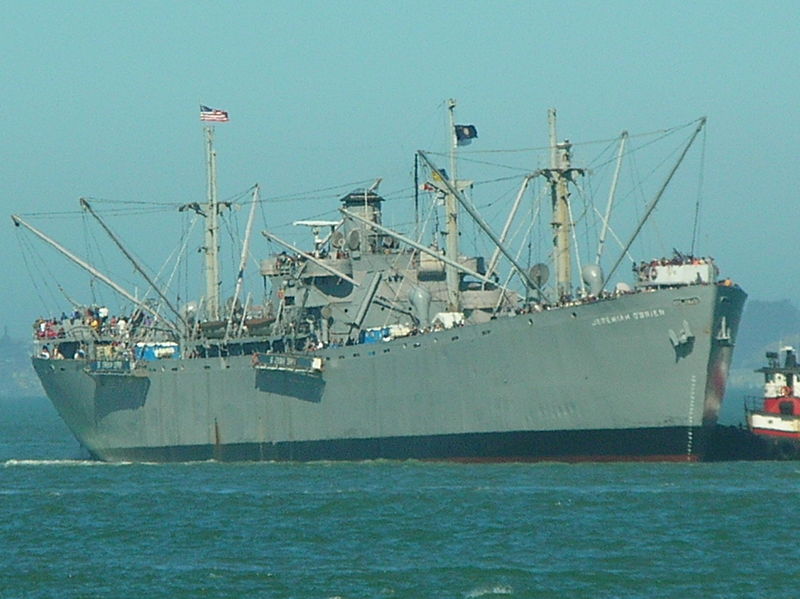
His body was returned to America in December 1948 aboard the prosaically-named Liberty Ship Barney Kirschbaum, one of the war’s industrial wonders; Kirschbaum’s duplicate, Jeremiah O’Brien, made the trip in reverse in 1994, sailing from her berth in San Francisco to England and then to the Normandy coast where she’d done duty in the invasion of the Continent in 1944; O’Brien is the last of the 6,000 ships that supported the D-Day landings.

Jeremiah O’Brien, one of three thousand Liberty Ships built during the war.


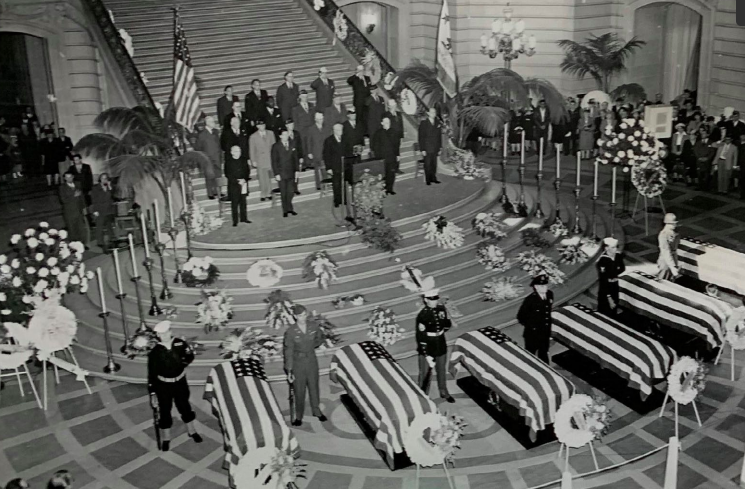
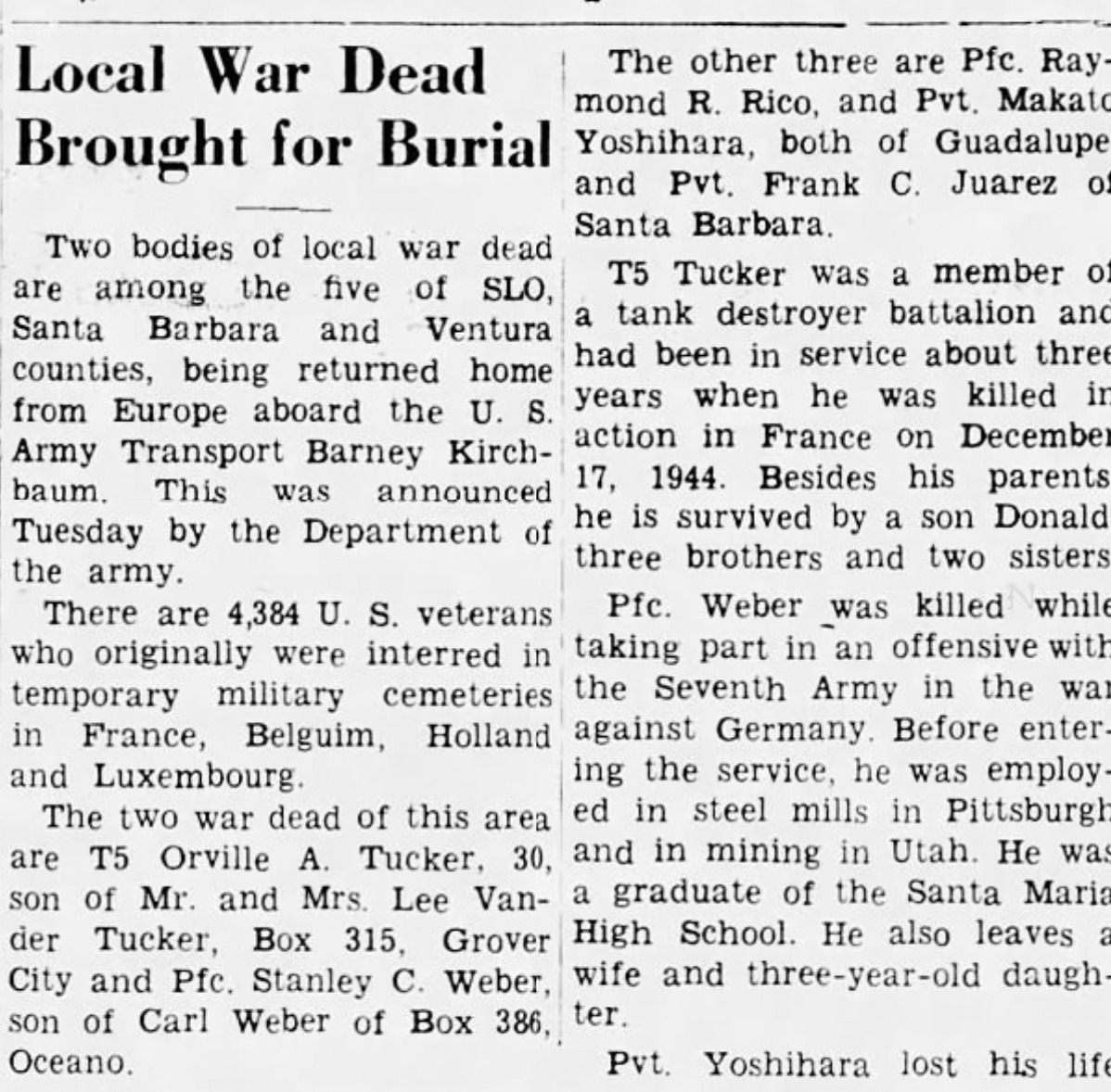
Accompanying Makoto’s coffin on Kirschbaum were the coffins of Orville Tucker of Arroyo Grande, killed on the second day of the Battle of the Bulge—five days before Makoto knelt over the wounded soldier— and Stanley Weber of Oceano, who died the next month in the counteroffensive that erased the Bulge and drove the Germans back.

The coffins, of course, would’ve been flag-draped. That’s an important detail, because belowdecks on Kirschbaum’s long voyage home, there were no “Japs;” no Ohioans, no Californians. These were our young men; even in death and even in the eighty years that separate our lives, they remind us that we, all of us, belong to each other.


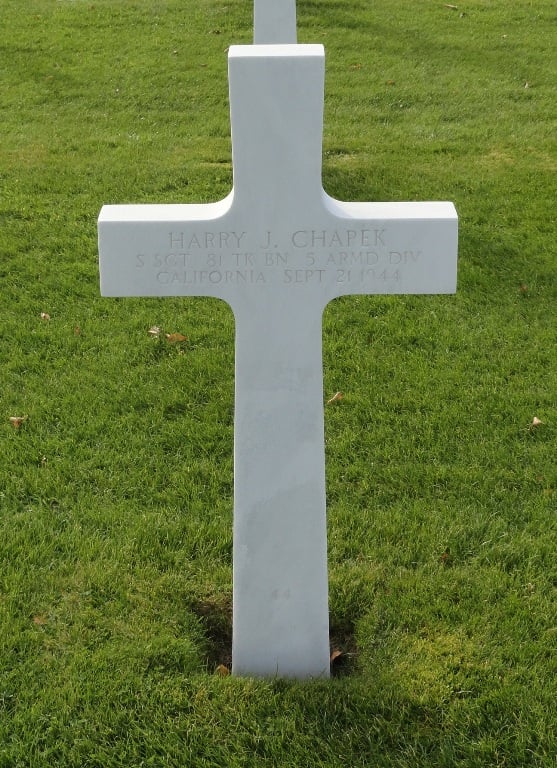
Sgt. Harry Chapek, American.

13 Saturday Nov 2021

Posted by ag1970 in Arroyo Grande, Uncategorized, World War II

≈ Leave a comment

A lot on my mind with this one.

Harry Chapek was a young Arroyo Grande man killed in action on the Belgian-German border, near the Siegfried Line, in September 1944.

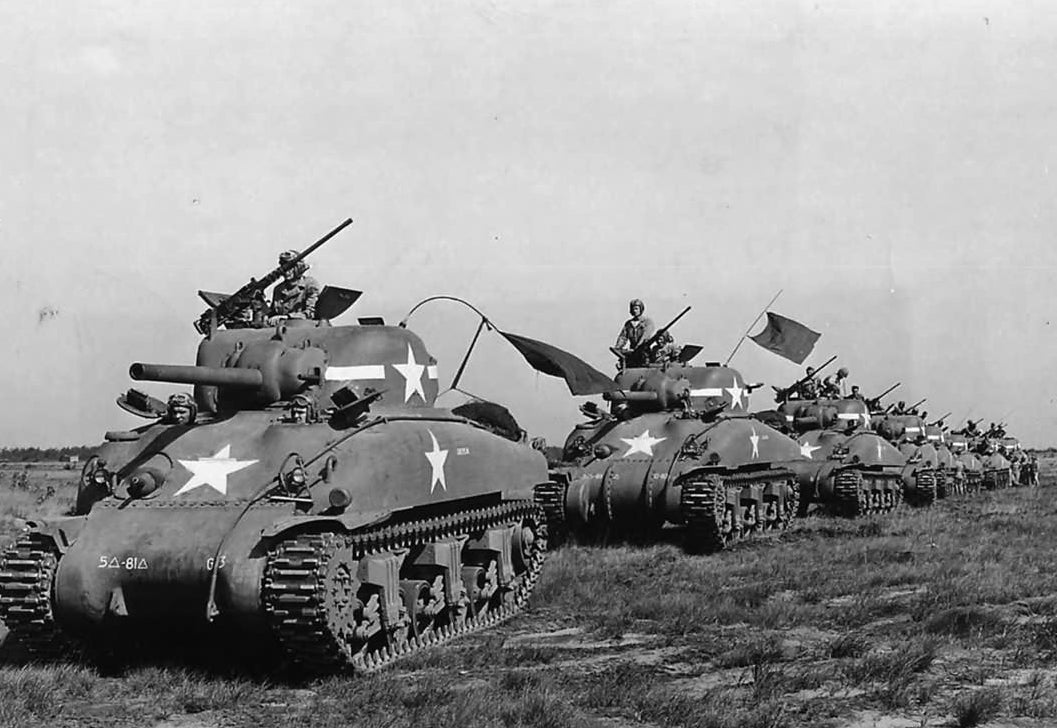
He was a member of the 81st Tank Battalion, 5th Armored Division and is buried at the American Cemetery at Henri-Chapelle, near Liege, Belgium.

Those are 81st Sherman tanks in the photo.

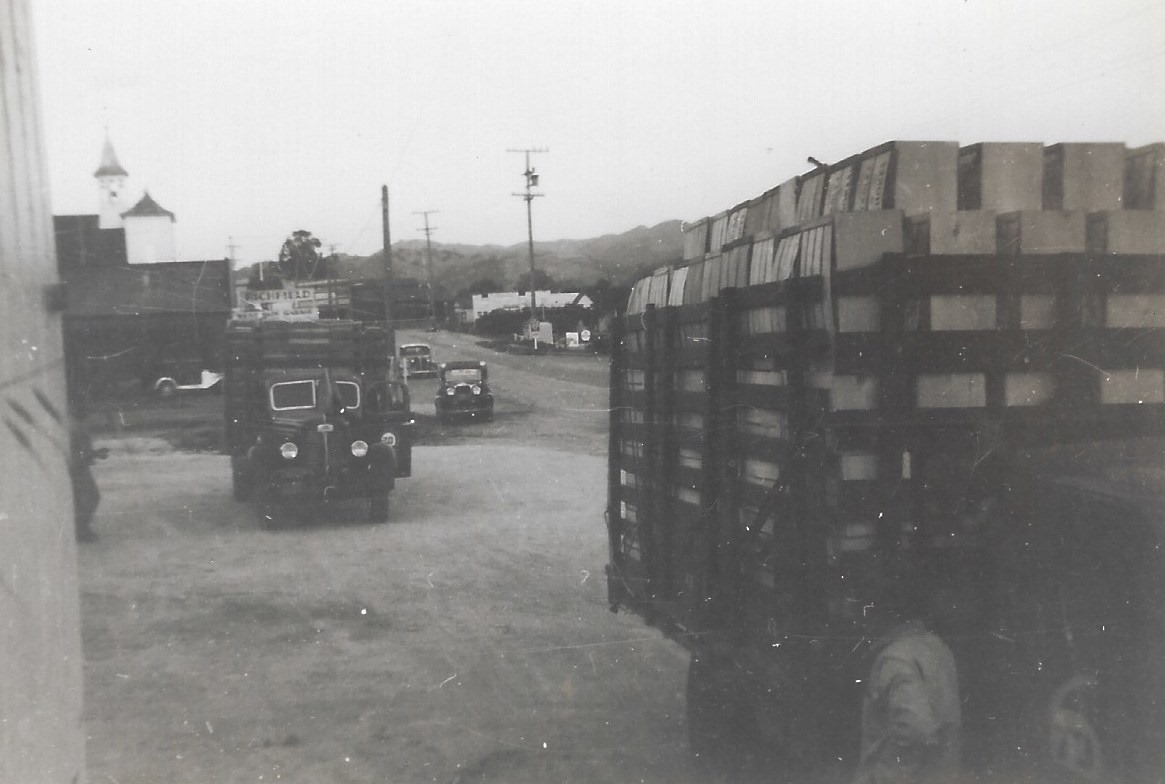
He was almost killed once before, in 1938. He was a driver for the Arroyo Grande Trucking Company, which stood at the site of today’s Bank of America–the photo of the site is courtesy of the Martin family. (That’s the old St. Patrick’s Catholic Church in the left background, built in the 1880s.) It was a vital part of the economy of our little farm town on California’s central coast, population 1,090 in the 1940 census.

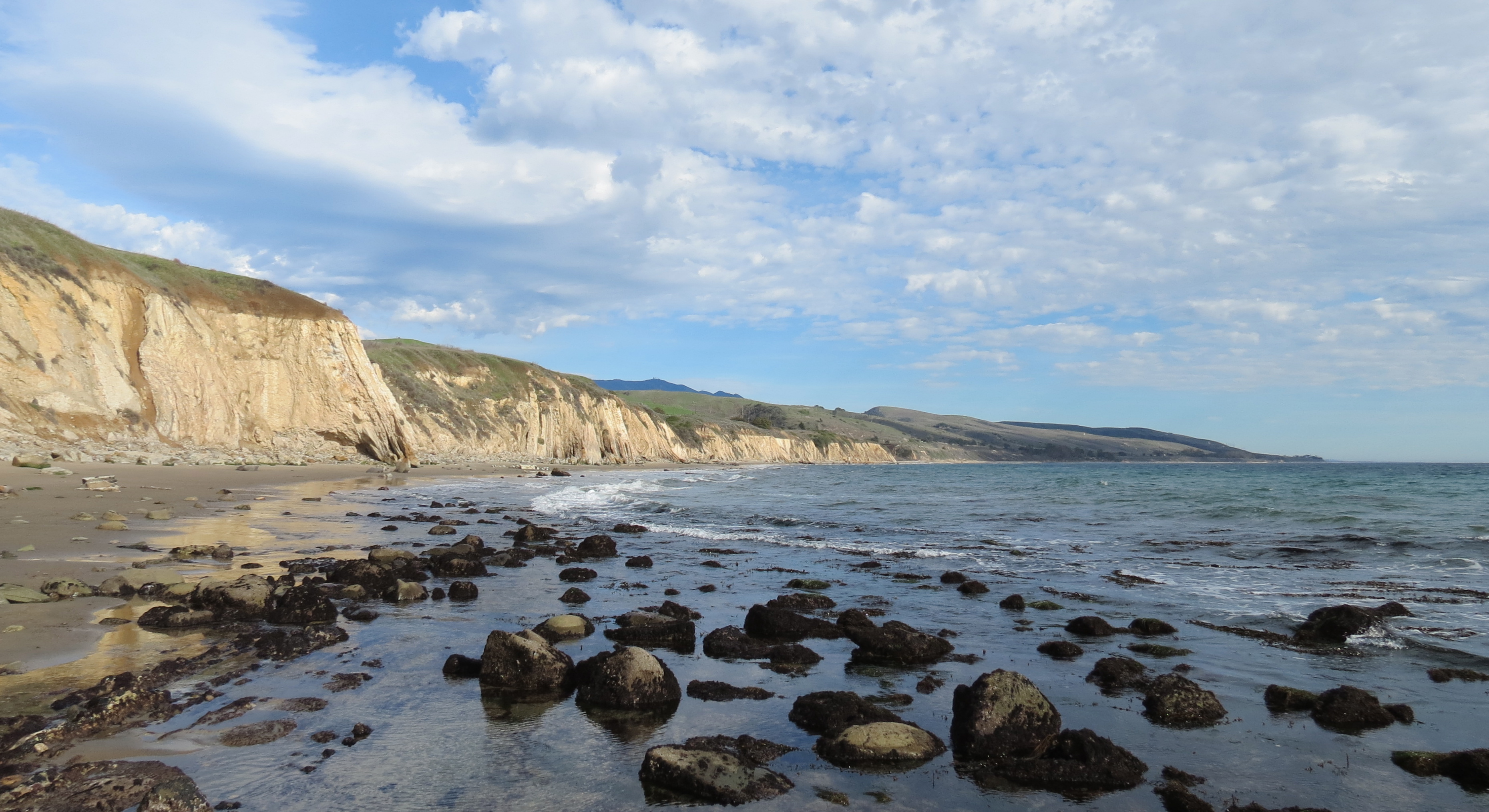
He was driving near Elwood, just south of the Gaviota Pass, and less than an hour north of another beautiful California place, Santa Barbara,  when a horse threw three little girls and galloped out into the highway in front of Chapek’s truck.

The impact killed the horse and the truck veered into a tree, where it caught on fire. Chapek was stuck in the cab, which in turn was buried by vegetable crates.

The California coast near the Gaviota Pass.

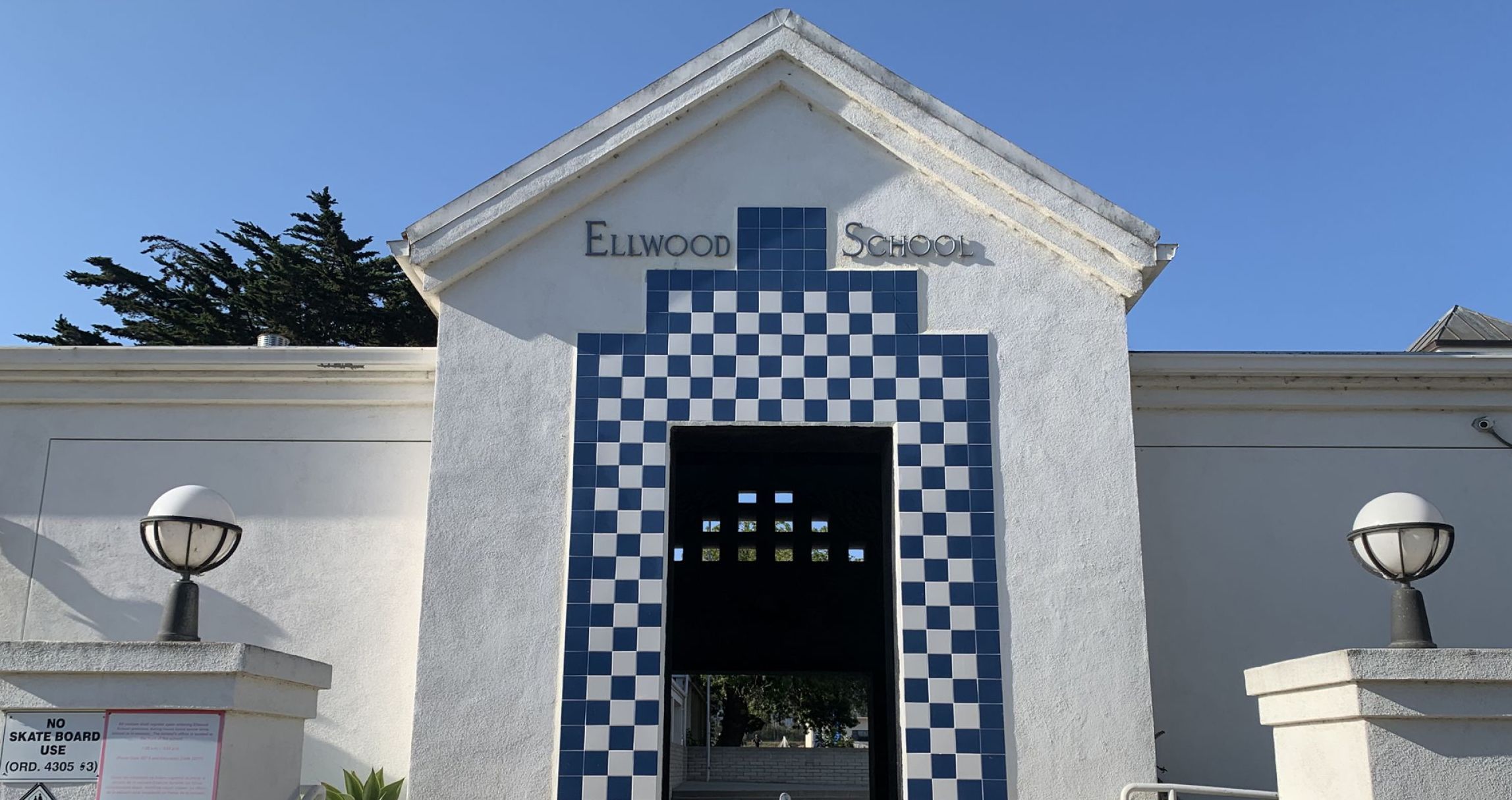
But that night there was a PTA meeting at the Elwood School, which is still there today, and a parent and a janitor ran out to the truck, dragged Chapek out–he was waving his arm out the cab window–and knocked the fire down with two of the school’s fire extinguishers. Four years later, a Japanese submarine shelled Ellwood.

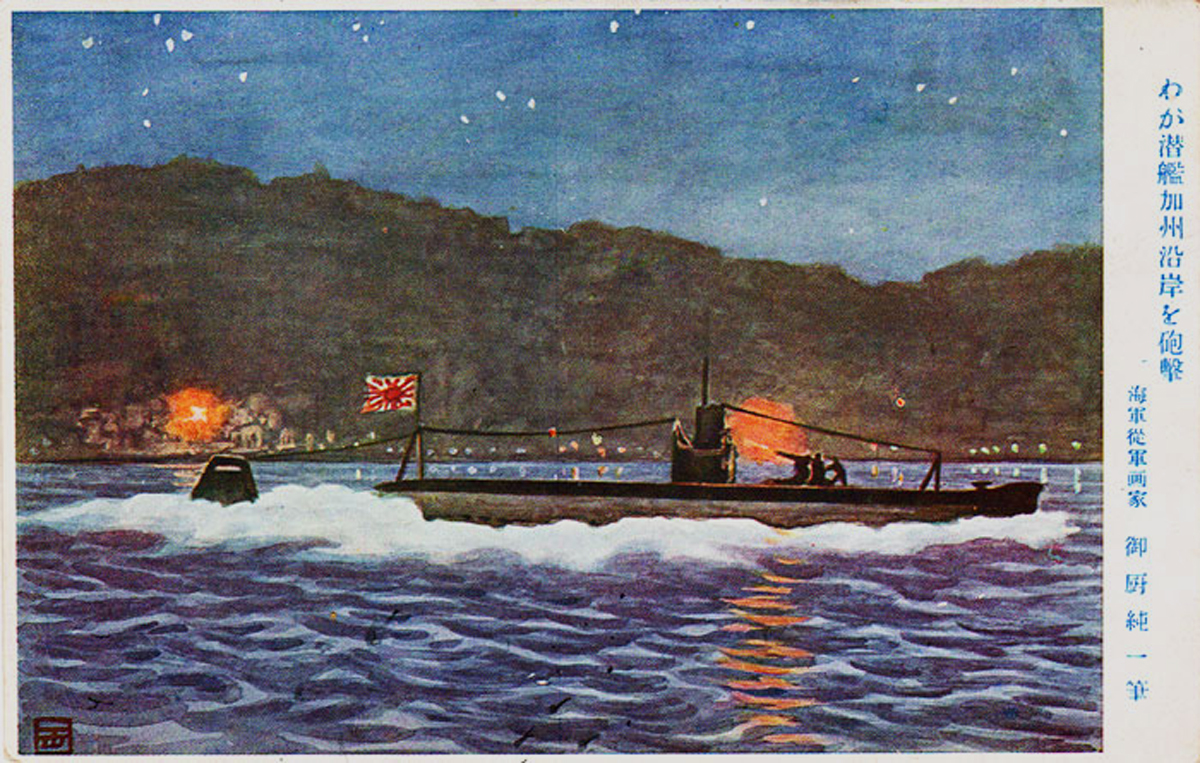
The Elwood School today; a contemporary painting shows the submarine I-17 shelling the area in 1942. (from Goleta History)

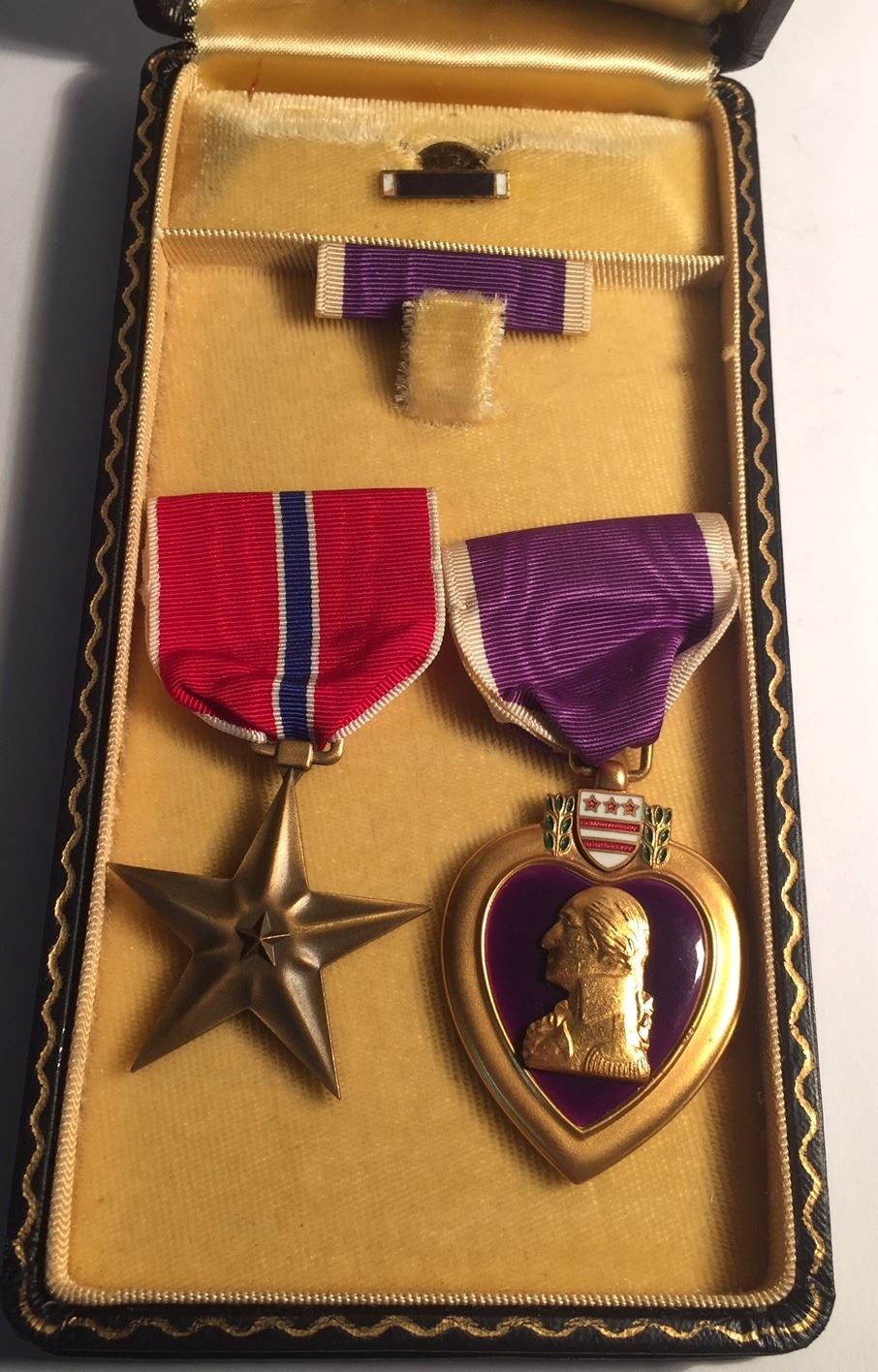
Six years later, a German artillery battery, covered by dense fog, fired a barrage that landed on the 81st’s “A” Company; it was probably the devastating explosion of .88 shells that killed Chapek, awarded a Bronze Star and a Purple Heart.

Growing up, he was a close friend of our friend George Shannon, who farmed near us in fields along Huasna and Branch Mill Roads, peppers and string beans and I think Brussels sprouts, among other crops. Mr. Shannon was an admirable man.

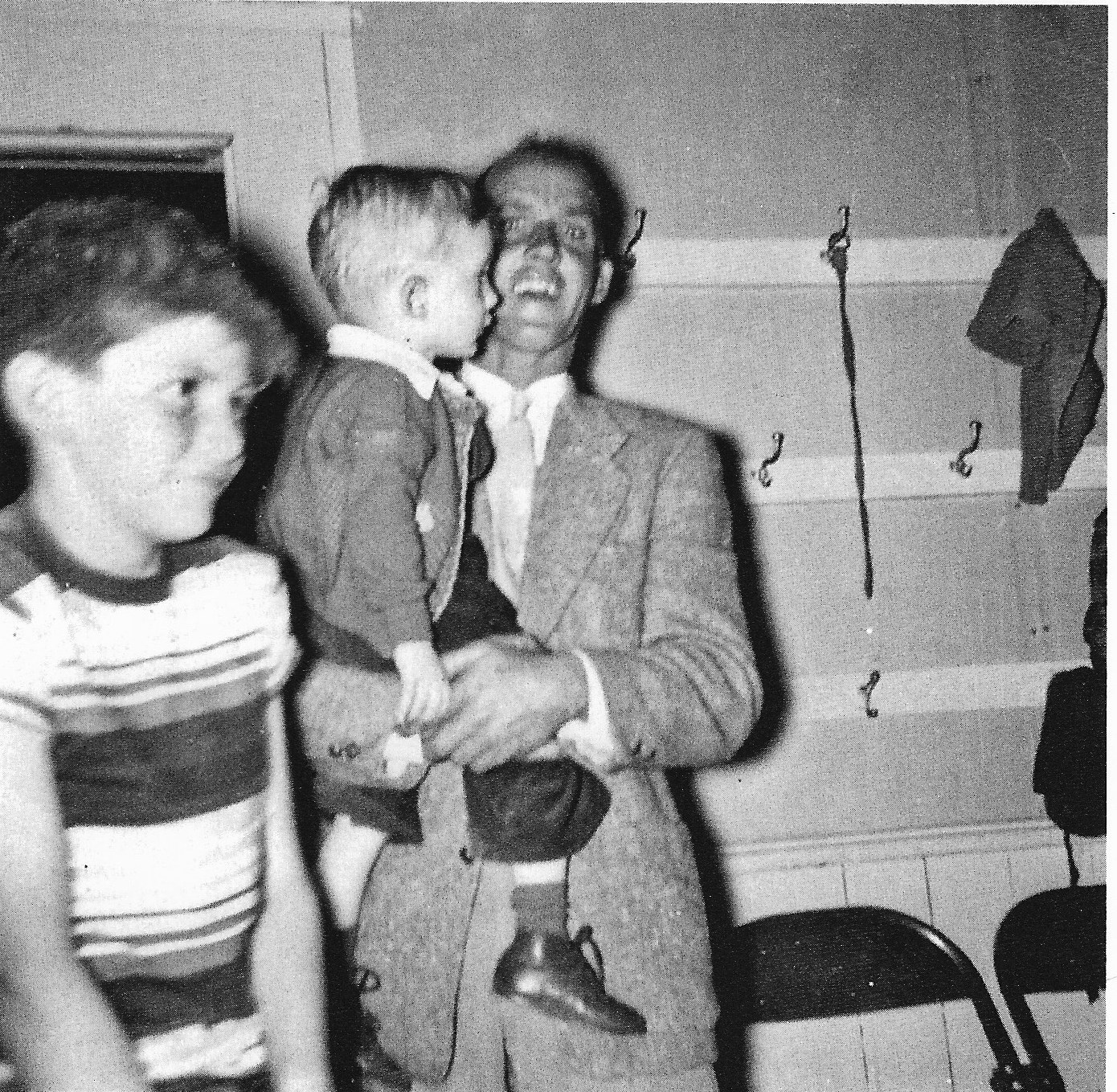
Farmer and neighbor George Shannon, with his son, Jerry, in the hallway between the two classrooms of Branch Elementary School, built in the 1880s. Shannon served as head of the school board.


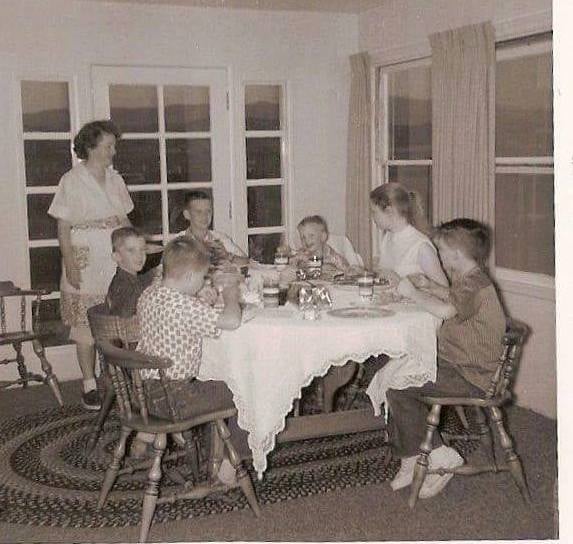
That’s my Mom serving dinner to us Gregory kids and to the three Shannon boys. You can tell how much she thought of them because dinner’s being served on the Irish lace tablecloth.

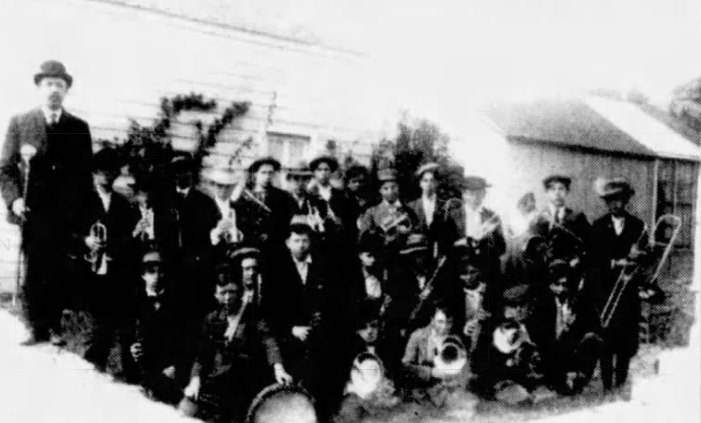
Chapek was an admirable man, too. As was his father, Matthias, or Mat. That’s Mat with the Arroyo Grande Boys’ Band about 1909. He probably lured potential juvenile delinquents away from a life of crime with a tuba or two.

He taught two generations of kids how to play musical instruments. Longtime teacher Ruth Paulding was one of them. The middle school’s named for her. Wayne Morgan, also an Eagle Scout, took up the violin thanks to Mr. Chapek. He was killed on December 7 on USS Arizona, along with another Arroyo Grande musician, Jack Scruggs, a trombonist in the battleship’s band.

I know something about the waves of immigration to Arroyo Grande, for example, from the Azores, Japan and the Philippines. Mat Chapek was from Bohemia– today’s Czech Republic.

It turns out that on upper Cherry Avenue–then called Leedham Lane–Arroyo Grande had a “Little Bohemia.” The Chapeks lived there, as did the Huebners, as did the Marsaleks.

That struck because one of my favorite books as a sophomore in Mrs. Flatt’s sophomore English class at AGHS, was Willa Cather’s My Antonia, about a girl from a family of Bohemian immigrants to Nebraska, to the Great Plains. It’s not more than six pages in before an inordinately large rattlesnake makes its appearance. That snake, and what I read later about the toll laundry and ironing took on frontier farm wives, bending their spines and hunching their shoulders—effectively and mercilessly transforming them into human question marks—remained with me always.

Arroyo Grande’s not much like Nebraska. The climate here is mild and the growing seasons overlap. But both places produce incredible wildflowers. This is field mustard near the foothills east of Arroyo Grande.

So Antonia and Chapek, the children of Bohemian immigrants, are linked in my mind now, even though Nebraska and California are so distant. The cemetery at Henri-Chapelle is more distant still—over 5,000 miles away from the foothills and the farm fields and the wild mustard that both Chapek and I grew up with. The distance, as the poet Whitman wrote, avails not. Sgt. Chapek’s life is now connected to mine. Time, Whitman also wrote, avails not. Arroyo Grande is my home town. Nearly eighty years after George Shannon lost his friend, our town survives both of them. It does so because of them.

It’s their gift to us, you see.

I a now a friend of the American Overseas Memorial Day Association Foundation in Belgium, which is a small honor. But that means I can now pay tribute to Sgt. Chapek on their website, and so draw recognition to the man with far greater honors.


Coming Home

02 Saturday Oct 2021

Posted by ag1970 in American History, Arroyo Grande, History, Uncategorized, World War II

≈ Leave a comment

The first World War II American casualties to be repatriated, San Francisco, October 1947. US Dept. of Veterans’ Affairs

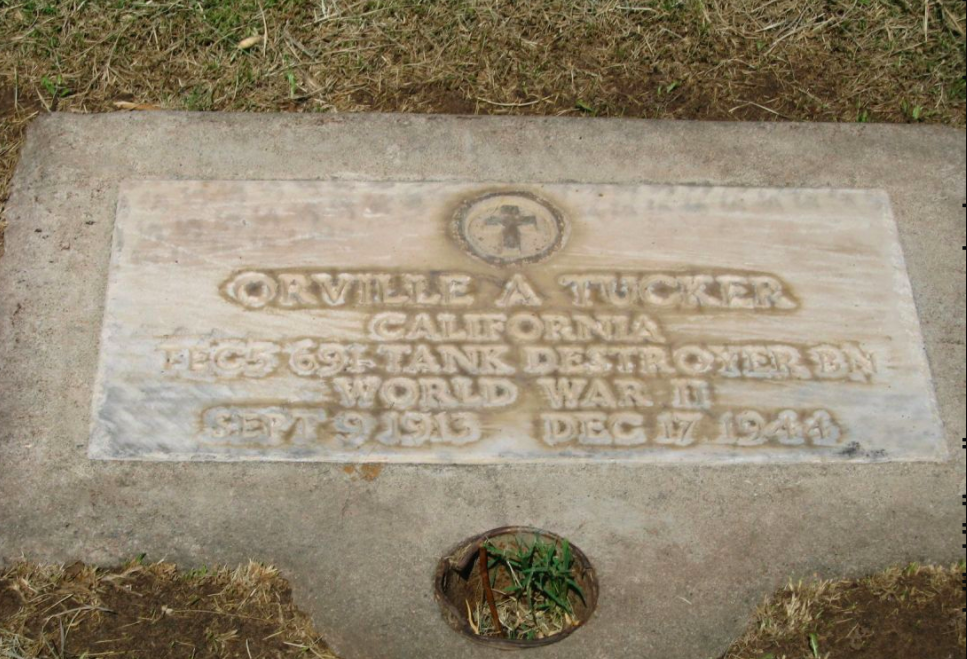
Of course I didn’t expect to meet him, but T5 Orville Tucker’s death crossed my life today. Here’s his grave, in the Arroyo Grande District Cemetery.

And there were a lot of things that struck me about him. The first was his date of death, and dates mean something to historians. We lost this American on the second day of Operation Wacht am Rhein, in what we now call the Battle of the Bulge.

It struck me, too, that he was part of a tank destroyer unit, like Frank Gularte, another Arroyo Grandean I know much better. Tucker was a member of the 691st TD Battalion, Gularte was part of the 607th. And the two soldiers died only days apart. Here’s what I wrote about Gularte on a website that memorializes fallen GI’s, killed in the war my father’s generation fought:

Sgt. Gularte served with the 607th Tank Destroyer Battalion and was killed in action 28 November 1944 near Metz, possibly outside the town of Merten. His son was born five days later in San Luis Obispo County, California. A memorial Mass was said in Sgt. Gularte’s memory at St. Patrick’s Church, Arroyo Grande, San Luis Obispo County, on Wed., 13 December 1944. Sgt. Gularte, before the war, was employed by E.C. Loomis and Son, a farm supply company; Gularte and his family were and are well-known and highly respected in the Arroyo Grande area.

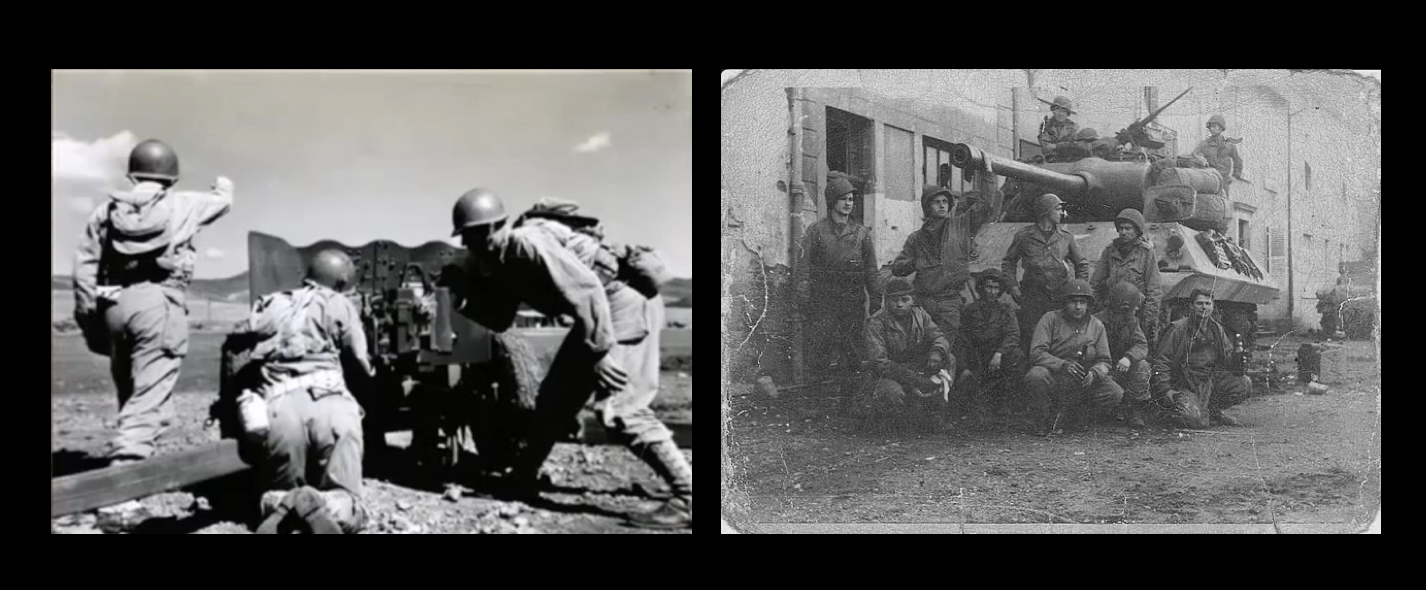
At the time of his death, Tucker’s battalion was still fighting enemy armor with the 57-mm artillery piece, like the one at left being manned by soldiers training at Camp San Luis Obispo in 1944. Frank’s 607th had graduated to the M36 tank destroyer–that’s a 607th TD in the other photo—built on the chassis and hull of the famed Sherman tank, but with a much more robust 90-mm gun.

But it was likely a Mauser rifle that killed Frank, in the hands of a German sniper, during an attack by the 607th that was to have been supported by infantry. They didn’t show, so Frank’s company went into action alone. German fire disabled three tank destroyers edging into Merten—a beautiful mountain town— and the American attack bogged down. Chaos ensued and it claimed Sgt. Gularte.

I don’t know yet how Orville died, but he’s got another tie to the Gularte family.

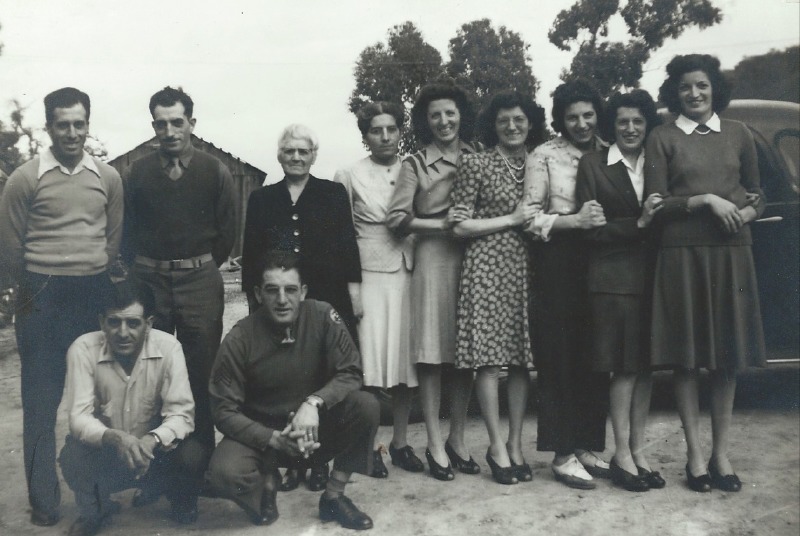
A family barbecue at the Gularte Ranch, behind the site of the IDES Hall just below Crown Hill. Manuel Gularte is standing; Frank is kneeling: Both are about to go to war in Europe.


As near as I can tell, in the opening hours of the Battle of the Bulge, Orville Tucker’s battalion was attached to the 28th Infantry Division. They were defending St. Vith, a Belgian town directly in the enemy’s line of advance and at the seam of two powerful German armies. Twenty-two thousand Americans were in the way of 100,000 Germans and their armor, including 500 tanks. The units that attacked St. Vith on December 17 included the 1st SS Panzer Division Leibstandarte SS Adolf Hitler, an SS unit that had it origins as the dictator’s bodyguard.

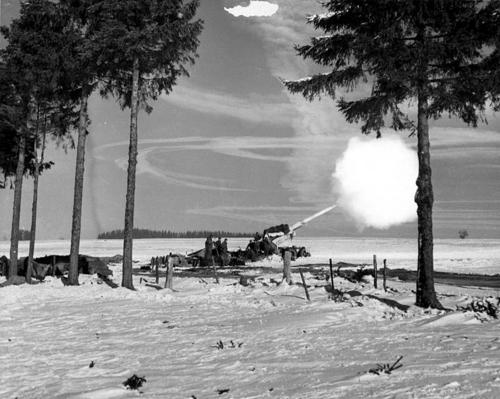
Their assignment was to take St. Vith by midnight December 17. It didn’t work out that way, partly in thanks to Orville Tucker and partly because of Frank’s brother, Manuel, also fighting to defend St. Vith. (Two Arroyo Grande settlers, Civil War veterans, had fought in separate regiments within 300 yards of each other at Gettysburg.) Manuel’s field artillery unit–they tended big 155-mm guns, updated versions of the artillery that stood guard over San Luis Bay here at home–and it was the accuracy and ferocity of their fire that delayed the German advance.

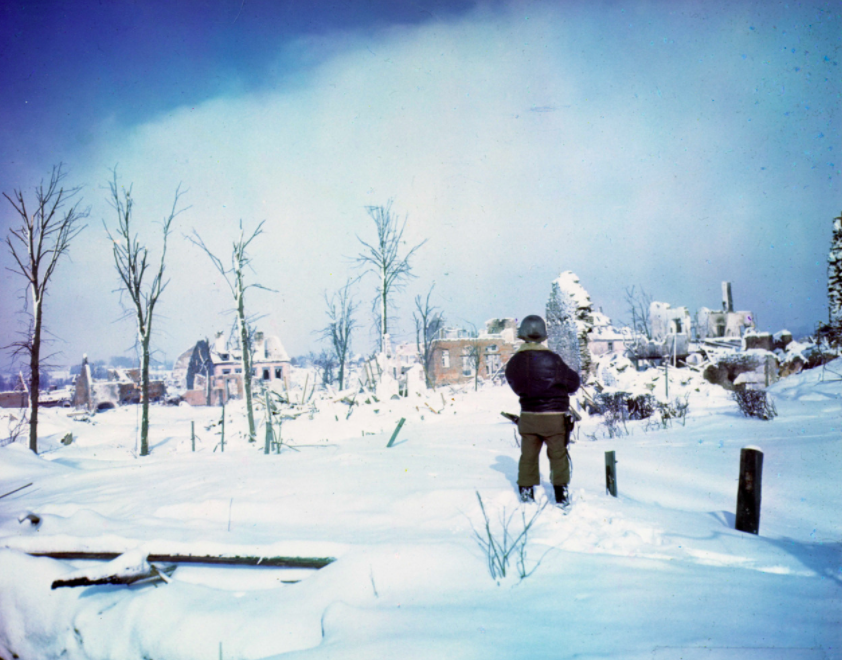
A 155-mm gun in action during the Battle of the Bulge; a GI on the outskirts of St. Vith in January 1945. The Battle of the Bulge was fought during the coldest winter in Europe in thirty years.

“Delay” was exactly what was needed. The panzers were fuel-poor (because Germany was: Berlin taxis were running on firewood in 1944) and the success of the Battle of the Ardennes depended on speed, on objectives seized promptly, even on the hopeful seizure of vast American stockpiles of gasoline.

Those might’ve been dispatched to the battlefield by my father, a lowly Quartermaster second lieutenant whose responsibilities included providing the African-American gasoline supply companies that kept the American army on the move.

By the time the American army had stopped moving—backward—and flattened the Bulge salient, 20,000 GI’s were dead, among them Orville Tucker. And though he died 5,000 miles away, Tucker was evidently one of the first local GI’s to come home. This is from the December 31, 1948, edition of the Arroyo Grande Herald-Recorder:


A sniper killed Yoshihara on the German frontier as the young man, a medic, was trying to save a brother soldier.

And the ship that brought Orville’s body home, the Barney Kirschbaum, named for an American merchant mariner killed in a 1943 U-boat attack, was a Liberty Ship, one of the miracles of the war, one of 2,710 such freighters launched from American shipyards during the war. Kirschbaum would’ve looked exactly like San Francisco’s Jeremiah O’Brien, tied up at Pier 45. (In 1994, O’Brien had the distinction of returning to the European Theater—to Normandy, no less—where she’d been part of D-Day fifty years before.)

The war dead intersect with my father’s life, as well. Once the war had ended, his duty shifted to training GI’s, nineteen-year-olds, some of them grads from Class of ’44. They’d come to Europe prepared the fight Germans, but the war was over, so Dad’s work, and theirs, was in Graves Registration. He trained these soldiers in the ghastly work of identifying the young Americans the war had claimed. Those young men—forever young— were then to be buried in one of a network of American military cemeteries. Many of those casualties, like Orville Tucker, would eventually come home.

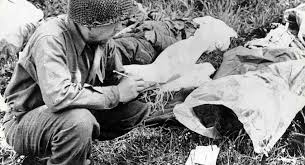
A Quartermaster, part of a Graves Registration unit, records the identities, soon after battle, of fallen soldiers.

One of the soldiers who came home after the war—in my family’s case to rural Missouri— was my father’s cousin, Roy.

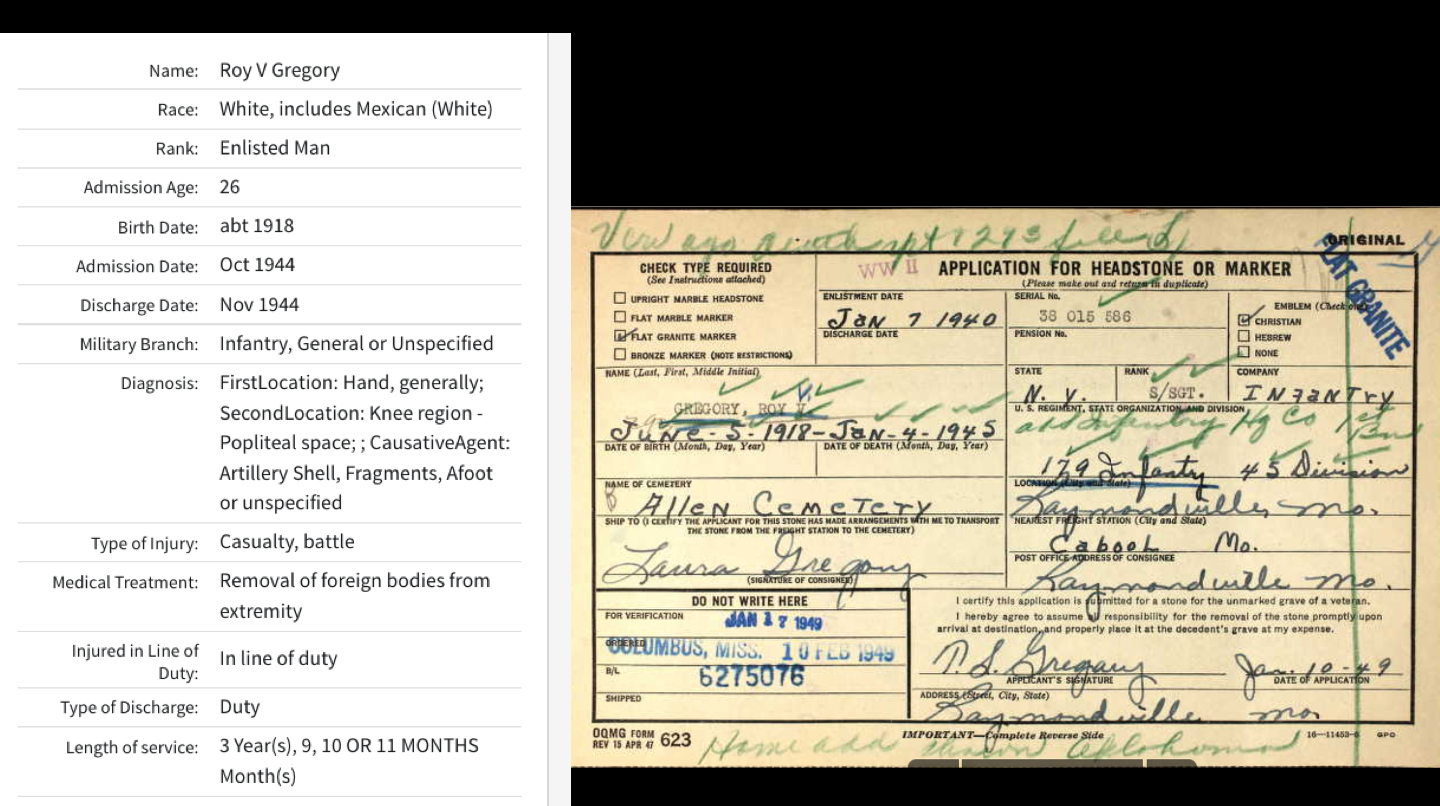
Roy was discharged from a field hospital, where he’d been treated for shrapnel wounds, in November 1944. He went back into action in Alsace, where, in January 1945, another elite SS unit essentially wiped out the headquarters company to which he was attached.

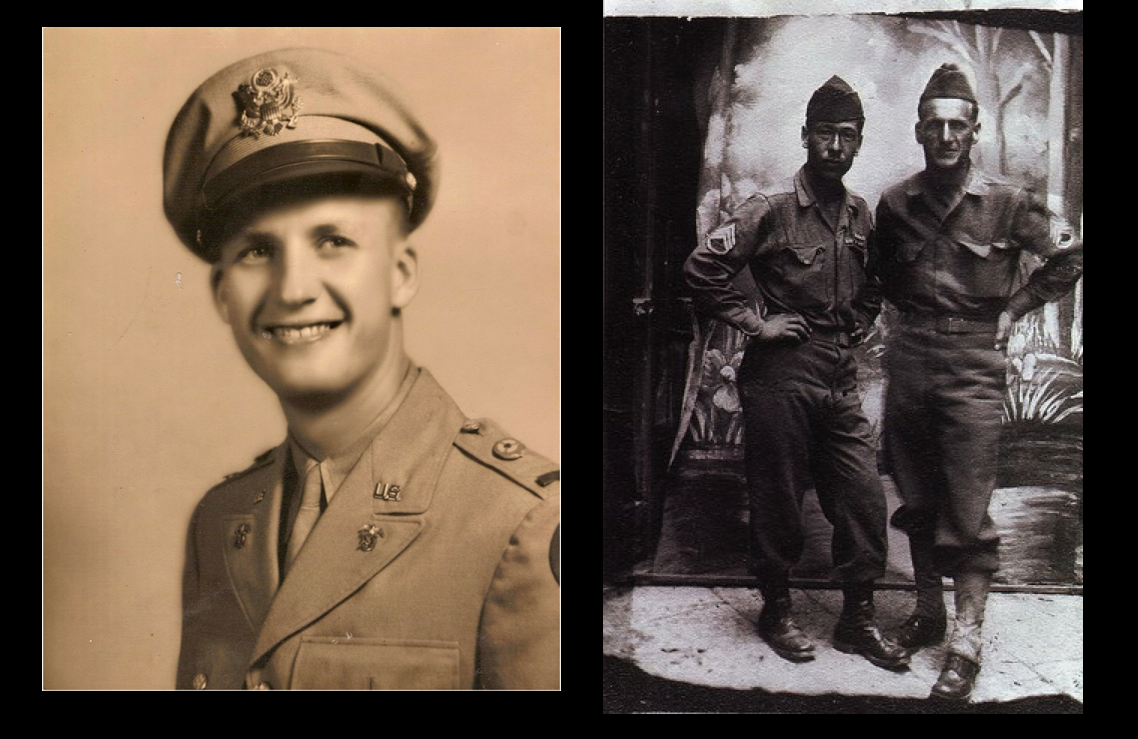
Roy—who’d fought with his buddy, Sgt. Chew, in Sicily, Italy, and finally France–looks remarkably like my Dad.

Sgt. Gregory’s hospital record; the family’s application for a military headstone. He is buried near my grandfather, John Smith Gregory.
My father as a lieutenant; Sgts. Chew and Gregory in a studio photograph taken in Italy.


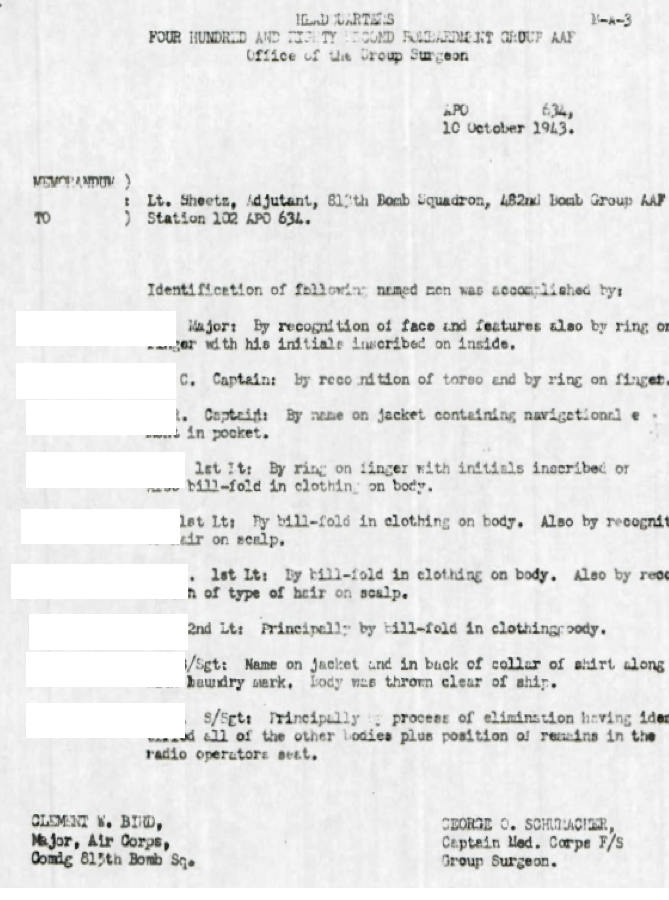
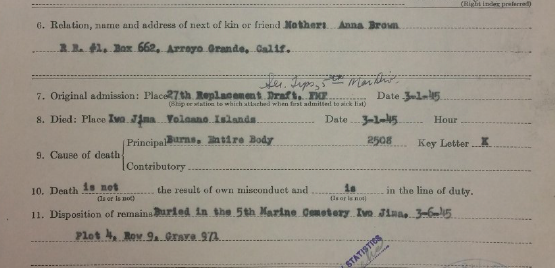
Graves registration work was ghastly, of course, because of the way these young men had died. Sometimes, in the Army Air Forces, when the flight surgeon of a bomb group had the duty of identifying the dead, the clues were circumstantial and almost always, as in the case of this Marine killed on Iwo Jima, the deaths were violent beyond imagination.

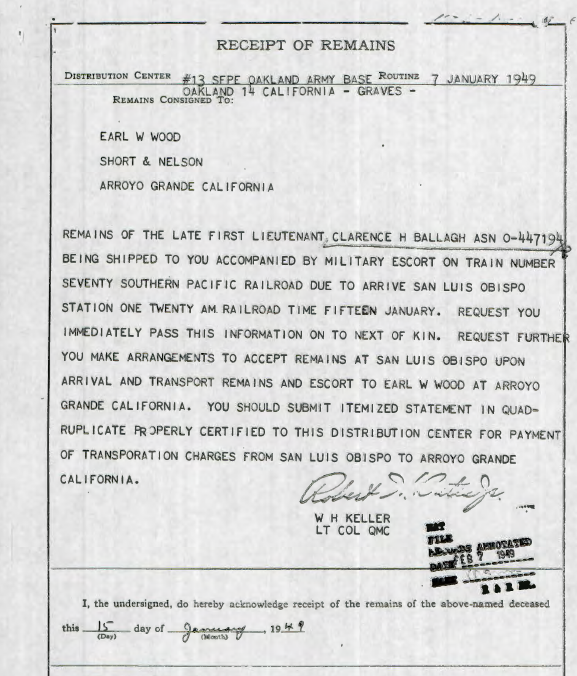
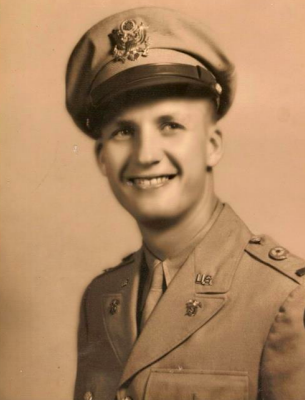
The dead recorded from this B-17 accident in northern England include Clarence “Hank” Ballagh, a young man whose ancestors came to Arroyo Grande in a covered wagon. He was the AGUHS valedictorian in 1938 and graduated from Cal with an engineering degree.
This young Marine, Louis Brown, was a farmer’s son from Corbett Canyon.

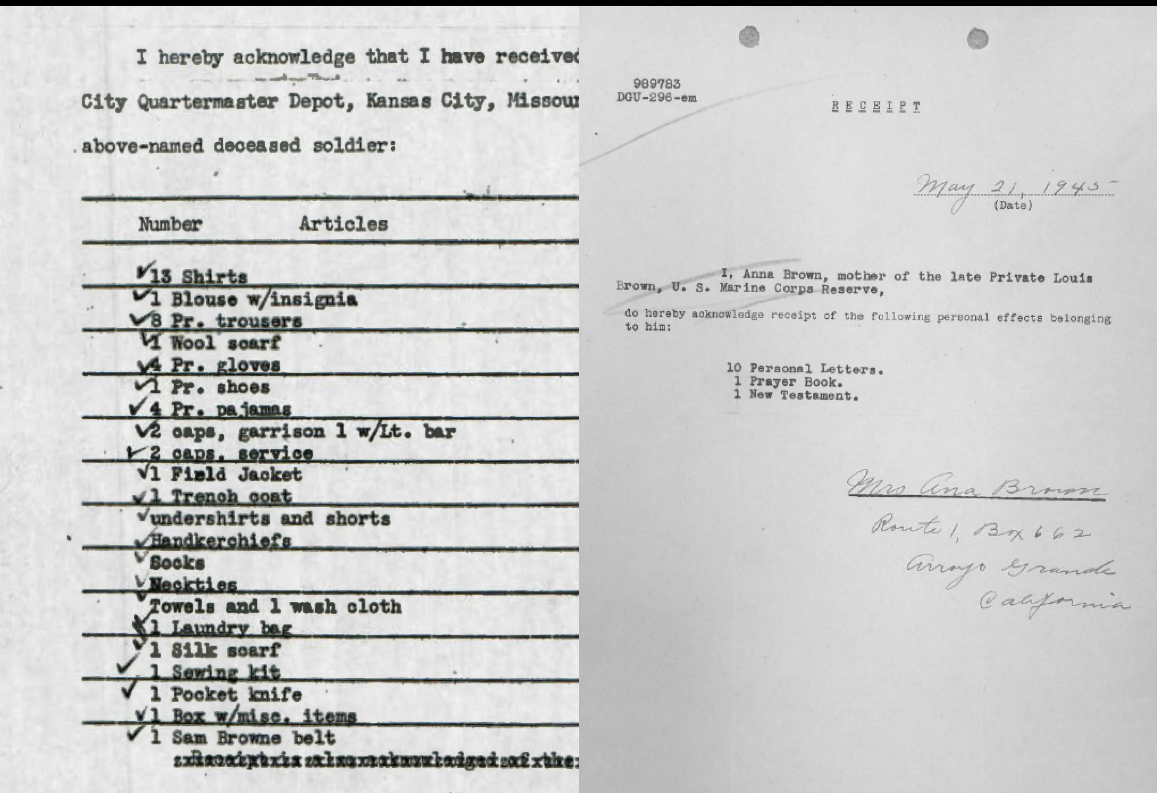
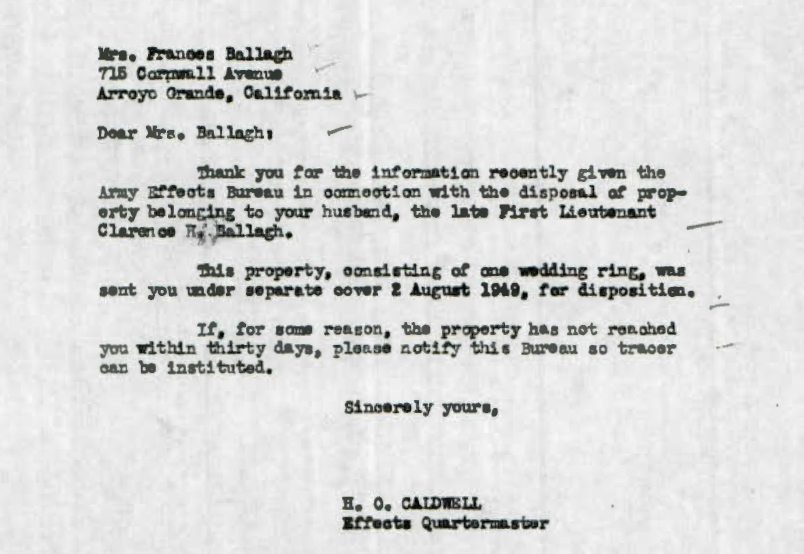
The Quartermasters also took charge of cataloguing a fallen man’s personal effects, and these reveal—with the possible exception of the Army Air Forces, where the sharp lines of rank blurred among bomber crews—that there remained a vast social gap between officers and enlisted men. These are the personal effects of Lt. Ballagh, the Berkeley grad, and Private Brown, who, like 64% of Americans in 1940, hadn’t finished high school:

Brown’s Rosary is listed in a separate Navy Department letter to his mother.

Ballagh was killed when his plane flew into the side of an English mountain; fragments of the B-17 remain there today. Brown was killed, most likely by a Japanese land mine, no more than 48 hours after he went into action on Iwo Jima. Both came home to Arroyo Grande, in a bureaucratic ballet in quadruplicate steps, that was unmistakably human. There’s no mistake that the Army wants Lt. Ballagh, even in death, to come home safely.

The records of the dead, I think, are important: they force us to confront a war now safely confined to history books and television screens. Beyond that, they reveal the terrible price that the living had to pay, as well.


The big guns above Shell Beach, 1942-1944

13 Monday Sep 2021

Posted by ag1970 in Arroyo Grande, Uncategorized, World War II

≈ 3 Comments


A World War I-vintage 155-mm artillery piece could hurl a 95-pound shell 20,000 yards.

If you’d been driving north to San Luis Obispo on the old two-lane 101, there was a a battery of these beasts on the hillside to your right as the road begins to curve inland, headed for true north.

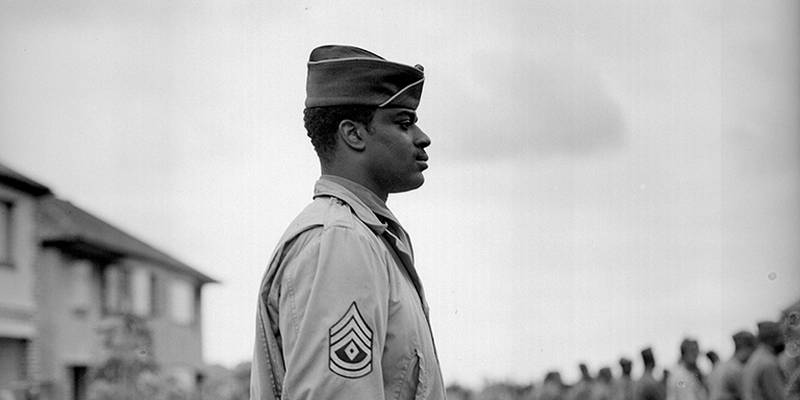
They were there to guard San Luis Bay and they were manned by G.I.’s from the 54th Coast Artillery, an African-American unit that had trained at Fort Fisher, North Carolina–taken from the Confederacy by the Union Army in January 1865–before some of them wound up serving in our county between 1942 and 1944.

I learned this today over lunch, a treat from military historian Erik Brun, who is researching the 54th during the unit’s stay here.

Erik told me that White North Carolinians were not at all fond of having Black G.I.’s close by–even though these soldiers were learning to handle guns that theoretically could inflict considerable discouragement on the U-boats hunting their quarry just offshore.

Those people had forgotten World War I, when 10 merchant ships were torpedoed off the Outer Banks.

In World War II, the U-boats claimed 80 ships. North Carolinians could easily see the glow of burning tankers in the shipping lanes off their coast.

They couldn’t see the crews thrown into the burning water.

So they didn’t want the 54th Coast Artillery anywhere near.

Detachments from the 54th would come to us instead, charged with defending Estero Bay as well as San Luis Bay. And so, for a brief time, Black G.I.’s were part of daily life here.

Some of the 54th’s soldiers played baseball against Arroyo Grande Union High School. A 54th officer–officers were White– married Lorna Folkerts of Arroyo Grande in a candlelit ceremony in a Camp San Luis Obispo chapel. And in 1943, an octet from the 54th sang for South Countians in a holiday concert at the Pismo Beach Army Recreation Camp. The barracks at the Rec Camp had once stood on the site of today’s Arroyo Grande Woman’s Club, where they were built in 1934 to house 230 Civilian Conservation Corps workers from Delaware, New Jersey and New York City.

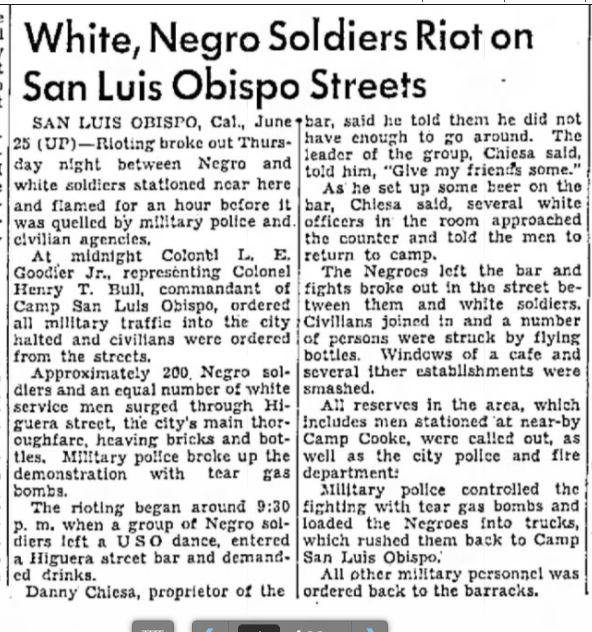
But the history of Black GIs in San Luis Obispo remains fraught. In June 1943, rioting broke out in San Luis Obispo and it made newspapers throughout America. This is from the June 25, 1943 Salt Lake City Tribune:

I have been trying to wrap my head around this. In an email to my friend Erik, I tried to explain it to myself.

* * *

It just occurred to me to look up the summer of 1943—what happened in SLO seems part of a national trend. There were race riots in —Mobile, Alabama (May 25) —Los Angeles (The Zoot Suit Riots, June 5-8) —Beaumont, Texas (June 15-17) —Detroit (June 20-22; 34 killed) —San Luis Obispo (June 24) —Harlem, NY (August 1-2)

It strikes me that racial tensions would’ve been intense here and across the nation.

The movement of Black Americans into defense jobs during the war was a factor in Mobile and Beaumont, where Black and White shipyard workers worked. The population influx, resulting housing shortages and competition between Black and White defense workers generated increasing tensions as the shipyards reached full production.

The same was true in Detroit, which created thousands of defense jobs—the city was a focal point for the Great Migration, where you could once find entire city blocks settled by families from the same county in Mississippi —but where housing shortages were (and are) notorious in the Black community and casual but cruel racism was, in 1943, a constant.

A similar influx, but of soldiers, happened here, in a little town not fully equipped to deal with thousands of GIs, including a shortage of places to entertain them. Blacks and Whites coming together (and the latter in such large numbers) and in seeming competition might’ve led to the kind of hostility seen in the shipyards.

It strikes me, too, that racism, including the stereotyping of Black Americans, might’ve typified a town like San Luis Obispo, which had little experience in interacting with them, including the soldiers of the 54th.

There’s a faint similarity, then, to the background of the Zoot Suit riots. Los Angeles was growing in the late 1930s and the war (e.g. the aircraft industry) accelerated it; the city did not plan well and the kind of housing problems that marked Detroit—as well as racism and job discrimination—were common to the Mexican-American community, which included Chavez Ravine.

But it was the decision to place a Naval installation there that resulted in fraught relations between sailors—outsiders, many from the Midwest or the South, who had little understanding of the Mexican-American community— and local residents. The two groups were strangers to each other, as was White San Luis Obispo to the 54th. So the Ravine in L.A. and Danny’s Bar on Higuera became flash-points for two of the 1943 riots.

* * *

I guess because I took a year of the History of the American South in college, at the University of Missouri, I’ve always been fascinated by this part of our history, by which I mean Black History, by which I mean American History.

My Dad, a quartermaster officer who grew up in Texas County, Missouri, was a small part of that history.

Lt. Robert W. Gregory, 1944


On the troopship to England, Dad was issued a .45 sidearm. It wasn’t for Germans. It was for Black soldiers, truckers, suffering belowdecks in the North Atlantic crossing. I wrote about this:

These were the men who would drive the deuce-and-a-half trucks on the  Red Ball Express. It was my father’s job the organize and send some of  these truckers, in gasoline supply companies, to the 1944 beachhead in  Normandy, where details from George Patton’s Third Army would arrive  regularly to kidnap them so that the great general would be the first to the  Rhine, the natural border between France and Germany. 

In this, Patton would succeed, but it was the Red Ball express that made his  moment, captured by wire service photographers, possible.  

Along the way, the black truckers died under artillery fire, died from worn out brakes and frayed tires and died from the irresistible urge to fall asleep  on darkened roads that led irrevocably east, from the Seine Valley to the  Ardennes. 

To stay alive, they learned to drive at night without headlights. If a driver  felt that sleep was too powerful to resist, he learned to switch seats with his  passenger and comrade while the truck was moving. When the trucks  didn’t move fast enough for the Red Ball drivers, they modified the  governors on their trucks’ carburetors. When the trucks broke down, they  resurrected them.  

On a typical day, 900 trucks were on the road, spaced at sixty-yard  intervals, to keep Third Army fed and its trucks and tanks fueled. 

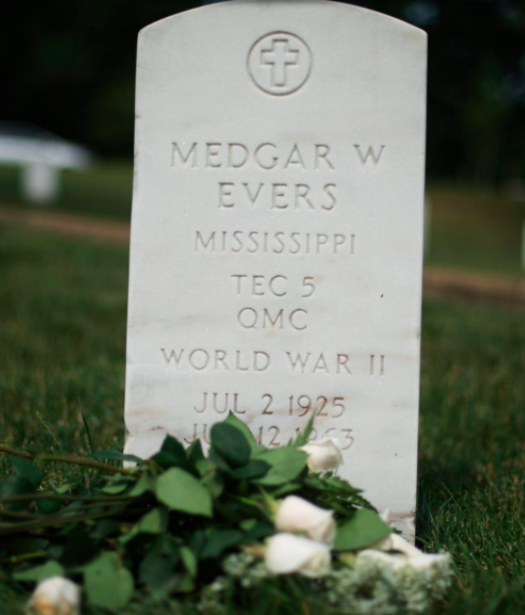
One of the Red Ball veterans was named Medgar Evers. After the war, he  became a civil rights activist. A sniper took his life near Jackson,  Mississippi, in 1963, with a Lee-Enfield rifle, the infantry weapon issued  the British soldiers who became my father’s wartime friends. 

Medgar Evers was thirty-seven years old. His wife, Myrlie, who would  become a formidable activist in her own right, and his three children were  at his graveside when he was buried at Arlington. 

Medgar’s killer was convicted. It took thirty-one years.


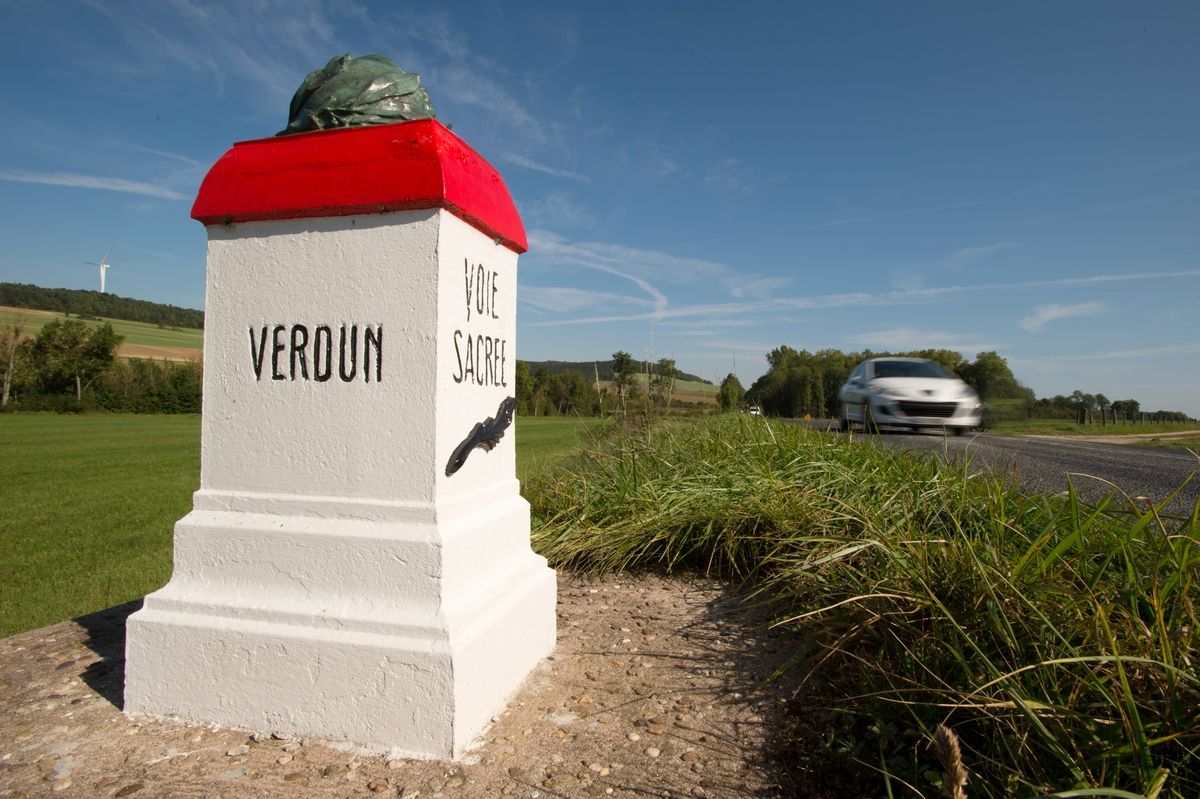
The 1916 Battle of Verdun was one of the ghastliest in twentieth-century history, claiming over 300,000 French and German lives and vaporizing seven French villages. But the French have honored their military truck drivers who were part of that terrible battle: The road to Verdun is called La Voie Sacree—The Sacred Way— and, as you approach the battlefield, which my students and I visited in 2010, markers commemorate French soldiers, the poilus, who drove the trucks.


So the French remember. What Arroyo Grande farmer Haruo Hayashi remembers during his time training with the 442nd Regimental Combat Team in Mississippi was the rigidity of Jim Crow. He couldn’t understand why Black soldiers weren’t allowed to watch USO shows inside the Camp Shelby (named after a Confederate cavalry officer) gymnasium. It bewildered him.

Haruo’s family was behind barbed wire at the Gila River internment camp.

So my time with Erik today gave me a lot to think about

This video shows a crew working the same kind of gun the 54th knew so well.


The wreck at 20,000 feet

11 Sunday Apr 2021

Posted by ag1970 in Uncategorized, World War II

≈ Leave a comment


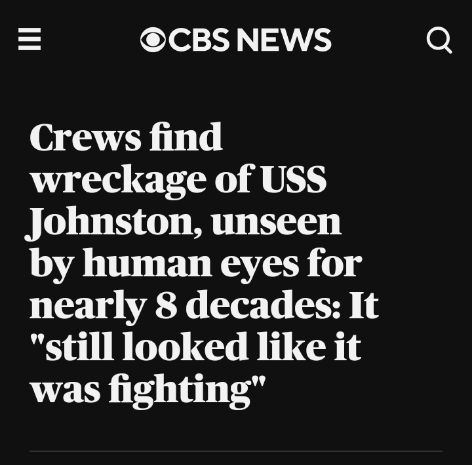
A news item, April 10:

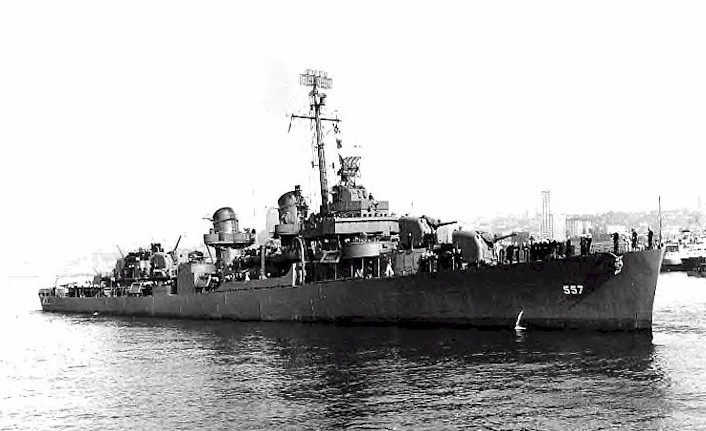
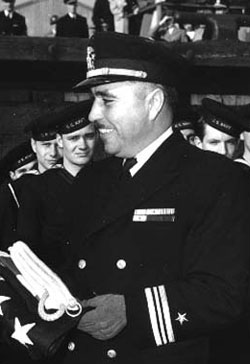
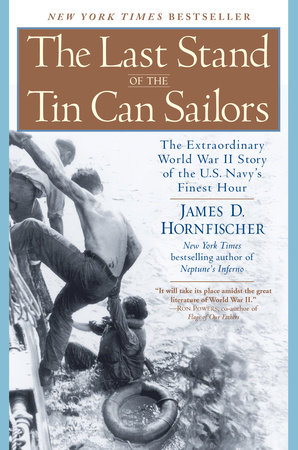
Lt. Cdr. Ernest Evans—vividly portrayed in the book “Last Stand of the Tin Can Sailors”— was commanding USS Johnston in October 1944.

His nickname, “Chief,” typical of the old Navy’s casual racism, alluded to his Cherokee/Creek ancestry. Annapolis must have been an ordeal for him.

Now, his destroyer was among those protecting landings in the Philippines when a massive Japanese task force—four battleships included—appeared from the northwest.

The main American force that was supposed to be guarding the invasion beaches—capital ships and big fleet carriers— was commanded by Adm. William Halsey.

It was gone. Halsey had been made the fool, lured away from the invasion by a Japanese decoy force that was essentially harmless.

The main battle force now appeared, intending to destroy the Americans as they landed.

Facing them were ships no bigger than USS Johnston and a complement of small aircraft carriers, “baby flattops.”

Evans was like Jesus’ Good Shepherd. The ships that were landing the GIs and their supplies were his flock; he was accountable for them and to them.

So he turned Johnston directly toward the enemy fleet. His destroyer, at 5500 tons, was armed with five 5-inch guns.

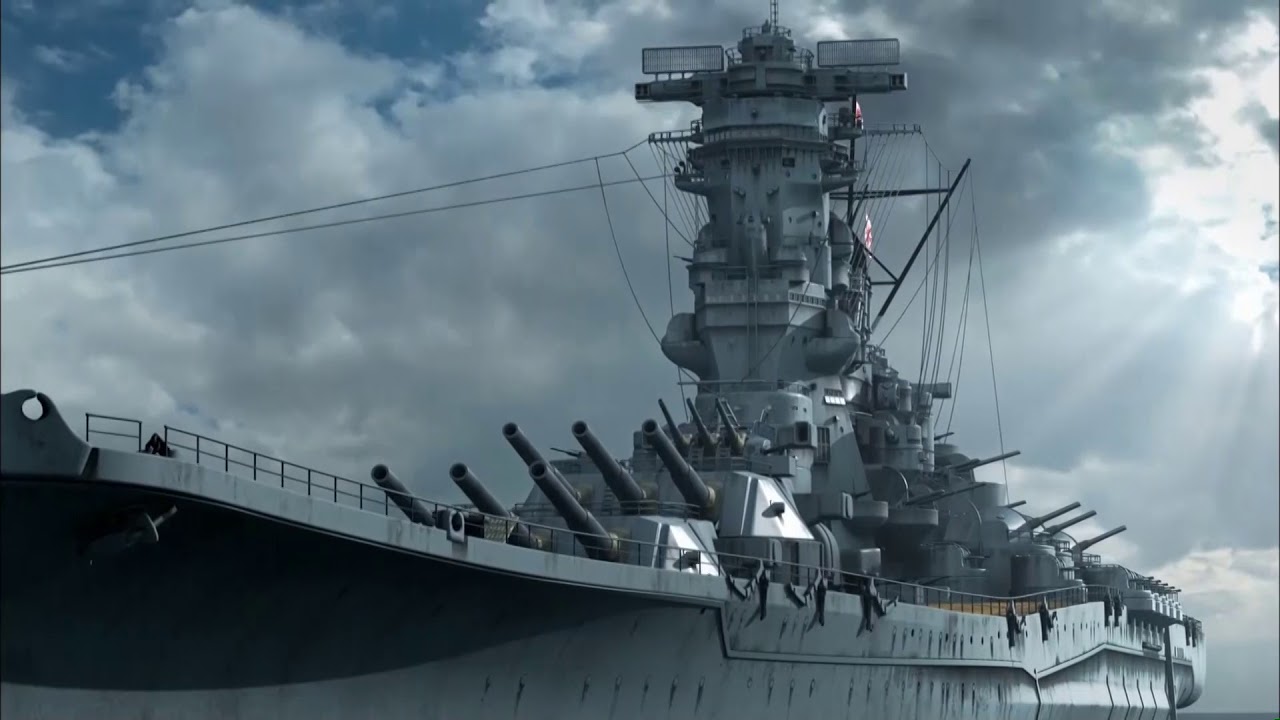
He was up against the battleship Yamato, 70,000 tons with nine 18-inch guns, twelve 6-inch guns and twelve 5-inch guns.

On her first run, Johnston fired two hundred shells and her entire complement of ten torpedoes: one of them blew the bow off a Japanese cruiser.

Johnston

Ships even smaller than Johnston—destroyer escorts—followed her lead and went in to attack. Yamato’s armor-piercing shells, intended to cripple battleships, went completely through the fragile destroyer escorts.

Yamato

Although eighteen-inch shells from Yamato struck Johnston’s engine room and so nearly halved her speed, Evans kept his ship fighting, dodging in and out of rain squalls or the smokescreen the destroyer escorts had laid down.

He fought two ship-to-ship battles, one against a heavy cruiser, another against a battleship seven times the size of his ship, at one point crossing an enemy ship’s “T” in a maneuver that would have made Lord Nelson proud.

The blue ships are crossing the T, bringing all their guns to bear.


Johnston scored at least sixty hits on the two enemy ships, but a six-inch shell from Yamato struck Johnston’s bridge, inflicting terrible casualties and mangling Evans’s left hand.

Evans kept his ship fighting.

The shellburst had nearly wiped out the bridge crew. It destroyed the wheel. Witnesses on a destroyer speeding past Johnston saw the badly hurt Evans–he’d suffered burn wounds and two fingers from his hand were gone—standing on the stern, bellowing orders down a hatch to where his ship was now being steered.

He waved at the passing ship.

Evans had taken Johnston into the fight at 7 a.m. By 9:45, the destroyer was dead in the water.

A swarm of Japanese destroyers then concentrated their fire on the ship that had bedeviled the entire fleet, and Evans finally ordered his men to abandon the sinking ship. He went into the water with them.

That was the last time Johnston’s crew saw their captain.

Evans

Ernest Evans was the first Native American naval officer to be awarded the Medal of Honor. 190 of his 327-man crew died with him.

But the Americans —little ships like Johnston and combat airplanes launched from the baby flattops—fought so fearlessly and so recklessly that after six hours of combat the Japanese, finally concluding that a fleet much bigger than theirs was about to prevail, abandoned their attack and withdrew.


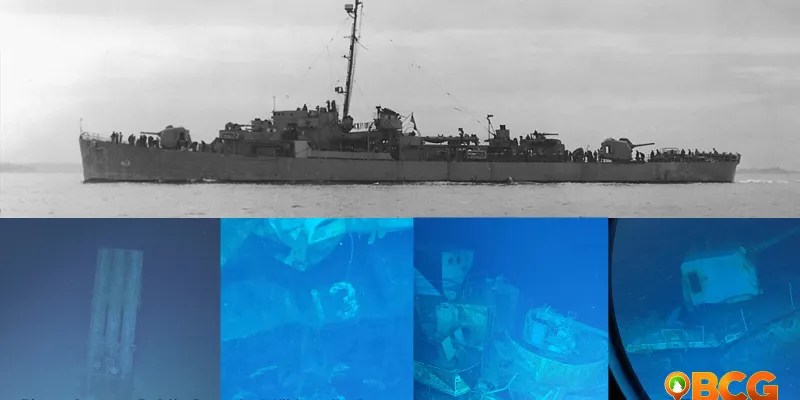
Earlier this month, when the submersible found the wreck of the Johnston at 20,000 feet, her five-inch guns were still elevated, still pointed toward the enemy.

In June 2022, the same expedition discovered Johnston’s comrade, USS Samuel B. Roberts (below), at 22,000 feet. In the same battle, Roberts, 1370 tons, took on the heavy cruiser Chokai, blowing off her stern with a torpedo hit; the ship later had to be scuttled. Roberts’s commander, Lt. Cdr. Robert Copeland, then turned his attention to the heavy cruiser Chikuma, setting that ship’s bridge afire and destroying her No. 3 guns before three fourteen-inch shells from the battleship Kongo sent Roberts to the bottom. Ninety of her 210-man complement died, among them Gunner’s Mate 3c Paul Carr. His aft 5-inch gun turret is at far right in the photo sequence below. Carr died only after firing 325 shells at the enemy in a little over 35 minutes. A guided missile frigate is named for him today.

Hornfischer’s account of this battle is superb.


← Older posts
Newer posts →

Subscribe

  • Entries (RSS)
  • Comments (RSS)

Archives

  • January 2026
  • December 2025
  • November 2025
  • October 2025
  • September 2025
  • August 2025
  • July 2025
  • June 2025
  • May 2025
  • April 2025
  • March 2025
  • February 2025
  • January 2025
  • December 2024
  • November 2024
  • October 2024
  • September 2024
  • August 2024
  • July 2024
  • June 2024
  • May 2024
  • April 2024
  • March 2024
  • February 2024
  • January 2024
  • December 2023
  • November 2023
  • October 2023
  • September 2023
  • August 2023
  • July 2023
  • June 2023
  • May 2023
  • April 2023
  • March 2023
  • February 2023
  • January 2023
  • December 2022
  • November 2022
  • October 2022
  • September 2022
  • August 2022
  • May 2022
  • April 2022
  • March 2022
  • February 2022
  • January 2022
  • December 2021
  • November 2021
  • October 2021
  • September 2021
  • August 2021
  • July 2021
  • June 2021
  • April 2021
  • March 2021
  • February 2021
  • January 2021
  • December 2020
  • November 2020
  • August 2020
  • July 2020
  • June 2020
  • May 2020
  • April 2020
  • January 2020
  • December 2019
  • November 2019
  • October 2019
  • September 2019
  • August 2019
  • May 2019
  • April 2019
  • March 2019
  • February 2019
  • January 2019
  • December 2018
  • November 2018
  • October 2018
  • September 2018
  • July 2018
  • June 2018
  • May 2018
  • April 2018
  • March 2018
  • February 2018
  • January 2018
  • December 2017
  • November 2017
  • October 2017
  • April 2017
  • March 2017
  • December 2016
  • November 2016
  • October 2016
  • September 2016
  • August 2016
  • July 2016
  • June 2016
  • April 2016
  • March 2016
  • February 2016
  • January 2016
  • December 2015
  • November 2015
  • October 2015
  • September 2015
  • August 2015
  • July 2015
  • June 2015
  • May 2015
  • April 2015
  • March 2015
  • February 2015
  • January 2015
  • December 2014
  • November 2014
  • September 2014
  • August 2014
  • July 2014

Categories

  • American History
  • Arroyo Grande
  • California history
  • Family history
  • Film and Popular Culture
  • History
  • News
  • Personal memoirs
  • Teaching
  • The Great Depression
  • trump
  • Uncategorized
  • World War II
  • Writing

Meta

  • Create account
  • Log in

Blog at WordPress.com.

  • Subscribe Subscribed
    • A Work in Progress
    • Join 68 other subscribers
    • Already have a WordPress.com account? Log in now.
    • A Work in Progress
    • Subscribe Subscribed
    • Sign up
    • Log in
    • Report this content
    • View site in Reader
    • Manage subscriptions
    • Collapse this bar
 

Loading Comments...