A man tries to teach Women’s History

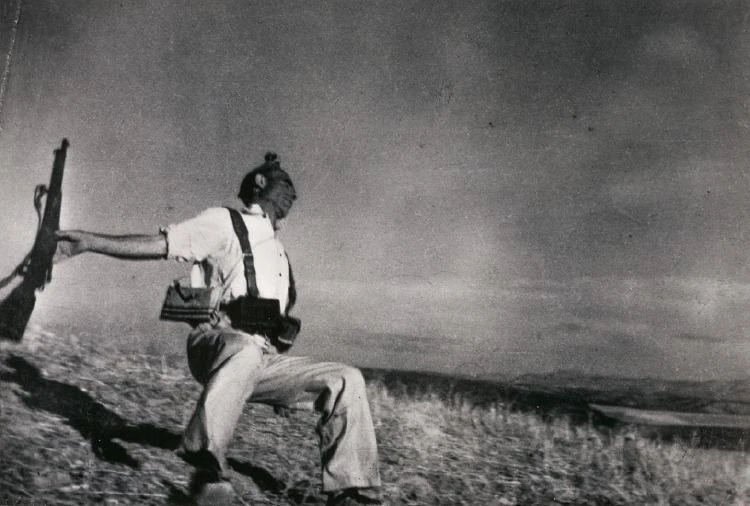
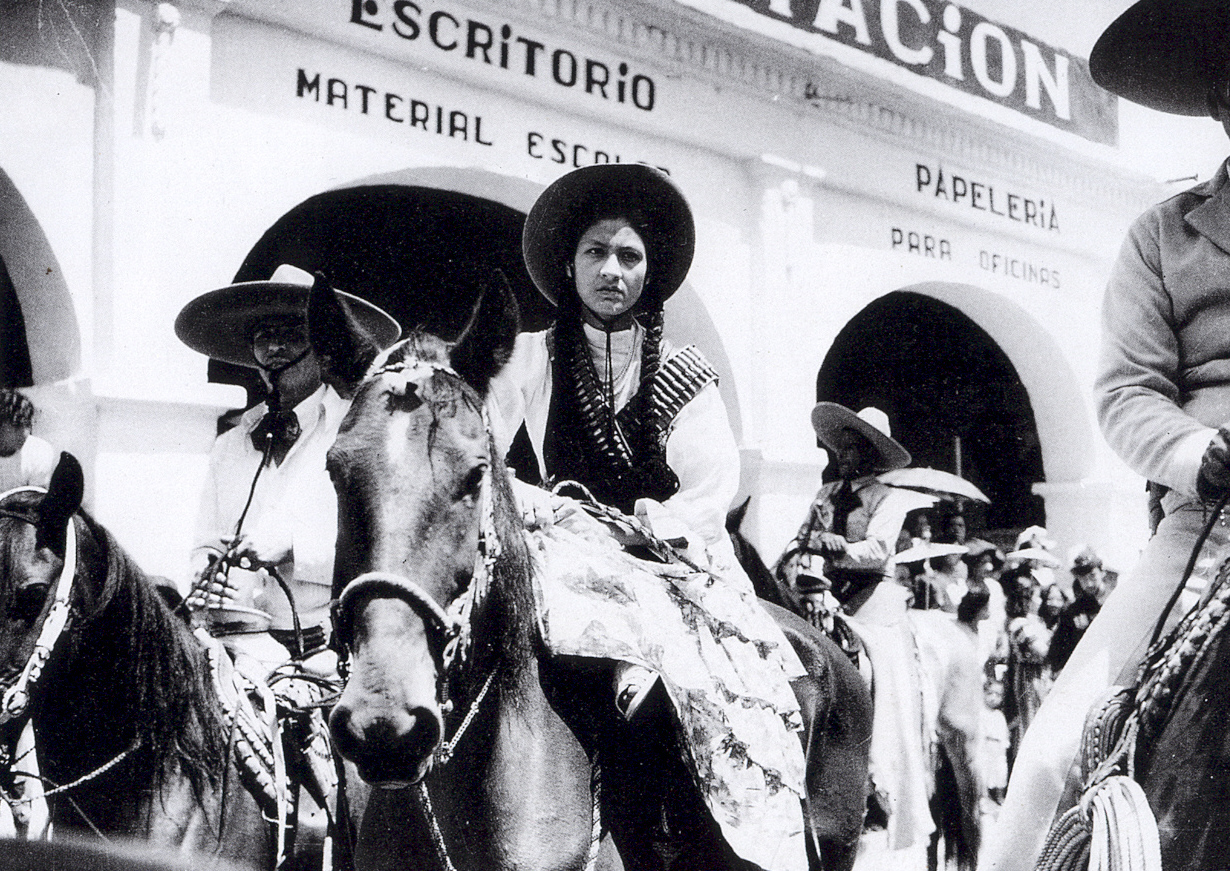
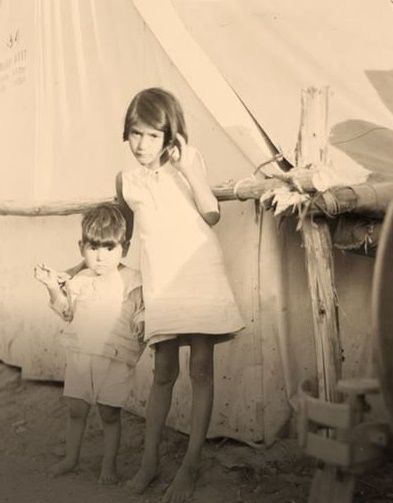
La Soldadera: A remarkable photograph from the Mexican Revolution (1910-1920)

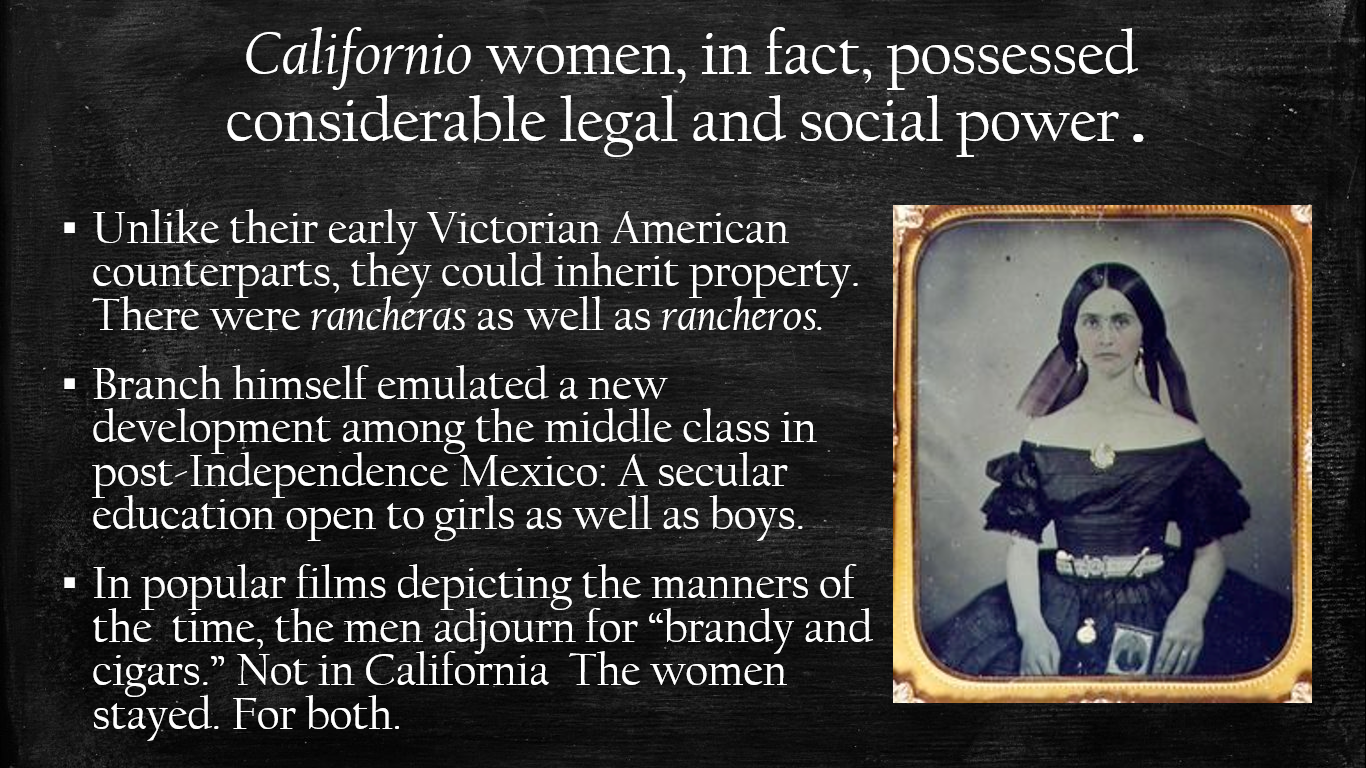
In researching the Arroyo Grande history class I’m to teach for Cuesta, I was pleasantly surprised to learn that Californio (i.e., Mexican) women enjoyed rights their Anglo-American counterparts didn’t.

Especially property rights. At least one of the women hanged in 1692 Salem was an unmarried property owner. She was a threat.


It reminded me, too, of how passionate I could get about teaching women’s history in my AP Euro classes. It was a topic I taught with sharp edges. Sometimes, anger can motivate a teacher. It did me.

Victorian and Edwardian English and American women enjoyed the same rights as “children, the feeble-minded and the legally insane.”

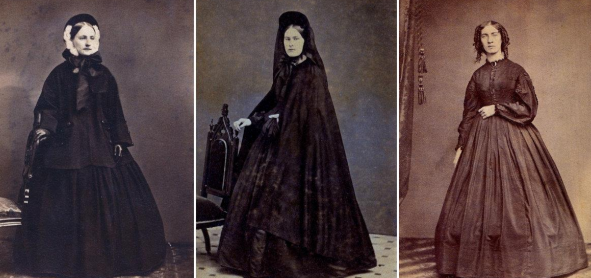
Victorian mourning dress

Stages of mourning for Victorian women

In nineteenth-century England, a widow was expected to remain in mourning for over two years. The rules were slightly less rigid for American women. These stages of mourning were observed by women.

Full mourning, a period of a year and one day, was represented with dull black clothing without ornament. The most recognizable portion of this stage was the weeping veil of black crepe.* If a women had no means of income and small children to support, marriage was allowed after this period. There are cases of women returning to black clothing on the day after marrying again.

Second mourning, a period of nine months, allowed for minor ornamentation by implementing fabric trim and mourning jewelry. The main dress was still made from a lusterless cloth. The veil was lifted and worn back over the head. Elderly widows frequently remained in mourning for the rest of their lives.

*Tragically, crepe is highly flammable. Middle-class Victorian homes were lit by gas jets.

Half mourning lasted from three to six months and was represented by more elaborate fabrics used as trim. Gradually easing back into color was expected coming out of half mourning,


And, if they were widows, they had a distressing tendency to catch on fire.

Meanwhile, women in Mexican California lit up cigars.

That did not last. The Americans came.

Thank goodness, a few generations later, the safety bicycle–equipped with drive chains and coaster brakes– came, too. Women began to wheel toward equity.


But women’s bicycle clubs, on their Saturday jaunts in the country, normally were accompanied by male outriders. Their job was to take the hits from the rocks being thrown at the women. Ministers thundered against the Satanic influence of bicycles from the pulpit. No wonder. Bicycles made the whalebone corset obsolete. Bicycles meant freedom–whalebone corsets and misogynistic ministers meant something else altogether.

A little while later, a powerful suffragist movement, one, in America, that had earlier coexisted with (but was subordinated to) abolitionism began to emerge.

So did the temperance movement. We’ve reduced temperance to cartoon Carrie Nations busting barroom mirrors, but the movement was a second forum for feminism. This was because alcohol was a major factor in domestic homicides, like that of Nancy Sykes in Oliver Twist. The dockets of London’s Old Bailey are dense with the murders of hundreds of women like Nancy.

Those records almost reduce the 1888 Ripper murders to a footnote.

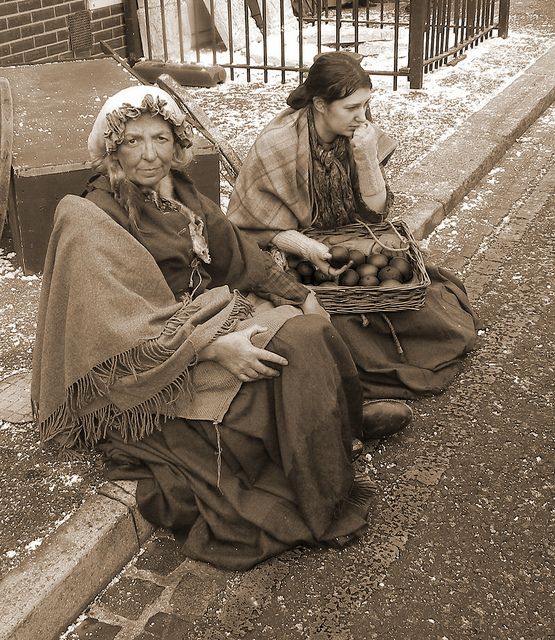
Street vendors, Victorian London. By now women had been pushed out of the factory work that typified their place in the early Industrial Revolution.

It was suffragism that gave fin de siècle feminism its focus. Women fought with mass demonstrations and speeches and petitions and parades.

They also bombed buildings, threw bricks through windows and set fires.

When they were jailed, they went on hunger strikes. Matrons held their mouths open with metal hinges while doctors threaded a hose filled with something like cream of wheat down their throats.

This was, of course, rape.

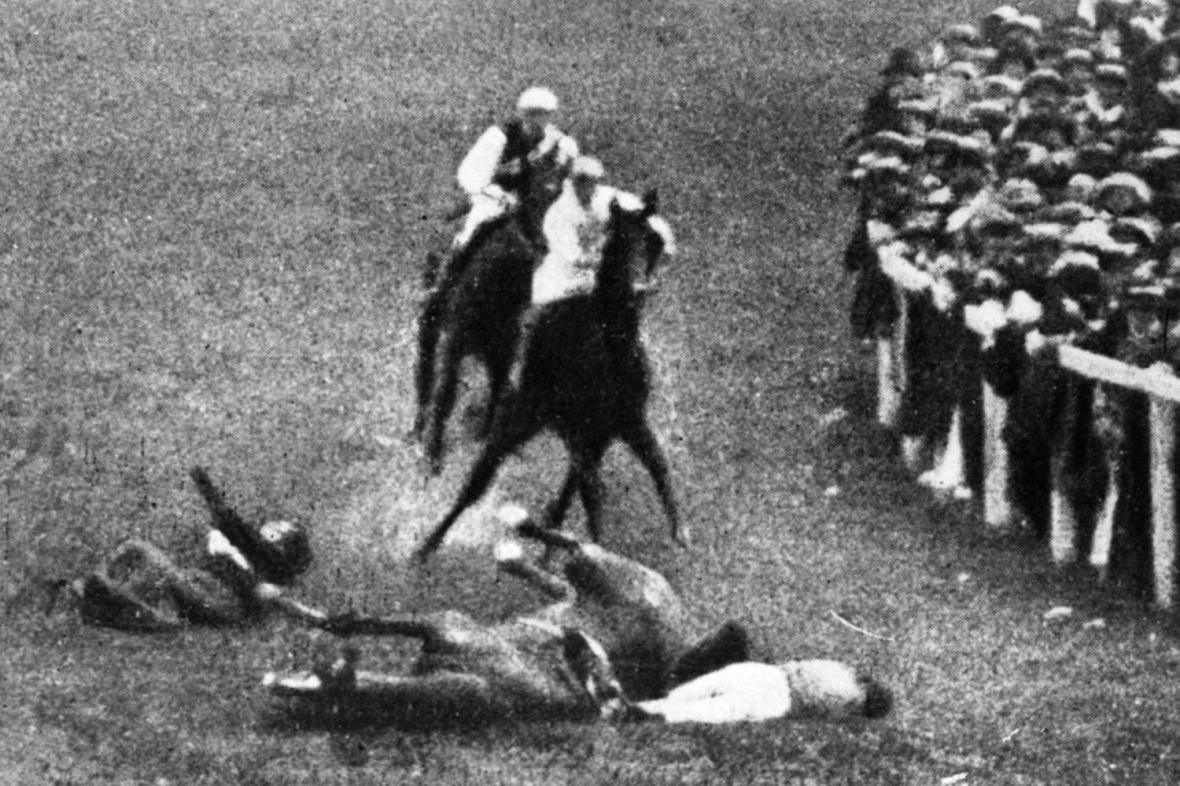
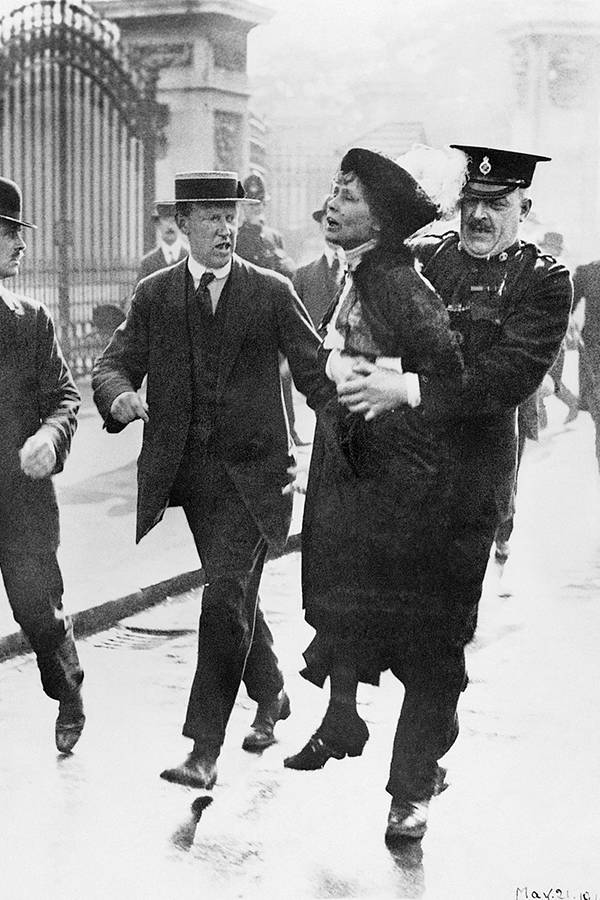
The death of Emily Davison (at left), 1913. Emmeline Pankhurst arrested (below).


English suffragist Emily Davison threw herself under King George V’s horse at the 1913 Derby to demonstrate how serious women were about the right to vote. The herky-jerky film that survives is still horrific.

A few more deaths nudged women’s rights a few more steps. Women–las soldaderas–fought alongside men in the Mexican Revolution. Ninety women fought in Dublin during the Easter Rising of 1916.

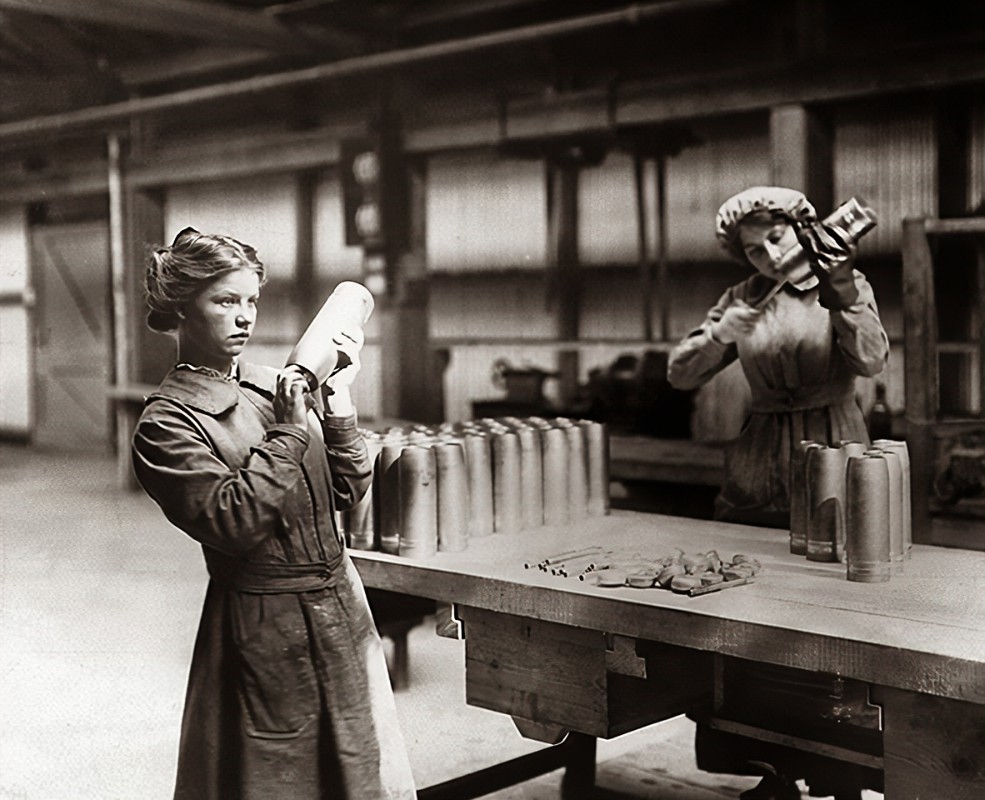
But the great turning point came with the Great War, when young women were called on to supply labor for the vast armaments industry that trench warfare required.


Some were blown to shreds in munitions factories. Others died far more slowly, from TNT poisoning, which turned their hair bright red and their skin yellow.

They were called “canaries.”

And then they got the right to vote.

Older historians, forty years ago, in a discipline still dominated by men, dismissed the very notion of women’s history.

Thankfully, nearly all of them are dead, too.

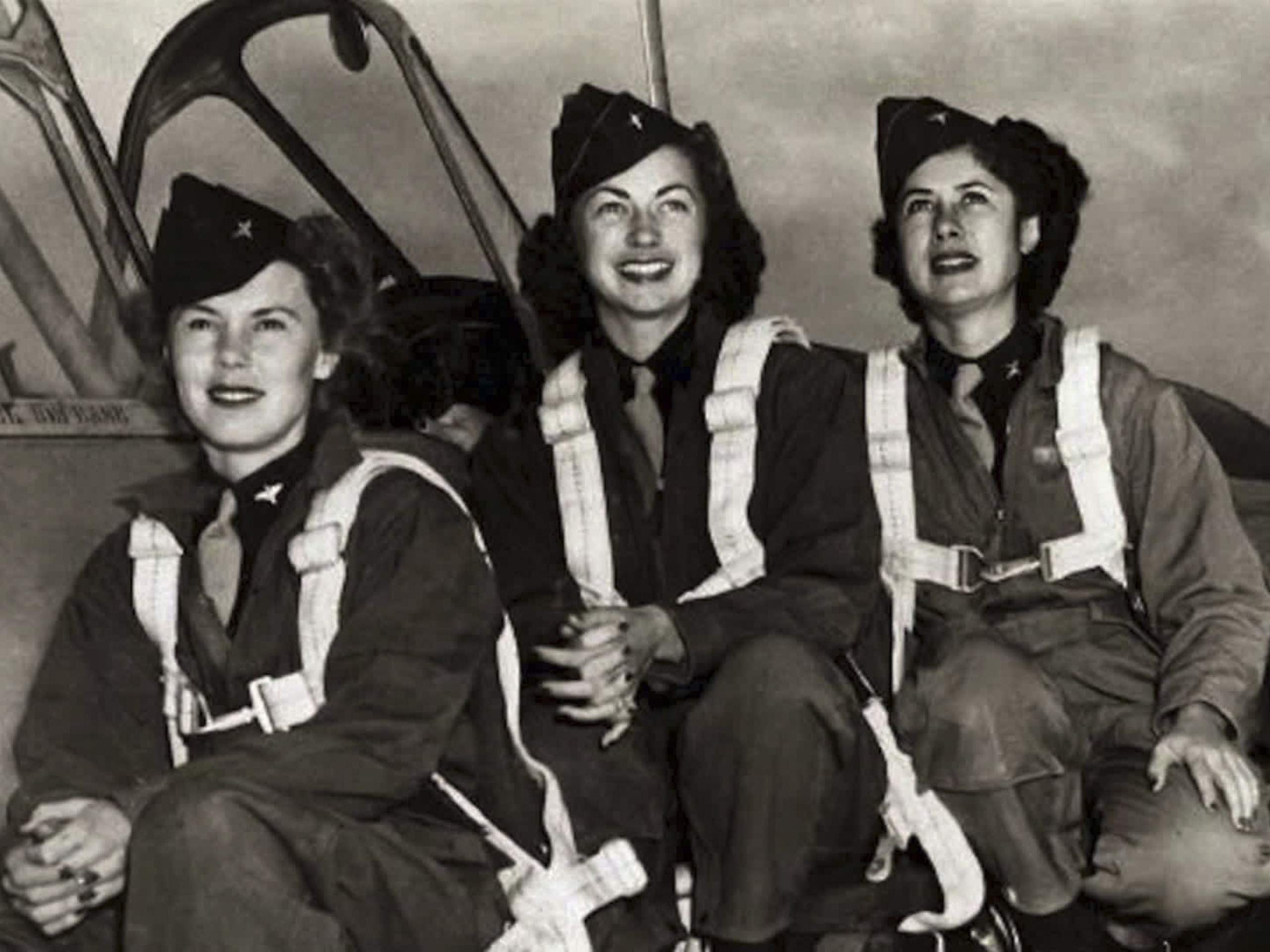
In 1944, Women’s Airforce Service (WASP) pilot Gertrude “Tommy” Tompkins (right) gave her life for her country. The P-51 Mustang fighter she was ferrying to its base disappeared into ocean fog over Santa Monica. Neither plane nor pilot was ever found.


“…I felt confident in your class.”
I’ve been feeling a little overwhelmed lately–too many irons in the fire–but I posted a photo of my old AGHS classroom a few days ago and a former student shared this about that room:

“I miss that room. I was going through such a difficult time but I felt confident in your class. It was a much needed safe haven. Thank you.”

Teaching is hard, and I’m so fearful because fewer and fewer young people are going into the profession–“calling” or “vocation” might be even better words.

Teachers have to plan meticulously but deal with chaos. Sometimes the lessons kind of sing and other times you’re like a comic–the flop sweat is notable– whose act is imploding on stage.

A sudden drop in barometric pressure—I am not making this up— or the addition of just one obnoxious student added to your class roll can turn thirty-four sweet kids into a pack of Tasmanian Devils.


Just when you’re almost begun to sort of manage your workload, Higher Ups decree a series of inservices with “breakout groups” and forms to fill, all about the latest teaching theory. The theories seem to come from a stylebook written, empty of humanity, by the behaviorist B.F. Skinner. The theories come with lots of buzzwords.

One example of the language: We actually had a superintendent once who announced at a beginning-of-the-year assembly: “I’m a data-driven kind of guy.” I almost threw up.

Another Higher Up once announced, with a straight face, was that our five-year-goal was to have every student in the district pass the No Child Left Behind exams. Every student. I had the audacity to raise my hand, in front of 700 people, and question his reasoning.

They have a shelf life of about three to five years, these theories do. Horizontal Alignment was replaced by Outcome Based Education which evolved into “Let’s Teach Them The Answers To The State Standards Tests.”

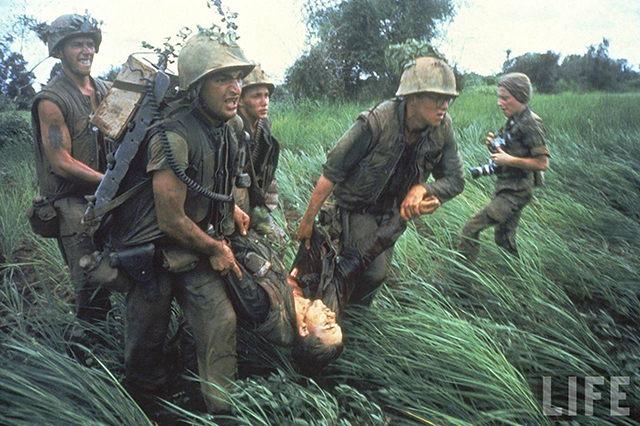
I got out just in time. The State Standards gave us two classroom days to teach the Vietnam War. I usually took eight.

I was recalling yesterday some of my principals over the years. Two were insane. Three were politicians. Two were fired, and they were among my favorites. Some I can’t remember.

You remember your students far more than you do those Higher Ups. And this marvelous young woman, my former student, just paid back my work in ways she can’t imagine. What a blessing.

Mr. Burns, Branch School

Courtesy of Michael Shannon


This photo comes from the year Dad was the clerk of the Branch School Board, and bids were being submitted for the new school. Mr. Burns drove a white-over-gold Dodge Polara with a big V-8. I have never forgotten seeing him speed down Huasna Road toward the four corners–he had to be doing 70 mph–because his passenger, picked up at the County Airport on Edna Road, was a construction company comptroller trying to get his boss’s bid in on time.

I don’t know whether the guy made it.

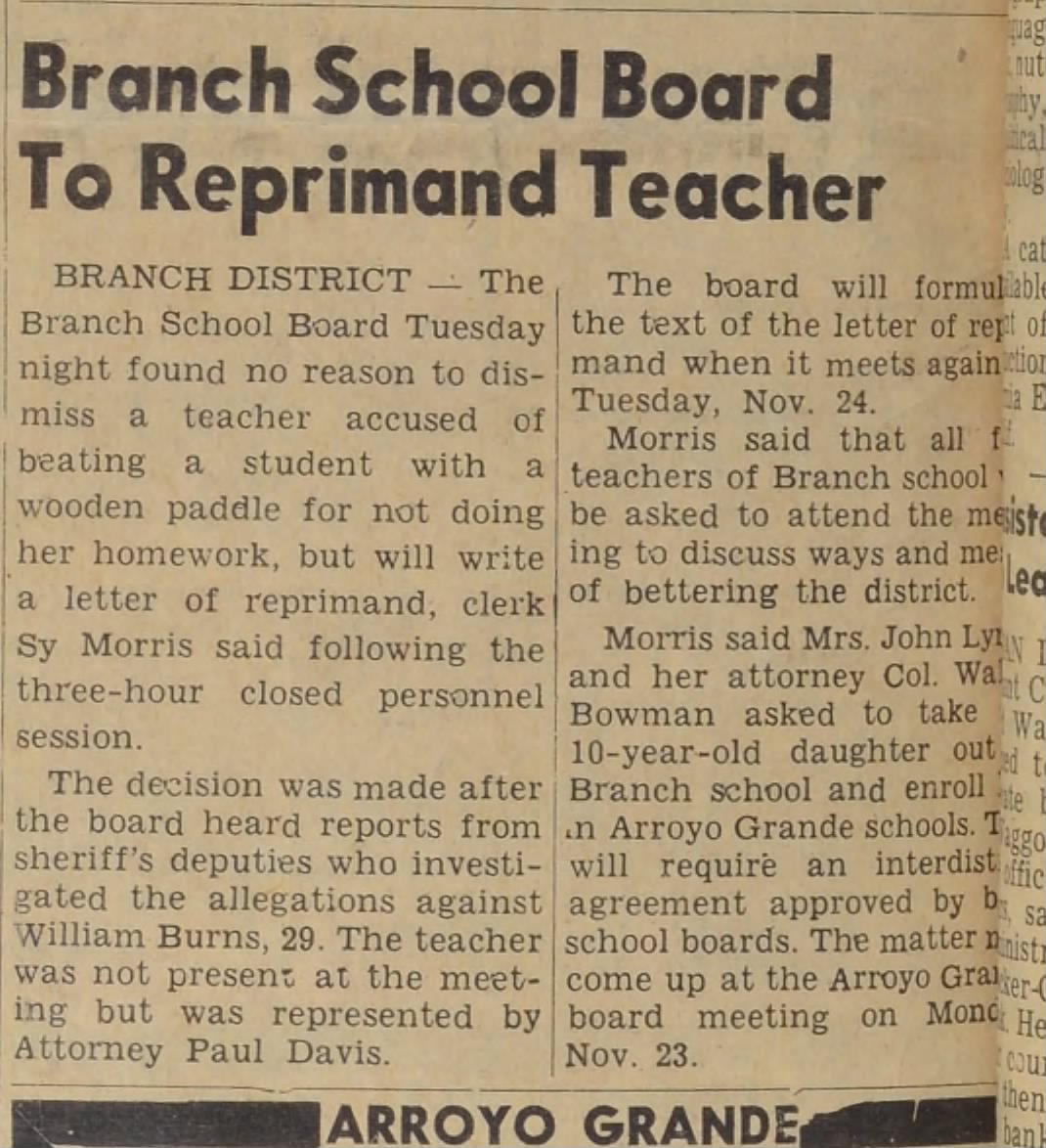
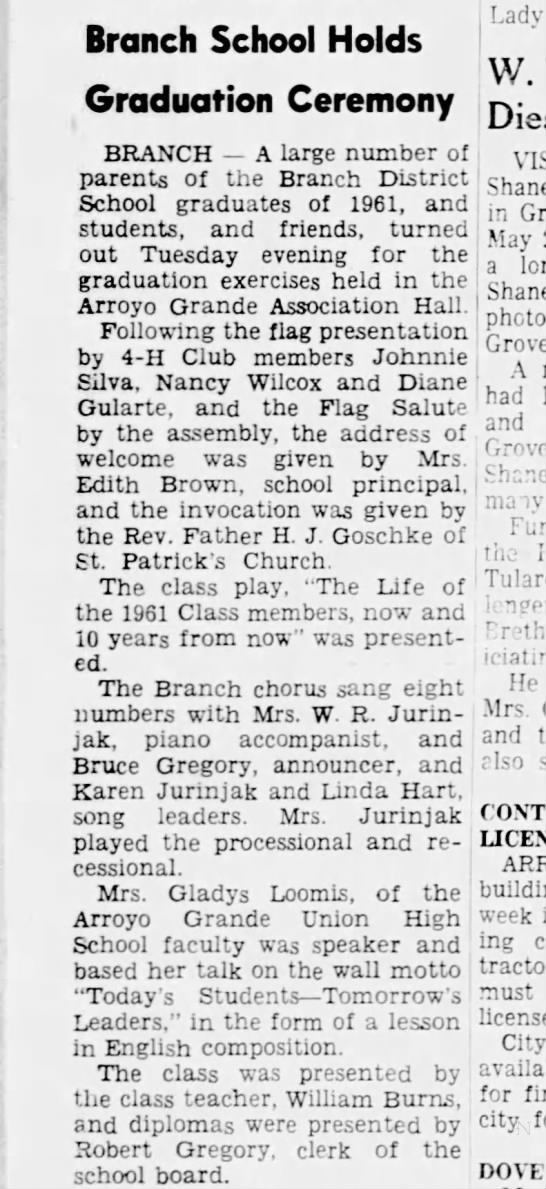
This article, from June 1961, cites Mr. Burns, my big brother and my Dad—and Mrs. Vard (Gladys) Loomis, who would’ve been a dignitary to us. She was a woman of great dignity, so the term “dignitary” fits exactly. The ceremonies were at the IDES Hall because the old 1880s two-room schoolhouse couldn’t hold any more kids–we were Boomers, after all, and there were immense and inconvenient numbers of us—so the big kids, 7th and 8th graders, had their classes at the Hall until the new school could be built.


I wish this story had a happy ending. It doesn’t. Midway through one school year, Mr. Burns was fired. I’m still not sure of the cause, and I don’t want to know. No one talked about it then, and I don’t want to talk about it now. It may have involved his corporal punishment of a student who refused to do her homework. I don’t think that was the case because, just a few years before, I’d seen two Branch teachers, Mrs. Brown and Mrs. Fahey, work over Danny Hunt in the hallway of the old school. They used those hardwood rulers with the sharp copper inserts along the edges and Danny was crouched in the fetal position–and whimpering–while two teachers I loved worked him over like Bad Cop-Bad Cop. To say that I was shaken is an understatement. That was sixty years ago.

Nothing happened to them. Those were less litigious days, and country schools were their teachers’ fiefdoms.

The Old School. It was pink in our day.


So maybe Mr. Burns did something even worse than what the article below suggests.

From 1965.

It’s absurd, of course, but I’ve been trying to look for him for years. I think I have an obituary, in Los Angeles, but I’m not sure of it. I think I have a wedding, in Monterey, in 1976, and she is lovely in her high school yearbook photo. It might just be the same William Edward Burns–the age, 36, fits. She is Marcia Katherine Ross, 25, and the two were married the day after Christmas.

And, of course, this couldn’t be Mrs. Burns, not at all. I don’t have any conclusive proof of what happened to him–or even any conclusive proof that he was heterosexual, which is irrelevant– not even after years when I periodically take time to look for him on genealogical and newspaper websites.

The point remains: He screwed up. He did something I never would’ve done as a teacher.

Mr. Koehn replaced him–he would be my algebra teacher later, in ninth grade, on Crown Hill, which remains the only year in my formal education that I enjoyed math. He decided, in P.E. to introduce us to golf and brought thirty aged short irons, some with wooden shafts, and a hundred whiffle golf balls to school and we fifth and sixth graders had the time of our lives, swinging without mercy. Our beloved bus driver and custodian, Elsie Cecchetti, was less than thrilled with the divots that swinging without mercy leaves behind. Many years later, when I took my students to Normandy and we saw the enormous craters left by the D-Day gunfire of Allied naval ships, I was suddenly reminded of what we kids had done to Branch School’s front lawn.

We missed Mr. Burns, though. He was charming and unforgiving, inspirational and demanding, sometimes generous and sometimes mean.

But my family, including my big sister, who taught with him at Branch, loved him. My big brother and I loved him because of his intelligence, his wit and his passion–and, frankly, because he was the first male teacher we’d ever had.

And what this flawed man wrote in that old Thesaurus remains one of the greatest gifts of my life:

Someday I expect to read great things by you.

Good Morning, Aztlan…

It’s pretty much impossible for me to tell you how much I love this band. Between Los Lobos and my Latin American History concentration—especially in Mexican history—next to getting (finally) my college diploma and loving teenagers in thirty years of being their high-school history teacher—scoring 96% on the Facebook “How Mexican Are You?” quiz remains one of the proudest achievements of my life.


They’re coming to Santa Maria April 8, and I think I need to get tickets. Elizabeth and I saw them at the Santa Barbara Bowl many years ago, and we danced our cabooses off for the entire set. So did everybody else.

I’ve never heard such straight-ahead rock and roll that also had so much meaning to me. Here they are at Watsonville High School in 1989, performing “La Bamba.” At one point, I think you can see a teardrop escape from beneath Cesar Rojas’s sunglasses. This performance is so joyful, even though it’s punctuated by dancing gabacho Hippies who have seemed to have misplaced the decade in which they belong, that it makes me tear up, too.

There is no song I love as much as this one, but it’s still not my favorite Los Lobos song. “Will The Wolf Survive?” about crossing the Border, is one of the most meaningful and beautiful songs of my life.

PBS once aired a documentary on the work that welfare agencies and coroners on this side of the Border do in identifying the remains of migrants lost in the desert—the dignity the coroners exhibited in their work, with human remains that look, after months in the desert, like driftwood—and the effort they put forth in trying to return them home, was incredibly moving.

So, too, were the candlelit wakes, the brightly-decorated caskets, and the tears of the families on the rare cases when their brothers or sisters, sons or daughters, husbands or wives, finally came home again.

So this is my favorite Los Lobos song:


And this, from an old blog post, is why:

sem-516418-_l8b2215-20130619

Cabbage harvest, Upper Arroyo Grande Valley. New Times


It’s a story I’ve told a million times, but it speaks volumes about why I love my Mom and why, 43 years after her death, I still miss her. She was pruning her roses and a farmworker–they called them braceros–came into our yard from the field next door and pantomimed filling a gallon jug with water. She nodded, filled it and handed it to me–I was about five: “Help him carry it back.”

That was the day I first fell in love with Mexicans. Not with Brussels sprouts, which is what they were harvesting that day, talking easily with me, as they snapped the sprouts off their stalks with their thumbs, in a language I didn’t think I understood.

“…fell in love with Mexicans.” It amazes me how that might shock some folks (Oh. Doesn’t he mean “Latinos?” or “Hispanics?” We’ve turned an entire people into a pejorative, the butt of ignorant, heartless jokes.) When our family went with the St. Pat’s youth group to Tijuana to help build a home, the mission director asked why we’d come, and there were many moving religious answers. When my turn came:

“I just like Mexicans.”

Capture

Migrant children, Nipomo, 1936, by Dorothea Lange. The little girl’s knock-knees are symptomatic of rickets, a nutritional disease.


My brother and I once spent an hour in one of George Shannon’s bunkhouses with some of his field workers (George Shannon deserves his own novel. One of the hardest-working and kindest human beings I’ve ever known, an unpretentious man who married into the Hall family, which, around these parts, is like some guy named Lincoln marrying into the Todds.) and they spread out religious medals and family snapshots and pocketknives, toys and firecrackers and belt buckles and, I think, one stuffed baby armadillo, and we chattered away the whole time, each side understanding about every eleventh word, until George came in, smiling, and told us it was time for us to go home for dinner. It was one of the happiest hours of my life and I think it was for them, too, because somehow my brother and I reminded them of family and home and they missed both.

a48a34c6110a0966768e6416f3ab69bd

Border fence, Tijuana. The crosses represent migrants lost in the desert.


They missed both. This Mexican was drunk but he was not incoherent. The mission directors were showing us the border fence, with clusters of white crosses at intervals, memorializing the deaths of those–one, a 17-year-old girl–whose coyotes had abandoned them in the desert, and a 13-year-old had started a trash fire at another point as a diversion so a small group of friends might have time enough to vault the fence to what was NOT the promised land, which was the drunk guy’s point.

You think I want to live in your country? he demanded of us, wide-eyed teenagers (and adults). He was drunk but also very angry, which made him clearer than a sober man. You people think we’re invaders? I don’t want to be in your country! I don’t want to be an American. I LOVE MY COUNTRY. I LOVE BEING A MEXICAN! I love my family and that is why I cross over and get arrested by La Migra and then cross over again. I hate it! But I am a man with a man’s responsibilities and if washing dishes in Chula Vista or working melon field in Indio is what it takes for me to be a man, I will do it. I love my country. Not yours. Not yours.

He wandered off and continued the talk with himself alone in that little park where the border fence meets a fetid stretch of Pacific Beach. We were stunned.

We met deportees at a la migra detention center, too.  They were flesh and blood, just as the Woody Guthrie song had always suggested.

“Deportees” (Plane Wreck at Los Gatos)

The crops are all in and the peaches are rott’ning,
The oranges piled in their creosote dumps;
They’re flying ’em back to the Mexican border
To pay all their money to wade back again

Goodbye to my Juan, goodbye, Rosalita,
Adios mis amigos, Jesus y Maria;
You won’t have your names when you ride the big airplane,
All they will call you will be “deportees”

My father’s own father, he waded that river,
They took all the money he made in his life;
My brothers and sisters come working the fruit trees,
And they rode the truck till they took down and died.

Some of us are illegal, and some are not wanted,
Our work contract’s out and we have to move on;
Six hundred miles to that Mexican border,
They chase us like outlaws, like rustlers, like thieves.

We died in your hills, we died in your deserts,
We died in your valleys and died on your plains.
We died ‘neath your trees and we died in your bushes,
Both sides of the river, we died just the same.

The sky plane caught fire over Los Gatos Canyon,
A fireball of lightning, and shook all our hills,
Who are all these friends, all scattered like dry leaves? 
The radio says, “They are just deportees”

Is this the best way we can grow our big orchards? 
Is this the best way we can grow our good fruit? 
To fall like dry leaves to rot on my topsoil
And be called by no name except “deportees?”


And, finally, a few years after that mission trip, I led some of my students to the American Cemetery at Colleville-sur-Mer, above Omaha Beach. We were looking for a G.I. named Domingo Martinez.

We found him. Because of the ocean breeze, the marble crosses and Stars of David in this impossibly beautiful cemetery are cold to the touch—it’s almost shocking—but if you let your hand rest against the marble for a moment, it begins to warm.

This is about Private Martinez.

https://drive.google.com/file/d/1H38UVxeRzTHAX7iC2Qn6cFmv6Zxh_0SM/view?usp=sharing

The New Jerusalem

Featured

Elizabeth, Thomas and I were watching the CNN series on the movies last night, and the installment we saw focused on the Eighties.

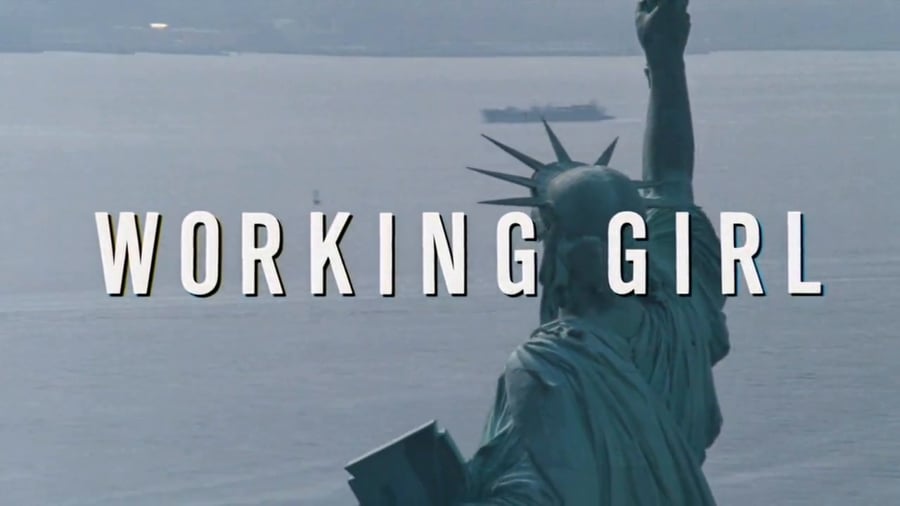
And, of course, Working Girl had to be one of the movies the documentary noted. They could’ve spent a lot more time on it, in my opinion.

If the big New Jersey Hair of Melanie Griffith and Joan Cusack is clearly dated, the film and its issues aren’t. This is a film about the obstacles women face, directed and written, I am proud to say, with great sympathy, by men.

I think it’s Mike Nichols’ finest film.

And I might still say that had Nichols ended Working Girl after the first three minutes.

The cinematography is stunning; the opening sequence, shot from a helicopter, is a loving study of the Statue of Liberty that then pulls back to reveal Southern Manhattan–including, tragically, the Twin Towers–the Jersey shore and the the camera swoops in again, gliding alongside the Staten Island Ferry until the dissolve that takes us to the ferry bench where, in an intimate closeup, Melanie Griffith and Joan Cusack share a birthday cupcake.

It is glorious, as is Carly Simon’s song “Let the River Run.”

This introduced me to a city that terrified me until I saw the Cooper Union, where Lincoln delivered the 1860 speech that made him president, saw the lobby and the city below the observation deck of the Empire State Building and saw, miraculously, the Chrysler building.

It took me two tries to “get” Paris. I fell in love with New York almost immediately. This stunning piece of film-making made that possible.

And I just found this version of Carly Simon’s song, from one of those European song competition shows, La Voz. The singer is Cuban-Spanish, her name is Lieta Molinet, and she nails it. If you are a female-type person, you might just notice that one of the male judges is both entranced and gorgeous. Be that as it may, I think this is a stunning performance of a stunning song.


A beautiful connection: “Unchained Melody”


I guess a lot of folks–for many reasons, some of them justified–are kind of sick of us Boomers.

There are so damned many of us–blame it on the polio vaccine–and we seem to be unwilling to get out of the way of younger people, the ones who should be running things.

But hold on, please, for just a minute.

What nobody can deny is that our generation was graced with incredible music. Whatever our faults, there’s the music.

For example, look at the reaction of this beautiful young woman, Emma, to Bobby Hatfield’s just-as-beautiful “Unchained Melody.”

This is the first time she’s heard the song.

(There are other videos like this one on YouTube. They are a joy to watch.)

And here, as I watch her and hear Hatfield, I am joyful, too.


They weren’t a band. They were a miracle.

How do you teach the Beatles, to your AP European History students, in a unit about cultural and social history, when they were born nearly forty years after the four arrived in New York?

(Oh, and they didn’t horrify ALL parents. My Mom loved ’em. Especially Ringo, who reminded her of a Basset Hound, which explains my dear four-legged friends, Wilson and Walter.)

I tried to teach them this way.

The entire lesson was about 1968, which reminds me, with some hope, that we’ve survived tough, tough times before.

Carole Lombard

Carole Lombard and her friends.

Today’s Date in History (January 16, 1942) is a sad one:

Only a little over five weeks after Pearl Harbor, actress Carole Lombard, returning from a War Bond drive, is killed when the DC-3 on which she is a passenger crashes into Mt. Potosi, near Las Vegas.

The crash site, 1942. Fragments from the doomed plane remain today.

I used to show My Man Godfrey during the Great Depression unit in my U.S. History, and my students, I think, loved the film–they were enchanted by William Powell’s butler and a little exasperated with Lombard’s ditzy heiress, Irene, who had the advantage of playing against an evil older sister, Cornelia (played by Gail Patrick, in real life a very nice human being.) In fact, Powell and Lombard—the love of Jean Harlow’s life was William Powell–were briefly married.

Godrey washes, Irene dries.

Irene dismayed me a little until I began watching more Lombard films–To Be or Not to Be, with Jack Benny and an impossibly young Robert Stack, Made for Each Other, with James Stewart, True Confession, with Fred MacMurray. It began to dawn on me that Lombard was one of the time’s most gifted comediennes and, of course, she was beautiful.

With James Stewart, Made for Each Other
In To Be or Not to Be, her last film. That dress!” was this dress, the one people referred to before Grace Kelly’s in Rear Window.

When she fell in love with Clark Gable–who, by the way, filmed 1940’s Strange Cargo with Joan Crawford, in Pismo Beach, stayed at today’s Pismo Hotel, and played a pickup softball game with some SLO High kids on the beach–he was inconveniently married.


Gable was a minor-key Hemingway–a “man’s man” who loved to hunt and fish. So Lombard began to learn how to do those things, too, in a strategic campaign that, in its duration and care, rivaled Eisenhower’s plans for D-Day. Gable loved dogs, too–including Irish Setters–but that was no stretch. If you google “Carole Lombard dogs,” you’ll see what I mean.

The couple at a Hearst Castle costume party with the seemingly less-than-amused W.R., “The Chief.”


The invasion was successful. Gable and Lombard were married in 1939—seeking to avoid publicity, they got the necessary blood test and marriage license in what was described as “a sleepy little town,” San Luis Obispo.

The photographs from that time show two people obviously in love. But, three years later, her devotion to him was not always reciprocated. Gable thought himself a man’s man in other ways, and Lombard could’ve concluded her War Bond tour with a train trip home, but rumors that her husband was having an affair changed her plans.

A TWA DC-3. Getty Images

She boarded TWA Flight 3, bound for Burbank, in Indianapolis. The plane stopped in Albuquerque, where the civilian passengers were asked to surrender their seats for Army Air Forces personnel headed for Los Angeles. Lombard refused to give up hers. Fifteen minutes after a fuel stop in Las Vegas, the DC-3, seven miles off course, crashed, killing its twenty-two passengers and crew.

Gable became a B-17 gunner and photographer who flew at least five missions; the old story goes that he was so grief-stricken over Lombard that he was actively seeking a death in combat. That’s probably apocryphal.

Clark Gable, combat aviator


Nineteen years later, Gable would film John Huston’s melancholy neo-Western The Misfits, with Marilyn Monroe and Montgomery Clift. It was the last film the three movie stars made.

But, of course, thanks to what Hollywood likes to call the magic of film, all of them–luckily for us–all of them, including Carole, are still alive.


“The Way of Truth and Love:” Jones County, Mississippi

Micah

It’s ironic that earlier tonight I was pondering the fact that my Uncle Tilford’s middle name was “Stonewall,” and that I am named for and descended from James McBride, a Confederate general for whom a chapter of the Sons of Confederate Veterans is named.


I think that’s why I so enjoyed writing a book that was about Yankee soldiers. Karma means there’s hell to pay; I had a debt to work off.

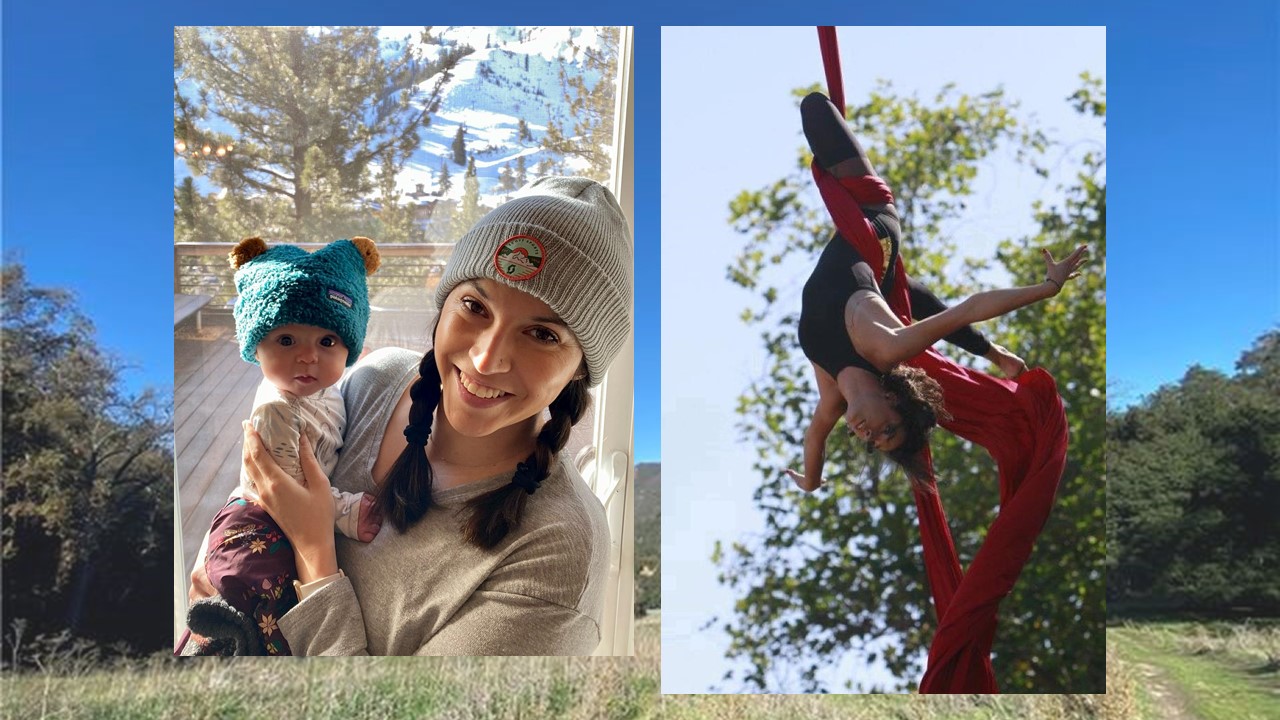
Only two hours after I confirmed Uncle Tilford’s middle name on ancestry.com, I found the photo of this stunning young woman. Micah is the daughter of a dear friend of Elizabeth’s, the Rev. James Johnson-Hill; her mother, Anicia, is a former Mission student of ours. The two are in the process of raising an extraordinary family, and Micah, the Mississippi State high school tennis champion, is one of their children.


She has just been named a “Distinguished Young Woman of Jones County, Mississippi,” where this lovely photograph was taken.


Wait. I’m a historian. Jones County, Mississippi? The bell inside my head began to ring.

That’s because “Jones County, Mississippi,” was featured in the book and the film The Kingdom of Jones, about a rebellion, led by a farmer named Newton Knight, against the Confederate States. Knight and his fellow rebels had no faith in a war whose conscription laws exempted any man who owned twenty or more slaves. [“It’s a rich man’s war and a poor man’s fight,” the bitter saying went.] Moreover, they had no use for slavery, period. Or for disunion. Knight had deserted from the Confederate Army for precisely that reason. That army’s cause was corrupt, but Knight wasn’t. He was an American.

Newton and Rachel Knight.


So was Knight’s wife, Rachel, a Black woman, and so were his guerrillas, who were biracial.


They harassed the Confederacy in Jones County, Mississippi, for two years with hit-and-run attacks–fourteen skirmishes in all–confiscated wagonloads of food intended for Confederate soldiers that were distributed instead among the poor people of southeastern Mississippi, spared the same folks taxes because the Confederate tax collectors, fearful for their lives, gave up trying to correct them, and defied the vows to extinguish the uprising uttered by two Confederate generals–the eternally dyspeptic Braxton Bragg, whose favorite form of discipline was the liberal application of firing squads, and the starchy Episcopal bishop Leonidas Polk.

Well, of course, Bragg and Polk lost their war. And Newton Knight lived to be 92.

And he got a movie.


So, one hundred years after Knight’s death, we come to Micah Bonds-Hill, a Young Woman of Distinction. What happened in Mississippi in those intervening years is abundantly painful. It would take books—and it has—to catalog the cruelty inflicted on Black Mississippians after Union troops left in 1877, but here are three more recent examples.

Emmett Till was murdered there in 1955, his body weighted down with a gin-mill fan and dumped into a swamp; three murdered civil rights workers were buried in an earthen dam in 1963 because they were trying to register Black voters; earlier that same year, a .303 Lee-Enfield bullet brought down Medgar Evers, a World War II veteran and civil rights organizer. Evers collapsed in the doorway of his home and died with his wife, Myrlie, holding him in her arms.

Medgar Evers’s grave, Arlington National Cemetery


Myrlie became a woman of distinction in Mississippi, too, an indomitable civil-rights advocate in her own right.

I have no right to burden this stunning high school senior with the weight of all that history. But these are such troubling times that this little girl, who can whistle forehands like missiles over the net, the possessor of a mind that is faster still, eases my troubles.

When I despair, I remember that all through history the way of truth and love have always won. There have been tyrants and murderers, and for a time, they can seem invincible, but in the end, they always fall.
–Mohandas Gandhi

The way of truth and love is painful and steep and sometimes it seems unending and sometimes it seems to disappear altogether. Micah is a light along the way.