I guess a lot of folks–for many reasons, some of them justified–are kind of sick of us Boomers.
There are so damned many of us–blame it on the polio vaccine–and we seem to be unwilling to get out of the way of younger people, the ones who should be running things.
But hold on, please, for just a minute.
What nobody can deny is that our generation was graced with incredible music. Whatever our faults, there’s the music.
For example, look at the reaction of this beautiful young woman, Emma, to Bobby Hatfield’s just-as-beautiful “Unchained Melody.”
This is the first time she’s heard the song.
(There are other videos like this one on YouTube. They are a joy to watch.)
And here, as I watch her and hear Hatfield, I am joyful, too.
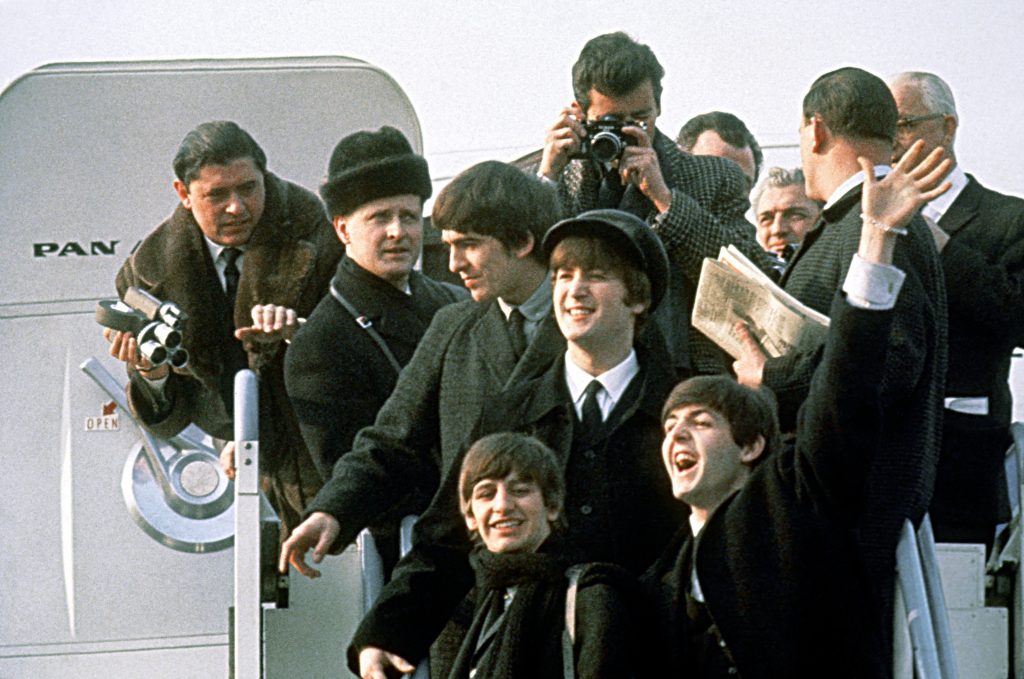
How do you teach the Beatles, to your AP European History students, in a unit about cultural and social history, when they were born nearly forty years after the four arrived in New York?
(Oh, and they didn’t horrify ALL parents. My Mom loved ’em. Especially Ringo, who reminded her of a Basset Hound, which explains my dear four-legged friends, Wilson and Walter.)
I tried to teach them this way.
The entire lesson was about 1968, which reminds me, with some hope, that we’ve survived tough, tough times before.
Today’s Date in History (January 16, 1942) is a sad one:
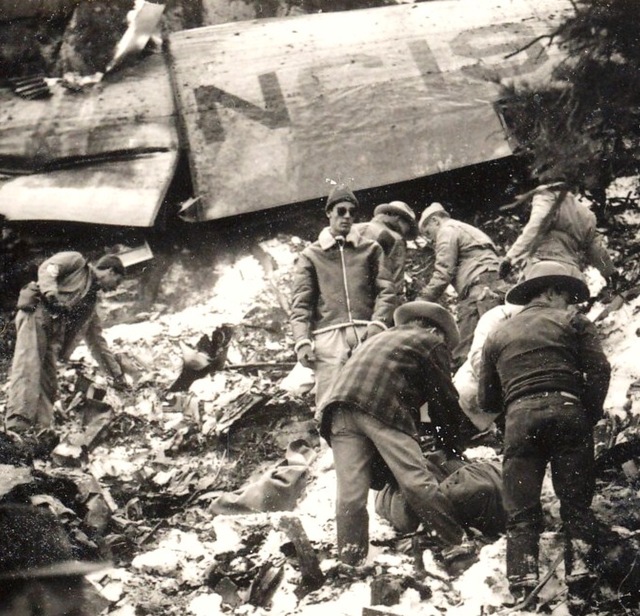
Only a little over five weeks after Pearl Harbor, actress Carole Lombard, returning from a War Bond drive, is killed when the DC-3 on which she is a passenger crashes into Mt. Potosi, near Las Vegas.
The crash site, 1942. Fragments from the doomed plane remain today.
I used to show My Man Godfrey during the Great Depression unit in my U.S. History, and my students, I think, loved the film–they were enchanted by William Powell’s butler and a little exasperated with Lombard’s ditzy heiress, Irene, who had the advantage of playing against an evil older sister, Cornelia (played by Gail Patrick, in real life a very nice human being.) In fact, Powell and Lombard—the love of Jean Harlow’s life was William Powell–were briefly married.
Godrey washes, Irene dries.
Irene dismayed me a little until I began watching more Lombard films–To Be or Not to Be, with Jack Benny and an impossibly young Robert Stack, Made for Each Other, with James Stewart, True Confession, with Fred MacMurray. It began to dawn on me that Lombard was one of the time’s most gifted comediennes and, of course, she was beautiful.
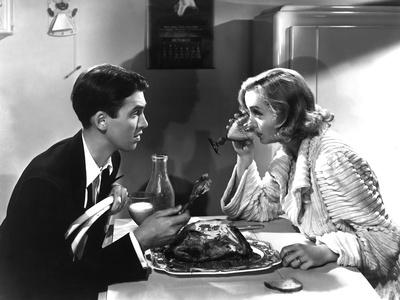
With James Stewart, Made for Each Other
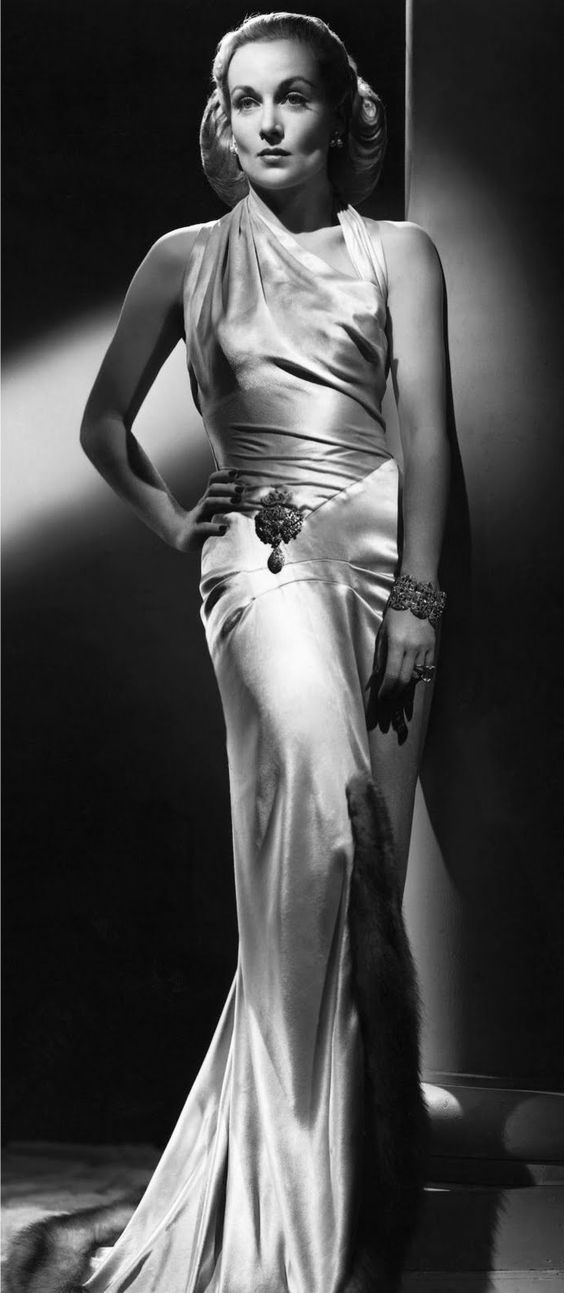
In To Be or Not to Be, her last film.“That dress!” was this dress, the one people referred to before Grace Kelly’s in Rear Window.
When she fell in love with Clark Gable–who, by the way, filmed 1940’s Strange Cargo with Joan Crawford, in Pismo Beach, stayed at today’s Pismo Hotel, and played a pickup softball game with some SLO High kids on the beach–he was inconveniently married.
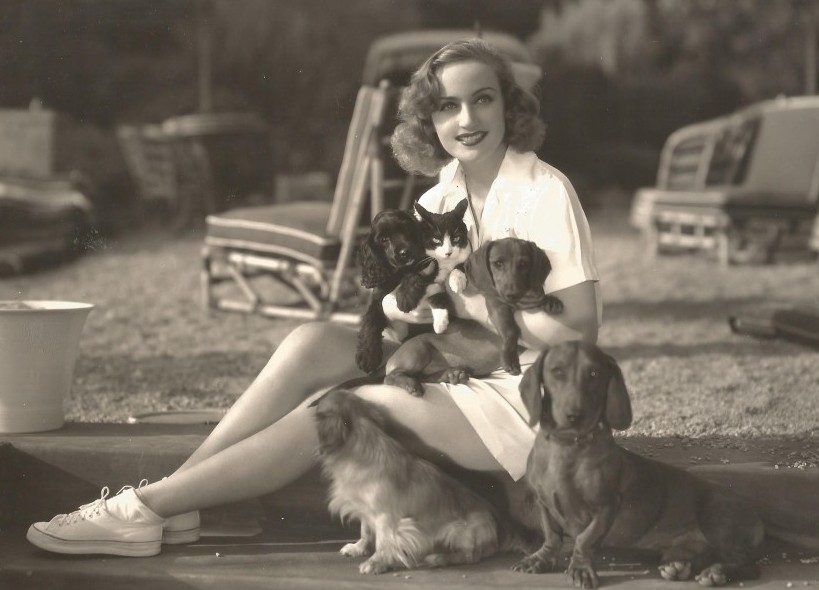
Gable was a minor-key Hemingway–a “man’s man” who loved to hunt and fish. So Lombard began to learn how to do those things, too, in a strategic campaign that, in its duration and care, rivaled Eisenhower’s plans for D-Day. Gable loved dogs, too–including Irish Setters–but that was no stretch. If you google “Carole Lombard dogs,” you’ll see what I mean.
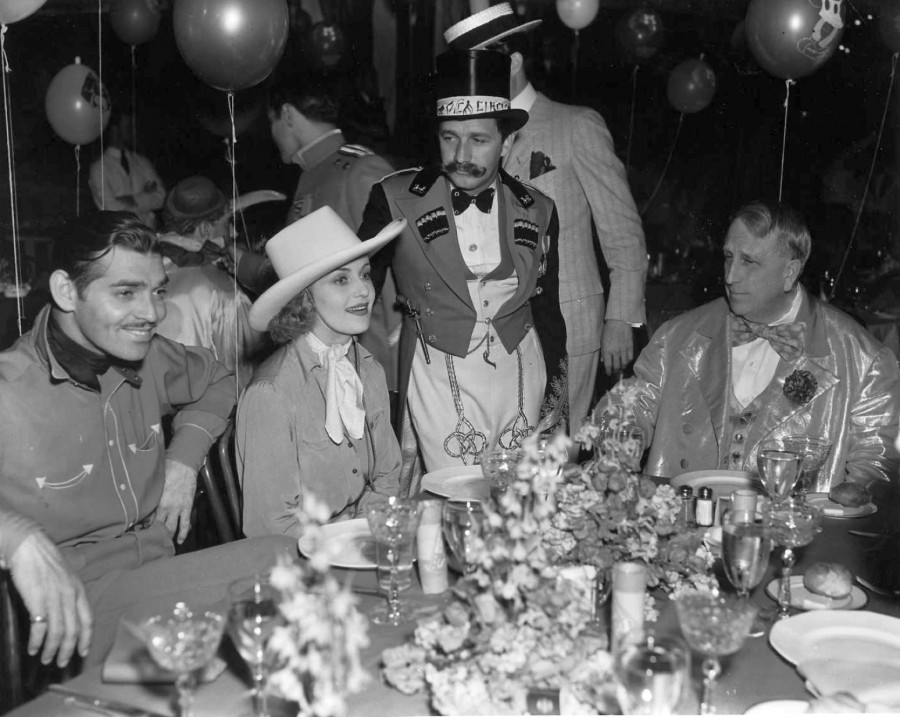
The couple at a Hearst Castle costume party with the seemingly less-than-amused W.R., “The Chief.”
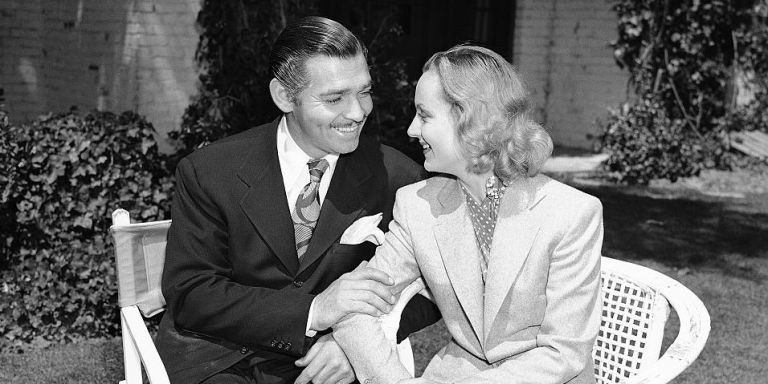
The invasion was successful. Gable and Lombard were married in 1939—seeking to avoid publicity, they got the necessary blood test and marriage license in what was described as “a sleepy little town,” San Luis Obispo.
The photographs from that time show two people obviously in love. But, three years later, her devotion to him was not always reciprocated. Gable thought himself a man’s man in other ways, and Lombard could’ve concluded her War Bond tour with a train trip home, but rumors that her husband was having an affair changed her plans.
A TWA DC-3. Getty Images
She boarded TWA Flight 3, bound for Burbank, in Indianapolis. The plane stopped in Albuquerque, where the civilian passengers were asked to surrender their seats for Army Air Forces personnel headed for Los Angeles. Lombard refused to give up hers. Fifteen minutes after a fuel stop in Las Vegas, the DC-3, seven miles off course, crashed, killing its twenty-two passengers and crew.
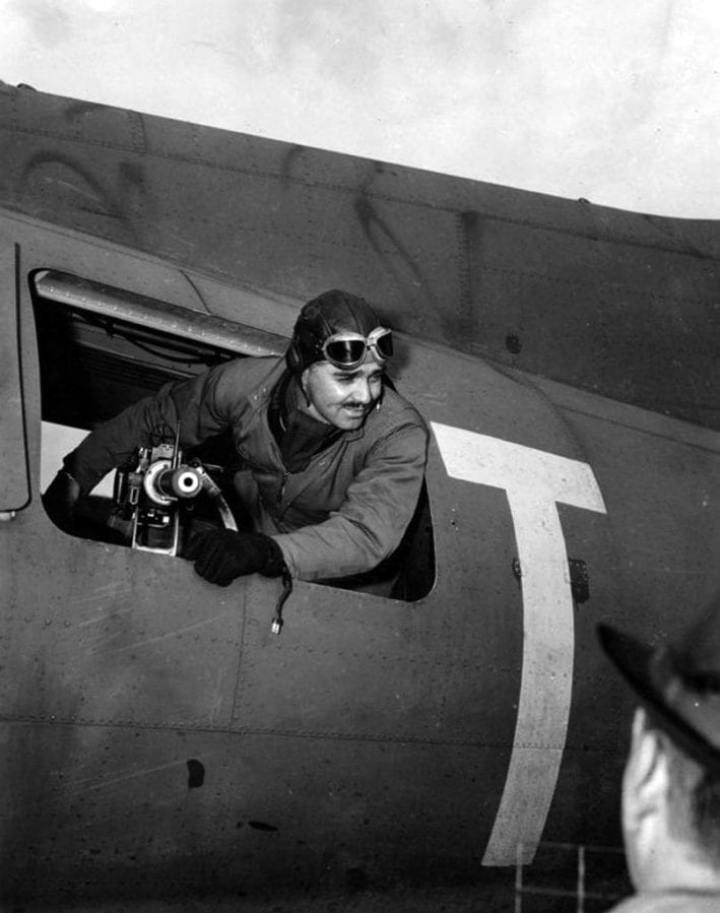
Gable became a B-17 gunner and photographer who flew at least five missions; the old story goes that he was so grief-stricken over Lombard that he was actively seeking a death in combat. That’s probably apocryphal.
Clark Gable, combat aviator
Nineteen years later, Gable would film John Huston’s melancholy neo-Western The Misfits, with Marilyn Monroe and Montgomery Clift. It was the last film the three movie stars made.
But, of course, thanks to what Hollywood likes to call the magic of film, all of them–luckily for us–all of them, including Carole, are still alive.
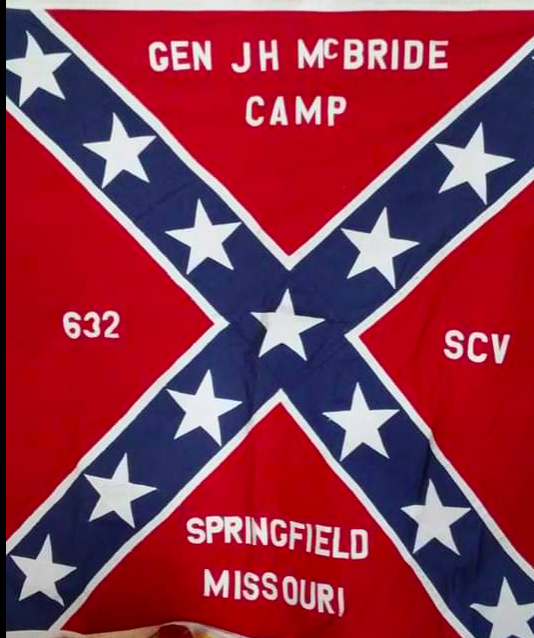
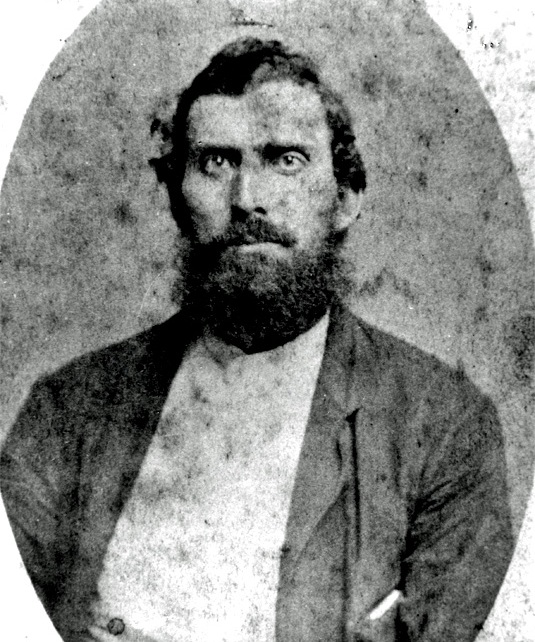
It’s ironic that earlier tonight I was pondering the fact that my Uncle Tilford’s middle name was “Stonewall,” and that I am named for and descended from James McBride, a Confederate general for whom a chapter of the Sons of Confederate Veterans is named.
I think that’s why I so enjoyed writing a book that was about Yankee soldiers. Karma means there’s hell to pay; I had a debt to work off.
Only two hours after I confirmed Uncle Tilford’s middle name on ancestry.com, I found the photo of this stunning young woman. Micah is the daughter of a dear friend of Elizabeth’s, the Rev. James Johnson-Hill; her mother, Anicia, is a former Mission student of ours. The two are in the process of raising an extraordinary family, and Micah, the Mississippi State high school tennis champion, is one of their children.
She has just been named a “Distinguished Young Woman of Jones County, Mississippi,” where this lovely photograph was taken.
Wait. I’m a historian. Jones County, Mississippi? The bell inside my head began to ring.
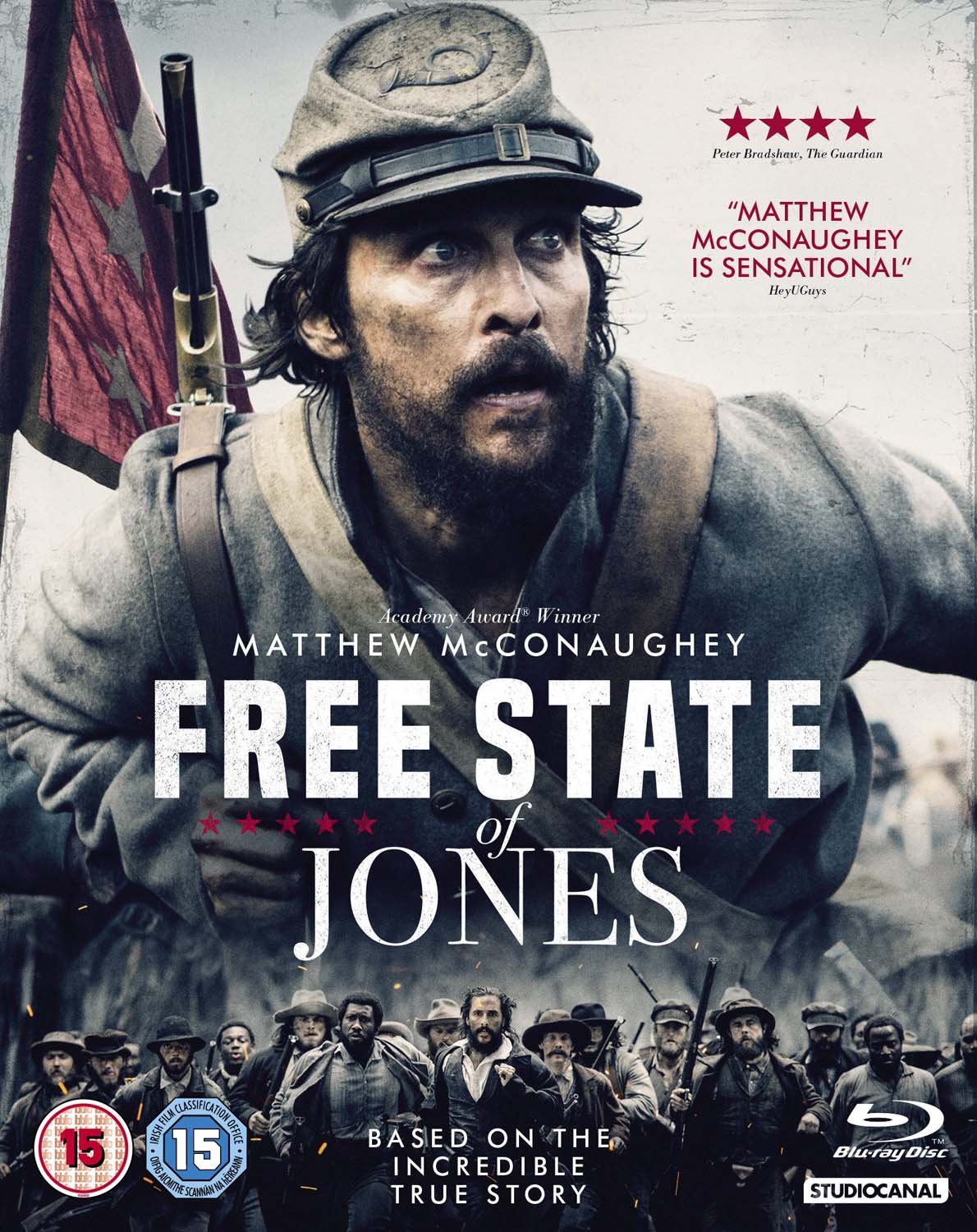
That’s because “Jones County, Mississippi,” was featured in the book and the film The Kingdom of Jones, about a rebellion, led by a farmer named Newton Knight, against the Confederate States. Knight and his fellow rebels had no faith in a war whose conscription laws exempted any man who owned twenty or more slaves. [“It’s a rich man’s war and a poor man’s fight,” the bitter saying went.] Moreover, they had no use for slavery, period. Or for disunion. Knight had deserted from the Confederate Army for precisely that reason. That army’s cause was corrupt, but Knight wasn’t. He was an American.
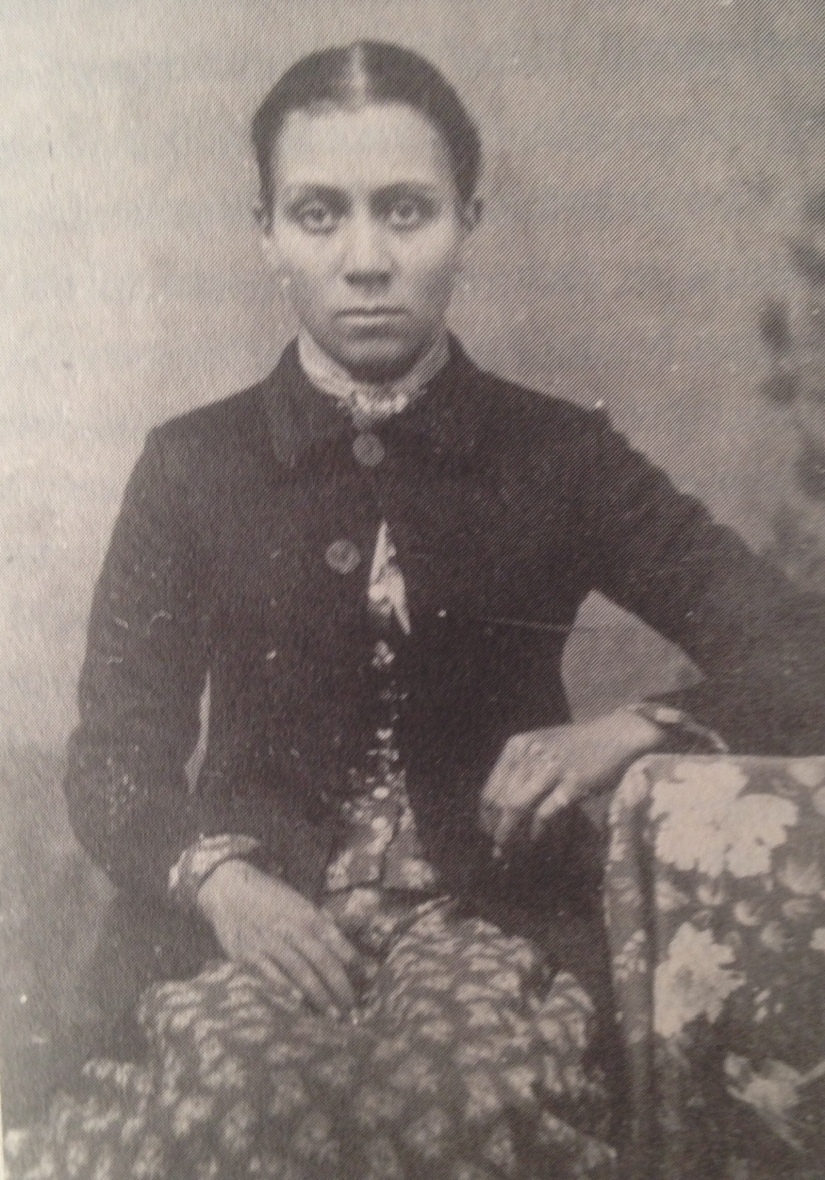
Newton and Rachel Knight.
So was Knight’s wife, Rachel, a Black woman, and so were his guerrillas, who were biracial.
They harassed the Confederacy in Jones County, Mississippi, for two years with hit-and-run attacks–fourteen skirmishes in all–confiscated wagonloads of food intended for Confederate soldiers that were distributed instead among the poor people of southeastern Mississippi, spared the same folks taxes because the Confederate tax collectors, fearful for their lives, gave up trying to correct them, and defied the vows to extinguish the uprising uttered by two Confederate generals–the eternally dyspeptic Braxton Bragg, whose favorite form of discipline was the liberal application of firing squads, and the starchy Episcopal bishop Leonidas Polk.
Well, of course, Bragg and Polk lost their war. And Newton Knight lived to be 92.
And he got a movie.
So, one hundred years after Knight’s death, we come to Micah Bonds-Hill, a Young Woman of Distinction. What happened in Mississippi in those intervening years is abundantly painful. It would take books—and it has—to catalog the cruelty inflicted on Black Mississippians after Union troops left in 1877, but here are three more recent examples.
Emmett Till was murdered there in 1955, his body weighted down with a gin-mill fan and dumped into a swamp; three murdered civil rights workers were buried in an earthen dam in 1963 because they were trying to register Black voters; earlier that same year, a .303 Lee-Enfield bullet brought down Medgar Evers, a World War II veteran and civil rights organizer. Evers collapsed in the doorway of his home and died with his wife, Myrlie, holding him in her arms.
Medgar Evers’s grave, Arlington National Cemetery
Myrlie became a woman of distinction in Mississippi, too, an indomitable civil-rights advocate in her own right.
I have no right to burden this stunning high school senior with the weight of all that history. But these are such troubling times that this little girl, who can whistle forehands like missiles over the net, the possessor of a mind that is faster still, eases my troubles.
When I despair, I remember that all through history the way of truth and love have always won. There have been tyrants and murderers, and for a time, they can seem invincible, but in the end, they always fall. –Mohandas Gandhi
The way of truth and love is painful and steep and sometimes it seems unending and sometimes it seems to disappear altogether. Micah is a light along the way.
I think–but I’m not sure–that this is the old Journalism classroom at Cuesta College, where classes were taught by a gifted instructor, Bob Tomlinson–gifted, most of all, in teaching the ethics of good reporting–and where the campus newspaper, TheCuestonian, was once produced. It was still in the Eleanor Roosevelt green-over-khaki paint scheme back in our days.
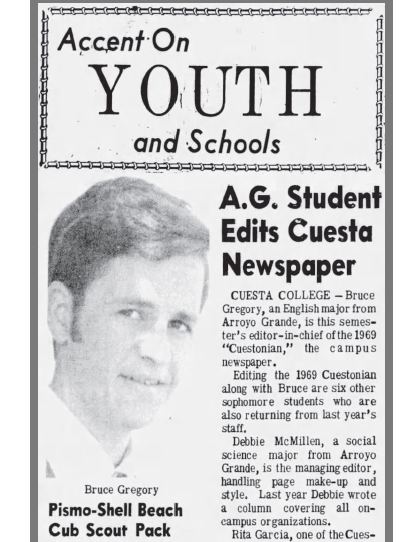
“Our days” because The Cuestonian is an old Gregory family tradition. My big brother Bruce, AGUHS ’66, was the editor in 1968-1969 and he developed a crush on one of his reporters. Fifty-two years later, Bruce and Evie are still married.
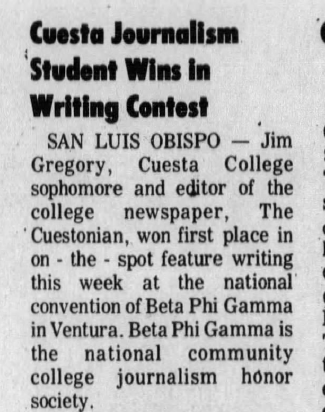
I, AGHS ’70, was the editor a few years later and we won, for such a little punky junior college operating out of World War II barracks, an embarrassing amount of awards, in statewide competitions, in writing, photography, graphics and page design.
You don’t judge a newspaper by its barracks.
This was the convention where one of the speakers gushed about a hot young television news talent named “Brokaw.“
Once you went up the steps, Mr. T’s office was inside the window to the left. He had no more room than a submarine ensign, because most of the office was filled with a monstrous machine called a “Justowriter,” which allowed the keyboard operator to type up the news stories which emerged in a perforated pink ribbon and then, through some alchemy still mysterious to me, the pink ribbon was translated into news columns. (In my imagination, the Justowriter—that’s one of the great beasties below— was steam-powered and drove monstrous pistons, but’s that’s just my imagination.)
The window to the right was my turf and that of the News Editor. We had, at age nineteen or twenty, our own DESKS and so felt immensely important. We filled the room with clackety-clack typewriter noises and immense blue clouds of cigarette smoke–smoking was as fundamental a part of news reporting as were the press passes tucked into the ribbon of your fedora.
Oh, right. We didn’t wear fedoras anymore.
The biggest part of the building was the journalism classroom, edged with banks of tabletops. When it was time to go to press, the desks were cleared away–the process for staging a square-dance in a Victorian one-room schoolhouse was much the same–and the banks of tabletops came alight in the panes of glass that punctuated them.
That’s where you laid out the newspaper, on the glass panes. You’d lay down a big sheet of blue-checkered paper (blue doesn’t pick up in offset photography) and the news stories composed on the Justowriter appeared as long printed columns. They were affixed to the page, guided by the blue lines now transparent in the light, with wax and you rolled them onto the paper with little plastic rollers.When you needed more room, you clipped the end of the story, which is why journalists are trained to get all the good stuff into the lead, or first paragraph, and the ones just following.
Clipping the ends off of stories generated immense emotional anguish from the reporters who’d written them. Me too.
In the back of the building was the darkroom. The reporters did not go into the darkroom. That was the place for more alchemy and photographers (Nikons, Pentaxes, Minoltas)–the ones who used something called “film” that had “speeds,” like Pan X and Plus X–were a justifiably prickly lot.All of them kept the door to the darkroom shut not just out of necessity but because they remembered the story of the great combat photographer Robert Capa, who shot seven rolls of film on Omaha beach on D-Day, was nearly killed seven times, and when the film was shipped back to the darkroom in London, the processor ruined six of them. Even the seventh roll was damaged–it still produced the immortal image below.
So we left the photographers alone, out of respect.
I sometimes wondered if they might not be working out a way to make moonshine out of developer fluid back there.
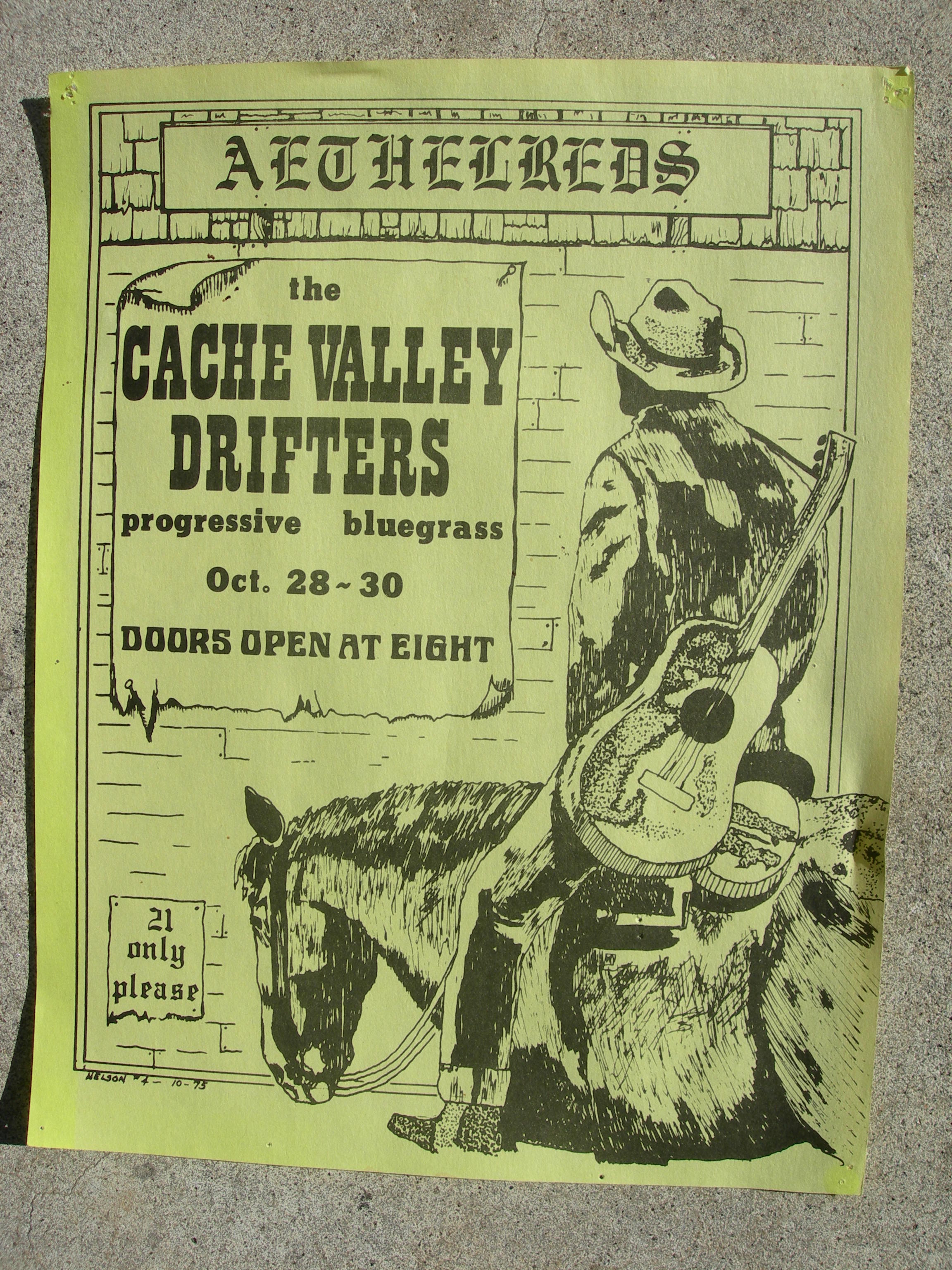
However, I was the only one who could actually go back there from time to time, because sometimes we had to trim headlines, not just stories, and we had a camera called a strip-printer that generated headlines along a strip of photographic paper one letter at a time–in Bodoni Bold. I got to be the Strip Printer Guy, which, just as Aethelred’s Bar on Monterey Street–the Hippie/Biker place that featured incredible bands- had a forever impact on my hearing, the strip printer did the same for my vision.
Putting the paper to bed–a process that sometimes lasted until the wee hours–meant me taking the assembled pages in a big box to Kent Blankenburg’s house–Kent and his brother, Dick published the Five Cities paper, which I still miss– in Arroyo Grande and pretty much throwing them out of the car onto his front porch.
Then I’d drive back to Madonna Plaza Shopping Center (Our Motto: “The wind doesn’t blow here. It sucks.”) to what I think was a Straw Hat Pizza Parlor where all of us would consume obscene amounts of pizza and a platoon or so of ice-cold pitchers of beer or Coca-Cola.
Ah, youth, when we had the metabolisms of muskrats.
We had some great news stories then. A small plane crashed into the roof of the gym where all of us Cuesta students pulled punch cards to register for classes. There was a Vietnam War protest with pallbearers carrying an empty black coffin and I interviewed one, a helicopter pilot in the war, who was both stricken by his experience and one of the most gentle persons I’ve ever met.
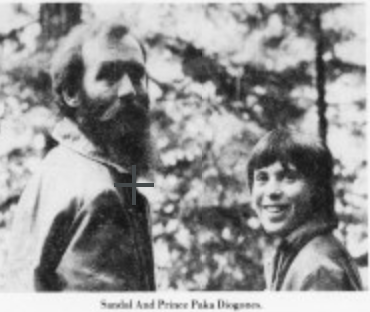
I got to interview a guy who lived on a boat in Morro Bay Harbor, and he was a happy fellow because of it. Moored nearby was the houseboat of two legends, Sandal and his son Paka, reclusive and gentle folks, artists, who took injured seabirds into their care and hand-fed them fish scraps until they were strong enough to fly again.
I got to interview the Black Panther Bobby Seale and the classic film director King Vidor and, during a journalism convention at a hotel in Sacramento–I was within a Frisbee toss of Gov. Ronald Reagan, the guest speaker– I accidentally stepped on state Attorney General Evelle J. Younger’s hand as he came up the stairs that I was descending and he tripped, falling flat on his face.
Evelle J. Younger was the California Attorney General. I didn’t like the way his bodyguards looked at me.
The cafeteria was just behind the journalism building, and the only good thing about the cafeteria was Ginger the Checkout Lady, given to smoking 100-mm cigarettes, wisecracking and referring to you as “Hon.” Ginger was a hoot. The food was not. Then the district somehow, either through divine intervention or Trustee Vard Loomis, one of my heroes, hired a European chef named Maurice who made marvelous lunches.
Swedish Meatball Day meant a throng of nineteen-year-old nouveaux Hippie peacenik students packed at the cafeteria doorway–another surplus Army building–trying to claw each other’s eyeballs out before Maurice ran out of meatballs.
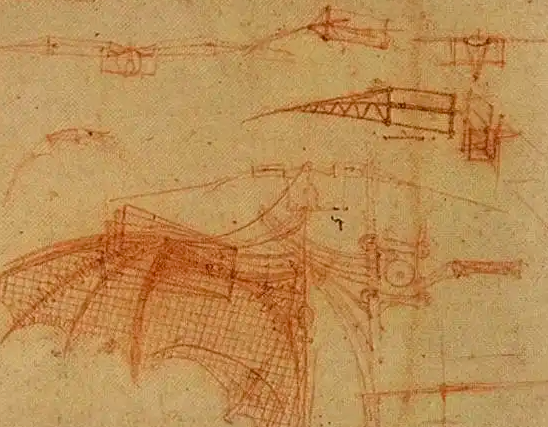
One of my favorite stories was about a slightly mad Canadian artist who took up residence in the Art Department–more barracks, the Art Department was, but augmented by Dali-esque murals–and began building an exquisite wooden replica of a Leonardo da Vinci flying machine. He was going to fly it. He gathered a little coterie of students who believed that he was going to fly it–one volunteered to be the co-pilot– and so they all worked on it merrily together, over there in the Art Department, and I still, to this day, believe it would’ve flown had not the mad artist’s sister driven down from British Columbia to take him, under sedation, back home.
The best part was TheCuestonian staff. I’ve read similar stories about Admiral Nelson’s captains, about the artists and writers who produced the classic Warner Brothers cartoons (Bugs Bunny, Daffy Duck, Elmer Fudd) and, in the book and film “The Right Stuff,” the Mercury astronauts. Gifted people in groups like these last no longer than snowflakes in March, so it remains one of the greatest honors of my life that I got to work with such talented, and now, from the great distance and advantage I have in age, such outrageously young women and men.
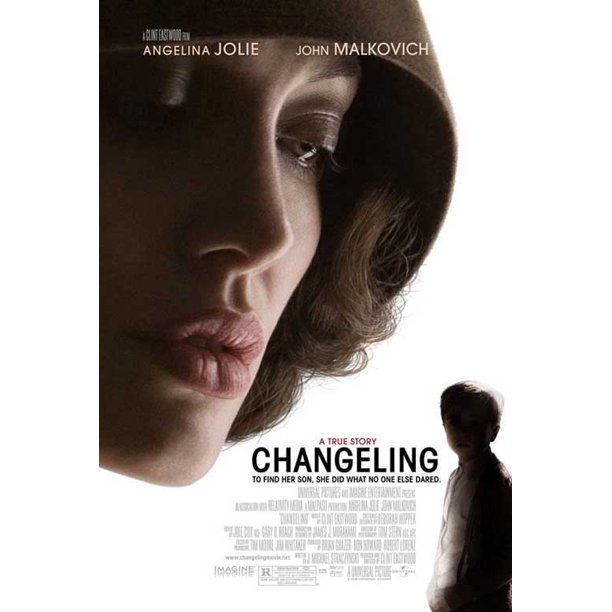
I tend to obsess over films. I watched this one, Changeling, again yesterday for probably the fourth time. It’s directed by Clint Eastwood—impressively, the music, including the closing title, is written by him, as well—and, while it’s not the best of his films, I find it absorbing. That’s because it’s set in 1920s L.A., and the first half of the twentieth century in Los Angeles is a time and a place that I find fascinating.
The story, based on real events, is horrific. A little boy named Walter Collins disappears and the LAPD, under Chief Jim Davis, makes a grand show of returning him to his mother, played in the film by Angelina Jolie, an actress whose fit is somehow perfect for the late 1920s.
The problem is that the little boy isn’t her son. The more she protests, the more she threatens the LAPD with the truth, the more mercilessly they behave toward her. She is eventually confined to an insane asylum because she is so vehement in her protests. She knows her little boy, and the one the cops brought home isn’t her son. (Among the “duh” clues the LAPD missed: Walter wasn’t circumcised. The little boy returned to Mrs. Collins was.)
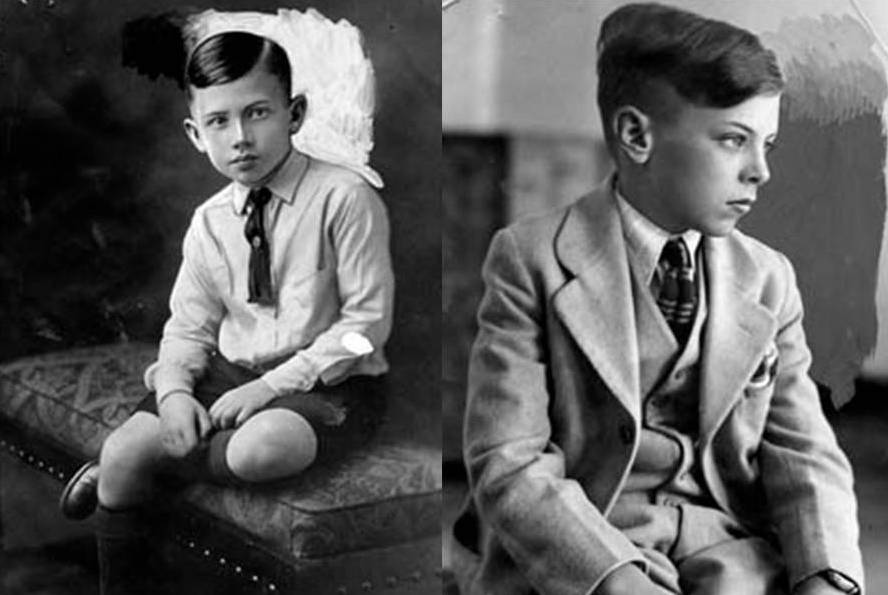
Walter Collins, left, and the “Changeling,” the impostor Arthur C.Hutchins. According to the film, Hutchins wanted to come to Los Angeles to get the chance to meet the cowboy actor Tom Mix and his horse, Tony.
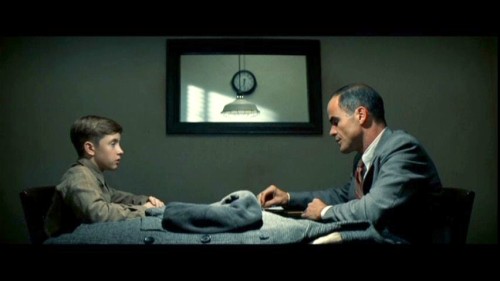
A chance lead forces a child welfare officer—superbly and compassionately played by Michael Kelly, interrogating a runaway in the scene below—to investigate a chicken ranch in Wineville, California. He concludes that Walter is more than likely among twenty boys who have gone missing only to wind up brutally murdered in remote Wineville–today’s Mira Loma. And his discovery eventually confirms Mrs. Collin’s protests. The little boy the LAPD brought home is an impostor.
The suspected child killer, Gordon Northcott, a Canadian psychopath who’d relocated to the chicken ranch east of Los Angeles where he carried out the murders—the “chicken coop murders,” after the place where the little boys were confined— is eventually arrested. The actor who plays the 23-year-old Northcott, Jason Butler Harmer, is terrifying, given to leers and bursts of laughter, eager, after his arrest, to be the center of attention.
Northcott fired his attorneys and represented himself at his trial. A mistake, just as it was here, in San Luis Obispo County recently, where a serial child molester—sadly, a former student of ours—insisted on representing himself because he knew, as Northcott did, that he was smarter than everyone else. That person was sentenced to 280 years in prison. Northcott was hanged at San Quentin, where it took him eleven minutes to die.
Christine Collins spent the rest of her life looking for Walter. In the film’s closing scene, a little boy who had escaped from Northcott has been found and returned to his parents. Jolie, as Mrs. Collins, tearfully watches the reunion at a police precinct and afterward says goodbye to Kelly’s officer. Here, Eastwood’s score is melancholy and lovely, and the computer-generated background, down to the Red Car, is evocative.
This will never be among the greatest of films, but it’s extraordinary nonetheless because it transported me so convincingly to a Los Angeles I know and yet don’t know.
Another film, one of the finest of its generation, would likewise take me to the Los Angeles of another time—a decade after the events in Changeling—in Polanski’s Chinatown.
The two films, neo-noir summonings of an old Los Angeles—the Los Angeles of Double Indemnity and The Big Sleep— brought the city back to life, and have so arrested me that I can’t let them go.
My Mom and I saw this film—I was a little boy— at the Fair Oaks Theater in Arroyo Grande. It remains one of my favorites. Thank you, Sir Sidney Poitier. Godspeed. Amen.
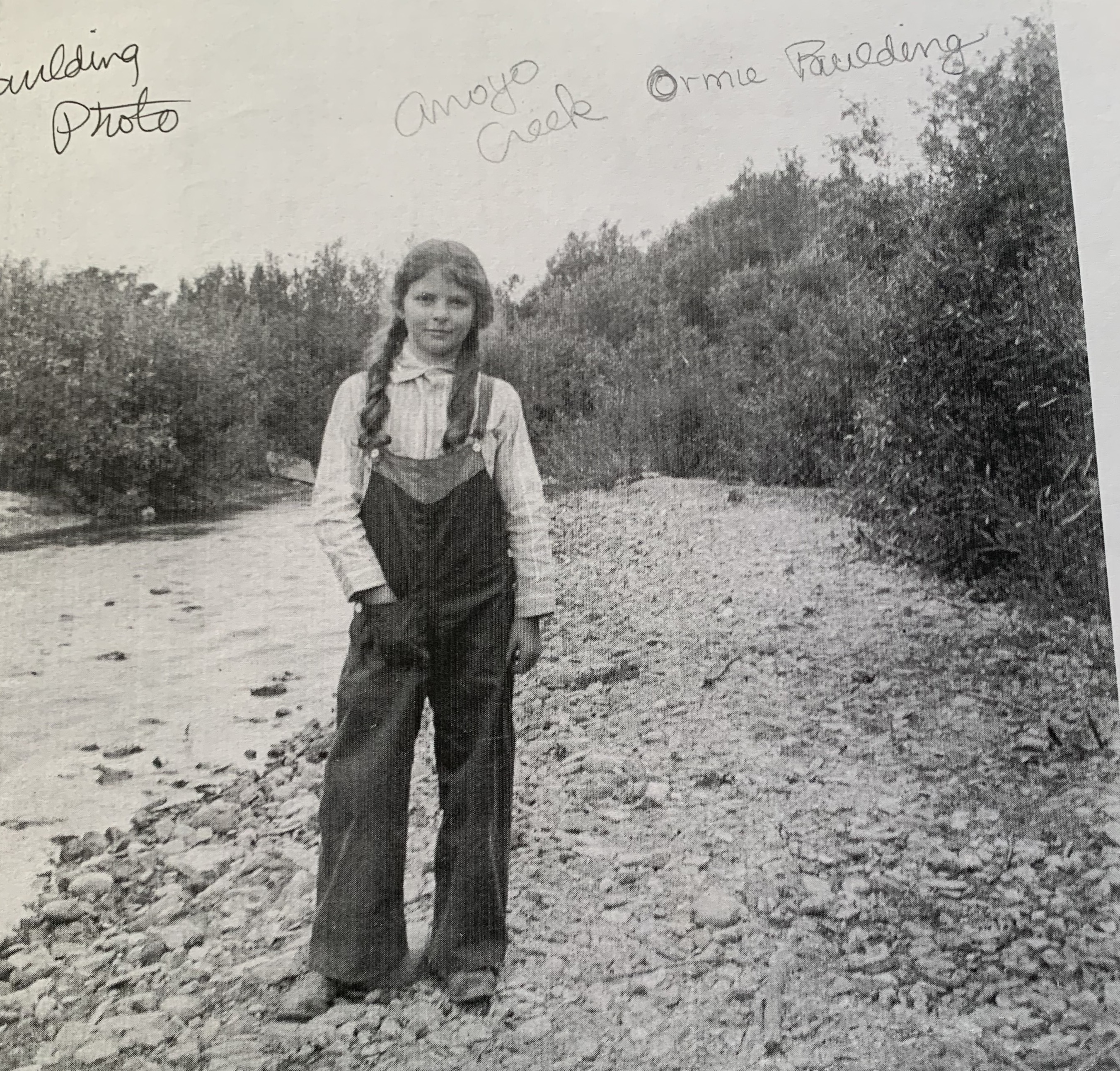
Mary Ormonde “Ormie” Paulding. From the Bennett-Loomis Archives.
She was born in 1883. As a nearly seventy-year-old who loves his sons but who’s bereft of daughters, I would have adopted her, given the chance. And had I a time machine able to go back to her time at about her age–perhaps twelve–I would’ve had a monstrous crush on her. The combination of overalls and pigtails would’ve been enough to reduce me to silly putty.
She grew up in a little farm town, Arroyo Grande, nourished by a beautiful creek which housed, in season, steelhead fighting upstream to spawn and, in another season, floods that once, in 1911, carried away a fourteen-year-old boy named Sam to his death.
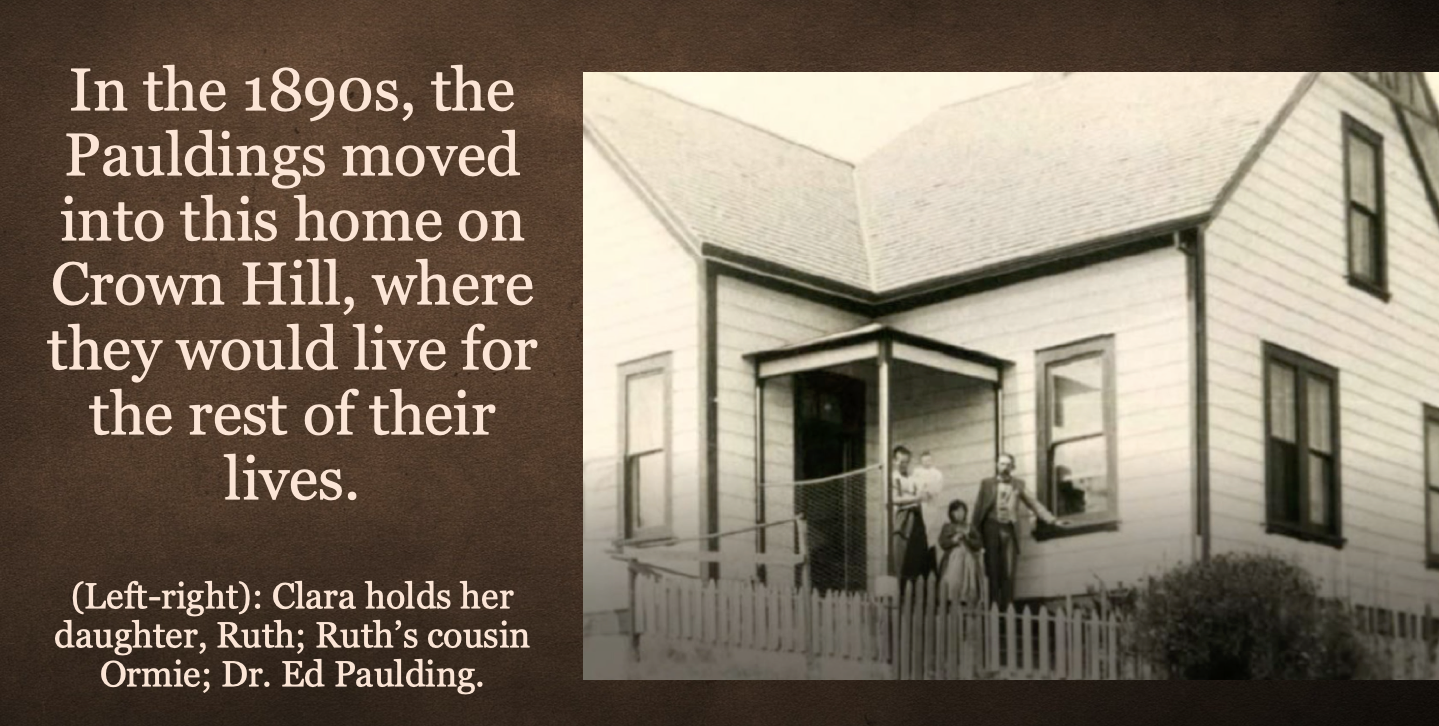
She had the comfort of intelligence–a dubious comfort, admittedly. Both her father and her uncle were medical doctors (another uncle was a pharmacist) the sons of missionaries, born in Syria, whose homes, if her uncle Dr. Ed’s is any indication, were filled with artifacts from the Neolithic Holy Land and Chumash California; homes dense with books, homes full of creative energy inside. Her uncle’s, outside, was bounded by an enormous garden—in dirt her Uncle Dr. Ed found joy— to the point where her Aunt Clara added a bathroom that made it impossible for her husband to re-enter the house without a bathtub stop first. It was only the second bathtub in Arroyo Grande. Sometimes Aunt Clara would hear a soft knock at the door. The folks on the porch asked politely if they could come in and see Ed and Clara’s bathtub.
Ormie’s Aunt Clara, as the saying goes, was a piece of work. She was Arroyo Grande’s foremost schoolteacher; she arrived here in the 1880s and began a career that lasted forty years. She was the descendant of the Puritan divine Jonathan Edwards, but she was an agnostic who just loved going to church. Ormie’s father was the medical director of Santa Barbara County who, in 1918, had the audacity to shut down the bars to stop the spread of the killer flu. He was not beloved.
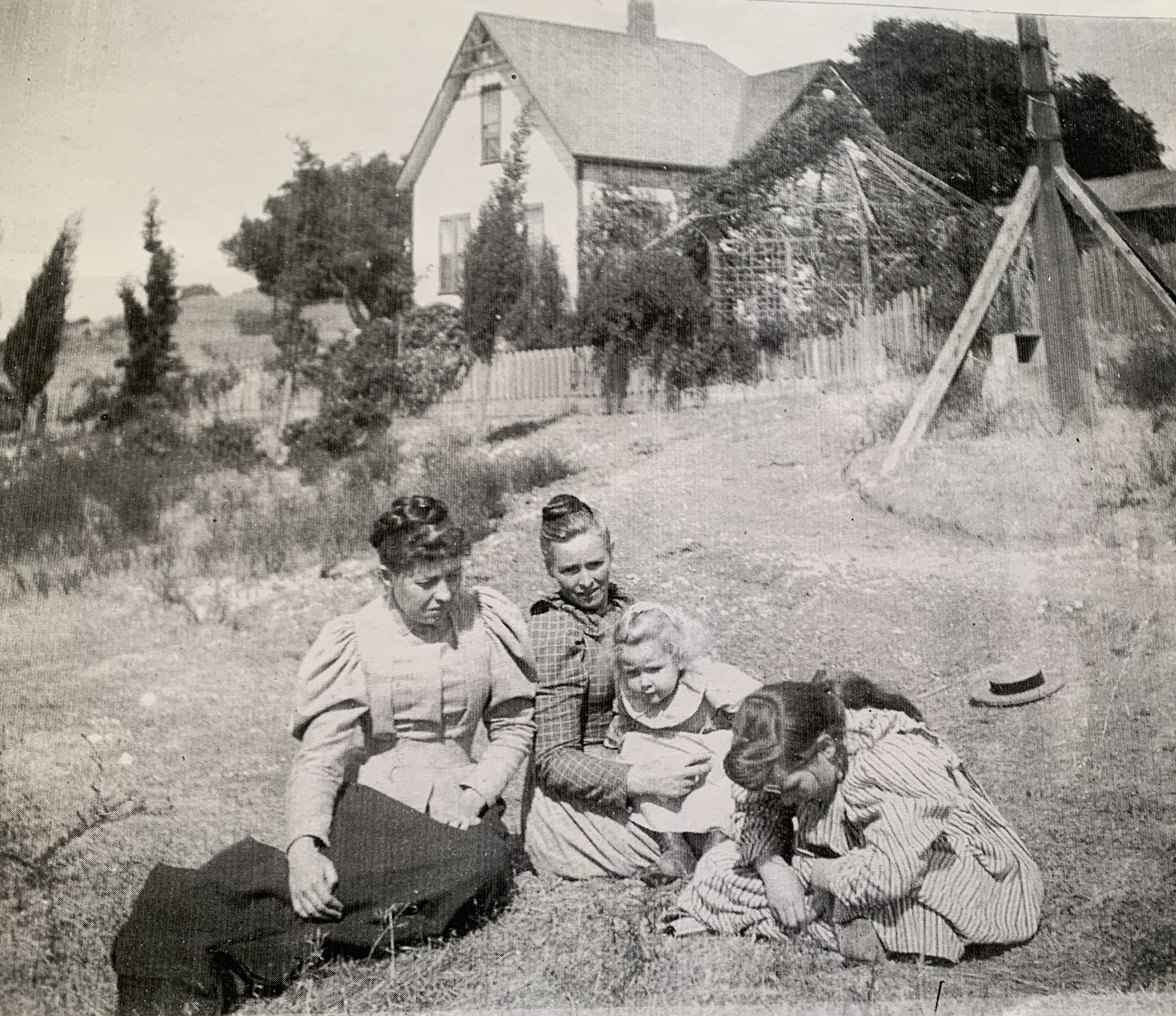
Ormie’s cousin, Ruth was very much beloved. She became such a transformative teacher, of languages, at the Arroyo Grande Union High School (where her commute, atop Crown Hill, consisted of walking across the street) that they would decide to name a middle school after her. That’s baby Ruth, the little blonde. Possibly that’s her cousin Ormie, on the right. The group is posed in the yard of the Paulding home, one that still stands today.
The scene is idyllic, but life, in the 1890s, wasn’t always. Ormie had another cousin, a little boy, the one who was to be first-born, but he was stillborn instead. Her uncle, Dr. Ed, buried him in the garden where he would be close to his parents. Ed planted flowers that gave life to the son who was robbed of the chance to live his.
From the Bennett-Loomis Archives
Ormie would move away from Arroyo Grande—but not very far, only twenty minutes or so today, by car—south to Santa Maria, where she would become a Santa Maria High School Saint, and then, years later, the high school’s librarian and then, after that, she worked for the Post Office.
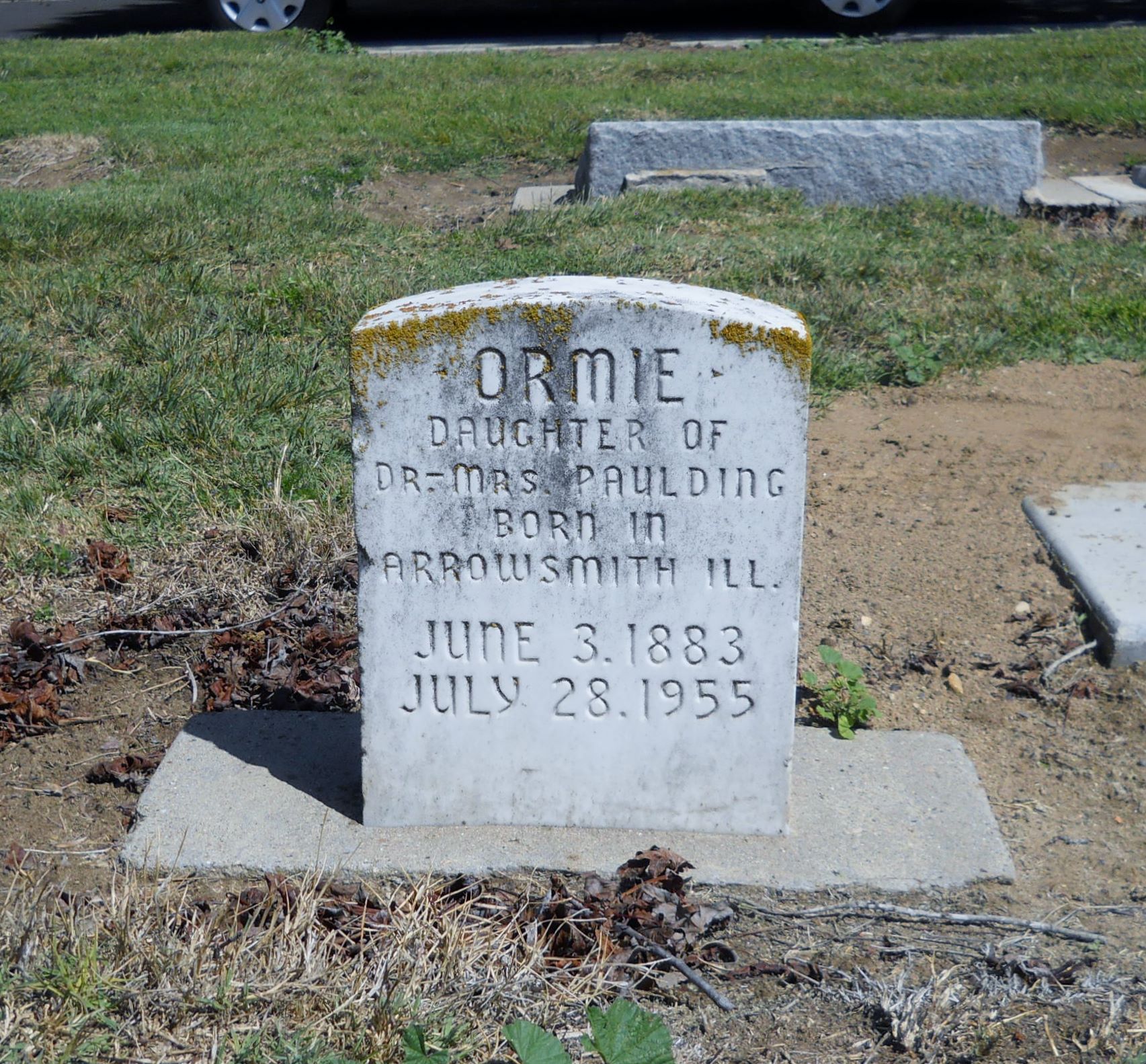
She died in 1955. Here is Ormie’s tombstone:
Death be not proud. The Arrogant Male in me regrets that she lived her life as a “Miss,” but this is what she did with her life: She served young people, who, if you haven’t noticed, are sometimes insufferable, and maybe introduced one, thanks to the school library, to The Arabian Knights or Willa Cather’s My Antonia or—on the chance that the Santa Maria High School Library even had it on their shelves–The Autobiography of Frederick Douglass. The power of school librarians is immense and compassionate, which is why the Far Right hates them so much.
And then she worked at the Post Office. Her obituary hints that even this seemingly mundane career gave her the chance to light up other lives. Post office patrons, it suggests, looked forward to buying a book of stamps from Miss Paulding. I think she had the power to reflect a person’s life back at him, in the instant of her look. You saw yourself welcomed in Miss Paulding’s eyes and so you were validated. I’ve known people like that. A friend who met the South African bishop, Desmond Tutu, a small man shaped, in his vestments, like a church bell, told me that he had that power.
In fact, her cousin, fragile and wheelchair-bound when I knew her, had the same kind of power, too. When I received communion at St. Barnabas, the Arroyo Grande Episcopal church, as a teenager, I would glance at the aged and fragile Miss Ruth Paulding as I returned to my pew. A smile from MIss Ruth carried the same freight as a priest’s blessing.
When World War II came, Ormie added a task not on her Post Office job description: She wrote hundreds of letters to servicemen overseas.
Hundreds.
The effort and the generosity of spirit implied in that task is a little overwhelming to me, living in a country where we observe a day—January 6—when patriotism and generosity were so debased.
Ormie’s generosity was boundless.
She loved animals. She was a charter member and a driving force in the Santa Maria Humane Society, and the lives she couldn’t save with letters, lives of young men lost in combat, she saved in the lives of the dogs and cats carelessly put aside. I can see her framing an abandoned mongrel’s face in her hands and looking into his eyes: the dog understands and looks back in the way dogs do, in absolute and unconditional adoration.
Hers was the same look that Ormie’s Post Office patrons saw.
And so she died a spinster—a terrible word—and I was born far too late to propose marriage to her, which I would have done, on the spot, when I was twelve. She didn’t need me. Women don’t need men to live lives that are graced by love, and filled by it, too. I think Ormie’s life was like that.
The life represented in that image, the little girl in overalls and pigtails, turned out to be more than a little miraculous. Women don’t need children any more than they need husbands. But without her knowing it—because I believe that kindness has the power to cross generations and so inform even unborn lives—we are, in a way, Ormie’s children.















 A Work in Progress