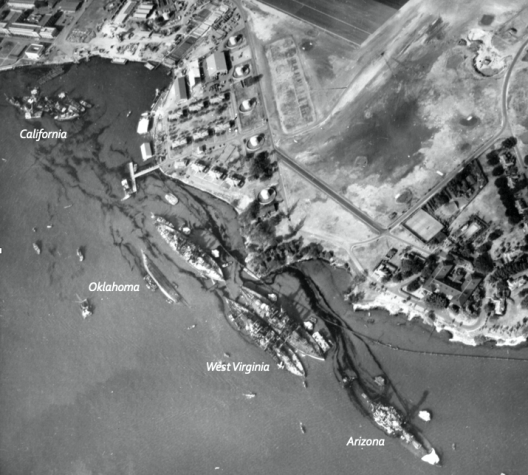
Watching From Here to Eternity yesterday reminded me of how miraculous Americans can be when they work together. One example of this would be the battleship California, sunk at her berth at the head of Battleship Row. These photos show her position a few days after, surrounded by repair vessels, trying desperately to keep California afloat, but she would finally sink and settle on December 10 You can see also the capsized Oklahoma and the sunken Arizona, with her bow blown away.
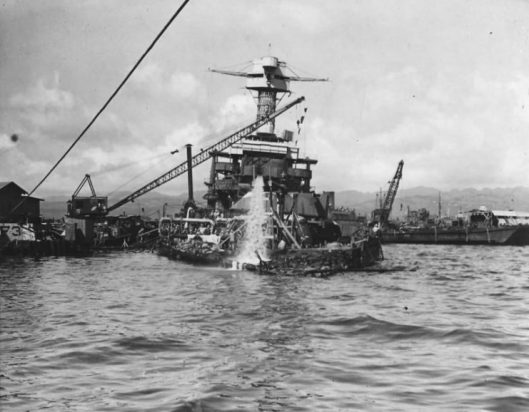
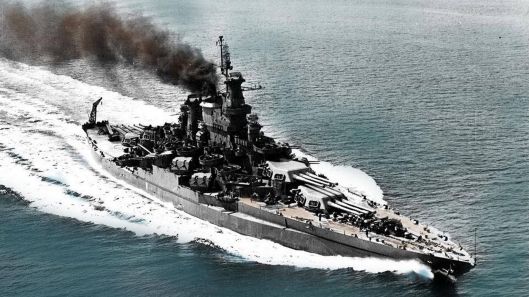
And here is California being raised from the mud at Pearl. She would not only be raised, but she’d be re-designed, repaired and put back into action by early 1944. Her lines (seen below) were far more beautiful than they’d ever been.
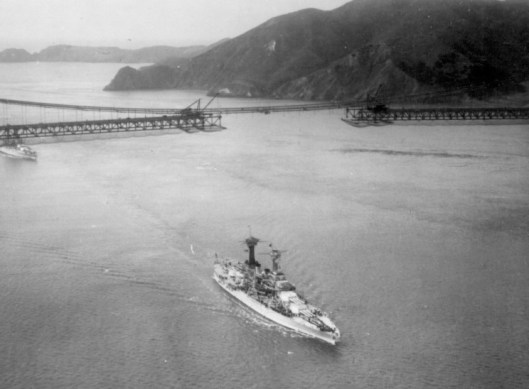
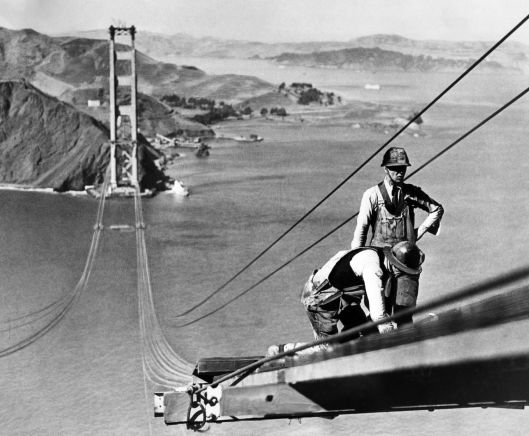
California had been launched in 1921; but even in her more ungainly interwar version, I found this photograph enchanting. Here she is passing beneath another American engineering miracle, still under construction: The Golden Gate Bridge.
It struck me how incredibly productive Americans can be—I looked forward every year to teaching my U.S. History students about 1930s bridge-building. But nothing demonstrated our productivity and ingenuity more than the civilian response to World War II, including the fabled “Rosie the Riveter” (women made up a third of the labor force).
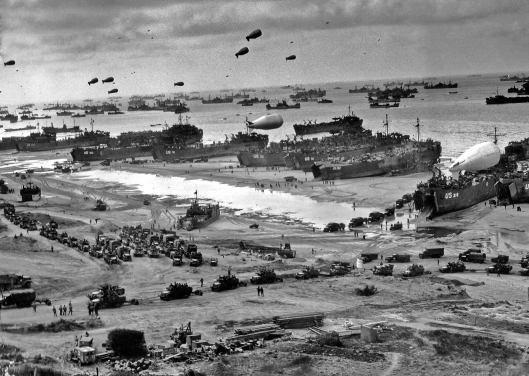
The image that so vividly demonstrates this part of our national character is this photograph of masses of supplies being offloaded onto Omaha Beach shortly after D-Day. I think this is one of the most inspirational photographs in our history.
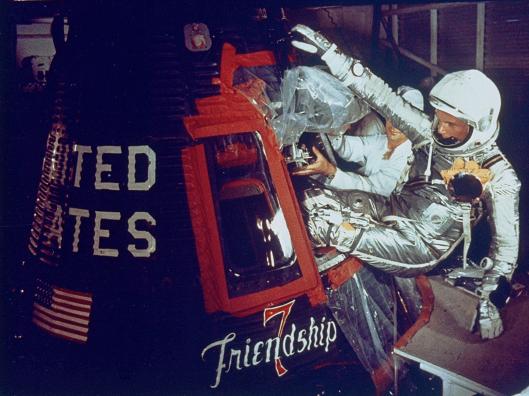
There is something else that reclaimed ships, bridges and wartime factories suggest, and that’s the capability of our national imagination, something I took for granted growing up when I would pad out into our living room, wrapped in a blanket against the cold, to watch a Mercury Program launch from Cape Canaveral. This is John Glenn, one of my Mercury heroes.
But the best example of this element of our national character–our imagination–didn’t come in wartime or in the New Deal years–and not even in the heady days of the seven Mercury astronauts. I think it came in 1956.
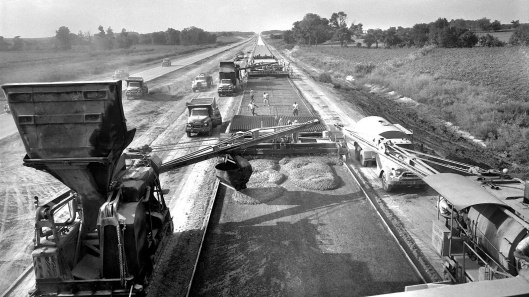
The largest work project in American history came in Ike’s time: The National Highway Act led to the construction of 41,000 miles of roads and generated hundreds of thousands of jobs. We proved once again that we could think big and build big.
And of course the Highway Act led to my life the way it’s turned out; when my father became the comptroller of Madonna Construction–he bid jobs up and down the state–that led to the family’s move from Taft to Arroyo Grande, my hometown.
I am sick of those who proclaim us a “failed country,” because they know nothing about our history. We don’t need them anymore than we needed Copperhead Clement Vallandigham or snake-oil salesman like Huey Long or Joseph McCarthy.
Watched a fascinating HBO documentary last night on what used to be called “New Journalists.” It focused on two New Yorkers, Jimmy Breslin and Pete Hamill. I was particularly struck by Breslin–not necessarily an admirable person, he was a brilliant writer and, even better, a brilliant reporter.
Two examples from JFK’s assassination: While the pack of print journalists hunkered down in front of Malcolm Kilduff for the announcement and followup details of the president’s death, Breslin tracked down the ER doctor who’d tried to keep Kennedy alive. The story even included the sandwich the doctor was eating when he was called to Examination Room 1, and Breslin’s description of Jacqueline Kennedy and her stoicism there is some of the most brilliant writing I’ve ever read.
Example #2: On the day of the funeral, Breslin looked around and realized he was one of 3,000 reporters covering the funeral procession. He broke away, sped to the cemetery, and found the man who was digging the president’s grave. It was, the man said, an honor, for which he was paid $3 an hour. Breslin’s story about the gravedigger somehow crystalized the entire nation’s grief.
The two journalists were a study in contrasts. Breslin agonized over every word. Hamill, like me, wrote rapidly and his New York “Times” pieces–on politics, on social justice, on the civil rights movement–still have a kind of shimmer to them today.
While Breslin was fond of the companions he’d immortalize in “The Gang Who Couldn’t Shoot Straight”–button men, professional arsonists (!), mob lawyers, gamblers–Hamill was dating Shirley McLaine and Jacqueline Kennedy Onassis. His best work–on his own alcoholism–was yet to come then, in the early 1970s.
He’d almost quit writing in 1968, when Robert Kennedy was assassinated. He’d made a mistake, he said. He’d gotten too close to his subject. Bobby’s death nearly killed him, too.
Old history: It’s estimated that 20 million people were living in the Americas in 1500, when Europeans began to arrive. By 1800, fewer than two million survived. Most of the difference—except for the premeditated deaths— can be explained by the diseases Europeans brought with their animals.
The Chinese, it’s said, eat bats, and it’s the “wet markets” that are popularly blamed for Coronavirus.
The Europeans ate beef and sheep and chickens–in fact, in winters, early modern Europeans slept with these animals. The animals kept them warm as both animals and humans conserved calories in a kind of suspended animation that enabled them to survive until spring. Then the Europeans ate their companions.
Europeans were therefore immune to the influenza and measles and the smallpox–a remarkably resilient disease–that dropped the Americans like scythed wheat, another European import.
Current events: In South Dakota today, the Lakota (Sioux) people are stopping cars on the highway where they enter reservation land so that they can protect their people from the novel coronavirus.
Novel, or new, diseases have a horrific impact on indigenous people: The 1918 influenza killed more than half the Native Americans in Alaska. The death rate for the H1N1 influenza in 2009 was four times higher among Native Americans than among the general population.
So the Lakota people are wary. And they are stubborn. The checkpoints exist because even though they live amid the most abject poverty in the United States, they want, above all things, to live.
A Lakota woman, the Butterfly Dance
The government is going to take the to court to force the highways open. The Lakota people are going to fight back, in court.
They will lose, of course. In 1890, the Lakota fought back against the government. They fought back by trying to run away. This is how the government responded, and this is how they lost. I wrote this piece six years ago.
* * *
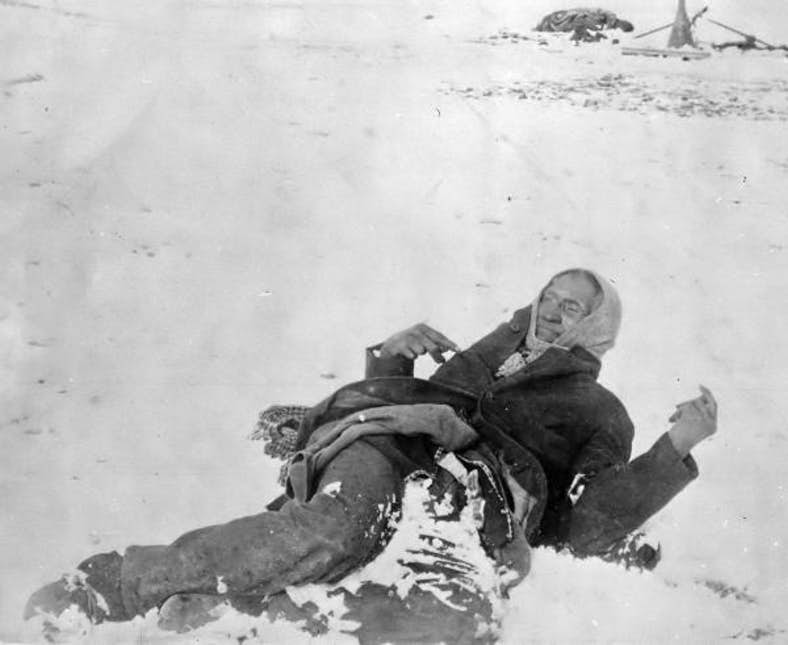
Big Foot in death, Wounded Knee.
In the winter of 1890, Lakota Chief Big Foot led his people away from the Standing Rock Reservation, in North Dakota, where Sitting Bull had just been killed, because he was afraid for them, afraid there would be more violence. He was fleeing for the Pine Ridge Reservation, in South Dakota, when the Seventh Cavalry caught up to his band. Big Foot was exhausted and sick from pneumonia. He raised a white flag.
When the Seventh confiscated the group’s weapons the next morning, Dec. 29, a rifle discharged. The regiment, which had surrounded Big Foot’s people, opened up with everything they had, including four Hotchkiss guns—42 mm howitzers.
They killed as many as 370 Lakota, including Big Foot. Rifle and shellfire killed many as they huddled close together—fish in a barrel—in panic, in the scant shelter of a creek bank.
Many others were killed while they were running away. The power of their fear was such that a few women and children, hungry and numb from cold, ran for two miles before troopers remorselessly rode them down and shot them.
Twenty cavalry troopers received Congressional Medals of Honor for the work they did at Wounded Knee that day.
The Lakota survivors—the blood from their wounds was frozen—were brought to an Episcopal chapel, decorated for the Christmas season, where, as historian Dee Brown notes, they were laid out on the floor under a sign that read:
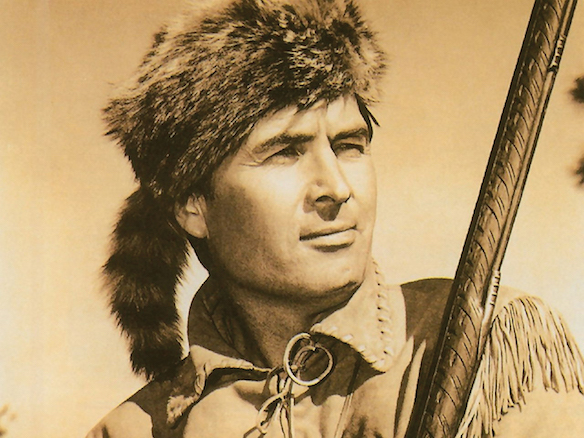
Fess Parker. He was later Daniel Boone, which required zero expenses in the wardrobe department.
My lovely wife, Elizabeth, found my (second) Davy Crockett hat. The story of the first one is tragic.
Okay, if you insist.
For you wee bairns, in the 1950s, Walt Disney ran a series of wildly imaginative episodes on the life of Davy Crockett, who was played by Fess Parker, who later made immense amounts of wine in Santa Barbara County. Davy wore a coonskin cap whose origins—poor innocent eviscerated raccoons— should have horrified us. But Disney made gazillions of dollars on the assembly-line production of knockoff coonskin caps made of petrochemicals, not raccoons, and my parents got me one.
It wasn’t hard to imagine being a frontiersman like Davy. Elm Street crossed the end of our street, Sunset Drive, and everything beyond was sand dunes and eucalyptus trees until you finally reached the Grover City city limits, where everything was sand dunes and eucalyptus trees until you hit civilization, represented by the Blinking Owl Bar.
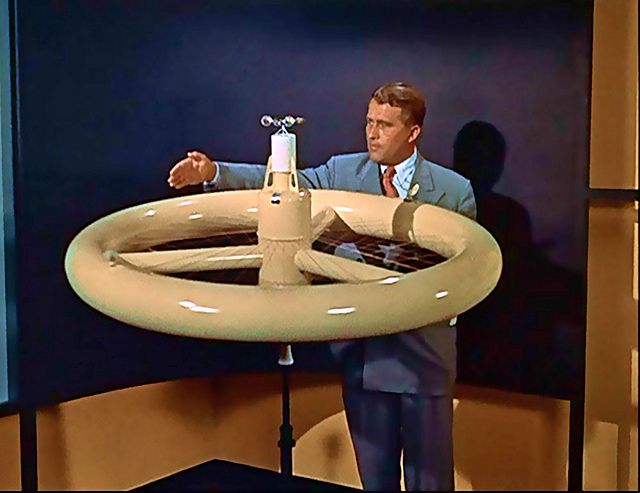
It was important, this hat was. Living on the wild frontier during the Cold War made that hat a powerful symbol. Davy Crockett was a 100% American, the obverse to Godless Communism. Our other Disney hero was Wernher von Braun, the rocket scientist, who exuberantly described the future of space travel, a subject in which he had expertise, having made Nazi rockets that obliterated entire English neighborhoods.
But Dr. von Braun was our Nazi, by golly. We nabbed him before the Commies did.
Dr. von Braun, explains, on the Disney Show, his model of an immense interstellar Space Bagel.
But that’s another story.
I was four. I was pretty much a Davy Crockett fanatic. I don’t remember much about being five because that occurred after the Disney episode where Davy got kilt (proper Tennessee spelling) at the Alamo by hordes of Marxist-Leninists disguised as the Mexican Army.
That was a desert year, being five.
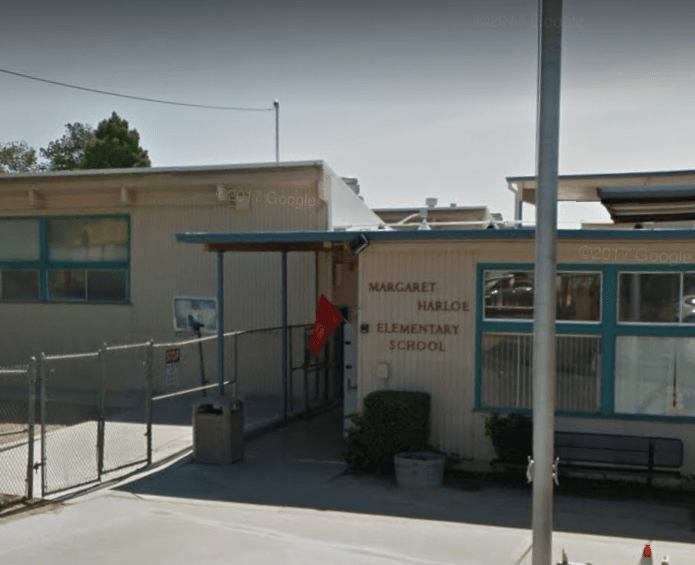
But I DO remember wearing my Davy Crockett hat to the Margaret Harloe Elementary School Open House in 1956. My big brother was a Harloe student who had finally decided to come down from the flagpole he’d climbed to try to escape the first day of school. They’d decided to wait until he got hungry.
That’s another story, too.
But what I remember about that night was the immensely tall Cub Scout–he must’ve been at least 4′ 6″– in his navy blue uniform standing at the entry way to the covered walkway near the principal’s office.
The flagpole is still there, as is the walkway, if you’d like to take colored chalk, measuring tape and a camera there to reconstruct the crime.
Anyway, this is what happened: This Cub Scout stood in the hallway, his legs slightly parted, and began to question the seriousness of my Davy Crockett hat.
The Scene of the Crime today, which hasn’t changed at all from the Scene of the Crime in 1956 except for twenty-three layers of paint.
This is true: I have always had a hot temper. That comes from Dad’s side of the family, implacable Ozark Plateau Confederates and roughnecks (one of Dad’s uncles had inserted a Taft oilfield camp cook into a boiler after a particularly bad meal), though not at the same time.
So this was a matter of Ozark Plateau honor, right here at Margaret Harloe Elementary School in 1956–the eve of Sputnik–and, given the historical times, I reacted as my ancestors would have reacted.
I punched the Cub Scout. Right in the stomach.
However, being a little fellow, my punch didn’t quite reach his stomach. He got a full-force enraged Davy Crockett Fan Club overhead left direct hit in the groin.
I remember my satisfaction at watching him double over like a folding jacknife.
What I remember next is the searing pain of my mother grabbing my earlobe and guiding me, through a force she light-heartedly called Friendly Muscle Persuasion, back to our home on Sunset Drive.
It’s not a far walk unless you’re being pulled by your earlobe.
When we got home, I was read three Riot Acts. I had brought dishonor on our family, on Margaret Harloe Elementary and on the Cub Scouts USA, a double-whammy since Mom was also a Den Mother.
Before I was confined to my room, I did one more hot-tempered thing. We’d come home to Sunset Drive with a fire Dad had built just before the Open House. It was a good one by the time we got home.
So I threw my Davy Crockett hat into the fireplace.
We all marveled at what I’d done but even more at the violence of the blue flames the burning hat produced and then, a moment later, at the ghastly smell. I would wonder, years later, if Chernobyl smelled like my Davy Crockett hat had.
Anyway, I did my time in my room. I came out chastened, I admit, but afterward, as I’ve said, they got Davy at the Alamo and being five was interminable.
Sometimes Mom would catch me singing mournfully, just under my breath
Day-vee… Dav-y Crockett King of the wild fron-tier…
But, thanks to Elizabeth, sixty-four years later, the wounds have healed. I’m back, Davy.
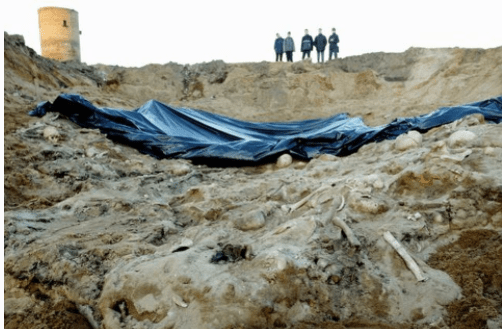
In the early 2000s in Vilnius, in Lithuania, when construction workers began unearthing skeletons, they called in the anthropologists. The work these scientists do is familiar in this part of the world. Thanks to Stalin’s NKVD and Hitler’s einsatzgruppen, mass graves that would be a horror anywhere else are common in Eastern Europe.
The only place remotely familiar is Spain, where everyone knows about the mass graves, legacies of the Civil War, but no one speaks about them.
In Vilnius, the skeletons were even older than the ones left behind by Stalin and Hitler and Franco. These were Napoleon’s soldiers.
The Vilnius burials
Nearly four thousand individuals were isolated, only part of the estimated 20,000 soldiers who died here. The numbers are staggering: Napoleon had taken a multinational army of 675,000 men into Russia in 1812. Near the end of his retreat, at Russia’s western frontier, only 40,000 remained. Half of them staggered into Vilnius.
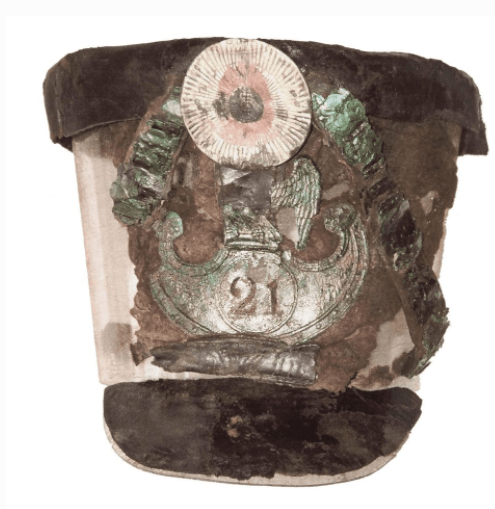
Some of the finds were fascinating. Many individuals had a notch in the front teeth of their lower jaws. This is where the stems of their clay pipes had fit. Bits of uniform cloth and infantry helmets, like this one, allowed archaeologists to match some soldiers with their units in what Napoleon called the Grand Armee.
Chemical analysis of the Vilnius bones hinted, from fragmentary nutritional evidence, at those soldiers who were more likely French and ate a diet based on wheat and those where millet was detected. These were the Italians.
By the end of the retreat, none of the Vilnius survivors was eating much at all. They’d slaughtered the horses that had drawn their baggage and then they’d begged the bewildered townsmen bare. Some starving soldiers broke into a medical office to steal the doctor’s anatomical specimens, suspended in formaldehyde.
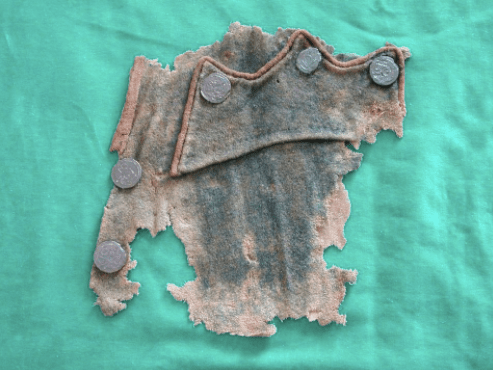
Uniform fragments like this one revealed the final killer: The scat left behind that was evidence of typhus, the same opportunistic disease that would kill so many in Ireland’s famine thirty-five years later.
Some of the skeletons would’ve belonged to the military doctors who remained behind in Vilnius. Napoleon didn’t. He abandoned his dying army—just as he had in Egypt fourteen years before—and, wrapped in furs, safe inside a fast sled, he raced in relays of horses, killed in their harnesses, to get back to Paris, where he could minimize the news of this epic disaster, reshape it in the imperial press.
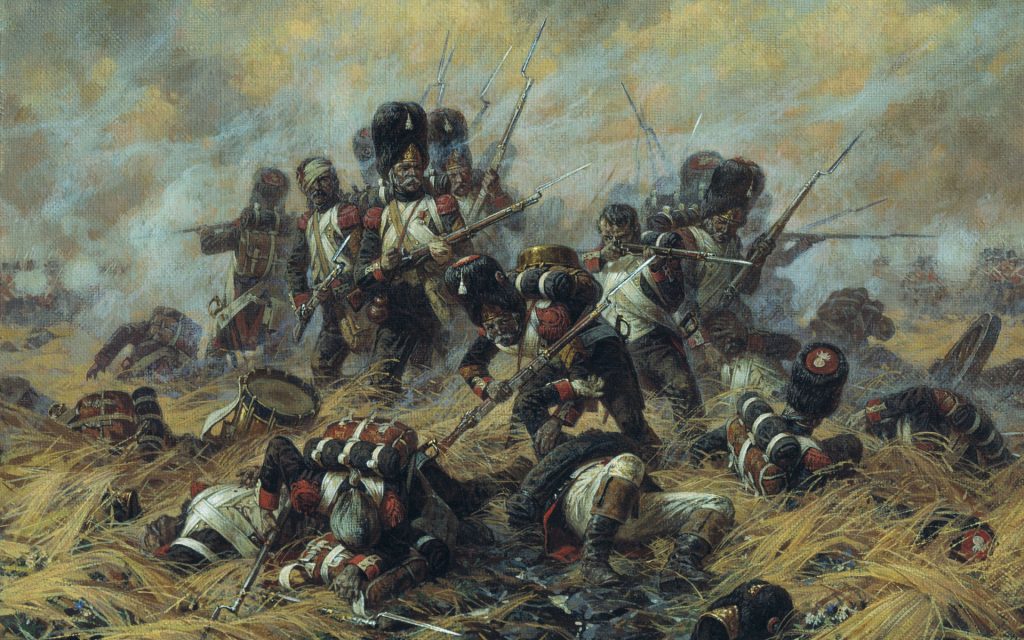
In this, he was spectacularly successful. He would make a comeback and lead let another army to spectacular failure at Waterloo two years later. This army included the troops esteemed more than any others, the Old Guard, his personal bodyguard. Many of them, tall men made taller by their bearskin helmets, were grey-mustached veterans who had been with him since the beginning. By the end, they were ironically the safest soldiers in his army. They were so venerated that they would always make up the emperor’s strategic reserve, to be used only as a last resort.
At Waterloo, that last resort came when the Guard was called on to cover the flight of the Emperor as his carriage sped, again at a horse-killing pace, toward Paris. The Old Guard would die, abandoned on the field in the moment that their emperor realized that the weight of late-arriving Prussian troops was more than his empire could bear. He realized, too, in the same moment and with perfect clarity, that his life was far more valuable than the lives of the veteran warriors who loved him the most.
The Old Guard at Waterloo
This week the president announced that “we are all warriors.” Here are warriors in New York City in a grave different only from the grave in Vilnius for the decency of its caskets and the symmetry of its trench.
But this grave, like the Vilnius grave, demonstrates some of the similarities between the emperor and the president. Like Napoleon, Trump has demonstrated a perverse genius for altering reality.
The president and his people are preparing to magically reduce the casualties of the last two months. They will claim that hospitals, eager for the Medicare money that comes with treating coronavirus patients, are inflating the numbers of admissions and, of course, the numbers of dead—the ones who lie unburied in a fleet of refrigerated trucks in Brooklyn, the trucks organized in neat rows where, in the distance, you can see the Statue of Liberty.
The president has blamed one of his more vivid leadership failures on hospitals, too. He obliquely and darkly implied that the lack of personal protective equipment was traceable to doctors, nurses and respiratory therapists who were selling the gear on some kind of coronavirus black market.
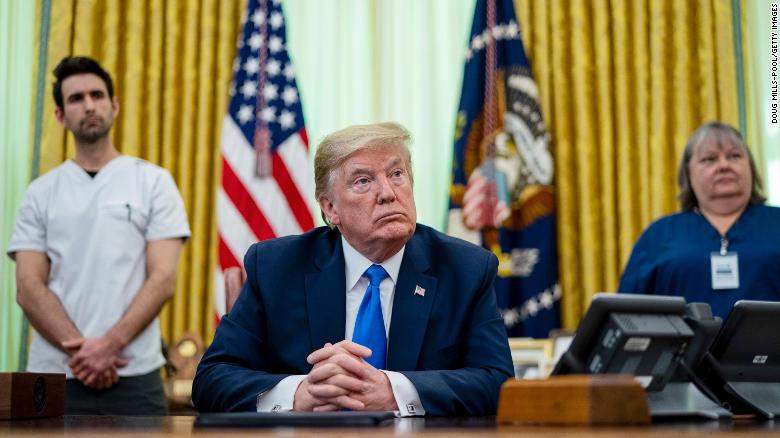
Yesterday, in the Oval Office, he quickly and sharply contradicted a nurse he was supposed to honoring when she revealed that the supplies of PPE were still sporadic and unreliable.
Trump prepares to humiliate an honored nurse.
“That’s not what I hear,” he said, without revealing, as he never does, where he’d heard it. “Many people tell me” is the closest we get to attribution from a president who constantly excoriates the background sources from the reportage of the New York Times or the Washington Post.
He was far more obvious in his repeated references to “The China Virus,” the one he claimed to have quashed at American ports of entry. But the tragic numbers in New York City came from Europe, from Heathrow and Orly and da Vinci-Fiumicino, as passengers made their transit through JFK and Newark.
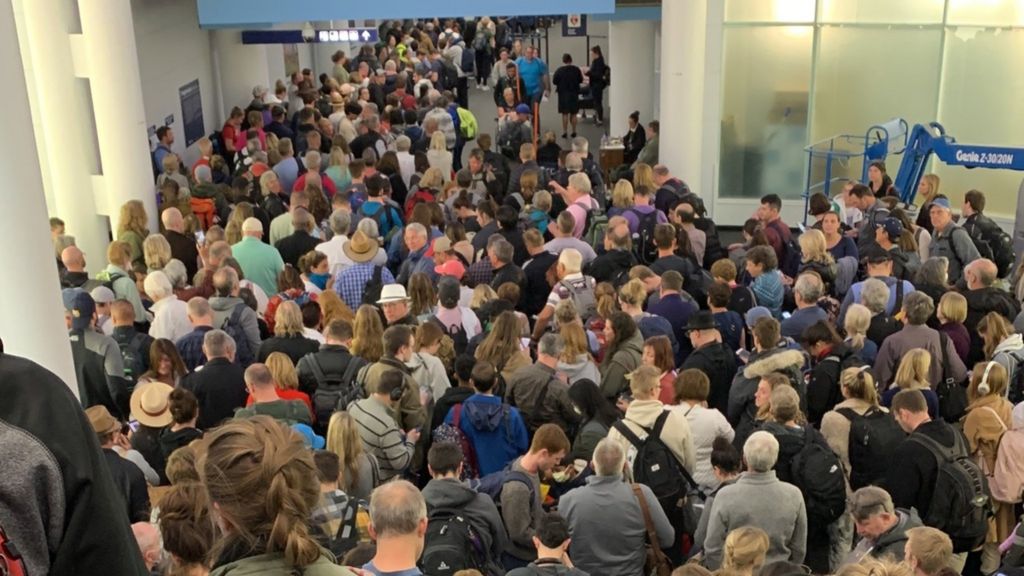
When he did respond to the East Coast threat, he did so with his customary incompetence, announcing “enhanced screenings” that left hundreds funneled into Customs hallways where they had far less freedom to move than the virus did.
But these were warriors, weren’t they?
JFK International, March 2020
Trump’s ignorance of history remains his greatest and most enduring personal virtue. He knows nothing about Napoleon and Russia and does not care. He refers repeatedly to “the 1917” flu. You could see his restlessness on a visit to Gettysburg, early on in what he called, early on, his “reign.” (Someone in the West Wing got him stop using this term, one he used for previous presidents, as well.) Later he passed on a visit to Belleau Wood because it was raining. He did speak, to his credit, at Normandy on the same trip, but it was transparently empty because he spoke in the same uncomprehending monotone that he reserves especially for the dead. The words written for him meant nothing to him. He was, as someone so aptly pointed out, like a sixth-grader delivering a book report about a book he hadn’t read.
And he did speak, to be fair, in the rain. In a July 4 speech, he praised the Continental Army for seizing airports from the British during the American Revolution.
And so the ignorance he so carefully cultivates—the coronavirus deaths are fake news, after all—will shield him until, God willing, he leaves office. The man who has called himself “a wartime president” will be whisked away from the battlefield.
He’ll be flown home to Mar-a-Lago where he will finally be alone with the thing he loves the most: A New York steak, very well-done, with a a side of fries and plenty of ketchup. And then there will be a thick slice of chocolate cake with two scoops of ice cream.
All he will have left behind are trenches filled with warriors. But the country will be opened again. We will have that much. And, in truth, when the trenches are covered over, the scars they leave behind will grow over and so fade away.
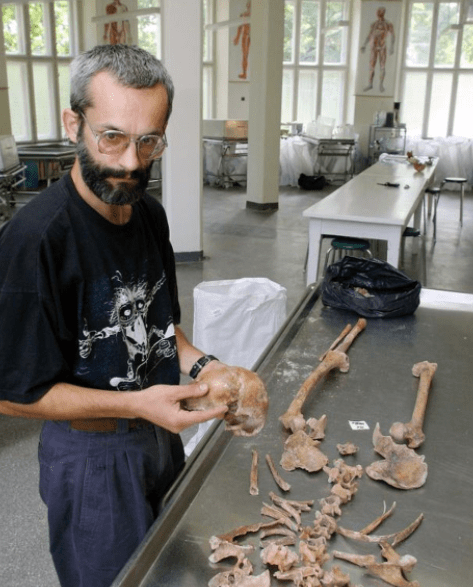
When the Vilnius warriors were finally unearthed, the scars there reopened. You can see it in the scowling face of the Lithuanian anthropologist. You can see it in the compassionate face of the young woman field technician as she reveals a young man who’d died nearly two centuries before she was born. What you see in both images, in both expressions, are human beings registering their humanity.
A little humanity is not too much to ask for. Unless you ask for it from the misshapen man who claims to leads us.
This should be simple. I needed a new mouse pad. My little mouse has been slippin’ and slidin’.
I found this one online and it was on sale and it was the last one! I bought it for $8.79.
And I bought it because I love Civil War history, and because this photo is in my Civil War book, Patriot Graves, which is about the nearly sixty Civil War veterans buried in my California home town, Arroyo Grande, about their combat experiences but also about their remarkable postwar lives.
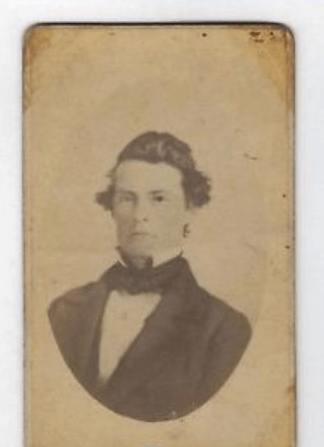
I am, after all, named for a Confederate, James H. McBride, who may (or may not) have been a brigadier general. This is his photograph, taken before the war, when he was a county judge and a bank president. While I have limited formal medical training, Gen.-or-Not McBride died in 1862, and I suspect, from the photographic record, that it was from Terminal Constipation.
James Haggin McBride, my great-great grandfather
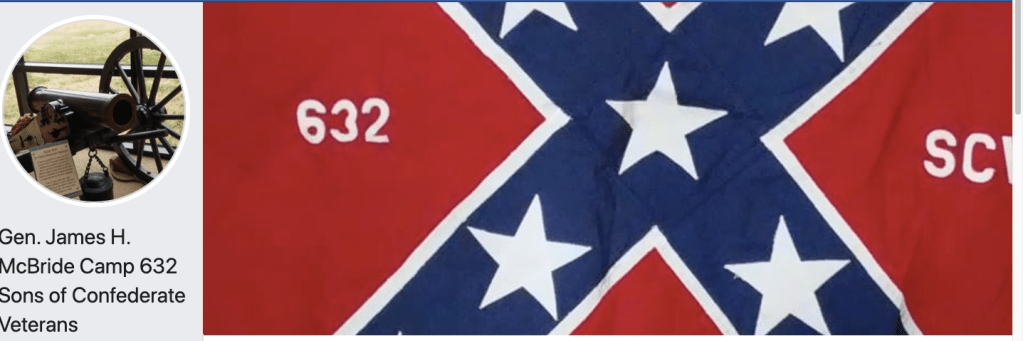
There’s even a chapter of the Sons of the Confederate Veterans named after my namesake. They’re in Springfield, Missouri, where the 1861 Battle of Wilson’s Creek was fought, one that included McBride and a regiment of Ozark Plateau secessionists armed with squirrel rifles. The SCV chapter even has a Facebook page.
It gets more complicated. My middle name, “Douglass,” is for Gen. McBride’s son, a young staff officer who had a disagreement with a Union artillery shell in Arkansas in 1862. So it goes. Family lore has it that they brought young McBride home draped over his horse, his boots reversed in their stirrups, JFK style.
Nope. It you’ve been sundered by a an explosive shell, this is how you come home:
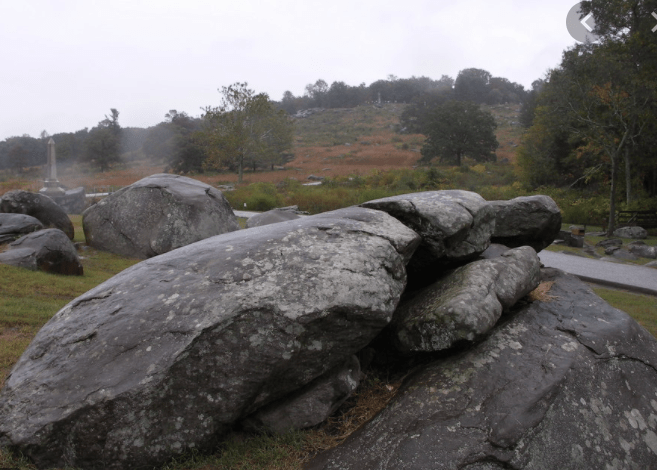
And, not to put too fine a point on it, but when Elizabeth and I took our young boys to Gettysburg many years ago, I stood on top of Devil’s Den and realized that Lee had sent boys not that much older than my sons to take this Union strongpoint, atop boulders left behind by ancient glaciers, and all that happened in this eminently defensible position is that Lee got his boys butchered. The length and the polysyllabic nature of the profanity I heaped on Lee that day cannot be be adequately captured here. I love history. I love my sons far more.
What impressed those two boys were the hundreds of graves in the National Cemetery where the markers are brass numbers, not names. We found, on the battlefield, a proper marble headstone that read:
Forty Confederates buried here.
Devil’s Den, Gettysburg
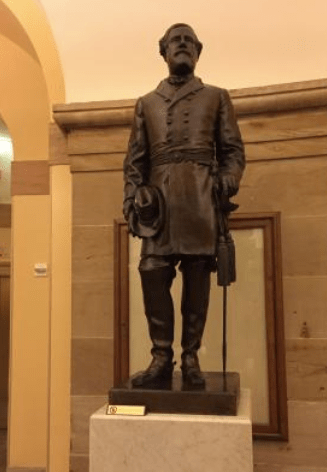
I am not the only one to consider Lee a butcher. It is pleasant for many to denounce those who protest Confederate statues today as politically correct crybabies. But when Lee’s statue was installed in the United States Capitol in 1909, the loudest and most passionate protest was from Union combat veterans. Bobby Lee had killed their closest friends. I don’t think the veterans, either living or dead, could be called “snowflakes.”
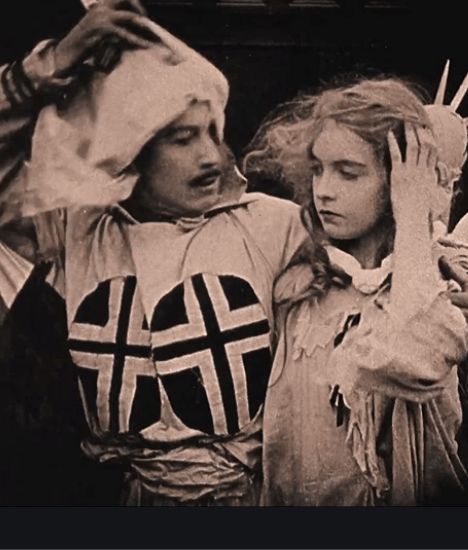
The protests didn’t end there. Fifty years after their war had ended, Union veterans condemned D.W. Griffith’s Birth of a Nation, especially its glorification of the Ku Klu Klan. This is Lilian Gish—she was to 1915 what Meg Ryan was to 1995—being rescued by a Klan leader (and former Confederate colonel) portrayed by actor Henry B. Walthall. What Walthall has rescued is the purity of Gish’s white womanhood. That purity had been endangered, in the film, by black Reconstruction troops.
Most of them were portrayed by white actors in blackface.
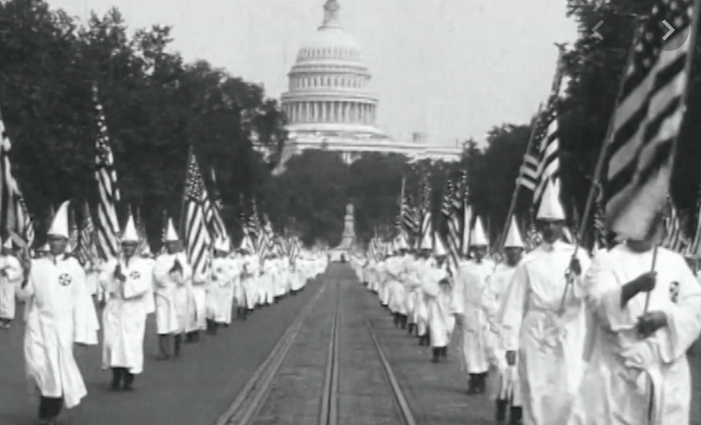
Which brings me to the United Daughters of the Confederacy. They were big supporters of this lot, seen in a familiar-looking city in 1926:
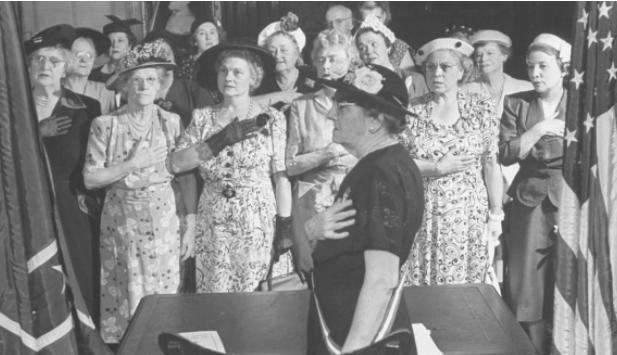
Here’s a photo of the Daughters. They look as if they’re reciting the Pledge of Allegiance. They seem to be facing the wrong way.
They published a children’s book that glorified the Klan. They articulated and nourished the myth of the “Lost Cause.” Most of all, they funded thousands of statues that replicate, in stone, their heroes—the boys they’d never have the chance to meet at the cotillion so vivid in their minds, boys whose uniform collars glittered with gold braid.
In their minds, the UDC girls, in old age long, long after the boys of their imaginations, boys from another generation, had died, sundered by artillery shells, could still hear the crisp sounds of their own petticoats, freshly starched by the servants also alive in their imaginations, as they waltzed with handsome young soldiers on a warm night redolent with magnolia.
Since the UDC girls couldn’t have their cotillion, they created, in stone, a division of dance partners scattered across the South, most of them glaring fearlessly at the County Courthouse.
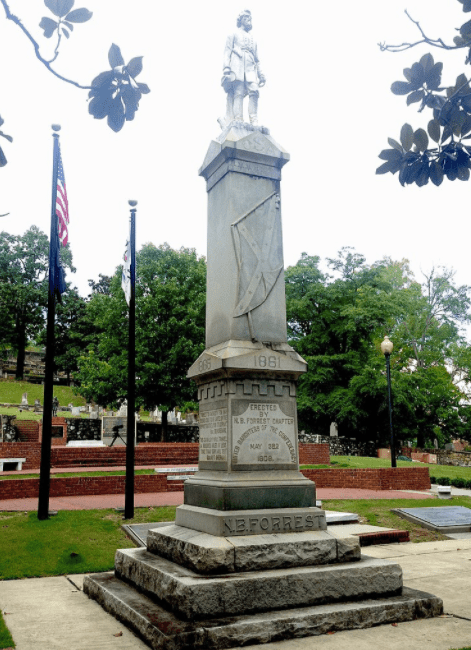
This one, in Rome, Georgia, is a tribute to Nathan Bedford Forrest, mentioned in passing in Forrest Gump, a Confederate cavalry commander who would be one of the Klan’s founders. He got a head start at the so-called Battle of Fort Pillow, Tennessee, in 1864, when his boys murdered 300 black Union soldiers who had already surrendered.
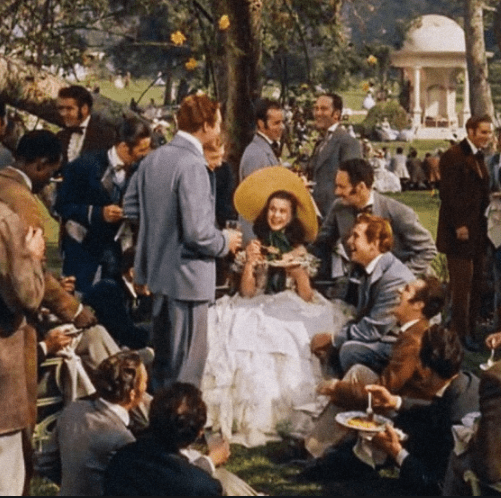
All of the United Daughters had to have swooned when Gone with the Wind was released. I am sure many of them, in the moments before death took them away, imagined themselves as Scarlett at Twelve Oaks, with all those handsome, chivalric young men paying court.
I’m still furtively proud of getting disinvited by the Santa Barbara chapter of the United Daughters of the Confederacy. They wanted me to talk about my Civil War book, Patriot Graves, when it suddenly dawned on me that they hadn’t read it.
Excuse me, ma’ams. My ancestors were Confederates, too, Our Confederates were, as you might’ve noticed in my book, some of the finest combat soldiers in the history of the world, and not just America. They were incredible.
And they were deluded. Delusion is a theme that has gained currency in our nation lately.
These men, our ancestors, I wanted to tell the United Daughters, fought to defend a monstrous evil, led by the nose—and to their deaths—by cynical politicians (they called them “The Fire-Eaters”) who cared for nothing so much as their own wealth. This was wealth grounded in human chattel.
Every Confederate ordnance of secession cited the defense of slavery—and the “injustice” of antebellum measures to prevent its expansion into the West—as the root cause of the Civil War. I have to bring this up, I finally did tell them, if you want me to be your guest speaker.
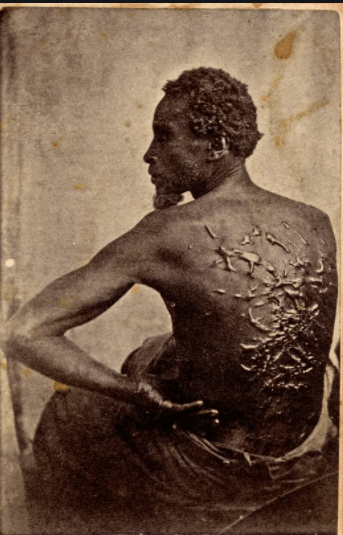
In my heart, I wanted to tell them even more. I wanted them to remind them of this man, in a photograph I know that all of the United Daughters of the Confederacy, Santa Barbara Chapter, have seen. This man is Whipped Henry, a habitual runaway from a Louisiana plantation. (Robert E. Lee endorsed the beating of slaves as a regrettable but necessary means of enforcing the social order he defended.)
I might even been compelled to bring up, to the United Daughters of the Confederacy, the terror slaves faced at having their families broken up by sales. When one Virginia mother was “sold South,” to the factory-fields of Deep South Mississippi, she used a hatchet to chop off her own foot. That queered the deal. She mutilated herself because nothing was as important to her as her children.
This is how much and how passionately the people we call slaves—it was slaveowners who called them “servants”—loved each other. In the historic record, in the New Deal slave narratives, taken down by young historians on wire recorders, their love for each other is the only constant that transcends their hatred of slavery.
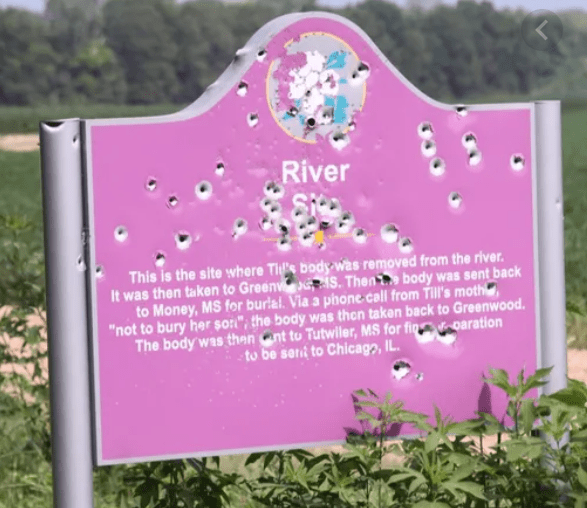
In the years after emancipation, the Klan hated far more. This is their legacy: The Emmett Till Memorial in Mississippi.
Fourteen-year-old Till, a Chicago 14-year-old, was beaten beyond recognition in 1955 and his body sunk in a bayou with a cotton gin fan used to weigh him down. When his corpse bubbled to the surface, the joke white folks told was this: “Ain’t it just like a nigger to go swimmin’ with a gin fan aroun’ his neck?”
This photo was taken ten months ago.
So I guess I will get a new mouse pad in the mail. You shouldn’t buy things on impulse. The impulse can release so many memories—even those that don’t belong to you. You’ve chosen, as a teacher, to adopt certain memories, so that you can pass them on to the students that you love so much, like the memory of Emmett Till, like the memory of the face of his heartbroken mother, Mamie, at Emmett’s funeral.
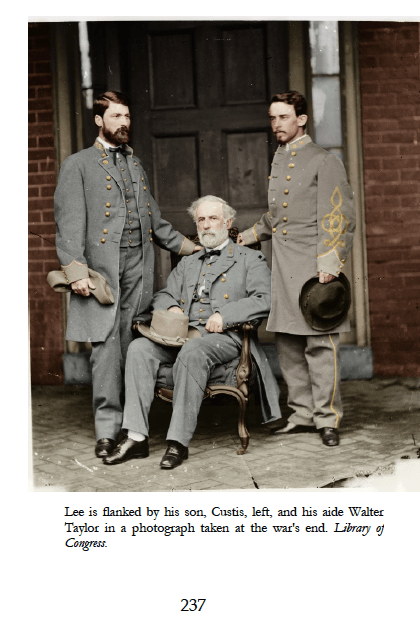
Robert E. Lee’s face is noble and grave and handsome—he was, in the years before the war, known as “the handsomest man in America.” He was a general. Mamie Till’s face is expressive and passionate and lovely. She was a schoolteacher.
She insisted that Emmett’s casket remain open for the funeral, so that Chicago folks could see what they had done to her boy. The photographs of Emmett’s face are horrific. His humanity has been erased.
You try to block out that face. Two more will appear in your imagination.
You’ll wonder, as you guide your mouse over Lee’s face, if somehow, in someplace that is not America, Gen. Lee and Mrs. Till might have the chance to sit down and regard each other in silence for a long, long time.
Sooner or later the great general, if he was any kind of man at all, would have to clear his throat and begin to speak in the gentle voice that his soldiers remembered. If he was any kind of man at all, he would surrender again and with the same grace he’d shown in Wilmer McLean’s parlor at Appomattox Courthouse.
There are some stories that are so true that cynics cannot abide them and will spend countless needless hours—when they could be doing better things, like planting squash or building model battleships—trying to debunk them. Henry Tandey’s story is one of those.
Even if it’s not quite true—it does have factual underpinnings, but not the kind of deeply sunk concrete foundation that its doubters require— it has become a kind of parable, which is a story that tells a higher truth without getting bogged down in footnotes. That may make it even more important.
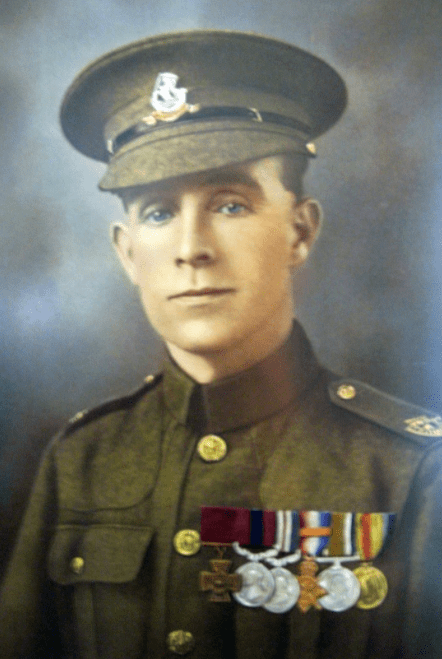
It’s a simple story. Henry Tandey was an immensely courageous British soldier (The VC, or Victoria Cross, is equivalent to the American Medal of Honor) fighting in the last year of the Great War, in September 1918, near Cambrai, where, only days later, an American engineer battalion would join the Brits in carrying the fight to their German enemy.
It was a German who entered young Tandey’s life that day. Tandey saw him pretty clearly through the gunsight of his Lee-Enfield .303. The fellow was staggering and disoriented and it would have been easy for the young Briton put the young German out of his misery–it looked as if he’d been gassed, after all.
Tandey started to squeeze the trigger and then something interposed. Was it a hymn he’d learned as a little boy? Was it something his grandmother had taught him? It was certainly something he couldn’t articulate at the time. Battlefields don’t lend themselves to thinking in ordered companies of sentences arranged in battalions of persuasive paragraphs.
Tandey let his finger relax and so let the helpless man go.
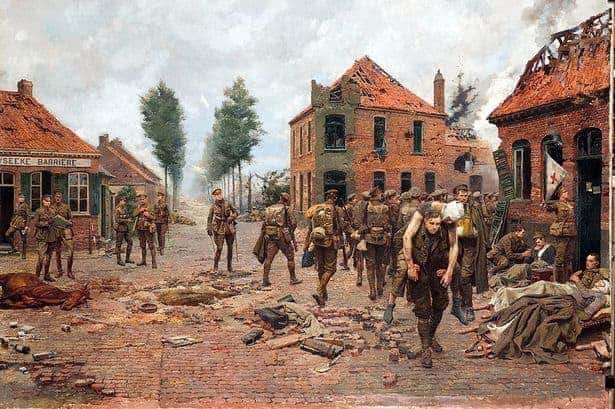
The German soldier survived the war, as did Tandey, but their paths would cross again, twenty years later, oddly enough and quite indirectly, in Munich, a beautiful city. That’s where the German saw this painting and instantly recognized the soldier in the foreground, in what must have been a customary moment of compassion, carrying a wounded comrade.
“I know that man!” the German veteran exclaimed to his guest, a visitor from Britain. “That’s the man who spared my life!” The veteran asked his British guest, a man of some power, if there was any way he could discover the British soldier’s name.
There was. The guest was, after all, Neville Chamberlain, the Prime Minister. After finding the artist and interviewing him, a young man working for Chamberlain identified the soldier in the painting as Pvt. Henry Tandey.
He was no longer “Pvt. Henry Tandey,” of course. He was a factory policeman working in the Triumph plant in Coventry, a beautiful city noted for its beautiful cathedral.
The delighted German sent a message of thanks to Tandey in Coventry.
Two years later, he bombed Coventry.
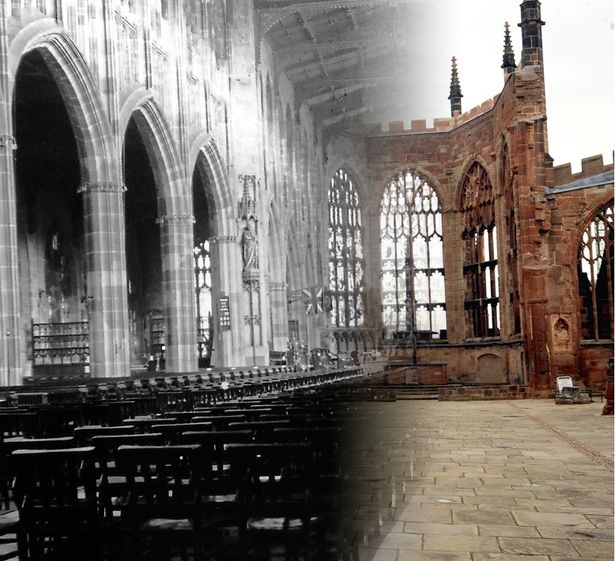
The black-and-white photos shows Coventry Cathedral’s nave, now vanished, against the fragment of choir that remains today.
Pvt. Henry Tandey, VC, had Adolph Hitler in his gunsights that day in 1918. “I couldn’t shoot a wounded man,” he said in the years after.
“I’m sorry to God I let him go.”
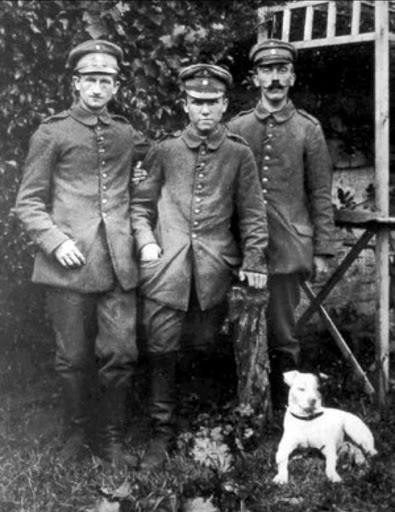
Hitler, at right, with his comrades and one of the dogs that were always part of his life. He poisoned the last one, a beautiful Shepherd, Blondi, so the Russians wouldn’t capture her.
Henry Tandey, late in life, and his medals. He died in 1977, nearly sixty years after he’d spared Hitler’s life.
PBS is re-running Ken Burns’s The Roosevelts: An Intimate History and I watched last night the episode that recalls the slide into World War II.
I tend to agree with the historian-commentators who marveled at the dexterity— and the sometime duplicity —with which FDR led Americans in those years. His sights, of course, were set on England, especially when, by the spring of 1940, England was alone against Hitler.
When many advisors, chiefly among them Ambassador Joseph Kennedy, urged the president to stop throwing money and military equipment away on a lost cause—meaning England and meaning FDR’s friend, Churchill—the president bristled. England was our next-to-last line of defense. The last would be our own Atlantic seaboard.
Then, of course, the war came from the opposite direction.
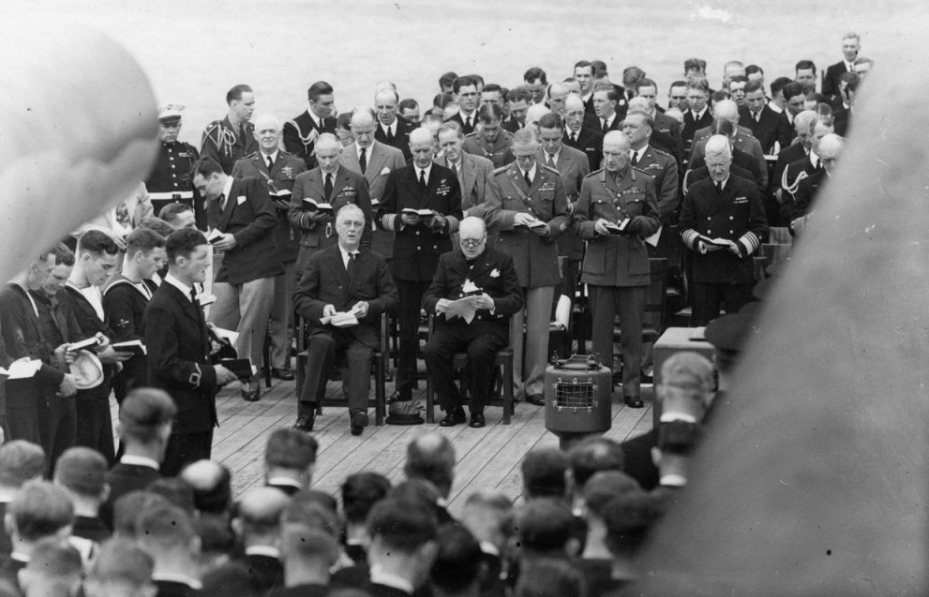
FDR and Churchill sing during Sunday services beneath the 14-inch guns of Prince of Wales, August 1941. The two drafted the Atlantic Charter on the great ship—later sunk by Japanese torpedo bombers off the coast of Malaya.
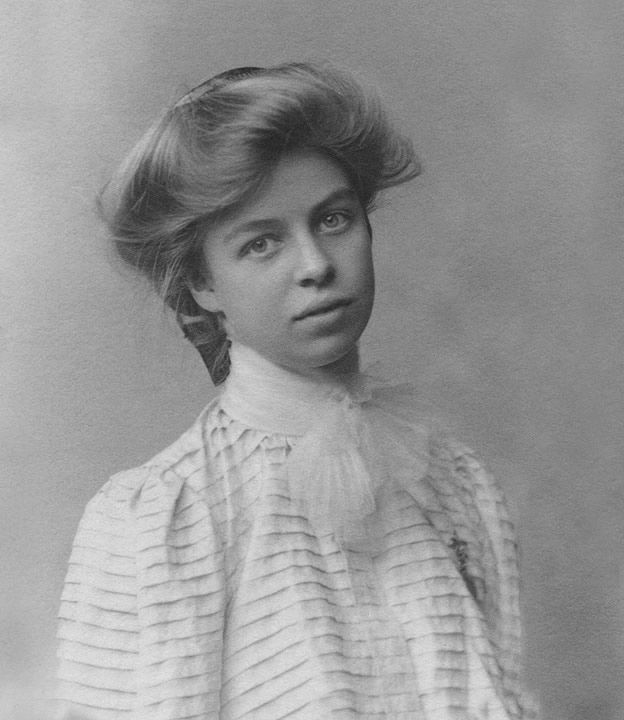
Despite the appeal of wartime drama, I’m thinking less of FDR and more of the First Lady today.
Her life was marked by sadness of immense breadth and depth; denigrated as a child—her nickname was “Granny”— devoted to a father who adored her, but who died an alcoholic, as did her younger brother, Hall. Her marriage was a love match that would come under constant and determined assault by her tyrannical mother-in-law, Sara Delano Roosevelt, because of course Eleanor was not good enough for her darling boy. The darling boy betrayed Eleanor in his love affair with her social secretary, Lucy Mercer.
(The president continued to welcome visits by Lucy, then a married woman, years after their affair had ostensibly ended, which came when Eleanor found Franklin’s cache of love letters. Now, when Eleanor was out of Washington, FDR would invite Lucy Mercer Rutherfurd to quiet dinners at the White House.)
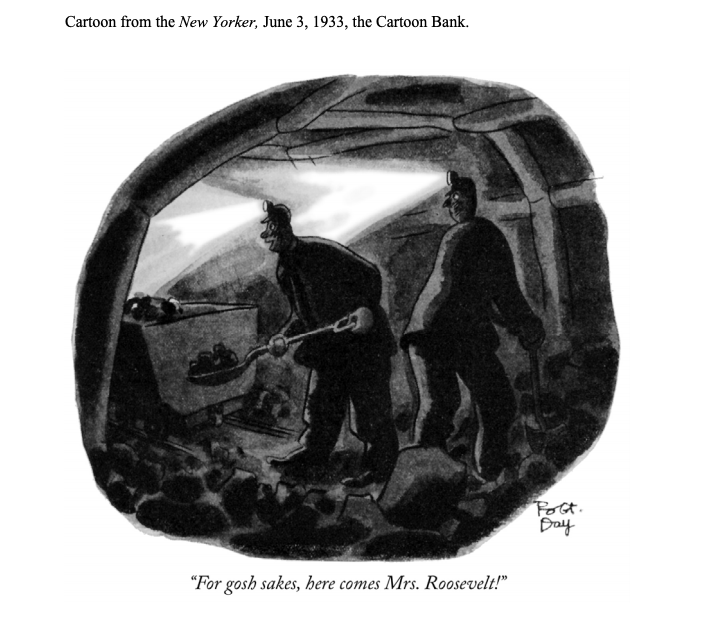
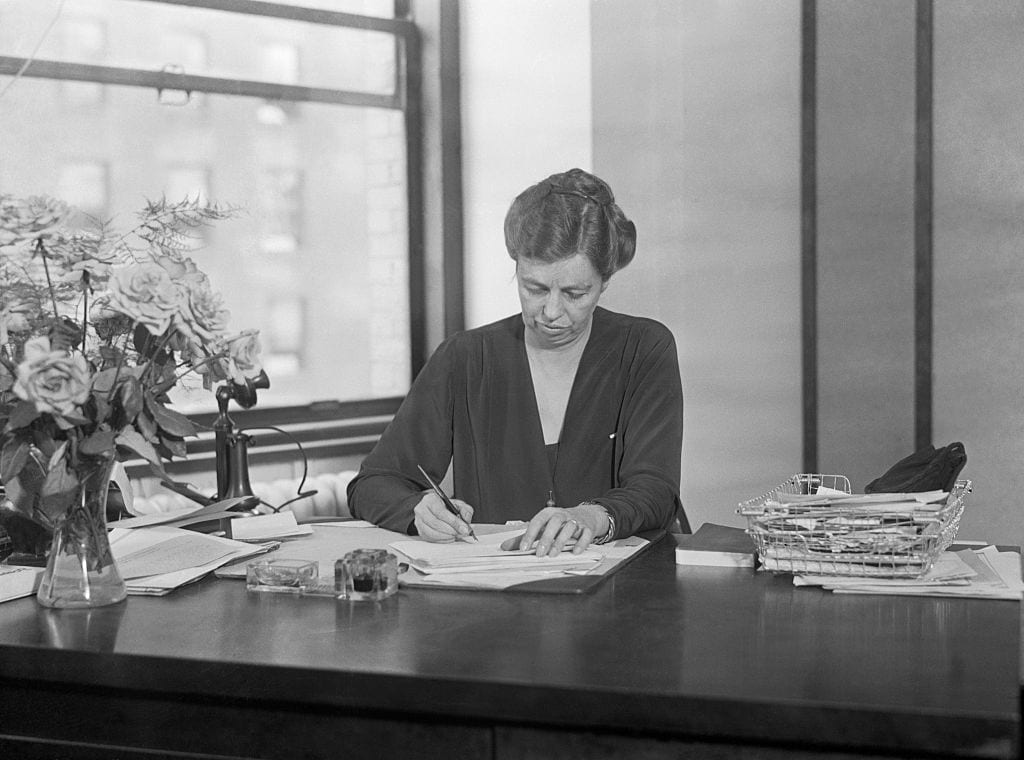
Eleanor was both intensely private—building her own residence at Hyde Park—and yet she was also the administration’s public face. The telecast reminded of this prescient New Yorker cartoon, from 1933.
“Prescient,” because this photo was taken two years later. She is, quite obviously, enjoying herself.
Despite an innate shyness, she worked tirelessly to support the New Deal and then the war effort. She had her own radio program. Americans heard her voice on the night of the Pearl Harbor attack; the president wouldn’t speak until he asked for a declaration of war the next day.
And hers was not a pleasant voice. Like her husband, she had patrician accents, but her delivery was sing-song and she hit unintentional and incongruous high notes that were almost painful to hear. But when the 1940 convention balked at nominating the liberal agriculture secretary Henry Wallace for vice president, the president asked Eleanor to speak—the first time a First Lady addressed a convention. Her speech was brief and as usual a little awkward, but the impact she had was so powerful that Wallace was nominated by acclamation.
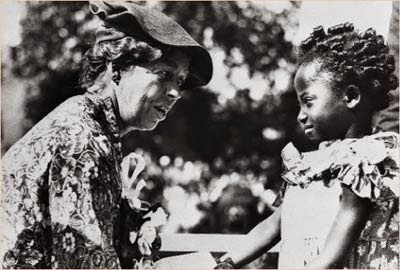
The documentary, too, addressed her humanity, her determination, for example, that black defense workers be treated with dignity and some semblance of parity, as well as her hatred of segregation. The old films revealed something else: This patrician felt at home with black Americans.
There was a stubborn and courageous innocence about her, too. She could simply not understand the deliberate cruelty that motivated Jim Crow and she could not tolerate the pain it inflicted, in a representative democracy, on millions of her fellow citizens. Beyond that, segregation was an assault on humanity. Asserting our common humanity would be the underpinning for all the missions she undertook in her long life. It would be, as well, one of he fundamental values my parents instilled in me.
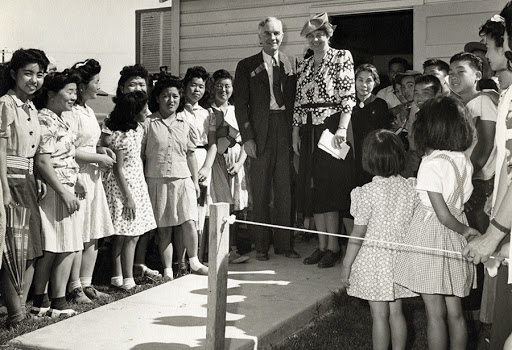
This belief in our common humanity is why she so passionately attacked Executive Order 9066. Franklin finally had to stop her: He was never to hear about Japanese-Americans from Eleanor again. Never. This didn’t stop her from another moment of symbolism: a semi-clandestine visit to the Gila River internment camp, where many of our Arroyo Grande neighbors were confined behind barbed wire, in the spring of 1943.
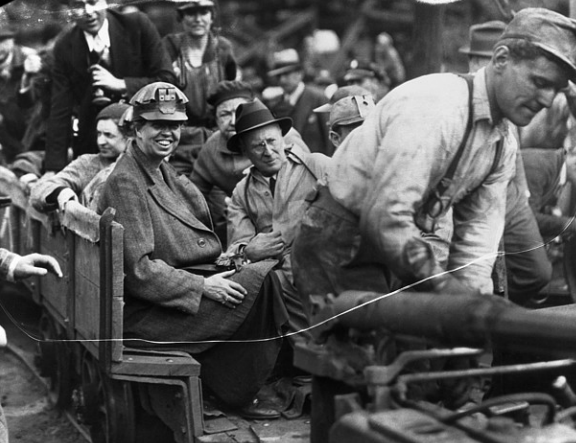
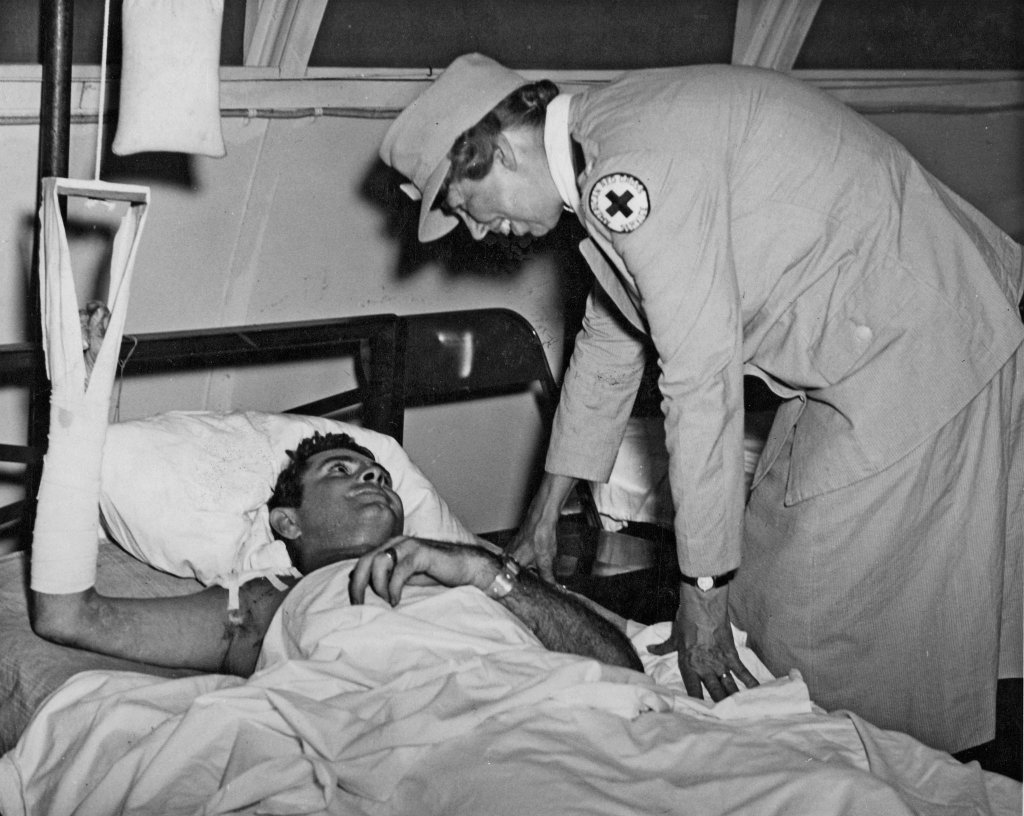
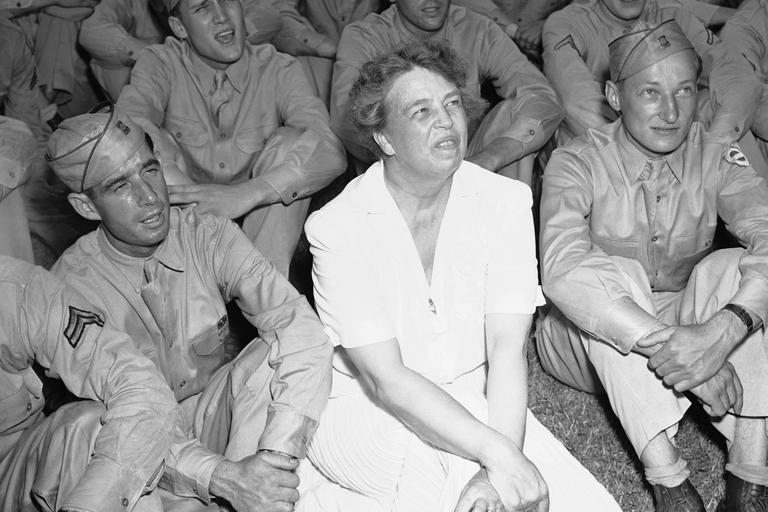
There is something in this photo of the visit, in the faces of the young women, that suggests her unspoken message. She was among Americans here, and happy, given the bleakness of the camp, to be among them—just as she had been in the CCC camps, in visiting WPA projects or riding in a coal car with Ohio miners.
And then, of course, she became a kind of surrogate mother. This is the Eleanor Roosevelt, with her surrogate sons, that endures the most to me.
Even as the war was winding down, in the wakening realization of what would soon be Franklin’s greatest victory, the president betrayed her. Lucy Rutherfurd was an arm-length away from the president when a cerebral hemorrhage killed him as he did paperwork at a card table, posing for a portrait, at Warm Springs, Georgia, in April 1945. The First Lady took the train down from Washington to begin the final arrangements. After she’d arrived, it was her daughter, Anna, broke the news about Lucy.
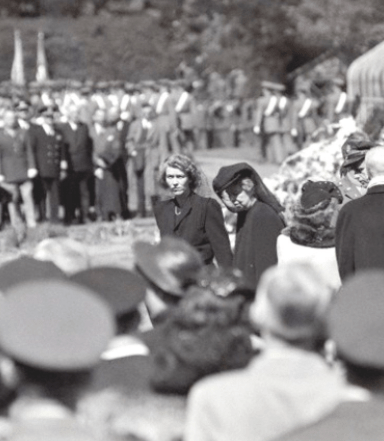
Mrs. Roosevelt and Anna at the president’s funeral, Hyde Park, New York.
Franklin, the documentary pointed out, frequently and effusively praised Eleanor for her energy, her political acumen, and for the intelligence she brought him from her visits to New Deal projects or to military bases. She was, he told his friends and advisors, remarkable. He never said these things to Eleanor.
That secret was, to me, nearly as profound a betrayal as the president’s relationship with Lucy. Eleanor, like most of us, longed for affirmation, but she would not beg for it.
She deserved to know—most especially from the man so central to her life— how truly remarkable she was.
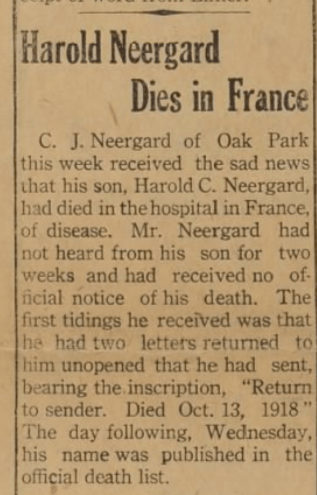
This was how Mr. Neergaard—his name misspelled— of Arroyo Grande learned of his son’s death in France. It’s hard to imagine getting news in so cruel a manner.
But this, of course, had been a cruel war on an epic scale. What ended it was crueler still.
One of the climactic battles of the First World War came at the end of September, 1918, two weeks before the flu took thirty-year-old Harold, on the St. Quentin Canal.
Part of the battle involved Americans, who came into the war so badly equipped (it was the mirror reversal of World War II, when we were the “Arsenal of Democracy”) that our fliers flew obsolete French Nieuports, the Marines at Belleau Wood were casually smoking cigarettes, bewildered German soldiers noted, as they advanced while firing French Chaucat light machine guns from the hip. The heavy machine gun we used was the British Maxim Gun and doughboys were driven into the Meuse-Argonne aboard Renault trucks driven by young men from what would someday be called Vietnam.
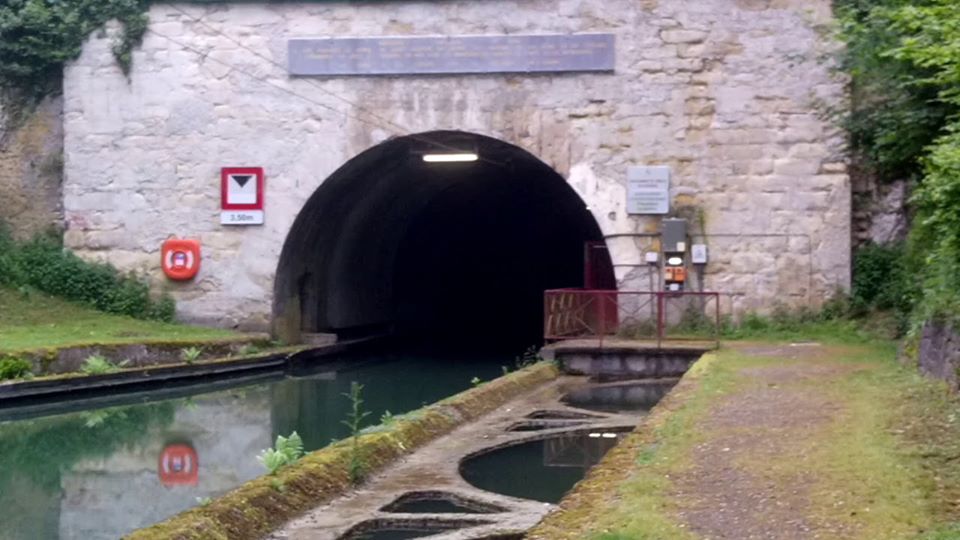
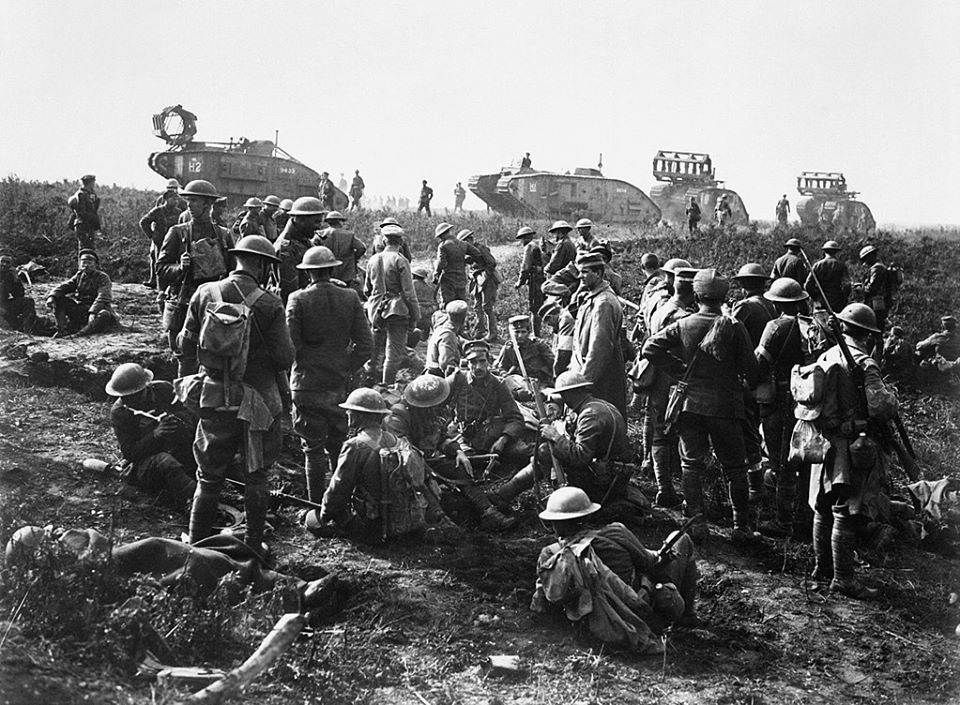
At the canal, the American 30th Division, shown in the photo with German POWs (the tanks are British), went into the Bellocourt Tunnel, shown below, and met the Germans in hand-to-hand combat.
The 30th Division prevailed in ways beyond the ferocity with which they fought. At least one historian has suggested that in the confines of the tunnel and in the closeness of the combat, the Americans brought the flu with them, too, and this was a new, far more virulent strain than the one that had struck the combatants earlier that year, in the spring.
The war ended six weeks later in part from sheer mutual exhaustion. The two sides were too sick to fight anymore.
The flu even played a role in the unsatisfactory peace that followed–the one that led to another, more terrible war–in part because the American delegate, Woodrow Wilson, became ill, with a temperature of 103 degrees, with what was quite possibly the flu
(This was 1919, but the flu came back to Arroyo Grande, too, in 1919 and again in February 1920.)
When Wilson recovered, some said, he wasn’t the same man he’d been. (His presidency would be shattered soon after by the stroke that incapacitated him.)
So it would be the vengeful French leader, Georges Clemenceau, who would dominate the peace settlement at Versailles. Which, of course, was not a peace at all. Even the attacks on 9/11 can be traced back to the terrible Versailles Treaty.
I imagine this pandemic might have powerful effects, many now unseen, that will play out decades away from us.
This was all provoked by Marlo Thomas and a St. Jude’s Hospital commercial. They always leave me little weepy. I immediately turn the channel, too, whenever they show the ASPCA abandoned dogs commercials. I’m just a wimp.
Anyway…
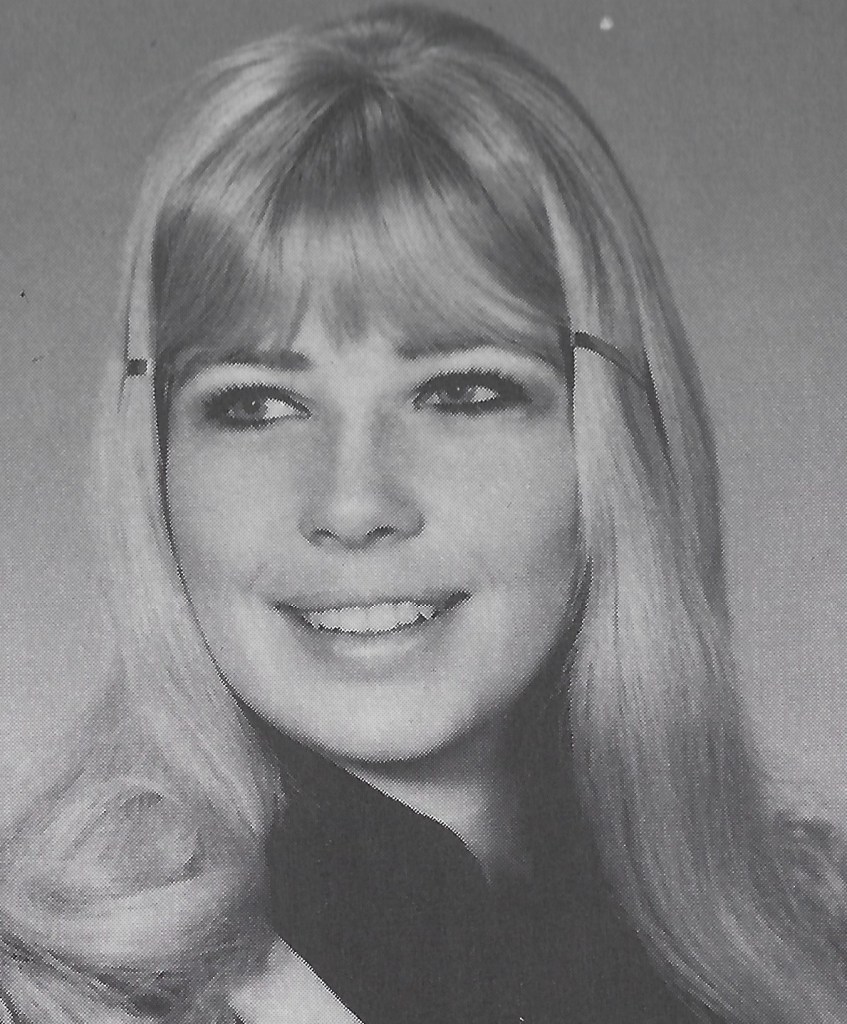
Jeri.
My woeful performance on the “Ten Famous People You Have Met and One You Haven’t” Facebook survey– my famous people were pretty anemic, including G.D. Spradlin, the actor who sent Martin Sheen Up the River in Apocalypse Now and the guy whom singer Trini Lopez portrayed in The Dirty Dozen. (“Lemon tree, verrry pret-ty…” Trini Lopez sang. The G.I. he portrayed blew stuff up.)
I remembered that Jeri was my date for the 1969 Arroyo Grande High School Winter Formal. She was very bright and had a refreshingly sardonic sense of humor that was about 23 years older than the rest of us. Jeri and I were just friends, with no romantic inclinations, except for the ones I felt for her car.
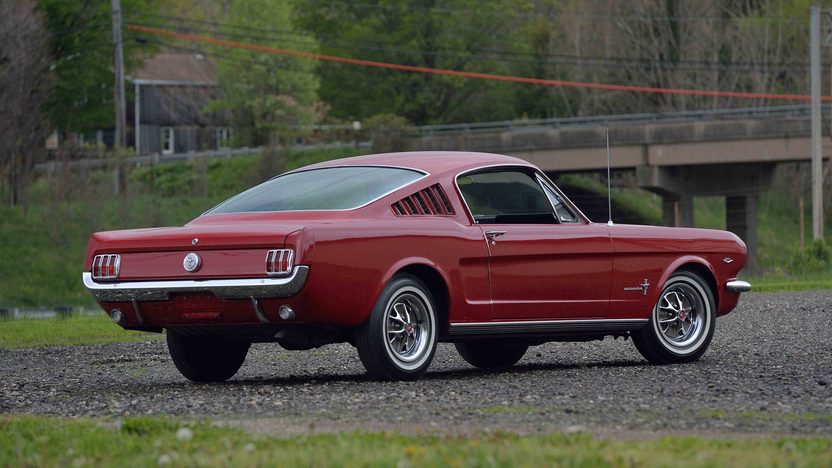
She drove a 1966 Mustang 2 +2 Fastback, with a classic short-block 289 V-8 under the hood. Sigh!
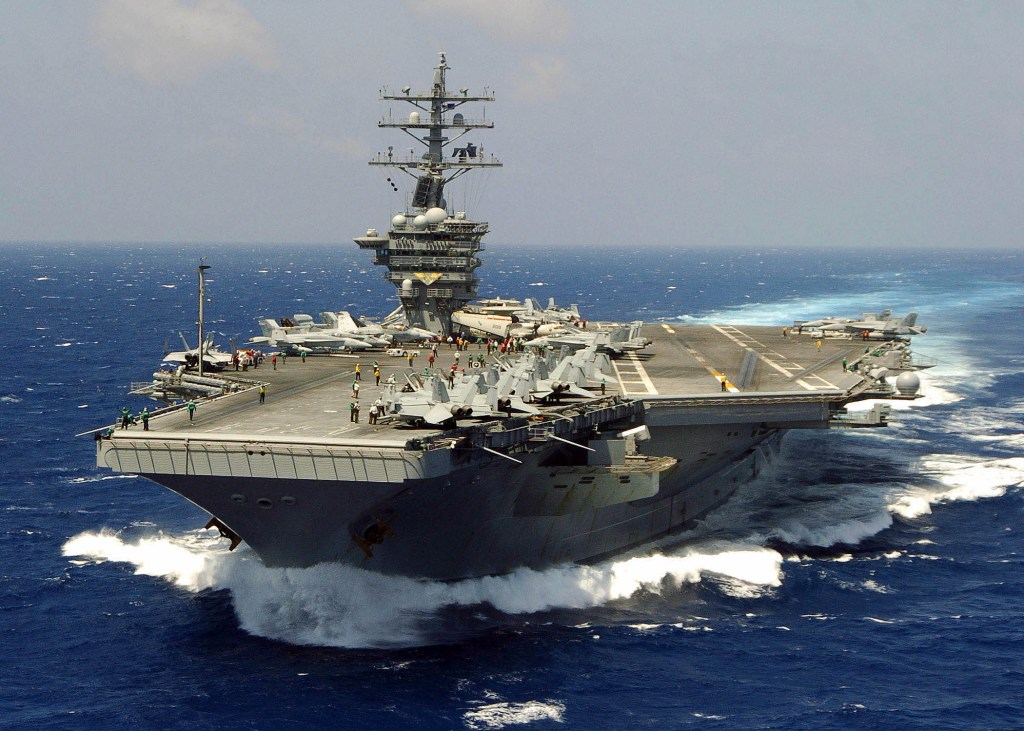
Alas, we went to the Madonna Inn for dinner in my father’s 1965 Chrysler, which, for those of you not up on your Chryslers, was roughly the size of the carrier USS Eisenhower.
Jeri and I on our way to the Madonna Inn.
No, Jeri was not a Famous People. We’ll get to that right after we order.
Yes, baked potatoes with sour cream, please.
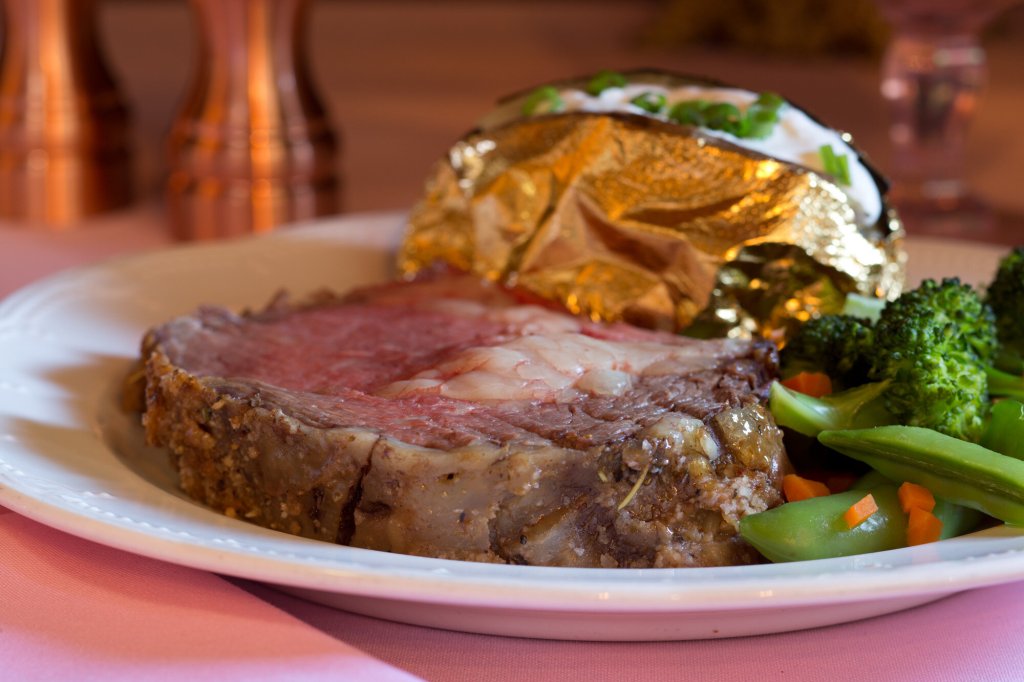
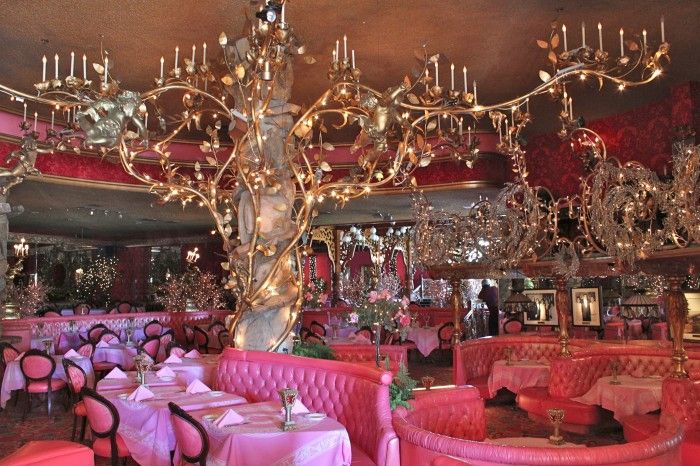
As we were beginning dinner (TWO prime rib dinners, $13.74. I kept the receipt), Jeri punched me in the arm. It wasn’t something wrong with the prime rib. It was DANNY THOMAS, sitting in a booth thirty feet away with Mrs. Madonna, and Jeri wanted his autograph. If Danny Thomas wasn’t exactly a celebrity on the scale of all four Cartwrights AND Marshal Dillon in the Madonna Inn Liberace Room on horseback, he was close enough for two kids from Arroyo Grande, California, USA.
The Madonna Inn–as always, casual and understated.
Now, I worked with Jeri on the school newspaper, and she’d punched me in the arm before. She could leave a bruise if you’d deserved it.
So, after about the third punch, I went over to the booth, introduced myself, blushing profusely and speaking in what must have sounded like Urdu (I knew Mrs. Madonna slightly; my Dad worked for Madonna Construction) and Mr. Danny Thomas provided the autograph.
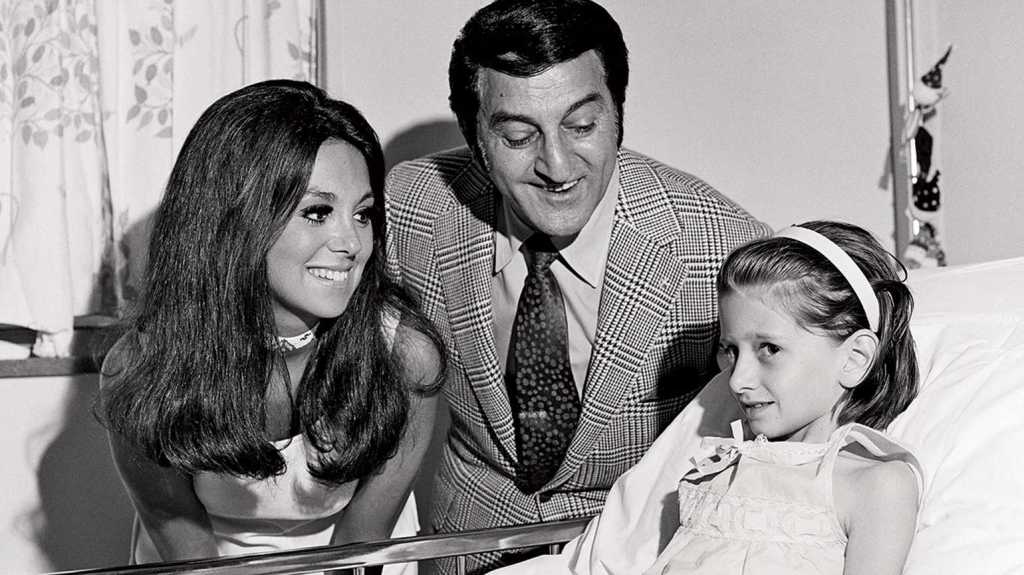
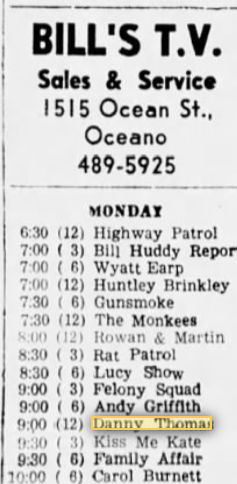
Danny Thomas and his lovely daughter, Marlo, at St. Jude’s, the incredible hospital Mr. Thomas founded. (Below) Mr. Thomas’s sitcom was at one point on opposite The Andy Griffith Show, which was awkward, because Thomas was Griffith’s executive producer.
That is not really the point of the story, but I have misplaced the point somewhere.








 A Work in Progress