The Great Northern Railway and Great Uncle Willie

From a kind of round-robin email to family:

Hello, all!

The SLO Railroad Museum just emailed me to let me know of the upcoming funeral of a local man, 93, who was one of the last steam engine engineers. (Elizabeth and I took a ride on one to the Isle of Skye, and it was just like a Harry Potter movie.)

That set me a-pondering. Wasn’t there an ancestor who was a train engineer?

Yup. Our Great Uncle William “Willie” Keefe, born in the Pennsylvania oilfields to Thomas and Margaret Keefe. He was #1 in the batch of ten that would include our grandfather, at #9.

I found his photo, not a good one:

Screen Shot 2019-10-28 at 2.44.10 PM.png

And I discovered that he was an engineer on the Great Northern Railway, whose route(s) ran thusly (it went out of business about 1970):

GNMap1.jpg

So there’s a chance some of Elizabeth’s Washington ancestors might’ve been passengers on Great Uncle Willie’s train.

There was no date of death for him on ancestry.com, so I did some hunting. After about 25 minutes, from the Minneapolis Star-Tribune:*

Screen Shot 2019-10-28 at 3.23.42 PM.png

So, sadly, he died on the job. He died on Monday, May 10, 1948–only three days before Bruce Keefe Gregory was born.

Then I looked up his train. It wasn’t diesel, not steam, but it was gorgeous.

Great_Northern_Empire_Builder_WP_1024x1024.jpg

*More Minnesota trivia: The 1862 Sioux uprising began in Meeker County, where Thomas and Margaret would later homestead and where most of the bunch o’ Keefes were born. I bring that up because John Rice, an Arroyo Grande settler whose house still stands in an old, old part of AG [photo below], was part of a regiment charged with ensuring order and witnessing the execution of 38 Sioux warriors in Mankato, Minnesota in December 1862.

Screen Shot 2019-10-28 at 3.45.20 PM.png

So it goes.  That is today’s report from The History Desk.

Screen Shot 2019-10-28 at 3.56.15 PM.png

Great Uncle Willie’s home in Minneapolis–the little fellow with the  yellow door.

Losing the B-17 Nine O Nine

920x920

Nine O Nine

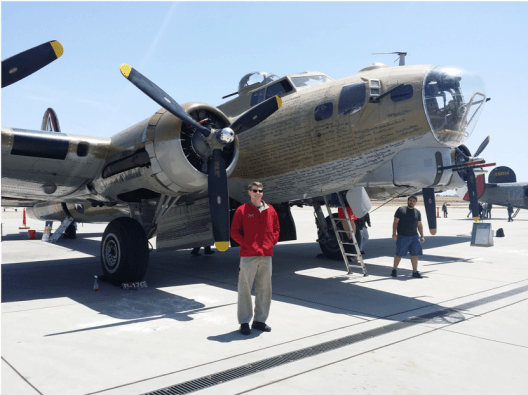
There was a tragic accident in Connecticut this morning when a vintage B-17G, “Nine O Nine,” crashed. The plane was a frequent visitor to our area, to San Luis Obispo County. My son and I saw this beautiful airplane, restored to resemble the 1943 original, which flew 140 combat missions with the 91st Bomb Group without a fatality. The chief of the B-17’s ground crew won a Bronze Star because his airplane flew 126 consecutive missions without aborting for a mechanical failure.

That streak ran out this morning, when this ship, built in 1944, lost an engine and went down just short of the runway.

Picture1

My son John with Nine O Nine, San Luis Obispo, 2012.

I wrote a book about aviators from my area— San Luis Obispo and northern Santa Barbara Counties.

I learned that a bomber squadron was usually made up of twenty B-17s like “Nine O Nine.” On maximum effort days—in the spring of 1944—there would be eight hundred to a thousand of these airplanes, both B-17s and B-24s, going into the air in shifts all over East Anglia. They would rattle dishes and wedding crystal in the modest homes below as they assembled and headed east.

Typically, B-17 pilots were twenty-two years old. Gunners were teenagers. There were liars among them as young as fifteen. San Luis Obispo County lost eighteen of these young fliers during World War II, both in combat and in horrific training accidents from Texas to Montana to South Carolina.

Among the young men who made it overseas, one, from Arroyo Grande, died when his B-17 flew into the side of Mount Skiddaw in England’s Lake District. Another, from Morro Bay, was shattered in his co-pilot’s seat by a cannon round from a Focke-Wulf 190. A San Luis Obispo navigator died when a Messerschmitt 109 collided with his B-17. A Templeton B-24 gunner took off on a mission that was scrubbed because of weather; when his bomber crashed returning to base, his aircrew were the only Eighth Air Force casualties that day.

At least two local men served in “Nine O Nine’s” 91st Bomb Group.

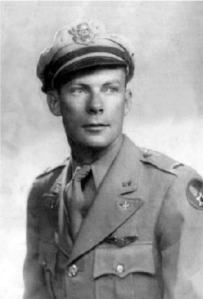
Robert Abbey Dickson’s B-17, “Wheel and Deal,” was brought down by antiaircraft fire over the Ruhr Valley in 1943. Dickson bailed out and when he hit the ground, the first German he met was an angry farmer armed with a vintage World War I Mauser. The young American was rescued by two Luftwaffe soldiers who rode up on a motorcycle and sidecar and fetched him back to their 88-mm gun emplacement. It suddenly occurred to Dickson that this might be the gun that had brought his bomber down.

But it was lunchtime. The first thing Dickson’s captors did was to offer him a bowl of potato soup.

Picture2

91st Bomb Group co-pilot Robert Abbey Dickson retired to Morro Bay.

Henry Hall of Cayucos was a twenty-year-old gunner on “Black Monday,” in March 1944, when Eighth Air Force undertook a “maximum” effort mission, with nearly a thousand heavies sent into the air. At this point in the war, the B-17s and B-24s weren’t just strategic weapons. They were bait, intended to bring up German fighters so state-of-the-art American fighters, like the P-51, could begin to winnow the young Germans down. But the winnowing that Hall saw involved Americans. Hall watched, horrified, as an Me-109’s attack on a nearby B-17 took effect. The plane’s right-wing landing gear dropped lazily. Then it began to go in, and on its way down, it clipped two more B-17s and sent them in, as well. That mission turned out to be fruitless: the target was obscured and Hall’s ship dropped its bombload on a “target of opportunity,” a German village—one, Hall thought, that had done little harm to any Americans— on its way home. It was a terrible day for Hall’s aircrew.

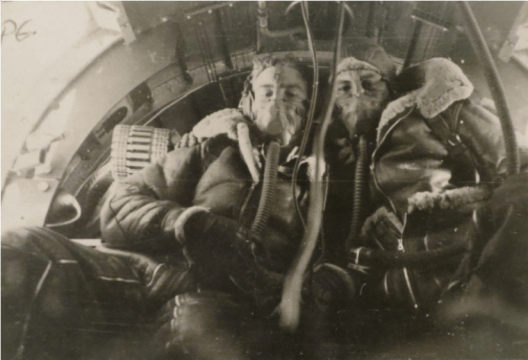
What kept them together, I learned, and kept them flying in unpressurized cabins where hypoxia and frostbite were common, when they endured sudden, terrifying attacks from German fighters so fast that no gunner could track them—those fighters, too, were flown by twenty-two year-olds—and when flak sliced through wings, fuselage, air hoses and human beings, was their devotion to each other.

Picture3

Waist gunners, friends.

You could not let your friends down.

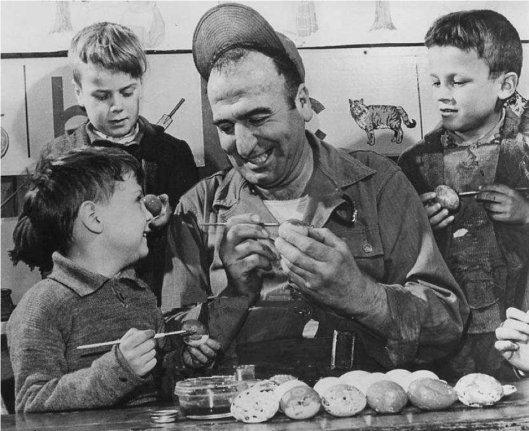
I learned, too, that among their best friends were the British schoolchildren who lined airfield fences along the tarmac at the start of every mission.

They were there to wave goodbye to their Americans, who were loud and boisterous, friendly and incredibly generous, with endless supplies of Hershey bars, because these young men had grown up in the Depression, and they knew what the British children, after their six years of war, knew. They knew what deprivation was like.

So those children were there for their Yanks.

Picture4

The 96th Bomb Group’s Sgt. George Crist of San Diego colors Easter Eggs with British children, 1945.

Meditation on a silver Corvette


ext_GAN_deg04Usually when I’m under the Brisco Road underpass, I reflect nervously on the 1989 Loma Prieta Earthquake, when part of the Nimitz Freeway pancaked. Or, as you wish, tortilla’d.

[We felt that quake in Los Osos. I was feeding John in his high chair and noticed, suddenly, that I had to move the spoon to track his mouth, because he was swaying. I snatched him up and dragged him, mostly but not completely out of the high chair, into the safety of the hallway. John was unfazed. The boy likes to eat.]

Thank goodness, I did not think about the earthquake today. What I thought about instead was the vision just beyond my windshield.

It was a silver 2019 Corvette that looked just like the one above.  It was beautiful and it sounded glorious, too. The engine purred and then, when the driver accelerated, it growled.

There was a time in my very young life when I wanted to grow up to be a 1963 Corvette Stingray.


tumblr_po9clcycxw1ttxfeno1_400


The Corvette I saw today looked so futuristic I would not have been at all surprised to see George or Jane Jetson behind the wheel.

Amber Derbidge and I once took kids to Europe and one of our stops was in Monaco, where the biggest yacht in the basin was owned by a man in Ladies’ Underwear. That was his business, to clarify. Then we passed one of the biggest Ferrari dealerships in Europe, but there were so many Ferraris on display that they were kind of dull, like Ford Escorts in the Mullahey lot.

But if you see one good thing, say, Princess Grace’s grave, which was strewn with rose petals, or a shooting star Elizabeth and I once saw in an empty sky over Utah—or a silver Corvette you weren’t at all prepared to see—that’s a singular beauty. Oh, and as much as I love sports cars, there’s no beauty like Grace Kelly’s. None.


gettyimages-75876421

When a place gets under your skin

I grew up in Arroyo Grande, California, but we didn’t get here–we relocated from a tough oil town, Taft–until 1955, and not 1953, as I’d earlier thought. I always felt a little ashamed since I grew up with friends whose families had been here since the 1840s or the 1880s. Some of my best friends have been, and are, and always will be, Japanese-Americans, and their families came here fifty years before mine did.

So when I write about the history of this town, going on five books now, I sometimes feel like an impostor, a poser. But, as I’ve written in one of those books, when we moved out to Huasna Road, east of town, in 1957, I recognized instantly, as a five-year-old, that this was Home.

And since most of my childhood was spent in delightful anarchy, in creekbeds and foothills and sometimes in and around abandoned houses, some of them adobe and some of them haunted, I discovered that I was an incurable explorer. So if not quite a native and nowhere near a Founding Family, I was, at least, a learner, and in learning the Arroyo Grande Valley I became entranced. It’s a love affair that began when I was five, and and here we are sixty-two years later.

This place gets under your skin. After many, many years away—twenty-six—I was so happy to come home again in 1996 and, best of all, to come home to teach young people. My parents are buried here, my schools still stand here and so do my memories. My friends, both living and dead, are never quite so much alive as they are in my imagination.

I am a lucky man to love a place so much.

I am thinking through a presentation to local students about the town’s history, and I tend to think vividly and visually in storyboards, so PowerPoint, as my high-school students would confirm, is the way I think history through.

So this is a very selective and in-the-rough history of Branch Street, Arroyo Grande, California, in my home town.

Branch Street

President, Spider.


Screen Shot 2019-08-26 at 6.28.42 PM


Our president*.

I’ve never heard such gobbledygook as the answer he gave on the last question at today’s presser—it was the last question because he didn’t want to answer it and abruptly walked off as soon as he hadn’t—on global climate change.

He talked about American energy production instead–about fossil energy–and he talked about his dedication to the wealth it generates (wealth that will never reach the 98% of Americans who will pay for it instead) and then he had the audacity to call himself an “environmentalist.”

Gobsmacked as they must have been, the reporters’ gaggle couldn’t break the White House press corps honor code: Honor requires that they treat him with the respect due a leader.

And then you realize, as the passengers did on Flight 97, that this leader’s seized the flight controls and is determined to take all of you down with him. So you wake from your shock, find your courage, and rush the cockpit.

It’s too late.

The president is–even beyond Laurence Harvey’s Manchurian Candidate or Bill Haydon’s MI6 mole in the John LeCarre novels–the perfect traitor. He has no conscience. He has no principles. He has no empathy. He has no loyalty, except to himself and to his spymaster–LeCarre called Haydon’s “Karla.”

So if it means making profit for himself, he will take all of us down with him. We will die betrayed. He will die a rich man—for once. He will die. What he leaves behind means nothing to him.

Even knowing the wreckage he’ll leave, I pray daily for a massive stroke that will drop him in the early morning before his hair is gathered into its ludicrous combover—when he still looks like Gollum—when he’s on the toilet with his tiny thumbs in mid-Twitter.

I would never do harm to another human, but I’ve never, in my life, prayed for another human to die. This is a first.

There have been so many deaths—so many lives—that have made  a better difference.

I’ve seen the grave of a young Marine from Arroyo Grande who died on Iwo Jima three days before he turned twenty-one.

I’ve seen the grave of a local farmworker, killed in Normandy, at the American Cemetery at Colleville-sur-Mer, above Omaha Beach.

I’ve seen the grave of a schoolteacher who gave over forty years of her life to local children and loved them in every moment of the giving.

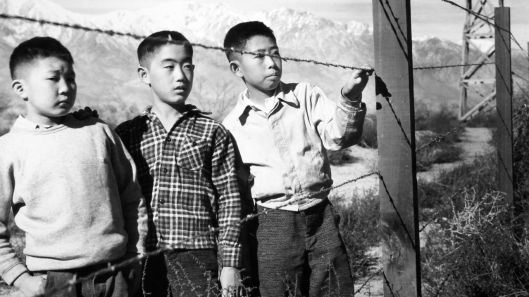
I’ve seen the grave of an immigrant, a World War II internee, who grandmothered a dozen children–Sansei, third generation Japanese-Americans—who were among my best friends in high school She taught them to live lives without bitterness.

These are my heroes. Naive as it may be, Frank Capra’s James Stewart, in Mr. Smith Goes to Washington, is my hero. Barbara Jordan of the House Judiciary Committee in 1974 is my hero. Jane Goodall, who taught me, from my first reading years, so much about the value of all life, is my hero.

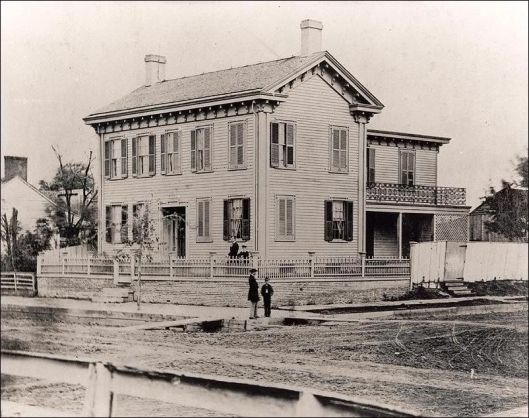
Abraham Lincoln is my hero, and so it’s the ultimate obscenity, to me, that this man lives in the same home where Lincoln once lived.

Nothing will erase—not even the absence of Donald Trump—the hatred that empowers him so. It’s been with us since the nation’s beginning. It cost Lincoln 620,000 lives to crush it, and even that terrible resolution turned out to be transitory.

But defeating Trump might scatter that hatred again into the dark corners where it belongs.

If there is a closet in Lincoln’s Springfield home—the one that pre-dates his White House— with a spider-web spun in its corner, then the spider in its center would be the closest Trump could ever hope to come to the sixteenth president’s legacy.

It would mean nothing for a Lincoln curator to find the the web and obliterate it with the stiff bristles of a broom.

Maybe then we could hope to become clean again.

But it’s entirely possible that the aftermath of the cleansing may be nearly as painful as the war that caused Lincoln so much despair. It may take as may generations as have passed since the great man, our most lucid and our most faithful president, left Springfield in the late winter of 1861.

Or it may be that we will never be clean again.

abb892ef94d791d01e339384c36b6dd1

Lincoln, just behind the fence in Springfield, 1860, with is son Willie–his best beloved, who would die of typhoid fever in the White House in 1862.

Shoah. Again.

https://drive.google.com/open?id=17RhbYpC6RRzouV2PKMd2LZpN09bK57P_

I’ve been retired five years. You would think I wouldn’t have to teach this lesson every year then and every year since.

But it needs to be taught because it obviously hasn’t registered in some dark places.

Using a word like “disloyal” is so pernicious. Captain Alfred Dreyfus, sentenced to Devil’s Island after a court-martial that brought France to the brink of civil war, was accused of disloyalty.

Statelessness would be one of the canards that would be used to excuse the persecution and attempted extermination of European Jewry.  The flip side of that canard is the suggestion that somehow being an American Jew—in other words, an American—requires loyalty to Netanyahu’s Israel, to his particular brand of chauvinism, which has such ironic precursors.

“Jews will not replace us,” the crowd, made up of fine people, chanted in Charlottesville.  Students in an Orange County’s Pacifica High School were recorded, in a video released earlier this week ,giving the Nazi salute.

I don’t understand the kind of stupidity that embraces deliberate forgetting. I never will.

The law, in its majestic equality

h2-mississippi-ice-raid-poultry-plant-immigration-arrests-kock-foods

Th’ abuse of greatness is when it disjoins remorse from power.
Julius Caesar II.i.18-19

I’ve been reading extensively about laws and legality on Facebook lately. Most of what I’ve read would be funny but the people who write these things take themselves so seriously. Their insistence on obedience to the law, at the expense of compassion and logic, isn’t funny. It’s heartless. And it’s terrifying.

So for all of you legal eagles out there, especially those who specialize in illegal immigration, here are things in the past that have been scrupulously legal:

–The Sanhedrin turning Christ over to the Romans for crucifixion. But Christ had committed sedition, once with such delicacy, by saying “render unto Caesar what is Caesar’s,” not a comment on obeying civil law, but a subtle and very sharp dig at the illegitimacy of Roman coinage, frequently debased, and so at Roman authority.

–The Fourth Lateran Council, 1215, required European Jews to wear badges—Stars of David, a precursor to the laws of Nazi-occupied Europe. You can still see bolts of cloth with Stars of David ready for the cutting in the Jewish Museum in Amsterdam.

–A series of laws enacted by the Scottish Parliament in the 1500s and early 1600s that mandated the death sentence for convicted witches. Witchcraft convictions, in duly-constituted civil courts, were particularly common in Scotland and Reformation Germany, where the overwhelming majority of victims were women, immediately suspect in a time of great social and political change.

–The Indian Removal Act of 1830, when gold was found on Cherokee land, was perfectly legal. Until John Marshall’s Supreme Court struck it down. The removal was nonetheless enforced by Andrew Jackson, the present president’s hero, who reportedly said: “Marshall has made his decision. Now let him try to enforce it.”

–Slave codes forbade the legal recognition of slave marriages, making it convenient for slaveholders in the Upper South to break up families for sale to the harsh conditions of places like Louisiana or the Mississippi Delta. One Virginia mother, to be sold South away from her children, defied the law by chopping off her foot with a hatchet to queer the deal.

–The legal justification for the Mexican War was that American soldiers had been killed on American soil. One young Congressman who disputed this was savaged for his lack of patriotism when he urged a series of resolutions, the “Spot Resolutions,” which demanded the government reveal the exact spot—more than likely on disputed territory along the Nueces River—where, more than likely, the war that gave us one-third of Mexico had begun illegally.

The Congressman was Abraham Lincoln.

–The Fugitive Slave Act, part of the Compromise of 1850, required northerners to return runaways to their masters. Thousands of white people flagrantly and shamelessly broke this law.

–In 1872, sixteen women were arrested for breaking the law. They attempted to vote.

–In the South before the civil rights movement, it was illegal for a black driver to pass a white driver on the road. No matter who arrived at an intersection first, the black driver had to yield the right of way to the white driver.

–In 1930-32, the Hoover Administration and local law enforcement officers, including the LAPD, “repatriated” 1.6 million Mexicans rounded up in raids throughout the Southwest. 60% of them were U.S. citizens. Four years later, the LAPD also appeared at the Arizona border to turn away more U.S. citizens, refugees from the Dust Bowl.

–Executive Order 9066, which led to the imprisonment of West Coast Japanese-Americans, was, according to Franklin Roosevelt, completely lawful, despite the objections of two powerful Americans: FDR’s attorney general, Francis Biddle, and the First Lady, Eleanor Roosevelt. By the way, it had been long illegal for Issei, first-generation Japanese immigrants, to become citizens because they were not white people. This was based on law, on the Naturalization Act of 1790.
 

9002

My ancestors came here legally.

That’s because there was no way for them to come here otherwise. They weren’t Chinese, they weren’t Filipinas, they weren’t Guatemalans.

They were from England, Ireland and Germany, so they broke no laws, most importantly the Naturalization Act of 1790. By happy accident, they were white people. That gave them substantial claim to legality and far more comfortable train seats.

Would I come here legally if I lived in a place like Guatemala, where my kids’ lives were threatened by street gangs or by government-sponsored death squads? The latter, by the way, have been a longtime South of the Border custom born, bred, trained and armed by the School of the Americas at Fort Benning, Georgia.

You bet I would. And that’s what thousands of “illegals” have tried to do: To present themselves, under international refugee law–laws drafted in the wake of the ill-fated ship St. Louis and the logical outcome of that debacle, lives swept up in chimneys in places like Auschwitz–at American ports of entry. Most of them, ultimately, would have been denied entry by immigration courts. That doesn’t matter. They’ve been turned away from the immigration courts and they’re sweltering in Mexico today. Those are the lucky ones. The others are in Immigration and Naturalization lockup.

Would I come here illegally if I lived in a place like Guatemala, where my kids’ lives were threatened by street gangs or government-sponsored death squads?

You bet I would.

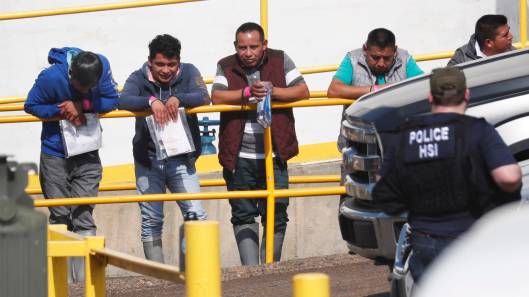
Would I come here to work illegally slaughtering chickens in the fetid Mississippi heat if it meant my kids had a chance at a college education? Or at surviving to adulthood? Would I be willing to work and live here if it meant paying American taxes and obeying every American law,  except for the one that forbids me from being a better father? Would I try to be someone as devoted to his children as that slave mother had been to hers?

You bet I would.

Whose job am I taking?  There are now too many jobs and not enough white Americans to fill them. I’ll take one of those. As an immigrant, who am I hurting?

No one.

Who am I helping?

This one. Her father loves her more than life itself. She knows that. She feels, at this moment of missing him, a fear so powerful that we can only pray that we will never feel anything like it.

maxresdefault


None of this matters, the legal eagles cackle—the law being such a splendid shield to conceal moral cowardice.

The law has been used so skillfully to that end from characters as disparate as Henry VIII, who used the headsman to rid himself of embarrassments like Thomas More, and Henry Clay Frick, who used instant deputies, Pinkertons, to shoot down the steel strikers at Homestead.

What if it’s the law—and those who insist on its application, their power disjoined from remorse—who are evil?

So what would you do in the chicken-slaughterer’s place, a man who, more than likely, did come here legally but who’s overstayed his visa?

That reminds me. My car payment is overdue.


46ca6570-d736-4c39-b5b6-81eec3ee328e-AP19219654744333


Not exactly “Nanny Dogs,” but…

Bear with me on this one. In AP European History, one phenomenon we studied was the mid-Victorian custom in middle-class homes of photographing dead children. What we got around to learning was that this macabre (to us) practice was actually a by-product of the Agricultural Revolution. Largely because of improved diet, more and more children were surviving to adulthood. In the 18th century and on the American frontier, both Mrs. J.S. Bach and Mrs. William G. Dana lost half of the twenty or more children they gave birth to.

Because of improved diet and improved health, by the mid 1800s children were surviving, even thriving. This meant that parental bonds between parent and child were growing stronger: you could afford to invest your love in something as precious as a child because you weren’t going to lose her. In fact, this is when the forerunners of the Dr. Spock books appeared and were almost guaranteed to be best-sellers.

So the photography of little boys and girls who had died was visible evidence of something very poignant: By the 1850s, parents loved their children so much that they didn’t want to let them go.

Which brings me to pit bulls.

While they weren’t exactly “Nanny Dogs”—it’s never wise to leave a child alone with any dog for too long—pits were the single most popular family dog in late Victorian and Edwardian England. Since parental bonds were by then far closer and more enduring, my guess is that you wouldn’t leave your child alone–or photograph her, for that matter–with a dog that’s considered vicious. I did read a study that claimed that, after Goldens, pits were the most patient breed who would endure the most pokes from children. And we did have a pit cross, Honey, who was one of the sweetest dogs we’ve ever owned. But she’s anecdotal.

Still, it again makes me wonder if the problem is less with dogs and more with humans. There are strains of the pit that have been bred to fight; the “toughening” of dogs like these, and the former quarterback Michael Vick is an example, involves inflicting pain on them. I’ve known people innocently walking their dogs who were attacked by a pit, and it’s a singularly terrifying experience. They are trying to kill your dog. Or you. Or both.

It’s not only terrifying, it’s disheartening. Some pits may have a killer instinct, but it’s a trait that’s been bred into a dog, or trained into a dog, by a human who has no heart. (Or, in the recent case involving a Belgian Malinois attacking and killing a local man, a wonderful man, a dog owned by a human who has no brain.)

It’s not my intent to argue for or against the breed here.

What I am trying to say is simply this: These photographs are fascinating.

But they may demonstrate that the traditional views we hold of dogs—or of other human beings—need to be subject to examination and reflection. I’m afraid that we are much more comfortable with tradition. It’s almost as if our prejudices have been bred, or trained, into us.

Remembering San Luis Obispo County Airmen on Memorial Day

9781467139526

The statistics are as somber as Memorial Day itself: for every American infantryman killed in World War II, three were wounded; for every American airman wounded, three were killed.

Twenty-six thousand Marines died in the Pacific; the same number of Eighth Air Force airmen died over Europe.

Other fliers died here. P-38 fighters would have been a common wartime sight over San Luis Obispo County; today’s Santa Maria Airport was an Army Air Forces base that specialized in advanced training of pilots about to head overseas. There were eight fighter crashes near that base in January 1945 alone.

One pilot died when his plane went down in the Oceano dunes. Two fighters collided over Corbett Canyon, but only one pilot survived. Three died—a pilot and two civilians– when another P-38 fell into a Santa Maria café.

Meanwhile, accidents claimed about half the eighteen county airmen killed in World War II. Those deaths seem especially capricious and cruel.

In 1943, Clarence Ballagh, a B-17 co-pilot, was merely hitching a ride north on another bomber for a few days’ leave in Edinburgh. That B-17 flew into the side of an English mountain. Fragments of the plane remain on Mt. Skiddaw today, 5,000 miles away from Ballagh’s Arroyo Grande grave.

Templeton’s Norman Hoover died, ironically, when his bombing mission was scrubbed in January 1945. His B-24 crashed returning to its Yorkshire base. It was the only plane lost that day.

Sgt. Charles Eddy of Templeton died in Idaho. Eddy’s B-24 was on a practice bomb run when it suddenly fell from 20,000 feet. The pilot and co-pilot fought desperately to regain control of the plane. They did, at one hundred feet. When they banked gently to return to base, the bomber plummeted into the ground and exploded.

Three county airmen, combat casualties, remain missing.

In 1943, a German fighter’s cannon round killed Clair Abbott Tyler of Morro Bay in his co-pilot’s seat. His B-17, returning from a mission to Lorient, France, went into the sea and took Tyler’s body with it.

French civilians reported seeing Cholame’s Jack Langston bail out when German anti-aircraft guns set his P-38 afire over Cherbourg in July 1944. His body was never found.

In Germany, near the war’s end, famed San Luis Obispo P-51 pilot Elwyn Righetti was never seen again after he’d crash-landed his crippled fighter and radioed that he was all right.

In a tragic coincidence, Righetti, Tyler and Ballagh all left behind little girls who were just beginning to walk when they lost their fathers.

Details like those are haunting.

Clair Tyler’s mother made wonderful enchiladas and Alex Madonna was the best man at his wedding.

Clarence Ballagh’s wedding band was returned to his wife in 1949. Lost B-17 gunner Donal Laird’s wristwatch was returned to his San Luis Obispo nieces in 2015.

Jack Langston played the saxophone; Lt. Ted Lee, shot down near New Guinea, was a trombonist.

As a little boy, lost B-29 pilot Jack Nilsson had been invited to Patsy Berkemeyer’s sixth birthday. Since Patsy’s parents owned a San Luis Obispo bakery, the cake must have been spectacular.

So is the life of P-47 pilot John Sim Stuart, a retired Cal Poly professor still married to Mary, the girl he met in 1944.

Despite being shot down twice, Los Osos retiree Al Findley, a B-24 radioman, was a joyful man who filled his life with friends. He died, at 96, April 28.

Another retiree, Morro Bay’s Jack Gibson—the father of County Supervisor Bruce Gibson–died in 2016 at 95.

Gibson was a B-29 crewman who got a letter from his mother, a knitter, about socks. Did Jack want argyle, striped, or plain? He wrote back that he didn’t care as long as she was the one who knitted them.

Soon after, the Japanese shot his bomber down. POW Gibson endured beatings, starvation and dysentery, but he survived. When he finally came home, he opened a dresser drawer in his bedroom.

Inside were six new pairs of socks.