Pretty Eleanor, Bank Robber

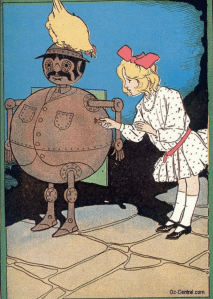
Eleanor Walling was an enchanting little girl—one can easily visualize her in a blouse with a sailor’s collar, with a big bow in her hair, like L. Frank Baum’s Dorothy. She was also a talent and a ticket-office draw for her father, a small-town impresario who owned the Lompoc Opera House, the setting for a 1912 rally for Bull Moose candidate Theodore Roosevelt. On that day, Eleanor enchanted the Lompoc Journal, too. The paper notes that

The program was introduced in a most pleasant manner by little Eleanor Walling, daintily clad and draped in a flag, stepping to the front of the stage and with her little violin leading the orchestra in the Star Spangled Banner in a way that carried the audience away.

20151127_022128
Illustrator John Rea Neill’s Dorothy, with Tik-Tok the mechanical man and Billina the hen, from L. Frank Baum’s 1907 Ozma of Oz

Eleanor was eight years old. Her mother had died young, but either she or J.O., Eleanor’s father, had bequeathed the little girl with extraordinary musical gifts. She was an actress as well as a violinist, appearing in her father’s plays, including The Moonshiner’s Daughter or in the title role in Editha’s Burglar, which “proved a hummer,” according to the Journal. Sometimes she shared the bill with silent films like Tobacco Mania.

Eleanor, born in Oregon, San Luis Obispo, or England, depending on the source, had, by World War I, joined her father and siblings in a new enterprise: the Walling Orchestra entertained at concerts and dances in a roadhouse owned by J.O. near Avila Beach. They were the band of choice when Arroyo Grande got its brand-new electric streetlights. But by 1920 or so, Eleanor had struck out on her own, for the vaudeville circuit, the story went.

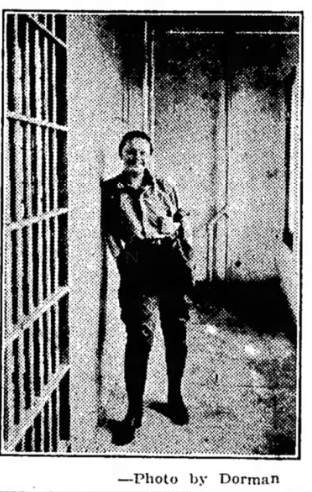
Pretty Eleanor was 20 years old and just as enchanting when she played the violin for her guards at the Kern County Jail in the spring of 1924. She’d been accused, with a male accomplice, of robbing a Taft bank of $5700. A revolver discharged during the robbery. Eleanor, much later, allowed that it might have been hers, but she wasn’t clear on who was holding it at the time. Then, after that, she suggested that she hadn’t been in the bank at all. Her story changed as often as her birthplace.

Screen Shot 2015-11-26 at 4.10.18 PM
An unrepentant-appearing Eleanor in the Kern County Jail, from the Bakersfield Californian.

But in the robbery’s immediate aftermath, she wasn’t suggesting anything. Detectives from both the sheriff’s office and the LAPD grilled her for two days. They got nothing. EFFORTS OF POLICE OFFICERS AMUSE GIRL HELD IN ROBBERY, a headline read. Her hair was cut short, like a Flapper’s, so she became the “Bobbed-Hair Bandit.” PRETTY ELEANOR SMILES AT OFFICERS AS THEY QUESTION HER, another headline announced. She decided to let her hair grow, now that she had the time. She pled “not guilty” in April.

She changed her plea in May. She might have been threatened by a defense witness called to testify on behalf of Bill Crockett, her accomplice, suspected of planning the bank robbery.

According to the prospective witness, a Folsom inmate, Eleanor had been with him when he had shot a “Dutchman” during an armed robbery in Los Angeles. He complained later that they’d paid doughboys $32 a month to kill Dutchmen, but they gave him 29 years, and he’d just wounded his. And his conviction came because Eleanor had turned state’s evidence. Now, he suggested, she’d been much more than an innocent bystander.

Meanwhile, the papers were reporting that she had been one of the robbers who’d  burst into the Taft State Bank on March 13, 1924, at 9 a.m., helping to round up customers and tellers. She’d been dressed as a man. She continued to dress that way—“her crossed legs garbed in khaki and long hiking boots”—after her arrest.

The Taft State Bank is today a popular sports bar.

Newspaper stories hinted that she wasn’t innocent in other ways. Both the defense witness and Bill Crockett were infatuated with her. So were the deputies at the Kern County Jail.

But by the time of the trial for the robbery, a reporter wrote, “gleaming hatred” appeared in Crockett’s eyes at the mere mention of her name. Crockett was unlucky in love and inept in crime: his mask had slipped as he herded the bank’s occupants into the vault, so a teller on the witness stand identified him without hesitation.  And while they’d made away with $5700–nearly $80,000 today–they’d overlooked another $30,000 nearby.

And not only had Eleanor confessed, but she’d led the detectives to the cash. They found a thousand buried under two railroad ties on General Petroleum property outside of Taft; another $1800 was buried at the base of a telephone pole.

Pretty Eleanor distanced herself from the robbery on the witness stand, when “every pair of eyes in the courtroom was directed at her,” as a Bakersfield newspaper reporter wrote. It’s a good bet that Bill Crockett’s eyes gleamed, him wishing he could burn holes in her, through that

…ponged blouse with a man’s collar, about which was knotted a shoestring “sheik tie.” Over her blouse she wore a brown and fawn-colored barred sports vest. A brown full silk skirt completed her ensemble.

She wasn’t there at all, she said. That was another man, Ray. All she’d done was to burn their clothes after and change the license plates on their car. Oh, and she’d buried the revolvers somewhere between Taft and Fellows.

Eleanor was giving one of her last performances for an audience of any size. They were rapt. She went to prison anyway.

Ironically, Bill Crockett was acquitted, only to be convicted later of a second robbery. He’d do time and so would two of his brothers, one a thief and the other a forger who, according to a family history, would do the hardest time of all, on Alcatraz.

Until Taft, Eleanor’s record was a clean one, with one exception: in 1920, she’d started an 18-month term in a Ventura reformatory. She hadn’t played the vaudeville circuit. She’d run away from home.

Her San Quentin term was five years to life. The “Bobbed-Hair Bandit” shared a cell with Clara, “The Girl with a Hammer,” after her murder weapon of choice. Eleanor had been an actress, but Clara was a drama queen: she tried to escape twice and failed both times, once breaking out of a town jail, once slashing her wrists with a razor blade she’d borrowed from a San Quentin matron. Eleanor did her time quietly.

Eleanor booking
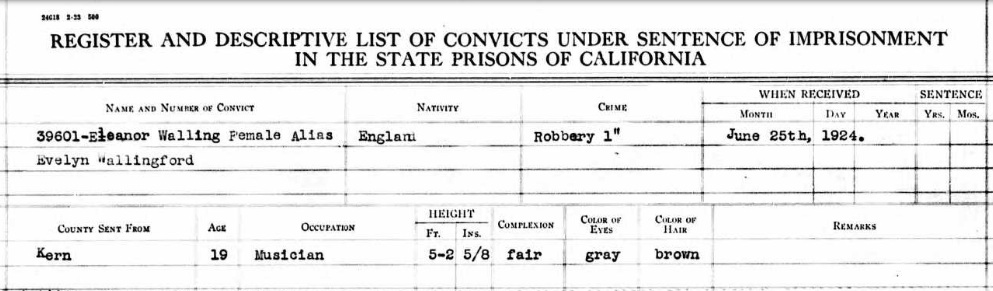
Eleanor’s booking record, San Quentin.

After her parole, she lived in San Francisco, in the Noble Hotel, on a narrow block of Geary Street. The 1930 census lists her occupation as “musician.”

Two years after that, the Oakland Tribune reported that she’d been questioned and released for a bank robbery in the city. Some San Francisco police detective must’ve been disappointed, because he’d certainly done his homework and it must have looked like a good collar. The armed robbers had been two women, dressed as men.

Intimidation

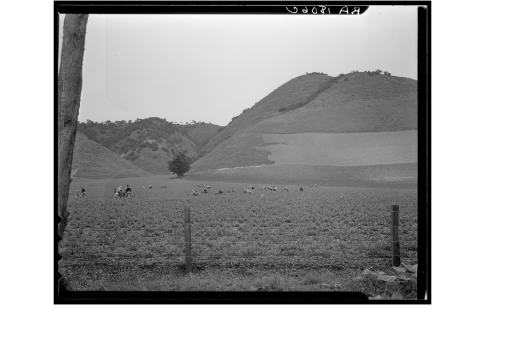
Filipino field workers thinning lettuce with the short hoe, Salinas Valley. Photograph by Dorothea Lange.

Filipino field workers thinning lettuce with el cortito, the short hoe, Salinas Valley. The tool would be outlawed in 1974. Photograph by Dorothea Lange.

I thought it would be a good idea to write about the Depression and New Deal, and I still think it is. What I wasn’t prepared for was the topic’s massiveness, the inchoate nature of local scholarship on the period, and the kind of conflict that, in some ways, is more hurtful than writing about the war.

I’m using Kenneth Starr’s series—if California has a Historian Laureate, it’s Starr, and he’s pretty even-handed—as a guide. But once you get into Starr’s depiction of the period 1934-37, the wheels start to come off your Comfort Train.

California was unique in so many ways in the Great Depression. The downturn didn’t have the wallop here that it did in the industrial Midwest, where at one point unemployment in Toledo was 80%, because California, in these prewar years, was still largely agricultural. It also, in large part thanks to a reactionary governor, Frank Merriam, resisted the New Deal–failing to stop FDR’s programs, but retarding their introduction into the state until long after they’d taken hold elsewhere. Around here, for example, the New Deal didn’t seem to have had real impact, except for the CCC, and, of course, except for AAA farm subsidies, until 1938 or 1939.

What California did have–and in spades–was a political right wing that veered, intermittently and locally, into a tight and militarized alliance between business and government: that’s a serviceable definition of corporativism–or Fascism.

This alliance had its beginning in the postwar years, with the Palmer Raids, Sacco-Vanzetti and, more locally, with the IWW and with San Francisco dockworkers’ agitation. By the mid-1930s, the right’s fear intensified, because there were communists among farm labor organizers–made manifestly clear by Steinbeck’s In Dubious Battle. In reality, the struggles of California workers at the time had little or nothing to do with ideology and everything to do with organizing for a living wage, for sanitary living conditions, and for a safer workplace.

That, according to the powerful elements in the state–the umbrella organization for big growers, Associated Farmers, Inc., the Union Pacific Railroad, Pacific Gas & Electric, and the City of Los Angeles, with the most aggressive “Red Squad” in the nation being the LAPD’s–that kind of agitation was communism, pure and simple.

The right had its roots in LA, although most of the earlier labor strife had come farther north. By the 1930s, the Imperial, San Joaquin and Salinas Valleys, and the Arroyo Grande and Nipomo Valleys, to a smaller extent, had become the front lines for fighting incipient Communism.

When Socialist Upton Sinclair ran for governor in 1934, it was the LA District Attorney who notified thousands of potential working-class voters, potential Sinclair voters, that they would have to appear and present legal proof of their residence. It was the LAPD who, in 1936, sent nearly 200 officers to entry points around the state’s borders with the extraconstitutional mandate to turn away travelers with “no visible means of support”–they waved through, for example, a gentleman in a brand-new Packard but detained, rousted, and turned away a poor family crammed into a 1921 modified Ford pickup. At night, they gathered hundreds of unemployed men–mostly very young men–handed them peanut-butter and baloney sandwiches, and put them on freight trains bound for the Arizona border.

In Salinas–there are rumbles about the 1936 strike in the old Arroyo Grande Herald-Recorders–lettuce workers were locked off the job while hundreds of scabs were brought in. The strikers threw rocks at the trucks bringing in the strikebreakers, which brought the Monterey County Sheriff, the California Highway Patrol, and hundreds of deputized citizens, armed with axe handles, onto the side of the growers. They beat strikers, men and women, senseless, used tear gas and nausea gas, set up machine gun nests, and when deputies mistakenly unloaded their shotguns on three carloads of strikebreakers, it took them all night and most of the next day to coax them out of the fields where they were hiding, terrified.

In an Imperial Valley strike, growers beat the attorney, on the courthouse steps, who was representing labor organizers indicted for criminal syndicalism. The sheriff and his deputies watched, waited, and then intervened, arresting the semiconscious attorney’s wife when she went to their car and retrieved a revolver. Another labor attorney–a Jesuit-educated Irishman, God love him–took over the case, and tore the prosecution to shreds: they had to drop four of the six charges against the organizers. The D.A. prosecuting the case had his term lapse, but was allowed to continue when the state attorney general named him a special prosecutor. The defense attorneys presented six hours of tightly-reasoned legal arguments (How can you send a man to prison, for example, for being a member of the Communist Party when the Communist Party was recognized by the state of California and regularly ran candidates?) while in his summation, the prosecutor–literally–clutched the courtroom flag to his breast and preached Americanism.

The jury deliberated sixty-six hours, brought back a handful of guilty verdicts, and recommended that the convicted be placed on probation. The judge ignored the jury and sentenced the defendants: one to eight years in prison. The women got the lesser sentences; the men went to San Quentin.

There were bitter strikes here, as well, in 1934 and again in 1937, when the CHP were imported to Nipomo, as they had been in Salinas, to protect strikebreakers and to intimidate strikers. The San Luis Obispo District Attorney, with a near-Dickensian name, van Wormer, and Sheriff Haskins felt confident enough to issue the strikers an ultimatum: Go back to work or go to jail, charged as vagrants.

99% of the workers, the Arroyo Grande Herald-Recorder proclaimed, with equal confidence, were eager and willing to go back to the pea fields, but they were intimidated by outside agitators.

The implacable 1%–doubtless, they were Communists–wanted forty-five cents a hamper to bring in the pea crop. The Herald-Recorder soberly reported that one worker maintained that twenty-five cents a hamper was more than enough to allow a family to support itself.

The final offer was presented, not by the growers, but by Sheriff Haskins: Thirty cents. Take it or leave it.

This research is going to lead me into dark places–and shining daylight there, even eighty years later, is going to make me enemies.
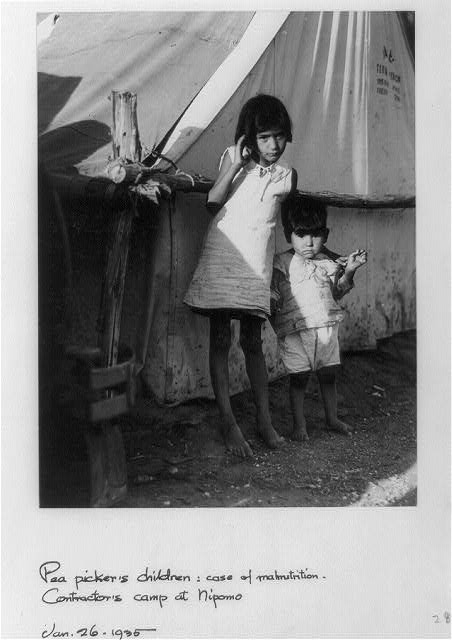
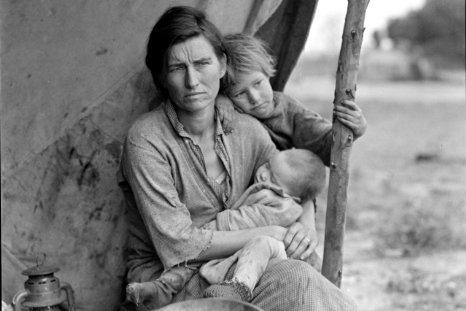
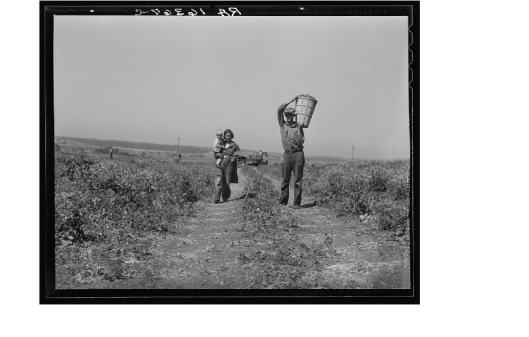
Pea pickers' children, Nipomo, 1935. The little girl's knocked knees are indicative of rickets, caused by a Vitamin D deficiency.

Pea pickers’ children, Nipomo, 1935. The little girl’s knocked knees are indicative of rickets, caused by a Vitamin D deficiency. Dorothea Lange photo.

Why We Write

Screen Shot 2015-10-21 at 2.45.13 PMJust got the page proofs. Serious proofreading comes next. Kind of numb, but also happy. These are stories that deserved to be set down and, hopefully, they will be remembered.

I think now, looking back on a little book that’s almost done, that they have an unintended educational value, too. There’s so much petulance and selfishness adulterating our national character today–our polity, especially.

Much of this book is a mirror-reversal of that: it’s instead about civic duty, about sacrifice, about generosity–“the better angels of our nature,” as Lincoln put it so vividly. World War II was, after all, just as the Civil War had been, a war where the survival of democracy was at stake.

I think that’s why I need to write another book. Had it not been for a bureaucracy as prosaic as the Soil Conservation Service, Corbett Canyon would today be a desert. One of the fundamental values of the Second New Deal was the belief that we had an obligation to generations not yet born. Those generations are today walking to school on sidewalks that are stamped “WPA 1940” below hillsides that support grazing cattle only because CCC kids built check dams there in 1937.

Democracy works. It takes courage to nurture it, though, and compromise to sustain it, and we need those qualities now every bit as much as we need rain.

Dad and Gen. Patton

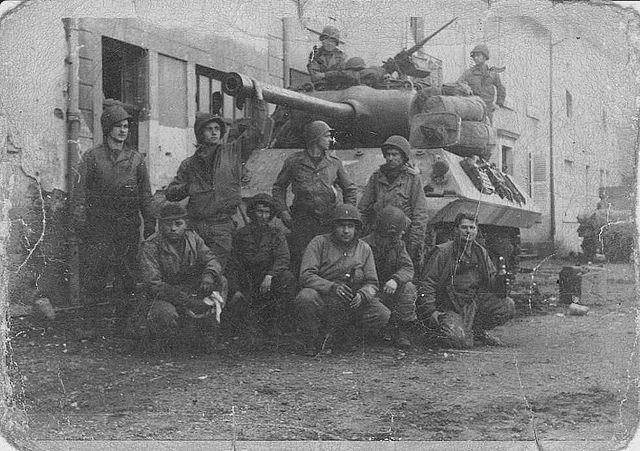
“Old Faithful,” a tank destroyer, with members of Frank Gularte’s 607th TD Battalion.

For the summer and fall, the 607th—its main armament at this point was a three-inch gun, towed by a half-track or ¾ ton truck–sprinted across France under the command of perhaps the most famous American combat general: they were a part of George Patton’s Third Army, and so undoubtedly infused with Patton’s fighting spirit. Patton wanted his tanks and trucks infused, not just his men, and in his drive during the breakout from Normandy—the grand chase across France that Domingo Martinez would not live to see—the general wasn’t hesitant about sending details back to Omaha Beach to steal entire gasoline supply companies. My father, a Quartermaster officer in London, was responsible for sending those units to the beachhead.

Their absence one day led to what had to be the most extravagantly profane cross-Channel phone call ever placed. An irate divisional commander, his division immobilized on Omaha with his men lying on their backs looking for clouds shaped like Rita Hayworth, bellowed that Lt. Gregory would be Pvt. Gregory within 24 hours, and added that there wasn’t a foxhole in northern France deep enough to protect him from the enemy artillery bombardment that the general would be happy to arrange. My father got off the hook when the gasoline’s disappearance was traced to Third Army.

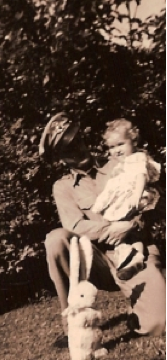
2nd Lt. Robert W. Gregory and his daughter, Roberta, 1944.

2nd Lt. Robert W. Gregory and his daughter, Roberta, 1944.

Thinking about Umpqua

Tags

, ,

10462813_10204064704081643_4755616275869953070_n

This is very difficult for me to share–and probably it’s just me. I need to share it in case it’s not.

All teachers, myself included, have confrontations with students. [We don’t sleep that night. At all.] When that happens, you wonder, somewhere in the back of your mind–fleetingly, because mostly you think about how badly you screwed up and how you could have handled the situation so much more effectively–if you’ve turned yourself and your kids into the next victims.

You don’t think about it every waking moment, but you certainly do when you lock the doors, close the curtains, and get them quiet for yet another lockdown drill.

And it’s not so much dying that you think about: it’s dying in such an apparently meaningless way.

I can’t imagine that my teachers ever had thoughts like mine. I also can’t imagine, with this added to the absurdity and the weight of all the expectations placed on teachers today, why any young person would want to become a teacher.

In the last few years, in the mandated anarchy of No Child Left Behind, which involved teaching to the test, and then The Common Core, which involves a curriculum of great enrichment (Not for students. For the textbook publishers who designed it),  it was the kids who saved me and my career. They kept me going.

But the shock–and, paradoxically, the monotony– of school shootings is a reality that teachers have to think about every day, and it’s poisoning our nation at its most important juncture: in the classroom, where adults and young people are supposed to be in partnership, where they are to work together to ensure that the nation has a future.

I always worked, very purposefully, to make my classroom safe for the students I loved to teach. I think I taught with high expectations, but I also wanted them to have a place–a place that belonged to them–where they would find humor, kindness, and acceptance. But neither my classroom, nor any classroom today, is a sanctuary. Not anymore.

“It takes life to love life.”


The more I learn about Mr. Branch, the more respect I have for him. The 1862-63 drought wiped out his cattle–cost him $8 million in today’s money—but he’d already started to make the shift to dairy farming, and that millstone brought in some nice income, too. At the same time–1862– he lost three daughters to smallpox. Despite these setbacks and a lawsuit that dogged him in his later years, he was fighting his way back to the very day of his death in May 1874.

“Setbacks” is an inadequate word.  He was in San Francisco when his daughters became ill, traveled hard, at sixty, to get home, but when he arrived, two were already gone. The third died soon after. He saw to it that when he was buried, his three little girls would be close alongside. He missed them–one of the girls was named for his wife–and you wonder if he didn’t blame himself for not being there to protect them, even, as fathers want so badly to do, to protect them from events beyond a father’s control.

He doesn’t look it here, but he was said to be a good-humored man–his actions speak to a someone with a positive outlook–and he was small, spare, wiry. Tough as nails. The energy, too, that he had to have must have been electric. It had to be, to drive an ambition that was much like Lincoln’s: “a little engine that knew no rest,” one of Lincoln’s law partners said.

(Lincoln had lost his mother when he was nine, and, although his stepmother was immensely sympathetic, he was estranged from his father–he would refuse to attend Thomas Lincoln’s funeral–and so he struck out early. Branch, as a toddler, lost his father; his impoverished mother had to divide her children among relatives, so he, too, got out and on his own as soon as he could.)

Now I’m reading a biography of the Lakota chief Red Cloud, and even that bears on Francis Branch. He was a mountain man, but gave up fur-trapping to become a Santa Barbara grocer, marrying Manuela, about 1835. He’d start running his first cattle on the Santa Manuela Rancho two years later.

The book suggests that this is about the time the bottom fell out of the market for beaver pelts: cheap English silk now became the main component for gentlemen’s hats. No demand for beaver pelts meant, simply, that by 1837, mountain men were obsolete.

But Branch, by then, was a rancher. He’d had the foresight to re-invent himself, at 35, for about the fourth career change of his young life.

His outlook on life reminds me a little of a favorite character of mine, Lucinda Matlock, from Edgar Lee Masters’ Spoon River Anthology, a collection of poems about the residents of a little Illinois town who tell the stories of their own lives with their tombstones’ epitaphs:

Screen shot 2015-10-02 at 11.21.29 AM

Heroes

Tags

, , , , ,

41UZcv5gi7L._SX331_BO1,204,203,200_

When I taught U.S. History, we spent a day every year studying the 1965 Battle of Ia Drang. There is a brand-new biography out of Hal Moore, the commander of the young Americans there. Moore was, and is, to put it mildly, a “quality human being.” His men came close to being overwhelmed by North Vietnamese regulars. One company was virtually annihilated, like their predecessors, the 7th Cavalry. But Moore and his men–he was, to his boots, both commander and father— hung on, calling air and artillery strikes virtually on their own positions, and they defeated superb North Vietnamese troops.

Sadly, we drew the wrong conclusion from that victory. We were assured, I think, that air mobility and firepower would defeat the NVA in a standup fight, which was absolutely right. But the lesson the North Vietnamese learned was to never fight Americans that way again. (To say we missed the lesson of our own Revolution is another story for another time.)

The fact remains that Moore and his men were unbelievably brave and tenacious. One of them, a British immigrant, Rick Rescorla, would go on, in civilian life, to become a civilian security consultant. After the Lockerbie Pan Am bombing, Rescorla urged his bosses, Morgan Stanley, to move out of the World Trade Center, which he sensed would be an inviting terrorist target. Morgan Stanley agreed with him, but their lease ran until 2006.

So Rick Rescorla died in the South Tower on 9/11.

That’s his photograph on the cover of Joe Galloway’s gripping account of the battle. The paradox–of discovering such admirable people in the midst of such unspeakable violence–is something I find heartbreaking. They may be heroes, but they are also very human, and so make me feel very human, as well. That kind of connection is a gift, and it is a generous and deeply moving gift to get from men you will never get the chance to meet.

61bgk+pnBLL._SX329_BO1,204,203,200_

Change the Damned Title (Please)

A crippled B-17 begins its plunge to earth over Berlin.

A crippled B-17 begins its plunge to earth over Berlin.

[Dear Editor Lady]:

It was good to talk to you today! You did mention the book title in passing. Arroyo Grande in World War II, to me, has the kind of appeal that would sell twelve—maybe fifteen—books. I am thinking and consulting Lincoln, Shakespeare, Exodus, Wilfred Owen and Ernest Hemingway. Nothing yet. Then there are several passages in the book that come from soldiers’ or sailors’ letters home. I was re-reading Elliot Whitlock’s—he would win the Silver Star for his conduct in bringing his crippled B-17 back to base in England—and a particular sentence arrested me:

…At that time Jim’s parachute caught fire as did an extra one we carried. Mine was burnt but not seriously. With his chute gone, Jim couldn’t jump. I decided to stay with the ship while Jim put out the fire. He succeeded in getting it under control, but his hands were so badly burnt that he couldn’t do anything the rest of the trip.

   He held the ship level while I finished putting the fire out…Somebody handed a fire extinguisher through a hole the fire had burnt, and so I looked back and everybody was there (in the tail) for which I thanked God. Nobody…had bailed out. They had not heard the order.

    …I had dived the ship immediately after the fire so that nobody would pass out it the oxygen was cut off. Suddenly we started to get an awful lot of flak (anti-aircraft fire from the ground) so I had to hurry back to the cockpit to do some evasive action which worked okay, incidentally. I had one of the boys get the maps…and had the radio operator get fixes so I plotted a course for home with as little flak as possible. The radio operator did a fine job so we came out on course and landed OK. All this was above the clouds, so I think I can qualify for navigator now as well as pilot…

   …Your prayers are standing by me. I was praying up there and all the rest of the men were praying, too…

Lots of love,

Elliott

So, this came to mind:

Your Prayers Are Standing by Me

A California Town in World War II

One of the major reasons I wrote this book was to connect an obscure and seemingly unimportant little town with events both famous and world-changing. These events happened so far away, so the theme of distance—spatial, temporal, emotional–is one that comes up over and over in the book. The book shifts between those distant events and the home front. Elliot’s poetic sentence represents, to me, a bridge between the distant and Home, between a plane in trouble over Berlin and a father and mother running a little grocery on Branch Street—in their prayers, almost willing the plane safely home. The book, likewise, is intended to be a bridge between Arroyo Grande and the war, and even more, between living generations and one that has almost disappeared. Frankly, I like it also because it’s organic: it comes from a kid who was in the AGUHS Drama Club and the Diction Club and not from Thucydides, whose high-school yearbook I can’t find. The fact that this is a religious sentence is, to me, irrelevant: it’s a bridge.

Here are just a few examples of that idea of “distance” and of “connectedness:”

>…its characters will enter the Arroyo Grande Valley, many after long and dangerous journeys; World War II will call their descendants—part of “The Greatest Generation”– away on journeys more dangerous still…

>…there were deep hurts that would need time to heal, hurts inflicted all the way from the hedgerows of Normandy to the desolate, shell-blasted landscape of Iwo Jima and, finally, to now-empty baseball fields in internment camps like Gila River.

>…the war, for Americans at home, was both distant and, for grieving families, painfully intimate…

>…Winds had carried the copper-red soil as far east as the mid-Atlantic to drop it, like gritty rain from a place that had none, onto ships still sailing freely between continents…

>…The U-boats would someday kill that young field worker, if indirectly, as part of a inexorable chain of events that would lead him to Normandy, so far away from the fields that border Arroyo Grande Creek, and to pastures bound by hedges and grazed by fat dairy cows…

>… The first gunshot heard in the Arroyo Grande Valley came a few weeks before Victoria ascended the English throne. It was probably fired from an 1825 Hawken rifle…

>… By the early part of the new century, some of the workers in those fields, their wide-brimmed straw hats like mushroom caps as they bent to their work, would figure prominently in the American history that Clara loved. They were first immigrants to arrive from Japan, most of them from the southern island, Kyushu, but a few of them from farther north, in the prefecture that surrounded the city of Hiroshima.

>…The next day, he and his classmates at Arroyo Grande Union High School gathered in their new gymnasium—a New Deal WPA work project that still serves as the Paulding Middle School gym today—to listen to Franklin Roosevelt’s dramatic eight-minute address…

>… Many years later, [a local cattlewoman] would tell Port San Luis Harbor Commissioner Donald Ross that she’d seen a sub—during I-21’s combat patrol– surface offshore during her shift on a volunteer shore patrol, somewhere along the beach in what is today Montana de Oro State Park. She let fly with her 30-30 carbine. The range was too great, she told Ross, but she had the satisfaction of seeing the crew scamper below and the captain dive the boat…Within weeks, I-21 would be sinking shipping off the coast of Australia, would shell Sydney Harbor, and would be lost with all hands near Tarawa in 1943.

>–I just saw one of the swellest sights. You will never believe it when I tell you. It was fresh green peas in a field…if you had been where we were and as long as we were, you would know why we thought so much of seeing a field of vegetables. We saw many wonderful sights….We saw country that reminded my of the Cuyama, some places reminded me of the scenery between San Simeon and Monterey. For the past few months we have seen nothing but country like that at Devils’ Den, except there is more wind and sand here.

–A letter home from North Africa

>That was Frank Gularte’s last full day of life. On the 28th, the 607th was ordered to take another town, Merten. Everything that could go wrong did… Somewhere in the melee, a German sniper took the life of the young man who would never see his son.…Five days later, Sally Gularte gave birth to Frank Jr. Only a few days after that–after she’d first held her son close in her arms–she received the War Department telegram that took her husband away from her.

>Juzo Ikeda’s life had been a successful one, too, marked by hard work. But his workplace had been beautiful—green hillsides, fields of black earth and, in the distance, above the ears of his team of horses, he could see shimmering white sand dunes. He could smell the sea…Japan had destroyed his family’s fortunes and so had trapped those who stayed behind; in coming to America, Juzo had set himself and his sons free.

But when death came for him in 1943, Juzo was in a makeshift hospital in a barren desert camp. He died not long after asking his son to remain loyal to the nation that had made them prisoners.

–On the other hand, I could be full of beans.

Jim

My Greatest Strength

1522176_10202851582434360_407912915_n

I took Mom some flowers yesterday (I also said “Howdy” to a lot of people. If you are of Portuguese or Japanese descent, I probably visited your ancestors.) and realized this week would have been Mom and Dad’s 75th wedding anniversary.

He came from the Ozark foothills to Taft, at 21, on a technically illegal baseball scholarship–Dad was a gifted and graceful athlete–and she was a soda jerk,18, and I think they fell in love over the ice-cream sundae she made for him. And, what a year–1939–to date! “Gone with the Wind,” “Wizard of Oz,” “Goodbye Mr. Chips,” and so on. Thank you, Hollywood, for making us four kids possible!

He was incredibly quick-witted and funny, an absolutely mesmerizing storyteller, brilliant (especially with numbers); she was sensitive, artistic, a brilliant, lifelong learner, intensely spiritual and she had a powerful sense of social justice. Me? I was lucky.

But if you know me, you know them.

Forty-six years after my Mom’s death, I still miss her, and she still inspires me. Each and every one of my life’s accomplishments was meant as a gift for her, and, if you’ve been one of my students, my Mom loves you every bit as much as I do.

I also inherited their deep and destructive flaws–Dad’s temper and his alcoholism, too, Mom’s struggles with depression–and the truly marvelous thing about getting older is how you begin to appreciate those things, as well. In confronting and enduring them, they become your strengths.

My parents may be my greatest strength of all.

Happy 75th, Mom and Dad. I love you forever.