
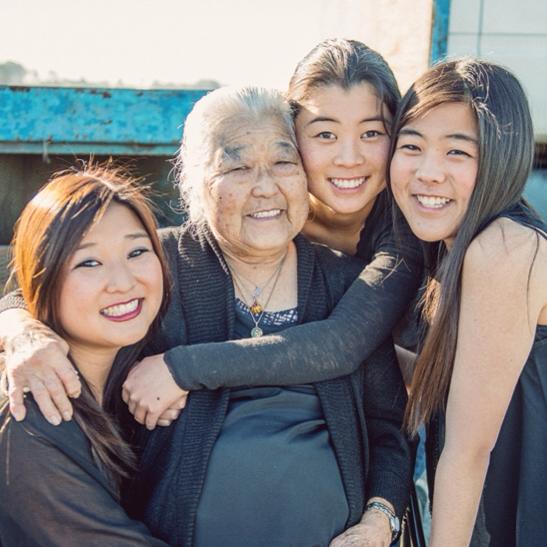
Rose and her granddaughters: Ally, Lauren, Jana.
This is an exchange from what has to be one of the finest antiwar films ever made. A young Australian, Frank, is about to join the ANZAC assault on Gallipoli, in one of the great catastrophes of the First World War; his father, an Irish immigrant, can’t let go of the past, demonstrated by Frank finishing a story he’s heard a thousand times.
- Dad: Fine. But what… do you want to join up for? The English killed your grandfather. Hung him with his own belt…
- (Both): …five miles from Dublin.
- Frank: I’m not going to fight for the British Empire. I’m gonna keep my head down. Learn a trick or two, and come back an officer. Maybe. I don’t want to be pushed around forever.
From Peter Weir’s Gallipoli
In 1799, the English executed three dozen Wolfe Tone rebels, shooting them down in front of their keening families in the village where my great-great grandfather was baptized. I thought of that and thought of this scene, so, of course, I thought, too, of Rose Hayashi. We have just lost her.
I knew she wasn’t well—four weeks ago, I interviewed Haruo, her husband of 62 years, for the book I’m writing. Rose was in a walker and moved quietly around the room with her son, Alan, close by her side. Alan wasn’t hovering—he gave Rose her space and her dignity, but he was there just the same. His discretion was a sublime act of devotion..
Rose had taught Alan the uselessness of hatred. He’d grown up a little angry, with the potential to become as righteously bitter as Frank’s Dad. He could not abide the racism and the insult that had scarred his parents’ lives, that had sent them to—can we call them what they were?—concentration camps in the Arizona desert. At Gila River, for example, in July 1942—where Arroyo Grande’s Japanese lived with those from Los Angeles who’d been put up in the stables at Santa Anita–two-thirds of the month’s highs were above 109 degrees, and the hot desert dust would start to take a toll, especially among older people, because it carried the spores that brought on Valley Fever.
Alan had every right, in my mind, to be angry. Not in Rose’s mind. She finally took aside her young son one day and, in very direct yet loving terms, told him how bitterness can eat away at a person. She and Haruo had learned, somehow, not to compartmentalize their hurt, but how to transcend it, defeat it, reject it, destroy it. This is a testament to that generation’s immense emotional strength, and that was a gift Rose gave to her five sons.
When I saw the family on my visit, I was struck by Alan’s attentiveness to Rose and by the family’s devotion to each other. The television was on to ESPN, the men who’d given their lives to hard work were taking the time on recliners and a sofa to do nothing, and grandchildren moved quietly through the house to say hello to Grandmother and to raid the refrigerator. Kim made me a coffee and a snack. There was nothing demonstrative, nothing melodramatic, but you could sense that Rose was nearing the end of her journey, and the subtle strength of the family around her was carrying her gently toward her transition.
I have never seen family love made so manifest by the fact that it was also so unobtrusive and natural. It was humbling to see. This, too, was Rose’s gift to her family, to the future, and, on a day when we never spoke, it was a gift I’d never asked for from her, yet one that gave me great joy in the taking.
Several days later, I obeyed a powerful need to send Rose a bouquet of flowers. I knew my own mother would understand, because, in a way, I had met her again on the day of my visit.
 A Work in Progress