
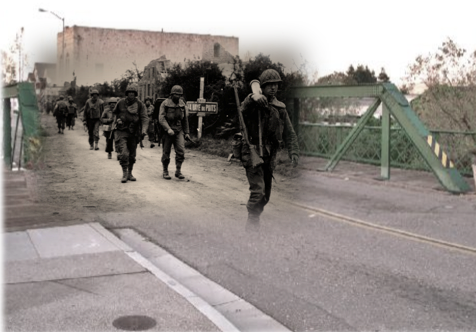
I’ve just retired. I taught history for thirty years, and I never, never ceased to get angry when I taught Verdun, for example. The bones in the ossuary there belonged to boys like my two sons, whose parents applauded at their first steps or who cheered when they scored their first football goal. I made it my business to make my kids understand that, and so I needed to lead them into dark places, like Fort Douaumont at Verdun, a place so dark that it swallowed the light of five hundred years of Western culture.
To go inside Douaumont, to study war, does NOT mean we glorify it. Two years ago, a student told me the First World War was her favorite unit (Not mine. I much prefer La Belle Epoque.) I asked her why in the world it was her favorite, when I felt so much despair in teaching it. She replied: “Now I understand how precious human life is.”
She understood precisely why I became a history teacher.
I am now under contract to write a book about my little California farm town’s participation in World War II. That is our bridge in the photograph’s background, and one of our young men died with the soldiers superimposed on the photo, from the 79th Infantry Division.
In the process of writing this book, something extraordinary has happened within me–within my heart: The more I research these young men of my father’s generation, the more they become my sons.
Through no one’s fault, they’ve been mostly forgotten. It’s my job, as a writer and teacher, to name them and to reclaim them for a new generation. When we come to know them, we are granted the chance to embrace them, and maybe that is the force that will carry us a small step further along in our evolution.
The great Jesuit theologian and anthropologist,Pierre Teilhard de Chardin,, believed that we have a divine gift: we can evolve spiritually as well as intellectually and physically. I believe he is exactly right.
But I believe also that we cannot advance if we leave behind the boys and men I’ve met, the casualties of war. Their lives were, and are, precious, and if they could somehow save other young lives, I think they’d do it in an instant.
A North Vietnamese soldier-poet wrote that “the bullet that kills a soldier passes first through his mother’s heart.” If the young men I now know could somehow spare other mothers the pain theirs went through, then I think they would do that in an instant, too.
It is our responsibility to confront and understand the horrific violence that took their lives. I now know a farmworker who died in a Norman village called Le Bot, a B-17 crew whose ship was blown apart over the Pas-de-Calais, a Filipino mess steward–the only rating allowed him in a segregated Navy–who was lost with his destroyer in the waters of Ironbotttom Sound, off Guadalcanal.
These young men lit a path, in dying, for the living to follow. If we ignore them, we will lose the path, and the dark will have won, after all.
 A Work in Progress