

…In the spring of 1945, an Arroyo Grande sailor and a native of Luzon, Camilo Alarcio, would find himself fighting for his life and for the life of his ship off the Japanese coast in after-combat action that went beyond the dramatic: it was miraculous.
Alarcio, as Felix Estibal had been on the doomed destroyer Walke, was a mess attendant, assigned to the aircraft carrier Franklin. In March 1945, Franklin’s 100 aircraft were engaged in raids on Kagoshima, Kyushu—the seat of the prefecture from which most Arroyo Grande Japanese had emigrated—when the Japanese struck back on March 19.
It was a little after 7 a.m., and Alarcio likely was serving breakfast, which that day included the Navy’s infamous powdered eggs, to some of Franklin’s 3,000-man crew when a Japanese “Judy” bomber somehow penetrated the carrier’s defense screen and made direct hits with two 500-lb. bombs. More than thirty aircraft, their ordnance and their fuel lines were packed on the main deck: Franklin seemed likely to share the fate of Admiral Chuichi Nagumo’s Pearl Harbor striking force when, at Midway in June 1942, American fliers had discovered four of his carriers, their flight decks laden with bombs, gasoline lines and aircraft, and sent them to the bottom in flames.
The bomb forward flipped a 32-ton elevator high into the air. like a flapjack, in a pall of smoke, instantly killing hundreds of crewmen. Twelve of the 13 pilots in the famed Marine Corps “Black Sheep” Squadron, based, since the beginning of the year, in Goleta, died in their ready room. The concussion knocked survivors flat. The second bomb exploded belowdecks. These were, or appeared to be, two mortal wounds.
It wasn’t over. Secondary explosions shook the carrier as fires reached twenty more aircraft, fueled and ready for flight on the hangar deck; those fires continued, throughout the day, to set off stores of bombs, rockets, anti-aircraft ammunition and aviation gasoline. At one point, the violence inside Franklin made the 32,000–ton ship shudder and spun her, like the needle on a compass, hard to starboard, where she lay dead in the water. She then began to list ominously to starboard, threatening, as the hours passed, to founder under the weight of the thousands of tons of water used to fight the fires onboard.
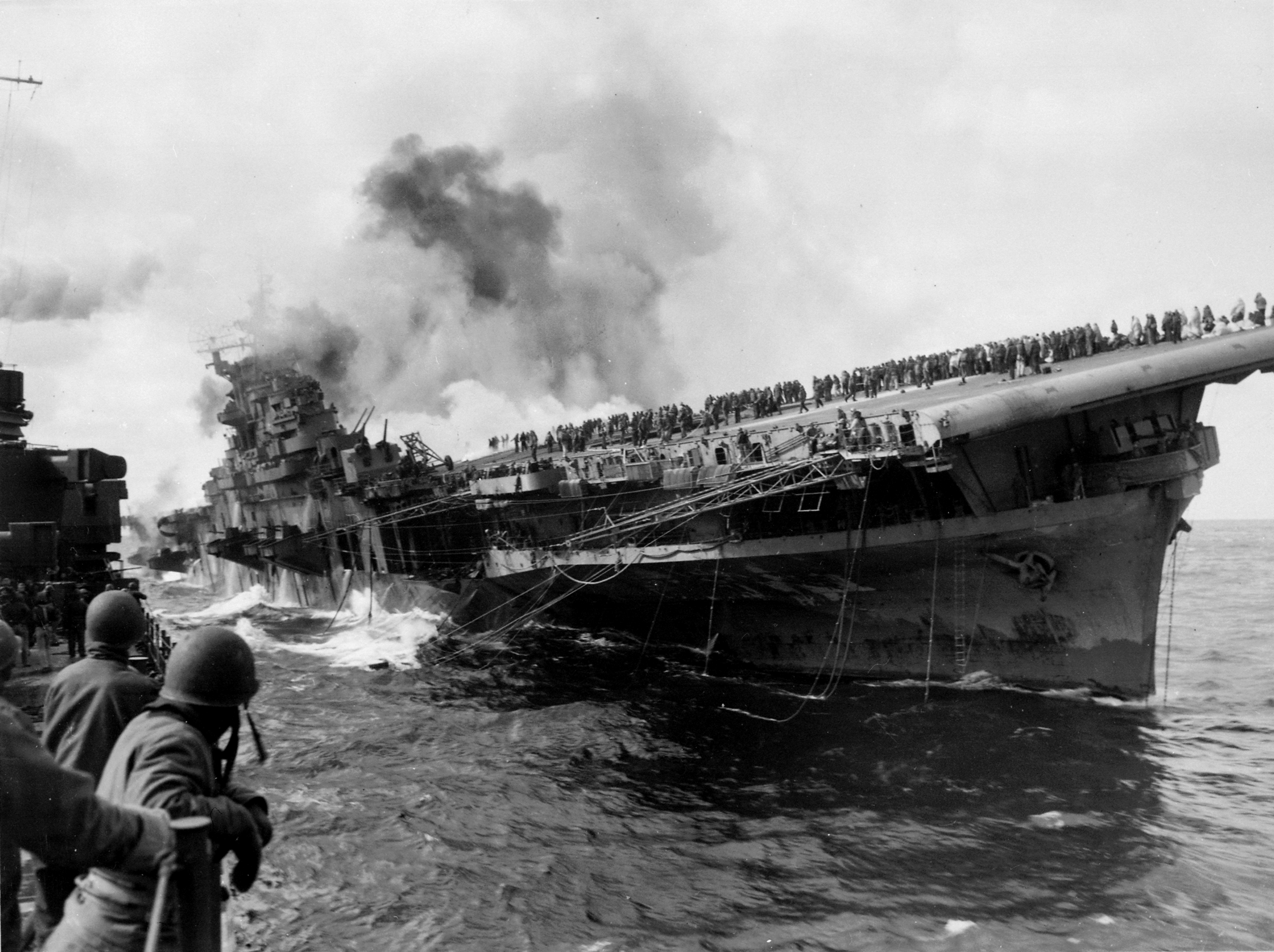
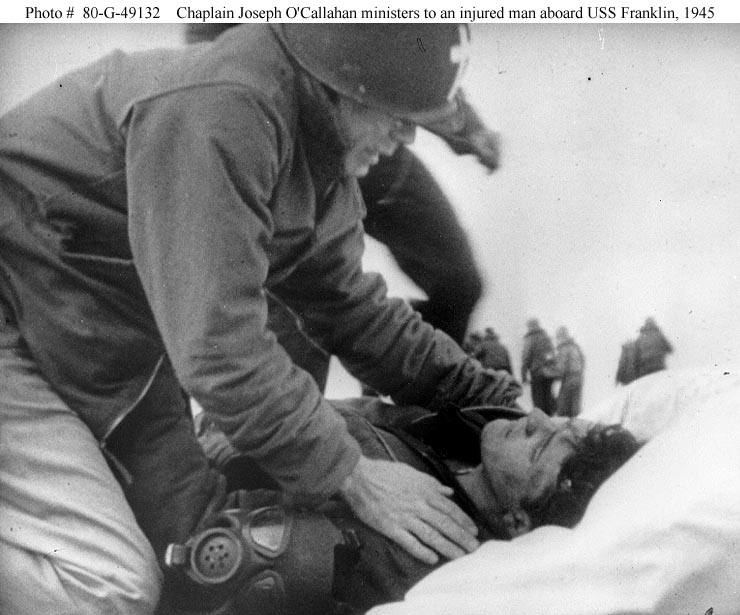
The explosions had killed or wounded a third of the carrier’s crew–the biggest single-ship toll since Arizona–but the survivors refused to give up on their ship and their home. Among them were Alarcio and a man, from shipboard Mass, well known to him: Father Joseph T. O’Callahan. Franklin’s chaplain was immortalized that day in a moment of combat footage that shows him, with immense tenderness, giving the last rites to a dying sailor. Survivors remembered him everywhere as the ship struggled to survive–he was easily identified because of the white cross he’d painted on his helmet–encouraging his boys, directing fire control parties, and leaning in close to hear the weakening voices of those who’d been wounded. He was constantly motion as were his lips, constantly in prayer.
O’Callahan would win the Congressional Medal of Honor.
While her crew worked to stabilize the ship, the cruiser Santa Fe was a constant companion alongside, fighting fires and evacuating the wounded. Eventually, Franklin was taken under tow, but only until her boilers could be re-lit and she could begin to make for Ulithi, in the Caroline islands, for emergency repairs. Two admirals had recommended that the crew abandon ship. Instead, 24 hours after the bombs struck, Father O’Callahan had fallen asleep halfway down a ship’s ladder and Alarcio and his shipmates were able to return to the task of feeding the crew: they were making Spam and bacon sandwiches.
Franklin’s voyage would not end at Ulithi. She would put in at Pearl Harbor and then, on April 28, 1945, the “Big Ben.” her scars still visible and grievous, would return home, to New York harbor and the Brooklyn Naval Yard. The carrier’s flight deck that day is shown below.
The ship would survive, and so would Camilo Alarcio, who would live to be 97. He became the much-beloved father and grandfather of a large, vital and attractive family; his children and grandchildren would make their mark in Arroyo Grande as superb athletes.
A single adjective in his obituary and on his tombstone seems to summarize his character, and the characters of his brother Franklins, best: “Devoted.”


My cousin, Bonner Green was blown off this ship & was surviver. He was the stepson of my uncle Clarence Trusedale & lived in Shandon as a teenager.
LikeLike
It’s one of the most incredible stories I’ve ever read! Wasn’t enough just to read short accounts of it, Will, so got online and ordered what looks like a pretty good book about it. Both the admiral commanding the division and Mitscher, the Task Force commander, thought she was a goner. The captain was a hardhead–in this case, a really good quality!! =)
LikeLike