
Eleanor Walling was an enchanting little girl—one can easily visualize her in a blouse with a sailor’s collar, with a big bow in her hair, like L. Frank Baum’s Dorothy. She was also a talent and a ticket-office draw for her father, a small-town impresario who owned the Lompoc Opera House, the setting for a 1912 rally for Bull Moose candidate Theodore Roosevelt. On that day, Eleanor enchanted the Lompoc Journal, too. The paper notes that
The program was introduced in a most pleasant manner by little Eleanor Walling, daintily clad and draped in a flag, stepping to the front of the stage and with her little violin leading the orchestra in the Star Spangled Banner in a way that carried the audience away.

Eleanor was eight years old. Her mother had died young, but either she or J.O., Eleanor’s father, had bequeathed the little girl with extraordinary musical gifts. She was an actress as well as a violinist, appearing in her father’s plays, including The Moonshiner’s Daughter or in the title role in Editha’s Burglar, which “proved a hummer,” according to the Journal. Sometimes she shared the bill with silent films like Tobacco Mania.
Eleanor, born in Oregon, San Luis Obispo, or England, depending on the source, had, by World War I, joined her father and siblings in a new enterprise: the Walling Orchestra entertained at concerts and dances in a roadhouse owned by J.O. near Avila Beach. They were the band of choice when Arroyo Grande got its brand-new electric streetlights. But by 1920 or so, Eleanor had struck out on her own, for the vaudeville circuit, the story went.
Pretty Eleanor was 20 years old and just as enchanting when she played the violin for her guards at the Kern County Jail in the spring of 1924. She’d been accused, with a male accomplice, of robbing a Taft bank of $5700. A revolver discharged during the robbery. Eleanor, much later, allowed that it might have been hers, but she wasn’t clear on who was holding it at the time. Then, after that, she suggested that she hadn’t been in the bank at all. Her story changed as often as her birthplace.
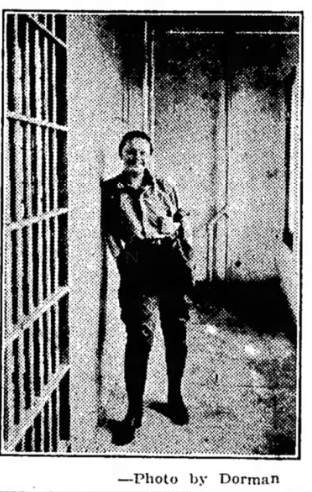
But in the robbery’s immediate aftermath, she wasn’t suggesting anything. Detectives from both the sheriff’s office and the LAPD grilled her for two days. They got nothing. EFFORTS OF POLICE OFFICERS AMUSE GIRL HELD IN ROBBERY, a headline read. Her hair was cut short, like a Flapper’s, so she became the “Bobbed-Hair Bandit.” PRETTY ELEANOR SMILES AT OFFICERS AS THEY QUESTION HER, another headline announced. She decided to let her hair grow, now that she had the time. She pled “not guilty” in April.
She changed her plea in May. She might have been threatened by a defense witness called to testify on behalf of Bill Crockett, her accomplice, suspected of planning the bank robbery.
According to the prospective witness, a Folsom inmate, Eleanor had been with him when he had shot a “Dutchman” during an armed robbery in Los Angeles. He complained later that they’d paid doughboys $32 a month to kill Dutchmen, but they gave him 29 years, and he’d just wounded his. And his conviction came because Eleanor had turned state’s evidence. Now, he suggested, she’d been much more than an innocent bystander.
Meanwhile, the papers were reporting that she had been one of the robbers who’d burst into the Taft State Bank on March 13, 1924, at 9 a.m., helping to round up customers and tellers. She’d been dressed as a man. She continued to dress that way—“her crossed legs garbed in khaki and long hiking boots”—after her arrest.

Newspaper stories hinted that she wasn’t innocent in other ways. Both the defense witness and Bill Crockett were infatuated with her. So were the deputies at the Kern County Jail.
But by the time of the trial for the robbery, a reporter wrote, “gleaming hatred” appeared in Crockett’s eyes at the mere mention of her name. Crockett was unlucky in love and inept in crime: his mask had slipped as he herded the bank’s occupants into the vault, so a teller on the witness stand identified him without hesitation. And while they’d made away with $5700–nearly $80,000 today–they’d overlooked another $30,000 nearby.
And not only had Eleanor confessed, but she’d led the detectives to the cash. They found a thousand buried under two railroad ties on General Petroleum property outside of Taft; another $1800 was buried at the base of a telephone pole.
Pretty Eleanor distanced herself from the robbery on the witness stand, when “every pair of eyes in the courtroom was directed at her,” as a Bakersfield newspaper reporter wrote. It’s a good bet that Bill Crockett’s eyes gleamed, him wishing he could burn holes in her, through that
…ponged blouse with a man’s collar, about which was knotted a shoestring “sheik tie.” Over her blouse she wore a brown and fawn-colored barred sports vest. A brown full silk skirt completed her ensemble.
She wasn’t there at all, she said. That was another man, Ray. All she’d done was to burn their clothes after and change the license plates on their car. Oh, and she’d buried the revolvers somewhere between Taft and Fellows.
Eleanor was giving one of her last performances for an audience of any size. They were rapt. She went to prison anyway.
Ironically, Bill Crockett was acquitted, only to be convicted later of a second robbery. He’d do time and so would two of his brothers, one a thief and the other a forger who, according to a family history, would do the hardest time of all, on Alcatraz.
Until Taft, Eleanor’s record was a clean one, with one exception: in 1920, she’d started an 18-month term in a Ventura reformatory. She hadn’t played the vaudeville circuit. She’d run away from home.
Her San Quentin term was five years to life. The “Bobbed-Hair Bandit” shared a cell with Clara, “The Girl with a Hammer,” after her murder weapon of choice. Eleanor had been an actress, but Clara was a drama queen: she tried to escape twice and failed both times, once breaking out of a town jail, once slashing her wrists with a razor blade she’d borrowed from a San Quentin matron. Eleanor did her time quietly.
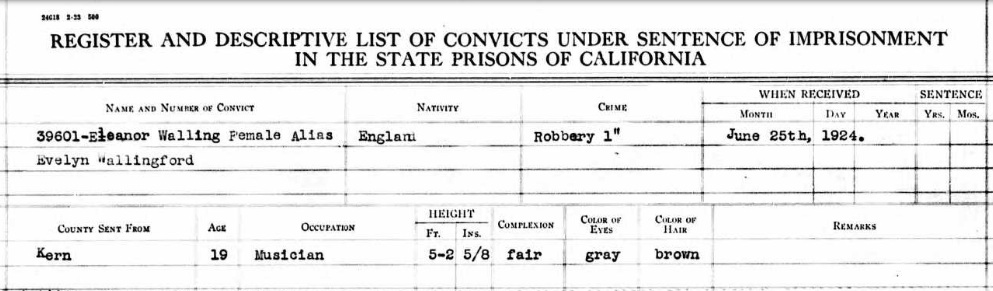
After her parole, she lived in San Francisco, in the Noble Hotel, on a narrow block of Geary Street. The 1930 census lists her occupation as “musician.”
Two years after that, the Oakland Tribune reported that she’d been questioned and released for a bank robbery in the city. Some San Francisco police detective must’ve been disappointed, because he’d certainly done his homework and it must have looked like a good collar. The armed robbers had been two women, dressed as men.
 A Work in Progress
Pingback: San Quentin Women In Vaudeville Show – Carol Ann Hilton
LOVE THIS! Thank you so much, sorry it’s so belated.
LikeLike