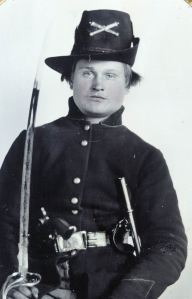
 There are 57 Union veterans in the Arroyo Grande District Cemetery. (We have one county Confederate that I know of, from the Washington Artillery of New Orleans, but he’s disqualified himself by getting buried in San Luis Obispo.) I suppose I will write a book about them.
So what I’ve done in the last two days is to link each soldier to his regiment and then link the regiment to a particular battle–or more than one, since many fought in more than one. A majority seem to have fought in what was then the “West”–the war west of the Appalachians, and I was amazed to find at least four who fought in the Indian conflicts that paralleled the fighting in the east between North and South. The battles in which Arroyo Grande veterans fought are listed below.
I’ve already found the regiment I would have wanted to serve with–surprisingly, a regular U.S. Army unit. They were held in reserve at Antietam, were on the other side of Little Round Top at Gettysburg, idly watching artillery bursts blow up caissons and their horses, and arrived in New York City just after the draft riots. I like their sense of timing.
Now I need to start tracking these men on ancestry.com to see if I can find primary sources and photographs of them. I’ve already found a letter written by one–a woman who served as a Union Army nurse in Tennessee. Then I have to get into my Myron Angel, Madge Ditmas and Pat Loomis and into the veterans’ obituaries to discover what they did here in Arroyo Grande in their mature years–I’ve already ordered a book that’s a kind of postwar psychological portrait of Civil War veterans, so maybe that will help me figure out what brought them to our little valley. I suspect they wanted the distance between themselves and the things they saw as young men.
Then I need to locate each regiment (and company, because those are listed) in combat reports and secondary sources to see if I can pinpoint these men and what they did at Shiloh, or Antietam, or Spotyslvania. And I’ve got a Medal of Honor winner to investigate.
We’ve also got:
–A cavalryman who fought in Custer’s Michigan brigade–his Wolverines–the men he led in the kind of audacious charges, in that quaint mid-Victorian pursuit of glory, that would make him a twenty-three-year-old major general and then doom him 11 years after Appomattox.
–A Minnesotan who fought in the 1862 Sioux uprising, and later in Tennessee. The government would hang 38 Santee Sioux warriors, cousins to the men who would rub out Custer, young men who struck back when they could no longer endure the humiliation that arrived with the “civilizing” of the prairie. They sang before the traps were sprung.
–Three infantrymen with O.O. Howard’s XI Corps at Chancellorsville, in the electric moment when Howard’s men ran for their lives: suddenly rabbits, foxes and deer, panic-stricken, burst from the underbrush and into their camp, and what followed the animals were thousands of Stonewall Jackson’s howling men.
–An ancestor of my friend Will Tarwater’s, a soldier who survived the slaughter of the Union frontal assault at Cold Harbor, Virginia, in 1864, perhaps Grant’s greatest blunder, and a lesson the British failed to learn when they mimicked Grant’s assault, on a massive scale, at the Somme against teams of German machine-gunners. He may have been present later for the ghastly Battle of the Crater in front of Petersburg.
Before I get to the primary sources, I’ve got to re-read my Bruce Catton and my Shelby Foote, my Stephen Sears and my James McPherson: it’s time to re-acquaint myself with a war I once knew almost by heart. And this wouldn’t pretend to be a comprehensive summary of the war–that’s been done far better than I could do–but a series of snapshots of the roles local veterans played in winning it.
Patriot Graves
The Civil War Veterans of Arroyo Grande, California
The mystic chords of memory, stretching from every battle-field, and patriot grave, to every living heart and hearthstone, all over this broad land, will yet swell the chorus of the Union, when again touched, as surely they will be, by the better angels of our nature.
–Lincoln, First Inaugural, March 4, 1861.
Preface: Gray Ghosts: My Confederate ancestors and why they had to be defeated.
Chapter 1. “A Fragment Spared by Time” FDR quote at the last Gettysburg reunion, 1933; then a flashback to Lincoln’s address in November 1863, when the smell of death was still present: the Sanitary Commission had by then interred the fallen soldiers–some in mass graves–but they had not yet gotten to all of the thousands of slain horses.
Chapter 2. “I Have Long Desired to See California” A Lincoln quote. Why they came to Arroyo Grande, and what they accomplished here.
Chapter 3. “He Fights” Grant in the West: Fort Donelson, Shiloh.
Chapter 4. “If There Is a Worse Place than Hell, I Am in It” Lincoln’s quote. Low ebb: Antietam, Fredericksburg, Chancellorsville.
Chapter 5. “The Whites Are the Same Everywhere” Red Cloud. Indian wars, 1862-64. The Minnesota Sioux uprising, the Powder River War against Red Cloud, the Sand Creek Massacre, Colorado.
Chapter 6. “This is a Glorious Occasion for a Speech” Which Lincoln declined to deliver. July 4, 1863: The turning points at Gettysburg and Vicksburg.
Chapter 7. “I Intend to Make Georgia Howl!” Sherman’s invasion of Georgia; the Battle of Atlanta, The March to the Sea: Savannah and the Carolinas.
Chapter 8. “A Most Fearful Sacrifice” John Bell Hood quote. The fight for Tennessee in the fall and winter of 1864: Franklin and Nashville. A lot of our veterans fought in this campaign, one in which Hood, less one arm and one leg with which he’d started the war, proved himself a consummate master at getting his own Confederates killed, and in bushel-loads.
Chapter 9. “There Will Be No Turning Back” Grant’s message to Lincoln. The war across the Rappahannock: The Wilderness Campaign, Cold Harbor, Sheridan’s war of movement in the Valley vs. trench warfare in front of Petersburg; the surrender.
Epilogue: Mr. Handy’s Bivouac


“…better angels of our nature.” My favorite President Lincoln quote.
LikeLike