
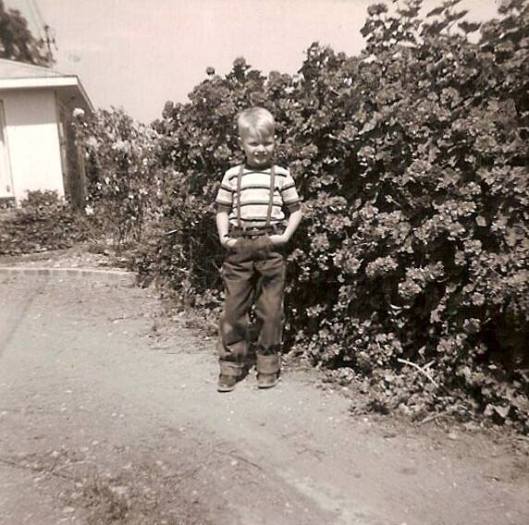
Me, age 6, Huasna Road, Arroyo Grande
This is a second attempt to make sense of horrible crimes. I taught a man who is now in the county jail on $7 million bail on 31 felony and misdemeanor accounts of molesting at least nine little girls. “At least” because these are the little girls that sheriff’s deputies have so far been able to identify. There are more.
The news hit Elizabeth and me exceptionally hard, because she taught him, too. We were close to the alleged molester’s family. And the news came in a week when a friend and colleague at Arroyo Grande High School whom I respected and admired–and feel so much the same for his wife and for his three children, all students of mine–died unexpectedly. It has been a steep and sobering tailspin.
As to the crimes, I have been dismayed by the comments that have followed the news stories about the accused man because they call for summary and vigilante justice. That solves nothing and helps no one. It only makes us all complicit in a different kind of savagery.
I find it just as difficult to summon any sympathy for the accused, if the accusations are true. I can find none. Child molesters are narcissists; they see other human beings as objects, as manipulatives, in their drive for gratification. They lack any kind of empathy (it is said that the accused man abused animals, as well). There must be something dead inside a person who does these things. Yes, the accused was more than likely physically and sexually abused himself. So was I.
And this is what growing up as a victim–if that’s what you choose to be–of violence and sexual abuse is like: every conscious moment is lived in fear. There is a constant undercurrent of dread, of impending doom, that you can never push aside. People like me have a sense of hypervigilance and a pronounced startle reflex: we jump at a dog’s bark or a Fourth of July firecracker. The anxiety is so pervasive that the most reliable palliatives are alcohol or drugs. Those are the only things that consistently and reliably push the fear aside, that allow a fleeing moment of release and self-acceptance, because abuse victims very often are generous, compassionate people with everyone except for themselves.
That is the kind of life that at least nine little girls, who will of course blame themselves for what happened to them, might live out.
They are not doomed to that. It will take an immense amount of hard work on their part, built, I believe, on a foundation of prayer, on our part, to bring them the healing they deserve.
What was done to these little girls was evil and it was powerful. Evil always presents itself this way, as something that is powerful, insurmountable,irresistible. But this self-infatuation is its weakest point. Evil cannot outlast the good will of all of us who love children. I became a teacher because I love children. One of the kindest compliments paid my teaching wasn’t about brilliant lectures. It was about providing a classroom that was safe and accepting.
And evil cannot outlast the power of God, who loves children most of all. These little girls are wounded. They are not damaged. Nothing and no one can violate the loving intention with which they were made.
Because these little girls are incarnate proof of God’s love for all of us, they have every chance, with our help, to become strong, loving and beloved women someday. They may themselves become the mothers of little girls of unimagined–even wondrous– strength and compassion.
This is how the cycle of abuse is broken. I hope it will be broken, too, in the accused man’s family.
But it takes time–God’s time–and in the meantime, the hurt we feel for little girls we may never know sears us. That is God’s intention, I think, as well. He is reminding us in our own pain, and our anger, that we are alive, that we care, that we love, that we endure.
And the Lord, as my Book of Common Prayer would remind me, endureth forever.
 A Work in Progress
Jim, excellent article/response to such a tragedy to all involved. As acquaintances of the Porters and knowing all the children, I am heart broken and in dismay. While I don’t believe the accusations levied against the parents, sadly, Jason is extremely guilty. Not only of damaging his family, but the life long pain that was inflicted upon the young girls. I pray for them. My two girls, Heidi and Nikki Boyle, were up last week for Fair Night. They always say that you were the best teacher ever at MCP. June 1, 2016 was my 50th year anniversary of graduating from Mission Central Catholic High School. Us remaining Grads of 69 kids will meet up again in October, starting with alumni night at the Mission football game. Mission will continue to be a great school.
Keep up your very fine writings. Steve Boyle
LikeLike
Thank you, Steve–that means a lot!! from Jim
LikeLike
I’ve read this so many times, and each time I see something new. I recently just found out who the accused is and that I too knew him. I mostly feel shocked and more sadness. Thank you for your take on this. I find it very healing…
LikeLike
We love you, Shauna!
LikeLike