
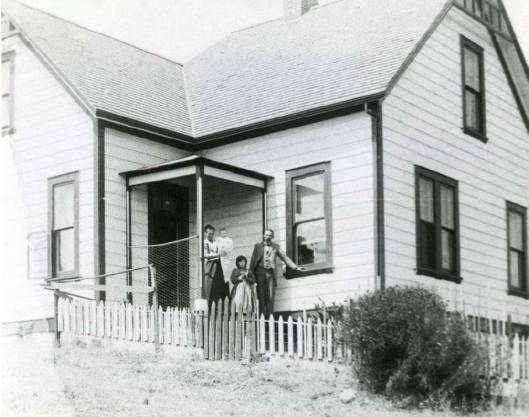
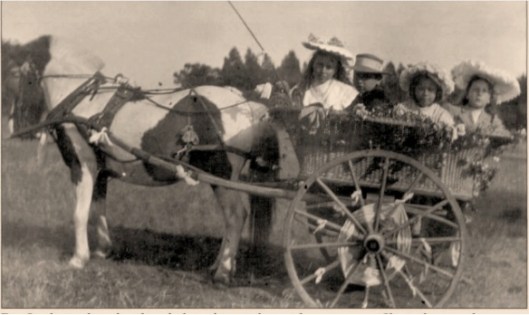
Clara, Baby Ruth, Ruth’s cousin, Ormie, and Dr. Edwin Paulding, about 1898.
Miss Ruth Paulding had retired by the time I knew her. She had taught language for so many years at Arroyo Grande Union High School, just across the street on Crown Hill from the house where she’d been born, that she had become an institution. So had her mother, Clara, a lifelong teacher who decided to teach one more year, in Oceano, when she was seventy-one, so that she could splurge a little on herself. Her teacher’s salary that last year bought her a porcelain kitchen sink. And dentures.
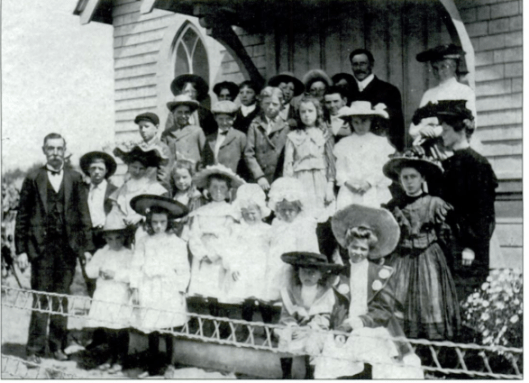
The St. Barnabas Sunday School, 1906. Clara Paulding, at upper right, was the church organist; this church is now Oceano’s St. Francis.
I got to see that sink, among a houseful of minor but precious treasures, during a tour today after rehearsal for the South County Historical Society production, The Mistress of Crown Hill.
I knew Ruth, or Miss Paulding, when I was a little boy. We were both parishioners at St. Barnabas Episcopal Church, then in a surplus World War II chapel on what was once Barnett Street; the street’s gone and so is the church, replaced by a gas station. Memories have more staying power than mere buildings, especially if they’re of women like Miss Paulding. She was by then in a wheelchair but had a kind of elegance about her, dressed as she was for Grace Cathedral instead of an old army chapel, and if her body was betraying her, her spine curved cruelly, her spirit was graceful and even youthful. If you got a little smile from Miss Paulding on returning to your pew from the communion rail, it carried the same freight as a priest’s blessing.
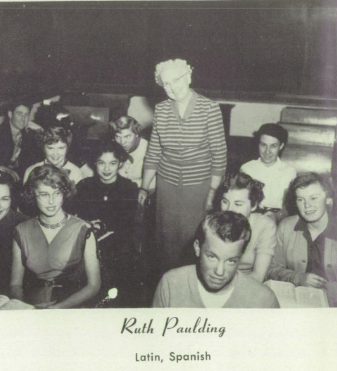
From the 1955 Arroyo Grande Union High School yearbook.
Ruth was born in that house and she would die there in the aftermath of the 1960s, when the nation seemed to be coming apart at the seams, because that was exactly what it was doing. Her mother, Clara, was a great student of history as well as a great teacher–she’d taught at Branch, Huasna, Santa Manuela, Oceano, was the principal of the Arroyo Grande Grammar School and one of the founders of the high school–and she might have been able to give us all some perspective then, perspective we need today, about the durability of America and of Americans.
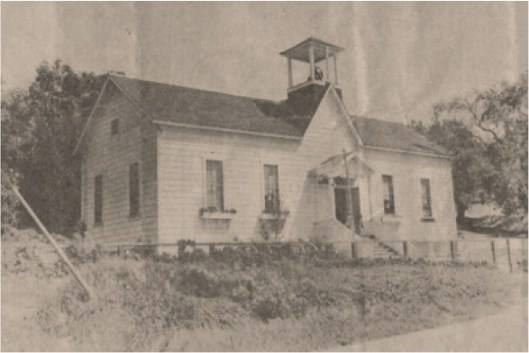
Branch Elementary School
Clara was durable. She and Ed buried a little boy in the front yard, under a white rosebush, who should have been Ruth’s older brother. He died a few hours after a birth that nearly killed Clara, as well. But this was a woman who had commuted to Cholame to teach, spent the night at Creston to come home down the Grade in her trap and pony where there were no turnouts and the road edged sheer drops of hundreds of feet.
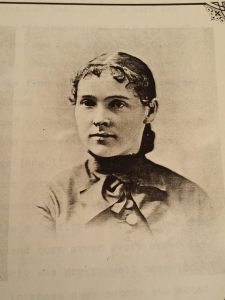
Clara Edwards Paudling, 1881.
I did not know that I had ties to Clara until later, but from what I knew about Ruth’smother, I was an admirer. She returned to college with Ruth, who’d been promised an extra $100 a year, if she took additional coursework, when the Second World War began to revive the economy. The pair decided to take summer courses at Clara’s alma mater, Mills College. Ruth took classes for the extra money; Clara, at ninety-three, took hers for pleasure, a course in “History of the United States to 1865” because, she said, she remembered the rest.
One of Clara’s assignments during nearly fifty years in the classroom had been at the school I attended, Branch Elementary. There is a photo of her in front of the school. Behind Clara and her bicycle in 1898 is the same doorway I would enter on my first day of formal education sixty years later. She taught, by herself, sixty children at eleven different grade levels and not only did she juggle them artfully, but she loved them, too.
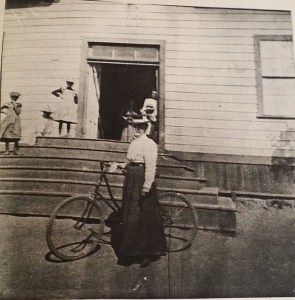
Clara Paulding, Branch School, 1898
Arroyo Grande’s population, at the time of the photograph, was approaching 1,000. Beyond the town, to the east in the Upper Valley, and to the west, bounded by the sand dunes at the edge of the Pacific, in the Lower Valley, there were patchworks of farms worked by ambitious pragmatists: Arroyo Grande men and their teams of heavily-muscled draft horses, their necks arched in effort, turned some of the richest soil in the world to prepare it for planting. They might have been plowing for sowing pumpkins or carrots, onions or beans, or one of the most important products in the many cycles of agriculture the Valley has seen: flowers, cultivated for their seeds.
What must have delighted Clara Paulding on her two-mile bicycle commute to her sixty students every morning would have been the sight of brilliant fields of flowers and, planted in others, she would have smelled the delicate fragrance of sweet peas.
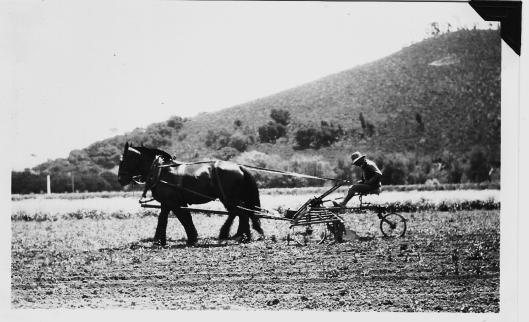
A Waller Seed Company employee cultivates a field in the Lower Arroyo Grande Valley at about the time of the First World War.
It’s not hard to imagine her, given her personality, waving cheerily to the men working those fields, their faces hidden by broad-brimmed straw hats, or to imagine them waving back, wide smiles creasing their upturned faces. because even as field workers they had never had this much hope, and even in the Upper Valley, hemmed in closely by the oak-studded Santa Lucia foothills, they had never had this much room.
Clara’s spirit was expansive. She may look severe in her photograph, but she adored, without disguising it, young people, and the youngest the most, a feeling they reciprocated. Her wave on school mornings would have touched these men, younger sons from a very crowded place, and not particularly welcome in this new place.
The men in the fields whom she greeted were from Japan, and some of them from a prefecture known as Hiroshima-ken.
Clara’s spirit suffuses the Paulding House when you walk inside. It is a loving, unpretentious kind of homeliness and you are honored to be its guest. It is also a little insistent, as Clara was (she was descended from Jonathan Edwards, the terrifying Puritan divine) that you wipe your feet. That’s why the bathtub, one of Clara’s more prized possessions, adjoins an exterior door that overlooks the gardens where Ed loved to putter. Ed was by nature a putterer. Clara was by nature a pragmatist, and Ed was not allowed back into the house after his gardening until he’d cleaned himself up in the bathroom first. And the bathtub was no trivial thing: people would drive out to the Coffee Rice home in the 1890s just to stare at a bathtub that was the equivalent of a Disneyland ride. People just didn’t have them, and the Pauldings had Arroyo Grande’s second. It is a long one and looks like it was made for leisurely baths accompanied by books or magazines and maybe a hot chocolate.
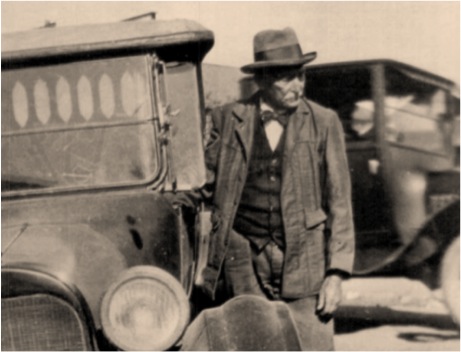
Dr. Edwin Paulding
Ed also loved woodcarving. Doctoring, not so much, although a glass hutch contains virtually every instrument he’d carried in his black bag, even his original Gray’s Anatomy. He resented it a little when folks got sick or fell off rooftops, as he did once, because it took him away from his flowers and his woodcarving. But there was nobody in San Luis Obispo County better equipped to deal with roof plunges than Ed: he was a natural-born orthopedist, and a bone set by Doc Paulding, it was said, healed as good as new and sometimes better. (Clara would need Ed when a speeding handcar smashed into her buggy at the foot of Crown Hill and broke her arm in three places. It healed completely. And the Pauldings got $1500 from the Pacific Coast Railway, which they needed. Ed was as inept with money as he was skilled at setting broken bones.)
So the mantle and smaller pieces–down to a little rocking chair for Ruth–were all made by Ed, and they’re cut with delicate and graceful motifs, usually floral, inspired by the models he’d just brought in from the garden where he loved to get dirty. Clara later bought a little farm, just outside of town, and it was there where Ed, in his older years, was happiest. When he got sick one day in what would turn out to be his last illness, he’d forgotten to take his morning medicine. Clara, 79, walked–or rather, marched–out to the farm and watched critically as Ed swallowed his required tablespoon.
Ruth, far right, as a little girl.
There are curios, under glass, everywhere: a rhinoceros-hide warrior’s shield that Ed’s missionary parents had acquired in Syria, where he was born, a Chumash water-carrier, like a canteen, caulked with Pismo tar; the contents of Ed’s pockets, including his pocket-watch and chain, money clip, a tiny folding knife. Aside from Gray’s Anatomy, there are books everywhere: a collected Dickens, A Thousand and One Knights, a multi-volume history of the United States, collections of English Romantic poets, especially Tennyson, Clara’s favorite. And there is the bedframe, dark walnut, with a lion’s head relief at the headboard, and that lion was Ruth’s lion. It protected her every night she went to sleep as a little girl; it was as solid and as real and as constant as were her parents.
And everywhere there are tea services. Ruth’s little-girl doll’s cups and saucers are painted with delicate, tiny flower buds. There is a sterling-silver coffee service at one end of the dining room table, and on a shelf above, there is the best of all. It’s the set Ruth reserved especially for her high school students when she welcomed them into the home of her own girlhood, and that service was reserved for hot chocolate so rich that teenagers would remember it the rest of their lives.
Jim Gregory is a retired Arroyo Grande High School history teacher and the author of the books World War II Arroyo Grande and the just-released Patriot Graves: Discovering a California Town’s Civil War Heritage.


Jim,
My good friend Nancy and Ruth are related. She was fascinated to see this post. Nancy said the photo was taken by Will Paulding, the druggist (Ed’s brother) and the ‘unidentified little girl’ Ormie Paulding, was Ed’s older brother’s daughter! Great writing. We really enjoyed this. Do you have more stories about Ruth????
LikeLike
Thank you so much for the new information! I wish I knew more about Ruth,but here’s an excerpt from my book, World War II Arroyo Grande, that features Clara. (Sixty years after the photo was taken, I would enter that doorway at Branch School to begin my own education!)
LikeLike
Jim, I will print out this information and photos for Nancy to see. (She is 89 yrs. young). Thank you so much for writing.
LikeLike
God bless her, and you!
LikeLike
Yes, we are . . . and finding your Blog was one Sign of this! Nancy expressed interest in your book so I will look for a copy for her. Che’usa
LikeLike