
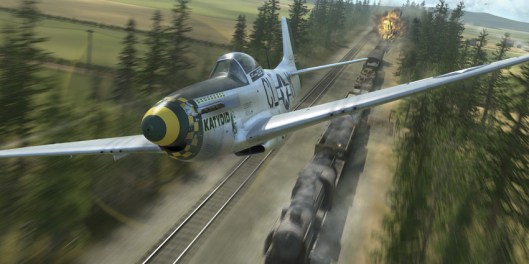
Artist’s conception of Lt. Col. Righetti’s P-51, “Katydid,” named for his wife.
By my count, 106 young San Luis Obispo County men were killed during World War II. Twenty-seven of them were airmen, most in the Army Air Corps and a few Navy fliers; there was a Naval aviation training school at Poly during the War.
I’m not sure why it is, but death in the air seems even more capricious and cruel than death in ground combat, and I think that’s because so many of those 27 county residents were killed in stateside accidents. [There were numerous fatalities in local crashes: a P-38 in Oceano, another that plunged into a Santa Maria cafe; a P-39 Aircobra that left a huge crater in Shell Beach.] Combat airplanes don’t forgive a lot, not even a moment’s inattention:
- Frederick George Gillis was an air cadet who died in Lancaster when his trainer went out of control and flew into a mountain. Both Gillis and his flight instructor bailed out in time. Gillis’s parachute didn’t open.
- A midair collision of two B-25 medium bombers “on a routine training flight” from Tampa killed Lt. Randoph Donalson over Newberry, South Carolina.
- When his B-17 pilot tried to make a crash landing in a meadow near Roundup, Montana, Staff Sgt. Charles Valys died when the plane hit the ground, exploded, and broke apart.
All of these men were in their twenties.
The “old man” among our lost fliers was Lt. Col. Elwyn Righetti, from San Luis Obispo, a P-51D pilot shot down near Dresden in the weeks following the notorious fire-bombing there. Righettti, 30, was the winner of the Silver Star with four oak leaf clusters for both his kills and his superb leadership of the 55th Fighter Squadron. Righetti survived his plane’s crash-landing. He radioed his comrades that he was all right, yet he was never found and is still listed as “missing in action.” There is a chance that he was killed by German civilians; another downed American was summarily executed the day before Righetti was shot down.
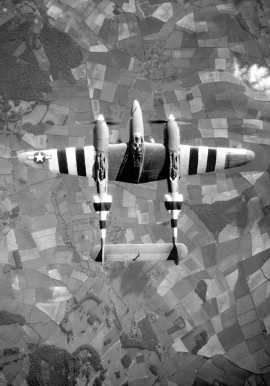
Jack Langston’s P-38 would have looked like this one, with its D-Day markings.
Righetti’s body was never found, and neither was 2nd Lt. Jack Langston’s. He was shot down by ground fire in his P-38 during a low-level attack on Cherbourg in the weeks after D-Day. Many of these fliers simply disappeared; Langston’s fighter exploded in the air.

A doomed B-17.
Sgt. Donal Laird was a ball-turret gunner in a B-17 named “Strictly GI,” shot down over Karlsruhe, a city of scientists once visited by Thomas Jefferson. Flak probably claimed 1st Lt. James Pearson, from Paso Robles, and the crew of his B-26 Marauder over Belgium during the Battle of the Bulge. An Army Air Corps captain and friend of flight engineer Loren Bubar found his body, later positively identified, a year after Bubar’s B-17 collided with a German ME-109 fighter near Frankfurt.
Loren lies today amid other young Americans in a military cemetery in Luxmebourg, 5,500 miles away from home.
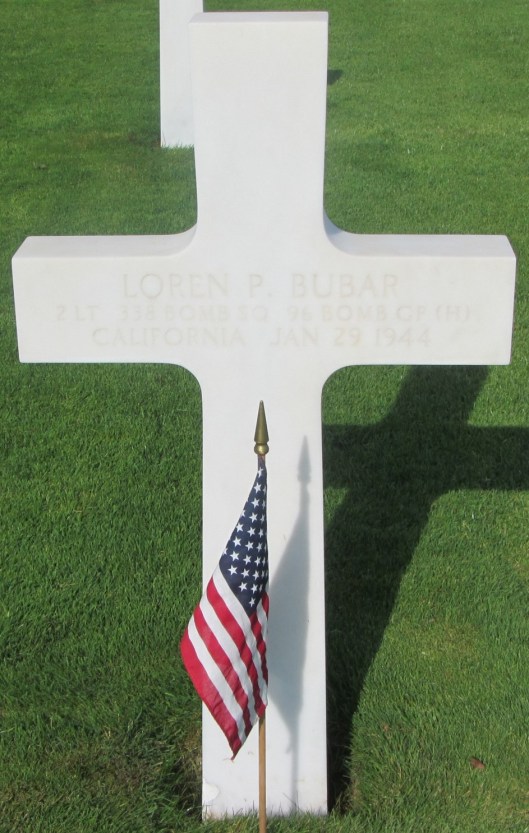
Loren Bubar’s grave.


Dear Gregory,
I admire our research and dedication to record the service of your fliers.
Thanks for your comments and interest in the FONFA website. Joe Griffin was a great guy and a true gentleman, sadly now passed away, like so many of his former colleagues.
We hope to keep the memories alive, and educate and inspire the young, through the Museum and the Memorial.
The next three Open days will be interesting, with new artefacts and the loan of a WW2 Merlin engine form the Rolls-Royce Heritage Collection.
Kind Regards,
Dr Henry Goodall
Chair of Trustees, FONFA
LikeLiked by 1 person
Thank you for your kind words, Dr. Goodall. I wish I could be there! There is no lovelier sound in the man-made world than that of a Merlin-Rolls Royce engine. We have had some P-51 fly-ins near my home town in Central California, and I can never keep my heart rate down when one does a fly-by. Such a lovely airplane, and I absolutely refuse to exit this life until I’ve seen and heard another just as beautiful—a Spitfire.
I would write a little book about my California home town, World War II Arroyo Grande, and it cites a member of Mr. Griffin’s group from our area, Lt. Jack Langston, shot down over Cherbourg 22 June 1944 in what seems to have been a near-suicidal strafing mission targeting the deep German artillery and anti-aircraft defenses. I hope to learn and write more about the 367th in a new book that focuses on our area’s aviators during the War.
Here are some of the young men we lost:
https://drive.google.com/open?id=0B05dFICUx2kGU3pBQ1NHUEE4b1k
My very best wishes to you and your wonderful organization.
Jim
LikeLike