
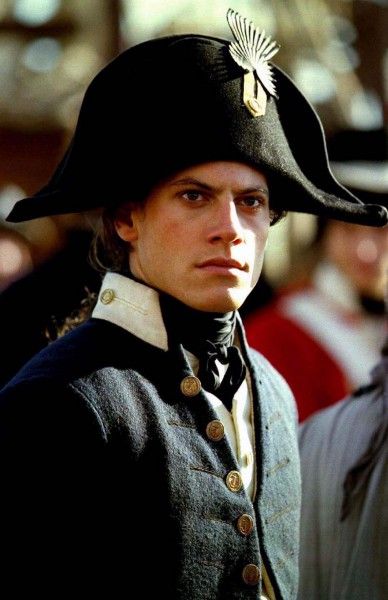
Ioan Gruffud as a hunky Lieutentant Horblower
in the television miniseries
My first adult reading had to have been, at least in terms of fiction, the trilogy of Horatio Hornblower novels my father had bought some time during World War II, possibly when he was stationed in London. He liked the books and they may have inspired him to take the steam train down to Portsmouth to see Admiral Nelson’s HMS Victory. One of the souvenirs he brought home with him, besides several bottles of Cointreau, was a little tin box of hard candy, its lid embossed with the image of the great ship on which Nelson–Hornblower’s real-life inspiration, just as Hornblower would inspire Captain Kirk– had died in 1805. My mother kept the box for years to store bobbins of her brightly-colored sewing-machine thread.
Hornblower, like Nelson, was a Royal Navy officer during the Napoleonic Wars, and he became so popular the his creator, C.S. Forester, could not get rid of him, in much the same way L. Frank Baum could not get rid of Dorothy nor Conan Doyle kill off Sherlock Holmes. Forester would eventually write nearly twenty in the series that followed the hero from his days as a green (This is meant quite literally. See below.) midshipman, with feet the size of shovels, to his last posting as an admiral in the West Indies, and in the process, his novels would spawn a little trailing fleet of fictional acolytes: Nicholas Ramage, Richard Bolitho and, of course, Jack Aubrey, the creation of Patrick O’Brian, a writer–like spy novelist John LeCarré–who has, through the force of his prose, leaped the gap between popular fiction and literature.
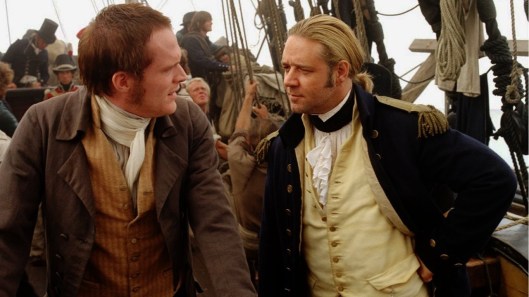
The best of friends: the logician Dr. Maturin and the passionate Captain Aubrey in director Peter Weir’s Master and Commander.
If Hornblower’s leap didn’t quite make it, blame his big feet. But that was what immediately lovable about Forester’s character: He was imperfect, a little cranky, relentlessly critical of himself, and modern. In the first few pages of the first novel in series, we learn he is disgusted because he, a frigate captain in his thirties, is beginning to develop a pot belly. He is given to shouting “God damn your eyes!” at his coxswains and servants, a phrase, sadly, that I never revived. Like his real-life inspiration, Lord Nelson, he starts each voyage confined to his cabin, where he is violently and spectacularly seasick. He sits a horse, elbows akimbo, buttocks and saddle at war with each other, with no more grace than Ichabod Crane did. He is trapped in an unhappy marriage with the unhappy Maria (“simpering” is the adjective Forester chooses) —had they lipstick in Napoleonic Europe, Maria’s would have been very red, liberally and inaccurately applied, and since she was constantly weeping at her husband’s departures, her mascara would’ve run like printer’s ink.
Fortunately for Hornblower, Forester kills Maria off by the third novel, replacing her with the far more elegant Lady Barbara, sensitive to and soothing of her husband’s many moods. She is, I think, a fictional counterpart to the sensitive and soothing Clementine Churchill, who deserved a Victoria Cross for not only putting up with Winston, but for her courageous persistence in loving him. Hornblower’s men love him, too–a phenomenon he can’t quite understand, which is charming in itself–because he inspires them and he is, in his prickly way, devoted to them, despite their tendency, in battle, to be skewered by splinters or reduced to jelly by enemy cannonballs bouncing their way along the main deck. (“Jelly” is a favorite of Forester’s, since it was in such short supply, I suppose, in wartime England)
Not that this moodiness of Hornblower’s was ill-earned: As a very young officer, his first prize ship—a “prize” was a captured enemy vessel that meant money for a crew, and Hornblower was given command of this one—was a French coaster hauling a cargo of rice. What Hornblower and his prize crew didn’t realize was that the little ship was holed below the waterline. So sea-water rushed into the hold and the rice did the usual thing that rice does when it gets flustered and wet: it expanded, tearing young Hornblower’s little command into pieces, the ship’s planks exploding like gunshots, before he and his crew had to be rescued. Hornblower has a history of leaks. In a later novel, Hornblower and the Atropos, as a junior post-captain, he’s given the honor of commanding Lord Nelson’s funeral barge—and balanced on the barge is the massive coffin that contains the tiny admiral—when, in mid-Thames, it begins to spring leaks. Hornblower manages to bring the barge safely to its destination, St. Paul’s, for Nelson’s funeral—I’ve seen that barge, in the Royal Naval Museum in Portsmouth—but not before suffering what has to be the most epic panic attack in English-language fiction.
Even his fighting ships betray him. His first ship-of-the-line, an early 19th century equivalent to a battleship, Sutherland, is Dutch-built and so is shallow-drafted—she’s meant to protect a coastline on which Hans Brinker occasionally skates—and so sails with all the grace of pig iron. The French sink Sutherland, good news for Hornblower, but capture him and Mr. William Bush, his stolid and mildly dim-witted First Lieutenant, which is not so good. Hornblower will escape eventually to go on to command, as a commodore, a little fleet of ships in the Baltic, including a bastardization of naval architecture called a bomb-ketch, which is essentially a floating mortar and so graceless as to make Sutherland look like a clipper ship.
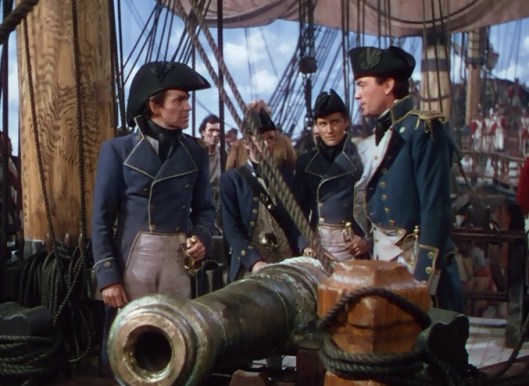
Robert Beatty, as Lt. Bush, at left; Gregory Peck, as a mysteriously American-sounding Hornblower, at right, in the 1951 film version of the first novels.
Forester wrote so many Hornblower novels and wrote them so well that one of my favorites was not a novel and was not written by him at all. A gentleman named C. Northcote Parkinson, thanks to his discovery of the mythical Hornblower Family Papers, wrote a biography, The Life and Times of Horatio Hornblower, as if his subject was not mythical at all. It is enchanting.
The best part reveals another facet of Hornblower’s character that redeems his crankiness and his seeming ill-luck: He is a man of immense courage. His moral center, part of what makes him so critical of himself, is clear from the first moment we meet him, as a midshipmen. A little later, as an immensely junior lieutenant, he is assigned to the luckless ship-of-the-line Renown, whose captain, Sawyer, is mean-spirited, vengeful, and flagrantly paranoid. He makes Bligh look liked Billie Burke’s Glenda the Good in 1939’s Wizard of Oz.
Before Sawyer can foul up a mission against the Spanish by court-martialing his officers on trumped-up charges of mutiny, he mysteriously tumbles down a hatch, fractures his skull, and so command passes to a far more capable man, First Lieutenant Buckland. Buckland will then lead the Renowns to a daring victory (the shore party is commanded by Bush) over the perfidious Spanish, who, in Hornblower’s world, are just as perfidious as they’d been in 1588, Good Queen Bess’s time.
At a much later time, 1970, it is Parkinson, thanks to the Hornblower Papers, who reveals the ultimate and shocking truth. Sawyer was in part right: There was a mutiny, but it was, according to C. Northcote Parkinson, a mutiny of one, on the part of the lowly Fifth Lieutenant, Horatio Hornblower. While Renown’s coterie of officers fretted about what to do about their mad captain—they were seized with paralysis with the enemy virtually within sight—it was Hornblower who shoved Sawyer down the open hatchway. It was an action motivated by Hornblower’s unfailing devotion to his duty, and it was the mad Captain Sawyer who was preventing Renown from doing hers.
 A Work in Progress
I went to sea because of Hornblower.
LikeLike