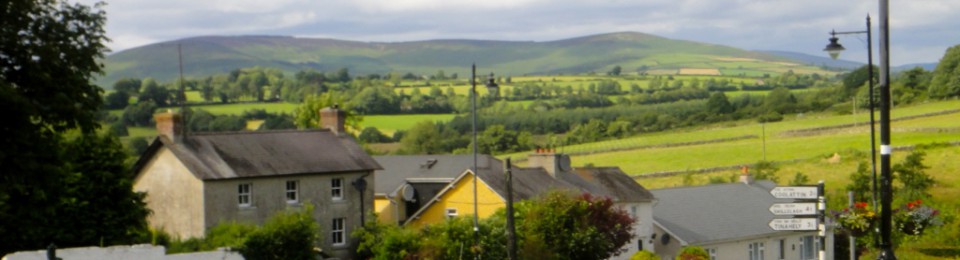
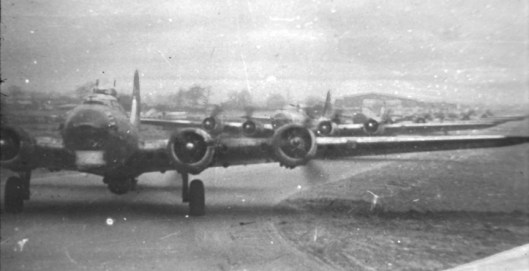
Two photos about the Eighth Air Force’s war in England: 398th Bomb Group B-17G’s taxi on the runway of their base in Hertfordshire, 1944; a young American airman with an even younger British friend.
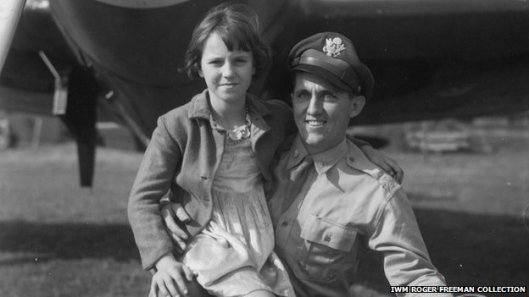
British schoolchildren adored the Yanks, and, of course, their Hershey bars. At the start of any combat mission, the perimeter fence around any American airfield in East Anglia would be lined with children, waving goodbye as the big bombers took off.
Many of their Yank friends wouldn’t come back, of course. For every American infantry soldier killed in World War II, three were wounded. For every American airman wounded in World War II, three were killed.
My father was no flier–he was a Quartermaster officer, stationed in London for much of the war. But he, too, found that link–that “Special Relationship”–with the English, who treated him with great kindness.
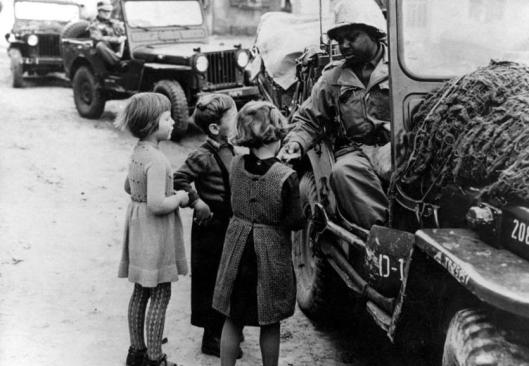
At the war’s end, he found something remarkably similar–a great kindness– in Germany. The photograph of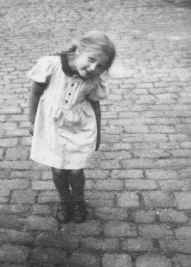 the other little girl, the shy little charmer, validates, in its way, my father’s fondness for the Germans he came to know. Her photo was taken by a GI in occupied Berlin in 1945.
Mr. Kamin, our German teacher, was leading a student trip there when he was approached by a matronly woman who had once been a little girl like the one in the photograph.
“You’re Americans, aren’t you?” she asked.
Mr. Kamin confessed it.
Her eyes welled with tears. “I just want to thank you for the kindness your soldiers showed me after the war.” She shook Mark’s hand, the German teacher born long after her GI’s had gone home.
I enjoy military history, obviously, and it is both tempting and dangerous to romanticize war. But I found, over and over again, in writing the book, incidents of kindness—there’s that word again—on the part of luftwaffe soldiers toward the American fliers they’d captured.
In several instances, they actually saved the lives of airmen who were about to be lynched by outraged civilians. That’s because these people had seen German schoolchildren reduced to ash by incendiaries or buried alive beneath tenement rows, collapsed in unrecognizable heaps by high explosives. The Americans were terrorfliegers, terror fliers, and cold-blooded killers. The only thing that saved the Yanks from German civilians was the intercession of German soldiers.
One 88-mm crew among them offered a local co-pilot, a man who lived in Morro Bay after the war, a bowl of potato soup for lunch after they’d shot his B-17 down one afternoon. Another one, a luftwaffe sergeant, while taking an airman by train to the interrogation center near Frankfurt, popped open the latches on his briefcase, reached inside, and brought out a thick slice of sausage on black bread that he handed wordlessly to his prisoner.
I don’t know how, and never will know how, to reconcile those Germans with the the SS guards in the camp photo albums who ate bowls of blueberries with their pretty secretaries or sang folk songs in manly choruses just beyond the smell of the children reduced to smoke in the crematoria chimneys of Auschwitz-Birkenau.
Those moments when I despair in history–and they are so frequent, and so barbaric– are never balanced completely by moments of decency. So I savor decency where I can find it.
War can reveal, in the briefest of moments, in gentle accidents, our decency, our deepest humanity. That’s when we find, as my father did, our best intentions and most generous impulses returned to us, even from people we were taught to hate.
Berlin, 1 May 1945
 A Work in Progress