
An excerpt from the book Central Coast Aviators in World War II.
* * *
Southern England, Spring 1944.
This royal throne of kings, this sceptred isle,
This earth of majesty, this seat of Mars
…This precious stone set in the silver sea
…This blessed plot, this earth, this realm, this England.
Shakespeare, King Richard II.
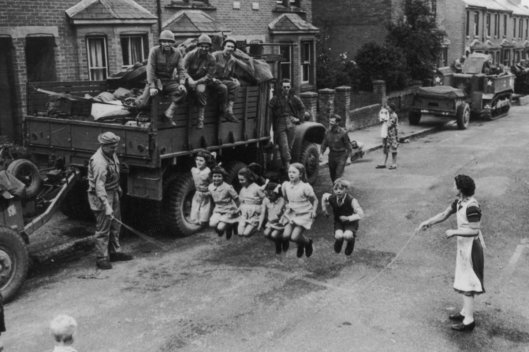
If there was a military historian with a gift close to Shakespeare’s, it was another Englishman named John Keegan. Keegan was a little boy in the English countryside, in Somerset, when the Americans began to arrive in their numbers in late 1943 and into the spring of 1944. Little English boys had lived for years with the deepest of privations—thanks, in large part, to the U- boat campaign that had nearly starved Shakespeare’s “sceptred isle” to death— and then the Americans came. They were, as Keegan later said in narrating a television history of the Great War in the pivotal spring of 1918, when he for once arrived at a loss for words, “…well, they were Americans.” By which he meant they were boisterous, cocky, well-fed, well- clothed, and, thank God, they were friendly, with an innocence and immediacy that was distinctly American. Their World War II counterparts taught English boys baseball and flirted with their big sisters, and married some of them, but most of them not, which meant that little boys Keegan’s age would inherit littler half- Yank nieces and nephews. Most of all, they were generous. There seemed to be no end to their Hershey bars (there wouldn’t be after the war, either, when, during the Berlin Airlift, one of bomber pilot Jess Milo McChesney’s comrades, Gail Halverson, air-dropped Hershey bars, floating on little parachutes, to the hungry children of blockaded Berlin) and no end to the rough affection for children that came with these big, loud men from across the sea.

GI’s introduce British war orphans to baseball.
And then they were gone. Keegan has vividly described the early-morning dark when that happened, when the chinaware and modest family crystal on every shelf in the Keegan home began protesting, rattling an alarm so loud that it woke the family up, if the motion beneath their beds hadn’t already made them sit bolt upright. The anxiety of Keegan’s family, and their neighbors, and of other families all across East Anglia, was relieved only when they went outside. Then anxiety gave way to wonder. They could feel in their breastbones the vibrations—“the grinding forced you to the ground,” Keegan remembered– of the engines of thousands of airplanes, but could see only dim red and amber lights in the sky, heading east, toward France. Some of the Americans Keegan had grown to love so quickly, his heroes, were on those airplanes, and tens of thousands of more, his heroes, were riding deathly pale on landing craft corkscrewing in foul Channel waters, and they were all headed for Normandy.
It was D-Day.
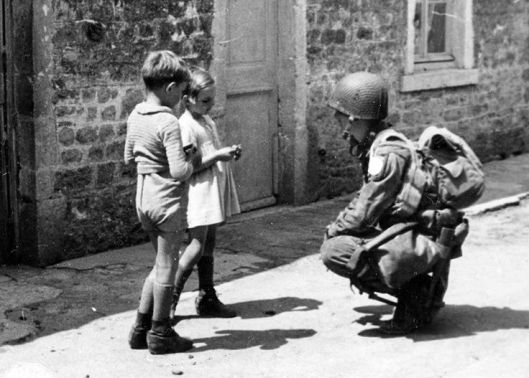
A GI introduces himself to two Norman children, 1944.
For the two years before D-Day, the Americans in England who had been carrying the brunt of their nation’s fight to Nazi Germany were the airmen of the Eighth Air Force. They made up 49 bomb groups and 22 fighter groups and their bases were 71 airfields concentrated in East Anglia, from Norfolk south to Essex, in places that must have sounded quaintly medieval to American ears: Bury St. Edmunds, Knettishall, Little Staughton, Matching Green, Molesworth, Snailsworth, Snetterton Heath, and Thorpe Abbots.
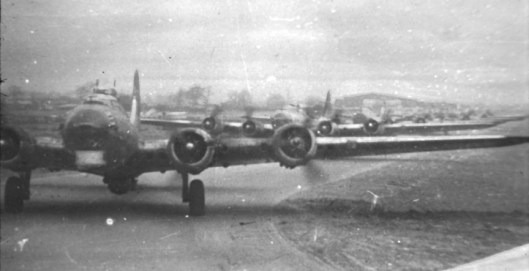
B-17s from the 398th Bomb Group prepare to take off on a combat mission, RAF Molesworth.
Bernard Shaw’s charming line about “two peoples separated by a common language” must have rung true, then, for young men, newcomers to England who’d ferried their bombers from Labrador (or for the luckier men, like Robert Abbey Dickson, who’d shipped out on Queen Mary, or future Cal Poly professor Richard Vane Jones, who’d made his trip on Queen Elizabeth.) Dickson’s luck held: when he first arrived in England, he was sent to the 381st Bomb Group, where he flew two orientation missions as a co-pilot. The 381st’s base was American-built, at Ridgewell, Essex, which meant that it had been built quickly in prefabricated stages by hard-working soldiers, black men, in army construction units. Bases like Ridgewell were marked by Quonset-hut barracks, each with a single, feeble, coal-burning stove, muddy streets, and mercilessly cold showers. But Dickson was quickly transferred to the 91st Bomb Group, based at RAF Bassingbourn, and the “RAF”—Royal Air Force—prefix made all the difference. An Eighth Air Force Base with the “RAF” designation had originally been built by the British, and, given Britons’ stubborn reluctance to give up their island, such bases had been built to last. Bassingbourn had paved streets and central heating. Dickson was delighted. It was, he remembered, almost like a country club compared to the 381st’s home base.
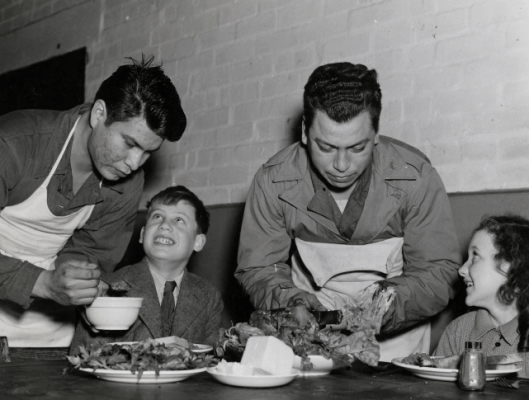 91st Bomb Group airmen serve Thanksgiving dinner to British children, 1944. The GI on the left is Joseph Running Bear, a Lakota soldier. Imperial War Museum.
Army food wasn’t country club fare. Bill Mauldin, the great cartoonist who created the imaginary Willie and Joe, his comrades in the Italian campaign, once remarked, without malice, that his mother was the worst cook in the world. Then he encountered army food, which was infinitely worse. At least airmen understood that they were fed better than men like Mauldin, dogfaces, who commonly used G.I. powdered lemonade to wash their socks. Still, even in the Army Air Forces, the green-hued powdered eggs, along with the ubiquitous Spam, were breakfast standards, and creamed chipped beef on toast—referred to as “shit on a shingle”– followed airmen across the Atlantic from the air bases stateside where they’d first encountered what seemed to be, to the military, a perverse culinary masterpiece. Radioman/gunner Albert Lee Findley Jr. found little relief off-base. “English food took some getting used to,” he admittted tactfully. (Many years after the war, Findley and his wife would live in England as the proprietors of an antique shop.) One vegetable, Brussels sprouts, was as common to English fare as Spam was to American mess halls, and, at war’s end, many English-based G.I.’s swore they would never eat them again.
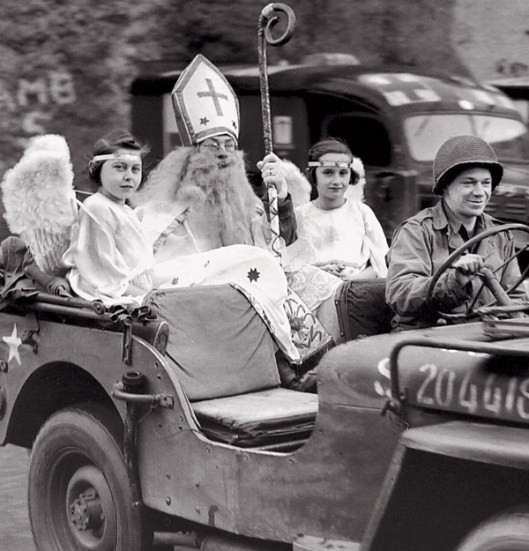
An American St. Nicholas in Luxembourg, 1944.
There were other features of English culture that the Americans found more to their liking. Airmen almost immediately found pubs near their bases, and the attraction was powerful. Historian Donald Miller writes of the 1943 arrival of an AAF engineer battalion, charged with laying out an airstrip outside the village of Debach, near the North Sea. Their discovery of what English called “the local,” this one called The Dog, resulted in the Yanks buying so many rounds “for the house”—the last round, just before closing time, was for forty-seven drinks—that the next day, a doleful little sign was posted outside The Dog: “No beer.” It was, Miller notes, the first time the pub had been closed in 450 years. The Americans, of course, also found young English women to their liking, as well. The War Department discouraged what were called “special relationships,” and made it nearly impossible, thanks to a bureaucratic maze, for the best-intentioned American soldier to marry, but, of course, the War Department failed. “Special relationships” were as common as visits to the local pub. Al Spierling of Arroyo Grande, a B-17 flight engineer, lost a little of his youthful idealism—Spierling was a thoughful young man who made a special trip to York to explore the setting for Brönte’s Wuthering Heights— when he learned that a gunner he knew, a married man, had taken up with an English girl. He was a little shocked. “For a twenty-year-old,” he said, “I learned a lot.”
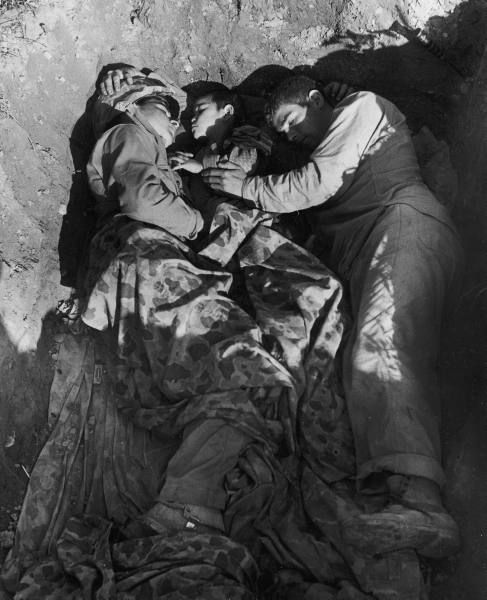
These two young Marines cared for this Okinawan orphan until family members were eventually found.
There was the other special relationship, the one historian Keegan remembered, and that was with English children. Airmen seemed to have great affection, just as other G.I.s did, for their smallest neighbors, and the affection was reciprocated. A typical sight at the beginning of any combat mission would be the children gathered at an airbase’s perimeter fence. They were there to wave goodbye to the crews as their big airplanes took off to reach their assembly points high above the English countryside.
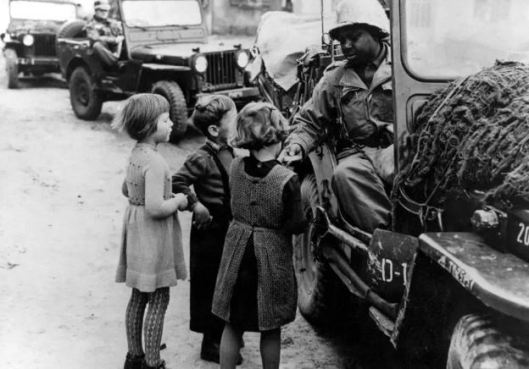
Berlin, May 1945.
 A Work in Progress