I made a severe mistake, a few hours ago, in bringing up Girl Groups in an otherwise splendid Facebook post on chili beans and cornbread.
I then compounded that mistake by frittering away some perfectly good weeding and/or cleaning time looking at old videos of The Ronettes, The Crystals, The Shirelles and Martha Reeves and the Vandellas. Sigh!
The undisputed queens of the genre, of course, were the Supremes. If the Supremes (or the Beatles or Petula Clark) were on The Ed Sullivan Show Sunday nights in 1964 or 1965, all activity in our home, with the exception of minimal breathing activity, ceased.
My Mom adored Diana Ross (and Ringo, by the way). I concurred on Diana, of course. But the most frankly sexy of the three, in my fervid thirteen-year-old imagination, was Flo, the Supreme on the left. She had the most captivating smile and when she looked directly into the camera I turned into a pile of goo. Flo was fictionalized as the tragic member of the group in Dreamgirls; she left the Supremes in 1967 because real life is tragic, too.
It happened, I guess, in part because Diana Ross’s eyelashes were so long and her ego was so big.
But none of that mattered when they were on Sullivan. That shimmy at the start of this performance, for example, was devastating, and Diana was enchanting.
Only The Supremes could transmute a song about infidelity into something so…well, I guess ‘joyful’ is the word. And, yes, it mattered that they were black and from Detroit. They were so beautiful and, thanks to the magic of our Zenith color television, they were singing to us and they were in our living room with us. The barrier between us, between their lives and ours, was seemingly dissolved.
We welcomed, then, the illusion that we knew the Supremes; of course, I went a bit beyond that and fell in love with them.
You couldn’t take your eyes off Diana Ross.
And when a song like this came on the radio, you couldn’t stop the acceleration of your pulse the instant you recognized the opening notes. You missed it the instant it was done.
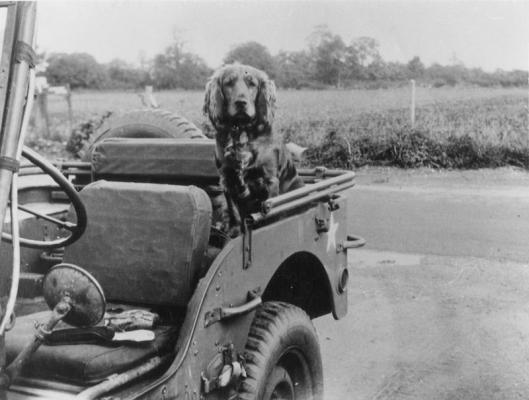
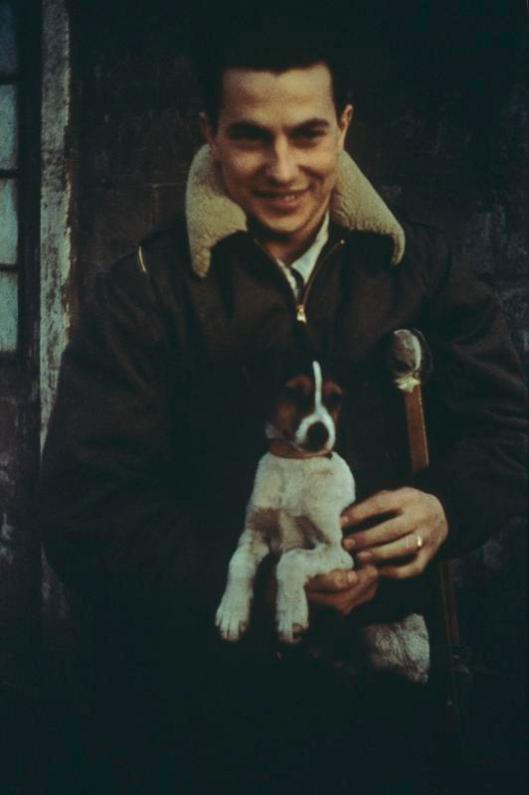
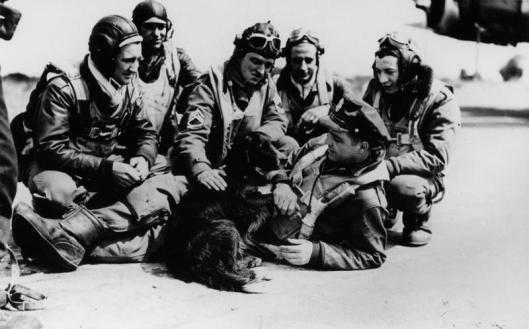
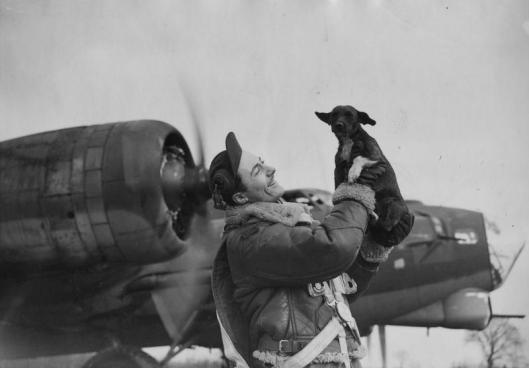
One of the most wonderful discoveries I made while researching the “Aviators” book was learning how much young American fliers loved their dogs—in the records of the American Air Museum in Britain, the best resource for the American Eighth Air Force, lovingly and meticulously kept by our historian friends across the sea, a dog’s nationality is officially listed as “British.”
I was reminded, too, of how young these men were–the average age of a B-17 or B-24 pilot was twenty-two. There were waist gunners as young as sixteen.
When you are that young, you have reason to live.
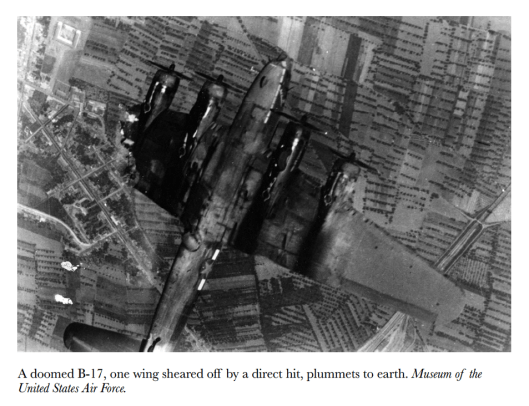
You want to get home. After twelve or fourteen hours in the air, where breathing and urinating and speaking, in unpressurized cabins at 25,000 feet where the temperature is twenty degrees below zero, are all encumbered. The discomfort is broken up by moments of unimaginable terror when you watch your friends’ airplanes break up in the air or you stop breathing to listen to anti-aircraft shrapnel—called “flak,” from a German word too serpentine to pronounce—hit your own plane. Flak sounds like dense hail on a tin roof. Some of it will sever throttle cables or hydraulic lines, or, far worse, some of it will kill friends even closer than the ones you watch falling so slowly to earth. There is nothing you can do about flak.
You want it to be over. You want to get home to the one friend who will still be there for you.
The historian for one B-17 group, the 92nd, provided me with my favorite find: She told me that the ground crews remembered that an airman’s dog would become excited and happy at a mission’s end at the moment when the animal recognized the distinctive pitch of his or her master’s B-17 engines.
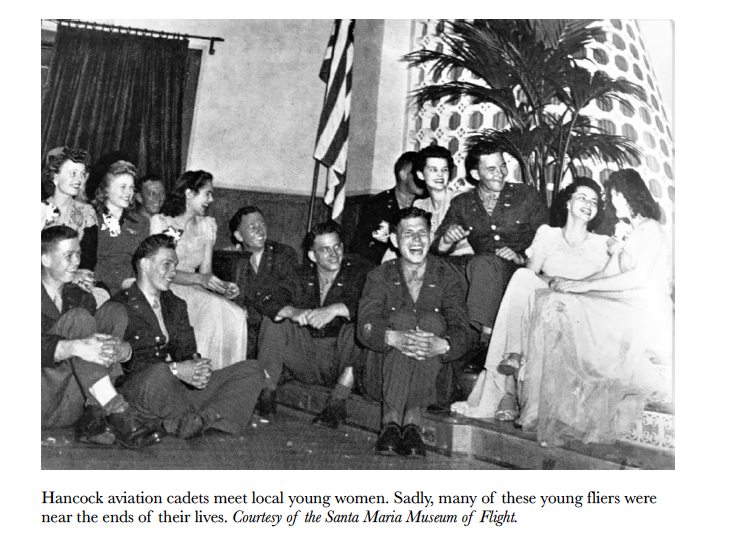
This is one of my favorite photos from the Central Coast Aviators in World War II book, and I got a little more insight into it today. These young women were more than likely USO guests of the Army Air Forces cadets at Hancock Field, Santa Maria, the site of today’s Hancock College. I see at least two girls–one of them looks a little like Betty Grable–with whom I would’ve fallen in love more or less instantly.
The poignant part is in the caption. For every American infantryman killed in World War II, three were wounded.
For every American airman wounded in World War II, three were killed.
I was giving a talk today in Grover Beach on Central Coast Aviators to the volunteers at the Five Cities Food Bank, who, by the way, lay out a lunch to rival any of my grandmother’s, and I noticed, during the talk, an older woman looking at me narrowly. I thought I was bombing, so I didn’t look at her for fear of breaking out in the flop sweat so familiar to standup comedians.
I was wrong.
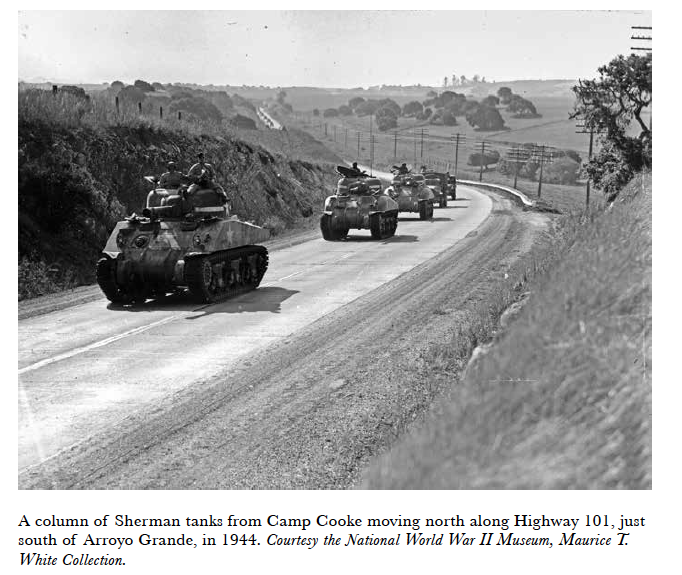
She came up to me after the talk and told me that she’d lived in Los Angeles during the War, and she was part of a USO visit to Camp Cooke, today’s Vandenberg Space Force base. In her time, in World War II, it had been a US Army armored training base, and she was one of the young women, densely chaperoned and caravaned north in Greyhound buses, who would visit the GIs, training to become tank crewmen, courtesy of the USO.
“We had dinner with them, and we went out to a dance, and then we went to church with them. And they were so happy to see us–I had a marvelous time!” Then she bought a book.
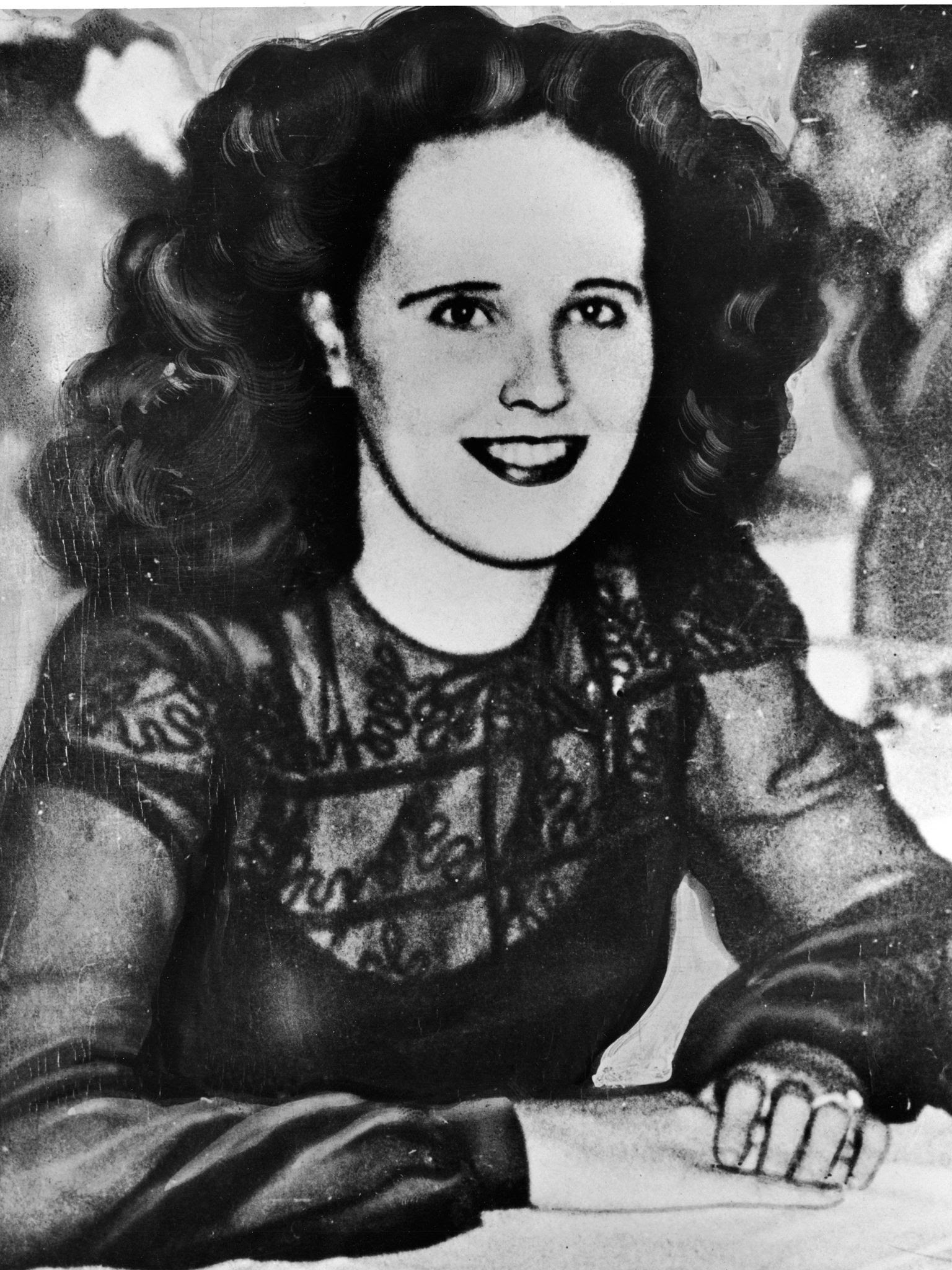
Before you think I’ve gone all soft in the head, I’m well aware that wartime was not an Andy Hardy movie. Illegitimacy skyrocketed, and so did juvenile delinquency. And one of the civilian workers at Camp Cooke–voted a “Camp Cooke Cutie” in the camp newspaper in 1944–was Elizabeth Short (below), the “Black Dahlia” murder victim three years later, which proves, sadly, that a tradition of trivializing women, and of brutalizing them, goes deep in American culture.
The doomed Elizabeth Short.
This woman’s experience was, thank God, vastly different, yet it was the same one I’d heard from a veteran Santa Maria Times reporter, Karen White, who once told me that her big sister went to USO dances at Camp San Luis Obispo. She, too had a marvelous time.
(As a high school history teacher, one of the best proms I ever chaperoned, when my wife and I taught at Mission Prep in San Luis Obispo, was at the Camp SLO Officers’ Club. The place is alive with the presence of officers and officers’ wives or fiancés from back home—they would’ve endured unbelievably uncomfortable wartime train trips—come all the way to California, from a long, long time ago. You can sense them there, sense the vitality of young lives interrupted. I remember feeling somehow comforted by the closeness of them. I’ve heard others talk about the same feelings I had.)
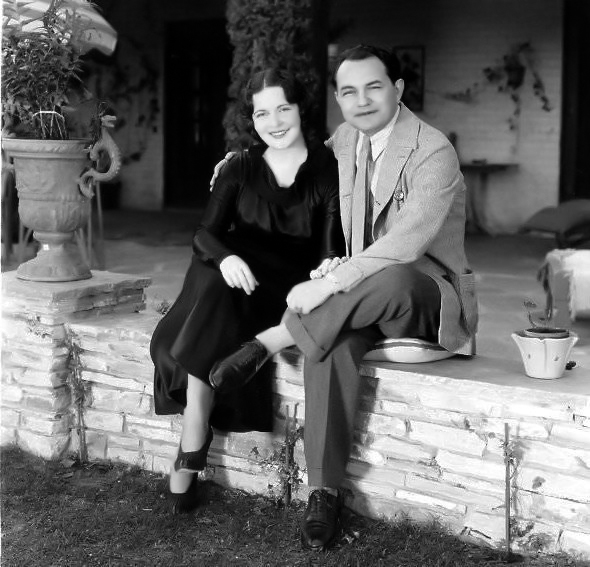
The graduation dances for Navy fliers who’d completed preflight training at Cal Poly—3,000 did during the war, while the civilian student population fell to eighty–had a special touch because the chaperone who brought the young women to Poly was none other than Mrs. Edward G. Robinson. It made sense, Edward G. had been a Navy man in the First World War, long before he became Scarface, long before Fred McMurray poured out his lifeblood and his murder confession to Edward G. in Double Indemnity.
Mr. and Mrs. Robinson.
So I was gifted today with story of a woman who went to a dance with young soldiers seventy-five years ago. For just the briefest of moments, she was, in my imagination and in her memory, a teenager again.
What a blessing.
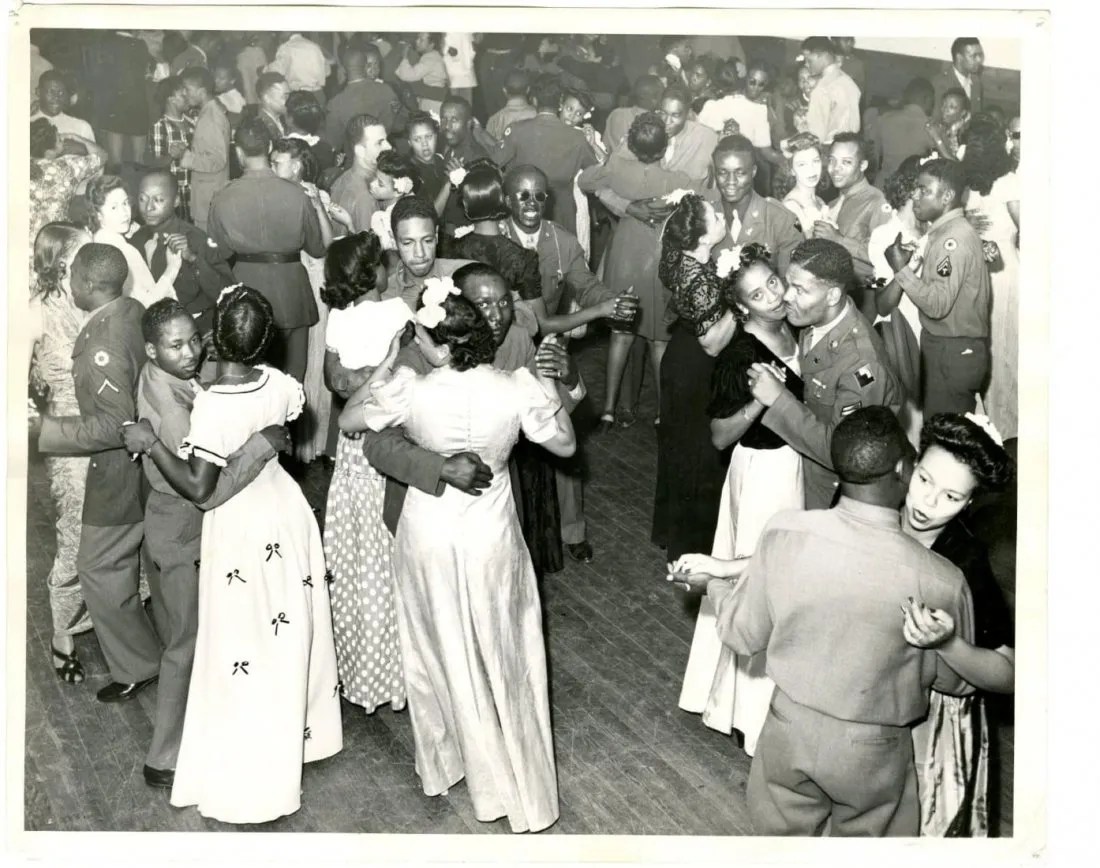
A wartime dance at the Black USO, San Luis Obispo; some of these GIs may belong to the 54th Coast Artillery, with batteries guarding Avila and Estero Bays. Courtesy Erik Brun
My grandmother, Dora Gregory, about 1910, and I made tonight’s dinner—oven-fried chicken and mashed potatoes—thinking of her. Her fried chicken, although I only had it a few times, was divine. It was what I’d call Border State Fried rather than Southern Fried—no batter, but the pieces sprinkled with top-secret seasonings and then coated in flour.
I remember that there would be a bunch of salads–macaroni and fruit, I think, and one made with hominy, and vegetable casseroles, with green beans a favorite, liberally flavored with bacon, sweet potatoes laced with butter and brown sugar—it’s a wonder I’m not dead yet.
(There would also have been, irrelevant as it may seem, sliced ham. Her ham deserves a whole separate post. Her husband, my grandfather John, raised hogs; slaughtering, curing and smoking happened in winter and whole families would participate, moving from one neighbor’s Ozark Plateau farm to another until all the hams were hung. It would’ve been a dreadful time of year to be a hog.)
Of course, Grandmother’s crowning glory, and even the chicken took a little bit of a back seat, was her mashed potatoes, fluffy as clouds. The chicken cracklings and their lubricant would be turned, through some kind of sorcery, into flour gravy ladled over the potatoes, with a little crater in their midst. But I thought that since her mashed potatoes were so good, the gravy was better used over biscuits.
(I like to think that my grandmother would love my mashed taters. Here they are.)
This was in Taft, so it must have been insufferably hot to cook.
The older men ate with linen napkins tucked into their shirt collars; finger-licking was forgiven. All that food would be washed down with iced tea and then the men would take naps while the women kept working.
Many of the men, of course, would someday die of coronary arrest. So it goes.
Then there was dessert. Some of those men, in their last moments, dreamed of lemon meringue pie. That may have been the vision that got them over to the Other Side.
I’ve friends in places like Edinburgh, Assisi and Dublin right now, so it’s kind of stoking that bittersweet urge to travel.
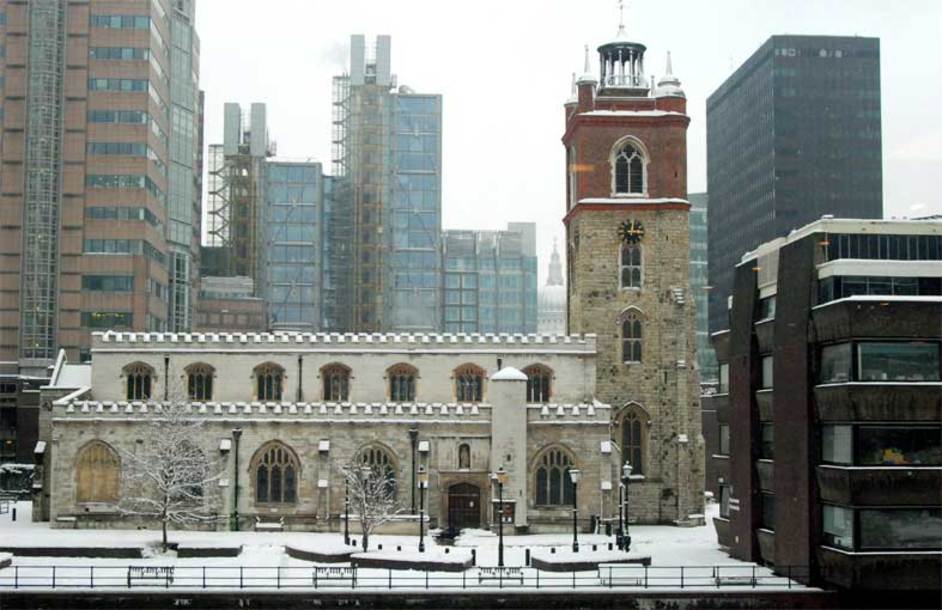
Here’s one place I’d like to see–oddly enough, because it’s such an anomaly, this little 14th-century church, set as it is in a part of modern London that’s all steel and glass and deeply unattractive. But it’s homely, too, with an afterthought of a cupola, built without much thought to its place in architectural history.
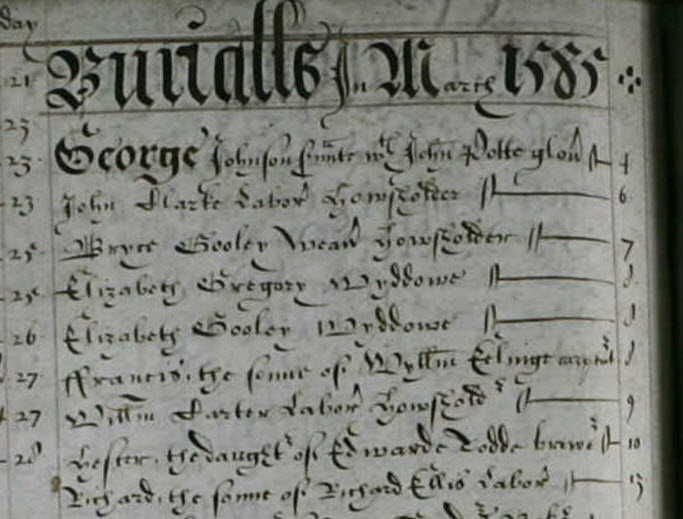
St. Giles-without-Cripplegate, a name that befuddles etymologists, is where my ninth great-grandmother Lady Elizabeth Gelsthorpe Gregory, was buried in 1585. Her husband, Sir John, a mere comma in English genealogy, was from Nottinghamshire, not far from where they found the little cache of bones that belonged to Richard III, with the deep puncture wound, inflicted post-mortem at Bosworth Field, in the royal rear end.
But that was far before Lady Elizabeth’s time.
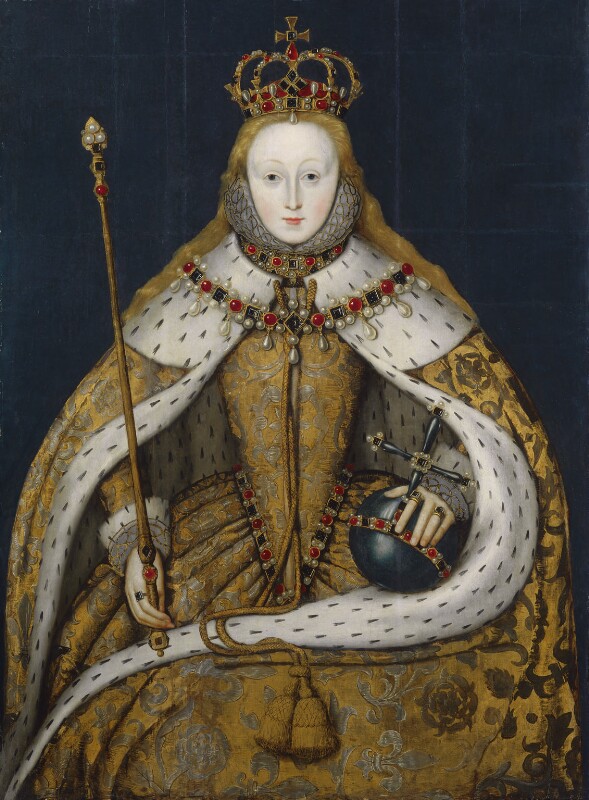
Nope. Her time belonged to this Elizabeth, the granddaughter of Henry VII, the victor at Bosworth. This is her coronation portrait.
What an exciting–and fearful–time to be alive for Lady Elizabeth Gelsthorpe Gregory. The year she was born, Henry VIII declared himself the head of the English Church. When she was five, Thomas More was beheaded.
A girl growing up faced a future nearly as bleak as More’s. (More’s dutiful daughter, Meg, fetched his head–it’d been parboiled to more or less preserve it– down from its spike atop London Bridge, wrapped in it soft linen, and reunited it with the rest of her father.) She was a rarity, Meg More, because she could read and write and speak fluent Latin and passable Greek; even a daughter from a prominent family like the Gelsthorpes would have had just enough learning, including music lessons, to make her marriageable with not a lesson beyond.
At puberty, Lady Elizabeth would’ve been enshrouded in clothing almost as barbaric as the not-yet-invented whalebone corset: linen petticoat surmounted by a stiffened bodice, or kirtle, that mashed the breasts and stifled breathing and then, over that, the gown–for noblewomen, made of dense and elaborate fabric (velvet, or even cloth of gold for prospective noble marriages); the gown would’ve been nearly as heavy as the chains sported by Marley’s ghost. English or French hoods–the latter, Anne Boleyn’s innovation–covered most of a woman’s head. Lady Elizabeth, like most Tudor women, grew up in a cocoon.
She didn’t take long to grow up. She was fifteen when she was married, in the middle of the reign of Henry’s successor Edward VI, the little prig. It appears that she went to the altar pregnant with what would turn out to be a baby boy. This was quite common to the times, a story the parish registers tell us from all the weddings followed scant months later by all the christenings. (Anne Boleyn was heavily and obviously pregnant, like a lower-case letter “b”– or “d,” depending on which way she was facing–when she married Henry VIII.)
Meanwhile, Lady Elizabeth lost that son two years after Mary Tudor became queen. She was twenty-five. Her son was named Thomas; he had just turned eleven. She would would lose another son three years before Elizabeth acceded and her husband three years afterward. A third son would survive her by just two years.
It was a heartbreaking life, made moreso because it was a time bereft of spiritual sureness, what with the Bible whipsawing back and forth between Latin and English and smaller armadas of bishops–High Church, Low Church–taking their turns as kindling, burned at the stake. (More traditional English believers were so incensed by the Bible translator Wycliffe that burned him at the stake forty years after he’d died.)
So she must have spent much of her life holding her breath and mumbling her prayers, the way the Lollards did. Something in you wants to comfort her, which will have to wait, of course.
Here she is in the 1585 parish register:
Three years later the Armada would be blown clear ’round England to wreck on rocks far to the north, off Scotland and Ireland. I wish my Lady Elizabeth Gelsthorpe Gregory could’ve lived to have heard news like that. We Gregorys have a fondness for underdogs. This was the speech Queen Elizabeth delivered to her troops awaiting the Armada and its army, beautifully interpreted by the actress Anne-Marie Duff in the BBC series The Virgin Queen.
Thirty-five years after Lady Elizabeth’s death, Oliver Cromwell would be married in St. Giles.
Eighty-nine years after, John Milton would be buried here.
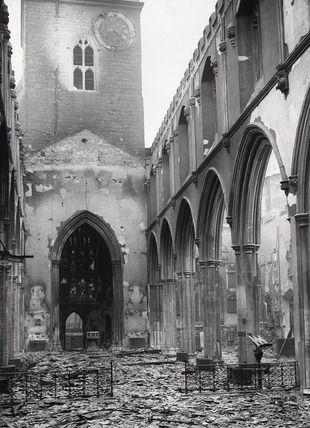
(She would’ve been incensed, I bet, when, In 1940, St. Giles was set afire in the Blitz.)
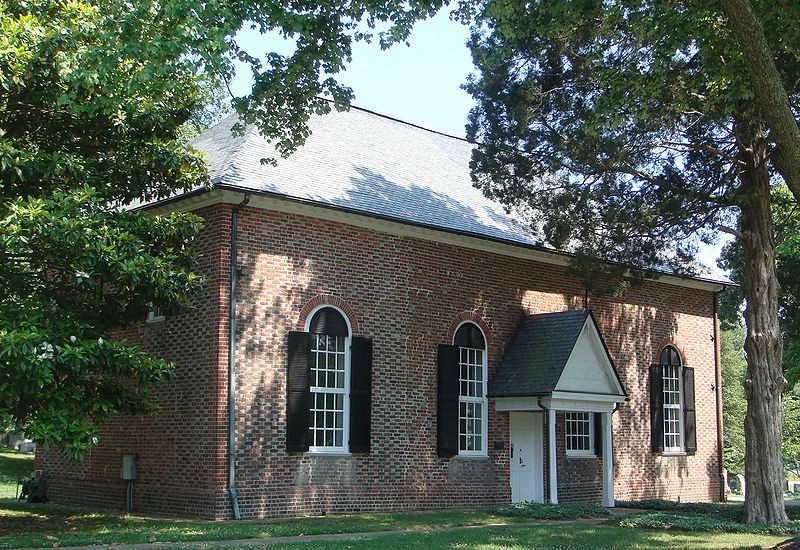
And about fifty years later, her great-grandson, John Gregory, an immigrant from Nottinghamshire, would be a member of the vestry in this little church, St. Mary’s Whitechapel, in Lancaster County, Virginia, the parish of Washington’s mother. (Another Gregory would marry Washington’s Aunt Mildred, a name that has persisted for generations in my family, despite its homeliness, and cede Mt. Vernon to the future president’s family. Do not take real-estate advice from anybody named “Gregory.”)
We had arrived. More or less. Mostly less. Here’s why:
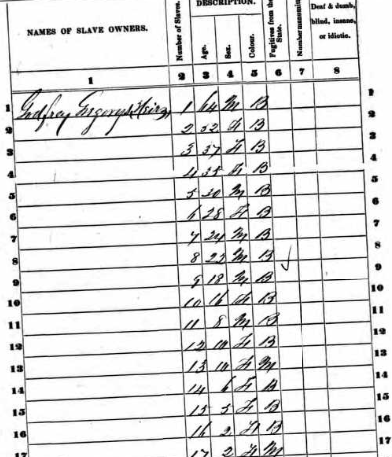
Washington County, Kentucky, of course, was named for the great man. And in the 1850 Kentucky census, here are the slaves owned by Godfrey Gregory, my second great-grandfather. He was, by Kentucky standards, a wealthy man. The slaves have no names in the census, a convenience that made them emotionally as well as legally disposable.
I have no way, of course, of knowing this would be so, but I like to think Lady Elizabeth Gregory would have boxed Godfrey Gregory’s ears. Life is cruel enough. She would’ve had little patience in the practiced cruelty and the hypocrisy that were slavery’s bedrock.


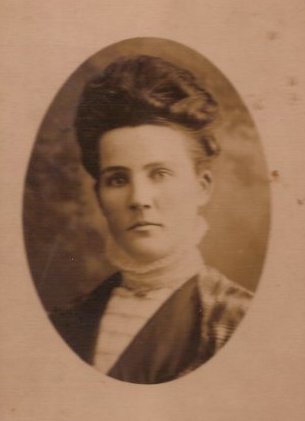 My grandmother, Dora Gregory, about 1910, and I made tonight’s dinner—oven-fried chicken and mashed potatoes—thinking of her. Her fried chicken, although I only had it a few times, was divine. It was what I’d call Border State Fried rather than Southern Fried—no batter, but the pieces sprinkled with top-secret seasonings and then coated in flour.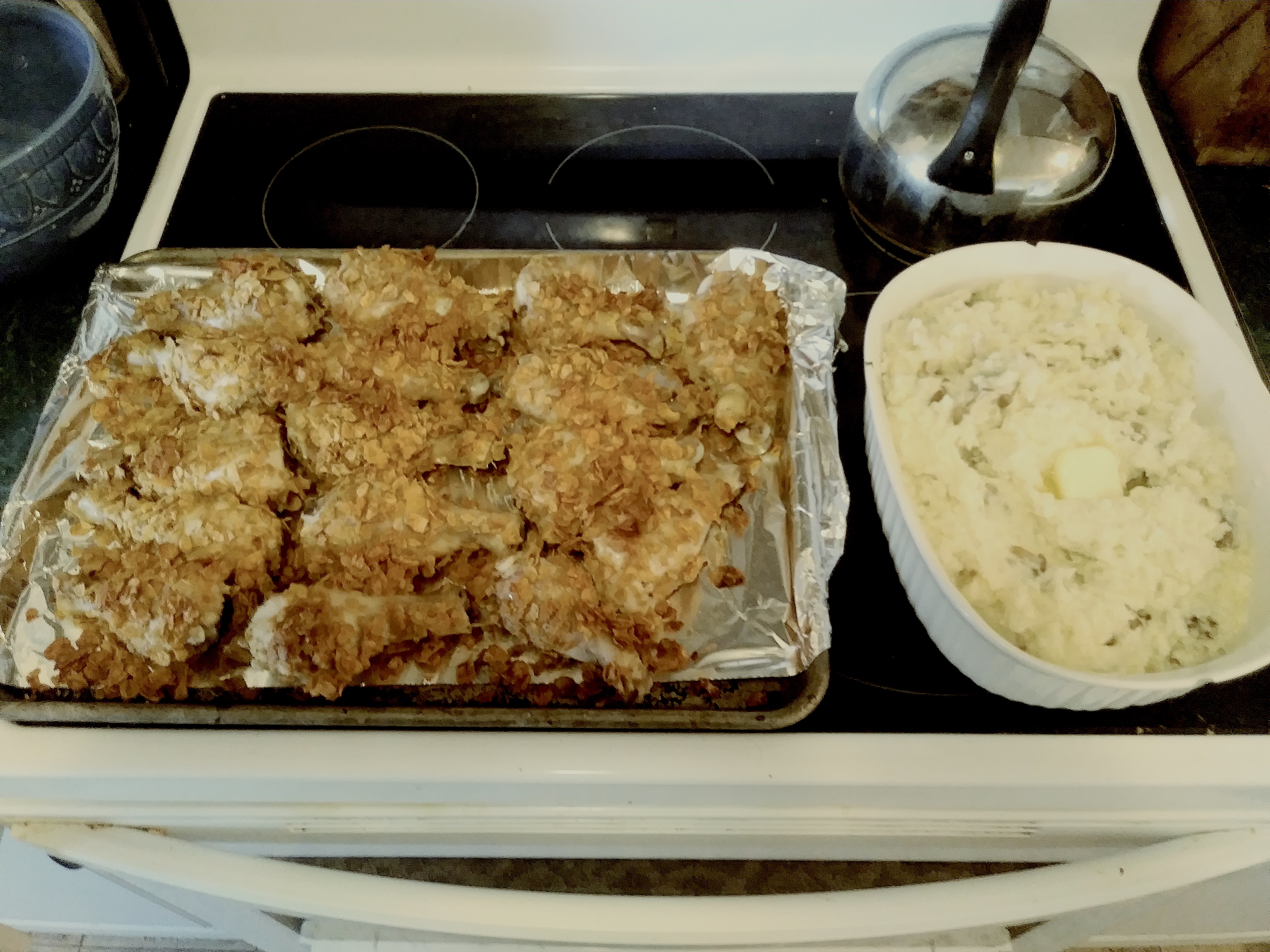
 A Work in Progress