
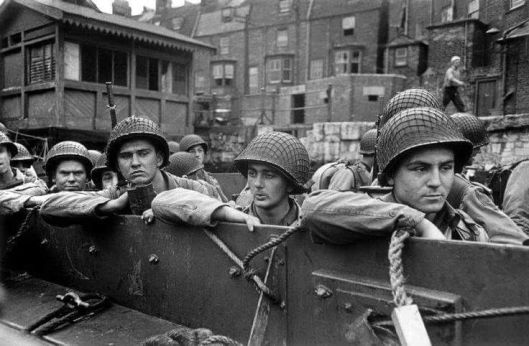
GI’s from Al’s generation on the eve of D-Day.
My friend and former AGHS history student Eddie Matthews and I talked recently about the seemingly contradictory nature of friendships. They don’t always depend on length or frequency of contact. Sometimes someone comes into your life just a few times and Eddie’s point, over our coffees, was that even a casual friendship like that can still evolve into one of the most meaningful friendships of your life.
That’s just the case with another friend, Al Findley Jr, of Los Osos, once a B-24 Liberator radioman who survived having two of his aircrew’s bombers shot down during World War II. The second time, he lost four of the most meaningful friends of his life.
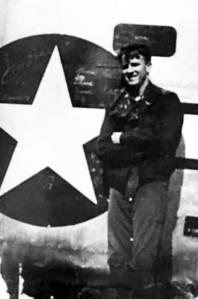
Findley next to his B-24.
Al died on April 28, at 96. His time had come. He’d had a long and extremely successful Air Force career and then became fascinated with antiques and that would become his retirement avocation. He retired to a beautiful place, Los Osos, and he left behind many friends.
I only met and talked to Al maybe four or five times. He was one of my sources for a book called Central Coast Aviators in World War II. But I count him as one of the best friends of my life. And so I miss him.
That’s what happens when you write books. In fact, the people you write about don’t even have to be alive to become close to you and important to you.
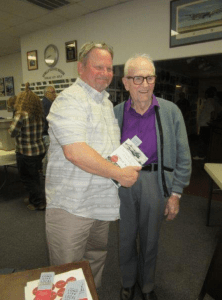
Two friends, Gregory and Findley, at the Estrella Warbirds Museum.
In old newspapers, I’ve been able to follow some local World War II servicemen throughout the course of their lives. Others left letters that were funny or poignant or even enchanting. Many were killed in action, but they became–not friends, exactly–to be honest, these soldiers from my parents’ generation became my sons.
In the 1930s, American social critics condemned that generation’s teens as self-centered, pleasure-seeking and lazy.
There’s just the slightest chance that those critics were right.
But then 400,000 of those young Americans died. That’s 400,000 military men and women. In 1942, as our industrial production surged, more Americans died in factory accidents than on the battlefield.
So I am so very proud to have known a World War II veteran who had no business living beyond his twenty-second birthday. And then he had the audacity to not just live such a long life, but to become a joyful person whose optimism was contagious.
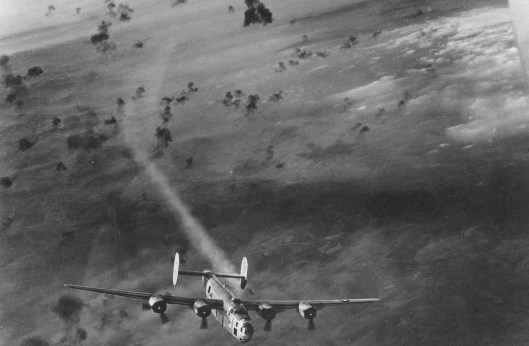
A B-24 trails smoke after a flak hit.
By contrast, much of my research begins in cemeteries. But that’s where you start to forget about death and instead begin to reconstruct lives. I write history to give lives back to the town and to the county where I grew up. I believe that old lives have the capacity to inspire us—in fact, they have the capacity to give life.
I’ve found old lives in yellowed newspapers and on tombstones, in copies of service jackets and in rifle company casualty reports. I found one in a copy of the telegram informing a Corbett Canyon farmer and his wife that their twenty-year-old had died five weeks before on Iwo Jima. I’ve found, in encounters even more fleeting than the ones Eddie and I discussed, my surrogate sons and daughters.
One of them died late last month.
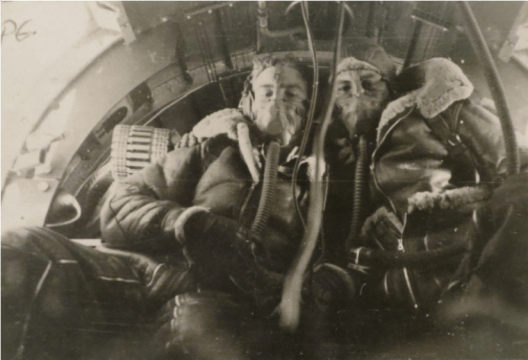
Waist gunners, Eighth Air Force, World War II>
Jim Gregory lives in Arroyo Grande. He taught history at Mission Prep and Arroyo Grande High School for thirty years. Eddie Matthews, an editor at Parthian Books, earned his doctorate in creative writing at the University of Swansea, Wales. Dr. Matthews teaches writing at Point Loma Nazarene University.


“So much of my research begins in cemeteries, and that’s where you start to forget about death and instead begin to reconstruct lives.” — That’s a beautiful way to put it. I’m glad you met him too. He seems to have impacted you in great ways. Awesome post!
LikeLike
Thank you so much!
LikeLiked by 1 person
No problem!
LikeLike