
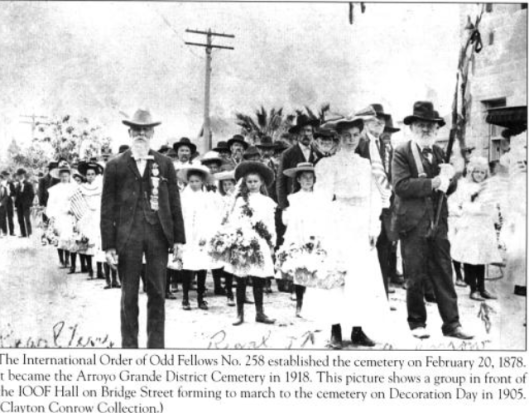
From Jean Hubbard and Gary Hoving’s Arroyo Grande: Images of America (Arcadia Press)
I got the nicest thank you from the Companions of Our Lady–that’s the widows’ organization at Nativity Church in San Luis Obispo. I have to admit that I really enjoy speaking to older people, although the borderline between “me” and “older people” is eroding rapidly. I’ve made six or seven presentations at senior homes and at least three to the widows/widowers group in the South County.
Thomas was helping me, and the women loved having him. They loved it especially when he won the door prize, a succulent that he promptly named “Frazier.”
I really felt for one woman. She and her husband had lived in the same house on the North Coast for thirty years. They’d come down here and perused some mobile home communities to look for a place to live when they couldn’t take care of a big house and yard anymore.
Then he died, of course. And she still misses him, of course. There was absolutely nothing self-pitying in the way she said this. So she moved into one of the trailer parks down here and she’s having a hard time fitting in. I gave her my card and told her to give me a call for some coffee some time.
Of course, she won’t call. I’m going to have to go backwards and she if I can find out her phone number instead.
It made me wonder if there is something we’ve lost.
In Patriot Graves, the Civil War book, here’s what would happen every Decoration Day (Memorial Day) in Arroyo Grande.
The old veterans and local schoolchildren would start a little parade and then march to the cemetery to honor their comrades who had passed on. Their would be patriotic songs and speeches and recitations–like “Barbara Fritchie,” the poem that Churchill recited once from memory to an astonished FDR– and all the things they made kids do in 1905. They were the kinds of things we still did at Branch School in 1958.
When that was all over, the veterans and the schoolchildren would walk (or ride, for the older vets) back to the IOOF Hall or the Grand Army of the Republic Hall, then across Bridge Street, and have a big chicken dinner.
The thought charms me: I can see the image of an silky-bearded veteran of Chancellorsville or Gettysburg or Missionary Ridge sitting next to an eight-year-old girl missing those top front teeth and both of them getting a little messy eating their chicken.
Maybe that never happened, but I think it did.
The idea of two generations so distant from each other–one ascending the arc of their lives, the other nearing its end–sitting down to table together seems to me to be such a healthy and vital idea.
Civil War veterans suffered terribly from PTSD and from drug and alcohol addiction; a decade after the war, 80% of the inmates in American prisons were veterans. The psychic damage the war had inflicted on them is what brought many veterans to Arroyo Grande. This was a place where they could start over again. For some, this was their third and final chance to start over: a third of the veterans buried in our cemetery had moved at least twice before coming to Arroyo Grande or Nipomo. They’d run out of continent.
So they were restless and troubled men and kept most of this hidden, of course.
Marching alongside children and then chatting with them over chicken dinners must have healed, if just a little, so many of the wounds so many of them carried.
Their wounds were invisible, for the most part–although many local veterans died decades after the war from wounds or disease they’d suffered as young men, and they’re not counted among the 620,000 lives we lost in that war. But, of course, the invisible wounds were deep and painful and, most of all, they were fearful.
Having a child–her littleness next to your relative bigness–sitting next to eat you can either be terror-inducing, or it can be enchanting, once you begin to chat.
Then you weren’t thinking about the eighteen-year-old brother you saw die in the Shenandoah Valley in 1862. All your attention would have been riveted, as you smiled with the teeth you had left, at the little girl with the gap in her teeth trying her best to eat her drumstick.
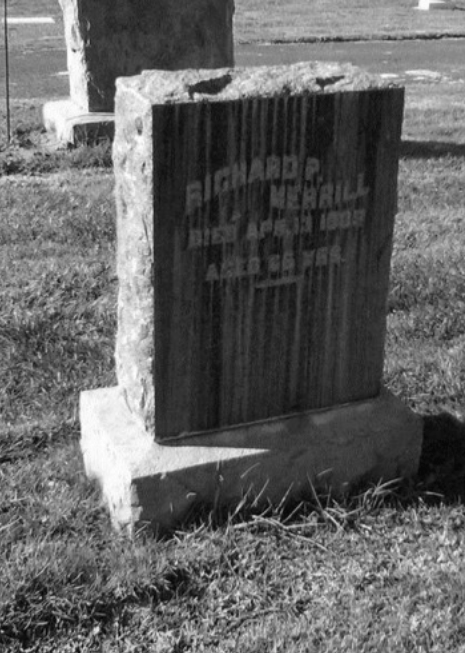
Here’s what children meant to one of those veterans: Richard Merrill, buried in our cemetery, fought at Antietam, the deadliest battle in American history, and at Chancellorsville. He contracted a disease, possibly dysentery, and was, according to a family history, “a great sufferer” for the rest of his life. He married, but his job history is a checkered one. He never joined any veterans’ group. So far as I know, he never talked about the war, not even with his wife.
His last job was at the Arroyo Grande Grammar School, on the site of today’s Ford agency. When Civil War veteran Richard Merrill, the school janitor, died in 1909, the children asked their teachers if they could have the afternoon off on the day of the old soldier’s funeral. Permission was granted them.
“Mr. Merrill,” his obituary concludes, “was a great favorite with the children.”
 A Work in Progress
The gift of insight sits squarely on your soldiers sir. I’m proud to know you.
LikeLike