
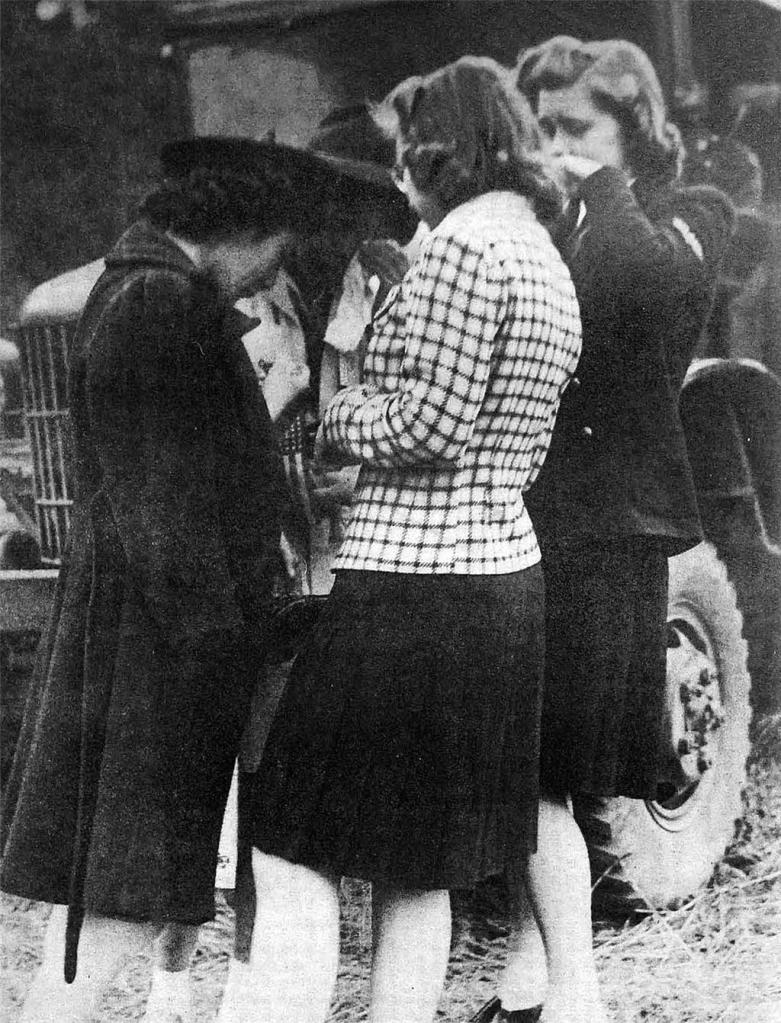
This photograph was taken on Bainbridge Island, Washington, on the day Executive Order 9066 was executed and these friends were separated.
There’s a good chance they never saw each other again.
When the buses came to take our Arroyo Grande, California, neighbors away on April 30, 1942, many of them—less than half—came back. I grew up here, and I don’t recognize many of the surnames in the old high school yearbooks.
One woman told me this: On the day the buses came to the high school parking lot, her mother saw a line of high-school girls, some Japanese, some not, walking up Crown Hill, walking up toward their high school, holding hands and sobbing.
Arroyo Grande’s Japanese-Americans went first to the Tulare County Fairgrounds, where they slept in livestock stalls, and then to the Rivers Camp in Arizona, where the temperature was at or above 109 degrees for twenty of their first thirty days there.
I interviewed a remarkable woman named Jean a few weeks ago. She is 94, is briskly intelligent, articulate and gracious. Her father owned the meat market on Branch Street in Arroyo Grande, population 1,090 in the 1940 census, and when his Japanese-American customers, farmers, came in to settle up before the buses came, he refused to take their money. “You keep it,” he told them. “You’re going to need it.”
When they came home three years later, he extended them easy credit until they could begin to bring in crops again. Jean showed me her father’s business ledgers, so I have no reason to doubt it when she told me that every one of those farmers paid her father back. In full.
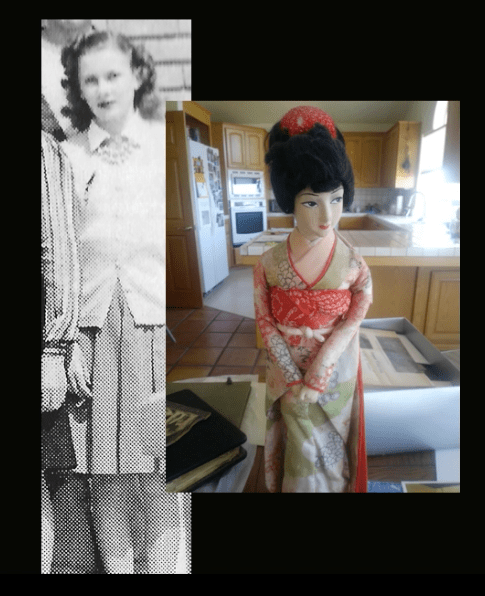
This is Jean as a high-school freshman. The doll, with her handmade kimono, came to Jean from Gila River in gratitude for her family’s friendship. For their loyalty.
At ninety-four, that loyalty runs in Jean as deeply as it ever has. One of her best high-school friends was named Yoshi. I can find a photo of the two together in second grade. I found a photo, too, of two second-grade boys in the Arroyo Grande Grammar School in 1926. They would die, about twelve minutes apart, on USS Arizona.
Yoshi’s brother became a war hero. He won a battlefield promotion to lieutenant when he went behind Japanese lines in China to rescue a downed American flier.
Yoshi’s brother brought that flier in and made him safe. Jean never saw Yoshi again and, because of April 30, 1942, there is a part of her that can never feel safe.
The war, at its outset for America, killed two of our sailors. It would claim many more local young men, killing them in Ironbottom Sound off Guadalcanal and on the beach at Tarawa. It would kill a young paratrooper in Holland during Operation Market Garden. It would kill, with a sniper’s bullet, a tank-destoyer crewman on the German frontier three days before his first child, a son, was born.
The war killed neither Jean nor Yoshi. They remain its casualties, nonetheless.
We had to stop the interview for a moment. In remembering her friend, Jean was fighting hard to stop the tears. One escaped. That moment taught me so much history, and with such intensity, that I almost couldn’t bear it.
 A Work in Progress
Among the many personal stories, some told and many untold, about the forced removal of Japanese Americans from the West coast simply because they looked like the enemy, Jean’s story about her friend, Yoshi, who was a victim of Executive Order 9066, will be remembered for her undying concern and memory of a friend who for no fault of her own was taken away. She obviously did did not see her friend as the enemy even though the newsprint of the time was responsible for causing the public to
identify all Japanese Americans of Japanese ancestry to be disloyal and aligned with the enemy and therefore deserving of punishment. We see the same attack on American Muslims initiated by the highest level of leadership in our government. A president who is incapable of distinguishing differences, and insist all Muslims are alike even though more than a half of century has passed since President Franklin Roosevelt’s Executive Order 9066. I would hope that most Americans, unlike our current president, will not let history repeat itself and violate the civil rights of fellow citizens; and instead, have the courage to stand with those to uphold and protect the Constitution and its Bill of Rights despite our religious, ethnic, and ancestral immigrant backgrounds.
LikeLike
Agree wholeheartedly. Your thoughts echo mine in another post. Blessings your way, Larry.
LikeLiked by 2 people
I will never get over the dignity with which my Japanese friends carried themselves after the war. Kaz , Stone, Haruo, Aki and all the rest must be remembered for that.
LikeLike