

I’m speaking in Santa Maria next week about our county’s World War II commemoration—the eightieth anniversary of the war, and of Japanese internment—when I wondered if any Santa Maria Nisei (second generation Japanese-Americans) had been among the town’s 55 wartime casualties.
Because of his surname, Makoto Yoshihara was at the bottom of the list.
He was actually born in Morro Bay; his parents moved to Guadalupe where they ran a boarding housel and pool hall. Makoto played football for the Santa Maria Saints, joined or was drafted into the Army in October 1941. His parents, like our Arroyo Grande neighbors, went to the Rivers Camp in the Arizona desert. The photo below shows evacuation day in Guadalupe, and I knew that Guadalupe had a prominent Japanese-American presence, but the numbers surprised me: Two hundred people were taken from Arroyo Grande, 400 from Santa Maria, but 800 from little, beautiful Guadalupe.

About two and a half years later, the insult heaped on our neighbors would be intensified by the headline that first reported Makoto’s fate. From the January 25, 1945, Santa Maria Times:
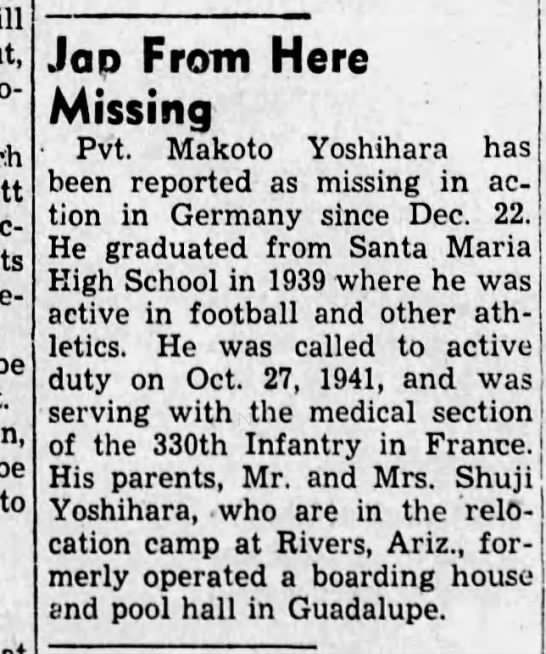
It is, of course, jarring to read. A month later, once Makoto’s death is confirmed, the newspaper softens its tone:
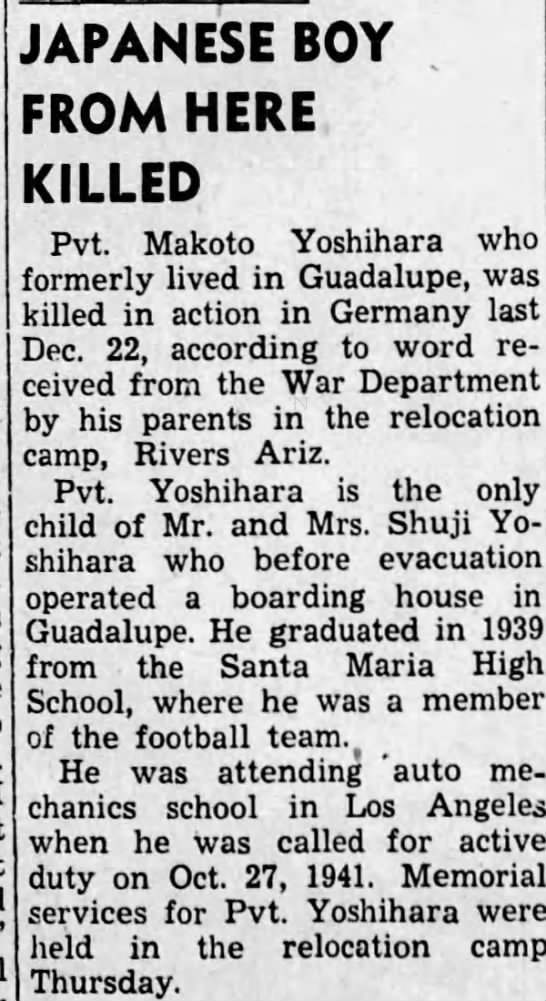
And you’re relieved at the slight change in tone until you read where his parents received that terrible telegram from the War Department. Everyone—everyone—behind barbed wire in the desert would’ve known almost instantly what had happened to Mr. and Mrs. Yoshihara’s son. The tarpaper barracks walls would’ve done nothing to soften the sound of a mother’s weeping for her only child.
Makoto had wanted to be a mechanic. This must be his high school senior photo. He looks like a serious young man.
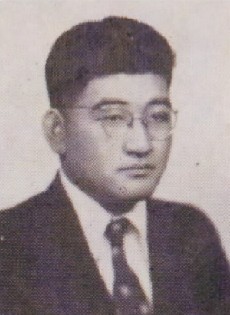
Which is why the Army—my father, a World War II veteran, would claim to be surprised by this—did something right. They made this serious young man a medic.
Another surprise came, at least for me, in the article with the insulting headline. Makoto was not a member of the famed 100th/442nd Regimental Combat Team, nor—since served in the European Theater—was he a Nisei intelligence officer, like so many local men were, the ones who underwent, at Camp Shelby, Mississippi, the same tough training that the 4-4-2 endured.
Makoto instead served in the 83rd Infantry Division, a unit that had a thoroughly White pedigree—the 83rd was traditionally an Ohio outfit, from the state that produced a batch of mediocre presidents, and here, probably the only Nisei among 10,000 White boys, was Makoto Yoshihara, the medic from Guadalupe, California. The Ohio boys probably had never seen the ocean. Makoto probably never got the chance to see fireflies, one of the natural wonders that make Midwestern summers, despite their oppressiveness, delightful.
He must’ve been lonely. And, if only at first, he must’ve endured racist attempts at humor.
The only other local Nisei G.I. I know of that served in a non-Nisei unit was Arroyo Grande’s Mits Fukuhara, who served in a tank battalion; Mits and his battalion missed the fighting because the war ended before they could join it.
Makoto didn’t miss the fighting; in fact, he saw some of the worst combat of the Americans’ war. The 83rd and his regiment, the 330th Infantry, got into a slugging match with the Wehrmacht in the Huertgen Forest in September 1944—the photos below give an idea of the terrain there— in a horrific battle that would last for two months. The nearest approximate I can think of in the American experience would’ve been the Battle of the Wilderness in 1864, where dense forest broke Grant’s infantry companies down into little knots of men, separated by trees and dense foliage that made it impossible to see each other—or the enemy. Lee’s men appeared as shadows, mirages, and disappeared in the smoke, because the muzzle flashes from Enfields or Springfields set the Wilderness afire. The fires burned the wounded alive.
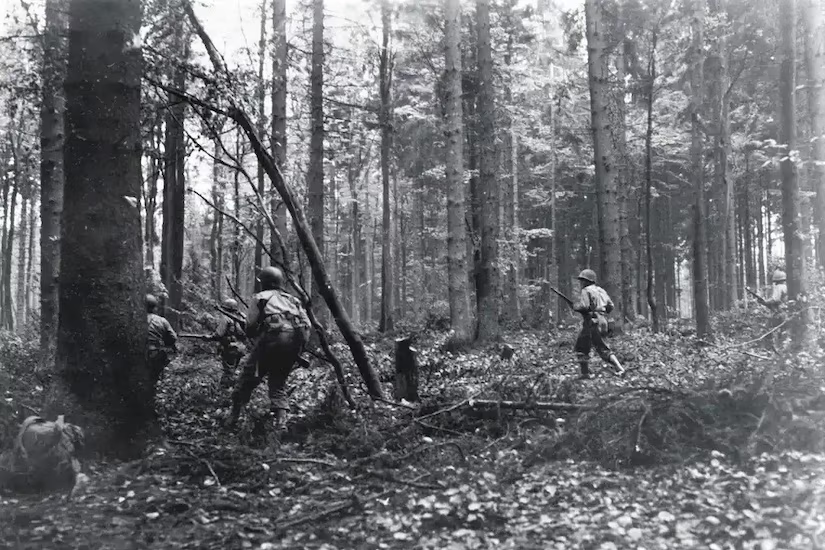
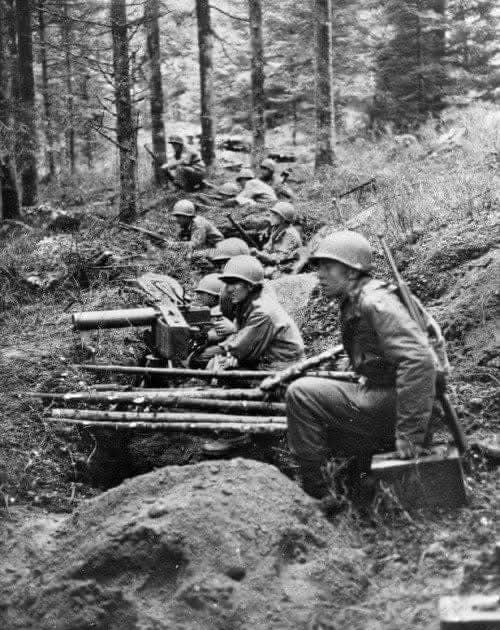
(In 1945, after Germany’s surrender, fires swept the Huertgen and detonated unexploded artillery shells. The war hadn’t ended at all for the scores of German civilians killed by buried ordnance that had been intended for soldiers.)
The battle for the Huertgen was a debacle. The Americans suffered nearly twice the casualties the German defenders did and they had to pull back and reorganize in December.
Somehow Makoto Yoshihara survived those two months in the forest.
And then, in December, the 83rd Division would face the Germans again in the massive offensive that we remember as the Battle of the Bulge, fought during one of the coldest winters in Europe in thirty years.
Makoto didn’t have to face that second, epic battle. Somewhere in the not-quite-lull in between, he died. The divisional after-action reports for the day he died, December 22, are bland; they suggested units relieving other units and the straightening of lines; battlefront housekeeping. But when you get down to the battalion level, the reports cite heavy German resistance, nighttime attacks, and cold. Always the cold.
The way he died once again confirms the Army’s wisdom in assigning him to the 330th’s Medical Detachment. The Santa Maria Times kind of redeems itself, thanks to the Bronze Star citation’s wording, in this article from September 1945:
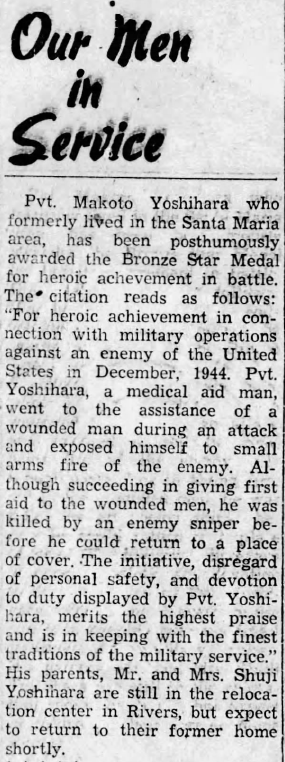
Makoto died saving a brother G.I.’s life because medics were favored targets for snipers; if you can kill a medic, the five or six wounded soldiers he might’ve saved will die, too.
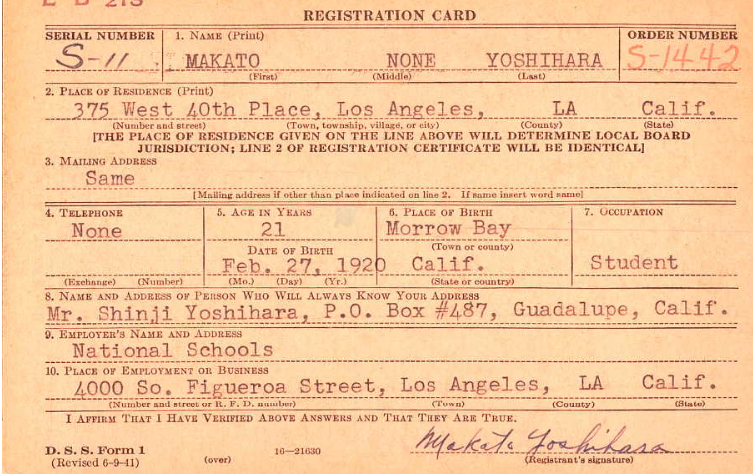
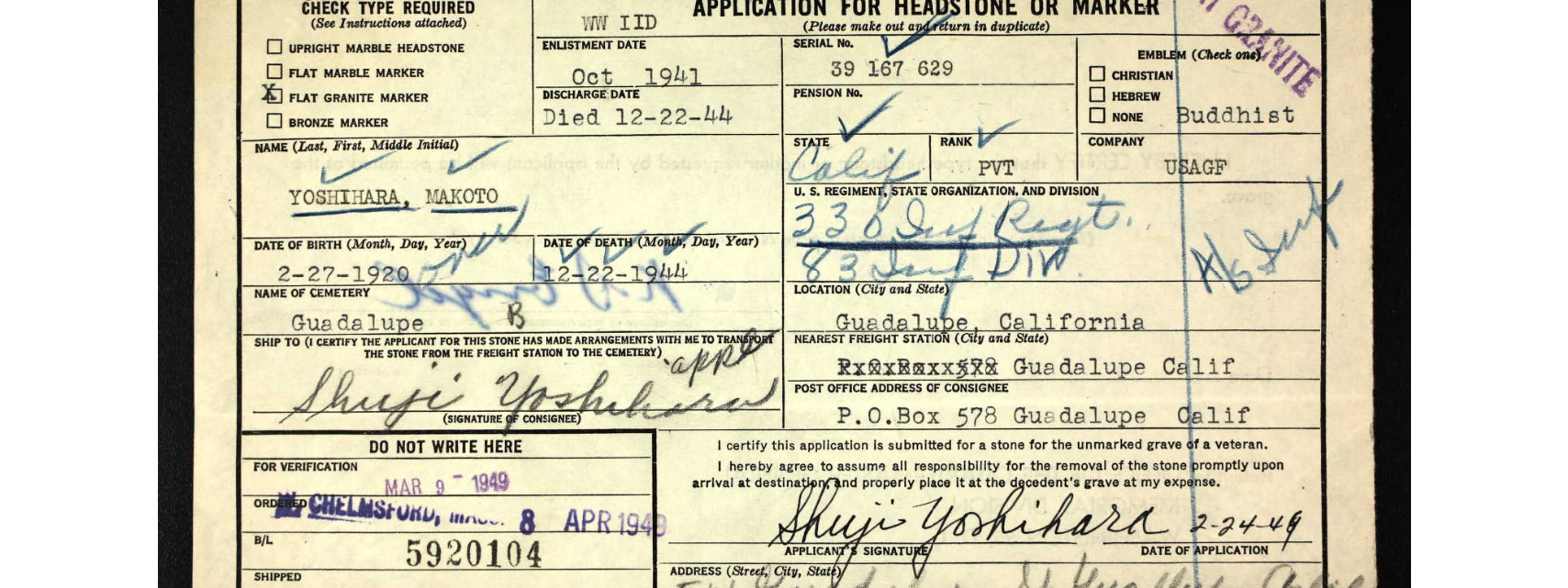
(Above): Tragic bookends: Makotto’s draft card, its spelling uncertain, and his family’s application for a military tombstone.
Makoto died 5,000 miles away from Guadalupe’s row crops, its Mexican restaurants, honky-tonks and the sand dunes and the vivid ribbon of ocean beyond.
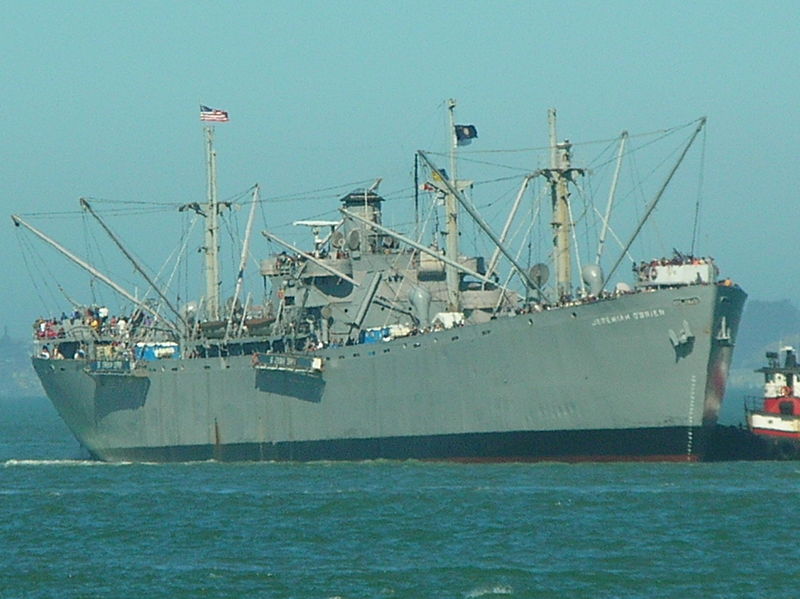
His body was returned to America in December 1948 aboard the prosaically-named Liberty Ship Barney Kirschbaum, one of the war’s industrial wonders; Kirschbaum’s duplicate, Jeremiah O’Brien, made the trip in reverse in 1994, sailing from her berth in San Francisco to England and then to the Normandy coast where she’d done duty in the invasion of the Continent in 1944; O’Brien is the last of the 6,000 ships that supported the D-Day landings.
Accompanying Makoto’s coffin on Kirschbaum were the coffins of Orville Tucker of Arroyo Grande, killed on the second day of the Battle of the Bulge—five days before Makoto knelt over the wounded soldier— and Stanley Weber of Oceano, who died the next month in the counteroffensive that erased the Bulge and drove the Germans back.
The coffins, of course, would’ve been flag-draped. That’s an important detail, because belowdecks on Kirschbaum’s long voyage home, there were no “Japs;” no Ohioans, no Californians. These were our young men; even in death and even in the eighty years that separate our lives, they remind us that we, all of us, belong to each other.


My experience says that if a corpsman is willing to care for the wounded in combat, there is no “Race.” I was always generously treated by the Marine boys I served with. First in the chow line, foxholes dug, gear carried, they knew what was up. I suspect “Mak” was treated the same.
LikeLike