Not that San Luis Obispo County needs outside consultants, thank you very much, when it comes to crime. The first recorded mass murder in California history, in December 1848, happened in the North County, at Mission San Miguel.
It was the mountain man James Beckwourth who found the bodies of ten victims—the Reed family and their servants— in the mission carpenter shop. He’d also found, on previous occasions, the bodies of mountain men Hugh Glass (The Revenant), killed by the Arikara, and Jedediah Smith, killed by the Comanche. I have a theory that it’s not going to be a good day if you see Jim Beckwourth riding up your driveway.
Later, the good citizens of my South County hometown, Arroyo Grande, lynched a father and his fifteen-year-old son, suspected killers, from a railroad trestle during the night of March 31, 1886, and in 1904, an inebriated cowboy shot Constable Henry Lewellyn dead in the doorway of the Capitol Saloon on Branch Street.
In between, a resident from Lopez Canyon, east of Arroyo Grande, was found in a vacant lot by a prostitute from a San Luis Obispo bordello, extravagantly named The Palace, sleeping off a drunk. He wasn’t going to be sober again, because he was dead. A suspect was arrested—victim and suspect had been heard arguing loudly by more prostitutes (San Luis Obispo was a busy place in the 1890s)—outside a bar on Monterey Street, dubiously named The Olive Branch.
The suspect was eventually acquitted, in 1894, for lack of evidence. So was the cowboy who shot Constable Lewellyn; the jury bought the defense lawyer’s claim that it was self-defense.
And in between 1848 and 1904, there were enough robberies, murders, arson fires, vigilante visits and citizen posses firing their revolvers enthusiastically into the air to fill a dozen Louis L’Amour novels.
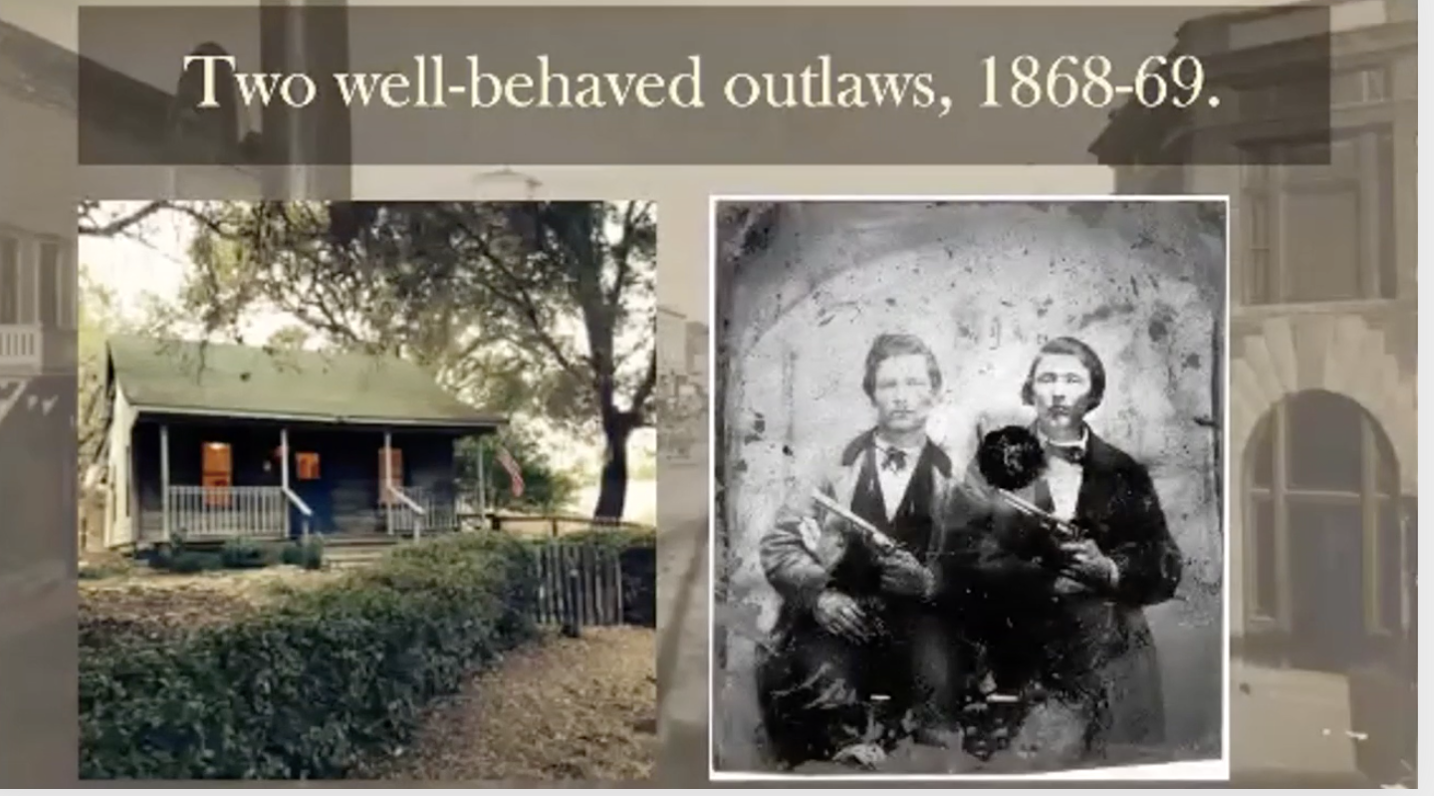
But we had visiting celebrities, too. When things got too hot in Missouri, the James Brothers, Confederate irregulars under the notorious William Quantrill during the Civil War, lived on their Uncle Drury’s ranch for awhile—Drury James was the co-founder of the Paso Robles Inn, still around today—and played at being cowboys. They weren’t. But Uncle Drury’s vaqueros learned to overlook Frank and Jesse’s cow-punching deficiencies because Jesse passed the time by idly picking off rattlesnakes and jackrabbits with his Colt revolver.
They returned to Missouri to pass into legend, etc.
And darn if I didn’t run into them there. Last May, my wife Elizabeth and I went to Missouri to see our much-beloved niece, Becky, graduate from the school that’s also my Alma Mater, Mizzou, where I’d studied at the Journalism School before the History Department began to captivate me and I changed majors.
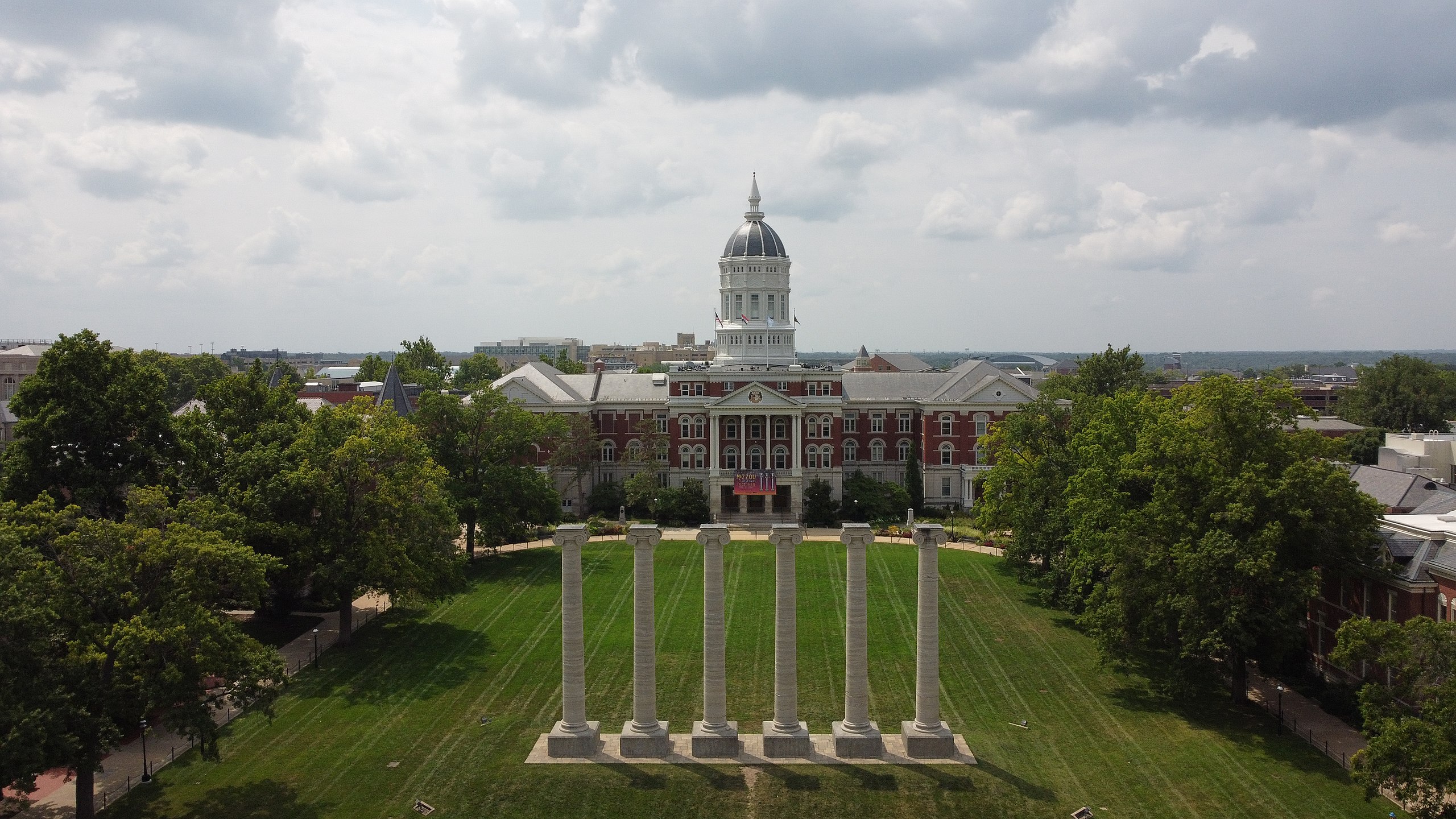
Elizabeth and I decided to drive to the western part of the state, to Lexington, Missouri, where my Confederate great-great grandfather, whose promotion to brigadier general evidently got lost in the mail—that’s States’ Rights for you—fought in 1861. The opposing forces left behind that souvenir in the column of the County Courthouse. I am named for that great-great grandfather, James H. McBride, who appears, from his portrait on the left, to have died from Terminal Constipation. My middle name, Douglass, comes from his son, a Confederate staff officer, who had an unfortunate encounter with a Yankee artillery shell in 1862 Arkansas.
So, as Kurt Vonnegut noted, it goes.
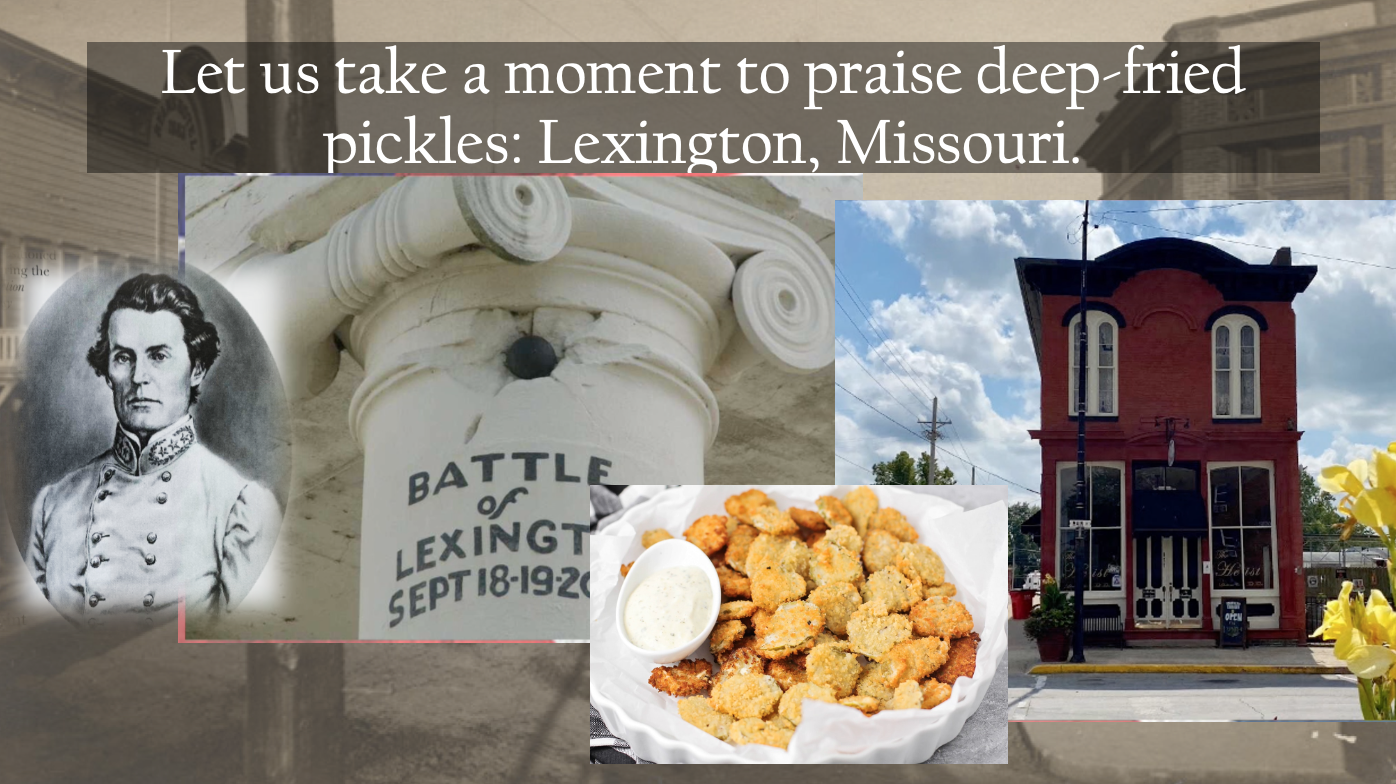
Not-quite Brigadier Grandfather James is less important than where we had lunch in Lexington, at that tall and narrow mid-Victorian restaurant, The Heist II. It was there where we discovered, along with a stunning Reuben Sandwich and a stellar BLT, the delight of fried pickles. They were incredible. My father was raised on the Ozark Plateau, and I once wrote an essay entitled “My Father and Fried Food,” and after The Heist, I understand him on a whole new level.
Anyway, it got its name from when it was a bank and was robbed by Frank and Jesse. Nellie-bar-the-door, that gave me, in between bites of fried pickles, to regale the waitress and most everyone within a four-table radius of Frank and Jesses James stories from San Luis Obispo County, California.
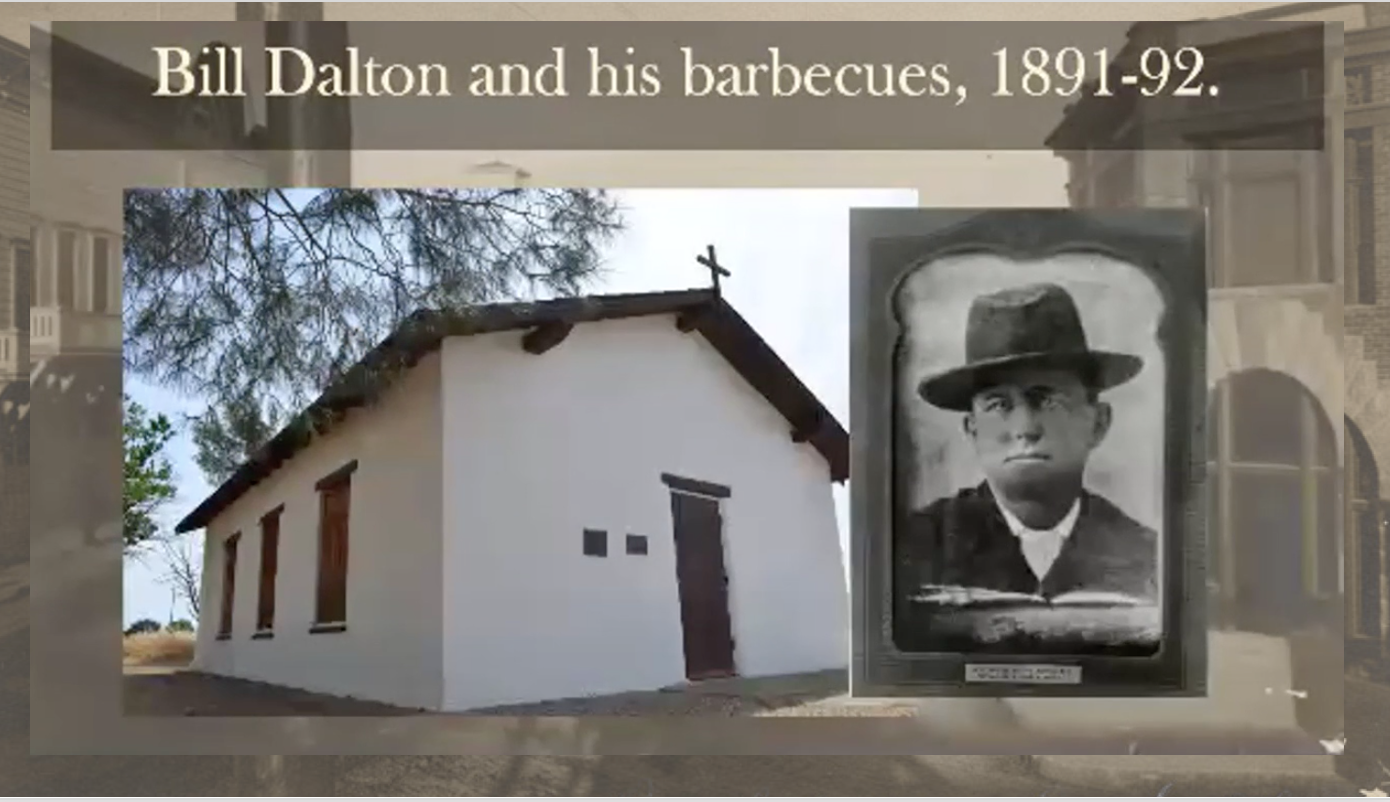
The James Gang was known also as the James-Younger Gang, thanks to Frank and Jesse’s cousins, and it was a Younger who became the mother to a brace of outlaws from a later generation, the Daltons. Bill was not an outlaw. He was a well-respected cattleman in San Miguel—some accounts that I’ve never verified claimed that he was a State Assemblyman—and one summer his brothers came to visit California.
(Which, of course, reminds me: the other reason for the James Brothers’ visit was their search for the grave of their Baptist preacher father, come to California to evangelize the gold fields, which needed it badly. They never found their father. Similarly, the ship Arkansas, loaded from ballast to main deck with Methodist missionaries, came to Methodize the gold fields at about the same time as Rev. James. It ran aground on Alcatraz and was towed across the Bay and beached, where it became a brothel.)
What Bill’s brothers, excitable boys, liked to do—within earshot of the adobe church congregation—was to barbecue, drink whiskey and target practice with their Colt revolvers. I don’t advise against doing things like this, but maybe not all at the same time.
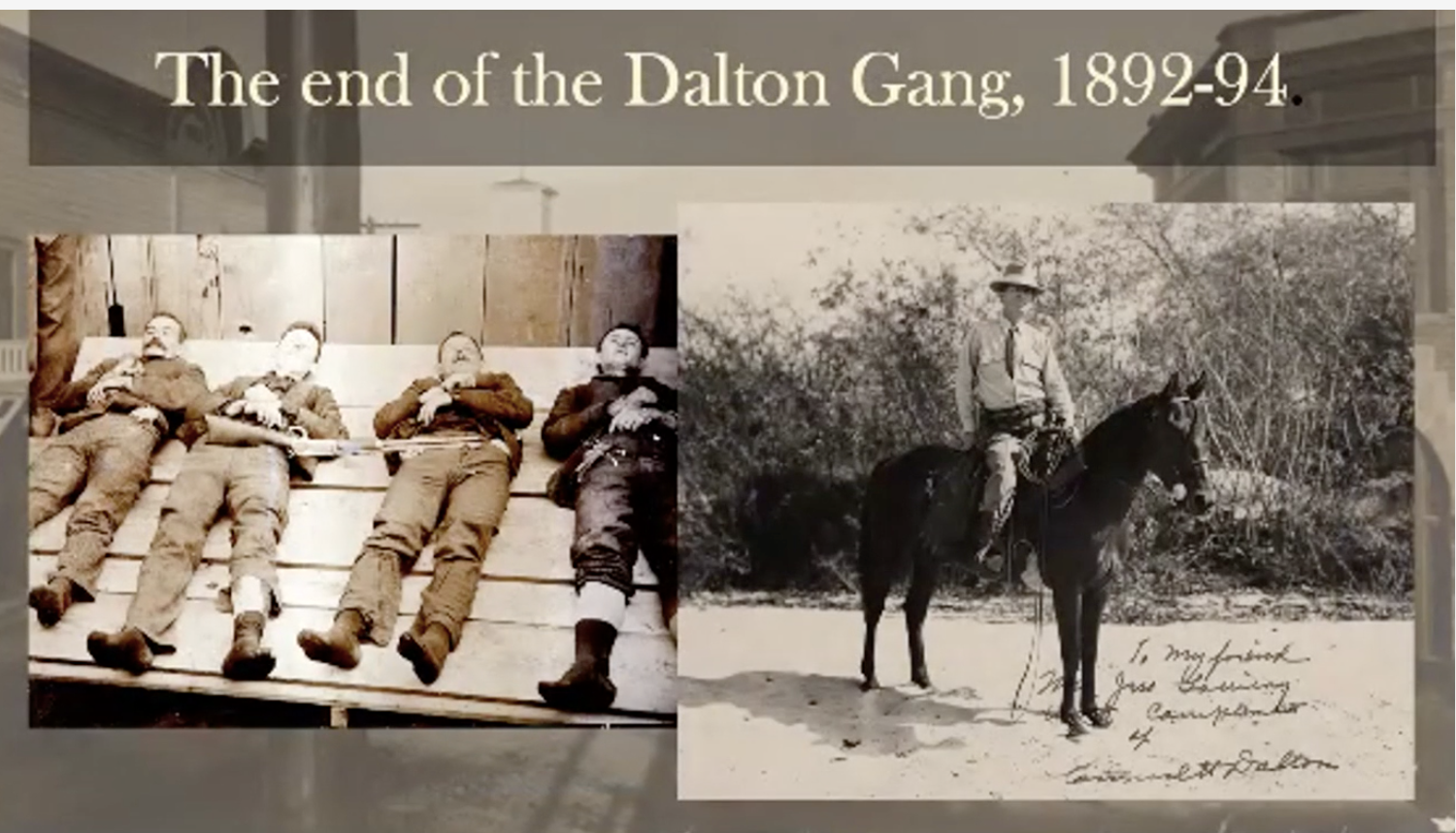
Bye and bye, Bill’s brothers returned to the Midwest, where they conceived of the idea of robbing two banks simultaneously in Coffeyville, Kansas. They had not thought this through completely, I think. Their timing was thrown off when the good citizens of Coffeyville realized what going on, denuded the hardware store of firearms, and air-conditioned the Dalton Gang, including brothers Grat and Bob.
They also air-conditioned brother Emmett, shot twenty-three times. He survived to become a script consultant for Hollywood westerns and autographed this photo for San Luis Obispo County Sheriff Jess Lowery.
Lowery’s career highlight was pulling over a truck near Pismo Beach, prying apart the two-by-fours atop its bed, and finding, just beneath, 72 five-gallon jerricans of bootleg Canadian whiskey headed for Los Angeles and gangster Tony Cornero, famed later for the gambling ships he operated just beyond the three-mile limit. Cornero also opened one of the first casinos in Las Vegas, which burned, due to either faulty wiring or Lucky Luciano. His life ended due to either a heart attack or Lucky Luciano.
So it goes some more.
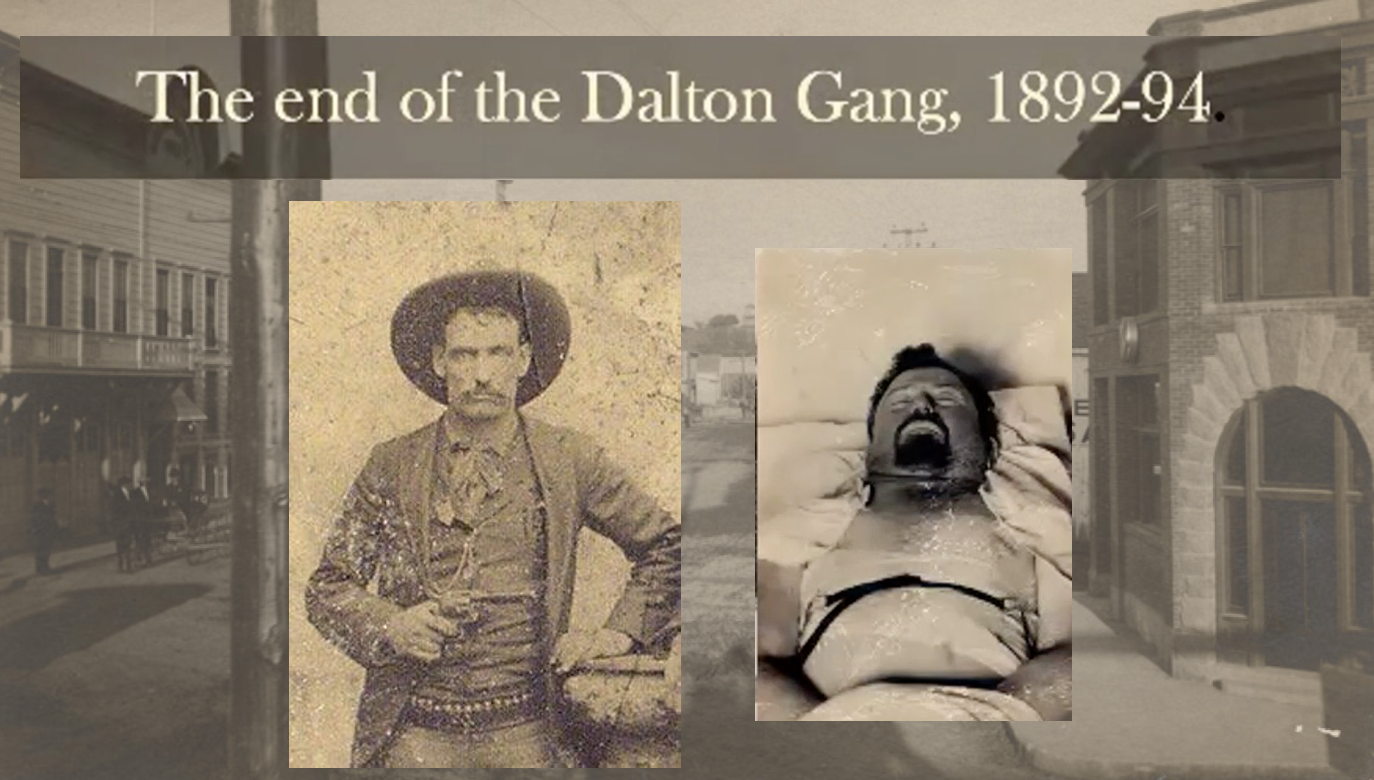
Bill Dalton’s life ended with a day that started out to be pretty optimistic. For reasons I still don’t understand, he decided to follow, after Coffeyville, the Outlaw Trail. His career was brief. A posse, led by Marshal Selton T. Lindsey, took off after Bill in Indian Territory—Oklahoma—and were hot on the trail until they encountered a wagonload of contraband whiskey intended for the Indian Nations.
The posse confiscated the evidence and drank it.
The next morning, only Marshal Selton T. Lindsey and one deputy were sober enough to continue the pursuit of Bill Dalton. While crouching behind the weeds atop a rise, they found him.
Bill evidently loved children. He was playing in the front yard of a friend’s house with his friend’s children when one daughter, leading a milk-cow in from pasture and back to the barn, passed Marshal Lindsey and his deputy, who were not doing a very good job of being surreptitious. When she reached Bill, she whispered to him urgently.
He ran for it. Urgently.
Lindsey and his deputy lit out after Bill, paused to get their aim, and began to air-condition him with their Winchester rifles. He fell, dead.
Not quite. When the lawmen crept up to Bill, he was still alive. He smiled at them.
Then he was dead.
The Daltons weren’t quite done with San Luis Obispo County. In 1972, soon after the release of their concept album about the gang, Desperado, The Eagles played a concert at Cuesta Community College. A fairly prominent Canadian, Neil Young, opened for them. Tickets were $5. I did not buy one: I didn’t know much about The Eagles, and $5, in 1972, $36 today, was for a starving college student like me—-who subsisted largely on 19-cent tacos and burritos at the San Luis Obispo Taco Bell where Creedence Clearwater Revival once dined—Highway Robbery.
Damn. I wish I’d bought that ticket.

 A Work in Progress
Thanks for sharing your insight and knowledge, much appreciated. C
LikeLike
Thank you, Curt!
LikeLike